Self-Censorship on Facebook - Sauvik Das1 and Adam Kramer2
←
→
Page content transcription
If your browser does not render page correctly, please read the page content below
Proceedings of the Seventh International AAAI Conference on Weblogs and Social Media

                                             Self-Censorship on Facebook
                                                  Sauvik Das1 and Adam Kramer2
                                                1                                2
                  .                               sauvik@cmu.eduu                    akramer@fb.com
                                            Carnegie Mellon University
                                                                ersity                Facebook, Inc.

                              Abstract                                           other lower-level forms of self-censorship might prevent a
  We report results from an exploratory analysis examining                       user from thinking or articulating thoughts at all. Hereafter,
  “last-minute” self-censorship, or content that is filtered after               we may refer to last-minute self-censorship simply as self-
  being written, on Facebook. We collected data from 3.9 mil-                    censorship, but one should keep the distinction in mind.
  lion users over 17 days and associate self-censorship behav-                   Last-minute self-censorship is of particular interest to SNSs
  ior with features describing users, their social graph, and the                as this filtering can be both helpful and hurtful. Users and
  interactions between them. Our results indicate that 71% of                    their audience could fail to achieve potential social value
  users exhibited some level of last-minute self-censorship in                   from not sharing certain content, and the SNS loses value
  the time period, and provide specific evidence supporting the
                                                                                 from the lack of content generation. Consider, for example,
  theory that a user’s “perceived audience” lies at the heart of
  the issue: posts are censored more frequently than comments,                   the college student who wants to promote a social event for
  with status updates and posts directed at groups censored                      a special interest group, but does not for fear of spamming
  most frequently of all sharing use cases investigated. Fur-                    his other friends—some of who may, in fact, appreciate his
  thermore, we find that: people with more boundaries to regu-                   efforts. Conversely, other self-censorship is fortunate: Opt-
  late censor more; males censor more posts than females and                     ing not to post a politically charged comment or pictures of
  censor even more posts with mostly male friends than do fe-                    certain recreational activities may save much social capital.
  males, but censor no more comments than females; people                           Understanding the conditions under which censorship
  who exercise more control over their audience censor more                      occurs presents an opportunity to gain further insight into
  content; and, users with more politically and age diverse
                                                                                 both how users use social media and how to improve SNSs
  friends censor less, in general.
                                                                                 to better minimize use-cases where present solutions might
                                                                                 unknowingly promote value diminishing self-censorship. In
                          Introduction                                           this paper, we shed some light on which Facebook users
                                                                                 self-censor under what conditions, by reporting results from
Self-censorship is the act of preventing oneself from speak-                     a large-scale exploratory analysis: the behavior of 3.9 mil-
ing. Important in face-to-face communication, it is unsur-                       lion Facebook users. As the first study of its kind at this
prising that it manifests in communications mediated                             scale, we were motivated to (1) understand the magnitude
through social networking sites (SNS). On these venues,                          of self-censorship on Facebook, (2) identify patterns of self-
self-censorship may be caused by artifacts unique to, or                         censorship that are exhibited across different products
exacerbated by, social media. For example, users may seek                        (groups vs. status updates vs. comments, etc.), and (3) con-
to maintain presentation of their self-images across multiple                    struct a data-driven model of self-censorship based on be-
social contexts simultaneously, may be unwilling to diverge                      havioral, demographic, and social graph features of users.
from the community’s perceived social norms (such as                                We found that 71% of the 3.9 million users in our sample
avoiding negative expressions), or may fear “spamming”                           self-censored at least one post or comment over the course
friends with uninteresting or unnecessary content (Frederic                      of 17 days, confirming that self-censorship is common.
& Woodrow 2012; Sleeper et al., 2013; Tufekci 2007;                              Posts are censored more than comments (33% vs. 13%).
Wisniewski, Lipford & Wilson 2012).                                              Also, we found that decisions to self-censor content strong-
   Social media also affords users the ability to type out and                   ly affected by a user’s perception of audience: Users who
review their thoughts prior to sharing them. This feature                        target specific audiences self-censor more than users who
adds an additional phase of filtering that is not available in                   do not. We also found that males censor more posts, but,
face-to-face communication: filtering after a thought has                        surprisingly, also that males censor more than females
been formed and expressed, but before it has been shared.                        when more of their friends are male. Additionally, we
Filtering at this phase is what we call last-minute self-                        found that people with more boundaries to regulate censor
censorship because it occurs at the last minute, whereas                         more posts; older users censor fewer posts but more com-
                                                                                 ments; and, people with more politically and age diverse
Copyright © 2013, Association for the Advancement of Artificial Intelli-         friends censor fewer posts.
gence (www.aaai.org). All rights reserved.

                                                                           120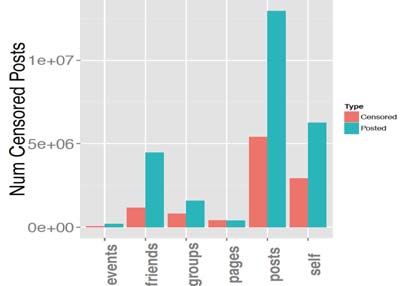
Related Work                                      that they “thought about” posting but ultimately did not
                                                                       post), the authors found that users’ reasons for self-
Self-censorship on social media has scarcely been studied              censoring content could be classified into one of five cate-
in its own right, but many fields have alluded to the phe-             gories: (1) users did not want to instigate or continue an
nomenon. It is known that people present themselves dif-               argument; (2) users did not want to offend others; (3) users
ferently in distinct social circle (Goffman 1959). Research-           did not want to bore others; (4) users did not want to post
ers have also found that the dynamic “presentation-of-self             content that they believed might be inconsistent with their
phenomenon” extends into the virtual world, noting that                self-representations; and (5) users neglected to post due to
users manage multiple identities when sharing online and               technological constraints (e.g., inconvenience of using a
behave differently based on the (virtual) social group with            mobile app). The first four of these reasons align with our
which they are sharing (Farnham & Churchill 2011). In                  concept of censorship as an audience control strategy.
face-to-face communication, totally distinct social circles               The first two categories, concerns about offending ties or
are rarely collocated, so people have a reasonable expecta-            instigating arguments, map well to the findings of Hayes,
tion of their audience and therefore can easily portray them-          Scheufele & Huge (2006), which notes that people in a po-
selves appropriately. Conversely, social networking sites              larized opinion climate may refrain from participating in
collapse many distinct social contexts into one. Conse-                discourse out of fear of criticism or disagreement. Indeed,
quently, several researchers have observed that SNS users              the first two reasons are reported to be especially prevalent
often have trouble with “boundary regulation,” or maintain-            for political content (Sleeper et al. 2013). The third catego-
ing consistency of presentation across the “boundaries” of             ry is related to the “imagined audience” described by Mar-
multiple social contexts (Acquisiti & Gross 2006; Frederic             wick & boyd (2010). Surely, the self-censoring user had an
& Woodrow 2012; Kairam et al. 2012; Marwick & boyd                     audience in mind when she decided that the content was too
2010; Wisniewski, Lipford & Wilson 2012).                              boring. Others have noted a similar effect, mentioning that
   Self-censorship in social media, then, can be construed as          the users in their study “indicated a concern for not over-
a boundary regulation strategy. Users who experience epi-              whelming audience information streams” (Frederick &
sodes of “regret” for sharing content that is inappropriate            Woodrow 2012). The fourth reason, and perhaps the most
for parts of their audience might resort to self-censorship to         prevalent (Sleeper et al. 2013), is consistent with the find-
avoid repeating a similar episode (Wang et al. 2011). Users            ings of the boundary regulation literature and once again
may also self-censor as a strategy for managing group co-              suggests that maintaining consistency across social contexts
presence in social media (Marwick & boyd 2010; Wisniew-                is important to users (Marwick and boyd 2013; Wisniewski,
ski, Lipford & Wilson 2012), perhaps only sharing content              Lipford & Wilson 2012). Finally, as most of their partici-
that would be reasonable for the “lowest common denomi-                pants either did not utilize or were unaware of audience
nator”—content that would be appropriate for any of the                management tools on Facebook, participants would have
user’s distinct social circles. Others have observed that to           censored as much as 50% less often if they could specifical-
deal with boundary regulation, users “imagine” an audience             ly and easily share and/or prevent certain ties in their net-
upon sharing content, and that this imagined audience mod-             work from viewing the content (Sleeper et al. 2013). These
ulates user-level self-censorship: If some of the “imagined”           findings stress the importance of “audience” control in con-
audience is not “appropriate,” users are likely to censor              tent sharing decisions.
themselves (Marwick & boyd 2010).                                         However, while self-censorship in social media is noted,
   Beyond self-presentation, others have noted that “priva-            we have not yet quantified its prevalence. Furthermore, it is
cy” concerns (defined by having unknown or potentially                 unknown how self-censorship manifests across different use
inappropriate audiences gain access to a user’s content)               cases of social media: Do users self-censor undirected sta-
may lead to censorship as well (Acquisiti & Gross 2006;                tus updates more than posts directed at a specific friend’s
Tufecki 2007). Though users generally tend to underesti-               timeline? Finally, while there are many hypotheses regard-
mate their actual audience (Bernstein et al. 2013), those              ing which users self-censor more or less, there has yet to be
aware of potential privacy breaches may utilize SNS tools              any empirical validation of these findings at a large scale.
such as Facebook privacy settings to avoid content with-               We offer insight into these gaps in the literature.
drawal or to allow for less vigilance, thus reducing self-
censorship. Recent work on the sharing behaviors of
Google+ users seems to corroborate this claim, noting that                                   Methodology
Google+ users construct and utilize “circles” to selectively
                                                                       Broadly, our analysis was guided by three questions: (1)
share or exclude content from individuals (Kairam et al.
                                                                       How many people censor content, and how often? (2) What
2012). Taken together, one might reasonably expect that
                                                                       are the patterns of self-censorship exhibited across Face-
users who utilize such selective content sharing tools might
                                                                       book and how do they differ? And, (3) What factors are
self-censor less.
                                                                       associated with being a more frequent self-censor?
   Perhaps the most directly related work is a qualitative
examination of the motivations users stated for their self-            For our purposes, we operationalize “self-censorship” as
censorship on Facebook (Sleeper et al. 2013). Through a                any non-trivial content that users began to write on Face-
diary study of 18 Facebook users (who reported on content              book but ultimately did not post. This method is fast and

                                                                 121
Demographic Behavioral Social Graph
Gender [GEN] Messages sent [AUD] Number of friends [DIV]
Age [AGE] Photos added [CTRL] Connected components [DIV]
Political affiliation [CTRL] Friendships initiated [CTRL] Biconnected components [DIV]
Media (pic/video) privacy [CTRL] Deleted posts [CTRL] Average age of friends [AGE]
Wall privacy [CTRL] Deleted comments [CTRL] Friend age entropy [DIV]
Group member count [AUD] Buddylists created [CTRL] Mostly (conservative/liberal/moderate) Friends [CTRL]
Days since joining Facebook [CTRL] Checkins [CTRL] Percent male friends [GEN]
Checkins deleted [CTRL] Percent friends (conservative/liberal/moderate) [DIV]
Created posts [CTRL] Friend political entropy [DIV]
Created comments [CTRL] Density of social graph [DIV]
Average number of friends of friends [DIV]
Table 1. Main effect features in our model. Columns represents what aspect of the user the feature describes, codes in square
brackets represent high level categories to which the features belong: GEN are features related to gender, AGE are features re-
lated to age, AUD are features related to audience selection, DIV are features related to social graph diversity, EXP are features
related to a user’s length of experience with Facebook, and CTRL are other control features that we account for in our models.
lightweight enough to not affect users’ experience of Face-
book. We also believe that this approach captures the es-
sence of self-censorship behavior: The users produced con-
tent, indicating intent to share, but ultimately decided
against sharing. Note that we do not claim to have captured
all self-censoring behavior with this method. The user au-
thored content, but censored it at the last minute. Figure 1. Screenshot of the “composer” (top) and comment
box (bottom) HTML elements on Facebook.
Computing a Measure of Self-Censorship
ducted in an anonymous manner, so researchers were not
This research was conducted at Facebook by Facebook re-
privy to any specific user’s activity. Furthermore, all in-
searchers. We collected self-censorship data from a random
strumentation was done on the client side. In other words,
sample of approximately 5 million English-speaking Face-
the content of self-censored posts and comments was not
book users who lived in the U.S. or U.K. over the course of
sent back to Facebook’s servers: Only a binary value that
17 days (July 6-22, 2012). This time period was selected for
content was entered at all.
pragmatic purposes, as a summer intern conducted this
work. Censorship was measured as the number of times a Model Features
user censored content over the 17-day period. We define For each user, we gathered or calculated features that were
posts as threads initiated by the user (e.g., status updates or hypothesized to affect self-censorship. These features can
posts on a friend’s timeline) and comments as responses to broadly be categorized into three distinct buckets: (1) de-
extant threads (e.g., replies to a status update or timeline mographic and (2) behavioral features of the user, and (3)
post). We aggregated censorship data separately for posts aggregate demographic and differential features of the us-
and comments, under the intuition that the two forms of er’s social graph (e.g., average number of friends of friends,
content represent sufficiently distinct use cases. We further the user’s own political ideology compared to that of his or
collected data about where the censorship occurred (e.g., on her friends). The main effect features, all included as con-
a user’s own timeline or on a friend’s), hypothesizing that trols, are listed in Table 1. As most of the features are self-
censorship may vary across these domains. explanatory, for brevity, we will talk about the meaning of
To measure censorship, we instrumented two user inter- non-obvious features as they become more pertinent to the
face elements of the Facebook website, shown in Figure 1: discussion.
the “composer”—the HTML form element through which In addition to these main effect features, we explored
users can post standalone content such as status updates— three interactions: (1) User’s political affiliation given the
and the “comment box”—the element through which users modal affiliation of the user’s friends (e.g., the effect of
can respond to existing content such as status updates and being a conservative when most of your friends are liberal),
photos. To mitigate noise in our data, content was tracked (2) political affiliation given the political entropy of friends
only if at least five characters were entered into the com- (e.g., the effect of being a liberal given a politically homog-
poser or comment box. Content was then marked as “cen- enous or heterogeneous social graph), and (3) gender given
sored” if it was not shared within the subsequent ten the gender diversity of the social graph.
minutes; using this threshold allowed us to record only the We selected variables by applying the following consid-
presence or absence of text entered, not the keystrokes or erations: (1) accessibility—we selected features that were
content. If content entered were to go unposted for ten easily accessible; (2) computational feasibility & reliabil-
minutes and then be posted, we argue that it was indeed ity—we selected features that could be computed reliably
censored (albeit temporarily). These analyses were con- given the available data (some users freely provide their
122political affiliation, as part of their profile, but there is no to self-censor more for fear of criticism (Hayes, Scheufele
way to specify one’s race); (3) interpretation & model par- & Huge 2006), we expected H7: users with more diverse
simony—we selected features and interactions which were friends will self-censor more.
open to straightforward interpretation and which we be-
lieved would have a straightforward impact on self-
censorship based on our own intuitions and the background Results
literature. Interactions were selected after carefully examin- User Demographics and Descriptive Statistics
ing the main effects of the model. Together, this analytic We were able to derive all but the politics metrics listed in
approach is designed to be primarily exploratory, as this Table 1 for 3,941,161 users, out of the initial set of five
construct has not yet been examined. However, we do form million. We were able to derive the politics metrics for a
hypotheses in order to give this measure of self-censorship smaller subset of 322,270 users within the United States,
context within the current literature. and use this subset of users in analyses where those mertics
Hypotheses become pertinent. Users were young, with an average age
As posts require substantially more effort to construct and of 30.9 years (sd 14.1). Furthermore, our population was
users who are concerned with posting “uninteresting” con- comprised of 57% females. Experience with Facebook was
tent should also be more likely to censor posts than com- roughly normally distributed with a mean of 1,386 days.
ments, we expected H1: posts will be censored more than Magnitude and Patterns of Self-Censorship
comments. Over the 17-days, 71% of all users censored content at least
The literature on the impact of gender on self-disclosure once, with 51% of users censoring at least one post and
suggests that women are more comfortable with disclosing 44% of users censoring at least one comment. The 51% of
than men (Cho 2007; Dindia & Allen 1992; Seamon 2003). users who censored posts censored 4.52 posts on average,
In turn, greater propensity for self-disclosure is likely in- while the 44% of users who censored comments censored
versely related to propensity to self-censor, because disclos- 3.20 comments on average.
ing more information online is an indicator of greater com- Figure 2 shows the distribution of comments and posts
fort with sharing. Taken together, we predicted H2: men censoring rates. The two distributions are similar, with
will self-censor more than women. Furthermore, we know notable spikes at both 0% and 100%; this spike can be
from (Dindia & Allen 1992) that both men and women self- explained by the short, finite time interval over which we
disclose more to same-sex partners, while (Walther 2007) collected data. In other words, some users had a very small
noted that users of CMC technologies work harder and edit denominator: A user who only had one potential post would
their writing more when it is directed at the opposite sex escore 100% or 0% if they censored it or not, respectively.
than at the same sex. These findings suggest H3: users Figure 3 shows a breakdown of how post and comment
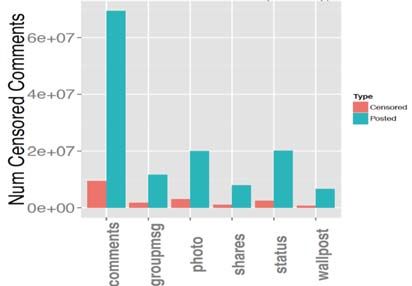
with more opposite-sex friends will self-censor more. censorship rates vary across popular Facebook products and
Younger SNS users have been suggested to be “more use cases. For posts, users tended to censor their own status
motivated for publicity and more willing to give up their updates (34%) and group posts (38%) more than posts on
privacy” (Tufecki 2007) and older users, even within a their friends timelines (25%) or event timelines (25%).
youth-skewed sample, have been shown to find social me- Most of these numbers agree with H6, that posts with
dia more cognitive demanding suggesting H4: younger vaguer audiences—the audience agnostic posts such as
users will self-censor less. We also suspected H5: users status updates—will be censored more. However, there was
with older friends will censor more, based on the intuition an exception: Group posts were censored most frequently.
that older audiences are likely to be more judgmental of For comments, users tended to primarily censor comments
what constitutes “appropriate” shared content. on photos (15%) and group messages (14%) more than they
It is also often suggested that imagined audience and censored comments on timeline posts (11%) and status
presentation of self across boundaries is important to users updates (12%). That comments on photos are censored
(Frederic & Woodrow 2012; Marwick & boyd 2010; Sleep- most of all seems to make sense—it may well be that
er et al. 2013; Wisniewski, Lipford & Wilson 2012) and photos elicit comments that users feel more apprehensive
that the perceived lack of boundary control is a primary about sharing.
cause for “self-censorship” on Facebook (Sleeper et al.
2013). Balanced with the observation that many users de- Modeling Self-Censorship
sire larger audiences than they perceive they have for the We modeled censorship for posts and comments separately
content they share (Bernstein et al. 2013), we expected H6: because of the large differences in the distribution of cen-
users who more frequently used audience selection tools sorship between them. Due to the skew in the distributions
self-censor less. Audience selection tools include usage of (see Figure 2), we elected to model censorship rates for
Facebook groups, buddy lists and private messages. posts and comments using a zero-inflated negative binomial
Relatedly, because maintaining presentation of self regression, or ZINB (Lambert 1992; Mwalili, Lessaffre, &
across social contexts might get harder with more social Declerck 2008). Zero-inflation attempts to model the over-
contexts and because more diverse social graphs likely abundance of users who censored zero times in the time
come with tumultuous opinion climates that can cause users interval. We used an intercept-only model for zero-
123Figure 3. Number of censored (red) and shared (blue)
Figure 2. Distribution of comments (top) and posts (bottom) comments (top) and posts (bottom) grouped by location.
self-censoring rates. Location represents where the content was shared (e.g.,
inflation, but found that it was insignificant at predicting “groupmsg” means comments on group posts). The “posts”
and “comments” locations are the values aggregated across
whether a user who censored zero times was a “true” zero
all locations.
(truly never censors) or a happenstance zero (happened to
not censor in the time period we measured). The negative censored posts when all predictors are held at their mean, a
binomial distribution was favored over Poisson because of 1% increase in the feature results in an estimate of 0.85x. In
the presence of overdispersion in the distributions of the other words, a 1% increase from the mean of the number of
response variables (Lambert 1992)—total censored posts days a user has been on Facebook indicates that the user
for posts, and total censored comments for comments. We censors 85% as many (i.e., 15% fewer) posts. Similarly, the
also offset the response variables for each model by the categorical feature, Gender: Male, has a coefficient of 1.26.
total number posts or comments actually posted by the user, Thus, compared to the baseline users who have the feature
as users who post more also have more opportunity to cen- Gender: Female, users with the feature Gender: Male cen-
sor, so the frequency of censorship should be proportional sor 1.26 times as much (i.e., 26% more).
to the frequency of posts. The predictor variables we used The regression results we share below are abbreviated for
are described in the “Model Features” section above. This brevity, but the full regression table can be found at:
model does not generate an R-squared value, so we report http://sauvik.me/icwsm_selfcensor.
the regression coefficients as our effect size measure.
Hypotheses Revisited
In the subsections to follow, we will make reference to
Pertinent model coefficients for the ZINB are presented in
coefficients in the ZINB model. These coefficients can be
Table 2 for the posts model and Table 3 for the comments
read as follows: For numeric values, a 1% increase in the
model. Posts were censored at a higher rate than comments
feature value yields a difference in the response equivalent
to multiplying the estimated response by the coefficient of (33% vs 13%, χ²=4.3e6, p=2e-16), lending credence to H1.
the feature, holding all other features at their mean. For From Table 2, we also see that males censored more posts
categorical variables, all but one of the discrete values of (coeff. 1.26—26% more) than females, but that males cen-
the variable are compared to a baseline value (the value that sored even more posts than females as the proportion of
is left out). All reported coefficients are significant at the their male friends increased (coeff. 1.11). However, we do
p=.05 level; nonsignificant results are reported as such. not observe either of these effects for comments—gender
For example, consider the Age feature, with a coefficient does not affect censorship of comments. Thus, H2 is sup-
of 0.85 in the posts model. If x is the baseline estimate for ported for posts but unsupported for comments, and H3 is
unsupported for both.
124For posts, older users seemed to censor substantially ly, users with more age diverse friends censored fewer posts
fewer posts than younger users (coeff. 0.85—15% less per (coeff. 0.96), but more comments (coeff. 1.17).
1% increase in age from the mean). The opposite is true for Taken together, it seems that “diversity” has two effects.
comments, however (coeff. 1.11). Thus, H4 is refuted for Users with more distinct communities represented in their
posts but supported for comments. Also, while the average social graph self-censored more, whereas users with more
age of one’s friends was unrelated to posts censorship, we diverse friends—of varied ages and political affiliations—
see that users with older friends censored fewer comments self-censored less. The one exception to this rule is that
(coeff. 0.87) refuting H5 for posts and comments. users with more age diverse friends censor more comments.
Curiously, users who were part of more groups cen- One possible explanation for the exception is that users may
sored more posts (coeff. 1.29) and comments (coeff. 1.14). not know how to appropriately respond to discussions start-
Similarly, users who used another audience selection tool, ed by friends from different age generations (Sleeper et al.
buddy lists, censored more posts (coeff. 1.13) and com- 2013). Thus, support for H7 is mixed, suggesting a need for
ments (coeff. 1.07). One notable exception to the trend was future research to tease apart these dual aspects of friend-
the use of private messaging, which was associated with ship diversity: diversity of community membership and
lower censorship for comments (coeff. 0.92). One explana- diversity of individual friend features.
tion for this finding is that comments are flat, coercing
many branching discussions into a single thread; so, any
one comment might be perceived as irrelevant to other dis- Discussion
cussions that are occurring within the thread. To more spe- While 71% of our users did last-minute self-censor at least
cifically target an audience, then, users might utilize private once, we suspect, in fact, that all users employ last-minute
messaging. Nevertheless, combined with our previous find- self-censorship on Facebook at some point. The remaining
ing that posts and comments directed at specific groups 29% of users in our sample likely didn’t have a chance to
were censored substantially more than the mean, it seems self-censor over the short duration of the study. Surprising-
that H6 is unsupported: users who are more aware of audi- ly, however, we found that relative rates of self-censorship
ence censor more, not less. were quite high: 33% of all potential posts written by our
Diversity (H7) had a mixed effect. A greater number of sample users were censored, and 13% of all comments.
distinct friend communities—which we took as a measure These numbers were higher than anticipated and are likely
of diversity—predicted for increased censorship. Users with inflated with false positives because of the imprecise nature
a higher average number of friends-of-friends, a correlate of of our metric. Nevertheless, our metric should be strongly
distinct communities in one’s extended friend network, correlated with self-censorship, so while the exact numbers
censored more posts (coeff. 1.29). Similarly, users with we report might be rough, self-censorship on Facebook
more biconnected components, the number of 2-connected does seem to be a common practice. Furthermore, the fre-
subgraphs in one’s social graph that we used as rough quency of self-censorship seems to vary by the nature of the
measure of distinct friend groups (Ugander et al. 2012), content (e.g., post or a comment?) and the context sur-
censored more posts (coeff. 1.12). Furthermore, users with rounding it (e.g., status update or event post?).
a higher friendship density, or users with more friends who The decision to self-censor also seems to be driven by
were friends with one another, censored less (coeff. 0.97) as two simple principles: People censor more when their audi-
is consistent with prior findings because higher density so- ence is hard to define, and people censor more when the
cial networks should have fewer separate communities. The relevance or topicality of a CMC “space” is narrower. For
effect was more slight and tumultuous for comments, how- example, posts are unsurprisingly censored more than
ever. While users with more biconnected components did comments. After all, posts create new discussion threads
predict for more comments censorship (coeff. 1.03), users over which the user claims ownership, are more content-
with more friends of friends had the opposite, though simi- rich, tend to require more energy and thought to craft, and
larly small (coeff. 0.95), effect. This finding might suggest require more effort to share, as users have to explicitly hit a
that users are apprehensive towards generating new content “submit” button. However, posts also make it hard to con-
towards large, impersonal audiences but are willing to join ceptualize an “audience” relative to comments, because
ongoing discussions within such communities. many posts (e.g., status updates) are undirected projections
Alternatively, users with more diverse friends generally of content that might be read by anyone in one’s friend list.
censored less. The presence of more politically identified Conversely, comments are specifically targeted, succinct
friends, which we took as a measure of diversity because replies to a known audience. Even groups of users who are
most users do not have many friends who share their politi- known to be comfortable with more self-disclosure are of-
cal identification on Facebook, predicted for dramatically ten only comfortable with such disclosure to a well-
reduced self-censorship for both posts (coeffs. 0.77, 0.77, specified audience, such as close relationships (Dindia &
0.95 for liberal, conservative, moderate) and comments Allen 1992; Bowman, Westerman & Claus 2012), so it
(coeffs. 0.91, 0.87, 0.95 for liberal, conservative, moderate). makes sense that users pay special attention to posts to en-
Users with more politically diverse friends also censored sure that the content is appropriate for the “lowest common
fewer posts (coeff. 0.92) and comments (coeff. 0.94). Final- denominator” (Wisniewski, Lipford & Wilson 2012).
125Type Feature Coefficient Type Feature Coefficient GEN Gender: Male (#) 1.26 *** AGE Age 1.11 *** GEN Gender: Male X Percentage male friends (##) 1.11 *** AGE Friends average age 0.87 *** AGE Age 0.85 *** AUD Group member count 1.14 *** AUD Group member count 1.29 *** AUD Buddylists created 1.07 *** AUD Buddylists created 1.13 *** AUD Messages sent 0.92 *** DIV Average number of friends of friends 1.32 *** DIV Friends age entropy 1.17 *** DIV Biconnected components 1.12 *** DIV Biconnected components 1.03 *** DIV Percentage friends liberal 0.77 *** DIV Average number of friends-of-friends 0.95 *** DIV Percentage friends conservative 0.77 *** DIV Percentage friends moderate 0.95 *** DIV Percentage friends moderate 0.95 *** DIV Friend political entropy 0.94 * DIV Friend political entropy 0.92 *** DIV Percentage friends liberal 0.91 *** DIV Friendship density 0.97 *** DIV Percentage friends conservative 0.87 *** DIV Friend age entropy 0.96 ** * p < 0.05, *** p
towards users who are comfortable with personal disclo-                                           References
sure. We also do not make claims of causality. The findings
we present are strictly observational correlations. Experi-              Acquisti, A. & Gross, R. Imagined Communities: Awareness,
                                                                         Information Sharing, & Privacy on the Facebook. Priv. Enhancing
mental approaches are necessary to determine that diversity
                                                                         Tech. 4258, (2006), 36–58.
is a cause of self-censorship, rather than a correlate. For
                                                                         Bernstein, M., Bakshy, E., Burke, M., and Karrer, B. Quantifying
example, if people who censor more come off as more like-
                                                                         the Invisible Audience in Social Networks. Proc. CHI 2013.
able and less offensive, they might be seen as more broadly
                                                                         Bowman, N.D., Westerman, D.K., & Claus, C.J. How demanding
attractive, resulting in a broader group of friends. Indeed,
                                                                         is social media: Understanding social media diets as a function of
the role of censorship in relationship building also provides            perceived costs and benefits – A rational actor perspective. Com-
an interesting avenue of study.                                          puters in Human Behavior, 28 (2012), 2298.
   Nevertheless, we now know that current solutions on                   Cho, S.H. Effects of motivations and gender on adolescents’ self-
Facebook do not effectively prevent self-censorship caused               disclosure in online chatting. Cyberpsychology & Behavior 10, 3
by boundary regulation problems. Users with more bounda-                 (2007), 339–45.
ries to regulate self-censor more, even controlling for their            Dindia, K. & Allen, M. Sex differences in self-disclosure: A meta-
use of audience selection and privacy tools. One reason for              analysis. Psych. Bulletin 112 (1992), 106.
this finding is that users might distrust the available tools to         Farnham, S.D. & Churchill, E.F. Faceted identity, faceted lives.
truly restrict the audience of a post; another possibility is            Proc. CSCW 2011, 359.
that present audience selection tools are too static and con-            Frederic, S. & Woodrow, H. Boundary regulation in social media.
tent agnostic, rendering them ineffective in allowing users              Proc. CSCW 2012, 769.
to selectively target groups on the fly (Sleeper et al. 2013).           Goffman, E. The presentation of self in everyday life. Doubleday
Future work will be necessary to unpack the nature of this               Anchor, Garden City, NY, 1959.
effect and strategies to improve the tools available to users.           Hayes, A.F., Scheufele, D.A., & Huge, M.E. Nonparticipation as
                                                                         Self-Censorship: Publicly Observable Political Activity in a Polar-
                                                                         ized Opinion Climate. Pol. Behavior 28 (2006), 259.
                        Conclusion                                       Kairam, S., Brzozowski, M., Huffaker, D., & Chi, E. Talking in
                                                                         circles. Proc. CHI 2012, 1065.
We studied the last-minute self-censorship habits of 3.9
million English speaking Facebook users, and found that a                Lambert, D. Zero-Inflated Poisson With an Application to Defects
                                                                         in Manufacturing. Technometrics 34, (1992), 1.
large majority (71%) self-censored content at least once.
Decisions to self-censor appeared to be driven by two prin-              Lampinen, A., Lehtinen, V., Lehmuskallio, A., & Tamminen, S.
                                                                         We’re in it together. Proc. CHI 2011, 3217.
ciples: people censor more when their audience is harder to
define, and people censor more when the relevance of the                 Marwick, A.E. & boyd, d. I tweet honestly, I tweet passionately:
                                                                         Twitter users, context collapse, and the imagined audience. New
communication “space” is narrower. In other words, while                 Media & Society, 13 (2010), 114.
posts directed at vague audiences (e.g., status updates) are
                                                                         Mwalili, S.M., Lesaffre, E., & Declerck, D. The zero-inflated
censored more, so are posts directed at specifically defined             negative binomial regression model with correction for misclassi-
targets (e.g., group posts), because it is easier to doubt the           fication: an example in caries research. Stat. meth. med rsrc 17
relevance of content directed at these focused audiences.                (2008), 123.
   We also uncovered the relationships between various                   Seamon, C.M. Self-Esteem, Sex Differences, and Self-Disclosure:
user-specific factors and the frequency of self-censorship               A Study of the Closeness of Relationships. Osprey J. Ideas &
on Facebook. Indeed, as the first study examining self-                  Inquiry, (2003).
censorship on Facebook at this scale, we directly supported              Sleeper, M., Balebako, R., Das, S., McConohy, A., Wiese, J., &
some prior findings—for example, that males and people                   Cranor, L.F. The Post that Wasn’t: Exploring Self-Censorship on
with more boundaries to regulate “self-censor” more—                     Facebook. Proc. CSCW 2013.
while showing findings from other work to be less con-                   Tufekci, Z. Can You See Me Now? Audience and Disclosure
sistent—for example, that people who exercise more con-                  Regulation in Online Social Network Sites. Bull. Sci., Tech, &
trol over their audience with audience selection tools self-             Soc, 28 (2007), 20.
censor less. Through this work, we have arrived at a better              Ugander, J., Backstrom, L., Marlow, C., Kleinberg, J. Structural
understanding of how and where self-censorship manifests                 diversity in social contagion. PNAS. 109 (2012), 5962.
on social media; next, we will need to better understand                 Walther, J.B. Selective self-presentation in computer-mediated
what and why.                                                            communication: Hyperpersonal dimensions of technology, lan-
                                                                         guage, and cognition. Comp. in Hum. Behav. 23 (2007), 2538.
                                                                         Wang, Y., Norcie, G., Komanduri, S., Acquisti, A., Leon, P.G., &
                  Acknowledgements                                       Cranor, L.F. “I regretted the minute I pressed share.” Proc.
                                                                         SOUPS 2011, 1.
Special thanks go to Michael Bernstein, Moira Burke, A.T.                Wisniewski, P., Lipford, H., & Wilson, D. Fighting for my space.
Fiore, Bill Fumerola, Robert Kieffer and Solomon Messing                 Proc. CHI 2012, 609.
for their help in the ideation, execution and articulation of
this research.

                                                                   127
You can also read


