Recent Pandemic Outbreak in India-Source and Management Strategy - IJERT
←
→
Page content transcription
If your browser does not render page correctly, please read the page content below
Published by :                                                   International Journal of Engineering Research & Technology (IJERT)
http://www.ijert.org                                                                                                   ISSN: 2278-0181
                                                                                                       Vol. 9 Issue 09, September-2020

 Recent Pandemic Outbreak in India- Source and
             Management Strategy
                    Dr. Gajanan Nagare                                                     Mr. Heramb Gupta
          Department of Biomedical Engineering                                    Department of Biomedical Engineering
           Vidyalankar Institute of Technology                                     Vidyalankar Institute of Technology
                     Mumbai, India                                                           Mumbai, India

                                                           Ms. Jinal Darji
                                               Department of Biomedical Engineering
                                                Vidyalankar Institute of Technology
                                                          Mumbai, India

    Abstract— Everywhere in the world there is a big well-being      severe acute respiratory syndrome (SARS) in 2003 and
emergency that began in China and was also massive all-              coronavirus respiratory syndrome in the Middle East (MERS-
inclusive. The virus named the novel coronavirus (nCovid-19)         CoV) in 2012 [3]. Covid-19, the third epidemic that resembles
and its spread is a great threat. COVID-19 is a worldwide            previous epidemics, is one of the biggest concerns in the
devastating pandemic. The world is faced with many problems
such as dissemination prevention, hospital patient care,
                                                                     world. Many COVID-19 cases have occurred in most
incubation analysis, and the successful action required to tackle    countries around the world since December 2019. People with
this pandemic. The first step to finding an answer is to find out    medical problems, low immunity, old age, and lung-related
where it started and how it started. This study offers a brief       health issues are more likely to experience COVID-19. The
overview of the spread of the first 50 cases in India and specific   symptoms of Covid-19 are cough, cold, breathing problems
events that were super propagators. It utilizes the epidemic         very similar to flu, although the mutational behavior of
curve to graph the initiation and further growth of the COVID-       COVID-19 shows many different symptoms. Various
19. It also encompasses various steps taken together to control      precautions have been taken around the world to prevent the
the transmission of the infection. The efficacy of social            spread of this virus and thus to consider various measures that
distancing and quarantine has been studied and the incubation
duration reported. The successful Kerala government model has
                                                                     will help doctors and the government to manage the
been reported to curb the propagation, mainly because of             pandemic.
experience with the Nipah Virus in the past. The study provides
a fundamental process-the steps for setting up a medical facility
                                                                                     II. ORIGIN OF THE VIRUS
for COVID-19 and describes the way the treatment of any                  In December 2019, people in Wuhan, the capital city of
patient or suspected case can be carried out.                        Hubei province of China started going to local hospitals with
                                                                     severe pneumonia of unknown causes. Many of the cases had
   Keywords—Coronavirus, India, Incubation, Kerela, Hospital,        a common exposure to the Wuhan wholesale seafood market.
Origin                                                               On 31 December 2019, China notified the outbreak to the
                                                                     World Health Organization. Later on, 12 January 2020, it was
                     I.    INTRODUCTION                              confirmed by the World Health Organization (WHO) that a
    A pandemic is termed as an outbreak of a disease around          novel coronavirus was the cause of a respiratory illness in a
the world. Pandemics are primarily illnesses caused by               cluster of people in Wuhan City. On 30 January 2020,
human-to-human infection transmission [1]. A pandemic is an          Director-General WHO declared that the outbreak of novel
epidemic of which affects many people from different regions         coronavirus (2019-nCoV) constitutes a Public Health
and countries around the world. The global COVID-19                  Emergency of International Concern (PHEIC) as per the
pandemic is one after several pandemics, including plague,           advice of International Health Regulations (IHR) Emergency
influenza and cholera. This novel Coronavirus has similar            Committee [4]. As of 31 January 2020, a total of 9720
characteristics to that of bats which had been transmitted to        confirmed cases and 213 deaths have been reported in China.
humans through pangolins or snakes and which have                    Outside of China, nineteen countries have reported a total of
subsequently been transmitted from humans to humans [2].             One Hundred and Six confirmed cases, most with travel
The symptoms were similar to those of Pneumonia. As a                history from China. These countries are Australia, Cambodia,
contact-based disease, the spread of this virus was enormous.        Canada, Finland, France, Germany, India, Italy, Japan,
The first case was confirmed in India on 30 January 2020.            Malaysia, Nepal, Philippines, Singapore, South Korea, Sri
Over time, the number of cases in India began to show an             Lanka, Thailand, UAE, USA, and Vietnam [4].
increase and began to show different types of transmission
over different time intervals. Coronaviruses (CoVs) are a                     III. COVID-19 OUTBREAKS IN INDIA
major group of viruses that mostly affect humans through the            A laboratory confirmed case of COVID-19 was reported in
zoonotic transmission. In the last two decades, this is the third    Kerala that was a student who returned from Wuhan. From
instance of the development of a novel coronavirus following         then the travel advisories were issued which included

IJERTV9IS090234                                              www.ijert.org                                                      371
                       (This work is licensed under a Creative Commons Attribution 4.0 International License.)
Published by : International Journal of Engineering Research & Technology (IJERT)
http://www.ijert.org ISSN: 2278-0181
Vol. 9 Issue 09, September-2020
screening of people who were returning from china and who which was practiced very strictly. Also, in many places almost
had symptoms such as cough, cold, fever and also non- throughout India Section 144 of Criminal Procedure Code
essential travel to China was prohibited. India evacuated 324 (CrPC) was imposed which restricted a person or a group of
people on 1 February 2020 and 323 people on February 2020 people residing in a particular area to visit a certain place or
from Wuhan region and were quarantined for 14 days and area. As the end of the lockdown period approached, several
tested negative [5]. Many actions were taken in order to state governments recommended extending the lockdown.
prevent transmission in India by screening the people on the The State Governments namely Odisha, Punjab, Maharashtra,
airport itself and advising those people to stay self-quarantined and West Bengal governments had extended the state
irrespective of the symptoms and the suspect cases were in lockdowns to 30 April 2020. At the end day of the 21day of
facility isolation. Also 112 people from Wuhan which were the lockdown the lockdown had been extended up to 3 May
quarantined at camp managed by army and 124 more people 2020. On 14 April 2020, the lockdown 1.0 was again extended
were evacuated from Japan which were kept isolated on the on till 3 May, with some sort of relaxations from 20 April 2020
the Diamond Princess Cruise ship at Yokohama before for the places that have been able to reduce the spread. And
bringing back to India [6]. In February 2020 there were only 3 for this lockdown 2.0, many guidelines had been revised.
cases but in March the cases started to increase and schools After that there was an extension in lock down until 14 May
and colleges in India were ordered to be closed starting from 5 2020 which was lockdown 3.0, during this lock down the
March in Delhi and later on in other states too. country was divided into three zones (Green, Orange and Red)
All states and districts started taking some voluntary depending on the number of cases and therefore few
actions in order to stop the spread that is the celebrations concessions in lockdown were granted. But considering the
publicly were prohibited and all the public places were made increased cases later there was a lockdown until 30 May 2020
to be closed. The malls, cinema halls and all such places were which was a lockdown 4.0.
made to be shut down and there were no permissions granted
for any of the public celebrations. The surveillance system in IV. FIRST 50 CASES IN INDIA
India included many major changes including all the The first case in India was found on 30 January 2020 in
passengers coming from all the countries were screened on the Thrissur Kerala; the patient had a travel history to Wuhan.
Airport and the count of the airports to be screened increased Later, on 2nd and 3rd of February 2020, two more confirmed
to 30 and all those travelling from different countries were cases in Kerala were reported. These two COVID-19
made to stay under isolation for about 14 days and all the confirmed cases came into light one in Delhi (Mayur Vihar)
information regarding passengers was tracked and along with who had a travel history to Italy and the other in Hyderabad
that there was cluster tracking which helped India to reduce who had a travel history to Dubai. The person in Delhi (Mayur
the spread at some extent. Later-on apart from the evacuation Vihar) proved to be super infectious and infected 6 people
which happened in the February month there was lot of which were confirmed positive in Agra on 4 March 2020,
evacuation happening from different countries in month of which further infected a person in Uttar Pradesh who was
March too but their isolation was well taken care of. In India confirmed positive on 9 March 2020. A 63-year-old Italian
slowly and steadily all places started to shut down. WHO tourist confirmed positive for the novel COVID-19 in Jaipur
declared the Novel Coronavirus Disease (COVID-19) on 3 March 2020 which infected 16 more people and
outbreak as a pandemic. confirmed positive on 4 March 2020, one of which was the
On 22 March 2020, Indian citizens observed ‘Janata wife of 63-year-olds and 14 others from the same Italian
Curfew’ starting from 7:00 AM till 9:00 PM. Later-on a tourist group along with one Indian driver who drove for
nationwide lockdown was declared till 31 March 2020 with them. On 5 March 2020, two more cases came forward one
only essential services opened and no landing of fights and was from Delhi (NCR) and had a travel history to Iran and
railways to be closed. The Indian government had announced another case was an employee of the firm in Gurgaon who had
a countrywide lockdown for three weeks starting at midnight a travel history to Italy was confirmed on 9 March 2020. On 6
on 24 March to slow the spread of COVID-19 as the number March 2020, one patient was confirmed in Delhi who
of people testing positive in the country reached 563. Most of travelled to Thailand and Malaysia. On 7 March 2020, two
these people had contact with travelers returning from more cases were confirmed one in Ladakh and the other in
countries affected by COVID-19, a few had been contracted Chennai who had travelled to Iran and Oman respectively. On
locally, suggesting that community transmission may have 8 March 2020, five more cases were confirmed in Kerala all
begun in some Indian states. Indian Government announced from the same family among which 3 had travelled to Italy
that all government offices would be shut for 21 days, except and the other two contracted it from them. On 10 March 2020
essential services such as the fire service, police, and six more cases were found which includes 2 in Pune and 4 in
hospitals. There were many hospitals and testing labs assigned Karnataka who had travelled to Dubai and the United States.
and sample testing was increased considerably. On 27 and 28 As of 18 April 2020, there have been 2,160,207 confirmed
of March 2020 there came forward drastic increase in the cases of COVID-19 with 85678 new cases (in the last 24
cases which were the result of public functions which took hours) in the world and 25,291 confirmed cases of COVID-19
place in the starting or mid of march. After this there was an with 1731 new cases in the South-East Asia Region [7].
increase in COVID-19 infected patients nationwide. There V. EPIDEMIC CURVE
was a call for 21 days lockdown which had stringent rules, Epidemic curve is a graphical representation of the
Social distancing had to be highly practiced. The reason incidences of a disease plotted over time and is useful for
behind the slow growth of patients was the social distancing inferring the magnitude, incubation duration, and other
IJERTV9IS090234 www.ijert.org 372
(This work is licensed under a Creative Commons Attribution 4.0 International License.)Published by : International Journal of Engineering Research & Technology (IJERT)
http://www.ijert.org ISSN: 2278-0181
Vol. 9 Issue 09, September-2020
attributes of an epidemic [8]. The epidemic curve is the figure 2 is the epidemic curve of the average of the total
number of reported cases by date of symptom onset [9]. This number of cases per day. Analyzing the number of new cases,
curve is obtained by plotting the quantity of cases of the every day is an important factor to determine the growth and
disease outbreak over a period. The curve indicates mode of spread of COVID-19. The obtained number of new cases per
spread of an outbreak. The transmission can occur within the day by using the total average number of cases in a day is
following ways: presented in the bar graph (Fig 3).
(i) Point source: during a source outbreak, persons are
exposed over a short time to the identical source, like one
meal or an occasion. the quantity of cases rises rapidly to a
peak and falls gradually. The bulk of cases occur within one
period of time of the disease.
(ii) Continuous common source: during a continuous
common-source outbreak, persons are exposed to the identical
source, but exposure is prolonged over days, weeks, or longer.
The epi curve rises gradually and might plateau.
(iii) Person-to-person spread (propagation): during a
propagated outbreak, there's no common source because the
outbreak spreads from person-to-person. The graph will
assume the classic epi curve shape of progressively taller
peaks, each being one period of time apart. The “incubation
period” means the time between catching the virus and setting
out to have symptoms of the disease. Most estimates of the
period of time for COVID-19 range from 1-14 days, most
typically around five days [10].
VI. METHODS
There have been several speculations about the number of
cases of COVID-19, worldwide. Several sources talk about
the cases in a particular country or a region. After considering
the cases in the country of the Republic of India, within the
period of 15 February 2020 to 18 April 2020, many sources
talk about the case count. The case counts shows of the
sources which were used: (1) World Health Organisation -
United Nations, (2) Statista - Global Business Data Platform,
(3) Worldometer, (4) India COVID-19 Tracker- A
Crowdsourced Initiative, (5) Ministry of Health and Family
Welfare, Government of India - Official Public Service
Announcement on Coronavirus from the Government, (6)
Trading View Website COVID 19 Stats [15-20]. The average
of the total number of cases per-day is taken for further
calculations and plotting of the epidemic curve. Further, the
number of new cases per-day was determined from this
average. This was done by subtracting the total average of
cases the day before from the total average cases of the day of
which the number of new cases has been identified.
VII. DISCUSSION
The shape of an epi curve seldom fits exactly with either
of these descriptions. For propagated outbreaks, the shape
may demonstrate overlapping waves of cases that may
diminish more slowly over time by obscuring subsequent
peaks and peaks. General observation of an outbreak 's mode
of spread may therefore be made from its epi curve [11].
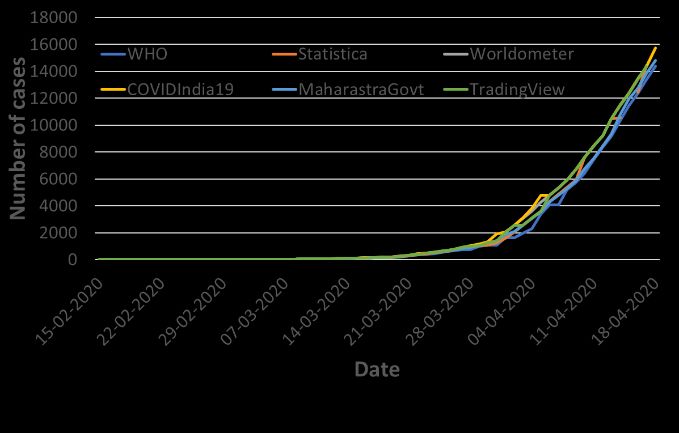
Hence, the plot of the epidemic curves presents the number of Followings are the observations and findings from the
cases of each source and is shown in Fig 1. It has been epidemic curve:
observed that the number of cases per day has a constant (i) There was a spike in the number of new cases
number of three and it is the same for all the six references till (average of 18.67 cases) on 4 March 2020 as compared to the
1 March 2020. After the number of cases starts increasing previous day 3 March 2020 (1 case) and 5 March 2020 (5.33
with time, there are slight variations in numbers across the cases). The incident which caused these cases was contained
datasets. The number of cases follows a general trend and the very well as a result of which the number went back to the
nature of the increase in the number per day is similar. The normal level.
IJERTV9IS090234 www.ijert.org 373
(This work is licensed under a Creative Commons Attribution 4.0 International License.)Published by : International Journal of Engineering Research & Technology (IJERT)
http://www.ijert.org ISSN: 2278-0181
Vol. 9 Issue 09, September-2020
(ii) The number of new cases per day almost doubled on
15 March 2020 (18.00 cases) as compared to the previous
days 14 March 2020 (11.33 cases) and 13 March 2020 (7.00
cases). In the following days the number of new cases then
rose to match this level, 16 March 2020 (8.33 cases), 17
March 2020 (20.8333 cases) and 18 March 2020 (17.47
cases).
(iii) The number of new cases per day at least tripled on
20 March 2020 (58.833 cases) as compared to the previous
day's 19 March 2020 (18.87 cases) and 18 March 2020 (14.47
cases) and stayed in this range till the 29 March where the
cases went to as high as 98.8333 cases per day (25 March
2020).
(iv) There was a spike in the number of new cases
(149.00 cases) on 27 March 2020 as compared to the previous
day's 26 March 2020 (85.17 cases) and 28 March 2020 (87.83
cases). This was because A Sikh preacher that returned from
travel to Italy and Germany, carrying the virus, turned into
"super spreader" by attending a Sikh festival in Anandpur
Sahib from 10–12 March.
(v) The number of new cases per day at almost tripled on
1 April 2020 (455.33 cases) as compared to the previous day's
31 March 2020 (190.33 cases) and 30 March 2020 (171.33 vaccine or drug in order to cure the disease. The flow of steps
cases). After this day the new number of cases per day has to manage the symptomatic patient are given in Fig 4.
increased almost every day.
IX. THE KERELA MODEL
(vi) There was a spike in the number of new cases
In 2018, the state had dealt with an outbreak of Nipah, a
(149.00 cases) on 27 March 2020 as compared to the previous
brain-damaging virus that, like the coronavirus, had originated
day 26 March 2020 (85.17 cases) and 28 March 2020 (87.83
in bats and transferred to humans. Nipah viral disease
cases).
outbreak had been reported in Kozhikode district, northern
(vii) There was a sudden spike in the number of new cases
Kerala, India and the fruit bats had been identified as the
on 1 April 2020 (455.33 cases). After this, the curve started to
source of the outbreak [20]. This disease was considered to be
follow a trend where the number of new cases dropped for a
very new and there was no such strong evidence related to it.
day or two followed by an increase in the number of cases till
Intensive measures were initiated by the state with the help of
it reached a new spike. After this, the cycle of decrease and
central government health authorities including the National
increase of cases has continued till 18 April 2020.
Centre for Disease Control, National Institute of
After the sudden rise in the number of cases on 1 April
Epidemiology, Indian Council of Medical Research (ICMR),
2020 the curve started showing characteristics of a propagated
and experts from AIIMS, New Delhi. Initiatives taken to
outbreak. The difference of time between two successive
prevent the spread was majorly contact tracing and
peaks gives us information about the incubation period of
quarantining. Strict isolation precautions were followed in
COVID-19 in India. The difference is as (1) 1 April 2020 to 5
order to prevent the spread and to control the epidemic also
April 2020: 4 days, (2) 5 April 2020 to 10 April 2020: 5 days,
strict measures were taken in order to prevent the droplet
(3) 10 April 2020 to 13 April 2020: 3 days, and, (4) 13 April
infections. At the community level, a special task force was
2020 to 17 April 2020: 4 days. The study showed the average
set up to re-ensure early suspicion and detection followed by
incubation period for India is 4 days.
isolation, treatment, and surveillance of confirmed cases [21].
The utmost care was taken by the government and medical
VIII. MANAGEMENT PLAN FOR PEOPLE WITH facilities resulted in early suspicion of the deadly epidemic in
COVID-19 SYMPTOMS a span of 12 days. The World Health Organization (WHO)
It is essential to practice precautionary measures to prevent
transmission and reduce the risk of infection from person to
person. While considering the person who has symptoms
which resembles to be that of COVID-19 there are various
plans to be considered while managing the patients so that the
disease doesn’t spread further and we get success in breaking
the chain of spread. It is important that all physicians likely to
handle the cases should know about the principles of
management of these people keeping in mind limited
resources such as facilities for test, places for isolation,
Limited medical facilities and most importantly there is no
IJERTV9IS090234 www.ijert.org 374
(This work is licensed under a Creative Commons Attribution 4.0 International License.)Published by : International Journal of Engineering Research & Technology (IJERT)
http://www.ijert.org ISSN: 2278-0181
Vol. 9 Issue 09, September-2020
termed Kerala’s handling of the outbreak a “success story”. certain districts were trained and engaged to produce masks
Kerala in spite of technical shortcomings was able to contain a and sanitizers. The citizens of India are facing numerous
potential disaster. difficulties to acquire the required protective gear. These steps
can be implemented to supply the demand of increasing
medical supplies.
(v) Break the Chain: Under the “Break the Chain”
initiative, the government had installed water taps
accompanied by sanitizers at public places implementing basic
hygiene measures. This initiative should be implemented all
over the country especially in places where there is a lack of
clean drinking water.
(vi) Transparency: It is a necessary condition for an
effective response. The Chief Minister of Kerala provides an
update of the scenario in the state, via a televised address,
daily, in which he informs citizens about the number of new
cases per day, number of patients recovered, and the number
of deaths; he outlines the actions the government has taken
and reinforces the importance of precautionary measures, such
The epidemic curve shows how the number of cases varied as physical distancing. He also informs the people of Kerala
with time (Table 1), we see that the Kerala Government was about the actions they can take, should they face any issues
successful to begin the flattening of the curve by 18 April accessing healthcare. This level of communication ensures
2020 (Fig. 5) and the new number of cases everyday also that the fear among people is reduced and thus acts as a
decreased (Fig. 6). As a result of this a number of steps that confidence-building measure in the government’s handling of
were implemented in the state of Kerala can be implemented the situation. If not at a national level this measure should be
across the entire country. implemented by individual state governments to maintain the
(i) Quarantine measures: Kerala is the only state that trust of the people and ensure cooperation.
mandates 28 days of home quarantine, while the national (vii) Diverse Action Plan: The Kerala state government
guidelines have been 14 days for those who return from invited religious leaders, local bodies and civil society
countries affected by COVID-19. After permitting organizations to participate in policy design and
International travel over time, all travelers returning from implementation, considering its specific socio-economic
countries with a travel history from a country where there are conditions, including urban slum environments. It has
positive cases to be mandated a home quarantine of 28 days. communicated effectively in different languages to educate
Those travelers who are coming from a country with lesser all, including migrants, and to prevent stigmatization of those
cases to be mandated a quarantine of 14 days for safety infected, even opposing the term ‘social distancing’, which
purposes. This Quarantine to be mandated with the means of has caste connotations, with ‘physical distancing and social
the Aarogya Setu App. solidarity’. India is a very diverse country. The population has
(ii) Care Homes: In Kerala COVID-19 care homes were several people from many varied backgrounds. To reach to
set up near the international airports. These care homes were every citizen the above-mentioned steps are very necessary for
set up in hospitals and even prison wards along with with effective implementation of plans and policies.
isolation beds. Private hospitals and buildings that were The Government of Kerala looked at the Corona Crisis
abandoned and had rooms with attached bathrooms were from various points of view. As we can call it the " Seven
taken over by the district administration and converted to care Point Plan" which includes (1) Patient Care of affected
centers. citizens, (2) Effective management of patients by quarantine
(iii) Tele Counselling Service: A 24X7 Disha call center and isolation measures, (3) Mental health of all citizens, (4)
was set up to counsel quarantined families on responsible Maintenance of Public Hygiene, (5) Networking and effective
behavior and to improve their mental health. This step is very communication, (6)Implementation of Government Rules with
necessary to be adapted all over India to ensure the mental cooperation and monitoring, and (7) Management of increased
stability of all the citizens during the lockdown. The 626 demand of medical supplies; played an instrumental role in
medical personnel who were employed also ran the patients successfully curbing larger effects of COVID-19. Every State
through a questionnaire which was meant to assess their Government in India with the help of the Central Government
physical and mental health, but also to catch lies. If anyone should align its plan of action and policies with this Seven
was caught sneaking out, the police, the revenue department, Point Plan to tackle the problem of COVID-19 effectively.
and village councils were ready to act and this office also X. CONCLUSION
delivered groceries to those in need. This new outbreak of the virus has challenged not only
(iv) Demand and Supply: Foreseeing a growing demand India's medical and public health infrastructure, but also the
for medical supplies at a time of crisis, a team of officials world as a whole. According to the analysis of the epidemic
were entrusted to procure the necessary medical supplies such curve, done in this paper, the incubation period is found to be
as masks, sanitizers and personal protection equipment gears. 4 days in this first wave of COVID-19 in India. If the first
There was an enormous community participation as not only wave is successfully curbed, there is a likelihood of a second
volunteer organizations and companies but also prisoners in
IJERTV9IS090234 www.ijert.org 375
(This work is licensed under a Creative Commons Attribution 4.0 International License.)Published by : International Journal of Engineering Research & Technology (IJERT)
http://www.ijert.org ISSN: 2278-0181
Vol. 9 Issue 09, September-2020
wave of the outbreak in India. Therefore, in addition to [8] Nsoesie EO, Beckman R, Marathe M, Lewis B. Prediction of an
Epidemic Curve: A Supervised Classification Approach. Stat Commun
curbing the outbreak, efforts should be made to prevent a
Infect Dis. 2011;3(1):5. doi:10.2202/1948-4690.1038.
future outbreak by implementing the seven-point plan that has [9] Wallinga, Jacco & Teunis, Peter. (2004). Different Epidemic Curves
proved to be for Severe Acute Respiratory Syndrome Reveal Similar Impacts of
effective in controlling COVID-19 in Kerala. Lastly, our Control Measures. American journal of epidemiology. 160. 509-16.
10.1093/aje/kwh255.
analysis suggests transmission reduction measures, as
[10] World Health Organization, Coronavirus disease 2019 (COVID-19)
COVID-19 will stay for a considerable amount of time and the Situation reports.
world will have to learn to adapt to certain standards that will [11] Centre for disease control and prevention, “CDC LC Quick Learn
further help us eradicate the pandemic. In India, the national Using an Epi Curve to Determine Mode of Spread”, Retrieved from
https ://www.cdc.gov/ training/QuickLearns/ epimode/Quick Learn.
lockdown has had a huge impact on the control of the spread
[12] Rawat, Mukesh. “Coronavirus in India: Tracking Country's First 50
of the virus. However, citizens should keep in mind that, once COVID-19 Cases; What Numbers Tell.” India Today, 12 Mar. 2020,
the lockdown is over, citizens will still have to avoid close https://www.indiatoday.in/india/story/coronavirus-in-india-tracking-
contact at the individual level. country-s-first-50-covid-19-cases-what-numbers-tell-1654468-2020-
03-12.
REFERENCES [13] “COVID-19 Situation Reports.” World Health Organization, World
[1] Qiu, W. & Rutherford, Shannon & Mao, A. & Chu, Cordia. (2017). Health Organization, https://www.who.int/emergencies/diseases/novel-
The Pandemic and its Impacts.Health, Culture and Society. 9. 1-11. coronavirus-2019/situation-reports.
10.5195/HCS.2017.221. [14] “Coronavirus in India: Latest Map and Case Count.” COVID,
[2] Singhal, T. A Review of Coronavirus Disease-2019 (COVID-19). https://www.covid19india.org/demographics.
Indian J Pediatr 87, 281–286 (2020). https://doi.org/10.1007/s12098- [15] “Coronavirus (COVID-19) Charts and Stats.” TradingView,
020-03263-6. https://in.tradingview.com/ covid19/.
[3] Chatterjee P, Nagi N, Agarwal A, Das B, Banerjee S, Sarkar S, Gupta [16] “ India.” Worldometer,
N, Gangakhedkar RR. The 2019 novel coronavirus disease (COVID- https://www.worldometers.info/coronavirus/country/india/.
19) pandemic: A review of the current evidence. Indian J Med Res [17] Diwanji, Sanika. “India: COVID-19 Cases Timeline 2020.” Statista, 21
2020; 151:147-59. May 2020, https://www.statista.com/statistics/1104054/india-
[4] World Health Organization. (2020, January 31).Novel Corona coronavirus-covid-19-daily-confirmed-recovered-death-cases/.
virus(2019-nCov) India Situation report1. [18] “#IndiaFightsCoronaCOVID-19.” MyGov.in, 3 Apr. 2020,
[5] "Coronovirus outbreak: People flown in from China quarantined". The https://www.mygov.in/covid-19/.
Hindu. (2020, February 1) Retrieved from [19] Rachita Vora. “COVID-19 and lessons from Kerala” idronline.org,
https://www.thehindu.com/news/national/coronavirus-outbreak-air April 01, 2020.Retrieve from https://idronline.org/covid-19-and-
india-flight-evacuating-324-indians-from-chinas-wuhan-land-in- lessons-from-kerala/.
delhi/article30709431.ece. [20] Chatterjee P. 2018. Nipah virus outbreak in India. Lancet.
[6] “India Situation Report.” World Health Organization, World Health 391(10136):2200. doi:10.1016/S0140-6736(18)31252-2.
Organization, www.who.int/india/emergencies/coronavirus-disease- [21] Ajith Kumar AK, Anoop Kumar AS. Deadly Nipah Outbreak in
(covid-19)/india-situation-report. Kerala: Lessons Learned for the Future. Indian J Crit Care Med.
[7] World Health Organization, Coronavirus disease 2019 (COVID-19 ) 2018;22(7):475‐476.
Situtation report 89,” vol. 2019, 18 April, 2020.
IJERTV9IS090234 www.ijert.org 376
(This work is licensed under a Creative Commons Attribution 4.0 International License.)You can also read


