RENEWING THE GOVERNMENT OF CANADA'S PARTNERSHIP WITH METRO VANCOUVER: INVESTMENTS TO ADDRESS GROWING DEMAND FOR PUBLIC TRANSIT - Cure ...
←
→
Page content transcription
If your browser does not render page correctly, please read the page content below
RENEWING THE
GOVERNMENT OF CANADA’S
PARTNERSHIP WITH
METRO VANCOUVER:
INVESTMENTS TO ADDRESS
GROWING DEMAND FOR
PUBLIC TRANSIT

Submission to the Government Canada for Budget 2020/2021
February 4, 2020
                                                           1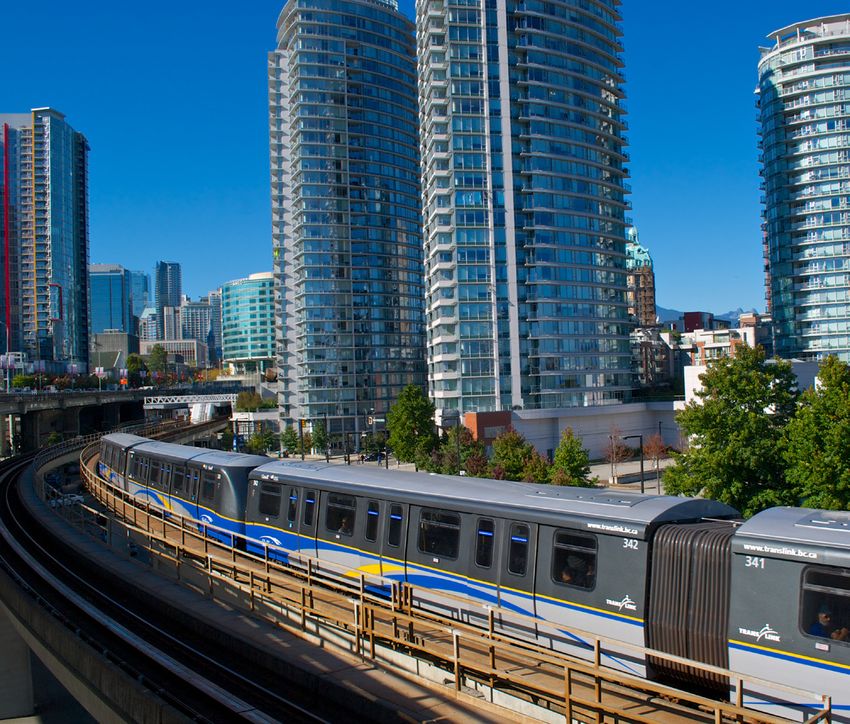
RECOMMENDATION 1:

That the Government design a national Permanent Transit Fund of $3.4 billion annually and
enshrine and protect it in legislation by 2021, to put federal transit infrastructure funding
on a long-term, predictable track by 2027 or earlier. This will allow transit agencies to better
plan infrastructure and services, and for Metro Vancouver would deliver approximately
$375 million annually to support future regional transit expansion in underserved and fast-
growing areas.

RECOMMENDATION 2:

That the Government provide transition funding to bridge the gap in advance of a
Permanent Transit Fund, for regions such as Metro Vancouver that have already allocated
existing infrastructure funds and that have shovel-ready projects designed to meet
growing public demand. Transition funding of $685 million by mid-2021 is required in Metro
Vancouver as the federal share of the final “Phase Three Plan” of transit expansion in the
current 10-year plan.

RECOMMENDATION 3:

That the Government provide funds to accelerate conversion of bus fleets to emissions-
free battery-electric technology by 2040. TransLink’s Low-Carbon Fleet Strategy requires
$225 million in federal investment to enable the plan to convert about 50% of its bus fleet to
battery-electric propulsion by 2030.

Submission to the Government of Canada | February 2020                                        2
INTRODUCTION

Collaboration between the Government of Canada and local governments is critical
to achieving progress on our country’s most pressing issues and priorities – including
climate change, productivity growth and making life more affordable for Canadians.

Over the past four years, Metro Vancouver has benefited from a strong partnership between federal, pro-
vincial and regional governments which has led to transformative investments in public transit. Our re-
gion’s transit plan – the 10-Year Vision for Metro Vancouver Transit and Transportation – is now underway
with $2.4 billion in federal funds from the Public Transit Infrastructure Fund (PTIF) and the Investing in
Canadian Infrastructure Program (ICIP). Already 92% of these funds are allocated to specific projects in
Phase One and Two of the plan, with most projects already in service, in procurement or under construc-
tion. Despite significant improvements in service, including more buses and SkyTrain vehicles, our transit
system can’t keep up with surging public demand. Over the past three years, Metro Vancouver transit rider-
ship increased by 20% – well beyond any other transit system in North America. This record-setting growth
represents a unique challenge not faced by other major Canadian cities: how to plan for increasing public
demand when the current federal funding environment is not yet designed to respond quickly enough to
regions struggling to stay ahead of ridership growth.

The Mayors’ Council on Regional Transporta-
tion is pleased to provide recommendations
to the Government of Canada on smart in-
vestments in transportation infrastructure
that should be considered for the 2020/2021
and 2021/22 budgets. Our proposals respond
to the urgency of adding capacity to Metro
Vancouver’s transit system, while providing
the stability and predictability needed for
good long-term transit planning by making
federal transit funding permanent, and en-
suring that we can move quickly to reduce
the GHG emissions associated with transit
through conversion of fleets to battery elec-
tric buses.

Submission to the Government of Canada | February 2020                                                  3
10-YEAR VISION FOR TRANSIT AND TRANSPORTATION

Developed by the Mayors’ Council in 2014, the 10-Year Vision for Metro Vancouver Transit and Transporta-
tion (the 10-Year Vision) is a strategy designed to keep the region moving. The Vision is a transit and trans-
portation plan that reflects agreement by 23 local governments across Metro Vancouver, and is supported
by the largest coalition of community, environmental and business stakeholders in B.C.’s history.

The 10-Year Vision is unique in Canada. It is a region-wide, integrated plan – from rail to buses to roads and
bridges – that supports our 30-year Regional Transportation Strategy and Regional Growth Strategy. The
10-Year Vision will be rolled out in three phases, each timed to the delivery of new projects and services.

The remaining projects in the 10-Year Vision include:

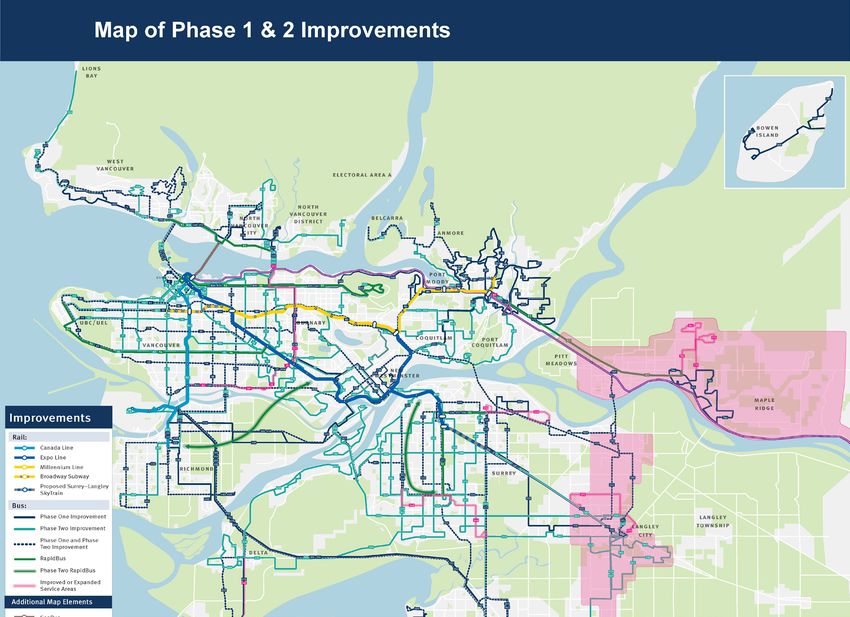
     •    Completing the new Surrey-Langley SkyTrain extension all the way to Langley
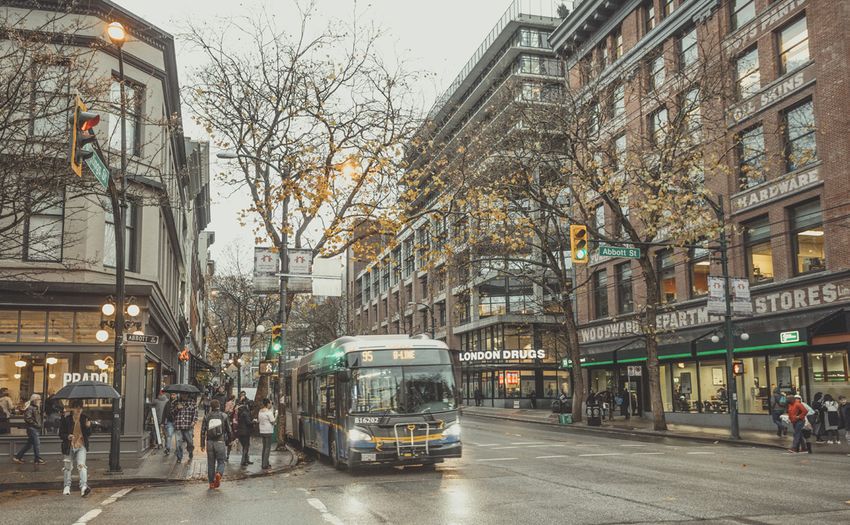
     •    Increasing bus and HandyDART service in every corner of the region
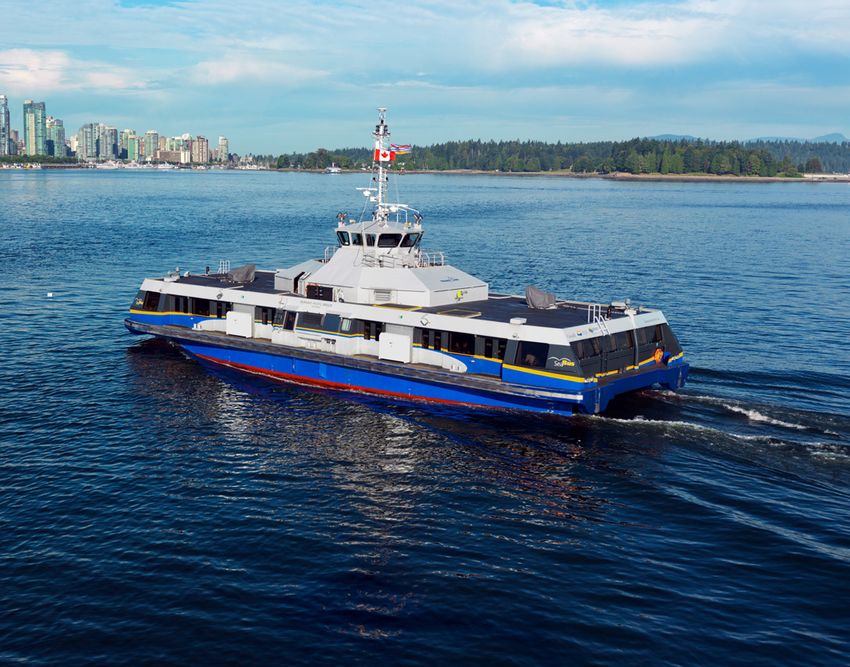
     •    Upgrading SkyTrain by adding more rail cars, increasing frequency and making station upgrades
          on the existing system
     •    Building 5 new high-capacity and high-frequency express bus routes in Pitt Meadows and Maple
          Ridge, Langley, White Rock, Surrey, North Vancouver, Burnaby and Vancouver
     •    Increased funding for regional cycling and walking networks
     •    Improving road conditions for drivers through continued upgrades to the Major Roads Network
     *See appendix for full 10-Year Vision dashboard

The Transport 2050 plan will identify projects and services beyond the 10-Year Vision that are needed to
respond to coming trends, challenges and priorities, potentially including higher capacity transit in areas
currently underserved by rapid transit.

Submission to the Government of Canada | February 2020                                                        4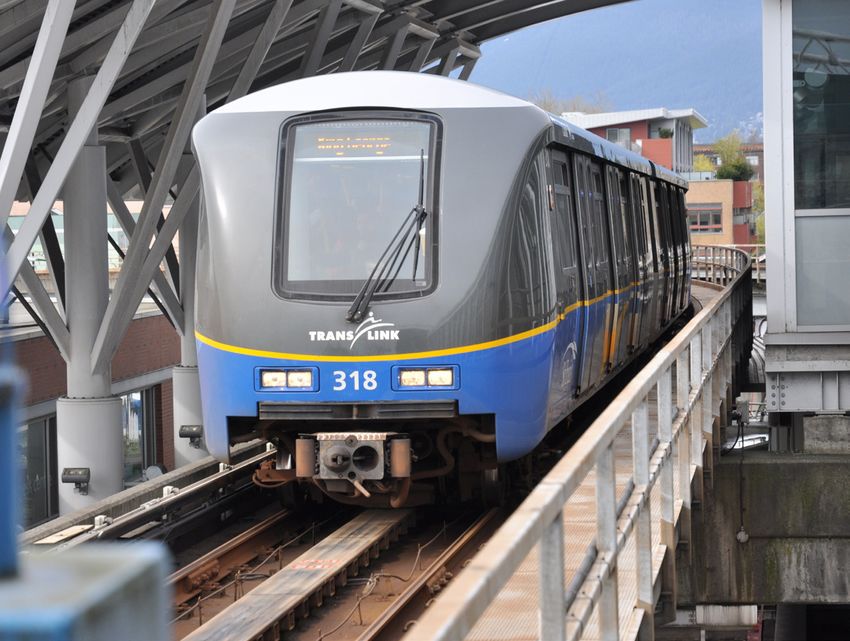
BY 2021, THE MAYORS’ COUNCIL’S 10-YEAR VISION WILL
  HAVE ADDED THE EQUIVALENT OF ALL OF VICTORIA’S BUS
             SERVICE TO METRO VANCOUVER

Submission to the Government of Canada | February 2020   5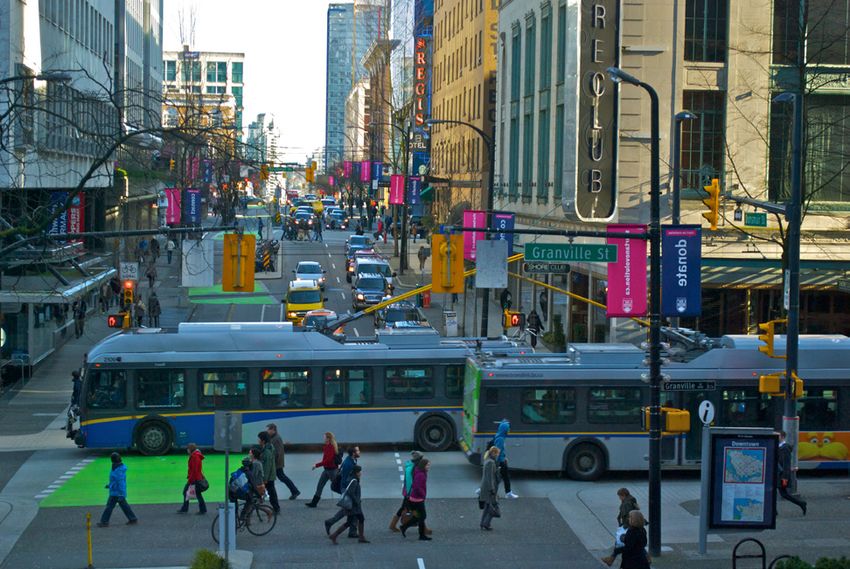
RESPONDING TO GROWING DEMAND

Metro Vancouver’s population is forecast to grow by            5.7%VANCOUVER

one million people over the next 20 years. This growth           2.3%MONTREAL

will put pressure on our transportation infrastruc-                               TORONTO 0.2%

                                                                                  EDMONTON 0.7%
ture, adding to the problem of road congestion and
overcrowding on transit that is already frustrating                3.0% SEATTLE

                                                                                  NEW YORK 1.1%
residents and businesses across the region. Over the
                                                                                  SAN FRANCISCO 1.3%
past three years, Metro Vancouver transit ridership in-
                                                                                  PORTLAND 1.8%
creased by 20% – well beyond any other transit system
                                                                                  CHICAGO 3.2%
in North America. At the same time, through integrat-
                                                                                  WASHINGTON DC 3.4%
ed land-use and transportation planning, a provincial
                                                                                  LOS ANGELES 5.4%
carbon tax and a regional fuel tax to support transit,
                                                                                  MIAMI 8.7%
and continuous transit service improvements, we are
supporting and incenting residents to make a modal            TRANSIT RIDERSHIP CHANGE 2016-2017
shift to public transit and active transportation for the
benefit of our environment, our health and our local
economy. Moving forward with the completion of the
10-Year Vision, without delay, is critical for our region’s
future.

Submission to the Government of Canada | February 2020                                                 6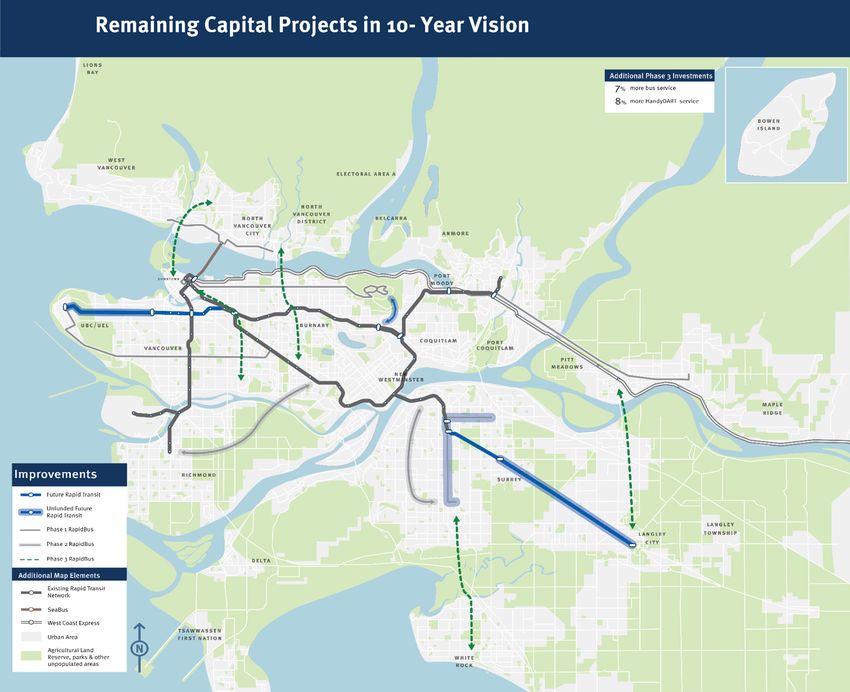
•    PROTECTING OUR ENVIRONMENT – We owe it to future generations to invest in sustainable
          transportation today and into the future. Public transportation is a critical element of Metro Van-
          couver’s overall plans to address climate change and we need to move forward now to support our
          overall reduction efforts. In regional plans going back to the early 1990s, right up to the current
          10-Year Vision, regional leaders have committed to developing comprehensive road pricing to re-
          duce congestion and road usage and to support transit investments. Only road pricing is capable
          of delivering meaningful reductions in per capita vehicle kilometers travelled and energy use from
          transportation. However, an essential precursor to moving to pricing road usage is ensuring that
          the transit network can provide a real alternative mobility option. The road to lower energy use
          from sustainable transportation starts with better transit.

     •    SUPPORTING A GROWING ECONOMY – As Canada’s primary Asia-Pacific gateway, the ability
          to efficiently and effectively move both people and goods across the Metro Vancouver region is not
          just positive for commuters – it also supports and benefits both the local and Canadian economies.
          Investments in public transit are critical to support a strong workforce in our region. Public transit
          helps connect people to better jobs and makes it easier for businesses to stay in the region. According
          to the Greater Vancouver Board of Trade, congestion costs the Metro Vancouver economy more than
          $1.4 billion annually, slows the movement of goods into and out of Canada’s largest port, and makes
          it more difficult for businesses to recruit and retain the workers they need to compete globally.

Submission to the Government of Canada | February 2020                                                         7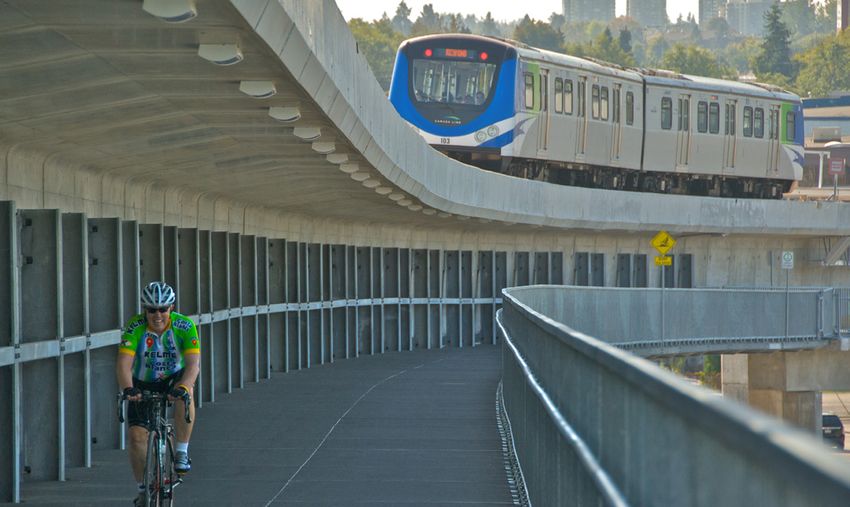
•    IMPROVING AFFORDABILITY – Transportation
          is a key consideration in planning for affordable
          housing across the region. Metro Vancouver is
          getting it right when it comes to planning for land
          use and transportation in tandem, so we can im-
          prove affordability and quality of life. Public tran-
          sit is a critical resource for low income households,
          seniors as well as new immigrants and refugees
          making the transition to life in Canada.

     •    CONNECTING CENTRES OF INNOVATION – Continuing to diversify the economy and improve
          lagging productivity relies on a commitment to innovative and advanced education. Some of the
          region’s most congested bus routes are those connecting with major post-secondary institutions.
          Expanding bus service and investing in alternative modes of transportation will help connect these
          centres of innovation that help drive our economy.

Submission to the Government of Canada | February 2020                                                    8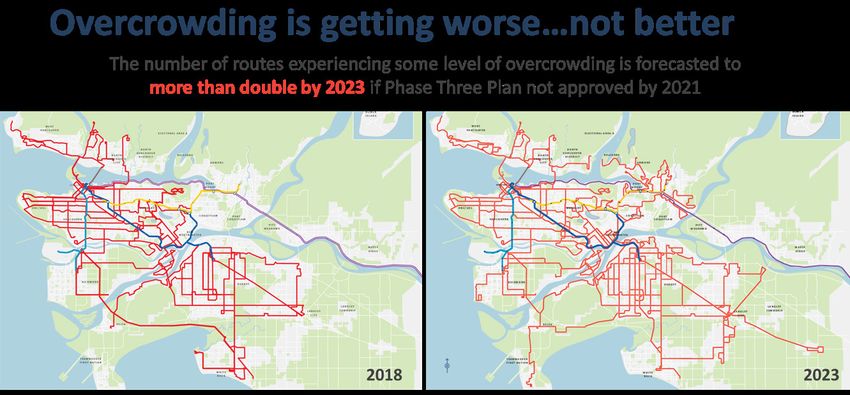
PUTTING INFRASTRUCTURE DOLLARS TO WORK

The Metro Vancouver region’s readiness to move forward with building the next phase of planned transit
infrastructure makes us unique compared with Canada’s other urban centres. We have a regional consen-
sus among 23 communities on long-term integrated land use and transportation planning. We also have a
supportive provincial government, with the Province of B.C. already committed to a 40% capital funding
share for all remaining projects in the 10-Year Vision.

                                                          A smart planning environment, supportive
                                                          provincial government and strong demand
                                                          create ideal conditions for the Government of
                                                          Canada to make an immediate commitment
                                                          to help us accelerate completion of the
                                                          final phase of the 10-Year Vision. This will
                                                          incentivize more sustainable transportation
                                                          choices and avoid falling behind ridership
                                                          growth.

Of the $2.4 billion in federal funding provided to
Metro Vancouver from PTIF and ICIP since 2016,
92% has been allocated to specific projects, with al-
most all either already in service, in procurement
or under construction. Most other cities in Canada
lag far behind this metric. This region’s exploding
ridership growth is driving high public support
for continued investment, regional unity behind
integrated transportation and land-use planning
priorities, strong support from the provincial gov-
ernment. Metro Vancouver also has a track record
of on-time and on-budget project delivery. This national leadership in ridership growth, transportation
planning, provincial support and project management puts Metro Vancouver in a unique position in Cana-
da and offers the Federal Government an opportunity to adapt its funding programs to support and incen-
tivize good practices.

Submission to the Government of Canada | February 2020                                               9
CONTINUING A SUCCESSFUL PARTNERSHIP

The Mayors’ Council is asking the Federal Government
to renew its partnership with B.C. and regional leaders to
quickly allocate funding to expedite completion of the 10-
Year Vision and maintain the momentum on nation-lead-
ing transit expansion and ridership growth.

Of this region’s original federal transit funding of $2.4 billion provided in 2017 and 2018, all but $196 million
currently available to Metro Vancouver has been allocated to specific projects that are in procurement or
will be in procurement shortly or are in service. This means that the remainder of our 10-Year Vision proj-
ects – including extending Skytrain to Langley, building the Burnaby Mountain gondola, and additional
rapid bus lines – are without a federal cost-sharing contribution.

By spring 2021, Metro Vancouver will need to approve the next phase of the 10-Year Vision in order to stay
on its long-term transit planning trajectory and avoid gaps in service expansion which could compromise
the region’s ability to sustain its modal shift towards active and sustainable transportation options. The
Province of B.C. has made a commitment to a 40% capital cost share of these projects, and the region is de-
veloping its own funding strategy for its share of capital and 100% of operating expenses. TransLink relies
on the most diverse set of revenue tools out of any Canadian transit agency to fund transit service and
expansion, including dedicated fuel and parking taxes, a hydro levy, development levies, property taxes and
North America’s third highest farebox cost recovery.

                                      Translink Regional Revenue Sources, 2018

Submission to the Government of Canada | February 2020                                                        10
RECOMMENDATION 1: PERMANENT TRANSIT FUND The Mayors’ Council supports the Federation of Canadian Municipalities in calling for a permanent federal funding allocation that would deliver $34 billion for the 10-year plan (2028-29 to 2037-38) with $30 billion in allocation-based funding and at least $4 billion for the complimentary merit-based stream, with consistent funding of $3.4 billion each year during the 10-year period. Although a Permanent Transit Fund (PTF) in 2027 may seem a long way off, because TransLink secures funding for transit expansion plans 10 years into the future, a properly designed PTF that provides revenue certainty to TransLink now will allow the agency to “bank” on future PTF revenues and commit to future projects now rather than waiting until 2027. A “bankable” PTF requires a federal funding program enshrined and protected in legislation and with signed long-term federal-provincial agreements, similar to how the permanent Gas Tax Fund was set up starting in 2012. RECOMMENDATION 2: TRANSITION FUNDING TO COMPLETE PHASE THREE OF THE 10-YEAR VISION Submission to the Government of Canada | February 2020 11
A future Permanent Transit Fund will provide critical funding for projects beginning in the last half of the
2020s. In the interim, all but $196 million of the federal transit funding currently available to Metro Van-
couver from ICIP is already allocated to specific projects, leaving these upcoming 10-Year Vision projects
without a federal cost-sharing contribution:

   CAPITAL PROJECTS                                       EST. TOTAL CAPITAL
                                                                                          FEDERAL                 FEDERAL
                                                                                       CONTRIBUTION            CONTRIBUTION
   REMAINING IN THE                                              COST                (Budget 2020/21 -            (Budget
   10-YEAR VISION                                                                        2021/22)                2023/24)

   Complete the Surrey-Langley
  Skytrain project from Fleetwood                                 $1.63B                   $330M*
             to Langley

 Accelerate conversion of bus fleet
 to emissions-free battery electric                              $450M                      $225M
        technology by 2040

     5 New Rapid Bus Corridors                                   $150M                      $50M

     Burnaby Mountain Gondola                                    $200M                      $90M

  SkyTrain, SeaBus, Bus and West
  Coast Express modernization &                                   $1.05B                    $215M                   $125M
     capacity improvements

 Rapid Transit to connect Newton
   and Guildford to Surrey City                                  $450M                                              $150M
              Centre

       * All except $196M of Metro Vancouver’s ICIP allocation has already been directed to specific projects, all of which is
       either in procurement or will be in procurement by mid-2020. The $196M in remaining funds will be allocated to this
       upcoming project alongside a proposed additional federal investment of $330M to complete the federal share of 40%
       of eligible project costs.

To stay on track, in Budget 2020/21 or 2021/22, federal transition funding of $685 million is required to sup-
port the next phase of our transit expansion starting in early 2023, and $225 million is required to acceler-
ate conversion of TransLink’s bus fleet to emissions-free battery electric technology with procurement to
begin by 2021.

The Mayors’ Council on Regional Transportation urges the Government of Canada to work in partnership
with the Metro Vancouver region to identify transition funding that will help bridge the gap ahead of the
implementation of a Permanent Transit Fund – so we can complete Phase Three of the 10-Year Vision.

Submission to the Government of Canada | February 2020                                                                           12
RECOMMENDATION 3: CONVERSION OF TRANSIT FLEETS TO BATTERY ELECTRIC BUSES In his recent mandate letter to the Minister of Infrastructure and Communities, Prime Minister Justin Trudeau called upon the Minister to “ensure that new federal investments in public transit are used to support zero-emission buses and rail systems starting in 2023 and work with municipalities to address any exceptional circumstances.” Over the next decade, TransLink has the opportunity to transition approximately 50 per cent of our bus fleet to clean, zero-emission, electric buses, with full conversion complete by 2040. If this opportunity is missed, internal combustion engines must instead be procured, making any meaningful GHG reductions from TransLink operations over the next two decades challenging. This includes procuring 591 e-buses by 2029, including our existing trolley-electric fleet and four e-buses. The benefits include zero tailpipe emis- sions and more than a 40 per cent GHG reduction from the fleet by 2030. This trajectory will allow us to reach a 2050 target of 80% GHG reduction and 100% renewable energy. Submission to the Government of Canada | February 2020 13
TransLink does not have a funding source for the transition to
electrification and if we had to make this transition with our
current approved funding, we would be competing with transit
expansion to do so. In order to convert Metro Vancouver’s bus
fleet by 2040, TransLink requires $248 million for charging infra-
structure and $199 million for the purchase of battery-electric
buses. Support from the Government of Canada is critical.

       TransLink’s Low Carbon Fleet Strategy
       In October 2018, the Mayors’ Council and TransLink’s Board of Directors approved two environ-
       mental sustainability targets:

        •    An 80 per cent reduction of greenhouse gas (GHG) emissions by 2050; and
        •    Utilize 100 per cent renewable energy in all operations by 2050.

       Beginning in 2023, TransLink will start to replace retiring diesel and CNG 40-ft and 60-ft transit
       buses with battery-electric buses. Between 2023 and 2030, TransLink may elect to replace some
       retiring buses with new hybrid-electric buses, but after 2030 all retiring buses will be replaced
       with battery buses to achieve complete electrification of the fleet by 2050.

       For TransLink to achieve its targets, electrification of the fleet will be capital intensive and will
       require leveraging capital contributions from senior government sources, such as the federal
       Green Infrastructure Fund.

Lower Emissions and Cleaner Air
Even the most cautious implementation plan by TransLink on its fleet transition will see an estimated 19
per cent GHG reduction from baseline numbers by 2029 – representing 56,000-tonnes of greenhouse gases.
By 2050, fleet transition would achieve an 80 percent reduction in GHG emissions.

The transition to electric buses also provides human health benefits by eliminating particulate matter and
nitrogen oxides – common urban air pollutants. Compared to diesel-hybrid buses, battery electric buses
are expected to reduce annual nitrogen oxide (NOx) by 26,000 g per bus and particulate matter (PM) by
3,500 g per bus.

Submission to the Government of Canada | February 2020                                                         14
The Mayors’ Council is composed of representatives from each of the 21 municipalities within the
transportation service region, as well as Electoral Area ‘A’ and the Tsawwassen First Nation, and
collectively represents the viewpoints and interests of the citizens of the region.
Chair - Jonathan Cote Vice Chair - Jack Froese Gary Ander Ken Baird
Mayor of the City of Mayor of the Township Mayor of the Bowen Chief of the Tsawwassen
New Westminster of Langley Island Municipality First Nation
Neil Belenkie Mary-Ann Booth Malcolm Brodie Linda Buchanan
Mayor of the Village Mayor of the District of Mayor of the City of Mayor of the City of
of Belcarra West Vancouver Richmond North Vancouver
Bill Dingwall George Harvie Mike Hurley Mike Little
Mayor of the City Mayor of the City of Mayor of the City of Mayor of the District of
of Pitt Meadows Delta Burnaby North Vancouver
Doug McCallum Jen McCutcheon John McEwan Ron McLaughlin
Mayor of the City Director of Electoral Mayor of the Village of Mayor of the Village
of Surrey Area A Anmore of Lions Bay
Mike Morden Kennedy Stewart Richard Stewart Rob Vagramov
Mayor of the City of Mayor of the City of Mayor of the City of Mayor of the City of
Maple Ridge Vancouver Coquitlam Port Moody
Val van den Broek Darryl Walker Brad West
Mayor of the City of Mayor of the City of Mayor of the City of
Langley White Rock Port Coquitlam
15APPENDIX
16You can also read


