RESIDENCY SURVIVAL GUIDE - Canadian Association of General Surgeons Residents Committee - 2019-2020 Edition - Canadian Association of ...
←
→
Page content transcription
If your browser does not render page correctly, please read the page content below
Canadian Association of General
Surgeons Residents Committee

RESIDENCY
 SURVIVAL
  GUIDE
      2019-2020 Edition
Table of Contents CAGS AND THE RESIDENT COMMITTEE 3 TEXTBOOKS 4 STANDARD SURGICAL TEXTBOOKS: THE LEGENDS 4 OTHER HELPFUL GENERAL REFERENCES 5 ATLASES, BOOKS ON SURGICAL TECHNIQUE 6 POCKET REFERENCES 7 NATIONAL EXAMS 9 LMCC II 9 SURGICAL FOUNDATIONS 9 ROYAL COLLEGE EXAM 9 CAGS EXAM 10 RESEARCH FUNDING 11 NATIONAL AND INTERNATIONAL FUNDING SOURCES 11 SURGICAL SOCIETY SOURCES 12 ROYAL COLLEGE GRANTS 13 PROVINCIAL GRANTING SOURCES 13 ONLINE RESOURCES FOR GRANTS AND PROPOSAL WRITING 13 ONLINE FUNDING RESOURCES 13 CONFERENCES 15 ELECTIVES 16 FELLOWSHIPS 21 PER SUBSPECIALTY 22 PER UNIVERSITY 23 FINDING A JOB 27 MILESTONES IN GENERAL SURGERY RESIDENCY 29 INTERNATIONAL SURGERY 31 PROFESSIONAL RESOURCES AND RESIDENT ASSOCIATIONS 33
CAGS AND THE RESIDENT COMMITTEE

Welcome to General Surgery!

The Canadian Association of General Surgeons Residents Committee developed
this handbook for you, a General Surgery resident. We are comprised of twenty-
one residents representing all of the General Surgery programs across the
country.

And, welcome to CAGS!

Check out the resident’s Facebook page at “CAGS Residents” for interesting
articles and information related to General Surgery. Be sure to like our page!
Follow CAGS Residents via our Twitter account (“CAGS_Residents”) as well!

Residents Committee Members:
Co-Chair: Wanda Marini, University of Toronto (wanda.marini@mail.utoronto.ca)
Co-Chair: Laura Baker, University of Ottawa, (laurbaker@toh.on.ca)

Program Representatives:
Caroline Huynh, University of British Columbia, (caroline.huynh@alumni.ubc.ca)
Tamara Gimon, University of Calgary, (tamara.gimon@mail.utoronto.ca)
Warren Sun, University of Alberta (warrensun@ualberta.ca)
Katlin Mallette, University of Saskatchewan, (kim749@usask.ca)
Marta Zmudzinski, University of Manitoba, (marta.zmudzinski@alumni.ubc.ca)
Jordan Crosina, Northern Ontario School of Medicine, (jcrosina@nosm.ca)
Tanya Kuper, University of Western Ontario, (kuper.tanya@gmail.com)
Emily Hodgson, McMaster University, (emily.hodgson@medportal.ca)
Dhurvin Hirpara, University of Toronto, (dhurvinh@gmail.com)
Julie La, Queen's University, (13jl67@queensu.ca)
Nadia Khan, University of Ottawa, (Nadkhan@toh.ca)
Mélina Deban, Université de Montréal, (melina.deban@umontreal.ca)
Xavier Paré, Université Laval, (xavier.pare.2@ulaval.ca)
Chadey Assane, Université de Sherbrooke, (chadey.assane@usherbrooke.ca)
Juan Mata, McGill University, (juan.matagutierrez@mail.mcgill.ca)
Shawn Brophy, Dalhousie University, (shawn.brophy@dal.ca)
Carrie Howard, Memorial University, (carrielhoward@gmail.com)
TEXTBOOKS

Before we begin the details, our general consensus on textbooks:

MUST HAVE ONE OF
       • Schwartz
       • Sabiston
       • Greenfield’s
       • American College of Surgeons

ONE SURGICAL ATLAS

CAMERON (consider after Principles of Surgery)

Senior level: access to “Surgical Clinics of North America” through CMA website

Standard surgical textbooks: The Legends

All available online for free at http://www.cma.ca. These books are generally
equivalent, so pick one to start your adventure in General Surgery Reading. We
suggest you borrow them from the library or peruse online before you buy.

   Principles of Surgery: Schwartz
   • Advantages: General guide on all general surgical issues. Anatomy,
       embryology, pathophysiology.
   • Disadvantages: Not an atlas or surgical technique book. Too detailed at
       times, difficult to recall all material read in one sitting.
   • Use for: Outlining presentations, POS, a starting point for junior residents,
       general overview of all topics.

   Sabistons
   • Advantages: General guide on all general surgical issues. Includes
      anatomy, embryology, pathophysiology. Some of us think it is the most
      useful of the three in preparing for oral exams and attending’s quizzes as
      opposed to Greenfield’s being better for preparing for written exams.
   • Disadvantages: Not an atlas or surgical technique book. Too detailed at
      times, difficult to recall all material read in one sitting.
• Use for: Outlining presentations, POS, acts as starting point for junior
residents, general overview of all topics.
Greenfield
• Advantages: Some find it easier to read and remember chapter details.
• Disadvantages: Again, no specific operative details.
• Use for: Overview for junior and senior residents, good review book.
ACS Surgery. (American College of Surgeons)
• Advantages: Available online, updated yearly, free with your ACS or CMA
membership, review questions and end of every chapter.
Cameron: Current Surgical Therapy
• Advantages: Clinically relevant, contains algorithms, good preparation for
senior years post POS. Provides a very focused and manageable overview
of specific subtopics.
• Disadvantages: Minimal anatomical information, minimal
pathophysiology, difficult for junior residents due to lack of background
knowledge. Different authors for each edition therefore little continuity
between editions.
Other helpful general references
Lange: Current Diagnosis and Treatment - Surgery
• Advantages: Brief, concise, portable, introduction to a topic, information
on other surgical specialties.
• Disadvantages: Not enough detail. Not appropriate for advanced levels.
• Use for: Junior residents, medical students, on call issues.
Rush Review of Surgery
• Advantages: Pure question and answer format. Mostly only useful for
self-assessment as there is only brief explanation of answers. Very helpful
to check knowledge of concepts and identify weak areas.
ABSITE Review
• Advantages: Good reference for POS, portable, easy to read, additional
subspecialty information.
• Disadvantages: Too general for senior years, no surgical techniques.Operative Dictations in General and Vascular surgery
• Advantages: Helpful for learning to dictate. Great script/starting point.
Top Knife
• Well-loved book on emergency general surgery. Easy to read style, fun
for all ages. Great tips for surgeons interested in trauma.
Cope’s Early Diagnosis of the Acute Abdomen
• Advantages: reasoned approach to physical exam. A classic. Latest
edition is 2010.
• Disadvantages: Not a good quick reference, this is more a cover-to-cover
read.
Chassin’s Operative Strategy in General Surgery: An expositive atlas
• Advantages: Excellent approach to most general surgical operations in a
concise and practical format. Nice figures and well written. Good
description of the steps of an operation, useful for preparing for oral
exams.
• Disadvantages: May not be the most up to date textbook regarding
surgical decision-making.
Shackelford, Surgery of the Alimentary Tract
• Advantages: Complete review of pathologies of the GI tract. Used by
some programs as THE review book for PGY-5. Especially good for
pancreaticobiliary tract. Outstanding figures.
• Disadvantages: Does not cover non-GI general surgery.
Acute Care Surgery: Principles and Practices
• Advantages: Good for residents interested in acute care
surgery/trauma/ICU. Head-to-toe approach to surgical emergencies.
• Disadvantages: NOT a review book.
Atlases, Books on Surgical Technique
Skandalakis: Surgical Anatomy and Technique: A pocket manual
• Advantages: Quick reference for surgical anatomy and technique if you
have not reviewed the operation beforehand. Good to keep in locker.• Disadvantages: Not very detailed, no thorough anatomy, all pictures in
black and white.
• Use for: Reviewing operation and techniques pre-op.
Zollinger: Atlas of surgical operations
• Advantages: Lots of pictures, the classic atlas.
• Disadvantages: Minimal written detail, cumbersome and not portable.
Mastery of surgery
• Advantages: Covers a lot of laparoscopic and open surgery, information
on pre-operative and post-operative care, thorough review of anatomy,
excellent colour pictures. Available online.
• Disadvantages: Not a quick reference, not always up to date.
• Use for: Learning operations.
Operative anatomy: Scott-Connor, Dawson
• Advantages: Focuses in on important anatomy for surgical procedure,
good written details on how to perform operation.
• Disadvantages: Could use more pictures, not a lot of information on pre
and post-operative management and complications.
• Use for: Learning operations
Maingot’s Abdominal operations, Volume I and II
• Advantages: Good mix of text and atlas. Great technical details. Clear
illustrations and good literature review. Benefits both senior resident and
general surgeon.
• Disadvantages: Not portable (except newest edition)
Atlas of Laparoscopic Surgery
• Advantages: Atlas of laparoscopic procedures, both basic and advanced.
Includes commentaries and illustrations.
Pocket references
The Mont Reid Surgical Handbook
Good for R1 and preparing right before a case or consult, point form and brief.
On Call: Principles and Protocols, and On Call: SurgeryExcellent reference for ward management, junior resident level. MD Anderson Concise review on all cancers, including epidemiology, diagnostic tests and treatment algorithms. Good references. Only draw-back: very specific to MD Anderson protocols. University of Toronto Surgical Oncology Manual A concise and practical guide to nearly all cancers general surgeons have to deal with.
NATIONAL EXAMS

LMCC II

The clinical version of the LMCC I. Mandatory for all Canadian residents. Price:
$2470 (if on time). Deadlines: January 30 for the Spring exam; June 30 for the
Fall exam.

http://mcc.ca/examinations/mccqe-part-ii/

Preparation suggestions: old case scenarios and Toronto Notes. There seems to
be a lot of repetition from old exams.

Surgical Foundations

All surgical residents must complete. Usually it’s done in second year, but can
be delayed if necessary. Yearly sitting in April. You must apply for assessment of
training (Deadline: April 30 for the following Spring exam; Price: $645 (if on
time). They then email you the following November with another registration
form and ask for fees for the exam (Deadline: February 1 for upcoming April
exam; Price: $780).

http://www.royalcollege.ca/rc/faces/oracle/webcenter/portalapp/pages/viewDo
cument.jspx?document_id=TZTEST3RCPSCED002007&_afrLoop=27368252662
282266&_afrWindowMode=0&_afrWindowId=null#!%40%40%3F_afrWindowId
%3Dnull%26document_id%3DTZTEST3RCPSCED002007%26_afrLoop%3D2736
8252662282266%26_afrWindowMode%3D0%26_adf.ctrl-
state%3D14p89guh1n_13

Preparation suggestions: form a group and practice together. Practice Questions
are very useful, and widely available from upper year residents; read around
them to find the answers. See textbook section for suggested reading. There is
often repetition noted from previous exams.

Royal College Exam
Written early May in various centres; oral component mid-June in Ottawa.
Deadlines: Apply for assessment of training the year before (deadline end of
April for the next year’s exams; Price: $630) AND THEN Registration Form
(deadline: Feb 1 of year of exam; Price: $3400)

http://www.royalcollege.ca/portal/page/portal/rc/common/documents/credenti
als/canadian_residency_training_application_e.pdf

Preparation: form a study group and meet regularly. Divide up material into
subjects and pick appropriate readings. Go through subjects one at a time (eg:
liver, breast, colorectal, etc.). NO CRAM STUDYING! Participate in mock orals
and start as early as second year.

CAGS Exam

This is a national exam taken by all residents in General Surgery, in every year of
residency training, usually sometime in February. It is a multiple-choice exam.
Purposes include preparation for the final Royal College exam and measuring
progress in training – marks may be compared across your own years, and within
your year’s cohort.
RESEARCH FUNDING
To obtain dedicated research time it is important to figure out who will pay your
salary. As soon, as you leave your regular residency for more than 6 months
most provinces will consider that you are no longer providing a service that is
worth being remunerated.

Many programs in Canada have internal funds to allow residents to pursue
dedicated research. However, these funds can be limited. It is therefore
important to apply for external funding. If you manage to get external funds,
you will not only be able to pay for lunch, but you will also benefit from the
prestige of peer-reviewed funding. It is a great way to validate the importance of
your project and begin building your academic capital.

It will be worthwhile to discuss research with a research chair in your program.
Some programs have a Surgeon Scientist Program, which may fund you as a
resident to complete a M.Sc. or Ph.D. This is tied in with the accredited Royal
College of Physicians and Surgeons Clinician Investigator Program at some
schools. Find out if this program exists where you are. See
http://www.royalcollege.ca/rcsite/education-strategy-accreditation/innovations-
development/initiatives/clinician-scientist-e.

Below are a few key sources of external funding. Keep in mind that there may be
other specialty specific funding agencies not listed. Make sure to ask your
supervisor about all possible funding opportunities and apply to as many as you
can. The process of applying for these types of grants will help you understand
your project better and will help you perfect your writing skills.

National and international funding sources

Canadian Institute of Health Research (CIHR)
     - Masters and doctoral awards. Application deadline changes annually
     - Fellowship award. Application deadline changes annually

Candidates must choose one or the other. Those with a strong research
background and/or previous graduate work may be competitive for the
Fellowship award. Those with little or no research experience are probably best
suited to the Master’s award.
https://www.researchnet-
recherchenet.ca/rnr16/search.do?fodAgency=CIHR&fodLanguage=E&view=curr
entOpps
Surgical society sources
Canadian Association of General Surgeons
- Canadian Surgical Research Fund
- http://www.cags-accg.ca/index.php?page=113
o Value = $10,000 x 1 year
o Application deadline: June/July each year
American College of Surgeons
- Resident Research Scholarships. (2 year scholarship)
- http://www.facs.org/memberservices/research.html
Association of Academic Surgeons
- Research Fellowship Award
- https://www.aasurg.org/awards/
Society of University Surgeons
- SUS Surgical Research Fellowship Award.
- http://www.susweb.org/sus-resident-scholar-award
Society of Gastrointestinal and Endoscopic Surgeons
- SAGES research grant
- http://www.sages.org/projects/research-grants/
- http://www.sages.org/projects/research-grants/grant-begin/
o Value = up to $30,000 x 1 year
o Application deadline November each year
Canadian Society of Colon and Rectal Surgeons
- Canadian Society of Colon and Rectal Surgeons Operating Grant
- http://cscrs.ca/research/
o Value = $10,000 x 1 year
o Application deadline: June each yearRoyal College Grants
Canadian Royal College
- Medical Education Research Grant
- http://www.royalcollege.ca/rcsite/awards-grants-e
o Value = $50,000 over a maximum of 3 years, maximum of
$25,000/year
o Up to $10,000 in salary support
o Application deadline: March each year
Provincial granting sources
There are many provincial grants available, however for the most accurate and
timely information you may wish to seek out your Research/Program Director.
Online Resources for Grants and Proposal Writing
CIHR IG: Guidebook for New Principal Investigators:
http://www.cihr-irsc.gc.ca/e/27491.html
NIH Grant Writing Tip Sheets
http://grants.nih.gov/grants/grant_tips.htm
How to Write a Good Proposal
http://fhs.mcmaster.ca/healthresearch/guide_grantsmanship.html
Grant Writing Resources
http://www.schulich.uwo.ca/research/services/grant_writing_resources.html
Online Funding Resources
Royal College of Physicians and Surgeons of Canada Awards and Grants
http://www.royalcollege.ca/rcsite/awards-grants-e
Community of Sciencehttp://www.cos.com/ Physicians' Services Inc Foundation, Resident Research Program http://www.psifoundation.org/ForApplicants/ResidentResearchGrants.php Canadian Surgical Research Fund http://www.cags-accg.ca/index.php?page=112 Canadian Society for Clinical Investigation http://www.csci-scrc.ca American Society of Colon and Rectal Surgeons https://www.fascrs.org/educational-grants-and-awards American College of Surgeons Resident Research Scholarships http://www.facs.org/memberservices/acsresident.html NSERC http://www.nserc-crsng.gc.ca/Media-Media/Index_eng.asp
CONFERENCES

Conferences are a great opportunity to present research, gather information on
the latest and greatest technology and guidelines, and of course meet up with
friends from medical school and foster relationships with surgical colleagues
across Canada and internationally. Here are a variety of conferences to check
out for 2020:

CAGS: Canadian Surgical Forum (September 24-26, 2020, Vancouver)
CATS: Candian Association of Thoracic Surgeons (September 24-26, 2020,
Vancouver)
CAPS: Canadian Association of Paediatric Surgeons (September 10-12, 2020,
Winnipeg, September 23-25, 2021, St. John’s)
ACS: American College of Surgeons (October 24-28, 2020, Washington,
October 16-20, 2021, San Diego)
APSA: American Pediatric Surgery Association (May 14-17, 2020, Orlando, May
20-23, 2021, Phoenix)
Critical Care Canada forum (October 4-7, 2020, Toronto, December 5-8, 2021,
Toronto)
Trauma, Critical Care & Acute Care Surgery (April 5-8, 2020, Las Vegas, April 11-
14, 2021, Las Vegas)
SAGES: Society of Gastrointestinal and Endoscopic Surgeons (April 1-4, 2020,
Cleveland, OH, April 7-10, 2021, Las Vegas)
AHPBA: Americas Hepatico-Pancreatico-Biliary Association (March 4-8, 2020,
Miami, March 17-21, 2021, Miami)
ASCRS: American Society of Colon & Rectal Surgeons (June 6-10, 2020, Boston,
April 24-28, 2021, San Diego)
STS: Society of Thoracic Surgeons (January 25-28, 2020, New Orleans, January
30-February 2nd, 2021, Austin)
AATS: American Association for Thoracic Surgery (April 25-28, 2020, New York,
May 1-4, 2021, Seattle)
SSO: Society Surgical Oncology (March 25-28, 2020, Boston)
AAES: American Association Endocrine Surgeons (May 6-8, 2018, Durham, April
4-6, 2020, Birmingham)
ELECTIVES

Electives are great opportunities for meeting people for potential fellowships as
well as jobs in the future. Most of us have been told that you should probably
have an idea of whether or not you might want to pursue a fellowship by the
beginning of your fourth year.

University of British Columbia
      - Co-Program Directors: Dr. Tracy Scott, tscott@providencehealth.bc.ca,
           Dr. Ahmer Karimuddin, akarimuddin@providencehealth.bc.ca
      - Division Chief Dr. Morad Hameed, morad.hameed@vch.ca
      - Post-graduate program manager Luiza Shamkulova
      - Email: luiza.shamkulova@ubc.ca Phone: 604.875.4111 ext. 23105
      - Fellowships offered: Trauma/ACS, MIS, HPB, Thoracics, Colorectal
           surgery, Surgical oncology & Pediatric surgery

University of Alberta
      - All electives have to go through the PGME office. Check out their
           policies at
           http://www.med.ualberta.ca/programs/residency/postgraduateprogra
           ms/incoming
      - Fellowships offered: ACS, MIS/Bariatrics, HPB. Find contacts at
           http://www.generalsurgery.med.ualberta.ca/ed-for-fel.html

University of Calgary
      - Program Administrator: Erin Layton
      - Email: gsresidencyprogram@albertahealthservices.ca
      - Fellowships offered: Endocrine Surgery (PD: Dr. Janice Pasieka,
           Janice.Pasieka@albertahealthservices.ca), Surgical Oncology (PD: Dr.
           Greg McKinnon, mckinnon@ucalgary.ca), Hepatobiliary (PD: Dr. Chad
           Ball, ball.chad@gamil.com), Colorectal (PD: Dr. Don Buie,
           wdbuie@ucalgary.ca), Trauma (PD: Dr. Rohan Lall,
           Rohan.Lall@albertahealthservices.ca), Upper GI surgery (PD: Dr. Neal
           Church, Neal.Church@albertahealthservices.ca), Vascular (PD: Dr. Paul
           Petrasek, Paul.Petrasek@albertahealthservices.ca), Thoracics (PD: Dr.
           Sean Grondin, Sean.Grondin@albertahealthservices.ca), Paediatric
           Surgery (PD: Dr. Steven Lopushinsky,
           Steven.Lopushinsky@albertahealthservices.ca)
University of Saskatchewan
- Program Director: Dr. Gavin Beck
- Administrator: Karen Bader
- Phone: (306) 844-1091
- Fax: (306) 844-1522
- Email: karen.bader@usask.ca
University of Manitoba
- Academic Administrator: Laura-Lee Bouchard -->
LBOUCHARD@hsc.mb.ca
- Telephone: 204-787-7581 (HSC Office) / 204-237-2096 (SBH Office)
- Fax: (204) 940 8970
- Fellowships offered: MIS (PD: Ben Yip, byip@sbgh.mb.ca), Vascular
Surgery (PD: Dr. Joshua Koulack, JKoulack@exchange.hsc.mb.ca),
Thoracics (PD: Dr. Gordon Buduhan, gbuduhan@gmail.com), Pediatric
Surgery (Contact Dr. BJ Hancock, BJHancock@exchange.hsc.mb.ca),
Colorectal Surgery (contact Dr. Ben Yip, byip@sbgh.mb.ca), ENT
oncology (PD: Dr. Alok Pathak, alok.pathak@cancercare.mb.ca)
Northern Ontario School of Medicine
- Contact Cyndy Smith program coordinator at cysmith@nosm.ca.
- Phone: (807) 766-7444
- She is able to direct residents to contacts at hospitals throughout
Northern Ontario.
University of Western Ontario
- Contact Christine Ward, Program Administrator
at Christine.ward@lhsc.on.ca
- Fellowships offered: Transplant/HPB (PD: Dr. Doug
Quan, douglas.quan@lhsc.on.ca), MIS (PD: Dr. Chris
Schlachta, Christopher.schlachta@lhsc.on.ca), Breast (PD: Dr.
Muriel Brackstone, murielbrackstone@lhsc.on.ca), Thoracics (PD: Dr.
Dalilah Fortin, dalilah.fortin@lhsc.on.ca)
McMaster University
- Program director: Dr. Michael Marcaccio
- Contact: Katie Niblock (program assistant)
- Phone: (905) 521-2100 x 73932
- Email: niblock@mcmaster.ca- Current electives offered: MIS (contact program assistant above)
- Fellowships offered: MIS
(http://www.cmas.ca/fellowships.aspx), Trauma (contact Dr. Edward
Passos at edward.passos@medportal.ca), Breast (contact Elyse Cornell
at cornele@mcmaster.ca)
University of Toronto
- Program director: Dr. Najma Ahmed (ahmedn@smh.ca)
- Administrative assistant: Stacy Palmer (palmers@smh.ca)
- Contact the PGME electives program at
http://electives.pgmeutoronto.ca/electives
- And PGME application instructions for electives, fellowships training,
observerships and residency at
http://www.pgme.utoronto.ca/content/applicants
- Fellowships offered: breast, colorectal, surgonc, HPB, MIS, peds,
transplant, trauma/ACS -
http://generalsurgery.utoronto.ca/edu/fellow.htm
Queen’s University
- Contact Nicole de Smidt (nicole.desmidt@kingstonhsc.ca)
- Fellowships: Critical Care Medicine (Contact Kim Telford, program
assistant, telfordk@kgh.kari.net, PD: Dr. David Messenger,
david.messenger@queensu.ca)
University of Ottawa
- Contact Isabel Menard (imenard@toh.ca)
- Fellowships offered: Colorectal (PD: Dr. Husein Moloo,
hmoloo@toh.on.ca), Pediatric Surgery (PD: Dr. Kyle COWAN,
kcowan@cheo.on,ca) , MIS/Bariatrics (PD: Nicole Kolozsvari
(nkolozsvari@toh.ca), Vascular (PD: Dr. Tim Brandys,
tbrandys@ottawahospital.on.ca), Thoracics (PD: Dr. Donna Maziak,
dmaziak@toh.on.ca), Critical Care (PD: Dr. Rakesh Patel,
rpatel@toh.on.ca), trauma (PD: Jacinthe Lampron (jlampron@toh.ca),
Breast (Erin Cordeiro, ecordeiro@toh.ca), Surgical Oncology (Carolyn
Nessim, cnessim@toh.ca)
McGill University
- Contact Rita Piccioni at rita.piccioni@muhc.mcgill.ca or Jessica at
generalsurgery.med@mcgill.ca- Fellowship information is available at
https://www.mcgill.ca/pgme/admissions/prospective-fellows
(under General Surgery)
- MIS, Bariatrics, HPB
Dalhousie University
- Contact: Crystal Marsman, administratrice de programme
- Email: crystal.marsman@nshealth.ca
- Phone: (902) 473-2810
- Fellowships in MIS/Advance Endoscopy/HPB and Transplant/Pediatric
General Surgery
- https://fellowshipcouncil.org/fellowship-programs/
Memorial University of Newfoundland
- Contact program administrators, Cheryl Perkins and Carol at
Surgical.Education@med.mun.ca
Laval University
- Program Director: Dr Mony Chhiv
- Phone : 418 656-2131, ext 408943
- Email : programmesdeptchirurgie@fmed.ulaval.ca
University of Sherbrooke
- Program director: Dr Émilie Comeau
- Administrator: Lise Gaudy.
- Email : chirurgieprogramme-fmss@usherbrooke.ca
- Phone : 819 346 1110 ext.12371
University of Montreal
- Program director: Dr Pierre Dubé
- Administrator: Yamina Bachi
- Phone: 514-252-3400, ext. 7267/5910
- Fax: 514-252-3894
- Fellowships offered: MIS/bariatrics (Sacré-Coeur Hospital),
HPB/transplant (CHUM), thoracics
(https://medpostdoc.umontreal.ca/programmes/chirurgie-
thoracique/), vascular
(https://medpostdoc.umontreal.ca/programmes/chirurgie-vasculaire/),
pediatric surgery(https://medpostdoc.umontreal.ca/programmes/chirurgie-
pediatrique/)
- Fellowship conditions: https://deptmed.umontreal.ca/wp-
content/uploads/sites/7/2011/08/demarches_statut_moniteur_clinique
.pdfFELLOWSHIPS General Surgery can be a stepping-stone to a variety of fellowship opportunities. There is more detailed information for residents about surgical fellowships in Canada on the Residents portion of the CAGS website (www.cags- accg.ca; look under residents and applying for fellowships.) Be sure to check the dates for application for these fellowships – often the process to apply is in fourth year or the year prior to your final year of residency. Fellowship Council offers fellowships in Advanced GI MIS, Advanced GI, Flexible Endoscopy, Bariatric, HPB and/or a non-ACGME Colorectal and Thoracic Surgery within Canada and United States. You apply in your PGY4 year to start fellowship after PGY5. Application opens mid December each year and its deadline is March/April following year. Interviews occur from April to May and the rank list must be submitted by end of May. Match results are available mid June. https://fellowshipcouncil.org Other fellowships include but are not limited to: Acute Care Emergency Surgery Bariatric Surgery Breast Surgery Colorectal Surgery Head and Neck Surgical Oncology Hepatopancreaticobiliary Transplant Minimally Invasive Surgery Pediatric Surgery Surgical Oncology Thoracic Surgery Trauma Surgery Vascular Surgery Intensive Care/Critical Care Here is some information re: applications to the programs as well as organizations associated with those subspecialties. This is not a complete list, but will hopefully provide you with more information.
Per Subspecialty

Thoracics
      - Apply to individual programs across the country (state where they are
          offered) although this may be changing soon.
      - CATS: Canadian Association of Thoracic Surgeons, AATS: American
          Association of Thoracic Surgeons (www.canadianthoracicsurgeons.ca;
          www.aats.org)

Vascular Surgery
      - Apply to individual programs, interviews should be in a similar time
          period and offers should all be made on May 15. Many programs do
          not adhere to these guidelines, though. In US, vascular program
          admission is through a match through the nrmp. (www.nrmp.org)
      - Of note, many programs are moving away from offering vascular
          surgery fellowships due to the introduction of direct entry programs
          into vascular surgery
      - CSVS: Canadian Society of Vascular Surgery, SVS: Society of Vascular
          Surgeons (US) (www.canadianvascular.ca; www.vascularweb.org)

Pediatric Surgery
      - Application is through a North American fellowship match
           administered through the NRMP (National Residency Matching
           Program) in the US (www.nrmp.org)
      - CAPS: Canadian Association of Paediatric Surgeons (www.caps.ca)

Surgical Oncology
      - Application is through a match through the Society of Surgical
          Oncology
      - SSO: Society of Surgical Oncology (www.surgonc.org)

Colorectal
      - Application is through nrmp in the US and application is to individual
          programs in Canada (www.nrmp.org)
      - ASCRS, CSCRS (www.fascrs.org; www.cscrs.ca)

Breast surgery
       - Apply through a match through the Society of Surgical Oncology
          (www.surgonc.org)
Transplant
- Apply through a match program through the American Society of
Transplant Surgeons (www.asts.org)
MIS/bariatrics
- Application is through a match through the Fellowship Council
(www.fellowshipcouncil.org)
- Match in 4th year of residency
- SAGES (Society of American Gastrointestinal and Endoscopic
Surgeons) (www.sages.org)
Hepatopancreaticobiliary
- Application is through the Fellowship Council
(www.fellowshipcouncil.org)
- AHPBA (Americas HepatoPancreato Biliary Association) and IHPBA
(International HPB Association) (www.ahpba.org and www.ihpba.org)
Trauma
- Application in Canada is through individual programs.
Critical Care
- Application is a match through CARMS (www.carms.ca)
Endocrine Surgery
- Application is a match through the American Association of Endocrine
Surgeons (www.endocrinesurgery.org)
Acute care surgery
- Application is to individual programs in Canada
Head and Neck
- Application is through a match through the American Head and Neck
Society (www.ahns.info)
Per University
Memorial University– No fellowship positionsQueen’s University – No fellowship positions University of Saskatchewan Fellowship 1) Acute Care Surgery Dr. Paul Hayes c/o Karen Bader Royal University Hospital, Room 70 Ellis Hall 103 Hospital Drive Saskatoon, SK S7N 0W8 University of British Columbia Fellowships 1) HPB – Stephen Chung, Director – stephen.chung@vch.ca 2) Advanced MIS – Adam Meneghetti, Director - adam.meneghetti@vch.ca 3) SPH Colorectal – Terry Phang, Director - tphang@providencehealth.bc.ca 4) Trauma/ACS – Emily Joos emilie.joos@vch.ca and Morad Hameed morad.hameed@vch.ca 5) Surgical Oncology (2 yr) trevor.hamilton@vch.ca 6) Thoracic Surgery (Royal College) (VGH): Dr. Alexander Lee (PD) / Program assistant: Liana Polsinelli, liana.polsinelli@vch.ca 7) Thoracic Surgery (MIS) (VGH): Dr. Anna McGuire / Program assistant: Glenn Pabilon, glenn.pabilon@vch.ca 8) Pediatric surgery: Dr. Robert Baird (PD) / Senior Program Assistant: Bindy Sahota, bsahota@cw.bc.ca University of Ottawa Fellowships 1) Colorectal Fellowship – PD Dr. Husein Moloo hmoloo@toh.ca PA Isabel Menard imenard@toh.ca 2) General Surgical Oncology Fellowship – PD Dr. Carolyn Nessim cnessim@toh.ca PA Isabel Menard imenard@toh.ca 3) Breast – Supervisor: Dr. Erin Cordeiro ecordeiro@toh.ca 4) Bariatric – Supervisor: Dr. Nicole Kolozsvari nkolozsvari@toh.ca 5) Trauma – Supervisor: Dr Jacinthe Lampron jlampron@toh.ca 6) Vascular - Supervisor: Dr. Tim Brandys, tbrandys@ottawahospital.on.ca 7) Thoracics - Supervisor: Dr. Donna Maziak, dmaziak@toh.on.ca 8) Soins intensifs - Supervisor: Dr. Rakesh Patel, rpatel@toh.on.ca McMaster University Fellowships 1) Trauma Fellowship – Emily Hutchinson, Admin hutchinem@HHSC.CA and Dr. Edward Passos is the Director (edward.passos@medportal.ca) 2) MIS – Marie Fairgrieve, CMAS Manager mfairgri@stjosham.on.ca https://www.cmas.ca/skills-training/fellowships 3) Breast - Dr. Barbara Heller, Director; contact Elyse Cornell at cornele@mcmaster.ca
University of Alberta Fellowship
1) Acute Care Emergency Surgery Dr. S. Widder Tel: 780-407-2005 2D4.27
Walter Mackenzie Centre Fax: 780-407-2144 8440-112 Street NW Edmonton,
AB T6C 2B7 email: heather.allen@ahs.ca
https://www.ualberta.ca/surgery/divisions/general-surgery/fellowship

University of Manitoba Fellowship (18-24 month program)
1) Pediatric Surgery Contact Information: bjhancock@hsc.mb.ca Dr. B.J.
Hancock, FRCSC, FACS Section Head, Pediatric General Surgery Director of
Surgical Postgraduate Medical Education AE201 – 840 Sherbrook
Street Winnipeg, MB R3A 1S1 Tel: 204-787-1246
2) Head & Neck Surgical Oncology Fellowship (one year program) Contact
Information: alok.pathak@cancercare.mb.ca Dr. Alok Pathak, Program
Director GF440A 820 Sherbrook Street
Tel: 204-787-3215
3) Thoracic Surgery (2 year program) Contact Information –
surgfellow@hsc.mb.ca Dr. Larry Tan, Program Director GE 6611 810 Sherbrook
Street Tel: 204-787-3791 Apply to Department of Surgery-Thoracic Surgery
Fellowship Attention: Fellowship Program Applications
4) Vascular Surgery (2 year program) Contact Information:
surgfellow@hsc.mb.ca Dr. Joshua Koulack, MD Z3409 Tache
Avenue Winnipeg, MB R2H 2A6 Tel: 204-237-2571 Apply to Department of
Surgery – Vascular Surgery Fellowship Attention: Fellowship Program
Applications
5) MIS Fellowship (1 year) Directors: Directors: Ben Yip ;
Ramzi Helewa

Dalhousie University Fellowships
1) MIS – c/o James Ellsmere at james.ellsmere@nshealth.ca 2) HPB – c/o Dr.
Scott Livingstone at scott.livingstone@nshealth.ca

McGill University Fellowship Montreal, QC
1) Trauma Surgery Fellowship (1 year) Dr. Tarek Razek Director, Trauma
Fellowship Program Program Director, General Surgery Program 1650 Cedar
Avenue, L8.136
Montreal, Quebec H3G 1A1 T: 514-934-1934
2) Minimally Invasive Surgery Fellowship (1 year) Maria Cortese,
Administrator McGill MIS Fellowship Steinberg- Bernstein Centre for Minimally
Invasive Surgery Montreal General Hospital, Room L9.309, 1650 Cedar Avenue
Montreal, Quebec H3G 1A4 T: 514.934.8044 F: 514.934.8438 E:
maria.cortese@muhc.mcgill.ca
3) Minimally Invasive Bariatric Surgery Fellowship Dr. Olivier Court Room
E16.165B, Montreal General Hospital 1650 Cedar Avenue, Montreal, QC. H3G
1A4
T: 514-843-1531 E-mail: olivier.court@muhc.mcgill.ca
4) HPB and Transplant Surgery Fellowship Dr. Peter Metrakos Room
D02.7743.1, Glen Hospital, 1001 Décarie Blvd., Montreal, Quebec H4A 3J1 T:
514.843.1600
5) Thoracic Surgery Fellowship (1 year) Dr. Jonathan Spicer [Fellowship Director]
Plus a Colorectal Surgery Residency (As this is Royal College Accredited
Program)

University of Toronto Fellowships
http://surgery.utoronto.ca/general-surgery-fellowships
1) Colorectal Surgery Program
2) General Surgical Oncology Program
3) Hepatobiliary Surgical Oncology Program
4) Minimally Invasive Surgery Program
5) Pediatric Surgery Program
6) Transplant Program
7) Trauma Program
8) Breast

Western University Fellowships
https://www.schulich.uwo.ca/generalsurgery/education/fellowship/index.html
1) Transplant Fellowship Program
2) MIS & Robotics Fellowship Program
3) Breast Fellowship
FINDING A JOB

Times seem to be tight at the moment for job finding as a General Surgeon in
Canada. This has become such a current issue that task forces have been
created at the Royal College and other stakeholder levels. There is obviously no
one solution to the problem, and most jobs continue to be found by being in
the right place at the right time and by word of mouth and contacts but we felt it
may be helpful to offer some tips. It is never too early to begin to think about
what you want to do at the end of residency and to begin to make contacts.

   -   Find a mentor
   -   Keep track of all extracurricular activities/groups you are involved with for
       your resume
   -   Do research – important for fellowships, which are important for jobs. Try
       to get published as the first author.
   -   Several websites are devoted to finding a job…
                  § CAIR TIPS page (www.cair.ca)
                          • Links to job websites in all provinces
                  § CAGS website (www.cags-accg.ca)
                  § OAGS website for jobs in Ontario (www.oags.org)
                  § Other specialty organizations and American College of
                     Surgeons (www.facs.org)
   -   Ask staff about how their careers developed
   -   Use your program directors and other staff to put in a word for you at a
       place/hospital you would like to work at
   -   Do electives in hospitals you would like to work in, and ask them what
       they would need in the future for jobs (ask what type of specialty training
       they will require)

Quebec
The Quebec job system consists in positions granted by the government called
PREMs (“regional plans for medical resources”). There is a defined number of
spots per region in Quebec. As in the rest of Canada, times are hard, but
available positions can be found at:
http://www.msss.gouv.qc.ca/sujets/organisation/medecine-au-
quebec/medecine-specialisee/prem/postes-disponibles

Ontario
A combination of hospital administrators/government funding and head of each surgery division determines which jobs are available. They are listed at: http://www.oags.org/joblisting.html Newfoundland A fellowship is required to work in tertiary care centres. There is a broad scope of practice, including ACS and endoscopy. No general surgeons in the province perform thyroid surgery. Nova Scotia Positions are posted on the Doctors Nova Scotia website (https://doctorsns.com/). Additionally, consider e-mailing the coordinators in each of the Nova Scotia Health Authority (NSHA) districts to see if there are any positions available. Alberta Available positions can be found on the following website: http://www.doctorjobsalberta.com/
MILESTONES IN GENERAL SURGERY RESIDENCY

Our flexible guideline of EXPECTATIONS for residents throughout the years:

   OPERATION       PGY 1-2   PGY 3-4 OPERATION         PGY 1-2 PGY 3-4
   Exploratory     Assist/   Surgeon Axillary LN       Assist/ Surgeon
   Laparotomy      Surgeon           dissection        Surgeon
   Exploratory     Assist/   Surgeon Thoracotomy       Surgeon Surgeon
   Laparoscopy     Surgeon
   Laparoscopic    Surgeon   Surgeon Lung resection    Assist/ Assist/
   Appendecto                                          Surgeon Surgeon
   my
   Open            Assist/ Surgeon Vascular            Assist     Assist/
   Appendecto      Surgeon         reconstruction                 Surgeon
   my
   Laparoscopic    Surgeon Surgeon Pelvic              Assist     Assist/
   Cholecystect                    exenteration                   Surgeon
   omy
   Open            Assist/ Surgeon Low Anterior        Assist/ Surgeon
   Cholecystect    Surgeon         Resection           Surgeon
   omy
   Umbilical       Surgeon Surgeon Abdominoperi        Assist/    Assist/
   Hernia Repair                   neal resection      Surgeon    Surgeon
   Laparoscopic    Assist/ Surgeon Liver resection     Assist/    Assist/
   inguinal        Surgeon                             Surgeon    Surgeon
   hernia repair
   Open            Surgeon Surgeon Whipple             Assist/ Assist/
   inguinal                        Procedure           Surgeon Surgeon
   hernia repair
   Lysis of        Surgeon Surgeon Common Bile   Assist  Assist/
   Adhesions                       Duct                  Surgeon
                                   Exploration
   Small bowel     Assist/ Surgeon Thyroidectomy Assist/ Surgeon
   resection/      Surgeon                       Surgeon
   reanastamosi
   s
   Colectomy       Assist/ Surgeon Parathyroidect      Assist     Assist/
   (hemi/STC)      Surgeon         omy                            Surgeon
Breast Surgeon Surgeon Parotidectomy Assist Assist/
Lumpectomy Surgeon
Mastectomy Assist/ Surgeon Transplant Assist Assist/
Surgeon Surgeon
*Please note the level of responsibility for each operation is extremely
hospital/rotation/university-dependent. By your PGY 5 year, you should be the
main surgeon (with staff assistance as needed) in most cases, assuming they are
not fellow-level/subspecialty cases. At the end of 5 years, we all come out just
about the same.INTERNATIONAL SURGERY
Keen to participate in an International Surgery elective? Many residents hope to
incorporate an international experience into their residency training. Below are
several great online resources available to help make this happen. This list is not
exhaustive. Contribute your experiences to the CAGS Wiki Surgery site. Some
schools also have departments set up specifically to facilitate these experiences
– ask your Program Director for direction.
Resource Suggestions
Key Sites
Canadian Association of General Surgery (CAGS) International Surgery
Committee
http://internationalsurgerycanada.com
• Facilitates CAGS members interested in the developing world
• Provides names of CAGS members interested in International Surgery.
• Details information on CAGS international collaborative surgical projects
and several international initiatives of CAGS members.
American College of Surgeons (ACS) – Operation Giving Back
http://www.operationgivingback.facs.org
• Provides information to help surgeons and surgical residents find and
organize volunteer opportunities aboard.
Academic Offices of International Surgery
Vancouver – Branch for International Surgery
http://www.internationalsurgery.ubc.ca
http://internationalsurgery.med.ubc.ca/education-courses/graduate-certificate-
in-global-surgical-care/
International Surgery Initiatives
Canadian Network for International Surgery (CNIS)
http://www.cnis.ca
• The world’s largest organization of International Surgery.
• Runs programs in seven African countries that focus on surgical skills
teaching, injury prevention, and safety promotion.
http://www.operationgivingback.facs.org/content2271.htmlWorld Health Office (WHO) http://www.who.int/surgery/publications/imeesc/en/index.html • WHO recommendations for minimum standards in surgical care
PROFESSIONAL RESOURCES AND RESIDENT
                   ASSOCIATIONS

Links to resident associations
Newfoundland/Labrador: PARNL: http://parnl.ca/
Nova Scotia/New Brunswick/PEI: PARI-MP: www.parimp.ca
Quebec: FMRQ: www.fmrq.qc.ca
Ontario: PARO: www.pairo.org
Manitoba: PARIM: www.parim.org
Saskatchewan: PAIRS: www.usask.ca/pairs
Alberta: PARA: www.para-ab.ca
British Columbia: PAR-BC: http://www.par-bc.org

Professional associations
Canadian Medical Association: http://www.cma.ca
British Columbia Surgical Society: http://www.bcss.ca/
Alberta Medical Association: http://www.albertadoctors.org/
Saskatchewan Medical Association: http://www.sma.sk.ca/
Doctors Manitoba: http://www.docsmb.org/
Ontario Medical Association: www.oma.org
Ontario Association of General Surgeons: http://www.oags.org/
College des Medecins du Quebec: http://www.cmq.org/
New Brunswick Medical Society: http://www.nbms.nb.ca/
Doctors Nova Scotia: http://www.doctorsns.com/
Medical Society of Prince Edward Island: http://www.mspei.org/
Newfoundland and Labrador Medical Association: http://www.nlma.nl.ca

Links to Other Organizations of interest to General Surgery
American College of Surgeons: www.facs.org
Resident and Associate Society: www.facs.org/ras-acs/
Society of American Gastrointestinal and Endoscopic Surgeons: www.sages.org
American Society of Clinical Oncology: www.asco.org
Society of Surgical Oncology: www.surgonc.org

Also see fellowships section for further organizations
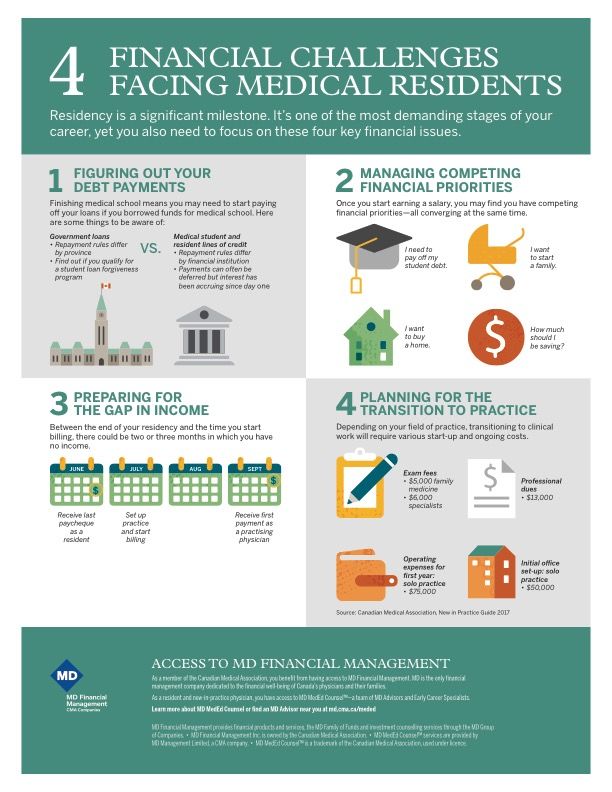
MAKE MANAGING YOUR FINANCES A HABIT
Dr. Jason Baxter (not his real name) is As Charles Duhigg notes in his bestsel- If you need to spend about $2,400 a
looking forward to earning his first pay- ler The Power of Habit: Why We Do What month on rent, food, transportation
cheque as a resident in family medicine We Do in Life and Business: “Cham- and other expenses, you’ll have $1,000
this summer. It will be a welcome pions don’t do extraordinary things. remaining. Decide how much you want
change from relying on student loans They do ordinary things, but they do to set aside for debt and then set up
and his line of credit through the four them without thinking, too fast for the automatic loan repayments so money
years of medical school. other team to react. They follow the comes out of your account on payday.
habits they’ve learned.”
Like all R1s in British Columbia, Jason’s
salary will be $50,661 this year, as de- Managing your finances might seem 3. SET UP A SAVINGS AND
termined by the collective agreement. complex and time-consuming at first. INVESTMENT PLAN.
After income taxes and other deduc- But the key is to get used to doing it, re-
tions, that works out to about $3,400 gardless of how much debt you can pay Let’s say that after paying your month-
a month. off or how much money you can save or ly costs, including your debt, you ex-
invest. Once you’re finished residency pect to be left with $100.
and are preparing for practice, it’s one
“When you’re a resident, less thing you’ll need to learn. And that
Is it worthwhile to save an amount this
small at this stage of your career? Yes,
the income is so low that will be a blessing, since there will be because the act of regular saving and
I don’t think it makes new financial issues to deal with as a investing sets the stage for good habits
practising physician. down the road. It may be small now, but
sense to try to save or $1,200 a year can grow significantly
Here are three areas of your finances to
seriously try to pay down focus on during residency. over the long run.
an enormous debt.” Use the compound growth calculator
1. TAKE STOCK OF YOUR DEBT. on md.cma.ca to see how your savings
Since family medicine is only a two- can grow over time.
year residency, Jason feels that putting Confirm the outstanding balances of
aside savings and other aspects of fi- your student loans and line of credit. By saving and investing early, you get a
nancial planning can wait until he’s Student loans typically have a grace chance to become more comfortable
in practice. period of six months after the end of with money management, riding the
your studies before you have to start market’s ups and downs, and making
“When you’re a resident, the income is making payments. Be aware, however, progress toward your financial goals.
so low that I don’t think it makes sense that interest starts accumulating Once you earn more income as a prac-
to try to save or seriously try to pay right away. tising physician, you will be equipped to
down an enormous debt,” he says. “It make financial decisions more easily.
will be much easier when you’re prac- Get an estimate of your monthly loan
tising and billing large amounts.” repayment amount through CanLearn’s This article is courtesy of MD Financial
Loan Repayment Estimator. The calcu- Management (md.cma.ca). As CMA
In theory, this sounds reasonable. After lator shows, for instance, that if you members, medical residents have ac-
all, there may not be much left of owe $100,000 and plan to repay over a cess to objective financial advice
Jason’s $3,400 once he has paid for ac- 10-year period, it will mean a monthly through MD Financial Management.
commodation, food, transportation payment of $1,197 based on a 7.7% in-
and other expenses. terest rate (5% fixed plus 2.7% prime). These presentations are provided for in-
formational purposes only and should
Why struggle and scrimp if all he could That’s $14,364 a year. For some resi- not be considered investment advice or
possibly save is $100 a month? The dents, debt repayment can run much an offer for a particular security or secur-
answer has to do with forming habits. higher, into tens of thousands a year. ities. Please consult your MD Advisor for
These amounts obviously need to be additional information concerning your
factored into your budget. specific wealth management needs.
SHAPE YOUR FINANCIAL
HABITS NOW MD Financial Management provides fi-
2. UNDERSTAND YOUR CASH FLOW nancial products and services, the MD
For Jason and other medical residents AND DEAL WITH DEBT Family of Funds and investment coun-
at this stage of their careers, it’s wise to ACCORDINGLY. selling services through the MD Group
view financial planning as a habit-for-
Let’s assume you have an after-tax in- of Companies. For a detailed list of these
ming exercise as much as an end goal.
come of $3,400 a month. Figure out companies, visit md.cma.ca.
Making the tasks a habit—through
practice and repetition—allows you to how much you need to spend on basic
operate on autopilot later on. living costs and other expenses, and
calculate what you’ll have left.You can also read


