REVIEW - Drug driving: recent developments - Journal of The Bar of Ireland - Law Library
←
→
Page content transcription
If your browser does not render page correctly, please read the page content below

THE BAR

REVIEW
Journal of The Bar of Ireland
                                Volume 26 Number 1
                                February 2021

Drug driving:
recent developments

CONTENTS

The Bar Review
The Bar of Ireland
Distillery Building
145-151 Church Street
Dublin DO7 WDX8
Direct:   +353 (0)1 817 5025
Fax:      +353 (0)1 817 5150
Email:    aedamair.gallagher@lawlibrary.ie
Web:      www.lawlibrary.ie

EDITORIAL BOARD
Editor
Eilis Brennan SC

Brian Kennedy SC
Paul McGarry SC
Sara Moorhead SC
Sean O hUallacháin SC
Peggy O’Rourke SC
Alex White SC                                                                                       6
Susan Ahern BL
Patricia Brazil BL
Lydia Bunni BL
Simon Donagh BL                                                                                    24           14
Elizabeth Donovan BL
Anita Finucane BL
Tom Flynn BL
Alison Walker BL                                                                                               18
Ciara Murphy, CEO
Vanessa Curley, Law Library
Aedamair Gallagher, Senior Research and Policy
Executive
Tom Cullen, Publisher
Paul O'Grady, Publisher
Ann-Marie Hardiman, Think Media

PUBLISHERS

Published on behalf of The Bar of Ireland
by Think Media Ltd
                                                 Message from the Chair                                 4    Interview                                       18
Editorial:   Ann-Marie Hardiman
             Paul O’Grady                                                                                    Making the system work
             Colm Quinn                          Editor’s note                                          5
Design:      Tony Byrne
             Tom Cullen
             Niamh Short
Advertising: Paul O’Grady                        News                                                   5
                                                                                                             Legal update                                      i
                                                 Bar CPD consultation
Commercial matters and news items relating       Resilience at the Bar
to The Bar Review should be addressed to:
Paul O’Grady                                     Justice Week 2021
The Bar Review
Think Media Ltd
                                                                                                             Law in practice
The Malthouse,                                   News features                                      10       Drug driving: recent developments               21
537 NCR, Dublin DO1 R5X8
Tel:   +353 (0)1 856 1166                        Member survey highlights ongoing issues            10       Climate change and the Supreme Court            24
Fax: +353 (0)1 856 1169
Email: paul@thinkmedia.ie                        New advertising regulations for barristers         13
Web: www.thinkmedia.ie

                                                 Law in practice
www.lawlibrary.ie                                Revoking a naturalisation certificate                       Closing argument                                28

Views expressed by contributors or
                                                 and the short waking life of Section 19            14       Vulnerable witnesses – a lot done, more to do
correspondents are not necessarily those
of The Bar of Ireland or the publisher and
neither The Bar of Ireland nor the publisher        Papers, editorial items, and all queries regarding subscriptions should be addressed to:
accept any responsibility for them.                                            Aedamair Gallagher at: aedamair.gallagher@lawlibrary.ie

                                                                                                        THE BAR REVIEW : Volume 26; Number 1 – February 2021       3
MESSAGE FROM THE CHAIR

    Looking to the future
    While lockdowns continue to impact on barristers’ work and lives, The Bar of Ireland is
    embarking on a strategic review in order to better plan for the future of the profession.
    We are now one month into 2021. The new year commenced on a very difficult                continue to provide and expand its role in the provision of legal services, having
    footing, with the entire island faced with high levels of Covid-19, although over the     regard to the core value of an independent referral bar. The review will include:
    past few weeks, it is reassuring to see a downward trend in the number of positive
    cases being reported. It would appear that progress is slow, and that further             1. an assessment of the future market, demand and expectations for the services
    upheaval seems imminent in the coming months.                                                of barristers including a diagnosis of the environmental, regulatory and
                                                                                                 competitive situation;
    Key workers vaccination                                                                   2. a detailed plan, setting out recommendations on where the Council should focus
    Members will have seen reports in the media of our call to have barristers designated        its priorities; and,
    as ‘key workers’ for the purpose of receiving the Covid-19 vaccine. I corresponded        3. an analysis of how best to maximise organisational resources in furtherance of
    with An Taoiseach, Micheál Martin, in early December highlighting that barristers            those priorities.
    are deemed to be an ‘essential service’ providing an essential and necessary service
    in the administration of justice and upholding the rule of law. The Government, the       All members will receive an invitation to have their say through a survey that is being
    judiciary and the Courts Service have ensured that the courts remain open at this         conducted by EY/Red C in February 2021.
    critical time to ensure continued access to justice, and the protection and vindication   I am very aware that the Council is in danger of causing survey fatigue; however,
    of constitutional rights.                                                                 this is an important initiative to assess the future direction of our profession and I
    Even under the highest level of public health restrictions, our members continue to       urge all of you to make your views known by completing the survey.
    provide representation in cases involving personal liberty, domestic violence, cases      Unfortunately a large cohort of members pay passive heed to what the Council is
    involving minors, and urgent civil cases such as injunctions, habeas corpus and           doing in the interest of our profession, so please, please take this one active step
    wardship applications.                                                                    this year and complete the survey. It is in all of our interests to ensure that the
    While the Council does not wish to displace any other priority groups who require         response rate is as high as possible so that we can be assured that any decisions
    the vaccine, it is vital that barristers are identified as one of the occupations to be   taken on your behalf are in keeping with the views and attitudes of our membership.
    defined under the ‘key worker’ category so that they can safely continue to perform       It is another avenue through which members can express their concerns. You might
    their role in the months ahead.                                                           also take time to encourage colleagues to also complete the survey.
                                                                                              Finally, I would remind each of you to please remain vigilant in relation to the
    Member survey and support                                                                 Covid-19 protocols in our workplace to protect both members and our staff:
    My thanks to the members who completed the member survey in December 2020
    to gain insights into how Covid-19 has impacted on our profession and how we are          n please wear your masks;
    coping.                                                                                   n please wash your hands;
    A more detailed article on the survey results is included in this edition of The Bar      n please keep your social distance; and,
    Review and the feedback has assisted the Council in taking decisions on the               n please work from home where possible.
    measures needed to further support our members as the crisis continues.
    Members will now be aware of my communication, which sets out some detail of a            Please stay safe.
    membership subscription credit, recognising the impact of the reduced operation
    of the courts and consequently the reduction in opportunities for members to
    provide their professional services.
    It has been a challenging task to strike a balance in the provision of a meaningful
    financial support for members while at the same time managing the finance of the
    organisation so that we can continue to provide the full range of services for
    members. My sincere thanks to our Treasurer, Seamus Clarke SC, ably supported by
    the finance team, who have worked tirelessly to achieve this goal. The Council will
    continue to monitor the situation.                                                        Maura McNally SC
                                                                                              Senior Counsel, Barrister
    Your views on the future of our profession                                                – Member of the Inner Bar
    Members will recall that the Council appointed EY to conduct a strategic review to        Chair of the Council of
    assess the future likely landscape and conditions under which the profession can          The Bar of Ireland

4     THE BAR REVIEW : Volume 26; Number 1 – February 2021
EDITOR’S NOTE

Reform on the horizon
This edition looks at reforms in the area of personal injuries and the treatment of vulnerable
victims.
The recent judgment of the Supreme Court in the Climate Case has                revocation of citizenship. Finally, we explore the numerous unresolved
far-reaching repercussions for the manner in which the Irish State must         issues that arise when prosecuting offences relating to vulnerable victims.
face up to its obligations to reduce greenhouse gases. However, the             The momentum from the Minister for Justice, Helen McEntee TD, towards
judgment also has significant implications for the litigation of public         the introduction of legislation for pre-trial hearings before the summer is
interest cases and it provides some indication of how the Court is likely       a welcome step in this regard that should increase efficiency in the
to approach the issue of unenumerated constitutional rights in to the           prosecution of all criminal trials.
future. In this edition, we address the key issues for public law litigation.
Just one year into her role as Chief Executive of the Personal Injuries
Assessment Board, Rosalind Carroll sets out her stall in relation to
proposed reform of the system around damages for personal injuries. She
discusses the Government’s Action Plan for Insurance Reform, the
implications of the Book of Quantum moving out of the PIAB’s remit, and
her plan to use the data on personal injuries cases to better inform
stakeholders and the public.
The prosecution of drug driving has been facilitated in recent years by
legislation specifically targeting the use of performance-affecting drugs
while at the wheel. Gardaí are now empowered to administer roadside
drug tests while specific offences have been introduced in relation to
having a concentration of certain drugs in the blood above a prescribed         Eilis Brennan SC
level. We examine how these measures are operating in practice.                 Editor
Elsewhere, we analyse recent Supreme Court cases relating to the                ebrennan@lawlibrary.ie

  Have your say!                                     On-demand CPD relaunch
  Member consultation                                The new CPD Playback page on www.lawlibrary.ie has been re-designed to be more efficient
                                                     and user-friendly. You can now easily filter webcasts by year and area of law.
  on new CPD
  requirements and
  competency
  framework
 Over the past year the Education and Training
 Committee has been working to review the
 CPD requirements for membership. Your
 views as a member are essential before the
 requirements of the new CPD scheme are
 finalised. A member survey will be circulated
 in late February inviting your input.

 The survey is available via
 https://rebrand.ly/CPDsurvey or using this
 QR code.

                                                                                                 THE BAR REVIEW : Volume 26; Number 1 – February 2021         5
NEWS

    The importance of resilience and self-care

                                  Anxiety, low job satisfaction and isolation      problem-solving skills (Seligman, 2011). Studies show that it is the
                                  topped the poll in a recent well-being survey    perception of the event that causes stress levels to rise, not the event
                                  by The Bar of Ireland. Such symptoms may         itself (Cacioppo et al., 2015; Guo et al., 2013). Coping skills to manage
                                  be exacerbated by the global pandemic,           psychosocial factors included the subjective evaluation and management
                                  which brings restrictions and changes to the     of stress according to your own needs. The acceptance of limitations
                                  usual routine, but there are many self-care      resonated with many participants and proved the most popular of coping
                                  strategies that can help manage stress and       skills. Regularly asking yourself what can you do about something, rather
                                  promote well-being.                              than what you can’t do, aids behaviour change from problem to solution
                                  To paraphrase Viktor Frankl, when you can        focus.
                                  no longer change your circumstances, you         The self-care coping skills (Fritz et al., 2011) highlighted the need for a
                                  must change yourself (Man’s Search for           regular routine of physical exercise, sleep, diet, and cognitive coping
    Karen Belshaw.                Meaning).                                        skills. There is no one size fits all, so each individual must take the time
    The Bar of Ireland recently held a well-being webinar, where Karen             to design their own well-being plan.
    Belshaw, MSc Psych & Well-being, presented on resilience and self-care         Well-being is more than the absence of negative conditions and feelings.
    to members of the Law Library with the aim of sharing effective coping         It is a complex construct with many components. The hedonic approach
    skills, partly in response to the survey.                                      suggests that it is the subjective evaluation of life satisfaction and
    Well-being has two distinct aspects: the cognitive – how we think about        positive affect. Eudemonic concepts of the good life suggest that
    ourselves; and, the affective – how we feel about ourselves. With this in      well-being is about each individual becoming a fully functioning person
    mind, Karen addressed mindful awareness, confidence, intrinsic                 leading to an existential existence.
    motivation, perception, self-care routines, psychosocial factors, and          Aristotle held that the ultimate aim in life is to reach one’s true potential,
    communication.                                                                 to find a balance between deficiency and excess, and to make the most
    Mindful awareness includes being fully present and cognisant of what           of one’s talents. This pandemic will pass, life will resume, so use this time
    you are experiencing, as opposed to falling foul of perceptual expectancy      to restructure and get ready.
    and assuming a negative result based on prior experience. There was a
    general consensus that barristers often experience the need for certainty      For more information on workshops and individual well-being
    and the desire to control outcomes, which can lead to stress and anxiety.      appointments, contact Karen Belshaw on 087-677 9883,
    Practising mindful exercises on a daily basis over a six-week period greatly   Karen@stresstraining.ie, or go to
    enhances cognitive control, reduces anxiety, and enables heightened            www.stress-management-ireland.com.

6    THE BAR REVIEW : Volume 26; Number 1 – February 2021

NEWS

     Get involved in
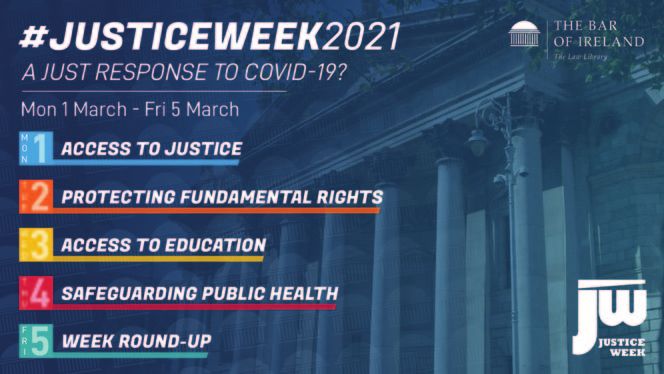
     Justice Week 2021

     Following the success of our inaugural Justice Week
     in 2020, preparations are now underway for Justice
     Week 2021, which will run from March 1-5. We hope
     to involve as many voices in the legal, policy and
     justice sector as possible.

     What is Justice Week?
     Justice Week is a joint awareness campaign of the legal professions         Ireland will host a series of online activities including a panel discussion
     across the four jurisdictions (Scotland, Northern Ireland, Ireland, and     with legal and policy experts on the limitations imposed on
     England & Wales). It aims to promote an understanding and awareness         fundamental rights during the pandemic, and an interuniversity debate
     of access to justice and the rule of law. The focus for 2021 will be the    comprising students from the main university law schools across
     impact that Covid-19 has had on citizens’ rights and the administration     Ireland.
     of justice, with particular emphasis on the important role that the rule
     of law and the justice system play in responding effectively to a public    How can you participate?
     health crisis. A key concern arising from the introduction of emergency     Justice Week is a valuable platform on which your organisation can
     measures in response to the pandemic is the constitutionality and           promote or highlight any of its justice-related activities, policy
     proportionality of restrictions imposed. The rule of law and a robust       priorities, research or other outputs, particularly where Covid-19 is
     justice system are vital to ensuring a co-ordinated and effective           concerned. Engage your community/following on social media using
     society-wide response to a pandemic, one that instils public trust,         the umbrella hashtag #JusticeWeek2021.
     protects rights, addresses inequities, upholds accountability, and
     ensures a balanced and proportionate response. The campaign will            To inquire further about how you/your organisation can get
     touch upon a number of themes throughout the week, including access         involved, please contact Aedamair Gallagher, Policy & Public
     to justice, access to education, and freedom of movement. The Bar of        Affairs Manager, at aedamair.gallagher@lawlibrary.ie.

    Joint event with OUTLaw

    The OUTLaw Network was founded in 2018, with the aim to                     Thanks to the speakers – Susan Ahern BL, Richie Fagan, President,
    generate discussion and debate through various events in an effort          Emerald Warriors Rugby Club, Moira Flahive BL, and Maura McNally
    to promote and foster the inclusion of LGBT+ individuals and allies         SC, Chair, Council of The Bar of Ireland – who led a highly engaging
    across the legal sector in Ireland. The Bar of Ireland has been             discussion on the topic of LGBT+ visibility and inclusivity in sport.
    involved since 2018 and the first joint event by OUTLaw and The
    Bar of Ireland took place on Thursday, January 21, 2021. A large
    audience joined online and the session was moderated by Sean                More information on the OUTLaw network is available on
    O’Sullivan BL.                                                              www.outlawnetwork.ie.

8    THE BAR REVIEW : Volume 26; Number 1 – February 2021
NEWS FEATURE

     Member survey highlights ongoing issues
     The findings of the most recent member survey confirm that the disruption to court business continues
     to have a detrimental impact on members’ livelihoods, as well as giving rise to serious barriers for clients
     seeking access to justice and the resolution of their disputes.

     With a response rate of approximately 15%, and reflecting wider Bar                       highlight the need for the Courts Service and the Department of Justice to
     demographics (42% female, 86% Junior Counsel; Figure 1), the results of The               ‘turbo charge’ preparations for alternative settings, modifying existing ones and
     Bar of Ireland’s latest member survey provide a useful basis for understanding            streamlining the hybrid possibilities of remote hearings. Developments in
     key trends and developments across the profession.                                        respect of the High Court personal injuries hearings, as well as certain Circuits
                                                                                               adopting a remote capacity, will be welcome, and reflect the progress made, in
     Impact on practice                                                                        particular in the Superior Courts. The task one year on is to replicate that
     The survey tracks member sentiment from our May 2020 survey, with                         approach across all court activity, while ensuring that physical hearings can also
     respondents reporting continuing concern in relation to future viability of               continue to be relied upon.
     practice. Over 52% of the profession identified the viability of practice as the          Member feedback on this issue reflects the submissions made by Council, that
     most significant challenge over the next 12 months (Figure 2). While in May               fewer hearings and lack of physical hearings is adversely impacting on issues
     2020, responses to this question were more pronounced taking the Bar as a                 such as income, formation of younger practitioners, and client welfare. The
     whole, the issue continues to impact disproportionality on those in years one             transformation programme of a digital Courts Service must include the
     to seven, 70% of whom reported it as significant and unmoved since May 2020               perspectives and experience of practitioners, in particular as to how physical
     (Figure 3). Unsurprisingly, the key driver of practice and income is court activity.      court activity will co-exist, and accessibility for all court users. In response to
     With backlogs arising due to restrictions in physical hearings, the survey results        these findings, and reflecting an awareness over the past number of weeks and

       l Senior Counsel           46        l Male                 188          l Criminal             32             l On Circuit           57     l 1-7 years            103
       l Junior Counsel          290        l Female               140          l Civil               237             l Dublin              223     l 8-12 years            63
                                            l Prefer not to say      9          l Mixed practice       56             l Mix                  56     l 13-20 years           91
                                                                                                                                                    l 20 years              80

     FIGURE 1: Demographics of survey responses.
     Rank which of the following challenges will present for
     you over the next 12 months:                                                              Economic viability – significant – by years:

       Integrating better use of                                                                   80%
          technology in practice                                                                   70%
                                                                                                   60%
        Maintaining collegiality
            between members                                                                        50%
                                                                                                   40%
         Financial and economic
             viability of practice                                                                 30%
                                                                                                   20%
                Developing new
                areas of practice                                                                  10%
                                                                                                   0%
                                     100%                  0%                    100%                           1-7                  8-12         13-20              20+

       n Significant       n Moderate       n Not a challenge     n Not applicable                 n May 2020    n December 2020

     FIGURE 2: Challenges anticipated by practitioners in the coming year.                     FIGURE 3: Economic impact December 2020 versus May 2020 by year of practice.

10    THE BAR REVIEW : Volume 26; Number 1 – February 2021
NEWS FEATURE
months of issues affecting members, the Council has already commenced a conditions, with respondents having experienced them “very often” in the past
process of putting in place a second subscription credit. A fund of ¤1.6m has months (Figure 4). Anxiety experienced during the pandemic is a natural
been earmarked and details of the credit are being communicated directly to reaction; however, the comments indicate that again, much of that anxiety has
members. This second credit also acknowledges the collective strength, solidarity its genesis in the courts largely halting some categories of business, the safety
and value of Law Library membership. ‘Maintaining collegiality at the Bar’ and of the court workplace, and a fear of continued restrictions. Similarly, ‘low job
‘Developing new areas of practice’ (both identified as significant by just under satisfaction’ might be seen as a proxy for the chaos and lack of certainty that
50% of respondents; Figure 2) reflect the store placed on the Law Library has pertained to many areas of practice in recent months, and as members
environment and the traditional networking opportunities it provides. The reposition their work context. Breaking the results down by years at the Bar,
challenge of developing new areas of practice is likely to be driven by necessity, we can see ‘burnout’ as a dominant feature of the younger Bar. Anxiety
as traditional areas of work have been disrupted, but also points to a spirt of pervades all cohorts, but as members progress, low job satisfaction becomes
entrepreneurship and innovation being applied to the barrister qualification. increasingly apparent. The survey validates continued work on the part of the
The message from these results reflects the continuous call to Council – how Equality & Resilience Committee to strengthen and develop member-specific
are we supporting our members, and what more can be done? supports and resources, and to create a culture of understanding and empathy
at the Bar. Almost 40% support the proposal for a programme of well-being
Income events and supports, which calls on a whole-of-organisation approach.
Asked to assess how their income has been impacted on a full-year basis, of
the respondents reporting a decline in income, 45% estimate the drop to be Satisfaction with The Bar of Ireland services
up to 50%, the majority of those anticipating it to be between 30% and 50%. Understanding how key Bar of Ireland services are received by the membership
Those in years 13-20 make up the largest cohort of that 30-50% drop (35%). assists us in measuring both the quality and design of services. Members
Less than 10% anticipate the most severe drop in income (a drop of 80%+). In expressed particular satisfaction with the Library, CPD offerings and
May 2020, over 30% reported such a drop over the previous two months. While communications in recent months (Figure 5). While technology has replaced
some may see it as a cause of some hope and optimism that the assessment of key face-to-face interactions for us all, it has also allowed members who may
income drop has moderated, a word of caution: members’ fee collection cycle have other obligations, those located outside the Law Library environs, and
is by its nature many months behind the delivery of service. As such, it could those who have a need for asynchronous access to participate in activities and
be the case that the full economic brunt has yet to wash through the system access services. Each of the categories of services raised saw a 20% increase
and be realised. on May 2020 (noting that ‘Practice Support and Fee Recovery Supports’ were
only established in the summer of 2020). As members and staff continue to
Well-being develop expertise in the use and management of technology and its application
The issue of well-being and mental health continues to find due prominence to the Bar environment, it is hoped that we can build on the improvements to
across debates and sectors over the last year, as well as its relationship to how date.
people work sustainably and safely. The Bar of Ireland has taken some steps in
recent years to focus on dignity and supports as members practice, and this Access to justice
agenda continues to be developed. Court services are, of course, a public service, and court users do not have a
‘Anxiety’ and ‘low job satisfaction’ were reported as the two most acute lobby group per se. As a consequence, the impact on the public, and in
Please indicate your satisfaction with each of the
In the past number of months, I have experienced: following in recent months:
Communication with members
Anxiety
in relation to developments
Financial measures implemented
Isolation to support members
ICT facilities and remote
hearing supports
Low job
satisfaction Library and information virtual service
Online CPD offering
Burnout Practice support
and fee recovery supports
100% 0% 100% 100% 0% 100%
n Very often n Sometimes n Seldom n Never n Poor n Good n Excellent
FIGURE 4: Impact on well-being. FIGURE 5: Member satisfaction with Bar of Ireland supports.
THE BAR REVIEW : Volume 26; Number 1 – February 2021 11NEWS FEATURE
The testimonies of members on this theme include:
Please consider how the following experiences might apply
to your clients in the past number of months: n consultations occurring on the side of the street as facilities in the courts
remain unavailable;
Material delays/ n delayed damages and deferred litigation impacting on client welfare, both
cancelled hearings emotional and economic;
Proficiency with
n repeated adjournment of motions/hearings damaging the standing of the
technology courts;
n challenges of technology in case preparation, client confidentiality and
Increased use of
ADR/mediation instructions; and,
n court facilities not always Covid compliant or available.
Other
100% 0% 100% Conclusion
n1 n2 n3 n4 n5 With almost a year now passed from the date of the pandemic starting, it is
regrettable that the survey results convey a view among members that the court
FIGURE 6: Impact on clients and access to justice.
system in the main appears still in reactionary mode. Clear, direct and proactive
particular the relatively unheard section of those who rely on the courts during communications as to the ‘what’, ‘when’ and ‘how’ of a modernised courts
these months, has yet to be fully heard. The progress made in relation to urgent system would embolden both practitioners and court users as to their future
family and child law cases (including domestic violence) is a credit to all agencies welfare. Until then, a degree of angst and frustration pervade.
and practitioners involved. However, citizens with civil and criminal matters The results of this survey offer some seeds of optimism, however, in respect of
before the courts continued to be impacted over the past year. practitioners seeking to prepare for new modes and sources of work, and by
Members were asked to rate, overall, how their clients have been impacted extension a moderation in view of how incomes and practice may be disrupted
(Figure 6). Some 65% answered a high rating (4-5), where 5 represents over the long term.
“severely impacted”. How will the pandemic play out in advance of a population-wide vaccination
The categories of impact include material delays/cancelled hearings (75% programme? How will the longer-term impacts of the crisis manifest in the
reported a high rating), followed by proficiency with technology (36% reported economy? What is the political will to ensure that our justice and courts service
a high rating). systems are strengthened and resilient?
The challenges of the Pexip platform and remote hearings support these These are some of the external factors that will define a great deal of 2021.
conclusions, with almost 40% rating as “poor” the impact it has on interactions The Bar of Ireland continues its mission to support the resumption of court
with other parties, and the effectiveness of managing briefs. business, safely, to the highest degree possible.
12 THE BAR REVIEW : Volume 26; Number 1 – February 2021NEWS FEATURE
New advertising regulations for barristers
New regulations in respect of advertising by legal practitioners came into effect on December 18, 2020.
has been included in these Regulations at the urging of The Bar of Ireland,
it not having been included in the original draft regulations. The thrust of
the submission was that this prohibition is necessary to protect the interests
of litigants and their access to justice and effective legal representation,
and to guard against any undermining of the cab-rank principle by which
we practise, which principle operates in the interest of litigants.
Dara Hayes BL
Confidentiality and publicity
Barristers and solicitors are now governed by the same rules when it comes Advertisements cannot breach the duty of confidentiality owed to clients
to advertising. These rules are contained in the Legal Services Regulation without the express prior consent of the client. An exception to this is in
Act 2015 (Advertising) Regulations, 2020 (SI 644/20). relation to matters already in the public domain. It is also permitted to state
Prior to December, advertising by barristers had been governed by our that you acted in particular proceedings.
Code of Conduct and guidelines published by the Bar Council in May 2008. Practitioners often, in conference programmes or social networking sites for
Those guidelines have been rescinded and the Code of Conduct is now example, list significant cases in which they have appeared. This practice is
framed by reference to the Legal Services Regulation Authority (LSRA) permitted by the Regulations, although it is provided that one’s role is not to
Regulations. While the change is significant, it is perhaps more evolutionary be overstated.
than revolutionary. The guidance that had been provided about what might The purpose of an advertisement, for the purpose of the Regulations, is
be included in an advertisement is now gone. However, the rules to publicise or promote a practitioner in the provision of legal services.
prohibiting certain content remain broadly the same as before. What Where the LSRA deems that the publication of a book or article, or the
follows is a brief guide to the new rules, but the Regulations should be giving of a lecture, is primarily for publicity or promotion rather than for
read by all practitioners. imparting legal information, such activity can fall under the Regulations.
The indicia of publicity and promotion can include: the extensive giving of
Lawful advertisement free copies of books; paying to have your article published or to deliver
The general premise of the Regulations is that it is lawful for legal your lecture; and, the repeated giving of the same lecture or publication
practitioners to advertise, whether they be individuals, partnerships or of the same article. It may herald the end, for lawyers, of the single
groups of practitioners sharing facilities, premises, or practice costs. An transferable speech.
advertisement is given quite a wide definition and includes oral, written Any advertisement must state by or for whom it was published. If not, it
and visual communications intended to publicise or promote the will be deemed to have been published by the practitioner or practitioners
practitioner in question in relation to the provision of legal services. Under that it seeks to publicise or promote.
Regulation 4 advertisements shall not:
Breaches of the regulations
n be likely to bring the profession into disrepute; A breach of the Regulations can be dealt with by enforcement under the
n be in bad taste; Regulations. It can also be treated as misconduct under Part 6 of the Legal
n reflect unfavourably on other practitioners; Services Regulation Act, 2015. The LSRA can investigate any alleged breach
n be false or misleading; either on foot of a complaint or on its own motion. Where it finds that an
n be published in an inappropriate location (hospitals, clinics, funeral advertisement is in breach of the Regulations, the Authority can issue
homes and suchlike); or directions and can seek undertakings in relation to future advertising. It
n expressly or implicitly solicit or encourage personal injury claims can also apply to the High Court, should it consider it necessary, to enforce
(although the term “personal injuries” and other such terms may be the Regulations.
included in an advertisement).
Since its submission to the Competition Authority in 2005, up to and
The use of terms such as “no foal no fee” or “first consultation free” are including the submission made to the LSRA last November, The Bar of
also prohibited, as is any suggestion that there is no risk to a client of Ireland has consistently expressed the view that advertising can be to the
having to pay costs. The Bar Council’s previous guidelines had contained a benefit of both legal practitioners and their clients. These Regulations
prohibition on advertising by reference to a barrister’s success rate. A similar appear to strike a balance between promoting the good that advertising
prohibition on legal practitioners advertising by reference to success rate may bring without undermining the interests of justice.
THE BAR REVIEW : Volume 26; Number 1 – February 2021 13LAW IN PRACTICE
Revoking a naturalisation
certificate and the short
waking life of Section 19
Two recent Supreme Court judgments have raised important issues around the dividing line between
executive and judicial functions, and the constitutionality of s. 19 of the Irish Nationality and
Citizenship Act 1956.*
revoke a certificate of naturalisation if he is satisfied that its issuance “was
procured by fraud, misrepresentation whether innocent or fraudulent, or
concealment of material facts or circumstances….”. Section 19(2) provides
that the Minister must give notice of his intention to revoke and for the right
of that person to apply for an inquiry as to the reasons for the revocation.
Aoife McMahon BL Section 19(3) provides that on application for such an inquiry, the Minister
shall refer the case to a committee of inquiry appointed by the Minister and
the committee shall report their findings to the Minister.
Two cases of note in 2020 concerned s. 19 of the Irish Nationality and While this section had been on the statute book since 1956, the Minister
Citizenship Act 1956 (the INC Act), which provided for the revocation of a for Justice only appointed a committee of inquiry pursuant to s. 19(3) in
naturalisation certificate: Habte v Minister for Justice;1 and, Damache v 2018. This committee of inquiry heard its first oral hearing on December 11,
Minister for Justice.2 In the latter case, the Supreme Court declared the 2018, at its offices in Tipperary.3
section unconstitutional. This article will analyse each case before
considering two themes that are dealt with in the judgments: prematurity Habte v Minister for Justice
as a preliminary issue in judicial review proceedings; and, the dividing line The applicant in Habte was born in Ethiopia and granted a certificate of
between executive and judicial functions. naturalisation in 2015. Her date of birth was the date of birth recorded on
Section 19 (1) of the INC Act provides, inter alia, that the Minister may her Ethiopian passport. However, her birth certificate contained two different
14 THE BAR REVIEW : Volume 26; Number 1 – February 2021LAW IN PRACTICE
dates of birth, which she explained was due to differences between the Prematurity as a preliminary issue in judicial review proceedings
Ethiopian and Gregorian calendars. She later became concerned that the In respect of the second set of proceedings in Habte, the Court of Appeal
date recorded on her Irish passport had recorded the incorrect date of birth (Murray J.) clarified the distinctions between whether a justiciable decision
but the Minister for Justice refused her application to have this error in her existed, prematurity, and the availability of an alternative remedy.6 The
naturalisation certificate rectified. The applicant was granted leave to seek critical question was whether the Court’s discretion was properly applied to
judicial review of the decision refusing to amend her naturalisation enable review given that there was a statutory process available in the course
certificate. The Minister for Justice then notified her of his intention to of which the applicant could make her case prior to a final decision.7
revoke her naturalisation certificate on the basis that she had submitted false Leaving the constitutional challenge aside, the grounds in Habte on which
or misleading information with her application. She was advised of her certiorari of the proposal to revoke was sought notably included that the
entitlement to seek an inquiry into the reasons for this proposed revocation Minister acted unlawfully in initiating that procedure because he failed to
pursuant to s. 19 of the INC Act. The applicant did not seek to avail of such afford the applicant fair procedures before so doing, and that the Minister
an inquiry but took a second set of judicial review proceedings seeking an failed to individually consider the applicant’s circumstances and the
order of certiorari of the proposal to revoke her naturalisation certificate and proportionality of the decision. The Court of Appeal held that once fair
a declaration that s. 19 was unconstitutional. procedures were afforded over the full course of a multi-stage
Ms Habte was successful in her first set of judicial review proceedings in decision-making process, this was sufficient.8 These were “quintessentially,
both the High Court and the Court of Appeal. Humphreys J. found that there issues to be resolved within and following the inquiry when the facts have
was an unenumerated Constitutional right to have one’s identity correctly been determined … it is following any decision to revoke that those grounds
recognised by the State and this included a person’s date of birth. This was of challenge should be agitated”.9
upheld in a separate concurring judgment of Power J. in the Court of Appeal. In relation to the constitutional challenge to s. 19, the Court of Appeal
The Court of Appeal (Murray J.) upheld the remaining grounds of the first reviewed the caselaw both for and against the proposition that such a
judicial review. In sum, while it was contrary to “absolute clarity and certainty challenge could be made prior to the commencement of the s. 19 process.
around the person’s citizenship”4 to have an initial certificate and an Murray J. noted that the arguments raised by the applicant could be resolved
amended certificate with the same registration number in parallel existence, within the alternative remedy of the inquiry process. He noted that there
this error could be rectified by the cancellation and re-issue of a was a certain incongruity in considering the constitutional argument at this
naturalisation certificate. juncture given that if it was heard following the s. 19 process and the
As regards the scope of s. 19(1) and in particular an “innocent” applicant succeeded on non-constitutional grounds, the Court would on
misrepresentation or “material” concealment giving rise to a ground for conventional principle decline to hear the constitutional claim. However, the
revocation of a naturalisation certificate, this was to be construed in light of Court concluded by finding that as the “underlying [constitutional] argument
the prior words “procured by”. There must be a certain causal connection is, in my view, weak … it can and should be disposed of now”, and went on
between the granting of the naturalisation certificate and the to reject the argument that s. 19 was unconstitutional.10
misrepresentation or concealment such that the certificate would not have In Damache, the applicant sought certiorari of the proposal to revoke
been granted ‘but for’ this misrepresentation or concealment. In the second notably on the ground that revocation would amount to a disproportionate
set of proceedings, which will be considered further below, the Court of breach of his rights under article 8 ECHR, and would also breach the principle
Appeal rejected the arguments that the Minister had acted unlawfully and of proportionality under EU law. The High Court (Humphreys J.) dismissed
that the section was unconstitutional because of the lack of judicial oversight these arguments, holding that there was a presumption that the ICN Act
over any revocation. would be applied in a manner compatible with the State’s obligations under
ECHR and EU law. The legislature had provided for the s. 19 procedure and
Damache v Minister for Justice that was an adequate and appropriate remedy.11 On appeal, while the
The facts of Damache v Minister for Justice were somewhat different. Mr Supreme Court confirmed that judicial review would not normally lie to
Damache was granted a certificate of naturalisation in 2008. Following an challenge a proposal to make a decision, for two reasons Dunne J. held that
eventful litigation history in the State,5 while on a trip to Barcelona he was this was an exceptional case warranting an examination of the issues. First, it
extradited to the US and pleaded guilty to materially assisting an Islamist involved “a systemic attack upon the section, with the result that the principal
terrorist conspiracy. He was sentenced to 15 years’ imprisonment, with credit issue before the Court is the question of the constitutionality of s. 19”. Second,
for furnishing a consent to be deported to either Ireland or Algeria on his “counsel on behalf of the Minister in the course of the hearing before this Court
release. accepted that the question of prematurity of the proceedings was no longer in
The Minister for Justice then issued him a proposal to revoke his issue”.12 Of note here is a similar approach taken by Simons J. in another 2020
naturalisation certificate pursuant to s. 19(1)(b) of the INC Act on the judgment: Náisiúnta Leictreach Contraitheoir Éireann v The Labour Court.13 In
grounds that he had failed in his duty of loyalty to the nation and fidelity to circumstances where both parties in that case were agreed that the
the State, having pleaded guilty to a terrorist offence. The applicant initiated constitutional issue should be resolved and where the exercise of judicial
judicial review proceedings seeking, inter alia, certiorari of the proposal to self-restraint would merely defer rather than avoid the necessity of a court
revoke his naturalisation certificate and a declaration that s. 19 was having to determine the constitutionality of the legislation, the Court examined
unconstitutional. the constitutional challenge although it had not been necessary to do so.
THE BAR REVIEW : Volume 26; Number 1 – February 2021 15LAW IN PRACTICE
The applicant in Damache made a two-pronged challenge to the not met as while the revocation of a naturalisation certificate had “a number of
constitutionality of s. 19: first, that the revocation of a naturalisation legal effects … deportation of such an individual would involve the invocation
certificate was a judicial rather than executive function; and, second, that of an entirely separate statutory procedure and the making of an entirely
the provisions of that section did not afford fair procedures to an individual separate decision and order … It is simply not something that is enforceable
who faced the severe consequences of the loss of citizenship. The first argument by court order without further and different procedures being followed and
was rejected by the Supreme Court while the second argument was successful, orders being made”.16
leading to a declaration of unconstitutionality. The fair procedures arguments The Supreme Court was asked to rule on whether this power was administrative,
in Habte had been rejected as being premature. What seems to have made the executive or judicial. If administrative, a ruling on whether the function was
pre-emptive constitutional challenge appropriate in Damache was the fact that “limited” within the meaning of Article 37 of the Constitution would have been
the procedural shortfall (the non-binding nature of the committee’s report) was requireat the administration of justice but was the exercise of an executive
an express term of the legislation, which could not have been remedied function.17 Thus, the Court appears to hold that a decision to revoke a person’s
throughout the course of the inquiry. nationality falls within the discretionary decision-making authority of the
The Supreme Court held that given the serious effects flowing from the loss of executive.
citizenship, high standards of natural justice were called for, to the level of A number of difficulties arise from these findings when considered alongside
requiring an impartial and independent decision-maker. While the Court was the findings in respect of the second (fair procedures) prong of the
satisfied that the committee of inquiry was an independent body, its findings constitutional challenge in Damache. First, if the revocation of citizenship falls
were not binding on the Minister. This was the basis on which the Supreme within the discretionary decision-making authority of the executive (as opposed
Court found the section to be unconstitutional. to being an administrative function), this principle does not sit well with the
finding that such a decision must be made by an impartial and independent
The dividing line between executive and judicial functions decision maker. Other functions deemed to be executive functions include the
Both in Habte and Damache, the argument that s. 19 was unconstitutional issue of deportation orders, granting permission to reside under s. 3 of the
because it permitted the executive to exercise a judicial function was rejected. Immigration Act 1999, and granting permission to reside under ad hoc
The reasoning of the Supreme Court in Damache on this argument was similar administrative schemes. These decisions can be characterised as decisions on
to that in Habte. At para 39, Dunne J. referred to the test set out in McDonald which the Minister for Justice herself (or those acting on her behalf) has the
v Bord na gCon No. 214 to be applied in determining whether a function was a final discretionary call.
judicial function reserved for the courts under article 34.1 of the Constitution: Second, in considering the fair procedures prong of the constitutional challenge,
the Supreme Court contrasted the position of Mr Damache with a person
“It seems to me that the administration of justice has these characteristic claiming international protection pursuant to the International Protection Act
features: 2015. The latter had a right of appeal to the independent International
Protection Appeals Tribunal (IPAT), but the former did not have the same level
1. A dispute or controversy as to the existence of legal rights or a violation of of procedural safeguards. The difficulty with this analogy is that a person who
the law; satisfies the criteria for international protection is entitled to that status as of
2. The determination or ascertainment of the rights of parties or the imposition right, unless excluded under ss. 12 or 47(3) of the 2015 Act. The Minister has
of liabilities or the infliction of a penalty; no discretion where such criteria are satisfied18 and arguably acts as an executive
3. The final determination (subject to appeal) of legal rights or liabilities or the means of enforcement. This can be contrasted with the broad discretion
imposition of penalties; associated with the executive functions mentioned above. The functions of the
4. The enforcement of those rights or liabilities or the imposition of a penalty IPAT seem to satisfy the criteria for a judicial function under the McDonald test
by the court or by the executive power of the State, which is called in by and such a tribunal is arguably a body envisaged by Article 37 of the
the court to enforce its judgment; Constitution as being constitutionally permitted to have a limited judicial
5. The making of an order by the court, which as a matter of history is an order function. This analogy seems to weaken the finding of the Court that the
characteristic of courts in this country”. revocation of a naturalisation certificate is an executive function.
Third, while it has traditionally been the function of the executive to grant
In applying this test, Dunne J. held that the fifth criterion was not satisfied: naturalisation certificates, the revocation of such certificates is a more recent
“from an historical point of view, it has long been the function of the executive phenomenon. The latter function has only been exercised in this State since
to decide on issues of naturalisation and it has never been the role of the courts 201819 and the comparative position in other jurisdictions was found by the
to make such decisions”. While at issue was a decision to revoke rather than to Supreme Court to be scanty.20 If this function has not traditionally been
grant a naturalisation certificate, “as a matter of logic [the court could not] see exercised by any organ of the State, it seems difficult to apply the fifth criterion
how that decision of itself is something outside the function of the executive”.15 of the McDonald test at all.21 The Supreme Court nevertheless held that as a
The Supreme Court was also satisfied that the fourth criterion in McDonald was matter of logic it could not see how the decision to revoke of itself was
16 THE BAR REVIEW : Volume 26; Number 1 – February 2021LAW IN PRACTICE
something outside the function of the executive.22 This seems to couple the Union may, because he loses his nationality, lose his status of citizen of the
decision to grant to the decision to revoke, such that if one is a traditional Union and thereby be deprived of the rights attaching to that status”.
function of the executive, so is the other. However, there are seeds in Both O’Donnell J.’s observations in P. v Minister for Justice and the findings of
considerations throughout the judgment that suggest that this should not the CJEU in Rottmann suggest that a principled distinction may be drawn
necessarily be the case. The Supreme Court referred to observations made by between the process of granting the benefit of citizenship to a non-national
O’Donnell J. in P. v Minister for Justice23 where he highlighted the different and that of taking from a citizen all the rights attached to that status.
points of departure as between a non-citizen seeking the benefit of citizenship Traditionally, the courts have had a role in safeguarding citizens’ rights.
and a citizen possessing the entire range of constitutional rights:24 Finally, in respect of the fourth criterion in McDonald, the Supreme Court
concluded that the revocation of a naturalisation certificate was not something
that was enforceable by court order without further and different procedures
Thus, the Court appears to hold that a
being followed and orders being made, namely the deportation procedure.
decision to revoke a person’s nationality Yet, the deportation of that individual would not necessarily follow. Although
falls within the discretionary decision- they no longer hold Irish citizenship, such an individual could apply for and be
granted a form of residence permission. Deportation is not the enforcement of
making authority of the executive. a revocation decision, but is, as the Court observed, an entirely separate
statutory procedure.
“The origin of the procedure [to grant naturalisation], and the extremely broad The Supreme Court also observed that it was quite clear that the revocation of
discretion conferred upon the Minister, lies in some fundamental conceptions a certificate of naturalisation has a number of legal effects. These included the
of sovereignty … A decision in relation to the conferral of citizenship … confers loss of rights guaranteed under the Constitution to citizens, the loss of EU
the entire range of constitutional rights upon such a person … [These citizenship and the loss of the right to an Irish passport. If Mr Damache had
procedures] apply only to non-citizens seeking naturalisation”. applied for an Irish passport following revocation, the Minister for Justice (or
the passport office) could simply rely on the revocation decision to refuse him
The Supreme Court also referred to the judgment of the Court of Justice of the an Irish passport. It could be enforced by the executive in this way.
European Union (CJEU) in Rottmann C-135/08. In that case, the CJEU Though difficulties seem to arise in reconciling the contrasting findings of the
confirmed that according to established caselaw, it was for each member state Supreme Court in relation to the two prongs of the constitutional challenge,
to lay down the conditions for the acquisition and loss of nationality. However, the result of a finding in favour of Mr Damache on either prong would have
once Union citizenship was granted to an individual, that individual then been the same: a declaration that s. 19 of the INC Act is unconstitutional and
possessed all rights attaching to that status. In this way, the revocation of Union the end of the colourful, short waking life of this section.
citizenship became a matter upon which the Court could rule:
“46. In those circumstances, it is for the Court to rule on the questions referred *With thanks to Sara Moorhead SC and John Stanley BL for their helpful
by the national court which concern the conditions in which a citizen of the comments on earlier drafts of this article.
References
1. [2020] IECA 22 (judgments of the Court of Appeal of February 5, 2020). 14. [1965] IR 217.
2. [2020] IESC 63 (judgment of the Supreme Court of October 14, 2020). 15. Para. 67 of Dunne J.’s judgment.
3. Its membership comprised retired judge Patrick McMahon (who served 16. Para. 70 of Dunne J.’s judgment.
as its chairman), former cabinet minister Olivia Mitchell and solicitor 17. Para. 73 of Dunne J.’s judgment.
Philip O’Leary. 18. See PNS (Cameroon) v Minister for Justice [2020] IESC 11, para. 74.
4. Para. 70 of Murray J.’s judgment. 19. Though some older cases concern other means of revoking citizenship
5. See para. 10 of Dunne J.’s judgment. acquired otherwise than by naturalisation, e.g., Kelly v Ireland [1996] 3
6. Paras. 96-97 of Murray J.’s judgment. I.R. 537 and N.A. Somalia [2017] IEHC 741.
7. Para. 98 of Murray J.’s judgment. 20. Para. 69 of Dunne J.’s judgment.
8. Para. 121 of Murray J.’s judgment. 21. See similar observations made by Simons J. in Zalewski v WRC [2020]
9. Para. 124 of Murray J.’s judgment. IEHC 178 at para. 113.
10. Paras. 125-128 of Murray J.’s judgment. 22. Para. 67 of Dunne J.’s judgment.
11. Paras. 16-19 of Dunne J.’s judgment. 23. [2019] IESC 47.
12. Para. 31 of Dunne J.’s judgment. 24. Paras. 26 and 93 of Dunne J’s judgment.
13. [2020] IEHC 303 (judgment of the High Court of June 23, 2020).
THE BAR REVIEW : Volume 26; Number 1 – February 2021 17INTERVIEW
Making
the
system
work
Almost a year into her role as Chief Executive of the Personal Injuries Assessment Board, Rosalind
Carroll spoke to The Bar Review about the Board’s role, and impending reforms in the sector.
task oriented. It’s much harder to build up that camaraderie, whether that’s
with stakeholders, or your own staff”.
She is also aware that the organisation must try to prepare itself for the
“unknowns” of the coming months: “Obviously, fewer cars on the road and
people in offices, fewer people in bars and restaurants, all equals fewer
Ann-Marie Hardiman accidents. Understanding what’s happening with those numbers is something
Managing Editor, Think Media Ltd. that we have to start thinking about from a strategic perspective”.
Rosalind Carroll had been in her new role as Chief Executive of the Personal Building trust
Injuries Assessment Board (PIAB) for just two weeks last March when the The PIAB is the independent State body that assesses personal injury
country went into lockdown. Rather than having time to get to know staff and compensation, and Rosalind sees this remit in its broadest sense: “Our most
stakeholders, she found herself in crisis management mode, as all but a small important function is assessing claims and ensuring that we have that
number of staff moved immediately to remote working. That small team independent, fair assessment of the claim that’s a good outcome for both
remains in the office, operating under strict public health guidelines, in order parties. That should have a more broad contribution to insurance in Ireland
to fulfil the PIAB’s statutory functions, and Rosalind is proud of the speed with and its functioning. Every time we make an assessment and that award is
which staff adapted, with services up and running again within a couple of accepted, we hope that we start contributing more to that. We want to make
weeks. There have been significant challenges, such as trying to move from a sure that people make informed decisions, that they understand what our role
predominantly paper-based service to electronic communication, or having to in the process has been, and that they then begin to trust the PIAB and trust
cancel 7,000 medical assessments at short notice, but all of this was achieved the system”.
without creating significant delays for claimants: “In 2019 our timeline for Rosalind sees a number of parallels between this role and her previous job as
assessment was about 7.8 months – that’s the average time from when the Director of the Residential Tenancies Board (RTB): “In the RTB one of our main
respondent [insurer] consents to the PIAB assessing the claim to an assessed purposes was delivering a dispute resolution service to move away from
award being made. Last year it went to 8.91 months”. litigation, and to provide a fair, independent service that was quicker and
One of the biggest challenges for Rosalind has been missing out on cheaper than a litigation alternative, so the principle is very much the same”.
face-to-face engagement with a stakeholder group that includes the public, There are parallels in terms of the wider issues too: “Housing is one of those
Government, the legal profession and insurers: “[Online meetings] are very really topical, critical areas that affects everybody. Insurance is the same.
18 THE BAR REVIEW : Volume 26; Number 1 – February 2021You can also read


