Roadmap for reopening Connecticut from Governor Lamont - CT.gov
←
→
Page content transcription
If your browser does not render page correctly, please read the page content below

Roadmap for
reopening
Connecticut from
Governor Lamont

MAY 26, 2020
To the people of the great State of Connecticut,

This report is the roadmap to reopen the State of Connecticut I’ve assembled with input from our state
agencies and departments, legislators, and subject matter experts from the Reopen CT Advisory Group. In
addition, this effort incorporated input from a wide range of Connecticut and regional stakeholders,
including leaders from neighboring states, local business owners, leaders from educational institutions,
organized labor, other representatives of frontline workers and community representatives.

The situation surrounding COVID-19 is dynamic and rapidly evolving. We learn new things about this virus
every day and as a result the plans I’ve outlined in this report will change based on new facts, insights and
breakthroughs both here in our state and around the world. Our plans may also change based on our strong
collaboration with our regional partners recognizing that this virus does not stop at state borders. This
report is our current best thinking on how to reopen Connecticut safely.

The last three months have tested us all in ways we never imagined. I am so proud of the strength,
generosity and resolve I see every day across our state, and I know that by working together we can
continue to protect the health and safety of our families, friends and neighbors as we reopen Connecticut.

Sincerely,

Ned Lamont

Governor

                                                                                                          1
Guiding principles for opening our state

1       We will be science-driven to ensure safety while reopening

    2        We will protect our residents who are at a higher risk for severe illness and death from
             COVID-19

3       We will ensure our healthcare system is ready to handle the needs of patients
        (both with and without COVID-19)

    4        We will minimize the harm to our economy, speed up recovery and restore
             Connecticut’s quality of life, while protecting public health

5       We will be fully equipped to respond to future crises, as infection rates may rebound
                                                                                                 2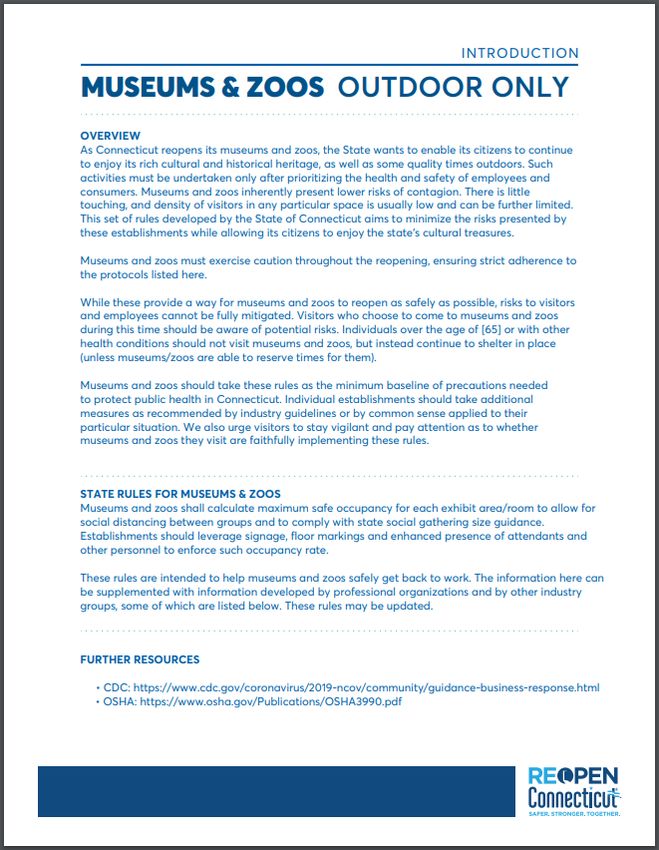
Data as of May 19, 2020

COVID is a major issue

                          Globally                                             United States                          Connecticut

                          4,952,763 confirmed cases                            1,513,503 confirmed cases              38,116 confirmed cases
                          63.5 per 100,000 people                              471.5 per 100,000 people               1,064.2 per 100,000 people

                          323,017 deaths                                       89,947 deaths                          3,449 deaths
                          4.1 per 100,000 people                               28.0 per 100,000 people                96.3 per 100,000 people

                          Over 1/3 of population                               US-wide restrictions                   CT-wide stay home, stay
                          currently under government                           ranked more stringent                  safe is less stringent than
                          imposed restrictions                                 than China at peak of crisis           other high infection states,
                                                                                                                      e.g, NY, MA, more stringent
                                                                                                                      than other states

Source: Washington Post, CDC, Express News UK, University of Oxford Blavatnik School of Government stringency index                                  3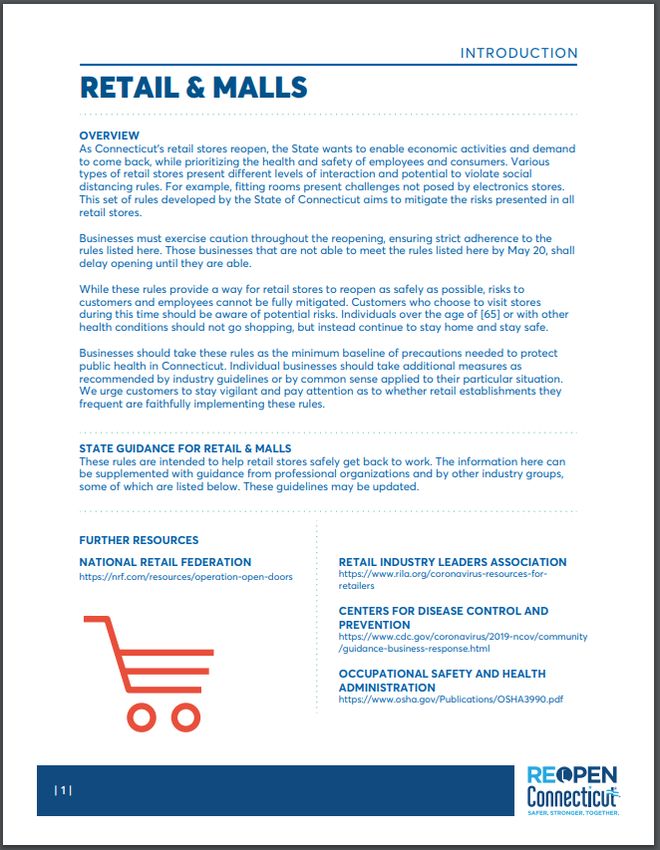
Features of COVID-19 which influence strategies for
intervention and reopening the State
   High transmissibility of the COVID-19 virus

   Large outbreaks in congregate settings such as nursing homes, prisons and workplace            We have to be
   High burden of transmission in densely-crowded urban centers which can serve as sources        prepared for the
   for spread to other communities                                                                risk of
   People who are infected with the virus that causes COVID-19 and have no symptoms or mild       resurgence in CT,
   symptoms play a major role in the community transmission of this virus from person to person
                                                                                                  even with
   High risk for severe complications and death among the elderly and those with underlying       implementation
   medical conditions
                                                                                                  of strong
   Key knowledge gaps at present                                                                  interventions,
    • How much transmission has occurred or may occur after we reopen
    • Whether transmission will increase or decrease in winter and summer seasons,                given the
    • The age groups (young adults, school children?) that contribute to transmission and
       serve as reservoirs for community spread
                                                                                                  transmissibility
    • Risk of severe complications in children (e.g. PIMS) and younger adults                     of COVID-19 virus
    • The nature of immunity after infection (lack of evidence for a back-to-work certificate
       based on antibody testing)

                                                                                                                      4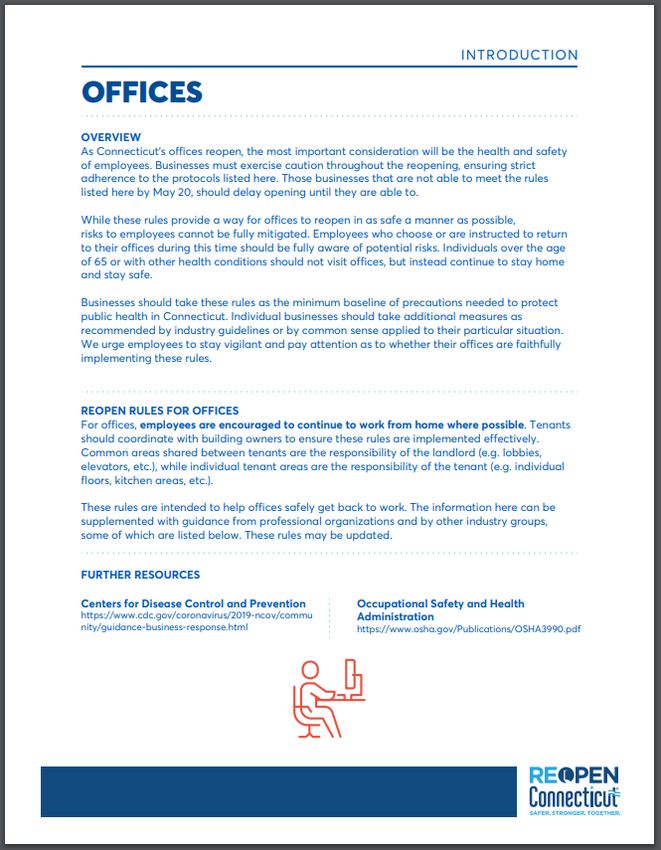
Initial priorities for phase 1 reopening

    Disease
  conditions
               1   COVID-19 related hospitalizations have a sustained decline during a 14 day period

               2   Execute widespread and streamlined testing of our people
       Virus
management
  (testing &
               3   Establish sufficient capacity for contact tracing and isolation
    tracing)
                   Implement a high touch program to protect persons and populations that are at higher
               4
                   risk for severe illness and death from COVID-19

 Healthcare
               5   Ensure our hospitals are able to provide optimal standard of care to all patients,
 capacity &        including those without COVID-19, as prior to the surge
   supplies
               6
                   Guarantee appropriate PPE is available to everyone who needs it
      “New
    Normal”
               7   Implement protocols to ensure appropriate safeguards are in place for safe opening of
                   each sector of our economy
                                                                                                           5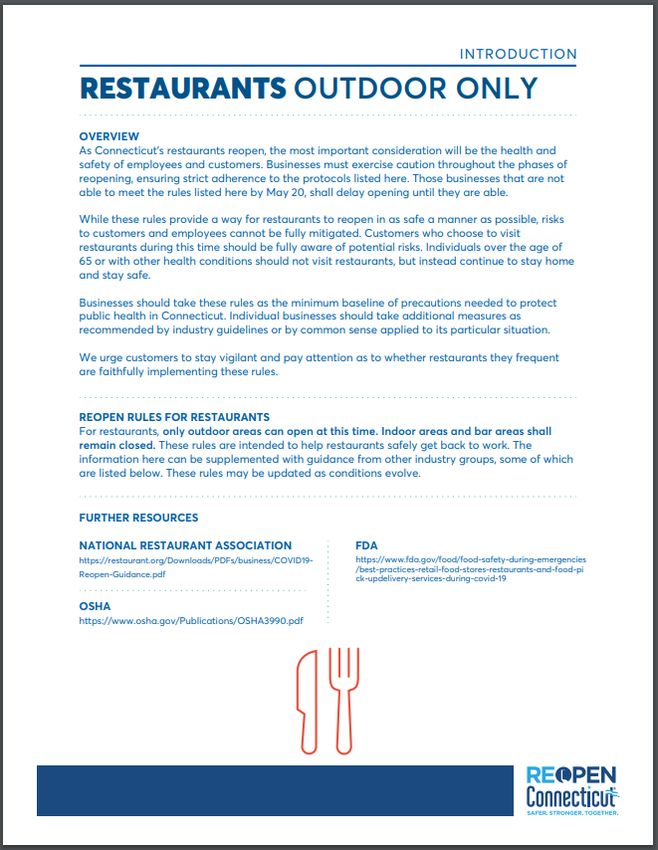
Hospitalizations        1
                      Confirmed COVID-19 hospital census by county (daily)

                      800                                                                55%
                                                                                           Decline
                      600                                                                since peak
In Connecticut,                                                                            (4/22)
                      400
there is cause for                                                                                       New Haven
                                                                                                         Fairfield
                      200
optimism …                                                                                               Hartford
                                                                                                         All others
                         0
                         03/22                  04/05                   04/19    05/03       05/17
Through "Stay
                      Confirmed new COVID-19 deaths by county (daily)
home, Stay safe",
                      250
CT is seeing                                                                                                 Fairfield

decreases in          200                                                                                    Hartford
                                                                                                             Litchfield
hospitalizations      150                                                                                    Middlesex

and deaths            100                                                                                    New Haven
                                                                                                             New London
                       50                                                                                    Tolland
                                                                                                             Windham
                         0
                                                 04/05                   04/19   05/03        05/17
                     Note: Data as of 5/20/2020
                     Source: CT Department of Public Health COVID-19 Updates                                      6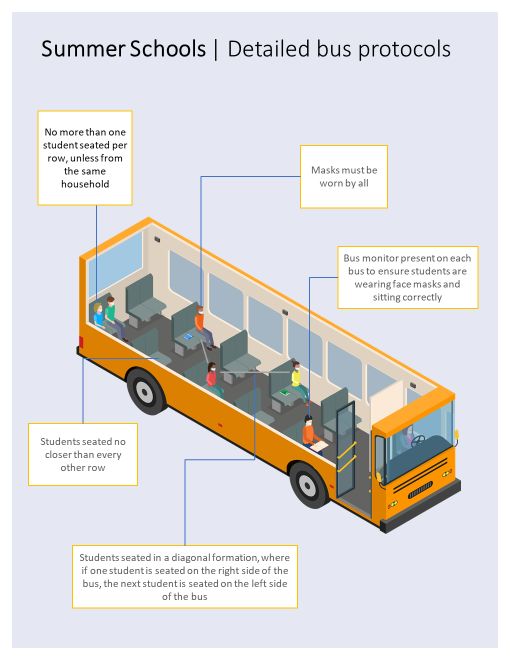
Testing       2

Guiding Principles for Testing and Isolation for COVID-19
    Large scale testing, as well as social distancing, public use of facemasks and best
    hygiene practices, is a critical path to an effective response

    Testing of targeted at risk asymptomatic infected individuals is essential to reducing
    transmission and preventing outbreaks

    Screening of staff will be required to protect individuals and staff that are more at-risk
    of infection and severe illness, particularly in our health care and correctional facilities

    Large scale testing needs to prioritize our cities, which have been disproportionately
    impacted by the epidemic and will be similarly impacted by COVID-19 in the future

    Provide guidelines and interventions to expand and promote safe testing at easily-
    accessible point of healthcare settings in our communities

    If testing is to be successful, individuals, whether COVID-19 cases or their contacts,
    will need active monitoring and strong and effective social supports during self-isolation
                                                                                                    7
Testing 2
Monitor transmission and
safeguard the health of the
Objectives community
of our
statewide Protect our critical and
testing most at-risk residents
strategy
Inform better decision-making
on ongoing reopen strategies
and protocols
8Testing 2
Testing during each phase of reopen is guided by specific
objectives and populations goals
Objectives Population goals Focus populations
Monitor transmission and Identify new community spread, All symptomatic individuals
safeguard the health of inform tracing and isolation, and
the community control large outbreaks Asymptomatic testing:
Mitigate community transmission • Nursing home, assisted living
Protect critical and by identifying asymptomatic and facility (ALF) staff
most at-risk residents symptomatic infected individuals • Nursing home, ALF residents
• Corrections facility staff &
Protect the population in
Inform better decision-making inmates
crowded and underserved areas
on ongoing re-open strategies • Individuals in high risk
and protocols Protect persons at higher risk for communities
severe illness and death from • Health care workers
COVID-19 • First responders
Ensure health of essential • Direct care employees,
members of CT workforce residents
Source: Reopen CT Health team Improve real-time and future 9
decisions at the state levelTesting 2
Connecticut is actively coordinating critical testing efforts, while
building a state-wide ecosystem to support broad access
The State will coordinate & partner in critical The State will enable the broader testing
efforts to ensure access to testing particularly for environment to expand across the state to
our higher risk persons and populations complement centrally coordinated efforts
Comprehensive testing at nursing Ongoing expansion of symptomatic
homes, ALFs, and prisons testing footprint through pharmacy
sites and existing health systems
Widespread access to screen both Targeted outreach into high-risk and
symptomatic and asymptomatic underserved areas by community
individuals in high-risk communities organizations and health system
partners
Recurring testing of critical workers
including first responders
10Testing 2
The State will support phased reopening with progressively
increased and widespread testing
Now (May 18) May 20 – Jun 20 Jun 20 – Phase 3 start Approx. Sept 1
# Tests
Build to 200k
per week
~45k Build to 100k Build to 170k + Additional for public
(end of
educational institutions
period)
Goals • Monitor transmission and safeguard • Expand efforts to protect • Provide broad testing to
the health of the community healthcare and other essential enable full reopening and
• Protect critical and higher risk workers reduce the probability of
residents • Expand efforts to protect future outbreaks
• Inform better decision-making on persons and populations at
ongoing re-open strategies, higher risk for severe illness
protocols and death
Focus • Symptomatic • Symptomatic individuals • Symptomatic individuals • Symptomatic individuals
individuals • Nursing home & assisted living • Nursing home & assisted living
populations • Point prevalence Phase in repetitive testing of: (ALF) staff staff
testing begun in • Nursing home staff • Nursing home & ALF residents • Nursing home & ALF residents
focus populations • Nursing home residents • Corrections facility staff & • Corrections facility staff &
including nursing • Corrections facility staff & inmates inmates inmates
homes and • Members of high risk communities • Members of high risk • Members of high risk
correctional • High risk health care workers communities communities
facilities • First responders • Health care workers • Health care workers
• Direct care employees and residents • First responders • First responders
• Direct care employees & • Direct care employees &
residents residents
• Faculty, staff, students of 11
state universities & schoolsTesting 2
The State will also put the best testing tools in place to learn about
COVID-19 prevalence and inform our future decision making
Currently in implementation Currently under consideration
Seroprevalence: Seroprevalence: Further study: Translating
Current snapshot in June Serial surveys evidence to intervention
Goals Goals Goals
• Understand what happened • Understand where infection is • Answer major questions on
during the outbreak: who and occurring rate and spread of infection,
where • Adapt interventions to immunity after infection,
• Enable the state to target optimize impact and mitigate reservoirs, and high-risk
their interventions • Safety monitoring for populations
reopening
Target population Target population Target populations
• 1,500 randomly selected • 3,000 randomly selected • TBD
adults adults
• NH residents and staff, HCWs, • PCR + Serology, using rapid
corrections staff and tests if validated
offenders, 1st responders • Every one to two months
• Serology done by lab network
• One-time, beginning in June
12Testing 2
Our approach to test symptomatic
individuals and trace contacts
For the symptomatic population
Negative test Our approach will
help prevent
outbreaks by
Individual is PCR testing Positive case ensuring access
symptomatic identified
Self-isolation to testing for
Active monitoring
symptomatic
Develop
individuals, rigorously
Track case
symptoms Trace contacts tracing contacts, and
during providing quarantine
quarantine
& isolation support to
Contact follow up Contacts
identified
avoid asymptomatic
Self-isolation Community (Using ContaCT) spread
support
Does not develop symptoms
during quarantine 13Contact tracing 3
Our priority is to scale tracing and provide support for
those in need during isolation
ContaCT will scale CT’s preexisting isolation efforts To ensure those impacted isolate safely, residents
across the state to reach and guide our residents will be supported through a range of measures
All COVID-19 positive individuals will be told to
The State will partner with community
self-isolate for a minimum of 10 days and 72
leaders to provide access to essential support
hours without fever (and 5 after symptoms),
including housing and food for those who can
and contacted by a health professional to
not self-isolate safely
actively monitor their status if they do not have
a healthcare provider
All contacts will be told to self-quarantine … while also providing access to the essential
for 14 days then contacted by a trained public healthcare, technology, and wellbeing
health professional each day to assess resources so that they are able to help stop
well being further transmission
Execution of these programs will be complemented with careful monitoring
14Higher risk persons
and populations 4
Persons and populations at higher risk for serious illness and death
from COVID-19 in CT
Nursing home residents1 Adults 60+ People of color2
3,461 Hospitalization and death rates are
2,190 deaths representing 62%
of all deaths in the state 2-3 times higher among our Black
Cases per 100,000
and Latino populations
100 Hospitalizations per 100,000
1,436
82 1,203 1,232 1,264 1,299
911 Hispanic 138
74
196 White 60
99
# nursing homes
0-9 10-19 20-29 30-39 40-49 50-59 60-69 70-79 80 Black 233
50
and
Asian 38
29 30 older
Deaths per 100,000
Incarcerated individuals3 Hispanic 22
0 White 21
0-10% 10-20% 20-30% 30%+ 598 confirmed COVID-19 cases in
Infection rate
CT prisons (~5.0% confirmed cases Black 51
~18,000 residents in facilities v. 1.1% for the full state)
with 10%+ infection rate Asian 6
Note: Data as of May 17, 2020, except where otherwise noted 1. As of May 20, 2020 2. As of May 3, 2020 3. As of May 15, 2020 15
Source: CT Department of Public Health COVID-19 Updates; CT Department of CorrectionHigher risk persons
and populations 4
Enhanced protection for persons and populations at higher risk for
serious illness and death from COVID-19
Regularly test nursing home & assisted living workers and residents to
Persons at Higher protect staff and residents from infection
Risk
65 or older, or with
Establish Rapid Response Team to address outbreaks and implement best
underlying conditions, in practices
congregate settings or Enhanced community outreach and support for residents 65 and older who
living alone are living alone
Establish culturally-sensitive community outreach and support programs to
reduce the impact of COVID-19 on the health of racial and ethnic minorities
Populations at and for people living in poverty and in densely populated areas who may
Higher Risk find it difficult to practice COVID-19 prevention measures such as social
distancing and to access health care
Department of Test DOC inmates & implement isolation and cohorting protocols to limit
Corrections spread
inmates & staff Regularly test DOC workers to protect inmates from infection
Each region must develop plans to support their vulnerable populations (e.g., food, housing) 16Higher risk persons
and populations 4
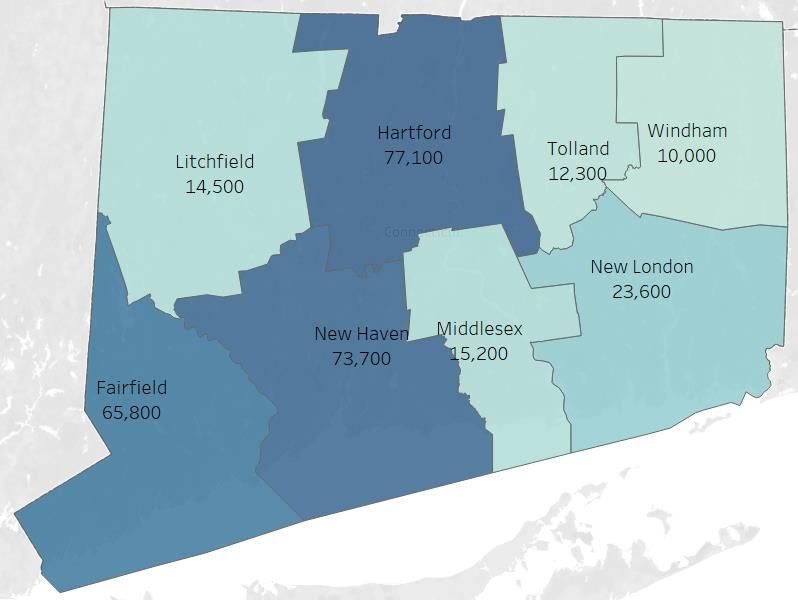
1.15 million Connecticut residents have two or more factors associated with an
increased medical risk of severe COVID-19 complications
Population with age 65+ and 2 or more
Underlying Conditions by County At Risk Populations
Total 65+
592,400
Underlying 65 Years
health or Older
conditions* 297,600 Total Underlying
Health Conditions
559,900 294,800 857,500
Total At Risk
1,152,300
Source: CT BRFSS Survey; 1. Two or more underlying health conditions 17Higher risk persons
and populations 4
We plan to support the higher risk persons and populations through six core
domains of support and accessible communications
Provide access to temporary housing
Ensure access to nutritious foods
if individual is unable to self-isolate
during duration of self-isolation
Temporary safely at home
Food Access Housing
Ensure access to telehealth and Personal care support, including
active monitoring personal hygiene
Technology & Holistic
Connectivity Wellbeing
Un-interrupted access to critical
COVID and non-COVID care in self- Job and salary protection for
isolation, including mental health individuals who are not able to work
Access to medications and Economic remotely while in self-isolation
Healthcare
medical equipment Relief
Ensure communications are accessible to all audiences, including ASL and
Communication
non-English speakers
18Higher risk persons
and populations 4
In the immediate term, to enable individuals to safely quarantine or isolate,
the State is considering two programs to ensure access to services and care
Active clinical monitoring Social support and wraparound services
Purpose: Ensure individuals who need to Purpose: Provide support to enable individuals to
quarantine or isolate (Q&I), have symptoms and do follow Q&I guidelines, by matching needs with
not have access to a health care provider, have existing resources including housing and food
active health monitoring while in Q&I
Process:
Process: • ContaCT platform will identify and refer
• ContaCT will identify and refer individuals in individuals in need of support at initiation and
need of monitoring to a clinical provider throughout self-isolation or self-quarantine
• These individuals will receive adequate clinical • Case workers will support individuals in self-
monitoring and treatment for COVID-19 while in isolation or self-quarantine by connecting them
Q&I, including providing as needed with State, local and regional resources as
thermometers and pulse oximeters and medical necessary
guidance throughout self-isolation 19Health care capacity
5
PPE supply 6
The State will closely monitor the
stockpile of PPE to ensure provisioning
of health services for the re-opening
Hospital network capacity and supplies PPE supplies stockpiled
The State’s healthcare systems needs to reopen to provide optimal An adequate supply of PPE is critical to
care that was interrupted by the epidemic ensuring a safe reopening of the economy
• Manage healthcare capacity through tracking key metrics across
4 prioritized resource groups State encourages private sector to
• Target metric levels defined for both reopening criteria and for procure their own PPE to met their needs
ongoing monitoring of reopening strategy
State is building a large PPE stockpile to
The State should maintain an adequate emergency reserve • Provide adequate supply for state
as it is doing agencies
• Ensure reserve stocks for critical
Equipment &
Beds PPE consumables Staffing shortages driven by unanticipated
increases in infections
Key metrics
% utilization of ICU # days inventory % utilization MD:patient ratio
& Non-ICU beds of critical PPE of ventilators RN:patient ratio
% reuse rate # days inventory
of consumables State stockpile:
2-3 month supply
Ongoing load balancing across system
20The likelihood of a COVID-19 resurgence is high even in the
optimistic scenario
We do not know at present how seasonality will influence COVID-19
transmission, but the potential is high that increased transmission will
The State will occur in the winter season when seasonal influenza is greatest
prioritize influenza
immunization to all A concomitant epidemic of COVID-19 with seasonal influenza will have
residents to protect major deleterious effects on our healthcare system since the State’s
hospital’s frequently enter surge crisis due to seasonal influenza alone
our population and
to safeguard our
The State will implement efforts to achieve universal immunization of
hospitals from a all residents who do not have a contraindication to influenza vaccine
concomitant COVID-19
and influenza The State will make provisions to secure an appropriate influenza
surge crisis vaccine supply, given the expected increased demand for the upcoming
influenza season
Immunization campaigns for seasonal influenza will be initiated in
early Fall
21We need to take steps to reopen our economy
Public Health
Assesses infection risk
to communities and
business sectors and
potential to implement Economic impact
risk-mitigation measures Assesses impact on state
• Widespread testing economic health with focus
• Contact tracing on number of unemployment
• Active monitoring claims filed, number of
• Quarantine and businesses affected, total
isolation employment within the sector
• Community support and GDP contribution from
• Social distancing the sector
• Hygiene safeguards
for business sectors
• Masks
22COVID-19’s impact on the economy has been significant
Loss of workforce
productivity …
4.8% 35K 531K
decrease in businesses unemployment
Q1 2020 GDP5 closed1 claims2
1300+ 37
… And significant schools closed
Universities closed
impacting
economic impact affecting
from school closures ~570K ~190K
students4
students3
1. Estimate only, excludes business that are voluntarily closed or are working from home, 2. From March 13 to May 18. Note: not all claims have been processed, 3. Includes
public, private and charter schools, 4.Includes private non-profits, public higher ed network, and UConn system. Does not include trade, vocational, for profit, military (Coast
Guard) 5. Decrease in US GDP
Source: IPEDS data; CT DOL 23While we kept more of our economy open than most states we have
experienced significant business and employment loss
A majority from closed businesses but also from businesses that remained open
Part of an ecosystem; work
GDP by operational state ($B)1 together towards recovery
Focus of next slides
1 2 3 4
106
246 38
77
25
Total GDP Open by law & "operational" Open but "closed" due to Working remotely Closed & non operational
e.g., essential retail, fear or lack of demand ("non-essential offices") ("public facing")
construction, manufacturing e.g., childcare e.g., technology, prof. e.g., restaurants, salons,
services, finance museums
Total
employment (#K) ~1,600 ~580 ~160 427 426
Unemployment
claims to date (#K) 100%2 13% 30% 14% 43%
1. Based on 2018 GDP from BEA; 2. Based on unemployment claims processed by May 18, 2020 24
Source: BEA, DOL, US Census BureauAs we Reopen CT, we must focus on what as well as how
How
What we
Phasing by we will
type of will open Rules and
business operate guidelines
25Each sector received a health risk score based on 2 dimensions
Adapted based on guidance from JHU School of Public Health
Contact intensity Modification potential
Weight: 40% Weight: 60%
Contact proximity Contact length Number of contacts Disinfection Social distancing
From St Louis Fed & O*NET From JHU*/qualitative From JHU*/qualitative From JHU*/qualitative From JHU*/qualitative
Expected proximity Average length of Approximate number of Ability to sanitize & Qualitative measure of
between employees, other interaction between people in the setting at the regulate – driven by enforceability of physical
employees, and customers individuals same time existing safety regime distancing measures across
e.g., current safety industry
Close physical proximity Higher interaction duration More contacts increases focus, government
poses higher public health puts employees and chance of exposure and inspection, strong Worse score for industries
risk given transmissibility of customers at greater risk could increase rate of industry groups where chance of deviation
COVID-19 transmission from regulations is high
Sub-weight: 33% Sub-weight: 33% Sub-weight: 33% Sub-weight: 50% Sub-weight: 50%
* Where possible; not available for all categories
Source: Johns Hopkins Bloomberg School of Public Health, St. Louis Fed 26Public health risk and economic benefit vary significantly by sector
Framework to think about what we will open and when
Public health risk from reopening
Based on contact intensity and modification protocol
3.0
Amusement, Recreation Bars
Performing Arts + Sports Education
2.5
Gyms and Fitness Venues
Other personal services
Hospitals (elective surgeries)1
2.0 Accommodation
Movies
Museums, Zoos, and Aquariums Hair & nail Restaurants Phase 1
1.5 Non-essential retail
Mgmt. of Companies Admin. and Support
Information ex. Movies Finance Prof. services
1.0
100 1,000 10,000 100,000
Closed and not operational Economic benefit from reopening
Size: Relative total # of employees in CT
Working from home Processed unemployment claims (since Mar. 1)
1. Includes all unemployment claims & employees for hospitals across CT (does not account for current operations as mostly related to COVID-19) 27
Source: CT DOL, St. Louis Fed, JHU School of Public HealthList of sectors open as of Phase 1 (May 20)
Never closed, open Manufacturing Utilities
under safe Construction Hospitals
workplace rules Real Estate Essential retail
Open under sector Restaurants (outdoor only, no bar areas)
specific rules Non-essential retail
Offices (continue WFH where possible)
Museums, Zoos (outdoor)
Outdoor recreation
Hair salons (June 1)
All sectors require strong distancing and hygiene safeguards and business can open only when ready and compliant 28Phase 2 & 3 business sectors to open
Phase 2 Accommodation (no bar areas) Movie theaters
Gyms, fitness, & sports clubs Bowling alleys
Approx.
All personal services Social clubs, pools
June 201 Outdoor arts, entertainment and All museums, zoos, aquariums
events (up to 50 people) Restaurants (indoor, no bar)
Outdoor amusement parks
Phase 3 Bars Outdoor events (up to 100
Indoor event spaces & venues people)
At least
Indoor amusement parks &
4 weeks arcades
later
1. While June 20 is the target date, the State will only move to phase 2 upon achievement of public health metrics 29Phase 2 education and community services to open
Phase 2 Selected youth sports (Jun 20) K- 12 summer school (July 6)
Public libraries (Jun 20) Other nonresidential programs,
All summer day camps (Jun 22) community colleges (July/Aug)
Nonresidential workforce Graduate programs (July/Aug)
programs (mid Jun) Undergraduate residential small-
Nonresidential scale pilot programs (July/Aug)
clinical/laboratory courses (mid
Jun)
Fall Undergraduate residential Boarding schools
programs
school K-12 Fall reopening (District
year calendar)
30
All sectors require strong distancing and hygiene safeguards and business can open only when ready and compliantGovernance plan to manage reopening criteria for each phase
Variety of state leaders Governor Lamont decides Criteria published to the
and experts provide input on reopening phase criteria public and tracked
Criteria released for
Legislators the next phase as we
enter the prior phase
Governor Lamont Criteria will be tracked
Public health as CT approaches the
experts next phase
Key CT agencies Criteria will evolve as we learn
consulting and supporting more about COVID and how CT
Business, education and in reopen criteria responds to each reopening phase
community representatives
CT could revert to a prior reopening phase if
One week of sustained increase in the seven day rolling average in new hospitalizations and 31
200 bed increase in the COVID-19 hospital census since beginning of the previous phaseReopening criteria for Phase 1 (May 20) have been satisfied 1. Sustained decline of 2. Widespread PCR 3. Sufficient contact 4. Protections for the hospitalizations testing tracing capacity most at risk Decline over a 14 day period without 42K tests administered per week with
5 criteria to progress to Phase 2

Declining transmission                  Testing and contact tracing           Business & social safeguards
                                         100,000 tests a week; connected with
Less than 100 bed net increase in                                              Rules and regulations disseminated
                                         >50% of identified contacts within 48
hospitalizations in last week of phase 1                                       two weeks prior to Phase 2 reopening
                                         hours

                  Protection for critical and at
                                                         Healthcare capacity
                  risk individuals
Social guidelines in place during reopening phases
Phase 1 Phase 2 Phase 3
65+ and high risk 65+ and high risk High risk
Stay home, stay safe for
at risk individuals
Worn at all times
Face masks / covering
Handwashing
Social distancing
Social gatherings
34With State OSHA input, guidelines were developed based
on social distancing and hygiene safeguards to safely
reopen key sectors during phases
Examples for three sectors—guidelines below are excerpts; full guidelines are posted on DECD website
Phase 1
Restaurants • Up to 50% capacity limit • Condiments in single use packets
outdoor only • 6+ feet between tables or containers
• Bars closed • Contactless payments and
• No recreation facilities paper menus
(e.g. pool tables) • Training, cleaning, signage,
PPE requirements
• Etc.
Guidelines for Phase
Offices, continue • Up to 50% capacity limit • Distancing in elevators
WFH if possible • Work from home if possible • Removal of non-essential 2 and Phase 3 to be
• 6+ feet between work stations amenities developed
• Thorough cleaning procedures • Training, cleaning, signage,
PPE requirements
• Etc.
Non-essential • Up to 50% capacity limit • Special requirements to open
retail and malls • Close all dining areas such as food fitting rooms
courts (take-out allowed) • Training, cleaning, signage,
• Enhance security presence to PPE requirements
prevent congregation of people • Etc.
35Phase 1 rules
by business
are posted on
DECD website
36A plan for repopulation of the campus
A plan for monitoring health conditions to detect infection
Higher education
reopening plans to
be developed A plan for containment to prevent spread of the disease
by each institution when detected
A plan for shutdown if it becomes necessary
Full report has been posted 37Public health guidance for colleges and universities in CT
Each specific guidance will be in force until relaxed by the State
Institutions may choose to impose stricter guidelines
Guidance element Specific guidance
Social distancing • 6 feet of separation whenever possible
Density of classrooms, dining halls, and other • 6 feet of separation between occupants
areas where groups congregate
Density of dormitories • Roommates and suitemates treated as a family unit. 6-foot spacing preserved with other dorm occupants
• (Density of bathroom use TBD)
• Students with pre-existing health conditions should be assigned to single-occupancy rooms
Personal protective equipment • All faculty, staff and students should wear masks
Disinfection • Hand sanitizer available at entrances to all buildings, classrooms, and dining halls
• Disposable wipes available in all bathrooms, classrooms, and other shared facilities (e.g. copy machines,
coffee stations, etc.) for wiping down surfaces touched before and after every use
• Frequent hand-washing and frequent deep cleaning of bathrooms and other high touch areas
Travel • Avoid unnecessary travel domestically and internationally
Faculty/staff work from home • Whenever possible
Faculty/staff advised to stay home • Initially, those 65 and over and/or those with high risk factors
Screening • Faculty, staff, and students should monitor their own symptoms and report them to health care providers
Testing • In non-residential test symptomatic; for residential students, test incoming students as they arrive on
campus (+ second round of testing within 7 to 14 days of the first) and faculty and student-facing staff be
tested shortly before residential students return to campus and re-tested periodically
Source: Report of the subcommittee on higher education, reopen Connecticut, corrected version—May 6, 2020 38Guidelines for
childcare centers,
summer camps and
K-12 summer schools
completed
Fall ReOpen plan
anticipated early
June
39Communications plan will educate and inform CT residents
What is the CT • CT is taking deliberate steps to prioritize health & safety, while reopening the economy
government doing? • While focusing on the public health of all residents, CT is prioritizing persons and
populations at higher risk for severe illness and death
• CT is posting specific rules and guidelines for sectors in each reopening phase, but guidelines
and recommendations may evolve over as time
How does COVID • Wearing a mask is the new normal, taking precautions like handwashing, using hand sanitizer
affect you? and regular disinfection are now commonplace
Why should I get • Getting tested is vital for identifying outbreaks, and preventing second resurgence of COVID
tested? • Testing will protect your loved ones, neighbors and community and allow the state to more
rapidly identify spread of the virus
How do I get tested? • Testing locations and the testing process are clearly laid out for you to access, so you can
identify a location and be tested easily. A state hosted website will provide all known testing
sites
What does it mean • You should work with the contact tracers and follow their instructions to reduce the spread
if I test positive? of COVID
• You should quarantine and isolate to reduce the spread of COVID, and you will be supported
What does it mean • You should quarantine and isolate to reduce the spread of COVID, and you will be supported
if I'm contacted?
What support is CT • CT is working with state, regional and local partners to develop programs for housing, food
providing? and health monitoring support for those in quarantine and isolation
• CT is protecting the most at risk persons and populations with testing, PPE and targeted 40
interventionsCommunications plan includes a variety of channels and
stakeholders to reach CT residents
Objective: Build trust in reopening plan with all stakeholders through consistent communication and
education
Key public health messages will be shared through a variety of channels to ensure the public is regularly
updated: Website, social media, press briefings, press releases, PSAs on TV/radio, digital advertising,
billboards, on- and offline print media, specific stakeholder communications channels
New website Reopen.ct.gov launched to provide access to reopening highlights, roundtable summaries,
reopening stories from all sectors and references for further information
Regular press briefings to provide updates and an open forum for the public's questions.
Regular press releases to provide written updates on key decisions and CT's health status
Roundtables held to provide open forums to discuss education, business and community topics
Education materials will be released on key opening criteria, business sectors and health and safety guidelines.
Specific attention for targeted communication to persons and populations at higher risk for severe illness and
death to ensure they are aware and comfortable
Key stakeholders (community leaders, etc) are partnered with and regularly engaged to inform their
constituencies and learn how their communities are impacted
41Risks that we are monitoring and actively managing
Testing ramp
Deployment of and
Second surge up delays and PPE procurement
resident participation
of outbreak residents’ willingness challenges
in contact tracing
to take tests
Reluctance to comply
Residents' reluctance
with safety Cross border with
to reengage with local
guidelines and neighboring states
commerce
intervention policies
42Experts assisted in developing this plan
Co-chairs of the Advisory Group
• Indra Nooyi
• Albert Ko
Health Business and economy Education Community Guidelines
• Alex Karnal • Oni Chukwu (Chair) • Richard Levin (Co-Chair) • Marcella Nunez-Smith (Chair) • Carrie Redlich
• Mehmood Khan • David Lehman • Linda Lorimer (Co-Chair) • Amy Porter • Sal Luciano
• Harlan Krumholz • Peter Denious • Miguel Cardona (Co-Chair) • Marie Allen • Kenneth Tucker
• Charles Lee • Alex Karnal • Rick Branson • Ken Alleyne • Edwin Camp
• David Scheer • Howard Hill • Steven Kaplan • Miriam Delphin-Rittman • Anne Bracker
• Josh Geballe • Karen Van Bergen • Alice Pritchard • Nora Duncan • Thomas St. Louis
• Matt Cartter • Joe Brennan • Jen Widness • Deidre Gifford
• Forrest Crawford • Rodney Butler • Rachel Rubin • Rochelle Palache
• Roberta Hoskie • Frances Rabinowitz • Jordan Scheff
• Steve Matiatos • Don Williams • Daria Smith
• Dan Meiser • Robert Raider • Michael J. Freda
• John Olson • Glenn Lungarini
• Timothy Phelan • Jan Hochadel
• Fran Pastore • Beth Bye
• Meredith Reuben
• Dave Roche
• Garrett Sheehan
• Jim Smith
• Pedro Soto
43You can also read


