SOARS RAVEN - UNC Greensboro
←
→
Page content transcription
If your browser does not render page correctly, please read the page content below
UNCG
FA L L 2 0 2 0

                       MAGAZINE

RAVEN                            Raven
                            Sizemore,

SOARS
                            first-year
                                honors
                               student

The aspiring music
teacher is inaugural
Sloan Scholar. Not
that she’d toot her
own horn.
PG. 40

SPARTANS’
IMPACT ON
PANDEMIC
PG. 22

BLM ART
ON ELM
PG. 28

PALMER
INSTITUTE
PG. 34

FALDERAL,
ANYONE?
PG. 38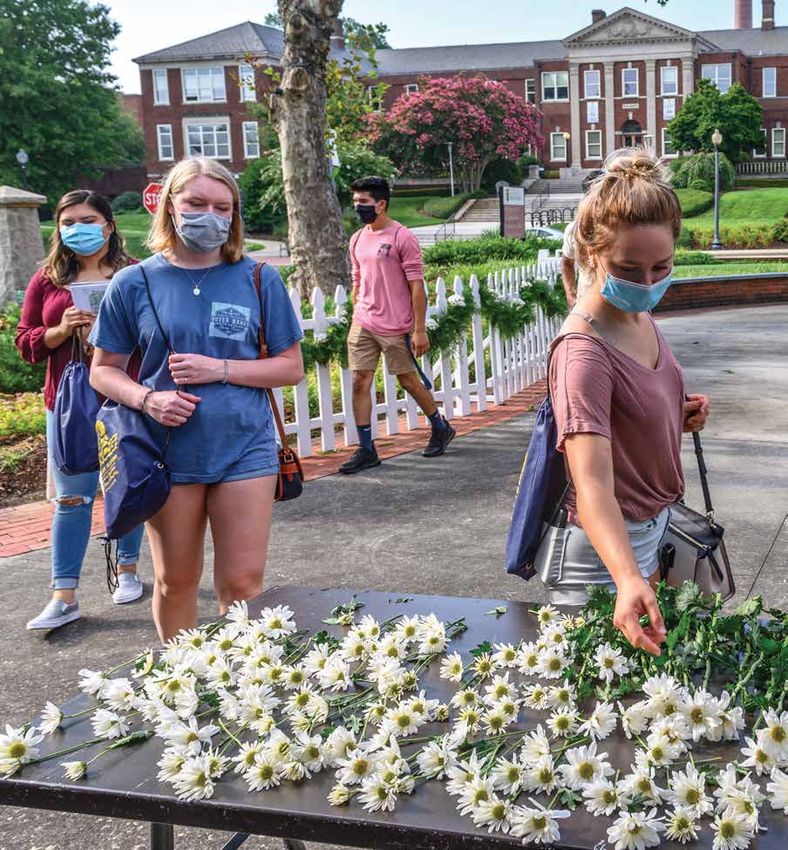
contents
                                                         2
                                                         news front

                                                         University and alumni news and notes

                                                        18
                                                         out take

                                                         Standing on ceremony, with flowers in hand

                                                        20
                                                         studio

                                                         Arts and entertainment

                                                        22 Novel Virus Requires
                                                        		 Smarter Approach
                                                        		        A more convenient COVID-19 test, bioactive
                                                        		        masks, moisture-repellent gowns, Selenium
                                                        		        studies, and nurses in action. UNCG alumni and
                                                        		        faculty are making a real impact with
                                                        		        innovations and research even as the pandemic
                                                        		        alters how we live.

                                                        28

                                                                  Represent
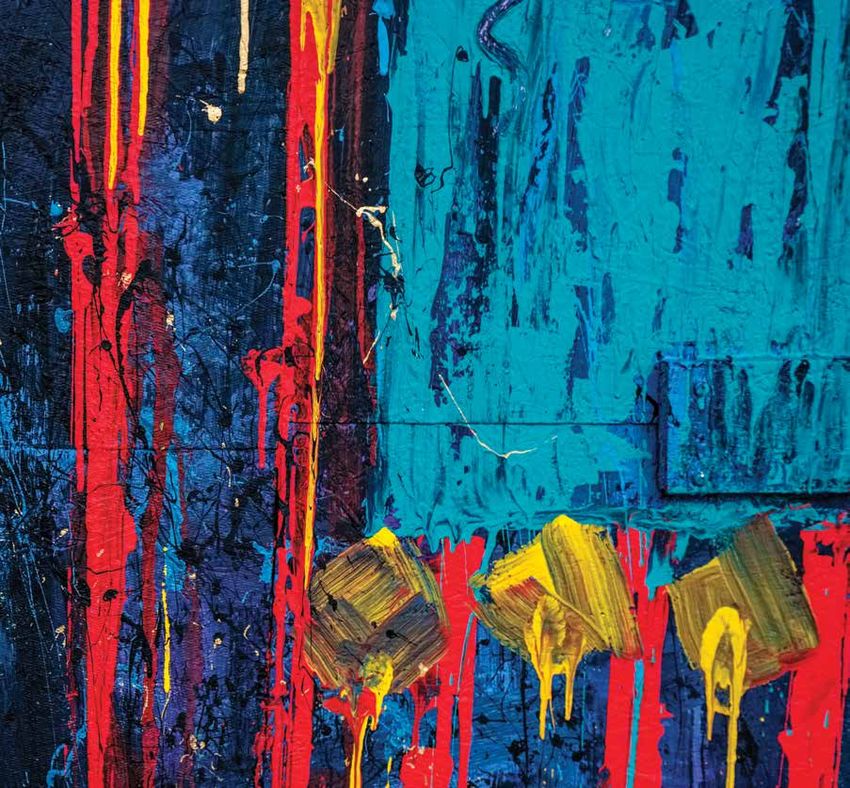
                                                                  Spartan artists proclaimed Black Lives Matter in
                                                        		        bold strokes last summer, as the nation confronted
                                                        		        the litany of deaths of Black Americans at the
                                                        		        hands of police and vigilantes.

                                                        34

                                                                  Lessons from the Past
                                                                  As Lacey Wilson ’18 MA joins the Charlotte

4
                                                        		        Hawkins Brown Museum as the new site director,
                                                        		        she and fellow Spartan staff members connect
                                                        		        its history to today’s pressing issues.

                                                        38
    PICKING FLOWERS First-year students started the
    year learning the campus’ oldest traditions. The
    campus Old Bell rang to welcome them, just as it
                                                                  Falderal, Anyone?
                                                        		        If you recall the Homecoming festivals of the 70s,
    has since the campus’ earliest days. They learned
                                                        		        80s, and 90s, you remember some terrific times!
    the lyrics to the school’s alma mater. And – in a

                                                        40
    socially distanced manner of course – each placed
    a fresh daisy in a modern-day daisy chain. We
    noticed a few were placed at the base of Minerva
                                                                  legacies
                                                        		        Endowed by Linda Fisher Sloan ’82 MFA and
    as well – another tradition. With everything that
                                                        		        Thomas R. Sloan, the Sloan Endowed
    seemed so unusual this semester, these timeless
                                                        		        Scholarships will help Spartans achieve their
    nods to heritage were a thing of beauty.
                                                        		        dreams. In UNCG Athletics, the Hoyle family and
                                                        		        Bodford family are real stars in the Campaign
                                                        		        for Champions.

                                                        42
                                                         grad tidings

                                                         Lots of class notes and pictures, too

                                                        		 Cover photography: Raven Sizemore, first-year
                                                        		 honors student and inaugural Sloan Scholar
                                                        		 By Martin W. Kane

                                                                  Check out the magazine website
                                                                  Visit alumnimagazine.uncg.edu to enjoy the
                                                                  digital version of the magazine in both photo-rich
                                                                  stories you can easily share on social media and
                                                                  in PDF format. While there, you can also submit a
                                                                  class note, view video clips, or click on archives
                                                                  to see former issues.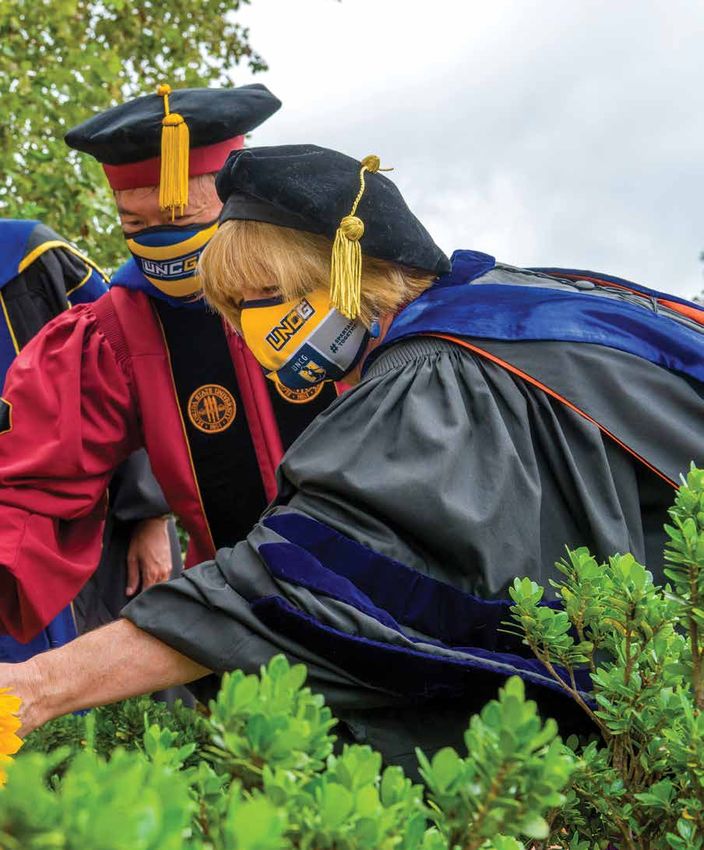
U
         bigpicture

       NCG has been a remarkable place
       during these extraordinary times.
   In our faculty and staff, I see tireless
dedication to our mission – literally
thousands of people pulling together
to create the best
possible academic,
                                                        newShield our
                                                           Spartans
social, and cultural
experience for our
students as they
pursue their
                                                           The three Ws. “Wear. Wait.             students as classes began, “More
dreams.                                                    Wash.”                                 than ever our shared success
   In our alumni, I                                           As students returned to campus      this year depends on you, each
see passionate                                             in early August, safety was a          and every one of you. And you
                                                           priority. COVID-19 protocols           have to do your part. Wear a face
support and a
                                                           were key.                              covering when you’re on campus
willingness to give                                           Wear a face covering.               in class and in the community.
time, expertise,                                              Wait in line at least 6 feet from   Wash your hands frequently. Keep
and treasure                                               the next person.                       your distance on campus and off
                                                              Wash your hands regularly.          campus. Your actions matter. We
where all of these
                                                              Through social media, through       have to work together wherever
resources are           FRANKLIN D. GILLIAM, JR.           signage in buildings and along         we are to keep each other safe.”
much needed and CHANCELLOR                                 sidewalks, via emails, through            As of the print deadline for this
deeply appreciated. Spartans are com-                      video, the campus community            magazine, Sept. 25, the precautions
                                                           was reminded again and again.          have kept illness from spiking.
ing together to support UNCG and our
                                                           As Chancellor Gilliam told the         No clusters of COVID-19 in the
students in new and meaningful ways.
   In our community, I see the power of
our shared place and fate and the unique
role we play in making Greensboro a
vibrant city.
   And most of all, I see in our students
resilience, persistence, focus, and                PRIORITIES AND PROOF
strength. They have earned our admira-             UNCG’s priorities are built around excellence, opportunity, and impact. In

                                                                                                                                         CHANCELLOR’S PORTRAIT PHOTOGRAPHY BY MICCICHE PHOTOGRAPHY
tion and respect. They have embraced               2017, Chancellor Gilliam signed off on strategic goals in these areas, as part
                                                   of the UNC System goals. How are things going?
life-saving community standards in ways
                                                     UNCG was recognized as the only System campus to exceed each of its
that have directly contributed to our              nine strategic plan metrics in the most recent year.
ability to manage this pandemic as effec-            Of all of the UNC System campuses, three – UNCG, UNC Charlotte, and NC
tively as possible. I am grateful to them,         State – met or exceeded their annual targets on all five of their priority metrics.
                                                     Priority goals for the 2017-2022 plan for UNCG include enrolling a
proud of them, and inspired by them.
                                                   substantially higher number of low-income students, graduating about one-
   Better days are ahead. For the present,         third more low-income students, greatly improving the five-year graduation
we face our challenges united by our               rate, reducing by 50% the achievement gap among underrepresented minority
common purpose as “one great unbroken              students, and producing nearly 20% more critical workforce credentials.
                                                     “Ensuring our students succeed and helping meet the needs of our state,
band,” as our school song says.
                                                   even during the most challenging times, are what we must do. Working
                                                   together, we are making a huge impact,” said Chancellor Gilliam.

2   UNCG magazine   °   Fall 2020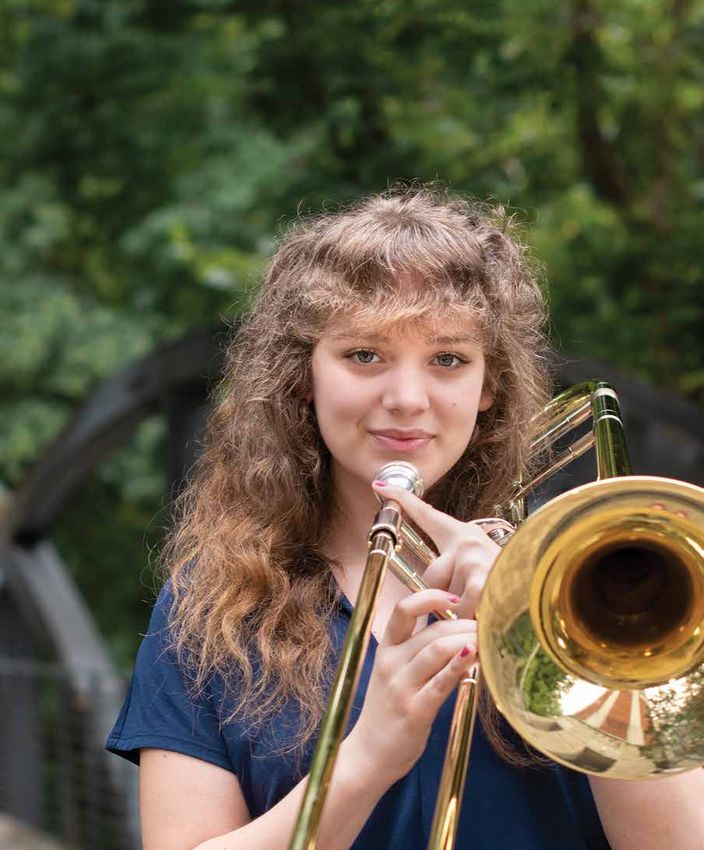
sfront
                                                                                                               “ More  than
                                                                                                                 ever our
                                                                                                                   shared success
campus community have been                                                                                         this year
                                                                                                                   depends on
detected. A COVID-19 online
dashboard kept the community
informed. The largest number                                                                                       you, each and
                                                                                                                   every one
of new positive COVID tests for
students so far is 18, reported the
last week of August.
   The chancellor continues to note
that everyone needs to be flexible.
                                                                                                                   of you.
                                                                                                                                 ”
We don’t know the future. But
the actions of each member of the
Spartan community brought the
opening of the school year cause
for hope – that this will remain an
impactful, on-campus experience
for our students.

               FIVE-YEAR
                                                                  LOW-INCOME                                           CRITICAL
         GRADUATION RATES:
                                                                 ENROLLMENTS:                                       WORKFORCES:
     By 2022, UNCG will improve
                                                          By Fall 2021, UNCG will enroll                         By 2021-22, UNCG will
    its five-year graduation rate
                                                           8,161 low-income students,                       produce 1,544 critical workforce
   from any accredited institution
                                                            a 15.1% INCREASE over                              credentials, an increase of
         to 62.4% . This is an
      improvement over a base
                                                           2015 levels (1,072 additional                     19.5% (252 additional critical
                                                            low-income students over          ACHIEVEMENT      workforce credentials over
          of 56.7% for UNCG’s           LOW-INCOME               a base of 7,089).       GAPS IN UNDERGRADUATE      a base of 1,292).
              2010 cohort.             COMPLETIONS:
                                                                                        DEGREE EFFICIENCY:
                               By 2021-22, UNCG will produce
                                                                                    By 2021-22, UNCG will reduce
                                2,115 low-income graduates,
                                                                                     by 50% the achievement
                                  an INCREASE OF 32.5%
                                                                                        gap in undergraduate
                                 (519 additional low-income
                                                                                      degree efficiency among
                                   completions over a base
                                                                                         underrepresented                    SEE THE RESULTS
                                          of 1,596).
                                                                                          minority students.                 ON THE UNC
                                                                                                                             SYSTEM WEB SITE.

                                                                                                               Fall 2020 °   UNCG magazine     3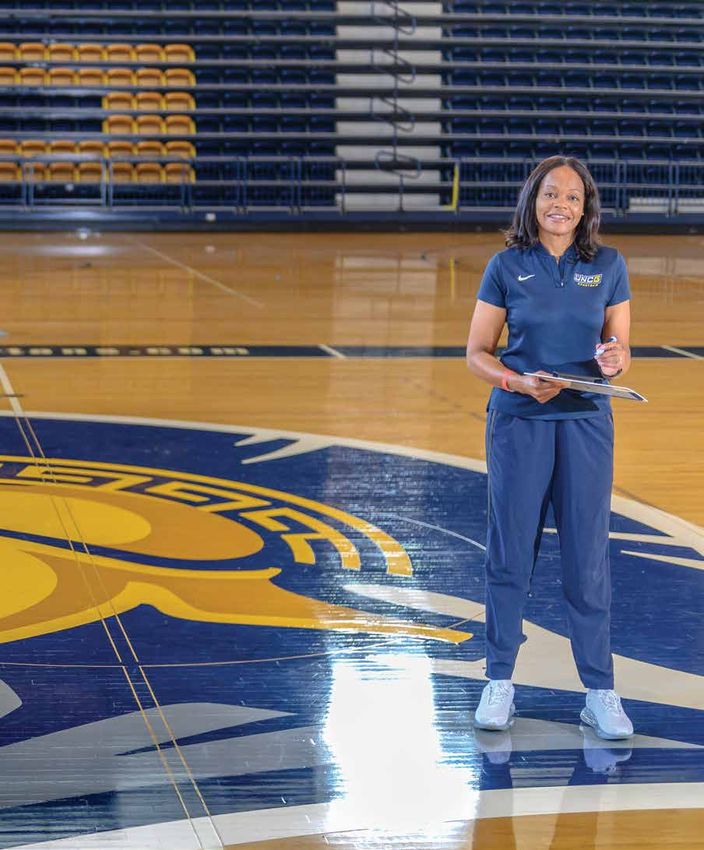
news
    front
 PA N D E M I C
  REPORT

CLASSES DURING COVID
T
        he semester would have no fall break, and     Many faculty wore clear faceguards as well.
        exams would begin in November. Arts              They managed traffic in hallways and           HOW WERE CLASSES HELD?
        performances were canceled or postponed       staggered the way people enter and leave          The average in-person class, as of
until later. In-person conferences and symposia       classrooms and buildings.                         the first of September, had fewer
were rescheduled. Fall sporting events would not         The biggest constant, everywhere you went?     than 17 students. For students
be held.                                              Face coverings. UNCG required all students,       attending in person, social
   Even move-in was radically different. And          faculty, staff, and visitors to wear a face       distancing was key – as was
it worked.                                            covering while indoors on campus and outdoors     everyone wearing face coverings.
   Students had a two-stage approach in early         when social distancing could not be maintained.   As for the large lecture-hall
August. In the drop-off stage, they unloaded          While they were provided to students and          classes – and many other course
their items in their rooms and returned home.         employees, many created their own.                offerings – they had been
They knew it as “Stop, drop, and roll.” And days         For dining, capacity at dining venues was      transformed into online classes,
before classes began, a final move-in stage. Still,   reduced by 50%, and new to-go dining              using video platforms such as Zoom.
the students had been told to bring only what was     locations were set up.
needed. The future wasn’t known.                         Even riding a bus was different. All
   The residence halls adjusted guest visitation      occupants of buses wore face coverings, and
policy to limit visitors. They increased cleaning     bus capacity could not exceed 50%.
in common areas.                                         For students who tested positive or were in
                                                                                                           REMOTE         IN-PERSON
                                                                                                             48%             44%
   Throughout campus, staff ensured everyone had      close contact with someone who did, the
personal protective equipment and could maintain      University created quarantine and isolation
social distancing by making modifications in          facilities for students.
classrooms, dining areas, residence halls, etc.
   The number of students living in residence           READ WHAT SEVERAL PROFESSORS
halls was about 70 percent of the usual number.         WROTE ABOUT THE YEAR AT
   All in-person classes were socially distanced,       UNCGREENSBOROAAUP.WORDPRESS.COM/
                                                        COVID-19-ESSAY
with all participants wearing face coverings.                                                                        HYBRID 8%

4   UNCG magazine    °   Fall 2020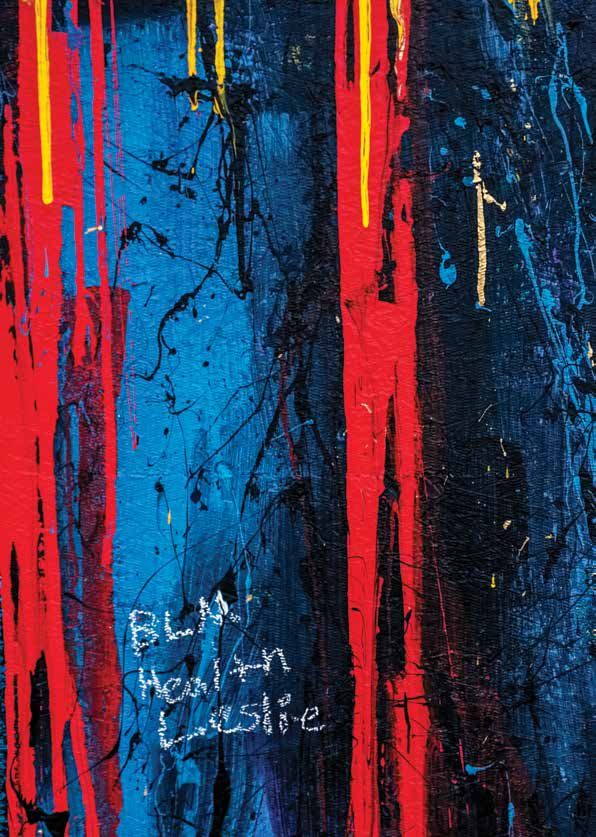
In class, face coverings
                                              were essential. Between
                                              classes, students wore
                                              face coverings if they
                                              couldn’t ensure social
                                              distancing. And once the
                                              Kaplan Center for Wellness
                                              was open in September,
                                              the climbing wall required
                                              face coverings, as well.

                                                                                                                                    9,255 STUDENTS
                                                                                                                                    RECEIVED A TOTAL
                                                                                                                                    OF $8,727,400
                                                                                                                                    THROUGH AUG. 4.
                                                                                                                                    Beginning in March, many
                                                                                                                                    students’ lives were
                                                                                                                                    disrupted. The federal
                                                                                                                                    CARES Act Emergency
                                                                                                                                    Grants were released
                                                                                                                                    directly to students for
                                                                                                                                    expenses such as food,
                                                                                                                                    housing, technology needs,
                                                                                                                                    childcare expenses, and
                                                                                                                                    more resulting from the
                                                                                                                                    campus disruption. Some
TOTAL POSITIVE CASE                                                                                                                 students applied; others
COUNTS SINCE JULY 1,                                                                                                                automatically received
2020 A UNCG COVID-19        Students                     Staff                    Faculty                 Contractor
                                                                                                                                    assistance based on
dashboard maintained
a running total of all                                                                                                              qualifying factors including
reported positive cases
                              61                           4                        1                         3
                                                                                                                                    those with lowest
that had the potential
to impact campus. The           Since July 1, 2020           Since July 1, 2020      Since July 1, 2020        Since July 1, 2020   estimated family
total as of September 13.                                                                                                           contribution (EFC).

                                                                                                                                    Fall 2020 °   UNCG magazine   5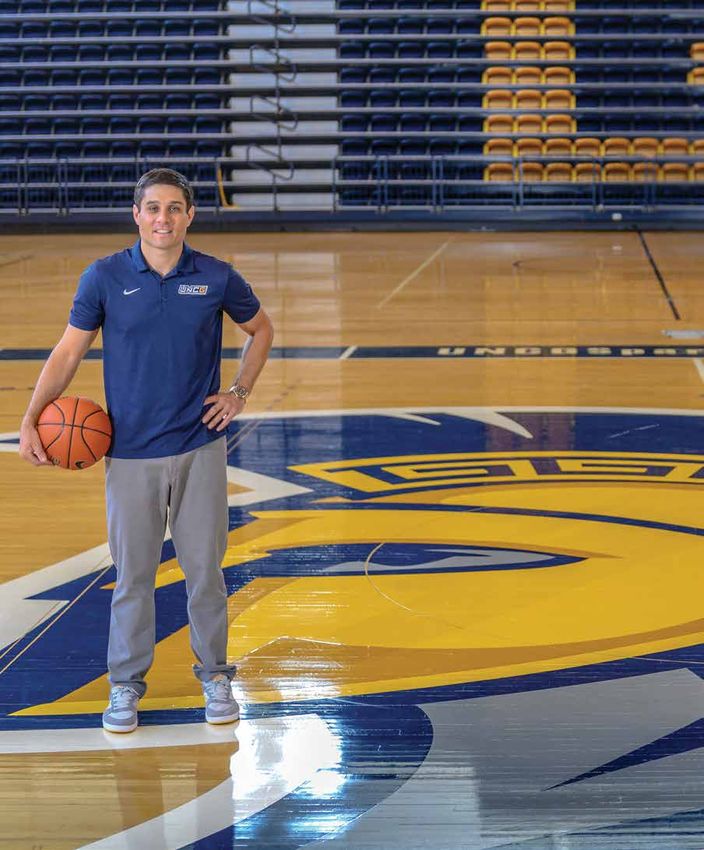
news
    front

Take care of
each other
“I will never forget how you aided me in my time of need,”
wrote one health and human sciences student to UNCG’s Division
of Student Affairs. “I was going to be in way over my head this
summer with bills and tuition.”
   Because of the COVID-19 pandemic, this student – and others –
found their university experience dramatically changed. They had to
adapt to online classes at the end of March, and many were faced with
new obstacles. Where should they live, how will they get there, where
will they eat? Some struggled to support not only themselves but also
loved ones they live with or care for.
   UNCG stood ready to help. In April, faculty, staff, and alumni banded
together to strengthen safety nets addressing immediate student needs.
Among these is the Student Assistance Fund for Emergencies (SAFE).
   Established by the Class of 1967 and operated by the Division of                                      GIVETO.UNCG.EDU
Student Affairs, SAFE provides one-time assistance to matriculating students
experiencing financial emergencies. These grants have covered sudden expenses for
housing, traveling, and education throughout the pandemic.
                                                                                                                            212
   Its work continues this fall.
                                                                                                                        students in
   “Our students need us now more than ever,” says Dr. Brett Carter, associate vice chancellor and                    immediate need
                                                                                                                       have received
dean of students. “We are creating a culture of care, which in turn motivates our students to become their best selves.”
   As of September, the Office of Student Affairs had awarded $98,000 to 212 students through SAFE. The average
award is $462. The office has been flooded with gratitude.
                                                                                                                       an average of
   “Thank you for providing this fund to students who are struggling,” said a Class of 2020 graduate. “I cried with
gratitude when I learned I would get help. Because of this award, I was able to
                                                                                                                           $462.
finish my master’s in human development and family studies and feel hope again.”          SEE GIVETO.UNCG.EDU.

                                                                                               SPARTANS DON’T LET
                                                                                               SPARTANS GO HUNGRY
                                                                                               Meals have not been a sure thing for a lot
                                                                                               of students during this pandemic.
                                                                                               Hardships such as job loss and family cri-
                                                                                               ses have exponentially increased student
                                                                                               need. Founded, funded, and operated by
                                                                                               Wesley-Luther campus ministry, Spartan

6   UNCG magazine   °   Fall 2020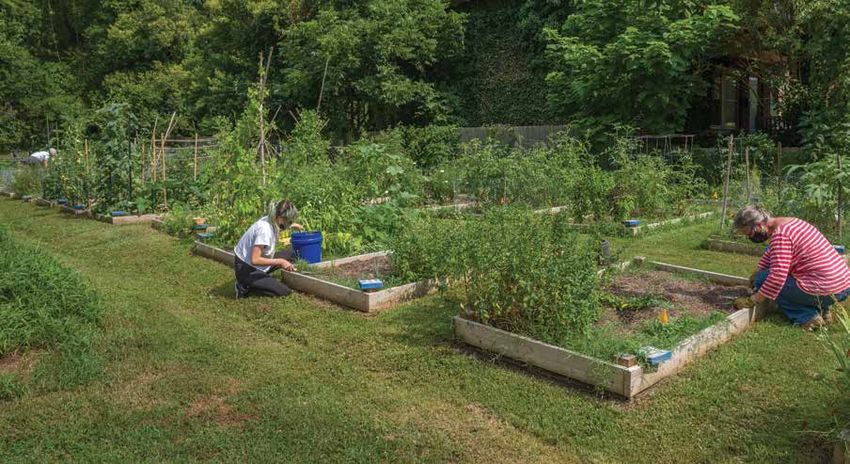
GREEN
THUMBS UP
IN THESE DAYS of face coverings and social           “Knowing that someone is growing those
distancing, many Spartans have turned to gar-        vegetables specifically for them helps reinforce
dening as a way to find solace during difficult      that there is a Spartan community that cares
times and to reconnect with nature.                  about them. Each act of caring, be it growing
   One site of Spartan gardening has been there      vegetables in the UNCG Gardens or baking
all along – UNCG Gardens. Celebrating their          goods for weekly dinners, creates a network of
10th year, the fully organic gardens are a com-      support that many students need during this
munity effort among faculty, staff, and students     challenging time.”

                                                                                                        “
in which participants learn all about site prepa-      Anthropology professor Susan Andreatta and
ration, planting, maintenance, and harvesting.
   The gardens are also a source of donations to
                                                     student volunteers have managed the day-to-
                                                     day of the gardens during the pandemic, and
                                                                                                          It’s a way
UNCG’s Spartan Open Pantry (SOP).
   “Students appreciate the opportunity to have
                                                     the result of their hard work shows. Dr. Corey
                                                     Johnson (Geography, Environment, and
                                                                                                        for students
fresh vegetables and leafy greens to round out       Sustainability), Jarrod Pratt (Facilities             who are
                                                                                                          using the
what nonperishable food we normally have             Operations), and Guy Sanders (Housing &
available,” says SOP director Andrew Mails.          Residence Life) also work on upkeep of the site.

                                                                                                          pantry to
                                                                                                        supplement
Open Pantry (SOP) has been serving
hungry UNCG students since 2009. With
                                               and non-perishable pantry
                                               staples for students who need them.
                                                                                                          their diet
nearly one in three students reporting         Some new SOP To-Go campus locations                            with
food insecurity over the last year, SOP        have opened this fall. Donations are
                                                                                                           healthy,

                                                                                                                                      ”
provides a lifeline. Want to help? The         accepted at giveto.uncg.edu.
Spartan Food Insecurity Fund works in               FOR MORE INFORMATION,                               fresh foods.
conjunction with Spartan Open Pantry to             HTTPS://SA.UNCG.EDU/                                – SOP student director
provide access to snacks, light meals,              SOP-SPARTAN-OPEN-PANTRY                                 Kellie Thomas

                                                                                                        Fall 2020 °   UNCG magazine   7
news
    front

Hagan and
Richburg
honored                                                                       SENATOR KAY HAGAN                       DR. ANTONIA MONK RICHBURG

UNCG’s Distinguished                  service at the state and local level.     and nation. She was a devoted,        Grantmakers. She is also a member
Service Awards represent the             The late Honorable Kay Hagan           inspirational woman whose life        of the United Way of Greater
most prestigious public service       will receive the Charles Duncan           touched so many.                      Greensboro Board of Directors. Her
honors conferred by the University.   McIver Award. She served as                  Dr. Antonia Monk Richburg          outstanding career and community
Named for UNCG’s founding             United States senator from 2009           ’87, ’00 MPA will receive the         work as an advocate for access to
president, the Charles Duncan         to 2015 and as NC state senator           Holderness/Weaver Award. She          health care and support services for
McIver Award is the University’s      from 1998 to 2009. At UNCG                serves as vice president and senior   the disenfranchised align with the
highest public service honor and      she served on the Friends of the          program officer for the Cone Health   mission of both our University and
recognizes extraordinary service      Library Advisory Board and the            Foundation, as well as chair of the   the namesakes of this award.
at the national or international      Excellence Foundation Board               Greensboro Housing Coalition             A formal award presentation
level. The Holderness/Weaver          of Directors. Throughout her              Board of Directors and vice chair     ceremony is planned for Spring
Award is named for Adelaide           career, Senator Hagan advocated           of the North Carolina Network of      2021.

                                                                              “Both
Holderness ’39, the first woman       for the state of North Carolina
to serve on its Board of Trustees,    and its citizens with dignity and              of our honorees set the standard
and H. Michael Weaver, a longtime     determination. “Service” is our          for selfless service in our community,
                                                                                                           ”
UNCG supporter who has served         University motto, and Senator
the University in many capacities.    Hagan embodied distinguished             our state, and our nation.
The award recognizes exceptional      service to the community, state,          — Betsy Suitt Oakley ’69, chair of UNCG Board of Trustees

100 YEARS AT SHAW Shaw is the oldest residence hall in
the Quad. Designed by notable architect Harry Barton – as were all the
Quad halls – it opened for the 1919-20 academic year. During the Quad
renovation 90 years later, Shaw was the most heavily redesigned
building. The columns and portico were retained, and an opening was
carved through the middle, presenting a grand entryway into the
Quad. A new, large plaza was added, along with new dorm rooms and
large seminar rooms.
  This year the Shaw Residence Hall is celebrating its 100 years of
history, as it moves into its second century.
  Alumni Engagement, University Events, and University Housing will
                                                                                                                                                             PHOTOS COURTESY OF UNCG ARCHIVES

host a reunion for all Shaw residents, past and present, during
Homecoming on Saturday, Oct. 24, at 2 p.m.
  The event, to be held online, will include stories from students, virtual
                                                                                            Top: Shaw Hall, 2020;
tours, historical videos, and more. See details at homecoming.uncg.edu.                     Above: Shaw Hall,
  Have stories or photos to share from past years at Shaw, as this event                    1920; Right: Shaw
approaches? Email alumni@uncg.edu.                                                          dorm room, 1957

8   UNCG magazine    °   Fall 2020
ALL THINGS
ACADEMIC
NEW UNCG PROVOST JIM COLEMAN views public higher education Provost Jim
as “one of the most brilliant ideas that humans have ever created.” Coleman
It’s challenging and political, yes. But the profound impact on
people’s lives – through teaching, research, community engage-
ment, and service – is second to none.
Coleman’s passion has propelled his 30-year career in higher
education. He comes to UNCG from the University of Arkansas,
where he also served as provost. He succeeds Dana Dunn, who
had served as UNCG provost since 2014.
An accomplished plant physiological ecologist, Coleman
received his PhD from Yale University. When he started his career
as an assistant professor at Syracuse University, he never imag-
ined working in administration. But after a yearlong stint at the
National Science Foundation – in which he was responsible for
managing $10 million in research funding – he realized he enjoyed
facilitating the success of other people and of organizations. And
he was good at it, too.
As provost, Coleman oversees everything academic – students,
faculty, research, and curriculum. He views his work as “ethereal in
nature.” He encourages faculty and staff to develop graduates
who are propelled on to
meaningful and successful lives; conduct research,
scholarship, and creative activities that change fields of study and
that matter to people; and improve the quality of life and well-
being in our community and beyond.
This year, he is focused on navigating the University through
the COVID-19 pandemic. More broadly, he shares Chancellor
Gilliam’s vision of becoming the national model for how a univer-
sity can blend excellence, opportunity, and impact. He’s passion-
ate about student success – increasing retention and graduation
rates – and equity and inclusion. His father was a professor and
civil rights leader in Pittsburgh, and his mother was a special edu-
cation teacher. Coleman has continued their legacies throughout
his career.
“Higher education as a whole has started to become an enforcer
of social inequality as opposed to the great equalizer. It’s schools
like UNCG that are still committed to that original mission,” he says.
“We also have high-quality research, and a deep commitment to
the city and the region. I came to UNCG because it checks all of
those boxes that I’m passionate about.”
Fall 2020 ° UNCG magazine 9news 1918 Peace Parade
front
Echoes
of 100
years
This year marks the 100th anniversary of the 19th Amendment,
codifying women’s suffrage in the U.S. This campus’ alumni magazine of PATRIOTISM PERSPECTIVE
the late 1910s, as WWI concluded, took on two big societal issues: women’s Is it a mere theory that, if women are granted suffrage,
suffrage and equal pay for equal work.
they will help to end the war? Perhaps. But have not the
Equal Pay for Equal Work? majority of ideas been “mere theories” before they were
(in June and November 1918 Alumnae News issues) proved to be facts? And there is no way to prove a theory
The magazine asked prominent people in the state about the equal pay except by trial. Is it illogical? Possibly. But certainly not
question. Among the printed responses, some excerpts: more illogical than that one-half of the world should
make laws which the other half must obey, and decisions
I am told by those who have investigated the subject,
in the consequences of which the other half must share.
that men, because they are men, are being paid from
... It is entirely conceivable that, after this war is over, the
30 to 80 per cent more than women for the same work
mothers of the world, if they are granted suffrage, will
in our schools. This is not fair, nor do I believe that the
find some way whereby their sons may be allowed to live
argument of “supply and demand” answers the question. for their country instead of die for it.
It merely serves to becloud the issue. — Minnie Mclver Brown — Clara Booth Byrd ’13, co-editor, June, 1917 (excerpt)
1899, director of State Normal College
Replying to your esteemed favor of the 5th, I beg to say
that the proposition that “justice requires that the amount The students were chagrined at
of compensation should not be regulated by sex, but by the THE the 1915 commencement when
Governor Craige spoke against
amount of service rendered” is so manifestly correct as to RIGHT TO women’s suffrage. That year, many
require no support. My own opinion is that the salaries
VOTE
students marched on College
of all public school teachers in North Carolina should be Avenue for women’s right to vote.
In 1918, 575 of the 650 students
increased at least 50 per cent. — T. W. Bickett, governor
signed a petition for women’s
If a woman does as good work as a man and does as suffrage. In the October 1919
magazine, co-editor Clara Booth Byrd ’13 made it plain:
much of it, then she should be paid as much. If she does not
“The suffrage battle is practically over. There remains
do so much or does not do so well, she should be paid less. before us only the question of ratification. Surely our own
If she does better or does more, then she should be Tar Heel State, foremost in so many movements, will not
PHOTO COURTESY OF UNCG ARCHIVES
paid more. This principle, I think, applies to all work lag behind in this. Surely not, if we, her daughters, do our
utmost to bring it to pass.”
of whatever kind. When we understand fully that
money is paid for work and not on the basis of any Footnote: Enough states ratified the amendment for it to become
national law in 1920. North Carolina ratified the 19th Amendment
kind of favoritism we will act on this subject just as
in 1971. Clara Booth Byrd, who led as alumni secretary from
we do when we buy cloth or food or land or any other 1922 to 1947 and who exercised her right to vote for five decades,
commodity. — P. P. Claxton, U.S. commissioner of education did live to see her state pass it.
10 UNCG magazine ° Fall 2020FEMINISM’S Dr. Lisa
Levenstein
MYSTIQUE
“IS FEMINISM DEAD?”
That’s the question Time magazine posed to its readers on a
June 1998 cover. The controversial story ultimately concluded that
the feminist movement had become largely irrelevant.
Dr. Lisa Levenstein refutes that claim with her new book, “They
Didn’t See Us Coming: The Hidden History of Feminism in the
Nineties.” Based on extensive archival research and more than
120 interviews, the book argues that the 1990s were a pivotal
decade for the feminist movement.
Key moments in today’s movement – the Women’s March of
2017 and #MeToo – can be traced back to work happening in the
’90s. Additionally, feminist tactics from the time can be seen in
today’s Black Lives Matter and envi-
ronmental movements.
Levenstein is associate professor
of history and director of the
Women’s, Gender, and Sexuality
Studies Program. She has spent
most of her career exploring the
lesser-known – but equally impact-
ful – moments and leaders of social
movements.
Levenstein found that the 1995
United Nations Fourth World
Conference on Women in Beijing
played a critical role in getting
feminists online. Over
30,000 activists from
around the world attended the conference. Women
staffed a computer center and trained attendees
on how to use the internet and email.
She also argues that women of color and women
from the global South were leaders in redefining
core feminist issues. Intersectionality – the rela-
tionships between sexism and other forms of
discrimination – became an important part of the
overall movement.
“Mass protests don’t just spring up out of
nowhere,” she says. “They build on decades of orga-
nizing that doesn’t get public attention – people
working in communities, spreading ideas, talking
with other people about injustice, strategizing, and
laying groundwork for future mobilizations.”
Fall 2020 ° UNCG magazine 11news
front
Personal Left: President Foust
touch
writes to the father
of a student.
COVID-19 is not the first pandemic our
campus has faced.
In 1918, influenza hit what was then called State
Normal and Industrial College. That was just
months after the campus was shortly quarantined
for a measles and diphtheria outbreak.
Sophomore Abigail Knight began
researching the flu pandemic’s effects
on the campus in an “Interrogating
UNCG’s History” Lloyd International
Honors College seminar last fall. She
Julius
had no idea how relevant her research
Foust
would become.
“ Ittoisconsider
One of her most interesting findings
was how President Foust handled the
pandemic.
encouraging
“I feel like I became close to President how
Foust in a way,” said Abigail. “Most of
my research involved reading his letters
resilient State
from the time of the pandemic.” Normal and
Most of them were to families of
students who’d fallen ill and were in
Industrial College
the campus infirmary. The campus was was. Records of
quarantined for months, and families
could not visit. For every day a student
students and
was in the infirmary, President Foust accounts of faculty
would send her family a letter updating
them on her condition.
members hardly
“That was a personal touch I wouldn’t dwell on the
difficult times.
”
have expected.”
Perhaps what stood out most to Abigail
— Abigail Knight
was not only how Foust handled the
pandemic, but also how the campus
ARCHIVAL LETTERS AND PHOTO COURTESY OF UNCG ARCHIVES
community as a whole handled this
difficult time – with resilience, positivity, and care. Middle: Graph depicts the
“It is encouraging to consider how resilient number of patients in the
State Normal and Industrial College was. Records infirmary during the peak of
of students and accounts of faculty members the Spanish Flu pandemic.
hardly dwell on the difficult times. No matter how Occupancy in the infirmary
peaked on Oct. 16, 1918.
many class scrapbooks and personal manuscripts
one might look through, one would be hard-
Bottom left: Abigail Knight
pressed to find accounts of how the quarantine with University Archivist,
impacted the lives of students. Instead, they were Erin Lawrimore.
writing about the bonds and friendships that they
had with one another.”
12 UNCG magazine ° Fall 2020RESEARCH FUNDS
RISE 40% SINCE 2015
In the latest fiscal year, UNCG
faculty brought in a total of
$42.4 million in grant and
HOUSES & Monica T.
contract funding to support
their research, scholarship, and
creative activity.
HERITAGE
Davis, MFA The FY 2020 total surpasses
candidate the last nine fiscal year figures
in the and contributes to a six-year
Department stretch of impressive growth in
of Interior research funding at UNCG.
WILSON, NORTH CAROLINA, was once home
Architecture
to a vital tobacco industry and the largest pop- From FY 2015 to FY 2020,
ulation of working-class African Americans in funding increased by 40%.
the state. Many resided in one of 301 “shotgun” “Over the past six years we
houses in the area until the tobacco industry have invested in attracting
moved overseas in the ’80s, resulting in many talented new faculty and in
of these homes becoming abandoned and increasing infrastructure and
eventually demolished. support – from instrumentation
Eighty-eight shotgun houses remain today, to internal grants – for our
and the majority of them have been renter- existing faculty,” said Vice
occupied for decades, leaving many residents of Chancellor for Research Terri L.
the historic district without the opportunity to Shelton. “Meanwhile, our
own a home. research networks and
When interior architecture master’s student coalitions have created
Monica T. Davis was deciding on the focus of hotbeds of interdisciplinary
her thesis, she felt compelled to help her inquiry, spurring a diverse
hometown. range of groundbreaking
After learning about the cultural significance discoveries and scholarly
of the East Wilson shotgun houses, she seized products. These activities are
the opportunity to turn the abandoned, historic also producing larger, multi-
dwellings into tiny homes that could bring back year, federal grants.”
life and culture to the area. The University’s largest new
“I am passionate about preservation, and a awards in financial year 2020?
lot of times, preservation isn’t prevalent in $15.6M and $6.1M projects
African American culture. To be able to preserve funded by the U.S. Department
the culture and historic character of these of Education to improve
homes while educating the people of my educational opportunities and
hometown is very rewarding.” academic outcomes for
The project began last spring, at 132 Ash St. disadvantaged and low-
East, with the goal of rebuilding four more houses income students across North
by the end of the year. Monica is the architect Carolina, South Carolina, and
behind all of the floorplans and renovations. Her Georgia and to partner with
vision is to preserve the historic character of the Piedmont school districts on
homes, but with a modern twist. teacher training. 42.4
39.7 $M
“My goal is for the people of East Wilson to 36.6 $M
PHOTOGRAPHY COURTESY OF MONICA DAVIS
$M
have a beautiful home to go back to after work.” 30.7
32.4
Top: The restoration project 30.3 $M
In addition to bringing work back into the $M $M
began with 132 Ash St.,
area as she employs members of the community
a one bedroom home built
to help restore the houses, she teaches
in 1910.
community members about architecture and Bottom: Monica’s rendering
craftsmanship. of the interior shows
“The cultural heritage of this neighborhood is modern finishes adorning
very significant, so we are rebirthing what has the historic bones, tying PAST SIX YEARS
been lost for so long.” together old and new.
Fall 2020 ° UNCG magazine 13news
front
Alumni honored at
virtual Homecoming
Carole Boston Weatherford ’92 MFA has helped
“ Ireaders
generations explore and honor the achievements and
contributions of the African American community, hope that my young
from Harriet Tubman to John Coltrane to the understand
Greensboro sit-ins and beyond.
She will receive UNCG’s McIver Lifetime that freedom was
Achievement Award during Homecoming Week. This not free and that
award is the highest honor bestowed upon an alumnus
of UNCG. people of conscience
The professor of English at Fayetteville State must speak their
University is the recipient of three Caldecott Honors,
multiple Coretta Scott King Awards, honors from the minds and live
American Library Association, the North Carolina
Award for Literature, the Ragan-Rubin Award, and the
Nonfiction Award from the Children’s Book Guild.
their values.
”
— Carole Boston Weatherford ’92 MFA
Agnes Johnson Price ’62 David Craft ’85 Debora Pleitez ’11 Dr. Cherry Callahan ’71,
’78 PhD
Woman’s College Legacy Award Minerva Service Award Young Alumni Award
Professional Achievement Award
Agnes defines the Woman’s As an engaged citizen, a local Though her career in the US Army
College era of UNCG as a lifelong business owner, and conservation spans only nine years, Debora has Over the span of more than
advocate for the education and enthusiast, David has spent most built a list of accomplishments 40 years, Cherry has made the
character-building experience she of his adult life advocating for that belie her short tenure, leading improvement of higher education
received as a student, a steadfast the betterment of his hometown her commanding officer, General her life’s work, either through her
fixture of the UNCG Alumni of Greensboro and alma mater, Terrence J. McKenrick, to sum up nearly 30-year tenure as UNCG’s
community, and, most recently, whether it be through fighting for her service to her country in the vice chancellor for student affairs
PHOTOGRAPHY BY PATRICK GRIFFIN
the chief steward for the Woman’s the preservation of green, open following way: “She is [...] the best or the countless local organizations
College tribute project. spaces or as a board member for officer I have served with in my she has helped shape through
various civic and arts-focused 34-year Army career.” mentorship, professional acumen,
groups. or her unmatched loyalty.
SEE MORE INFORMATION ABOUT HOMECOMING AND THESE AWARDS AT ALUMNI.UNCG.EDU.
UNCG will partner with five Native American UNCG’s UCLS season is postponed, but
EXTRA, tribes plus Head Start and Little Free Library, the line-up is not canceled. Oscar winner
using a $1.4 million grant, to boost literary Geena Davis has already rescheduled for
EXTRA resources for Native American youth. next year.
14 UNCG magazine ° Fall 2020LET
IT
FLY
HAWAII NATIVE. French scholar. The best Frisbee thrower on Kaplan
Commons. The loudest supporter at any UNCG Athletics game.
Reference librarian Mark Schumacher has been on the faculty of
University Libraries since 1979, and this year, he retires.
Over more than four decades, he has helped thousands of professors
and students locate materials. Before students and faculty could save
files to a floppy disk, Schumacher helped them print out scrolls of results.
As research moved to the internet, and reference systems experienced
a complete overhaul, Schumacher was there to help scholars find what
they needed.
“While things changed, they didn’t change so instantaneously that we
couldn’t keep up,” he says.
He took part in a ceremony to bid farewell to the old card catalog and
continued guiding Jackson Library visitors toward the information they
sought.
“When someone brought in a question that seemed kind of tricky, when
somebody was looking for something they had no idea of how to find – I
found it very rewarding to help them,” he says.
Around 1979, Ultimate Frisbee took root at UNCG, and for many years
Shumacher was the faculty advisor. There’s even a team Frisbee with an
image of his face on it. He played on a team until he was 61, and you can
still spot him throwing on the EUC lawn from time to time.
Many from UNCG also know him from soccer and basketball games.
“We loved hearing you loud and clear in the stands,” said a former
student-athlete. He even had his own red and yellow cards for soccer
games.
In his retirement, Schumacher plans to help in Special Collections, and
to continue building a book collection in honor of his mother.
SEE VIDEO AT ALUMNIMAGAZINE.UNCG.EDU.
Xhenet Aliu’s debut novel, “Brass,” is the The Brubeck Centennial Once again, US News and World Report
winner of the 2020 Townsend Prize for Symposium is canceled because has ranked UNCG no. 1 in the state for
Fiction, an award for first-time novels. of the pandemic. A re-scheduling social mobility. For the first time, UNCG is
Aliu joined the faculty last year. is being discussed. in the top 25 nationally in this category.
Fall 2020 ° UNCG magazine 15news
front
GAME
KNOWING HOW TO LEAD WHEN THE
WES MILLER AND TRINA PATTERSON have adapted their leader-
ship strategies during these unusual times.
“The key is in life, like basketball, you have to be flexible and
prepared for the unknown,” said Patterson, head coach of UNCG
Women’s Basketball. “During these times, you have to prepare
your players somewhat differently in your system and make sure
that everyone can contribute to the organization.”
Some of the challenges created by the COVID-19 pandemic
have included plenty of Zoom calls, lots of schedule changes,
practicing social distancing, and wearing face coverings, includ-
ing when they are coaching their student-athletes.
“There’s no one specific thing that speaks to how you lead dur-
ing this time,” said Miller, who’s entering his ninth year as
the men’s head coach. “It’s a multitude of things
every day; which is what leadership is anyway.
“ We’ve had Leadership doesn’t change because the goals
Wes Miller, are still the same. We’ve had to become more
UNCG’s
head men’s to become creative in the manner in how we lead –
from meeting in smaller groups, finding
basketball
coach more creative in ways to interact on the court, and sharing
team meals. That’s been the challenge.”
the manner in Last season, both basketball programs
”
won at least 20 games. Patterson won
how we lead. her second Southern Conference (SoCon)
Coach of the Year honor in four years after
— WES MILLER leading the Spartans to a Division I-era record
COMPOSITE PHOTOGRAHPHY TAKEN SEPTEMBER 2020
23 victories and the SoCon regular-season
championship.
The men have won at least 20 games in four con-
secutive years and compiled 104 victories during that run
of excellence, the second most of any North Carolina Division I
men’s basketball program in the state.
“A good leader will make the priorities, the priorities,” Patterson
said. “Every day when I wake up, I have a discipline of my daily
life. I wake up early and I hear the birds chirping. I tend to be dis-
ciplined with my meditation. As a leader, you know that there’s
going to be some challenges. You have to be able to handle
16 UNCG magazine ° Fall 2020PLAN
FUTURE IS UNKNOWABLE BY ROB KNOX
things and attack them. You can’t be afraid. You can’t lead by
fear. Having internal and spiritual strength helps.”
These were lessons Patterson learned during her playing career
at the University of Virginia under head coach Debbie Ryan and
as a member of Tara VanDerveer’s staff at Stanford. Ryan
and VanDerveer are members of the Women’s Basketball Hall
of Fame.
Miller’s journey took him to UNC Chapel Hill, led
“
by coaching legend Roy Williams.
A member of their 2005 national champion-
ship team, Miller says he learned two keys:
A good
leader will
Trina
a relentless work ethic and an emphasis Patterson,
make the
every day on doing the right things. UNCG’s
Miller also believes in overcoming head
priorities, the
adversity. women’s
“Embracing failure is a key trait of a basketball
priorities.
”
leader,” he said. “I realize there is going to coach
be failure within everything that we do.
That’s just the nature of it. Failure is an
— TRINA PATTERSON
opportunity to learn and grow, especially for
our program. The people that succeed the most,
fail the most.”
Patterson took her team all the way to the Women’s
Basketball Invitational championship game during her first year
at UNCG. The next two years, the program faltered. That’s when
Patterson developed five core values for her program: gratitude,
unity, integrity, servitude, and humility.
“Ultimately, I knew it was time to develop the culture and priori-
tize what’s important to our program. How am I going to make
this last? How can the impact of this program continue to have
growth?” They’ve since had a remarkable turnaround.
For the men’s team, Miller knows that being a “growth pro-
gram,” the next play and moment are the most important ones.
“Leadership has been this continuous growth process for me,
and I hope it never stops,” Miller said. “I think the day I stop learn-
ing and growing – as far as trying to lead better – should be the
day I do something else.”
Fall 2020 ° UNCG magazine 17Outtake
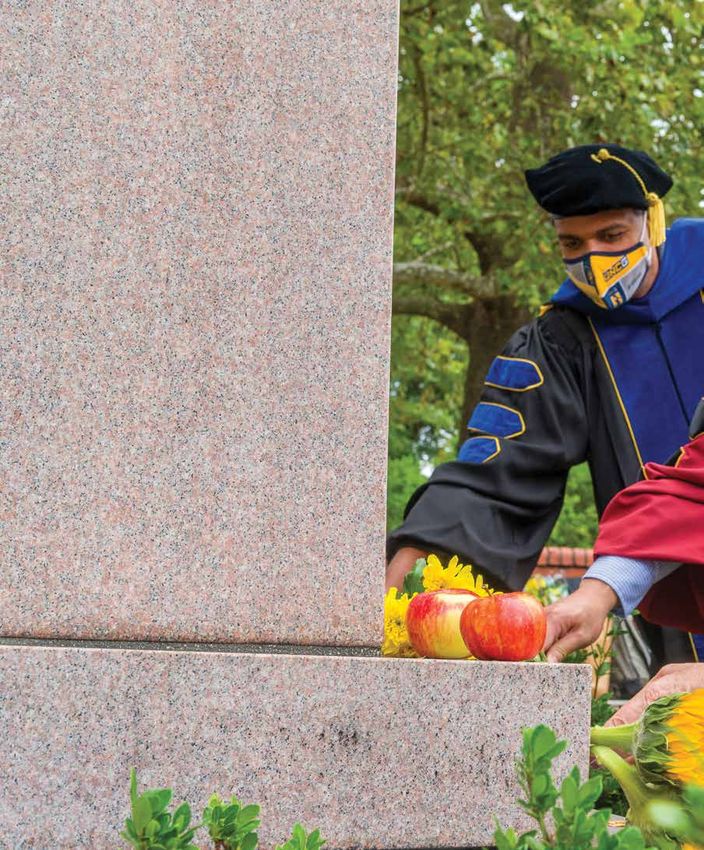
STANDING ON CEREMONY
Faculty Convocation is held
every September. This year’s
was held with social distancing
protocols, with Spartan-spirited
face coverings, and with most
faculty participating remotely
via Zoom video conferencing.
Dr. Anthony Chow, joined by
Dr. Laurie Kennedy-Malone
and Dr. Michael A. Hemphill,
made a very thoughtful gesture.
They knew many students start
their year by placing a coin, a
flower, or an apple at the base
of the Minerva statue, which
represents wisdom. It’s said
to bring good luck. This fall,
relatively few students could do
that. So in the Sept. 9 ceremony,
they each set beautiful, large
sunflowers at the base. It’s not
known how many actually
believe in the good luck tradi-
tion. But this feeling of care for
our students is something to
believe in with all our hearts.
PHOTOGRAPH BY
MARTIN W. KANE
“The real ceremony
begins where the
formal one ends ...”
— Linda K. Hogan
18 UNCG magazine ° Fall 2020Fall 2020 ° UNCG magazine 19
thestudio
                                               A WAM WELCOME
                                               THE WEATHERSPOON ART MUSEUM always has something new: new
                                               exhibitions, programs, and opportunities for teaching and learning. This
                                               fall, a new director joins the Greensboro art community. Juliette Bianco
                                               succeeds Nancy Doll, who retired after leading the museum for 22 years.
Juliette                                       Bianco comes to UNCG from Dartmouth, where she worked at the Hood
Bianco,                                        Museum of Art, most recently as deputy director.
new director
                                                 Campus and community impact through meaningful engagement with
of the
                                               diverse works of art is a value that Bianco holds closely. She’s partnered
Weatherspoon
                                               with museums on exhibitions related to civil rights and social justice,
                                               including the Brooklyn Museum, the San Diego Museum of Art, and the
                                               International Center of Photography.
                                               WHAT’S EXCITING ABOUT LEADING AN ART MUSEUM?
                                               Art museums are places where we can encounter objects that resonate
                                               with us and ways of seeing the world that perhaps we’ve never consid-
                                               ered, and also experience a deepening of our existing thoughts or beliefs.
                                               Having a “conversation” with a work of art means truly engaging with
                                               another person’s creative expression of their perspective. I want to make
                                               that experience accessible to everyone.
                                               HOW CAN EXHIBITIONS BE RELEVANT AND ACCESSIBLE
                                               TO A COMMUNITY?
                                               A museum should be a center for generative and inclusive dialogue and
                                               collaboration. Museums are sometimes thought of as places where art is
                                               merely deposited and displayed. University museums are all about turn-
                                               ing that notion upside down: each object’s impact grows and changes
                                               through active and engaged teaching, learning, and creating with people
                                               on campus and in the community. We’re all part of the same art-driven
                                               ecosystem!
                                               HOW WOULD YOU LIKE STUDENTS AND ALUMNI TO SEE
                                               THE WEATHERSPOON?
                                               I want students to feel that the Weatherspoon is their museum – that
                                               they’ve contributed to making it a place that reflects their values and
                                               shares something with them and their peers. I hope alums continue to visit
                                               and participate in making the museum exciting and relevant for the next
                                               generation of students.

NEW ANNE AND BEN CONE MEMORIAL DIRECTORSHIP
THE CONES were deeply devoted          Juliette Bianco is the first Anne and      to the Weatherspoon’s collection – the
supporters of the Weatherspoon.      Ben Cone Memorial Endowed Director.          core of which was started by Ben’s
Honoring their memory, a gift from     Anne and Ben Cone became prolific          aunts, Claribel and Etta Cone – they
an anonymous donor recently estab-   patrons of the arts in Greensboro,           also donated $2 million to finance the
lished the Anne and Ben Cone         particularly at Woman’s College              building, which now houses the muse-
Memorial Endowed Directorship Fund   (UNCG), where she graduated in 1935.         um and bears their name. Throughout
— the first of its kind for the      In addition to supporting and financ-        their lives, they remained loyal
University’s museum.                 ing the acquisition of numerous pieces       supporters of the museum and UNCG.

20   UNCG magazine   °   Fall 2020
Spotlight on incarceration
After spending months in jail and on probation, he ultimately received
a bill of innocence. He turned his experience into art.
Sherrill Roland ’09, ’17 MFA is the founder of the Jumpsuit Project,
which raises awareness around issues related to incarceration.
This year, he won the prestigious Southern Prize from South Arts.
Roland created the Jumpsuit Project after a wrongful conviction just as
he had started the final year of his master’s program. He spent 10 months
in jail. He was exonerated of all charges in 2015 and returned to UNCG to
complete his degree. For his MFA thesis project, Roland wore an orange
jumpsuit every day on campus, a performance art project supported by UNCG
art faculty such as Sheryl Oring. He documented his campus interactions.
Since graduating, he has held many fellowships and residences, such as the
Center for Documentary Studies’ 2018-19 Post-MFA Fellowship in the Documentary
Arts. He has exhibited his work at museums ranging from the Studio Museum in
Harlem to Georgetown University’s de la Cruz Art Gallery.
The project helps viewers understand the social and political issues surrounding the
United States justice and prison system. “We have so much trust in the system,” he
says. “As a society, we are naive about how the criminal justice system really works.”
Sherrill Roland
at 2017 UNCG
Research &
Creativity
Expo
LEARN MORE AT WWW.JUMPSUITPROJECT.COM.
MAKING WAVES in what is now the Department of actors or the plot. They wanted you
ON ‘OUTER BANKS’ Media Studies. Smith credits professor to almost be able to pause it at any
One of the most popular series binge- Frank Donaldson’s class on Charlie second, and the photography would
watched around the globe during the Chaplin with helping him understand captivate you and make you want to
pandemic quarantine was “Outer how to become a better filmmaker. visit. And I think we accomplished that.”
Banks,” the hit Netflix television series When creating the look for
that premiered last spring. “Outer Banks,” Smith’s goal was to
The show is about a group of teenag- make the environment just as much
PHOTOGRAPHY COURTESY OF NETFLIX
ers hunting for treasure on a picturesque of a character as the main charac-
island called the Outer Banks. ters were.
The cinematographer behind all of “The show creators wanted the
those beautiful sunset scenes is former environment to pull you in no mat-
UNCG student Brad Smith, who studied ter what was happening with the
Fall 2020 ° UNCG magazine 21PANDEMIC UPDATE
NOVEL
VIRUS
REQUIRES
SMARTER
APPROACHES
22 UNCG magazine ° Fall 2020BY MATTHEW BRYANT, SUSAN KIRBY-SMITH ’06 MA, PAT HOLMES, EDEN BLOSS, MICHELLE
DANNER-GROVES ’16 MA, AND MIKE HARRIS ’93 MA
M
any members of the larger Spartan community
are playing big roles in addressing the
COVID-19 pandemic. Here are some highlights.
QUICK AND NIMBLE SETS THE PACE
THE COVID-19 PANDEMIC has created unprecedented challenges for the world. But for some, it has
presented unique opportunities. Equipped with the right mix of experience, knowledge, and tools, those
with a vision and willingness to take risks have embarked on journeys into uncharted waters in the hope of
finding better solutions.
Two UNC Greensboro alumni – Keivan Ettefagh ’13 PhD and James Patrick Healy ’14
PhD – have taken the leap, and they are moving full-sail ahead on mass-producing an
innovative technique for collecting and testing samples for COVID-19.
As vice president of technical innovation and lab manager, respectively, they
are part of Greensboro’s Select Laboratory Partners (SLP), a local company
that specializes in laboratory implementation, management, and support for
healthcare practitioners.
Their mission? Create an easy-to-use testing kit – using saliva instead of a nasal
“
swab – and a lab process that can turn results around in 24 hours. They not only
accepted the challenge, but as of this printing, they are sending out 20,000 test kits per You’re
watching
month and running close to 3,000 tests per week. They are on track to reach 50,000 test
kits per month and 10,000 tests per week.
The two met during teaching assistant training for the inaugural year of UNCG’s
PhD in Medicinal Biochemistry program. Ettefagh went on to be a member of the Cech
every
Lab; Healy studied under biology professor Vincent Henrich. step and
asking,
Their lab process is based on a newer type of molecular nucleic acid testing, which
they have meshed with their existing expertise on the regulation, management,
compliance, and reporting of data obtained during testing. That was the first step of
their challenge.
‘What can
we do
”
The second was to then scale up. It is one thing to figure out a better testing
better?’.
method. It is quite another to produce it at a quantity and quality that is high enough
to meet the extreme demands that COVID-19 has wrought.
And how does a small operation like SLP compete with bigger companies who are —James Patrick
racing to do something similar? Ettefagh and Healy indicate that part of their advantage Healy ’14 PhD
“
is their size, which makes them nimble. SLP was able to quickly pivot and retool for
What’s COVID-19 testing based on existing knowledge, processes, and industry connections.
“What’s wonderful about our company is it’s very science-driven,” says Ettefagh.
wonderful “Our chief operating officer has a PhD in chemistry, and that helps direct us. Our
CEO is trained as a molecular technologist instead of having a business degree. It’s
about our a constant responding to what is out there as scientists and improving upon those
company things.”
“What I learned in manufacturing is the idea of continuous improvement,” says
is it’s very Healy. “You’re watching every step and asking, ’What can we do better?’ It could be as
simple as ‘Move this or that to a different location’ or as complex as ‘Let’s change the
science-
”
whole way we do this thing.’”
driven. What will they do when a vaccine is finally found? Ettefagh says their long-term
goal is to convert their process into other diagnostic molecular testing – focusing
—Keivan Ettefagh ’13 PhD
on other viral diseases, cancer, and genetic mutations that lead to a higher risk for
cardiovascular diseases.
Fall 2020 ° UNCG magazine 23PANDEMIC UPDATE
ENVISION A HIGHER-TECH MASK
KEPLEY BIOSYSTEMS, led by Dr. Anthony Dellinger ’15 PhD and
co-founded by UNCG nanoscience professor Dr. Christopher Kepley, is a
North Carolina life sciences startup that looks for sustainable solutions to
environmental problems through invention.
Their projects run the gamut – from a synthetic and sustainable fishing
bait, to odor technology to help train newly adopted dogs, to microbial-
resistant technology initially created for the management of horseshoe
crab blood.
When the COVID-19 pandemic began, the bioscientist team realized
they had an impetus to develop something to help the medical community,
as well as patients and potentially others.
Their thoughts turned towards masks – the crucial piece in
American public health, and even more crucial for medical
professionals in a crisis situation.
As Dellinger and others at Kepley know from working in a
hospital, N95 masks are very, but not completely, effective, need to
be replaced frequently, and can spread virus if they
are not disposed of properly, plus they can limit
oxygen intake.
What if they could create a mask that could
Bioactive
efficiently eliminate pathogens – bacterial, viral, mask
and fungal – and provide breathable, sterile air for
“
technology
In any realm,
the wearer? And what if, through a secondary mechanism, in areas of
the mask could expel sterile air into the environment? Fully healthcare
we’re looking bioactive masks.
“We wanted to introduce something that would
(top),
essential
to make lives comprehensively solve all of the problems associated with workers
(middle),
easier and
masks – if it was just purely filtration, or if it was because
of a lack of comfort related to oxygen exchange capabilities. and travel
(bottom)
environmentally But most importantly, we wanted to make something that
”
we could confidently say is killing the microbes that come
better. in,” says Dellinger.
— Anthony Dellinger ’15 PhD In July, Kepley Biosystems filed an accelerated patent for a
personal protection air sterilization technology.
The proposed mask’s rate of efficacy against COVID-19 or other
pathogens has of course not been tested. There is no prototype yet. But the
plan is exciting.
They envision a mask that could be used to slow the spread of
COVID-19 and also to protect patients and others from secondary
infections within medical facilities. The technology could also be adapted
for use in manufacturing, shipping, and food preparation and packaging
MASK ILLUSTRATIONS COURTESY OF KEPLEY BIOSYSTEMS
facilities, as well as in shared, enclosed spaces such as aircraft, operating
rooms, auditoriums, and cars.
Dellinger says that resources to create the antimicrobial mask are
available. Now, it’s a matter of the right partnerships.
“We were inspired to get this patent and get the word out there, to
stimulate communication in the community, and to share that we have a
fundamental proof of concept for an actual device,” says Dellinger.
“We thought that obviously had advantages for the medical world but
also for a lot of other industries. In any realm, we’re looking to make lives
easier and environmentally better.”
24 UNCG magazine ° Fall 2020PPE GOWNS REBUFF MOISTURE
TASMIN FARZANA ’14 MBA has learned plenty of new things while working from
home during quarantine. For one, there’s chess, a game she admits she hasn’t quite
mastered. Another is chemistry.
Farzana, senior procurement manager of Global Operations at Hanesbrands Inc.,
oversaw the chemical component of the company’s agreement to supply the U.S.
Federal Emergency Management Agency with more than 20 million medical gowns.
The water repellent gowns needed to be tested before use by medical professionals.
“I had to rely on my high school chemistry,” Farzana jested. “Before the
agreement, we had never made gowns. The part I led was the chemical, which I’d
never managed before. I had to learn quickly.”
Under normal circumstances, Farzana leads a global team and supports supply
chain operations by managing direct and indirect materials for Hanesbrands
products: fabric, elastics, and so on. What made this project difficult was timing.
“Usually you place the order to the supplier, but we didn’t even have six weeks.
So if the gown delivery is due within a month you need everything the next day,
right? So it’s not like suppliers are sitting on it for us when we place an order,” she
said. “Having never managed this category I had to establish relationships with
multiple global suppliers and allocate inventory immediately.”
Farzana said another challenge was navigating things like airport closures amid
the spread of COVID-19. One day they’d be tracking materials on time, and the next
they would be stuck in Miami.
“
“Here’s Bryan problem solving, right,” said Farzana. “What do you do with
this situation?”
Farzana credits her time with UNCG’s Bryan School of Business and Economics When I hire
for helping to prepare her for these types of professional challenges. people I ask,
“The challenging projects I had, when I hire people I ask, ‘How good are you at
problem-solving?’ And that’s Bryan’s motto. I absolutely love that,” she said. “My ‘How good are
MBA projects, they were practicing what they were preaching. Those things helped
me a lot.” you at problem-
And it’s a good thing they did — there wasn’t much time between her last day at solving?’ And
UNCG and her first day at Hanesbrands, Inc.
“Actually, the day of my final exams, I was walking to the parking deck and I got that’s Bryan’s
my Hanesbrands email that day. They were interested in an interview, it was pretty
motto.
”
amazing,” she said.
“I started at a very lowly contractor level and I was there in that position for three I love that.
months and thankfully my work was noticed. I have been fortunate that I have been
—Tasmin Farzana ’14 MBA
promoted to several positions in the past five years.”
That work has also been noticed by the Triad Business Journal, who named
Farzana to their 40 Under 40 list earlier this year.
Farzana has plenty to be proud of and certainly takes pride in her work. But she
said the gown project has been satisfying in a different way.
“When I look back, I’m really proud of this project that Hanes took and also I’m
thankful to the Hanes leadership that they thought I’m able to lead this part of a
PHOTOGRAPHY COURTESY OF TASMIN FARZANA
project even without certain experience. I’m grateful to experience it during that
time. My focus during that time was — this is going to help millions of people,”
she said.
“That drive, when you’re challenged with this type of task the whole team had this
grand vision that we’re helping people. Everybody came together. It took a village.”
Fall 2020 ° UNCG magazine 25You can also read


