Supplementary Recommendations to Commonwealth Budget Submission 2020-2021 - Treasury.gov.au
←
→
Page content transcription
If your browser does not render page correctly, please read the page content below
The peak body for roads within an integrated transport system

                                  Supplementary
               Recommendations to Commonwealth
                    Budget Submission 2020-2021
                                                            August 2020

THE LEADER • THE COLLABORATOR • THE FACILITATOR • T H E C H A M P I O N
Supplementary Recommendations to Commonwealth
 Budget Submission 2020-2021 August 2020
 Prepared by Roads Australia
 Level 6, 437 St Kilda Road, Melbourne VIC 3004 (03) 9821 5255
 www.roads.org.au

        @RoadsAustralia

        linkedin.com/company/roads-australia

P2                         THE LEADER • THE COLLABORATOR • THE FACILITATOR • T H E C H A M P I O N
INTRODUCING ROADS AUSTRALIA
Roads Australia (RA) is the peak body for roads within an integrated transport system,
representing an industry that contributes $207 billion annually to the economy and
supports 1.3 million jobs. RA brings industry, government, and communities together to
lead the evolution of Australia’s roads, integrated transport and mobility.
RA welcomes the opportunity to make this supplementary submission for consideration
in the formulation of the 2020-21 Commonwealth Budget together with our original
December 2019 submission.
1 RA Commonwealth Budget Submission 2020-21, December 2019 www.roads.org.au/Portals/3/Policy/Submissions/Roads%20Australia%20Budget%20Submission%20
2020.pdf?ver=2019-12-20-102653-537
SUPPLEMENTARY RECOMMENDATIONS TO COMMONWEALTH BUDGET SUBMISSION 2020-2021 P1TWO SUPPLEMENTARY KEY RECOMMENDATIONS
RA recommends the 2020-21 Commonwealth budget deliver:
Recommendation 10: Funding to support collaborative State and Territory Government initiatives with
Industry towards Infrastructure Delivery and Procurement Reform.
Recommendation 11: Funding to support the expansion of State and Territory Government Regional
and Rural road safety infrastructure programs.
RECOMMENDATION 10 RA also notes this was an area of focus for the
Transport and Infrastructure Council (TIC), as
SUPPORTING IMPROVEMENT outlined in their communiqué from 22 November
INITIATIVES IN PROCUREMENT AND 2019.3 It was highlighted that TIC endorsed an initial
analysis, and sought further investigation on policy
CONTRACTING TO ENHANCE POST options to:
COVID-19 INFRASTRUCTURE DELIVERY
» better plan and match transport infrastructure
construction demand and supply;
Collaborative efforts between Industry and
» deliver best practice major project procurement
Government have highlighted the need for
and risk allocation settings; and
significant change to enable road and related
transport infrastructure projects to be delivered » review infrastructure construction regulatory
more effectively and with enhanced value for arrangements.
our community.
RA’s Procurement Reform Report
Recommendation 3 in the December 2019 RA In response to the call for reforms, RA’s primary
submission was that the Commonwealth provide focus over the last 18 months has been on working
funding in the 2020-21 budget to accelerate initiatives with stakeholders across government and industry to
to improve market capacity, procurement processes, develop a set of procurement reform strategies and
approaches to risk allocation in the transport corresponding recommendations.
infrastructure sector.
In May 2019, Victorian Premier Andrews met with
RA has continued its work in this important area RA and some CEOs from its membership. They
in support of the imperatives outlined in the expressed concerns about the delivery of major
Infrastructure Australia Australian Infrastructure Audit transport infrastructure projects in his state.
2019.2 The Audit shows there is considerable room The Premier encouraged RA to bring solutions
for improvement in how we plan, fund and deliver for consideration. He acknowledged RA’s unique
infrastructure in Australia. It concludes that, while membership across national industry and
both the public and private sectors generally perform government organisations.
well, infrastructure projects are increasing in size
and complexity, and will require new approaches if In response to this request, RA hosted an industry
they are to be effectively delivered. and government roundtable on 8 November 2019 on
‘Financial Sustainability in Construction’. Participants
included senior personnel from the Victorian Major
Transport Infrastructure Authority (MTIA) and the
Department of Treasury and Finance Victoria (DTF),
together with senior stakeholders from industry.
2 Australian Infrastructure Audit 2019 www.infrastructureaustralia.gov.au/sites/default/files/2019-08/industry_efficiency_capacity_and_capability_-_2019_
australian_infrastructure_audit.pdf
3 Transport and Infrastructure Council Communiqué, November 2019 www.transportinfrastructurecouncil.gov.au/sites/default/files/documents/12th_transport_and_
infrastructure_council_communique_22nov_2019.pdf
P2 THE LEADER • THE COLLABORATOR • THE FACILITATOR • T H E C H A M P I O NUsing the outputs from the meeting, RA subsequently Since that time, RA has compiled the outcomes into
convened a major workshop in Melbourne on 5 March a Draft Procurement Reform Report. The draft Report
2020, to discuss issues around five key themes: outlines the major procurement and risk issues
» Issue 1: Work Pipeline currently being encountered and proposes a series
of recommendations and strategies to address these
» Issue 2: Risk, Commercial & Contractual issues. These have been split into seven broad areas,
» Issue 3: Capability & Capacity and cover 22 recommendations:
» Issue 4: Design Process » Ownership and Accountability
» Issue 5: Culture & Inclusion » Pipeline Visibility
Participants agreed that there were significant » Planning and Design
opportunities for improvement in major project » Legal and Risk Framework
procurement processes that must be addressed if » Capacity and Capability
governments are to get best value for money, and
» Culture and Inclusion
industry is to get the best use of its capital and
people. » Governance
The RA workshops identified major areas for RA believes that implementing those
improvement and focussed on developing strategies recommendations will help drive major change to
to address the following specific issues: procurement processes. It will improve planning and
design of projects; more appropriately allocate and
» The process for risk definition and allocation,
particularly on large projects. manage risk; give a more fulfilling role to medium
and smaller contractors; and improve skills and
» The size and complexity of projects has capacity building.
increased significantly and as a result, small to
medium contractors are unable to effectively Since completing the draft Report, RA has held a
participate. series of high level meetings with both the Victorian
» Governments do not lay out a long-term and NSW Governments, and is working to finalise
pipeline of work so that companies can invest the report, and agree next steps. A copy of the final
and gear up. report will be available in due course.
» The time available during procurement is often
not long enough to allow for sufficient risk
assessment. RECOMMENDATION 10
» The time available during the design phase That the Commonwealth provide funding in
for most big projects is often not adequate the 2020-21 Budget to support collaborative
for design firms to innovate or explore better State and Territory Government initiatives with
engineering solutions.
Industry towards Infrastructure Delivery and
» Current procurement models which apply Procurement Reform.
‘hard edged’ risk transfer can often result in
significant and complex legal disputes which
ultimately create a lose-lose scenario.
» Governments do not engage with industry early
enough in the design stage.
» State and territory education systems and the
Federal immigration model are not coping
with the increased demand for skilled labour
and industry does not do enough to encourage
women and people from diverse backgrounds
into the industry.
SUPPLEMENTARY RECOMMENDATIONS TO COMMONWEALTH BUDGET SUBMISSION 2020-2021 P3RECOMMENDATION 11 The webinar brought together experts from across
Australia, including Robin Jackson, Chief of
INCREASED NATIONAL SUPPORT FOR Infrastructure Prioritisation, Infrastructure Australia
EXPANSION OF REGIONAL AND RURAL (IA) who reinforced that regional roads account for
a disproportionate amount of road fatalities. One
ROAD SAFETY INITIATIVES of the key themes of the IA Infrastructure Priority
List4 is a regional focus for both regional and rural
Proven low-cost infrastructure solutions can road network safety improvements. Mr Jackson
have a high impact on regional road safety also highlighted that the pace with which projects
outcomes. can be progressed from concept or problem stage
to solution and delivery can help to speed up the
recovery of the economy – which has increased
Recommendation 5 in the December 2019 RA importance in the current COVID-19 environment.
submission proposed that the Federal Government
Presenter Bernard Carlon, Executive Director,
should strongly link infrastructure funding to road
Centres for Road Safety & Maritime Safety, Transport
safety outcomes to combat Australia’s rising road
for NSW, highlighted the stark road crash data for
toll. This additional recommendation focusses on
country roads in NSW. Mr Carlon emphasised the
recent RA discussions with State and Territory
ongoing importance of road safety, highlighting
road managers and industry experts on successful
the 9,816 fatalities and serious injuries (FSIs) that
regional road infrastructure safety treatments.
occurred on country roads in NSW between 2015 and
Despite making up only 17% of the nation’s 2019, at an estimated cost of $13 billion.
population, it is estimated that deaths on regional
The Towards Zero Infrastructure Program5, which
roads account for two in every three of the lives lost
is included in IA’s list as a High Priority Initiative,
nationally. While driver behaviour and vehicle design
found that a $1 billion investment in road safety is
have a role to play in improving safety, relatively low-
estimated to avoid 628 fatalities and 4,820 serious
cost infrastructure treatments can be an effective
injuries over the lifetime of the investments,
and efficient way to reduce the number or impact of
returning a benefit-cost ratio (BCR) of 5.06.
crashes. These treatments can be especially helpful
in reducing run-off-road and head-on crashes. Mr Carlon presented TfNSW research6 showing
the effectiveness of several road safety treatments
RA welcomes the recent federal funding
including:
announcements in June and July 2020 relating to
road safety infrastructure, as part of the $1.5 billion » Full containment (roadside and median barriers):
nationwide infrastructure package, including $500 90-95% reduction in head-on FSIs; 90-95
million for targeted road safety works. RA has been reduction in run-off-road FSIs; and 50-75%
supporting increased Federal funding for low- reduction in FSIs across all crash types;
cost road safety treatments for some time, so it is » Median barrier only: 90-95% reduction in head-
encouraging to see these types of treatments being on FSIs;
funded, including shoulder widening or sealing and » Roadside barriers: 90-95% reduction in run-off-
audio-tactile line markings. road FSIs;
RA has continued to engage with road safety experts » Wide centreline: 50% reduction in head-on
and road managers on this important issue, most crashes; and 20-25% reduction in run-off-road
recently through a Regional Road Infrastructure crashes; and
webinar on 8 July 2020. The webinar was attended » Audio-tactile line marking: 20-25% reduction
by over 120 participants from across industry and in run-off-road crashes; and 25% reduction in
government, the outcomes from which are attached head-on crashes.
as an Addendum.
4 Infrastructure Australia, Infrastructure Priority List 2020 www.infrastructureaustralia.gov.au/infrastructure-priority-list
5 Towards Zero Infrastructure program www.infrastructure.nsw.gov.au/media/1726/towards_zero_business_case_summary_summary.pdf
6 NSW Government https://towardszero.nsw.gov.au/saving-lives-on-country-roads
P4 THE LEADER • THE COLLABORATOR • THE FACILITATOR • T H E C H A M P I O NPresenter, Mike Stapleton, Deputy Director General,
Queensland Department of Transport and Main RECOMMENDATION 11
Roads, provided an overview of regional road safety
initiatives carried out in Queensland. That the Commonwealth provide increased
funding in the 2020-21 Budget to support the
Wide centre line treatments (WCLT) have been used expansion of State and Territory Government
successfully in high-risk areas to reduce crashes Regional and Rural road safety infrastructure
where a vehicle crosses the centre line. This has programs.
been operationalised through application of policy
requiring any project on a rural road with 4,000
vehicles per day or more to use WCLT and audio
LEVEL CROSSING SAFETY
tactile line marking. In Queensland, this has been
found to reduce the rate of FSI crashes by an average UPGRADES
of 20% and the rate of head-on crashes by an As a related recommendation to Recommendation
average of 46%. 11 outlined above, RA has been made aware of
Mr Stapleton highlighted other road safety the Australian Railway Association (ARA) Budget
treatments in Queensland, including: Submission. Following discussions between RA and
the ARA, RA supports the ARA recommendation,
» Township entry treatments (TET): implemented which states that:
where high-speed rural roads transition to lower
speed roads; The Commonwealth Government support the work
» Sealing roads: with more than 2,000 kilometres currently underway by the Office of the National
sealed since 2001; and Rail Safety Regulator (ONRSR) to develop a National
» Regional roads stimulus packages. Level Crossing Portal, by providing any additional
resourcing or support needed to streamline the
Industry are also partnering with government to help completion of the project and secure the necessary
bring further innovation to this road safety challenge. jurisdictional data.
Presenter Colin Dominish, Regional Director,
Southern Hemisphere, GHD Digital, described7 their Once completed, it is recommended that the
digital innovations to help improve road safety across Commonwealth Government work with industry
Australia, including the role of technologies such and the detailed data available within the portal to
as ITS in improving safety of roads. As a specific develop a prioritised national list of level crossing
example, GHD is working with road authorities on an removal projects, particularly focussing on high-
initiative that involves using video in remote locations risk crossings in regional areas. The data available
to understand the workings of an intersection, through this historic initiative will, for the first time,
including trailing of a mobile phone app to measure allow for a truly data driven approach to improving
the road roughness index. the rail and road safety outcomes across the
country related to level crossings.
RA supports the continued and accelerated
investment in these proven, relatively low cost,
road safety initiatives, and related projects being
implemented in all States and Territories. With
increased funding support for regional and rural road
safety, these initiatives can be implemented using
existing proven approaches to save lives, with the
added significant benefit that they often utilise local
industry resources that benefit of regional economies
as they emerge from COVID-19 challenges.
7 RA Policy Webinar Presentations and Reports https://roads.org.au/Policy/Safety/Presentations-and-reports
SUPPLEMENTARY RECOMMENDATIONS TO COMMONWEALTH BUDGET SUBMISSION 2020-2021 P5ABOUT ROADS AUSTRALIA of crashes. These treatments can be especially
helpful in reducing run-off-road and head-on
Roads Australia (RA) is the peak body for roads crashes.
within an integrated transport system,
representing an industry that contributes $207 EVENT SUMMARY
billion annually to the economy and supports 1.3
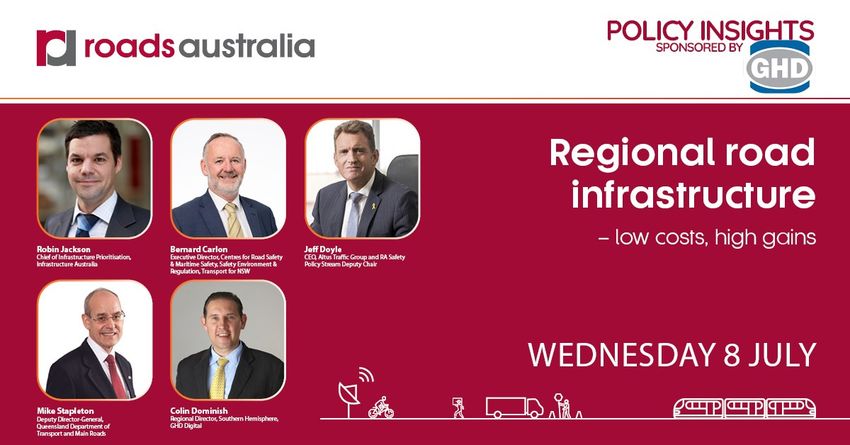
million jobs. Over 120 attendees joined RA’s webinar on 8
July 2020 to hear from:
RA brings industry, government and
communities together to lead the evolution of • Robin Jackson, Chief of Infrastructure
Australia’s roads, integrated transport and Prioritisation, Infrastructure Australia,
mobility. • Bernard Carlon, Executive Director,
Centres for Road Safety & Maritime
The nation’s only roads champion, RA’s 150+ Safety, Transport for NSW,
members includes all of Australia’s road • Mike Stapleton, Deputy Director General,
agencies, major contractors and consultants, Queensland Department of Transport and
motoring clubs, service providers and other Main Roads, and
relevant industry groups. • Colin Dominish, Regional Director,
Southern Hemisphere, GHD Digital.
RA’s current policy focus extends across five
activity streams: Safety; Capacity; Transport Speaker presentations are available on the RA
Reform; Journey Reliability; and Sustainability website.
with Diversity and Inclusion an underlying
commitment across each stream. The webinar was moderated by Jeff Doyle,
Safety Policy Stream Chair, RA and Chief
Register for upcoming policy events to Executive Officer, Altus Traffic Group and
contribute to the debate. sponsored by GHD.
BACKGROUND RECENT ANNOUNCEMENTS
Despite making up only 17% of the nation’s There have been several federal funding
population, deaths on regional roads account for announcements in June and July 2020 relating
two in every three of the lives lost nationally. to road safety infrastructure, as part of a $1.5
billion nationwide infrastructure package
While driver behaviour and vehicle design have including $500 million for targeted road safety
a role to play in improving safety, relatively works.
low-cost infrastructure treatments can be an
effective and efficient way to reduce the numberDetails of the funding by jurisdiction is provided safety improvements, and well as mobile
in table 1, below. telecommunications coverage in regional and
remote areas.
RA has been supporting increased Federal
funding for low-cost road safety treatments for Mr Jackson indicated that the speed with which
some time, so RA is encouraged to see these projects can be progressed from concept or
types of treatments being funded, including problem stage to solution and delivery can help
shoulder widening or sealing and audio-tactile to speed up the recovery of the economy.
line markings, otherwise known as rumble strips.
IA is calling for submissions to the 2021
POLICY INSIGHTS Infrastructure Priority List and specifically
encourages submissions from the following
The webinar brought together experts from areas, which are relevant to roads:
across Australia.
• Addressing national waste and recycling
Robin Jackson, Chief of Infrastructure management challenges; and
Prioritisation, Infrastructure Australia (IA) • Responding to national road maintenance
presented on the Infrastructure Priority List for issues.
2020, which is IA’s largest list yet, comprising
147 nationally significant infrastructure Submissions close 31 August 2020. Visit IA’s
proposals. A mid-year update, with new projects
website for more information.
and initiatives, will be released in coming weeks.
Bernard Carlon, Executive Director, Centres for
He reinforced that regional roads account for a Road Safety & Maritime Safety, Transport for
disproportionate amount of road fatalities, and NSW, presented road crash data for country
one of the key themes of the List is a regional roads in NSW.
focus for both regional and rural road network
T1. Recent road safety funding announcements
State/ Funding (Joint Federal
Road Safety Upgrades Include:
Territory & State/Territory)
Upgrades to traffic signals to keep them on during
$3.2 million
ACT power outages, the installation of road safety barriers
and a variable speed limit
NSW $398 million Mass action rollout of audio-tactile line markings
Widening and sealing shoulders and improving or
NT $34.6 million installing guardrails, truck stops and audio-tactile line
markings
QLD $150 million Audio-tactile line markings
Safety barriers, shoulder sealing audio-tactile line
SA $59.5 million
markings
Heavy vehicle rest areas, electronic school zone signs
TAS $17 million
and roadside barriers
Intersection upgrades on 30 high-speed, high-risk rural
VIC $97.2 million intersections, Pedestrian and Safer Schools (urban and
regional) upgrades
Approximately 1,400 kilometres of roads treated, with
WA $100 million shoulder sealing and audible edge lines being installed
in every region of WAHe reminded us of the ongoing importance of Other road safety treatments in QLD include:
road safety, highlighting the 9,816 fatalities and
serious injuries (FSIs) that occurred on country • Township entry treatments (TET):
roads in NSW between 2015 and 2019, at a cost implemented where high-speed rural
of $13 billion. roads transition to lower-speed roads;
• Sealing roads: with more than 2,000
The Towards Zero Infrastructure Program, kilometres sealed since 2001; and
which is included in IA’s list as a High Priority
Initiative, found that a $1 billion investment in • Regional roads stimulus packages.
road safety is estimated to avoid 628 fatalities
and 4,820 serious injuries over the lifetime of the Colin Dominish, Regional Director, Southern
investments, returning a benefit-cost ratio (BCR) Hemisphere, GHD Digital, presented on digital
of 5.06. innovations to improve road safety across
Australia including:
Mr Carlon presented TfNSW research showing
the effectiveness of a number of road safety • The role of technologies such as ITS in
treatments including: improving safety of roads. GHD is helping
to assist road authorities in this, such as
• Full containment (roadside and median though the use of video in remote
barriers): 90-95% reduction in head-on locations to understand the workings of an
FSIs; 90-95 reduction in run-off-road FSIs; intersection.
and 50-75% reduction in FSIs across all • Their current work on a trial with TfNSW of
crash types; a mobile phone app to measure the road
• Median barrier only: 90-95% reduction in roughness index.
head-on FSIs; • The use of training simulators to help
• Roadside barriers: 90-95% reduction in drivers transition to larger heavy vehicles.
run-off-road FSIs; • The role of autonomous vehicles and the
• Wide centreline: 50% reduction in head-on need to manage this well in regional areas
crashes; and 20-25% reduction in to help save lives.
run-off-road crashes; and
• Audio-tactile line marking: 20-25% EVENT OUTPUTS & NEXT STEPS
reduction in run-off-road crashes; and
25% reduction in head-on crashes. A snapshot of the event was promoted through
RA’s LinkedIn channel.
Mike Stapleton, Deputy Director General,
Queensland Department of Transport and Main Looking ahead, RA plans to host further policy
Roads who provided an overview of the work webinars on this and related topics.
that has been happening in Queensland (QLD).
In August 2020, RA will host another webinar
Wide centre line treatments (WCLT) have been featuring experts in regional road safety, and will
used successfully in high-risk areas to reduce look to expand on the issues raised in both
crashes where a vehicle crosses the centre line. these events in a Road Work podcast.
This has been operationalised through
application of policy requiring any project on a
rural road with 4,000 vehicles per day or more to
use WCLT and audio tactile line marking. In
QLD, this has been found to reduce the rate of
fatal and serious injury crashes by an average of
20% and the rate of head-on crashes by an
average of 46%.You can also read


