THE BODYBUILDING PROJECT - SAARA HANNULA
←
→
Page content transcription
If your browser does not render page correctly, please read the page content below
The BodyBuilding Project

                     1
The BodyBuilding Project

                           The BodyBuilding Project

                                          Alan Prohm
                                           Daria Faïn
                                         Robert Kocik
                                    Scott Andrew Elliott
                                 Christina Guerrero Harmon
                                        Saara Hannula
                                          Elisa Laurila
                                        Riikka Notkola

2
Dedication:

         “The thing that I think is most important is to block coal-fired power plants.”

                                 James Hansen, Goddard Institute of Space Sciences, 2008

The final writing and editing of this document were completed on June 23, 2008,
exactly 20 years from the date of James Hansen’s historic warning to the U.S. Sen-
ate that global warming was real and already happening. The day we finished, the
top U.S. climate scientist and global warming oracle was back on Capitol Hill with
renewed warnings and a highly intensified statement of the urgency for action. This
document, and the commitment that went into producing it, are dedicated to all
informed, entrenched, and compassion-maintaining advocates of immediate activa-
tion everywhere.

In James Hansen’s words: “We’re toast if we don’t get on a very different path. This is
the last chance.”

‘NASA Scientist’s Global Warming Warning: “This Is The Last Chance” ’,The Huffington Post, June 24, 2008,
http://www.huffingtonpost.com/2008/06/23/ nasa-scientists-global-wa_n_108789.html

For a transcript of James Hansen’s speech, go to:
http://www.columbia.edu/jeh1/2008/TwentyYearsLater_20080623.pdf

                                                                                                           3
.

    The BodyBuilding Project

                               Contents

                               The Project . . . . . . . . . . . . . . . . . . . . . . . . . . . . . . . . . . . . . . . . . . . . . . . . . . . . . . . . . . . . . . . .5
                               The Residency . . . . . . . . . . . . . . . . . . . . . . . . . . . . . . . . . . . . . . . . . . . . . . . . . . . . . . . . . . . . .6
                               The Current Stage. . . . . . . . . . . . . . . . . . . . . . . . . . . . . . . . . . . . . . . . . . . . . . . . . . . . . . . . . .7

                               Theory
                               The BodyBuilding Process: Conceptual-Somatic Strategy and Analysis . . . . . . . . . . . .10
                               Enactivism: The BodyBuilding Approach to Climate Art . . . . . . . . . . . . . . . . . . . . . . . . . 30
                                        1. Getting the Climate Thing . . . . . . . . . . . . . . . . . . . . . . . . . . . . . . . . . . . . . . . . . . . . .31
                                        2. Kinaesthetic Messaging for Social Change . . . . . . . . . . . . . . . . . . . . . . . . . . . . .44

                               Components
                               Movement Research . . . . . . . . . . . . . . . . . . . . . . . . . . . . . . . . . . . . . . . . . . . . . . . . . . . . . . . . . . . . . 52
                               Community Research . . . . . . . . . . . . . . . . . . . . . . . . . . . . . . . . . . . . . . . . . . . . . . . . . . . . . . . . . . . . .70
                               Material Research . . . . . . . . . . . . . . . . . . . . . . . . . . . . . . . . . . . . . . . . . . . . . . . . . . . . . . . . . . . . . . . . .74
                               Architecture . . . . . . . . . . . . . . . . . . . . . . . . . . . . . . . . . . . . . . . . . . . . . . . . . . . . . . . . . . . . . . . . . . . . . . .76

                               A Transmission Event
                               Event Description . . . . . . . . . . . . . . . . . . . . . . . . . . . . . . . . . . . . . . . . . . . . . . . . . . . . . . . . . . . . . . . . .80
                               Menu . . . . . . . . . . . . . . . . . . . . . . . . . . . . . . . . . . . . . . . . . . . . . . . . . . . . . . . . . . . . . . . . . . . . . . . . . . . . .90

    4
The Project                                                                                     2006, already two years behind us, will go down in history as the year global
                                                                                                warming became common knowledge. We were told then by the world’s leading
                                                                                                scientists and social advocates that we had 10-15 years to reverse the trend or it
                                                                                                would be too late. Our inability to respond with anything like the helpful panic of
                                                                                                an organism about to save its own life shows how wide the gap really is between
                                                                                                our rational and our bodily intelligences, and between us as individuals and the
                                                                                                collective, species-level body we must identify with if we are to survive. Organ-
   Salvation fitness for an endangered species; No-time-to-wait training for the mus-            ismic, species and planetary wisdoms must be empowered to find their voice in
   cular but bound; a Wake-up calisthenics to build strength in numbers one by one              the increasingly hysterical and groundless fray of contemporary debate. How? By
   and Jump! to it.                                                                             a radical reenfranchisement of bodily “getting it” as the endangered substrate of
                                                                                                knowing, planning and acting. We do not have time to talk ourselves out of world
   The BodyBuilding Project undertakes to create a participatory movement exercise in           war, economic breakdown and climate failure, but we do have time for the whole
   response to the world’s climate crisis. Through intensive conceptual and bodily research     symphony of tiered and reasoned reflex responses by which the human and plan-
   into themes of panic and inaction, we are working to evolve a movement form that will        etary body will finally speak up on its (our own) behalf.
   assist its practioners in activating their emergency response mechanisms on a voluntary
   basis. This form will consist of a simple, easy-to-learn movement that both symbolizes and
   minimally activates a salutory panic response. Its clumsy working title: “The Composure-     BodyBuilding is an interdisciplinary arts initiative to sound a tuning note for the
   Panic Immediate Activation Exercise”. A sort of issue-specific Tai Chi or Qi Gong, the form   onset of this symphonic gut reaction. Through careful embodied analysis of our cri-
   will function both as a regular mental/physical training exercise that can be practiced      sis condition – taking prominent sociological, psychological, and political/economic
   and transmitted privately, and as the basis for a participatory performance spectacle to     formulations into account – we will focus in on particular points of blockage and
   raise awareness of the urgency of our situation and encourage people (through muscu-
   lar/physiological sensation rather than words or images) to take action.                     impasse precluding corrective action. Processing a particular formulation of the
                                                                                                impasse through a series of conceptual, sensory and movement exercises, we will
   Once the form has been developed and refined to a sufficient degree, it will be shared in      derive the kinaesthetic figure of the impasse, the structured dynamic of stimuli,
   an ongoing series of transmission rituals, both for its own meditative/motivational value,   response impulses, and response inhibitions that in case after case continues to
   and as a polemical “movement meme” against inaction.
                                                                                                short-circuit the salvational agency of our species-wide common sense. Inverting
                                                                                                this figure we have the antidote of a counterfigure, the gestural key to training
                                                                                                visceral and kinaesthetic readiness for breaking the cycle of deflations, and for
                                                                                                opening a channel to the sea-changes latent in a disinhibited biological passion to
                                                                                                respond.
The BodyBuilding Project is a somatics-focused arts initiative to address the
global climate crisis. Our aim is to evolve and deploy a mode of artistic address
                                                                                                This figure will form the basis of a movement exercise which we will develop and
that will effectively speak urgent reason in the body’s language. Launched with
                                                                                                prepare for transmitting to others.The transmission itself will be designed as a scal-
a 3-week research and development residency at Robert Wilson’s Watermill
                                                                                                able participatory event, whereby anyone who has learned the form can pass it on
Center in September 2007, we have since produced a 200 page book captur-
                                                                                                to others, either individually or in groups, and either in a quiet private setting, or as
ing our basic working method and materials, and at the time of this writing
                                                                                                a more elaborate public happening. In either case the transmission will serve the
are commencing a second phase of development on the movement form.
                                                                                                ritual function of spreading the exercise and with it the divine spark of an agitation
Working with collaborators in Berlin and Helsinki, we are currently focusing
                                                                                                to act.
on refining the existing movement material into a highly simplified and easily
transmissable movement exercise for ritual transmission.

                                                                                                                                                                                       5
The BodyBuilding Project

The Residency                                                                          line, clear the body of stress and maintain the open flow of empathic sensing
                                                                                       and heart energies. Since these systems are in direct opposition in our current
                                                                                       physiology – the one is on when the other is off – we recognized that what is
Robert Wilson Watermill Center, Sept 2007
                                                                                       required may amount to the growing of a new organ. Be that as it may, after our
                                                                                       three weeks of research, we were confident that we had a solid base of material
                                                                                       to work from in synthesizing a simple new movement form out of postures and
                                                                                       actions relating to these opposed and complentary organ systems.
The BodyBuilding Project was launched with a 3-week research and develop-
                                                                                       Outside of the daily practice and group work sessions, participants worked in
ment residency at Robert Wilson’s Watermill Center in New York State.
                                                                                       specialized sub-groups developing separate components of the project. A move-
                                                                                       ment research group (Daria, Saara, Alan) was dedicated to carrying out more
The group that came together for this residency consisted of 8 artists uniting
                                                                                       intensive experimentation with the core material, and to designing possible ex-
many different creative orientations, skill sets and nationalities. Poetics, dance,
                                                                                       ercises for trying with the others. A community research group (Riikka and Elisa)
somatics, architecture, sculpture, political theory, community art, art pedagogy,
                                                                                       went out into the community to learn what issues and concerns local residents
graphic design, and performance were all included and drawn on in this phase
                                                                                       had concerning global warming, how they personally related to topics of panic
of the project.
                                                                                       and inaction, and with that information to help us in tailoring our work for a
                                                                                       community-specific transmission. A materials research group (Robert, Christina
In addition to Alan Prohm (US/FIN: Poetics/Theory/Performance) who initiated
                                                                                       and Scott) took on the challenge of exploring how the somatic and conceptual
and directed the project, the participants were Daria Faïn (FR/US: Dance/Chi
                                                                                       principles we were developing could be embodied in a rethinking of material
Kung/Somatics), who led the movement research, Robert Kocik (US: Poetry/
                                                                                       culture itself, focusing on the fabrication of adobe bricks as new world building
Prosodics/Architecture), Scott Andrew Elliott (CA/FIN: Environmental Art/Con-
                                                                                       blocks out of local and found materials. Robert also worked individually con-
struction), Saara Hannula (FIN: Environmental Art/Performance/Architecture),
                                                                                       ceiving and design the Stress Response Building, a structure intended both to
Christina Guerrero Harmon (MEX/US: Environmental Art/Installation), Elisa Lau-
                                                                                       house the form and its private and collective practice, and to embody com-
rila (FIN: Art Education/Community Process) and Riikka Notkola (FIN: Art Edu-
                                                                                       posure-panic principles in architectural space. At the same time, Alan pursued
cation/Community Process).
                                                                                       background research to keep our process tied in to developing world affairs, and
                                                                                       the broader theorizing of our particular somatic-conceptual work process and
The work at Watermill was focused primarily on intensive movement and somat-
                                                                                       creative strategy.
ics research into the bodily mechanisms underlying composure, panic and inac-
tion as possible reactions to a crisis event. This research was supported by a daily
                                                                                       The Watermill Residency concluded with an afternoon community event where
group practice of Chi Kung, and involved the bodily exploration of various panic
                                                                                       we shared our work and experimented with two different “prototype” move-
and inertia scenarios, studying the role of the various organs in these processes,
                                                                                       ment exercises. Guests were treated to a performance exemplifying the somatic
and looking for principles and practices that could provide a basis for our self-
                                                                                       principles guiding our search for this possible salvational exercise, a performed
therapeutic movement exercise.
                                                                                       poetic monologue articulating the meaning and purpose of the exercise, an ex-
                                                                                       hibition of the artwork, architecture and conceptual material emerging from our
By the end of the residency, we had understood that the task of the exercise
                                                                                       process, an hour-long collective movement event in which the audience was
we were designing, called the Composure-Panic Immediate Activation Exercise,
                                                                                       invited to enact one possible version of the form, and an all-local/organic family
would be to simultaneously stimulate two complementary organ systems, the
                                                                                       picnic on the back lawn.
one activating emergency adrenal discharge for the benefits of a healthy panic
response, and the other supporting the organism’s capacity to reabsorb adrena-

6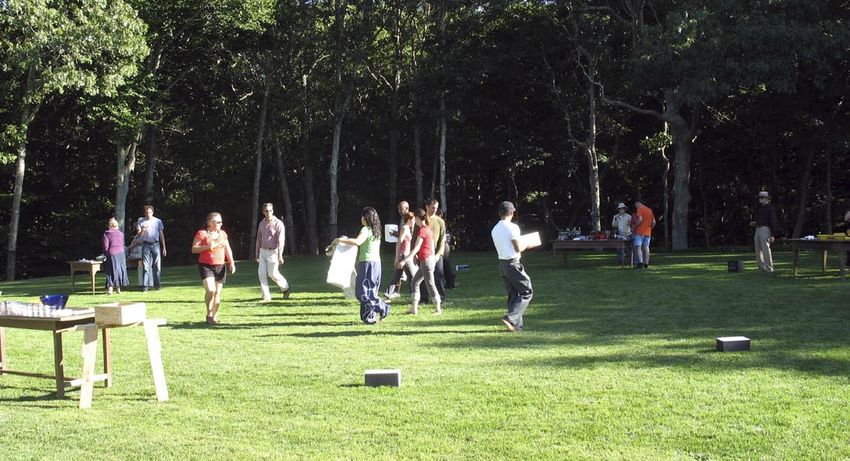
The Current Stage

After a year hiatus, spent documenting and digesting this material, the BodyBuild-
ing Project is currently starting out on a second phase of development. Two
members of the original group (Alan and Saara) will continue where the group
left off, aiming to develop the movement form further and to design a process
and a proper communal ritual for transmitting it. An important goal of this phase
will be to simplify and purify the movement form, and to experiment with it
personally over an extended period as an imagineable daily practice. Our aim is
to spread the movement form and its message to a larger crowd, who may then
transmit it further. In particular we will seek to communicate it to movement
researchers and environmental activists worldwide as a new approach to an old
question.

At the moment of writing Alan and Saara are seeking to partner with relevant
collaborators in Helsinki and Berlin, for as long as it takes to bring the form to
its final state. The next public appearance of the BodyBuilding Project is planned
for the Summer 2009 Art Monastery festival in Calvi dell’Umbria. The festival
will provide us with an opportunity to continue our unrelenting pursuits in yet
another setting of great clarity and focus.

                                                                                     7
The BodyBuilding Project

8

Theory

         9
The BodyBuilding Project

The BodyBuilding Process:
Conceptual-Somatic
Strategy and Analysis
ALAN PROHM                  The kinaesthetic messaging strategy on which the BodyBuilding Project was prepared to
SAARA HANNULA               make its gamble was laid out in the original Watermill Center residency proposal. The
                            strategy was conceptually quite specific, if still highly speculative and hypothetical without
                            testing in practice. Only the movement research process and eventual transmission to the
                            public could provide proof of concept. The formulation of this strategy seems to have had
                            a lot to do with the initial interest and support generated around the project, though in the
                            end the practice of directing the embodied research and experimentation along conceptual
                            guidelines proved very controversial and problematic for the group’s actual collaboration.
                            This, according to the initial proposal, is what we set out to do:

                                   Through careful embodied analysis of our crisis condition – taking prominent sociological, psy-
                                   chological, and political/economic formulations into account – we will focus in on particular
                                   points of blockage and impasse precluding corrective action. Processing a particular formulation
                                   of the impasse through a series of conceptual, sensory and movement exercises, we will derive
                                   the kinaesthetic figure of the impasse, the structured dynamic of stimuli, response impulses, and
                                   response inhibitions that in case after case continues to short-circuit the salvational agency of
                                   our species-wide common sense. Inverting this figure we have the antidote of a counter-figure,
                                   the gestural key to training kinaesthetic readiness for breaking the cycle of deflations, and for
                                   opening a channel to the sea-changes latent in a disinhibited biological passion to respond.

                            The process we followed to develop and implement this strategy, and ultimately to realize
                            and deploy the “composure-panic immediate activation exercise” that would constitute
                            the central message of the BodyBuilding campaign, began at the personal level of our
                            own experiences of panic and inaction, or activation and inhibition, in various situations.
                            The concrete movement research needed to begin from a point of personal relation to
                            these themes, though the conceptual focussing of the project as a whole required starting
                            from a much broader perspective. The Movement Research section of this document will
                            show the steps we actually took in this concrete dimension of the process, drawing on the
                            knowledge and experience of Daria Faïn, following the difficulties we encountered and
                            changes of direction that were made to find a way forward. In this section, our strategy will
                            be represented in the order of its conceptual logic.

10
The BodyBuilding Process: Conceptual-Somatic Strategy and Analysis
WAR
At the time we came to Watermill, of course, the war in Iraq was already an
ongoing calamity at such a constant state of crisis intensity that it could never be
1 THE CURRENT SITUATION felt as such. In the US context, but also internationally, it also represented one
of the most demoralizing failures in the background of our efforts to encour-
age vigorous response to impending dangers. In 2003, as the threat of war was
– taking prominent sociological, psychological, and political/economic formulations growing, we as a people actually managed the collective moral outrage and
into account... resolute activation to respond preemptively to the war the White House was
planning. Veterans of the resistance to the Vietnam war could be heard observ-
ing excitedly how much more quickly this resistance was gathering than in the
A key challenge to enabling an adequate response to the crises of our current 70s. And when millions around the globe gathered on February 15, 2003 to “say
situation is the difficulty of gaining a comprehensive sense of the threats we face. no to” the war, we were all a little amazed at ourselves for doing this, and felt a
To run away from a danger you need to know it is dangerous and where you virtuous thrill at the size we had taken, a feeling the New York Times rewarded
are running. The contemporary landscape is a brutally complicated terrain of with the famous but short-lived acknowledgement that “public opinion” (i.e. us)
meshed forces and trends, and modelling an exemplary panic response requires amounted to an other superpower. It seemed our capacity to activate and coor-
taking this whole web into account, just as successfully (spontaneously, compos- dinate life-saving responses as a global body had only grown and that there was a
edly) executing that response requires forgetting this understanding as informa- new power and confidence dawning among us. But it failed to stop the war. The
tion and acting on it as concrete lived reality. dull trauma of this failure, and the humiliation of having to grow used to a war
situation which was as bad as we had predicted but had now become a reality
Research into the relevant forces and trends defining our current situation be- beyond the reach of any resistance, remains an important psychological factor
gan months before the residency, and involved the gleaning of news items from contextualizing our efforts to respond to the global warming crisis, and needs to
a variety of media relevant to three overarching areas of crisis: War, Financial be taken into account.
Collapse, and Climate Change. In each of these areas, and in the corresponding
journalistic niche industries, we can observe a heightened pitch of apocalyptic More impendingly than the war in Iraq, at the time we began our residency,
panic rhetoric leading up to and following the time of our residency. Coverage rumors of a new war in Iran were reaching a peak they have not been at be-
in each area involved assessing specific local events relevant to potentials for a fore or since. Aircraft carriers had been hovering in the Gulf taunting Iran, and
major global calamity. In the weeks and days immediately leading up to our resi- fueling speculation that a policy might already be underway to incite an accident
dency, scholars, reporters and citizens on the ground could be heard crying “red that could then be spun as a first strike by Iran, justifying a US counter-assault.
alert” in each of these areas, and voices otherwise invested in an appearance of In the news media the assessment of this threat was focused around legislation
balance and objectivity were crossing clear thresholds in sounding the alarm and that was being moved through Congress to impose sanctions on Iran, declaring
urging immediate action to stave off a disaster larger in its sphere than any in its Revolutionary Guard Corps (IRGC) a supporter of terrorism. Since a main
living memory. result of this declaration (which went through on October 25th), would be to
legally and rhetorically simplify the process of initiating aggressions against Iran,
Research materials on these three areas of crisis were gathered into three sub- many were watching the progress of this bill with held breath, as the next step in
folders, and synthesized during the residency in the flow-chart (p. 38), which a storyline that seemed destined to climax soon in a new conflict with unspeak-
attempts to show both the major forces and trends behind each threat and their ably disasterous consequences.
vicious intricate interrelatedness.
11The BodyBuilding Project
Triple Threat Flow Chart
Drawn at Watermill over Days War with Iran
Iraq Collapse of Democratic Society
Draw your own arrows and test
your scenarios by marking the
propagation of impacts “if ...” RESOURCE WARS Tendency to Police State Civil Unrest
Terrorism
Neo-Liberal Foreign Policies Sub-Prime Lending Crisis
Darfur Militarization of Civil Society
Military Industrialism Stock Market Panic
Population Displacement Personal Credit Overextension
Defecit Spending Unemployment
War O
Poverty Inflation, Recession, Depression
Wealth Accumulation Health Care Insecurity
Shift to Euro Standard CLIMATE CRISIS
Neo-Liberal Globalization Privatization
Trade Policies Population Displacement Strange Weather
Infrastructure Failure PEAK OIL
Rising Sea Levels Disease, Illness, Death
Financial Collapse O
Overdevelopment CO2 Emissions
Melting Polar Ice Caps
Deregulation
Industrial Agriculture Methane Emissions
Fossil-Fuel Powered Glaciers Melting
Industry and Economy Resource Depletion
GLOBAL WARMING
Corporate Monopoly of
Deforestation Seed Stocks (Biopiracy)
Climate Change O
Species Extinctions
Water Shortage
12The BodyBuilding Process: Conceptual-Somatic Strategy and Analysis
AP
13The BodyBuilding Project
The possible consequences of a war with Iran were themselves the subject of FINANCIAL COLLAPSE
much speculation in the days we worked at Watermill. Clearly oil prices would
go up. Clearly the Middle East would grow more inflamed. Clearly the enmity In September and early October of 2007 the threat of a major collapse of world
and inspiration of terrorist groups would increase. Very possibly there would be financial markets was not in the headlines the way the threat of war with Iran
another major attack on US soil. And if that happened, another current of threat was, but it was making its way there from a buzz of dire warnings and analysis by
speculation was saying more and more loudly at this time, for sure there would non-prime time economists. The BodyBuilding Project factored this analysis into
be martial law in America. Off-hand comments from government officials over its picture of our current situation from the start. And within weeks of complet-
the previous few years had encouraged this speculation, and attention to legisla- ing our Watermill residency the storm these voices were predicting was on the
tive activity under Bush and Cheney now seemed to substantiate it. Protocols, radar, and within months it had hit, at least the beginnings of it, in the form of the
infrastructure and manpower were all in place for a smooth transition to a po- sub-prime lending crisis. Still now, a year later, the magnitude and implications of
lice state in the case of a major attach or some other major unrest in the coun- this crisis are being nervously assessed as it continues to spread and expand.
try. In an editorial on September 27th, Daniel Ellsberg, famous whistleblower in
the Watergate affair, even argued that the possibility of war with Iran and the In an October 26th op-ed for the New York Times, entitled “A Catastrophe Fore-
possibility of another 9/11 were equivalent in this sense, that they would both told”, Paul Krugman framed the crisis in the terms most relevant to our research,
almost inevitably lead to the suspension of civil society. as a failure to react to a well-understood threat. He quoted reputable warnings
from as far back as 2003 and 2004, and asked “why was nothing done to head
off this disaster?” His answer, “ideology”. The ideology that views an unregulated
I think nothing has higher priority than averting an attack on Iran, which I think will market as a fair and flawless one in this analysis functions as an inhibitor to a
be accompanied by a further change in our way of governing here that in effect
will convert us into what I would call a police state.... I would say after the Iranian
social management impulse that would otherwise connect the dots of clear logic
retaliation to an American attack on Iran, you will then see an increased attack and act to avoid predictable losses and suffering. The reality, of course, is further
on Iran - an escalation - which will be also accompanied by a total suppression complicated by the fact that the actual management of financial markets under
of dissent in this country, including detention camps, mainly for Middle Easterners the free-market ideology is anything but free-market, and actually involves built-
but not exclusively.
in response-supression mechanisms that prevent the market from responding to
(Daniel Ellsberg, “This Coup and The Next One”, Thursday, September 27, 2007,
crises according to its own logic, in particular when that logic indicates a collapse.
CommonDreams.org. http://www.commondreams.org/archive/2007/09/27/4131/) From the radical economist Webster Tarpley, and from the more moderate lib-
eral economist Michael Hudson, who at the time was serving as Chief Economic
Advisor to Dennis Kucinich’s presidential campaign, we had learned of the exis-
tence of the “plunge protection team”, a panel of US governmental and financial
experts whose explicit function was to intervene in the event of any emerging
financial crisis and prevent the stock market from “panicking”. According to their
analysis, the financial systems undergirding all of contemporary society have been
cultivated to grow in directions that are inherently destabilizing (not to mention
unjust and inequitable on many fronts), and the possibility for those systems to
fail and be corrected or replaced in due course has been artificially suppressed. In
this view, the themes of panic and inaction, or activation and inhibition, show their
relevance at the most concrete levels of the management of world affairs.
14The BodyBuilding Process: Conceptual-Somatic Strategy and Analysis
CLIMATE CHANGE
“One responsibility we all have is action. Action, action, action.”
Arnold Schwarzenegger
“The need to act is now.”
Al Gore (UN Summit on Climate Change, NYC, 24 September, 2007)
The Fall of 2007 was full of dire warnings that climate change, advancing at a
rate each set of calculations found to be faster than could have been imagined
from the last, was nearing a point of no return. Arctic ice shelves were collapsing
into the sea. Summer melting was enough this year to clear an ice-free passage
through the arctic circle. Polar bears were seen stranded and drowning as the
ground softened around them. And throughout the world it was becoming clear
that threatened results of global warming, e.g. disruption of seasonal weather
patterns, increases in the frequency and intensity of catastrophic storms, displace-
ment of peoples from impacted regions, and the dwindling of populations among
many animal species, were no longer projected, but already occurring. Every new
speech, article, protest action or documentary film found itself in the inevitable
struggle to formulate its call to action in more urgent terms than the last. The
panics at large in reality seemed even to cross and mix, and attempting to up the A NASA satellite image from September 16, 2007,, shows Artic summer ice. (Reuters/NASA)
volume, prophets of the panic we lack found themselves calling on the panics we
have, e.g. New York Times’ columnist, Nicholas Kristof, in an August 16th op-ed:
If we learned that Al Qaeda was secretly developing a new terrorist technique that
could disrupt water supplies around the globe, force tens of millions from their
homes and potentially endanger our entire planet, we would be aroused into a
frenzy and deploy every possible asset to neutralize the threat.
Yet that is precisely the threat that we’re creating ourselves, with our greenhouse
gases.
Inevitably all the while, in the heart of every activist and would-be agent of
change, the anxiety lingered that each new warning could go as unheeded as
the last, that shouting and pointing were wearing themselves out. The spectacle
of global warming’s real dawning in the public debate and markets of attention
in 2006/2007 thus provided us with the sobering reflection that our own inac-
tion is a more formidable threat to the planet and our survival than carbon or
methane as such.
An iceberg melts off in Eastern Greenland. July 19, 2007 (AP Photo/John McConnico)
15The BodyBuilding Project
Climate change-related events occurring at the same time as our project:
The Future in our Hands: Addressing the Leadership Challenge of Climate Change,
UN Headquarters, New York, 24 September, 2007. http://www.un.org/climatechange/2007highlevel/index.shtml
Major Economies Meeting on Energy Security and Climate Change, US Department of State, Washington, D.C. 27-28
September, 2007. http://www.state.gov/r/pa/prs/ps/2007/sep/92882.htm
Confronting the Global Triple Crisis: Climate Change, Peak Oil, Global Resources Depletion and Species Extinction.
George Washington University, September 14-16 2007. http://www.ifg.org/programs/Energy/TripleCrisis/
Step It Up 07: National Day of Climate Action
http://stepitup2007.org/article.php?list=type&type=46
Focus the Nation: Global Warming Solutions for America.
http://www.focusthenation.org
Weather Report: Art and Climate Change
Boulder Museum of Contemporary Art
September 14 – December 21 2007. http://www.bmoca.org/artist.php?id=74
Related quotes and articles:
“We unlocked a pressure cooker of public concern in April by simply calling for local action,” said [STEP IT UP] campaign
co-coordinator May Boeve, amid hopes that Saturday’s action will prove to be a wake-up call for politicians.”
in “Groups Urge New Drive to Fight Oil-Climate Crisis” September 20, 2007 by OneWorld.net
http://www.commondreams.org/archive/2007/09/20/3962/
“ “It’s a killer — it’s the hottest topic, so to speak,” said Ms. Lippard, 70.”
in “Looking for Inspiration in the Melting Ice”,
Claire Dederer, The New York Times, September 23, 2007
“Just about the only thing that the administration thinks the countries need to agree on is an aspiration long-term goal,”
said Mrs. Claussen at a press briefing last week, explaining that while that goal would be helpful, it is not essential.
“What is essential is that countries commit to the kinds of actions they are going to take starting right now,” she said.
in “Bush to host climate-change conference”, by Rachel Kaufman, Sep 24, 2007, Washington Times.
“I can’t understand why there aren’t rings of young people blocking bulldozers,” Mr. Gore said, “and preventing them from
constructing coal-fired power plants.”
Al Gore in “The Big Melt”, by Nicholas Kristof, August 16, 2007, The New York Times.
“It seems to me that young people, especially, should be doing whatever is necessary to block construction of dirty (no CCS)
coal-fired power plants.”
Dr. James Hansen, in “Al Gore, James Hansen and Civil Disobedience”, by Gordon Clark, September 2,
2007Commondreams.org. http://www.commondreams.org/archive/2007/09/02/3566/
Protesters on a train carrying coal to the Drax power station in North Yorkshire after Photo source: “Climate change protesters hijack coal train”, by Martin Wainwright, June 13, 2008, guardian.co.uk.
they stopped it just south of Drax. (Photograph: John Giles/PA Wire.) http://www.guardian.co.uk/environment/2008/jun/13/activists.climatechange?gusrc=rss&feed=networkfront
16The BodyBuilding Process: Conceptual-Somatic Strategy and Analysis
Encouraging, then, perhaps, both the scale and number of these calls to action, But all action is not equal, and in the age that is upon us we must expect to hear
hitting a real peak around the time of our residency, particularly in the US. There calls to action that are actually inertia orders in disguise. This is the suspicion
was the big UN summit in New York on September 24th, “The Future in our with which another major climate change event, happening while we were at
Hands: Addressing the Leadership Challenge of Climate Change” Here world Watermill, was met. On September 27th and 28th, nearly overlapping with the
leaders and their representatives met in great solemnity, fronted by Al Gore and UN summit from which he was conspicuously absent, George Bush was hosting
Arnold Schwarzenegger lending their star power to the proceedings. Shortly a summit of his own, called a “Meeting of Major Economies on Climate Change
before, there had been “Confronting the Global Triple Crisis”, a mega-teach- and Energy Security” [US Department of State, Major Economies Process on
in organized by the International Forum on Globalization and the Institute for Energy Security and Climate Change, September 27 and 28, 2007. http://www.
Policy Studies at George Washington University. This event brought grass-roots state.gov/g/oes/climate/mem/].The event, anounced after it was known that Bush
organizations, foreign policy experts and activists together in Washington, with wouldn’t be attending the UN summit, drew skepticism from the start. Already
movement headliners such as Vandana Shiva and David Korten, to mobilize and the framing of the title showed the organizers sandwiching the environmental
refocus global warming activism on three systematically interlocking crises: cli- crisis between economic and security concerns, the twin reliable excuses for
mate change, peak oil, and global resource depletion and species extinction. On doing nothing or making things worse. And as the event unfolded, it was clear
an on-going basis, a nation-wide, government-sponsered educational initiative that their agenda would not even try to fake the urgency the other events were
called Focus the Nation was getting underway, launched on the occasion of the taking as their starting point. A counter-spectacle of this sort, compounded by
IPCC’s (Intergovernmental Panel on Climate Change) fourth and last assessment ongoing revelations during this time of how the White House had been regularly
report on global warming, released in May. On September 17th, Bill McKibben’s interfering with the formulation and publication of climate science, represent
grass-roots STEP IT UP initiative issued a press release, announcing their second to us a whole sphere of powerful activism and organizing whose actual aim is
National Day of Climate Action on November 3rd. As with the first event on inertia.
April 14th, over a thousand local events were coordinated around the country
to show popular demand for action on climate chane. This initiative on its own The conflictual relationship that could be felt intensifying among major national
represented a major surge in climate-related art activity, but there was also the and global interests heightened the sense during this time that the push to sus-
attemptedly epoch-making show, “Weather Report: Art and Climate Change”, tainability might have more war feeling in it than just green optimism and good
which opened at the Boulder Museum of Contemporary Art in Colorado on vibes. As voices began to speak up and bodies to act, the resistance of the status
September 14th, curated by Lucy Lippard. Her first show in 15 years, the exhi- quo could itself be felt as active, motivated, and dead serious. Forces diametrically
bition’s hype seemed to draw on the hope that the sheer urgency of the times opposed on the practical decisions were flying the same banners of sustainability
would make environmental art as hot a topic in the 00s as feminist art or alter- and green energy. Two of the most respected and highly-positioned voices in
native social practices in the 70s. the debate were even heard acknowledging that, where policy was stalling or
failing, it might come down to direct grass-roots action against coal plants. While
All of these events, whatever networking, agreements, or aesthetic experiences shorter-term and smaller-scale than the policy leadership they would be meant
they managed to achieve, appeared in the buzz of news and commentary pri- to fill in for, calls for civil disobedience coming from both Al Gore and James
marily as publicity actions, strategized to draw attention, focus awareness and, Hansen seemed to indicate that confrontation would be inevitable in achieving
stretching the ambitions for efficacy a bit further, catalyze action. In a way, then, the kind of change that would be enough. The discussion that ensued involved
they are themselves signs of a reaction happening, bits of panic response calling assessing how complicit Gore and Hansen would be willing to be in a possible
for panic response all over, actions taken to sell others on taking action. And surge of militant activism, whereas the real issue remained the difficulty of getting
while inevitably a lot if it amounted to more shouting and pointing, in the best news of something as limited and particular as a new coal plant to hit the nerve
cases the call and arguments for action were themselves embodied in actions of a total global threat to life on the planet.
being taken, symptomizing the change being urged; enactivist, then, in the sense
described in the climate art essay near the end of this document.
17The BodyBuilding Project
2 POTENTIAL PANIC SCENARIOS The set of scenarios we worked with in the early stages of our movement
research came from our own personal experiences of panic and response or re-
sponse failure.These scenarios were generally less epochal than Al Gore’s parable
...we will focus in on particular points of blockage and impasse precluding of the frog, but were useful precisely because they were concrete and immediate
corrective action.
enough to ground our discussion and experimentation in the familiar sensations
and thought-chains that make up our own organism’s response behavior. Scale
The process laid out for our research and development residency at the Water- here does not matter, only potential intensity. For everyone the BodyBuilding
mill Center involved selecting certain real or imaginable situations as exemplary Project is trying to help, the hope lies precisely in bringing the big picture (our
scenarios for studying the problematic of triggering an adequate response.These current situation and global panic scenarios) down into contact with the trigger
scenarios were taken from our own personal experiences of panic response, as wiring of our most personal and particular responsiveness. In practice we looked
well as from the arguments for urgent response being made in relation to cur- at both panic scenarios, in which the wiring was triggered, whether beneficially or
rent events.The aim in either case was to analyse the scenario for its micro-event otherwise, and inertia scenarios, in which the reaction failed to trigger.
structure and pin-point moments where the potential for a catalytic “getting it”
was either realized or not. To take a simple example, the experience of saving
oneself from a potentially deadly snake bite involves a pre-conscious recognition
of the snake as a threat (a recognition that owes its efficacy to the biological
messaging regime that has hard-wired the snake shape into the human percep-
tual system).The result is that before any rational assessment of the situation has
time to take place, even before any awareness of seeing a snake has registered,
the potentially life-saving knee-jerk fright response is triggered by neural circuits
wired precisely for that. If this example embodies a simplified ideal of the healthy
salvational response we are after, other scenarios are more complicated and ex-
emplify gaps or delays in the chain of reactions that might prevent an adequate
response. Certain scenarios were selected and analyzed precisely for the insight
they give into inhibiting mechanisms that could potentially be overcome through
sensitization or training.
A simple panic scenario that stood as an emblem for our problem as we started
the project came from Al Gore’s film An Inconvenient Truth, where he character-
izes our situation via the metaphor of a frog in hot water. In the film’s cartoon
rendering of this metaphor, which we know millions of viewers around the world
have seen, we watch how a frog, dropped into a beaker of boiling water, imme-
diately and instinctually leaps out again. Whereas, when the same frog is placed
in a beaker of tepid water whose temperature is rising, it does not react to any
particular increment of warming as a specific trigger, always a little hotter seems
okay. It therefore misses the opportunity for its self-preservation instinct to kick
in and do its job before it’s too late.
18The BodyBuilding Process: Conceptual-Somatic Strategy and Analysis
Some examples of the personal scenarios we brought to our first days of A SCENARIO ANALYZED:
movement research:
Andrew Meyer and the Taser (Not) Heard Round the World
Scenarios in which the panic successfully incites an adrenaline-enhanced respon- The task with any panic or inertia scenario deemed relevant to our research
siveness: was to analyse the micro-event structure of the situation, observing the psycho-
physical phenomena moment by moment to determine where information was
You’re at your grandmother’s and you lightly bump a precious heirloom vase connecting to forces and where forces were either activating or remaining sup-
which begins falling off the table.
pressed. To learn to articulate this micro-event structure as clearly as possible,
You’re picnicking at the top of a waterfall and your child stands up and begins Alan and Saara walked through a number of non-personal scenarios, evolving
toddling near the edge of the cliff. a short-hand chart language to graphicalize the relevant events and dynamics.
The first example we took came from an event that occurred on September
You’re between a rushing stream and a steep rock, and a rattlesnake starts rattling
at you from a few feet away.
19th at a campus of the University of Florida, where John Kerry was speaking. A
student named Andrew Meyer, who had waited in line to ask questions at one of
the microphones provided, was tasered and apprehended when he finished ask-
Scenarios in which the panic overwhelms and debilitates responsiveness: ing his three questions (see below). Video of this event was posted on Youtube
and showed a whole hall full of intelligent young Americans doing nothing as
Your beloved dog is bit by a poisonous snake but will not move away from it to this young man was wrestled to the ground without violent resistance, repeat-
safety; your boyfriend takes cool-headed action but you just freeze. edly tasered, and then arrested. Naomi Wolf, author of The End of America and
watchdog of the advance of a US police state, commented the same day with an
You’re pinned in a hot crowded bus not able to move; the claustrophobic panic
and inability to react reinforce each other.
editorial in the Huffington Post:
Today’s news shows a recognizable shock moment in the annals of a closing so-
Inertia scenarios, in which an emergency is noted without triggering a panic ciety.... It is an iconic turning point and it will be remembered as the moment at
response which America either fought back or yielded. This violence against a student is dif-
ferent from violence against protesters in the anti-war movement of 30 years ago
Someone collapses in the street and needs help. The feeling of not doing anything because of the power the president has now to imprison innocent U.S. citizens for
to help a) if there’s a crowd and you can defer responsibility, b) if you’re alone and months in isolation. And because, as I have explained elsewhere, we are not now
know it’s only you. in a situation in which ‘the pendulum’ can easily swing back.That taser was directed
at the body of a young man, but it is we ourselves, and our Constitution, who
The lecturer or discussion leader in a small class pauses, looks around, and asks received the full force of the shock.
“are there any questions?” Painful silence, but the pressure and awkwardness only
mount. [ “Shocking Moment for Society: Tasering at University of Florida”, Naomi Wolf,
September 19, 2007, Huffington Post. http://www.commondreams.org/ar-
An intimate conversation is taking a turn that makes you tune out, the situation chive/2007/09/19/3949/ ]
glazes over, and contact and empathy fail without either of you doing anything to
correct it.
We were interested in what it would have taken for “America” to fight back the
A deadline is approaching. You notice you’re not feeling the stress you usually rely way Naomi Wolf would have wanted, and what about the situation made it seem
on in such situations to overcome the odds and produce. so normal for almost everyone there to sit by and do nothing.
19The BodyBuilding Project
actors
context/ Sensing for external
setting + EVENT OUTRAGE confirmation or denial
of outrage
actions
OBSERVER
Viewing frames: Expectation frames:
f1 as individual arrest e1 that people hurt people
f2 as general police violence e2 that police hurt civilians
f3 as concerted attack on democracy e3 that government suppresses dissent
20The BodyBuilding Process: Conceptual-Somatic Strategy and Analysis
+ (encouragement) ACT SITUATION
check possible response
+ imagine taking action RESPONDS
(initiate response action)
against situation - (fear or other inhibitor)
imagine (alternate) - inhibit response
response
+ more outrage suppress response impulse
- less outrage
POLICE PERSPECTIVE
personal
reassessment
inhibit response
suppress response impulse
f1 as student talking e1 civilians have free speech
f2 as activist legally advocating impeachment e2 activists are agitators
f3 as agitator inciting a riot e3 advocating impeachment at
a public forum is inciting a riot
21The BodyBuilding Project
This is our analysis of the event:
Actors:
Andrew Meyer
Police
John Kerry
Active Audience
Passive Audience
Event structure:
1) Person stands up to speak in turn at public forum.
2) Passionate questioning of invited speaker (John Kerry), police standing
directly behind the questioner:
“Why did you cede the election early?”
“If you’re against war with Iran, why don’t you call for Bush’s
impeachment?”
“Were you a member of the secret society “Skulls&Bones” at Yale?”
3) Police move to apprehend him as he finishes speaking.
4) He protests vocally but not violently, calling attention to his apprehension.
5) Resists physically -- is wrestled to the floor by police.
6) Continues protesting vocally -- threatened with tasering -- asks “what did
I do?”
7) Is tasered 4 (?) times, cries out in pain.
8) Is brought to his feet & removed from the premises.
9) Police tell him that he is being arrested for inciting a riot.
Frames
To understand the social and personal-psychological dynamics determining the
public’s response, we identified a set of available frames through which it would
have been possible to perceive and interpret the events as they unfolded, each
frame registering the event at a wider angle of generality, and according to a dif-
ferent set of expectations about what could be happening in a situation of the
sort. The first, most common and most likely frame involved seeing what was
happening as the simple arrest of an individual (whether justified or not), and
relied on the corresponding expectation that in certain situations individuals use
22The BodyBuilding Process: Conceptual-Somatic Strategy and Analysis
force against other individuals, and that in the case of the police this is generally ics of this University of Florida campus, can’t we assume that enough of the
justified. The second frame generalized one step further to see this event as an students at this John Kerrry event shared the same basic politics and world view
abuse of power or act of police violence, drawing on the expectation that police as those two or three who did stand up in Andrew Meyer’s defense? Presumably,
are known to overreact and hurt civilians without reason. And the third frame, as the events or non-events of that day were debated over the next few week
through which Naomi Wolf for instance understood the event when it came to in the media, a certain number were kicking themselves for their own failure to
her attention, involved seeing it already as a direct assault on free society, based react. So, what made the difference? Identification, for one. If his defenders were
on the expectation that governments and those who enforce their policies are his friends, bonds of personal relation were in force to connect their perception
wont (both in general and, increasingly, at this particular moment in American of what was happening to him to their resources for defending themselves. In an
history) to forcibly suppress the voices of dissenters. affinity group, or through movement building, these veins and tendons of inter-
identification and meta-embodiment are precisely what is being grown. In the
The response Wolf called for in her editorial would have required those pres- body that results, a whole different scale of sensitivity and responsiveness is pos-
ent to perceive the event through some frame larger than that of an individual sible. Like education and changes in the informational environment, this scale of
incident of disruption and arrest. One friend or defender of the speaker did call body building takes time. In an emergency situation developing at the rate Wolf
out police brutality, and if the speaker had been African American, for example, ascribes to it, for example in her The End of America where she enumerates 10
in a crowd of African Americans whose cultural experience includes the wide- steps in a countdown towards the closing of society, the same effect may need
spread expectation frame of police brutality, a defensive response based on that to be achieved more quickly.
frame could have been expected. But among the privileged white student body,
this provoked no reaction. To “get” the shock moment for what it was, according One way to evaluate the potentials for activating an emergency response in a
to Wolf, they would have had to understand their free society as embattled and situation like this is to consider the mental and physical state of individuals. If so
in the process of closing.This frame would certainly have been available to them, and so had identified more closely with Andrew Meyer, if so and so had been
as it has had a certain airing in public debates and controversies around Bush ad- more aware of broader repressive trends in society, if so and so had felt the
ministration policies. So, calling out “fascism” or “police state” might have raised sensations of outrage or empathy more strongly in their body, so and so may
this frame in the onlookers’ minds, but would that have been enough? Another have crossed a certain threshold and reacted. But these potentials and triggers
dimension of the scenario analysis not represented in our chart involves the de- can also be assessed interpersonally. In this sense, twenty people hesitating to
gree of identification with or embodiment of a frame. Without direct personal react can represent more potential than a handful who are certain to. Just as an
or cultural experience of the police state threat, activating this frame would still individual’s body builds potential as stimuli towards a certain response accumu-
have been unlikely to entail a response. Wolf shows that she understands this late, even if they enter by different senses and register in different parts of the
problem when she concludes “That taser was directed at the body of a young person without explicit connections being made, so in a social body or group the
man, but it is we ourselves, and our Constitution, who received the full force of potential builds collectively, and widely distributed reaction potentials can be trig-
the shock.” The after-the-fact rhetorical link, however, is not the kind that could gered as a united resource for action. So, just because no one reacted, it doesn’t
have connected an immediate perception of local events to an impassioned necessarily mean that a massive, society-saving response wasn’t on the verge of
reaction against global trends. happening. To say this, we would need to know the potentials in the crowd as a
whole, and what might have been brought to the fore with the proper trigger
or positive feedback to confirm latent response impulses. It is this as much as
Potentiation and Triggers anything else that convinces us of the worthwhileness of training reactivity, the
So, what might have? Obviously, had the expectation frame of dissent suppres- thought that with a small key in our own bodies, we might help unlock energies
sion been stronger, the reaction might have been different. This is a question, to form a far larger body, and suddenly stand at the stature to activate urgently,
then, of education and information. But, without knowing the social demograph- overwhelmingly, against the great triple threat we face.
23The BodyBuilding Project
3 DERIVING THE KINAESTHETIC FIGURE of these stimuli and either encouraging the reaction impulses they illicited, or
allowing them to sink back and be suppressed. We wanted to understand the
Processing a particular formulation of the impasse through a series of conceptual, bio-energetic activity that took place in those who responded to confront the
sensory and movement exercises, we will derive the kinaesthetic figure of the
terrorists, as opposed to in those who didn’t. What we were looking for in this
impasse, the structured dynamic of stimuli, response impulses, and response inhibi-
tions that in case after case continues to short-circuit the salvational agency of our analysis, both conceptual and embodied, we called the kinaesthetic figure*, a
species-wide common sense. psycho-physical profile of the response dynamics as they played themselves out
in the body of an individual or of the group.
The scenario from this phase of the research most relevant to our overall goal is
the one that imagines news of a new coal-fired power plant under construction * Kinaesthetic Figure
hitting the population with the urgency of sirens announcing a house fire in a
This term was defined in the proposal as “the structured dynamic of stimuli, re-
town of wooden houses . And the hope of enabling such a trigger-wire trans- sponse impulses, and response inhibitions”. Early on in our process at Watermill
mission in our responsiveness to the climate crisis involves understanding the we acknowledged that, since the dynamic in question involves all mental and bodi-
comprehension gap that would make such a response sound like an overreac- ly systems at once, the term “kinaesthetic” is necessarily inadequate. Bioenergetic
tion. In the procedure we sketched out in our work plan, we were to begin with Figure, Somatic Figure or even Phenomenological Figure might be more valid for
their generality, even clumsier in other ways. However, since what we can reliably
an analysis of the inhibition dynamics operating in a situation where an urgent engage through a movement exercise is precisely the kinaesthetic dimension of
reaction is required but unlikely, and design exercises to act directly against these the response complex, it seems useful to keep using this term. The kinaesthetic
inhibitions. The apparent far-offness and impersonality of the climate threat was here can then be taken as the surface of a two-way interface between a person
still our greatest obstacle, and so as an exercise in designing exercises based on and the situation impinging physically upon them, on the one hand from the out-
side, and on the other from within. What manifests in the proprioceptive sensors
this type of analysis, we took a more concrete and immediate situation as our registering pressure and movement in the muscles, organs and limbs (the kinaes-
case study, namely the alleged heroic response of passengers on United Flight thetic properly understood), is only one dimension of the phenomenology in play
93, the one plane that didn’t hit its target on 9/11. in these scenarios, but being a zone of palpable intersection where sensations and
motor impulses meet and negotiate bodily response outcomes, it is the right focus
for our research towards an activation exercise that will overcome inertia patterns
The alleged reaction of passengers on Flight 93 plays a mythical role in the and free our capacities for sudden confident selfless self-preservation.
American psyche post-9/11. It counters the trauma and humiliation of the at-
tack the nation suffered with the scenario of a fearless, selfless, and tragically Our analysis of the Flight 93 scenario paid special attention to the moments
victorious response to brutal terror. As such, though at a far narrower scale, it of potential panic onset. For everyone on the plane there was a last moment
has a value potential exactly opposite the deflationary memory of failing to stop in which everything seemed okay and normal, followed by a first moment in
the Iraq war, or the nagging sense of impotence in face of the climate threat which something appeared to be going wrong. It is impossible to say exactly
itself. This iconic role alone made it seem a powerful and important narrative to how the hijacking situation first dawned in the consciousness of the passengers,
engage in our work. and presumably it happened differently for different people. But invariably each
passenger was at one moment presented with evidence of a terrifying situation
Our first step, then, was to carry out the same sort of analysis we had devel- unfolding and faced with their own mental/bodily reaction. Since the heroism of
oped for the Andrew Meyer story, identifying the actors, events and situational the moment centers on certain passengers activating to rush the hijackers and
factors structuring the narrative both of how things went, and of how things fight the plane out of their control, the other crucial moment that interested us
might have gone. In preparing a session of movement research based on this was the one in which the impulse to activate finally overcame whatever inhibi-
narrative, we were particularly interested in the moments of stimulus (e.g. first tions may have been holding it back. The practical question is how to get from
sight of violence, onset of understanding the scale of the threat) and in the pre- the one moment to the other.
sumed feedback loops in play either confirming or failing to confirm perception
24You can also read


