The Diary of a'N' Level Challenger - Serangoon Garden Secondary School
←
→
Page content transcription
If your browser does not render page correctly, please read the page content below
Serangoon Garden Secondary School

     The    Diary
     of a‘N’           Level          Challenger

Name of challenger: _____________________________________

Class: _____________
PROLOGUE

          It is such an honour and a joy to work with
         4NA students with your big hearts and even
          bigger smiles! The 4NA route is so rich and
         diverse now that all of you must work hard
        and get the best possible post-GCE N options
            that you can have – PFP, Direct Poly via
         Higher Nitec, Sec 5NA, ITE, etc. Study hard
        and stay united! Remember to let the words
        of your school song guide you always - “Forge
           on with all our zeal and might: Serangoon
                   Garden flame, burn bright!”

Vice Principal, Ms Foo Siew Yong

                            1
CONTENTS

1. Where to go after ‘N’ Levels?              Page
   a. Education Pathways                         3
   b. Career Guidance                         4 – 24
   c. Long Term Goal – Courses I want to go     25

2. Study Tips                                 26 – 35

3. Calendar of Events                         36 - 39
   a. ‘O’ Level exam dates
   b. School exam dates
   c. Other important school academic
      activities

4. Self-Management
   d. Monthly Planners                        40 - 51
   e. Monthly Mini Goals & Reflections

5. Words of Encouragement & Well Wishes         52

                             2
PART I: WHERE TO AFTER ‘N’ LEVELS?
EDUCATIONAL & CAREER GUIDANCE
3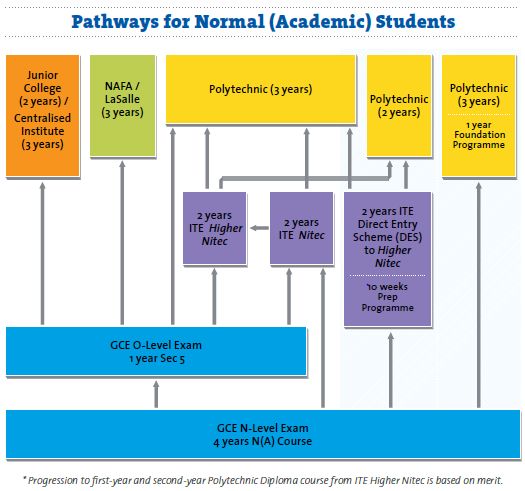
PART I: WHERE TO AFTER ‘N’ LEVELS?

What are the various post-secondary school tracks?
                     3 MAIN TRACKS
    1. Junior Colleges (JCs) or Millennia Institute (MI)
            Prepares students for GCE ‘A’ Level examinations
Education in the JCs and MI focuses on self-development, critical
thinking, intellectual analysis and communication and interpersonal
skills that prepare you for higher learning at the universities and life
beyond. Classrooms are venues of lively discussions and debates,
encouraging you to think both critically and creatively. While education in
the JCs and MI is academically challenging, holistic development is also
emphasized through various elective programmes and CCAs .
For more information, refer to:
www.moe.edu.sg/education/pre-u/
                       2. Polytechnics
A polytechnic education gives you hands-on experience in a dynamic and
progressive learning environment. The courses offered are market-driven
and career-oriented, leading students to fulfilling and rewarding careers
and preparing them for further education.
For more information on the unique strengths of each poly, refer to:
Nanyang Polytechnic – www.nyp.edu.sg
Ngee Ann Polytechnic – www.np.wdu.sg
Republic Polytechnic – www.rp.edu.sg
Singapore Polytechnic – www.sp.edu.sg
Temasek Polytechnic – www.tp.edu.sg

         3. The Institute of Technical Education (ITE)
Aims to equip its students with technical skills and knowledge to meet the
workforce needs of various industry sectors. Suitable for students who
prefers hands-on learning.
For more information, refer to:
https://www.ite.edu.sg/wps/portal/definitely/

4 EDUCATIONAL & CAREER GUIDANCE
Important Post-Secondary Academic Qualifying Criteria to Note:
Post Secondary Institutions Criteria
1. JC (See Annex 1) L1R5 less than or equal to 20 (based on GCE O level results)
Note
L1 = EL / HMTL
Must include Combined Humanities as one of the
relevant 5 subjects (R5)
Must include a Math / Sc as one of the R5
If you include HMTL, cannot include your MTL grade
2. Pre-U / Centralised L1R4 less than or equal to 20 (based on GCE O level results)
Institute Note
L1 = EL / HMTL
If you include HMTL, cannot include your MTL grade
3. Polytechnics (See Annex EL + R2 + B2 (dependent of individual poly’s cut-off points
2) for each course; based on GCE O level results.)
Note: JAE 2013 (based
on GCE O level results,
lowest cut-off point
CoP = 28)
4. Direct Entry Scheme for ELMAB3 is less than or equal to 11 points and student has
4NA students to First obtained one of the following:
Year Poly Foundation EL ≤ 3 and MA ≤ 3, to be eligible to apply to selected FP
Prog (as from 2012) courses in Annex 3. Each of the best 3 subjects must be
Grade 3 or better. Up to 75% of FP places offered will be
(See Annex 3 & 4) from this category.
EL ≤ 2 and MA ≤ 3, to be eligible to apply to selected FP
courses in Annex 4. Each of the best 3 subjects must be
Grade 3 or better. About 25% of FP places offered will
be from this category.
5. Direct Entry to Higher GCE NA level – ELMAB3 less than or equal to 19 with EL and
Nitec for 4NA students Math at least a Grade 4
(See Annex 5)
For Business and Accountancy related courses, EL grade
must be at least a 3.
6. NITEC (See Annex 6) Minimum criteria:
3 GCE ‘N’ Passes (Grade A-D or Grade 1-5) in
Note: JIE 2013 (based Mathematics, Science and one other subject
on GCE N level results, Or
lowest cut-off point for 2 GCE ‘O’ Grades (Grade 1-8) in Mathematics and Science
best and relevant 4 N
level subjects = 20) However, note ITE cut-off point for courses is based on
best 4 subjects
Qualification for Sec 5N: ELMAB3 is 19 points or less.
Grading System for NA
Grade 1: ≥ 75, Grade 2: 70 – 74, Grade 3: 65 – 69, Grade 4: 60- 64, Grade 5: 59 – 50, Grade U: < 50
5Annex 1
JC CUT OFF POINTS
(Info is current as of 12 Jan 2014)
Minimum Requirement: L1R5 is less than or equal to 20. (Approximately, total of best 6
subjects, including EL/HMTL, Combined Hum and a Math/Sc, is less than or equal to 20)
Cut Off Point Criteria: L1R5 Aggregate Scores (with Bonus Points*) of the last student
admitted to the JC in the Joint Admission Exercise (JAE) for the year.
2012 2013
NO JC Arts Science Arts Science
1 Raffles Institution 3 3 3 3
2 Hwa Chong Institution 3 3 3 3
3 National Junior College 5 5 5 5
4 Victoria Junior College 3 4 6 5
Anglo-Chinese School
5 - 5 - 5
(Independent)
Anglo-Chinese Junior
6 7 7 7 6
College
7 Temasek Junior College 7 6 7 7
8 Anderson JC 10 8 9 8
Saint Andrew's Junior
9 9 9 9 9
College
10 Catholic Junior College 11 10 10 10
11 Meridian Junior College 10 9 9 9
12 Nanyang Junior College 10 9 8 8
13 Tampines Junior College 13 13 13 13
14 Jurong Junior College 14 15 12 15
15 Pioneer Junior College 16 16 14 15
16 Serangoon Junior College 15 14 12 12
17 Innova Junior College 20 20 20 20
18 Yishun Junior College 20 20 19 19
* Bonus Points are given for the Categories listed below. Only a maximum of 4 bonus
points from 2 categories can be awarded.
HMTL Distinction – 2 points, Pass – 1 point
CCA Distinction – 2 points, Pass – 1 point
Affiliation Applicable only to secondary schools affiliated to CJC, ACJC, SAJC. 2 points for
affiliation but only after student has fulfilled minimum criteria for JC entry – ELR5 is
less than or equal to 20
6Annex 2
POLY CUT OFF POINTS
(Info is current as of 12 Jan 2014. For more details, please go to
www.poly.edu.sg)
The ELR2B2 aggregate score (including CCA bonus points) including the subject
Min requirements of various courses. Most polytechnics have a minimum requirement
Req of 26 points for the ELR2B2 total score.
The ELR2B2 aggregate score (after deducting CCA bonus points) of the last
Cut Off student posted to the course under the year's Joint Admission Exercise (JAE).
Point (Approximately, it is the aggregate of your 5 best subjects including EL.)
Criteria
2011 2012 2013
Course
S/NO Course By Group POLY JAE JAE JAE
Code COP COP COP
APPLIED SCIENCE
Applied Chemistry with
1 SP S64 12 12 12
Pharmaceutical Science
2 Applied Food Science & Nutrition TP T26 17 17 18
3 Baking & Culinary Science TP T44 16 16 16
4 Biologics & Process Technology NYP C49 16 16 16
5 Biomedical Science SP S98 8 8 8
6 Biomedical Science TP T27 11 11 10
Biomedical Science / Biomedical
7 NP N59 9 9 9
Laboratory Technology
8 Biomedical Sciences RP R14 19 19 16
9 Biotechnology RP R16 23 23 20
10 Biotechnology SP S72 10 10 10
11 Biotechnology TP T31 13 13 12
12 Chemical & Biomolecular Engineering NP N56 13 13 13
13 Chemical & Green Technology NYP C55 17 17 19
Chemical & Pharmaceutical
14 NYP C73 17 17 19
Technology
15 Chemical Engineering SP S70 12 12 13
16 Chemical Engineering TP T33 18 18 17
17 Environmental Science RP R29 26 26 26
18 Food Science & Nutrition NYP C69 16 16 17
19 Food Science & Technology SP S47 14 14 14
20 Landscape Design & Horticulture 1 NP N57 18 18 18
21 Materials Science RP R17 26 26 26
22 Materials Science SP S37 15 15 14
723 Medicinal Chemistry NYP C45 14 14 14
24 Molecular Biotechnology NP N49 10 10 10
25 Molecular Biotechnology NYP C74 13 13 12
26 Nutrition, Health & Wellness SP S44 12 12 13
27 Perfumery and Cosmetics Science SP S38 13 13 12
28 Pharmaceutical Science TP T25 13 13 13
29 Pharmaceutical Sciences RP R22 25 25 22
30 Pharmaceutical Sciences NYP C65 14 14 14
31 Pharmacy Science NP N73 10 10 10
32 Veterinary Bioscience NP N90 9 9 9
33 Veterinary Technology TP T45 11 11 10
Consumer Behaviour and Research
34 RP R48 - - 9
(NEW)
BUILT ENVIRONMENT
1 Architecture SP S66 14 14 13
2 Civil Engineering with Business SP S68 17 17 17
3 Environmental & Water Technology NP N74 15 15 -
Environmental Management & Water
4 SP S52 14 14 15
Technology
5 Green Building & Sustainability TP T29 20 20 23
Hotel & Leisure Facilities Management
6 2 NP N40 13 13 13
7 Hotel & Leisure Facilities Management SP S95 14 14 14
Integrated Events & Project
8 SP S50 13 13 14
Management
9 Integrated Facility Management TP T28 16 16 18
10 Landscape Architecture SP S94 17 17 17
11 Real Estate Business NP N48 15 15 15
Sustainable Urban Design &
12 NP N89 15 15 14
Engineering
BUSINESS & MANAGEMENT
1 Accountancy NP N51 11 11 11
2 Accountancy SP S75 11 11 12
3 Accountancy & Finance NYP C98 13 13 14
4 Accounting & Finance TP T02 11 11 12
5 Arts Business Management NP N91 11 11 9
6 Aviation Management & Services TP T04 11 11 12
7 Banking & Financial Services NYP C96 14 14 15
8 Banking & Financial Services NP N53 9 9 10
89 Banking & Financial Services SP S76 11 11 11
10 Business & Social Enterprise NP N79 12 12 12
11 Business Administration SP S71 12 12 12
12 Business Information Technology NP N61 14 14 13
13 Business Information Technology SP S82 15 15 -
14 Business Information Technology TP T36 16 16 17
15 Business Management NYP C94 16 16 16
Business Process & Systems
16 TP T43 18 20
Engineering
17 Business Studies NP N45 11 11 11
Business/Logistics & Operations
18 TP T01 14 14 15
Management/Marketing
19 Communications & Media Management TP T40 12 12 13
20 Culinary & Catering Management TP T18 15 15 16
Customer Relationship and Service
21 RP R34 25 25 26
Management
22 Financial Business Informatics TP T17 14 14 15
23 Financial Informatics SP S46 12 12 12
24 Food & Beverage Business NYP C46 16 16 17
25 Fund Management & Administration NYP C56 16 16 17
26 Hospitality & Tourism Management TP T08 14 14 15
27 Hospitality & Tourism Management NYP C67 16 16 17
28 Hotel and Hospitality Management RP R37 18 18 18
Human Resource Management with
29 SP S48 12 12 12
Psychology
30 Integrated Events Management RP R28 20 20 21
31 International Business NP N85 6 6 8
32 International Business SP S36 8 8 7
33 International Supply Chain Management NP N80 16 16 16
34 Law & Management TP T09 13 13 13
35 Leisure & Resort Management TP T19 15 15 17
36 Logistics Management NP N58 16 -
37 Marketing NYP C99 17 17 17
38 Mass Media Management 3 NYP C93 15 15 15
Restaurant and Culinary Operations
39 RP R46 20 20 23
NEW!
40 Retail Management TP T39 17 17 18
41 Sport & Wellness Management NYP C81 17 17 18
42 Sports & Leisure Management RP R27 26 26 26
43 Tourism & Resort Management NP N72 10 10 10
944 Tourism and Resort Management SP S55 12 12 12
Wellness, Lifestyle and Spa
45 RP R44 21 21 24
Management
46 Business Innovation and Design (NEW) SP S34 - - 10
ENGINEERING
1 3D Interactive Media Technology 4 TP T49 21 21 22
2 Aeronautical & Aerospace Technology NYP C51 15 15 15
3 Aeronautical Engineering SP S88 12 12 12
4 Aerospace Avionics RP R20 23 23 21
5 Aerospace Electronics NP N75 13 13 15
6 Aerospace Electronics SP S90 14 14 14
7 Aerospace Electronics TP T50 15 15 16
8 Aerospace Engineering TP T51 13 13 14
Aerospace Engineering (Quality
9 RP R40 21 21 19
Systems)
10 Aerospace Systems & Management NYP C52 16 16 17
11 Aerospace Technology NP N65 12 12 13
12 Audio-visual Technology NP N76 14 14 14
5
13 Automation & Mechatronic Systems NP N50 21 21 22
14 Bioengineering SP S58 14 14 14
15 Biomedical Electronics RP R15 26 26 -
16 Biomedical Engineering NP N60 15 15 15
17 Biomedical Engineering NYP C71 18 18 18
18 Biomedical Informatics & Engineering TP T38 19 19 -
19 Civil Aviation RP R39 21 21 -
20 Clean Energy SP S45 16 16 19
21 Clean Energy TP T52 19 19 21
22 Clean Energy Management NP N84 15 15 18
23 Common Engineering Programme RP R42 26 26 26
24 Common Engineering Programme SP S40 16 16 16
25 Common Engineering Programme NEW! TP T56 20 20 20
26 Computer Engineering SP S53 19 19 21
27 Computer Engineering TP T13 20 20 23
28 Digital & Precision Engineering NYP C62 17 17 18
29 Digital Entertainment Electronics RP R38 26 26 -
30 Electrical & Electronic Engineering SP S99 19 19 22
31 Electrical Engineering NP N43 22 22 25
Electrical Engineering with Eco-Design
32 6 NYP C48 20 20 23
1033 Electronic & Computer Engineering NP N44 23 23 26
Electronics, Computer &
34 NYP C89 26 26 26
Communications Engineering
Electronics / Media & Communication
35 Technology / Computer Engineering / TP T05 20 20 -
Microelectronics/Aerospace Electronics
36 Engineering Science NEW! NP N93 9 9 9
37 Engineering with Business SP S42 15 15 14
Engineering with Business Management
38 NP N71 17 17 16
Programme
39 Industrial & Operations Management RP R11 26 26 -
Info-Communication Engineering &
40 SP S85 20 20 -
Design 7
41 Manufacturing Engineering NYP C88 26 26 26
42 Mechanical Engineering NP N41 20 20 21
43 Mechanical Engineering SP S91 18 18 18
44 Mechatronics/Aerospace Engineering TP T06 20 20 22
45 Mechatronics and Robotics SP S73 20 20 22
46 Mechatronics Engineering NYP C87 26 26 26
47 Micro & Nanotechnology RP R30 26 26 -
48 Multimedia & Infocomm Technology NYP C75 25 25 26
49 Nanotechnology & Materials Science NYP C50 19 19 18
50 Renewable Energy Engineering RP R41 26 26 26
51 Supply Chain Management RP R21 24 24 21
52 Telematics & Media Technology NYP C53 21 21 26
HEALTH SCIENCES
1 Dental Hygiene and Therapy NYP C72 12 12 15
2 Health Management and Promotion RP R43 26 26 26
3 Health Sciences (Nursing) NP N69 28 28 28
4 Healthcare Administration NEW! RP R45 25 25 26
5 Nursing NYP C97 28 28 28
6 Optometry NP N83 12 12 13
7 Optometry SP S67 12 12 26
8 Outdoor & Adventure Learning RP R33 25 25 -
9 Sports & Exercise Sciences RP R26 25 25 23
10 Sports Coaching (new) RP R26 - - 19
HUMANITIES
111 Applied Drama and Psychology SP S43 13 13 13
2 Child Psychology & Early Education NP N86 11 11 12
3 Chinese Studies ^ NP N70 13 13 13
Creative Writing for Television and New
4 SP S41 12 12 12
Media
5 Early Childhood Education NP N66 14 14 14
6 Early Childhood Studies TP T54 13 13 13
7 Gerontological Management Studies TP T53 16 16 16
8 Psychology & Community Services NP N77 10 10 9
9 Psychology Studies TP T48 9 9 9
10 Social Sciences( Social Work) NYP C47 13 13 15
INFORMATION & DIGITAL TECHNOLOGIES
1 Business Applications RP R18 25 25 24
2 Business Enterprise IT NYP C68 18 18 19
3 Business Informatics NYP C78 18 18 -
4 Business Information Systems RP R13 26 26 25
5 Cyber & Digital Security TP T15 16 16 18
Digital Entertainment Technology
6 NYP C70 20 20 22
(Games)
7 Digital Forensics NEW! TP T55 12 12 13
8 Digital Media SP S57 17 17 -
9 Digital Visual Effects NYP C57 19 19 21
10 Engineering Informatics NYP C80 23 23 26
11 Financial Informatics NYP C58 15 15 -
12 Financial Informatics NP N81 14 14 15
13 Game & Entertainment Technology TP T16 19 19 21
14 Infocomm & Network Engineering 8 TP T37 22 22 -
15 Infocomm Security Management SP S54 15 15 13
16 Information Security NYP C54 17 17 20
17 Information Technology NYP C85 20 20 21
18 Information Technology NP N54 18 18 18
19 Information Technology RP R12 26 26 26
20 Information Technology SP S69 17 17 18
21 Information Technology TP T30 19 19 21
22 Interactive and Digital Media RP R31 26 26 26
23 Interactive Media Informatics TP T34 22 22 -
24 IT Service Management RP R23 26 26 26
25 Mobile & Network Services TP T42 21 21 26
1226 Multimedia & Animation NP N55 14 14 14
27 Music & Audio Technology SP S97 12 12 12
28 Network Systems & Security NP N64 17 17 18
29 Business Intelligence & Analytics (New) NYP C43 - - 19
30 Mobile Sotware Development (NEW) RP R47 - - 26
MARITIME STUDIES
1 Marine & Offshore Technology NP N42 17 17 17
2 Marine Engineering SP S63 16 16 18
3 Maritime Business SP S74 16 16 16
4
MEDIA AND DESIGN
1 Advertising & Public Relations NP N87 12 12 12
2 Animation & 3D Arts NEW! NP N92 12 12 11
3 Apparel Design & Merchandising TP T20 15 15 15
4 Chinese Media & Communication NP N88 13 13 13
5 Communication and Information Design RP R32 21 21 19
6 Design for Interactivity RP R36 22 22 23
7 Digital Animation SP S35 15 15 15
8 Digital Media Design (Animation) NYP C61 18 18 18
9 Digital Media Design (Games) NYP C60 20 20 20
Digital Media Design (Interaction
10 NYP C59 22 22 21
Design)
11 Digital Visual Effects NP N78 15 15 18
12 Environment Design TP T46 19 19 20
13 Experience and Product Design SP S51 16 16 17
14 Film, Sound & Video NP N82 11 11 12
15 Game Design RP R35 22 22 23
16 Games Design & Development SP S56 16 16 16
17 Industrial Design NYP C83 20 20 21
18 Interactive Media Design TP T21 18 18 20
19 Interior Architecture & Design TP T22 15 15 15
20 Interior Design SP S89 16 16 17
21 Mass Communication NP N67 10 10 10
22 Media and Communication SP S86 12 12 13
23 Motion Graphics & Broadcast Design NYP C66 18 18 19
24 Moving Images TP T23 19 19 -
25 New Media RP R19 22 22 22
26 Product & Industrial Design TP T35 19 19 20
1327 Product Design & Innovation NP N68 17 17 16
28 Retail & Hospitality Design TP T47 17 17 19
29 Sonic Arts RP R24 19 19 19
30 Space & Interior Design NYP C64 18 18 18
31 Technology & Arts Management RP R25 21 21 20
32 Visual Communication TP T24 14 14 18
33 Visual Communication NYP C63 17 17 19
Visual Communication and Media
34 SP S93 14 14 15
Design
35 Visual Effects and Motion Graphics SP S39 16 16 16
14Annex 3: Group 1 Courses Offered Under PFP
Group 1
List of polytechnic diploma courses* offered under the Polytechnic
Foundation Programme to students who obtained ELMAB3 ≤ 11,
WHERE EL ≤ 3 & MA ≤ 3 and each of the best 3 subjects ≤ 3
Applied Sciences Engineering
Applied Chemistry with Pharmaceutical 3D Interactive Media Technology -
Science - S62 (SP)^ T49 (TP)^
Applied Food Science & Nutrition - T26 Aeronautical & Aerospace
(TP) Technology - C51 (NYP)^
Baking & Culinary Science - T44 (TP) Aeronautical Engineering - S88
Biologics & Process Technology - C49 (SP)^
(NYP) Aerospace Avionics - R20 (RP)
Biomedical Engineering - T38 Aerospace Electronics - N75 (NP)^
(TP)^Previously known as Biomedical Aerospace Electronics - S90 (SP)^
Informatics & Engineering
Aerospace Electronics - T50 (TP)^
Biomedical Science - N59 (NP)
Aerospace Engineering - R40 (RP)
Biomedical Science - R14 (RP)^
Aerospace Engineering - T51 (TP)^
Biomedical Science - S98 (SP)^
Aerospace Systems & Management
Biomedical Science - T27 (TP)^ - C52 (NYP)^
Biotechnology - R16 (RP) Aerospace Technology - N65 (NP)^
Biotechnology - S72 (SP)^ Audio-visual Technology - N76
Biotechnology - T31 (TP) (NP)^
Chemical & Biomolecular Engineering - Automation & Mechatronic Systems
N56 (NP) - N50 (NP)^
Chemical & Green Technology - C55 Bioengineering - S58 (SP)
(NYP) Biomedical Engineering - N60 (NP)^
Chemical & Pharmaceutical Technology - Biomedical Engineering - C71 (NYP)
C73 (NYP)
Clean Energy - S45 (SP)^
Chemical Engineering - S70 (SP)^
Clean Energy - T52 (TP)^
Chemical Engineering - T33 (TP)
Clean Energy Management - N84
Environmental & Water Technology - N74 (NP)^
(NP)^
Common Engineering Programme -
Environmental Science - R29 (RP) C42 (NYP)
Food Science & Nutrition - C69 (NYP) Common Engineering Programme -
Food Science & Technology - S47 (SP)^ R42 (RP)
Landscape Design & Horticulture - N57 Common Engineering Programme -
(NP) S40 (SP)
Materials Science - R17 (RP) Common Engineering Programme -
Materials Science - S37 (SP) T56 (TP)
15 Medicinal Chemistry - C45 (NYP) Computer Engineering - S53 (SP)^
Molecular Biotechnology - N49 (NP) Computer Engineering -T13 (TP)
Molecular Biotechnology - C74 (NYP) Digital & Precision Engineering -
Nutrition, Health & Wellness - S44 (SP) C62 (NYP)
Perfumery & Cosmetic Science - S38 (SP) Electrical & Electronic Engineering
- S99 (SP)^
Pharmaceutical Science - T25 (TP)
Electrical & Electronic Engineering
Pharmaceutical Sciences - C65 (NYP)
Programme - T05 (TP)
Pharmaceutical Sciences - R22 (RP) Electrical Engineering - N43 (NP)^
Pharmacy Science - N73 (NP)^
Electrical Engineering with Eco-
Veterinary Technology - T45 (TP)^ Design - C48 (NYP)^
Electronic & Computer Engineering
Health Sciences - N44 (NP)^
Electronics, Computer &
Communications Engineering -
Dental Hygiene & Therapy - C72 (NYP)^
C89 (NYP)^
Health Management & Promotion - R43 (RP) Engineering with Business - S42
Health Sciences (Nursing) - N69 (NP)^ (SP)
Healthcare Administration - R45 (RP) Engineering with Business
Nursing - C97 (NYP)^ Management - N71(NP)^
Optometry - N83 (NP)^ Infocomm & Network Engineering -
Optometry - S67 (SP) T37 (TP)
Sports & Exercise Sciences - R26 (RP) Manufacturing Engineering - C88
(NYP)
Sports Coaching - R49 (RP)
Mechanical Engineering - N41
(NP)^
Mechanical Engineering - S91 (SP)
Mechatronics & Robotics - S73
(SP)
Mechatronics Engineering - C87
(NYP)^
Mechatronics/Aerospace
Engineering - T06 (TP)^
Multimedia & Infocomm
Technology - C75 (NYP)
Nanotechnology & Materials
Science - C50 (NYP)
Renewable Energy Engineering -
R41 (RP)
Supply Chain Management - R21
(RP)
Telematics & Media Technology -
C53 (NYP)^
16Information & Digital Technologies Built Environment
Business Applications - R18 (RP) Architecture - S66 (SP)
Business Enterprise IT - C68 (NYP) Civil Engineering with Business - S68
Business Informatics - C78 (NYP) (SP)
Business Information Systems - R13 Environmental Management & Water
(RP) Technology - S52 (SP)
Business Information Technology - S82 Green Building & Sustainability - T29
(SP) (TP)
Business Intelligence & Analytics - C43 Hotel & Leisure Facilities
(NYP) Management - N40 (NP)^
Business Intelligence & Analytics - T57 Hotel & Leisure Facilities
(TP)^ Management - S95 (SP)
Cyber & Digital Security - T15 (TP)^ Integrated Events & Project
Management - S50 (SP)
Digital Entertainment Technology
(Games) - C70 (NYP) Integrated Facility Management - T28
(TP)
Digital Forensics - T55 (TP)^
Landscape Architecture - S94 (SP)
Digital Visual Effects - C57 (NYP)
Real Estate Business - N48 (NP)
Engineering Informatics - C80 (NYP)
Financial Informatics - N81 (NP)^
Sustainable Urban Design &
Engineering - N89 (NP)
Financial Informatics - C58 (NYP)
Games & Entertainment Technology - Media & Design
T16 (TP)^
Infocomm Security Management - S54
(SP) Apparel Design & Merchandising -
Information Security - C54 (NYP) T20 (TP)^
Information Technology - N54 (NP)^ Design for Interactivity - R36 (RP)
Information Technology - C85 (NYP) Digital Animation - S35 (SP)
Information Technology - R12 (RP) Digital Media Design (Animation) -
C61 (NYP)^
Information Technology - S69 (SP)
Digital Media Design (Games) - C60
Information Technology - T30 (TP) (NYP)^
Interactive & Digital Media - R31 (RP) Digital Media Design (Interaction
IT Service Management - R23 (RP) Design) - C59 (NYP)^
Mobile & Network Services - T42 (TP)^ Environment Design - T46 (TP)^
Mobile Software Development - R47 Experience & Product Design - S51
(RP) (SP)
Multimedia & Animation - N55 (NP)^ Games Design -R35 (RP)
Network Systems & Security - N64 (NP)^ Games Design & Development - S56
(SP)
Industrial Design - C83 (NYP)^
Interactive Media Design - T21 (TP)^
Interior Architecture & Design - T22
(TP)^
Business & Management 17 Interior Design - S89 (SP) Motion Graphics & Broadcast Design
- C66 (NYP)^
Aviation Management & Services - T04
(TP) Digital Film & Television - T23 (TP)^
Previously known as Moving Images
Business Information Technology - N61
(NP) Product & Industrial Design - T35
(TP)^
Business Information Technology - T36
(TP)^ Product Design & Innovation - N68
(NP)^
Business Process & Systems
Engineering - T43 (TP) Retail & Hospitality Design - T47 (TP)^
Civil Aviation - R39 (RP) Sonic Arts -R24 (RP)
Financial Business Informatics - T17 Space & Interior Design - C64 (NYP)^
(TP) Visual Communication & Media
Financial Informatics - S46 (SP) Design - S93 (SP)
Industrial & Operations Management - Visual Communication - C63 (NYP)^
R11 (RP) Visual Communication - T24 (TP)^
Visual Effects & Motion Graphics -
S39 (SP)^
Maritime Studies
Marine & Offshore Technology - N42
(NP)^
Marine Engineering - S63 (SP)^
Maritime Business - S74 (SP)
18Annex 4: Group 2 Courses Offered Under PFP
Group 2
List of polytechnic diploma courses* offered under the Polytechnic
Foundation Programme to students who obtained ELMAB3 ≤ 11,
WHERE EL ≤ 2 & MA ≤ 3
Business & Management Media & Design
Accountancy & Finance - C98 (NYP) Mass Communication - R32 (RP)
Accountancy - N51 (NP) Previously know as Communication &
Information Design
Accountancy - S75 (SP)
New Media - R19 (RP)
Accounting & Finance - T02 (TP)
Technology & Arts Management - R25
Banking & Financial Services - C96
(RP)
(NYP)
Business Administration - S71 (SP)
Humanities
Business Management - C94 (NYP)
Business Studies - N45 (NP)
Business/ Logistics & Operations Gerontological Management Studies -
Management/ Marketing - T01 (TP) T53 (TP)
Communication & Media Management - Social Sciences (Social Work) - C47
T40 (TP) (NYP)
Consumer Behaviour & Research - R48
(RP)
Culinary & Catering Management - T18
(TP)
Customer Relationship & Service
Management - R34 (RP)
Food & Beverage Business - C46 (NYP)
Fund Management & Administration -
C56 (NYP)
Hospitality & Tourism Management - C67
(NYP)
Hospitality & Tourism Management - T08
(TP)
Hotel & Hospitality Management - R37
(RP)
Integrated Events Management - R28
(RP)
International Logistics & Supply Chain
Management - N80 (NP)
Law & Management - T09 (TP)
Leisure & Resort Management - T19
19(TP)
Marketing - C99 (NYP)
Mass Media Management - C93 (NYP)
Outdoor & Adventure Learning - R33
(RP)^
Restaurant & Culinary Operations - R46
(RP)
Retail Management - T39 (TP)
Sport & Wellness Management - C81
(NYP)
Sports & Leisure Management - R27
(RP)
Wellness, Lifestyle & Spa Management -
R44 (RP)
20Annex 5
Higher Nitec Courses
21Annex 6
Nitec Courses
Who can apply: GCE 'O' and 'N' Level Holders
Minimum Requirements: Pass 2 GCE 'O' level subjects or Pass 3 GCE 'N'
level subjects. However, please note: you may meet minimum
requirements for entry but you may not get a course as the cut-off points for
all courses are based on the total points for the best 4 GCE N level subjects
as detailed below.
Cut-off Points Criteria for NITEC courses: Based on an aggregate of best 4 GCE
'N' subjects, including pre-requisites and bonus points where applicable and is
subject to availability of vacancies. Selected courses will require applicants to
attend an admission interview, medical examination or drawing test.
2011 JAE 2012 JAE 2013 JAE
Cut-Off Cut-Off Cut-Off
S/N Nitec Course Campus
Points Points Points
6
1 Aerospace Avionics ITE College Central 4 5
8
2 Pastry & Baking ITE College West 7 8 8
3 Applied Food Science ITE College East 7
Culinary Skills (Western) / 9
4 ITE College West 7 10
Western Culinary Arts
5 Service Skills (Tourism) ITE College West 8 8
6 Aerospace Technology ITE College Central 9 9 8
Community Care & Social
7 ITE College East NA 11 10
Development
Digital Audio & Video
8 ITE College East 8 8
Production
Info-Communications
Technology (Cloud ITE College East - 13
Computing)
9
Info-Communications 9
Technology (Cloud ITE College West 10 12
Computing)
Fitness Training ITE College East - 14
10
Fitness Training ITE College West 11 11
22Food & Beverage
11 ITE College West 17 15
Operations
Service Skills (Office) ITE College Central 9 8
12 Service Skills (Office) ITE College Central - 6
Service Skills (Office) ITE College East 11 10
Aerospace Machine
13 ITE College Central - 8 and 11 6
Technology
Digital Audio & Video
14 ITE College West 8 8 7
Production
15 Digital Animation ITE College Central 15 20 16
ITE College East 16 11 16
16 Electronics
ITE College West - - 16
17 Nursing ITE College East 15 15 14
18 Visual Communications ITE College Central 15 12 15
19 Security Technology IITE College West 10 10 11
Automotive Technology
20 ITE College West 12 12 12
(Light/Heavy Vehicles)
Info-Communications
Technology
21 ITE College Central - - 8
(Networking and Systems
Admin)
Info-Communications
Technology
ITE College West 10 9 9
(Networking and Systems
Admin)
22
Info-Communications
Technology
ITE College East - - 14
(Networking and Systems
Admin)
Chemical Process
23 ITE College East 14 13 14
Technology
Mechanical Technology ITE College East 14 15 20
24
Mechanical Technology ITE College Central 14 15 14
Mechatronics ITE College West - - 17
25
Mechatronics ITE College Central 14 14 14
26 Electrical Technology ITE College East 14 13 15
27 Electronics ITE College Central 11 16 10
28 Facility Technology ITE College East - - 20
23Facility Technology ITE College West 13 18 16
Space Design
29 ITE College Central 14 16 13
(Architecture)
30 Product Design ITE College Central 18 19 20
31 Interactive Media Design ITE College Central 16 16 15
Service Skills (Retail) ITE College Central - - 14
32
Service Skills (Retail) ITE College West 16 17 14
33 Visual Effects ITE College Central 16 12 13
Social Media & Web
ITE College Central - - 15
Development)
34
Social Media & Web
ITE College Central 15 14 10
Development)
35 Electrical Technology ITE College West 16 11 12
Mechatronics (Medical
36 ITE College Central 11 11 11
Technology)
37 Machine Technology ITE College Central 17 17 15
38 Opticianary ITE College East - - 6
39 Floristry ITE College Central - - 8
Fashion Apparal
40 ITE College Central - - 9
Production and Design
41 Rapid Tranist Technology ITE College West - - 10
Medical Manufacturing
42 ITE College Central - - 11
Technology
Mobile Systems and
43 ITE College West - - 12
Services
44 Asian Culinary Arts ITE College West - - 12
Laser & Tooling
45 ITE College Central - - 14
Technology
46 Attractions Operations ITE College West - - 15
Space Design (Interior and - -
47 ITE College Central 15
Exhibition) - -
Semiconductor - - 16
48 ITE College Central
Technology - -
49 Beauty and Wellness ITE College East - - 18
50 Hair Services ITE College East - - 20
24My Preferred Course of Study After ‘N’ Levels
Choice Pathway Post – Course EMB3
Number Secondary Aggregate
Institution
For eg: Polytechnic Singapore Accountancy EMB3 ≤ 9,
st
1 Choice Foundation Polytechnic (S75) Where EL ≤
Programme 3 & MATH ≤
(PFP) 3 and each
of the best
subjects ≤ 3
For eg: Direct Entry ITE College Higher Nitec in EMB3 ≤ 14,
nd
2 Choice to Higher Central Accountancy Where EL ≤
Nitec 3 & MATH ≤
4
For eg: 5NA Serangoon ‘O’ Level EMB3 ≤ 19
rd
3 Choice Garden
Secondary
School
st
1 Choice
nd
2 Choice
rd
3 Choice
25PART II: STUDY TIPS
The Challenger’s 10 Tips to Success!!!
Now, your ‘N’ level examinations are just months away! Don’t panic and
pretend that they will go away – THEY WON’T!
But, if you are organized and have healthy study habits, you will achieve
success in your examinations!
Have a Positive Attitude
Always believe in yourself, learn to overcome the challenges you face
and have the power to believe that you can succeed.
Set Goals that provide you with DIRECTION
AND LEAD TO SUCCESS.
Each goal you set should state WHAT you will do and WHEN you will
accomplish it. Implied in each goal you set is your WILL (determination)
to do it. For example, “I will (your determination) finish revising for my
History, Chapter 1 (what you will do) by March 20 (when you will
accomplish it).
Develop Interest
Develop an interest in what you are studying. Try to relate what you are
studying to you own life to make it as meaningful as possible. This can
motivate you to study better and concentrate.
Study Place
Find a comfortable and quiet place to study with good lighting and little
distractions (Avoid your own bed! It is very tempting to just lie down
and take a nap).
Revise Immediately
It is best to review the topics right after school when it's still fresh in
your memory.
26 Revision Timetable
Draw up a revision timetable – it should be realistic, cover all
subjects and allow you time to relax as well.
Space out your studying. You will learn more by studying a little
every day instead of waiting to cram at the last minute. By studying
every day, the material will stay in your long-term memory but if you
try to study at the last moment, the material will only reside in your
short-term memory that you will easily forget.
Learn to manage your time well.
Make Notes
Make sure that you understand the material well. Don't just read
through the material and try to memorize everything.
Take notes and write down a summary of the important ideas as
you read through your study material.
Concentrate and Focus
Make sure you are not tired and/or hungry when you study.
Otherwise, you won't have the energy you need to concentrate.
Don't try to do two tasks at the same time. You won't be able to
concentrate on either one very well. Concentration means focusing
on one thing at any one time!
Seek Help
Don’t think you are alone! A problem shared is a problem halved. If
you face problems while studying, get your teachers or friends help
immediately!
Relax
If you panic, you are lost! There is no running away from the exams
so make use of the time you have right now and give yourself the
best chance of doing well by starting to revise early and keeping
calm.
27Self-Revision Checklist For
English Language
4NA Syllabus (1190)
Paper 1 (Writing) 1 hour 50 minutes
Section A (Editing)
Read and Follow the Instructions
Make sure that you circle the errors and that you write the answer in the
correct line in the spaces given.
Revise your Grammar Rules
Revise the rules for use of tenses, Subject-Verb agreement, verb forms,
plural and singular forms of nouns, consistency in use of pronouns, and
use of adjectives, adverbs and connectors.
Try out grammar editing exercises. Look for a good assessment book
for grammar.
Check your answers and if you did not get the answer correct, check
against the grammar rules to find out why your answer was incorrect.
Section B (Situational Writing)
Understand the Questions
1. Study all the questions and sample essays as well as your
own. Highlight the key words indicating:
the objectives of the activity/event/ building the facility, etc (purpose
of task)
the purpose of writing this (what are you trying to achieve by giving
the speech, writing the letter or report?) (intent of the writer)
the audience (who it is written for)
the format (speech, formal letter, informal letter, report)
the context (situation. Do not copy the words given)
the writer’s position (who are you writing as? The Head Prefect?)
the words in bold
28 highlight and number all the required parts in the bulleted points
(because each bullet can have more than 1 point to address)
2. Study the visual stimulus.
Think about how to apply the information for the different options.
Do not lift or copy the words given but think about how the
information about the options given can help to achieve the purpose
of the activity/ event/ task. You should not include the information
given in your explanation but you should come up with your own
reasons based on the information. There is no merit in repeating
what has already been given in the question and the examiner does
not need a photocopy of the question!
When writing about how your choice achieves the purpose, as far as
possible, use your own words in explaining. For example, if the
purpose is to “build stronger bonds with the community”, think of
other ways of saying this eg. “enhance communication”, “develop
better relationships”, “provide more opportunities for interaction with
the residents”, etc.
3. Understand the ways different questions are crafted and the
different requirements of the questions. Do not assume that
all the questions are asking for the same things.
Read the complete sentence for each point. Don’t jump to
conclusions about what the question wants and end up reading the
points only partially.
Read carefully as some words may be missed when they are written
in a long sentence. Did they ask you to explain or describe the uses
or how to organize or how to design the area? Did they ask you to
explain how you will fulfil all the objectives, as you describe your
planning of the event/ your ideas for designing the place, etc?)
29Practise writing out the formats without referring to the
samples for formal letters, informal letters, speech and
reports.
Some students just try to memorise without writing them out. When
they actually try to write during the examination, they tend to leave out
some details (eg. date, our Dear Sir, etc) or they put things in the
wrong order. Or they mix up the formats.
Practise Planning and Writing A Few Essays within Time
Limit.
Writing without planning creates a mess in terms of organization of
information.
10 minutes spent in planning makes the writing much easier as you
only need to write out the points in proper sentences.
Remember that it is not enough to just address the points (mention
them). You need to develop them (explain, give specific information or
elaborate on what you mean).
Make sure you fulfil all the requirements of the question. Tick against
each point to ensure that you have answered it.
Practise Editing Your Own Work
It is very important that you learn to spot your own errors and correct
them. Watch out for common errors in spelling, punctuation (capital
letters and small letters, full stops and commas), use of the plural and
singular forms (the Sec 4 students’ parents or parent?), tenses, verb
forms (has went or has gone? will bought or will buy?) and subject-verb
agreement (the students is/ are?).
Use a dictionary to check your spelling and memorise all the words that
you have spelt wrongly.
Get a peer to help you check.
Make sure you make this a habit to check your work for every
piece of work you write.
30Section C (Continuous Writing)
Practise Planning
Look at the Ten Years’ Series questions/ any EL assessment book
with trial papers.
For discursive/ informative/ expository questions, think of 4 Big Ideas
for each content paragraphs. Then jot down in point form what you
will write for each paragraph using the PEER structure (Point-
Example- Evidence/ Elaboration –Reiteration)
For the narrative topics, think of some creative plots with interesting
endings (you can use a mindmap for this)
Prepare Some Good Introductions for the topics you have
planned.
Keep an EL notebook of your own original introductions which you can
use when needed.
You can also jot down a few good introductions from books you have
read.
Remember: Do not memorise “purple prose” (“prescribed” descriptive
phrases found in essay books that many students will be
regurgitating), or introductions and stories from “model essay” books.
Practise Writing
Write a few essays of the required length within the time limit given for
the examination. Who knows? One of them may be usable for your
examination.
Practise Editing Your Own Work
Again, check for errors just like for Section B.
31Paper 2 (Comprehension) 1 hour 50 minutes
Study the Visual Text
Look at advertisements, websites, posters or visual texts from other
sources (e.g. newspaper, magazines) to practise identifying the
message.
Based on the visual text, identify the message by looking at the
picture, logo, headings, sub-headings, bulleted points, etc.
Think about questions like:
Who is the intended audience? What kind of people would be
attracted to this advertisement, website, poster, etc?
What is the intention of the “writer” in including this picture? Does it
promote something? Does it send any message? Eg. a beauty centre
advertisement might put in a picture to send the message that if you
have pimples, you are not attractive and so you should go to their
centre for skin treatment.
What is the intention of the “writer” in including these bulleted points
or the information? Eg. are these points intended to “sell” the product
in some way? Are these points included to tell you the type of people
they want to attract?
Look at the words and the picture. By using the words or picture, what
is the intended effect on the reader? Are they trying to make you
curious, instil fear, attract your attention, make your feel pity for the
person(s)/ animals, make you feel guilty, unattractive, etc?
Read and Understand the Different Types of
Comprehension Questions.
Learn to understand the different types of comprehension questions
(literal, inferential, quotation, vocabulary, own words, evaluative, how
the language is used to create impact and the global question). This
enables you to know how to tackle the questions and to answer in the
way that the examiners want. Your teacher will teach you more about
how to do this in class.
Revise the different literary terms (personification, simile, etc).
When you read books, newspaper, or any articles, practise identifying
the literary features and explaining the effects of using them.
32Practise Some Comprehension Papers within Time Limit
Give about 20 minutes to the summary which constitutes 15 marks of
the 50 marks in this paper (30%).
Practise identifying the points – know what to leave out and what is
relevant.
Practise shortening the sentences to keep to 80 words.
Paper 3 (Listening) 45 minutes
Spend Time Listening to Radio Broadcasts and Podcasts
Some podcasts can be downloaded into your MP3 or handphones and
you can listen to them when on the bus etc. Watching English
programmes and news will help too.
Learn to take down notes when your teachers are teaching.
Try using graphic organisers or taking notes in point form .
Paper 4 (Oral Communication) About 20 minutes
Practise Reading Aloud
Practise reading with clear pronunciation and articulation, fluency and
pace, and expressiveness. Read with a sense of your audience, the
purpose (objective of this speech, etc), and pretend that you are really
placed in that situation (context).
Record your reading and play it back so that you can check if you are
reading too fast, mumbling or slurring.
Study the Visual Stimulus for Spoken Interaction
Identify the activity that the people are engaged in. Think of the purpose
of the activity and the age group/ profile (type) of people participating eg.
the elderly or families or students, etc.
Develop a personal response to what you see. One way is to think of 3
Big Ideas that you want to comment on. For example, if there are 3
33possible advantages for the activity eg. promotes a healthy lifestyle, to
build family bonding and allows for social interaction between residents,
you can talk about these 3 when asked to talk about your opinion of the
activity.
The reading passage and the spoken interaction topics are related
thematically. You can also use the passage to give you some ideas so
as to respond to the visual stimulus. Extend beyond what you see in the
picture to talk about other ideas related to the theme for the next 2
questions. Eg. how you would encourage more people to take part; why
it is everyone’s responsibility to take care of their own health; and the
effects on the country etc.
Prepare and Practise for the Spoken Interaction
Read the newspaper to keep up with current affairs.
Think of ideas for different conversation topics and list down the
points you have for each topic in your EL notebook.
You can then take these out to revise before your examination.
Practise speaking in Standard English regularly. Otherwise, you will
not be able to express your ideas properly under stressful
examination conditions.
All The Best!
34Other Useful websites
(for additional details and resources)
1) Maths:
www.ace-learning.com.sg/
2) General Info on your ‘O’ / ‘N’ Level Exams:
www.seab.gov.sg
35PART (III): CALENDAR OF EVENTS
Timeline for N Level Academic Activities 2014
*Note: Dates of school academic activities may be subjected to
changes
June
Wk Dates N Level Exams / School School’s Academic
Exams Activities
1 02 – 06 June 03 – 12 June
2 09 – 13 June Supplementary
Classes
(Refer to Schedule
given)
3 16 – 20 June
4 23 – 27 June
Term 3
Wk Dates N Level Exams / School School’s Academic
Exams Activities
1 30 Jun – 4 Jul 8 JULY TO 16 JULY
2 7 – 11 Jul GCE ‘N’ LEVEL ENGLISH
3 14 – 18 Jul ORAL EXAM (1190/4)
18 JULY
SUBMISSION OF ART &
F&N COURSEWORK
4 21 – 25 Jul
5 28 Jul – 1 Aug 29 JULY – 07 AUG
6 4 – 8 Aug PRELIMINARY EXAM 1
31 JULY TO 7 AUG
GCE ‘N’ LEVEL MOTHER
TONGUE ORAL EXAM
(1172/3, 1182/3, 1192/3)
7 11 – 15 Aug
368 18 – 22 Aug 18 AUG
SUBMISSION OF D&T
COURSEWORK
22 AUG
PRELIMINARY EXAM 2
ENGLISH
(For students who do not
pass Prelim 1)
9 25 – 29 Aug 25 AUG
PRELIMINARY EXAM 2
HUMANITIES (SS)
(For students who do not
pass Prelim 1)
10 1 – 5 Sept
Term 4
Wk Dates N Level Exams / School Exams &
Common Tests
1 15 – 19 Sept GCE ‘N’ Level Exams
15 Sept COMBINED HUMANITIES (SS)
(2193/1, 2194/1)
16 Sept MOTHER TONGUE PAPERS 1 & 2
(1172, 1182, 1192, 3238, 3239)
ENGLISH LANGUAGE LISTENING
COMPREHENSION
(1190/3)
17 Sept ENGLISH LANGUAGE PAPERS 1 & 2
(1190)
18 Sept
19 Sept ART PAPER 2 (6125/2)
2 22 – 26 Sept 22 to 25 SEPT
PRELIMINARY EXAM 2*
(Maths, Science, Geo/Hist, Electives)
(For students who do not pass Prelim 1)
3 29 Sept – 3 Oct
4 7 – 10 Oct GCE ‘N’ Level Exams
6 Oct
377 Oct SCIENCE PAPERS (5105 &5107)
PHY/CHEM & CHEM/BIO
8 Oct COMBINED HUMANITIES (HISTORY)
(2194/3)
MATHEMATICS PAPER 1 (4042/1)
9 Oct
10 Oct MATHEMATICS PAPER 2 (4042/2)
COMBINED HUMANITIES (GEOGRAPHY)
(2193/2, 2194/2)
5 13 – 17 Oct GCE ‘N’ Level Exams
13 Oct PRINCIPLES OF ACCOUNTS (7091/1 and
7091/2)
14 Oct LITERATURE IN ENGLISH (2022/1 and
2022/2)
DESIGN & TECHNOLOGY (7054/1)
15 Oct FOOD & NUTRITION (6072/1)
‘N’ Level 2014 ends!
38IMPORTANT DATES FOR STUDENTS TAKING ‘O’ LEVEL
SUBJECTS
4th July to 18th July: Mother Tongue Oral (1132, 1142, 1162)
22nd July: Mother Tongue Listening Comprehension (1132,
1142, 1162)
17th October: Mathematics Paper 1 (4016/1)
27th October: Mathematics Paper 2 (4016/2)
4th November: Mother Tongue Papers 1 & 2 (1132, 1142,
1162)
3940
41
42
43
44
45
46
47
48
49
50
51
PART IV:
WORDS OF ENCOURAGEMENT &
WELL WISHES

           52
WORDS OF ENCOURAGEMENT &
WELL WISHES
53WORDS OF ENCOURAGEMENT &
WELL WISHES
54SERANGOON G ARDEN
SECONDARY SCHOOL
DESIGNED BY
4E5N / 4NA ACE COUNCIL 2014
55You can also read


