Engineering Postgraduate Prospectus 2021 - No 1 - The ...
←
→
Page content transcription
If your browser does not render page correctly, please read the page content below

Engineering
                   Postgraduate Prospectus 2021

   No 1          No 1              No 1
New Zealand      Global        In New Zealand
 University*   Reputation**   for Employability***
1
Contents
LEADING THE WAY
no.
NEW ZEALAND’S HIGHEST RANKING
ranked
UNIVERSITY AND ENGINEERING FACULTY
TOP UNIVERSITY IN NEW ZEALAND FOR EMPLOYABILITY
According to the Times Higher Education World University Rankings 2020, QS World University Rankings 2020 and QS Graduate Employability Rankings 2019.
FIRST IN NEW ZEALAND IN
Gain knowledge to Chemical Electrical Civil and Structural Mechanical
contribute to a better world Engineering Engineering Engineering Engineering
According to the QS World University Rankings by Subject 2020.
Engineering is increasingly ubiquitous – both in its variety and visibility. Our postgraduate programmes
are designed to develop your abilities to solve problems, innovate and create positive change in our ever-
evolving technological landscape.
We all approach postgraduate study for
different reasons, but are united in the
Engineering is becoming as diverse as
IN GOOD COMPANY
those who pursue it. This is valuable
challenges and thought-provoking questions to our potential to address tomorrow’s
that we share. As a faculty, we’re willing to global challenges – from environmental MORE THAN 1,400 POSTGRADUATE STUDENTS ENROLLED IN 2019
satisfy intellectual curiosities, contribute sustainability and structural safety, to the
to the ongoing developments in our fields design of software and advanced medical
and potentially create new knowledge. systems. To realise this potential, we are
We welcome you to join us on our ongoing committed to fostering collaborative
20
journey. environments for all our students,
regardless of their professional and research
Te Herenga Mātai Pūkaha/the Faculty
backgrounds.
of Engineering’s research output spans
diverse areas, many of them with tangible Congratulations on taking a step towards
impact on our regular lives. This means becoming part of our outstanding whanau.
you’ll get the chance to learn from globally- We look forward to seeing you apply your
recognised experts whose influence extends passions to better academia, industry and
to decisions outside the classroom. We society. 67.4% 27%
boast strong collaborations with industry
and other research organisations, and
work in increasingly cross-disciplinary
PROFESSOR GERARD ROWE student clubs, associations international students postgraduate women in
fields – all these ensure that we’re creating
knowledge pathways towards the intellectual Acting Dean of Engineering and networks from 69 countries engineering
independence, practical skills, and empathy The University of Auckland
to understand our world.
Cover attributions: *QS World University Rankings 2020 | **QS World Rankings Academic and Employer Reputation 2020 | ***QS Graduate Employability Rankings 2019
Disclaimer: Although every reasonable effort is made to ensure accuracy, the information in this document is provided as a general guide only and is subject to alteration. All students enrolling at the University of Auckland
must consult its official document, the current Calendar of the University of Auckland, to ensure that they are aware of and comply with all regulations, requirements and policies. Publication date: May 2020.
2 3
BUILT FOR RESEARCH
Investigating language
The Acoustics Research Centre is a development, pronunciation
collaborative effort between experts from recognition and vocal
Mechanical Engineering, Audiology, Architecture,
and Music, focusing on research, teaching and
health by applying signal
the delivery of professional services. processing techniques
We are proud to be a recognisable force – both in New
Zealand and internationally – in the development of a The Boundary Layer Wind Tunnel
broad range of research, from fundamental to applied, with is New Zealand’s largest wind tunnel. It contains ASSOCIATE PROFESSOR
CATHERINE WATSON
demonstrable positive impacts on society and industry. instrumentation for many aerodynamics studies,
Te Herenga Mātai Pūkaha’s research collaborations extend such as investigating pedestrian flows around
beyond our immediate physical spaces; we’re seen working buildings, aerodynamic drag and the power of
elite cyclists, and pressures on model racing cars.
alongside private industries, government organisations and other
research institutions, and encourage cross-disciplinary projects The Centre for Advanced Composite
in emerging fields with global demand. As a postgraduate Materials blends expertise from engineering,
student, you’ll have access to the best subject matter experts, science and medicine to conduct fundamental,
research centres, facilities and equipment that we can offer. applied and industry-focused research on
synthetic and bio-based composite materials,
CAMPUSES and their processes, design and performance.
CITY, NEWMARKET AND GRAFTON
AND A BRAND NEW BUILDING WITH 50 SPECIALIST LABS – ALL The Creative Design and Additive
HUBS FOR MULTIDISCIPLINARY ACTIVITY, HOUSING A TOTAL OF Manufacturing Lab focuses on technologies,
OVER 3,000 PIECES OF PURPOSE-BUILT EQUIPMENT LOCATED design methods, and ways to develop AM
ON CITY-ADJACENT GROUNDS WITH PLENTY OF ACCESS materials with a goal to see the processes
TO PUBLIC TRANSPORT, SO YOU CAN CONVENIENTLY surrounding these evolve from prototyping
ENJOY WHAT AUCKLAND OFFERS OUTSIDE OF STUDY methods to a high-value manufacturing reality.
The Civil Structures Hall holds Australasia’s
largest ‘strong wall’ at 9m high, a 200m2 strong
floor and a shake table to develop full-scale
“Doctoral study was a time-efficient way to reach the
projects, including earthquake testing.
pinnacle of educational achievement and embark
on an interesting career path. The lab facilities here The Complex Fluid Dynamics Laboratory
allowed me to conduct world-class structural and contains high-speed lasers, stereo-scopic
seismic testing, and the novel outcomes enabled me to particle image velocimetry and rheometry used
undertake subsidised travel to present at international to investigate the properties and behaviours of a
conferences, which I benefitted from and enjoyed a lot. wide variety of fluids.
“My research involved the development of a cement-
stabilised, flax-fibre reinforced, rammed earth housing The Geothermal Institute is one of the Leading the way
world’s first research and training centres for
solution for rural Māori communities. It involved all in structural steel
stages of a project: finding a community to work the field. As home to the world’s largest group
of geothermal researchers, they also offer innovations for
with, identifying and characterising local sources of
materials, structural and seismic testing, facilitating consulting services to support the planning, earthquake-proofing
Mauri Model decision-making workshops with all development and management of projects and improved fire safety
stakeholders, designing the structure, obtaining around the globe.
building consent for the dwelling, training local The Human Aspects in Software ASSOCIATE PROFESSOR
individuals, project managing the construction and Engineering Lab supports projects focused CHARLES CLIFTON
commissioning the dwelling. on improving software practices and processes,
“Not every research project is as open or as unorthodox particularly where the field relates to human
as the one I had, but I liked it. I enjoyed learning about behaviour and needs.
Māori culture and indigenous knowledge, using them
to inform my methodology and applying them to a
real-world housing solution. I’ve made meaningful
connections and close friendships with individuals in
the Māori community from Ahipara and Rotoiti, where
my research work was based.
“Following my PhD, I took up an R&D position, which
drew on a lot of my technical knowledge, and my
current role benefits from my experience engaging
with many different stakeholders. This now includes
local councils and Iwi, facilitating decision-making
processes and applying engineering skills to large-
Operations
scale projects, including a roading improvement
project in Auckland, the design and implementation Research applied
of a 5-star residential development and a regional to resource utilisation
conference centre in New Zealand.” planning and generating
JOHN CHEAH efficient healthcare services
Graduate: PhD in Civil Engineering
Current: Project Managing Consultant,
Synergine Group Limited DR MIKE O’SULLIVAN JR and
ASSOCIATE PROFESSOR CAMERON WALKER
4 5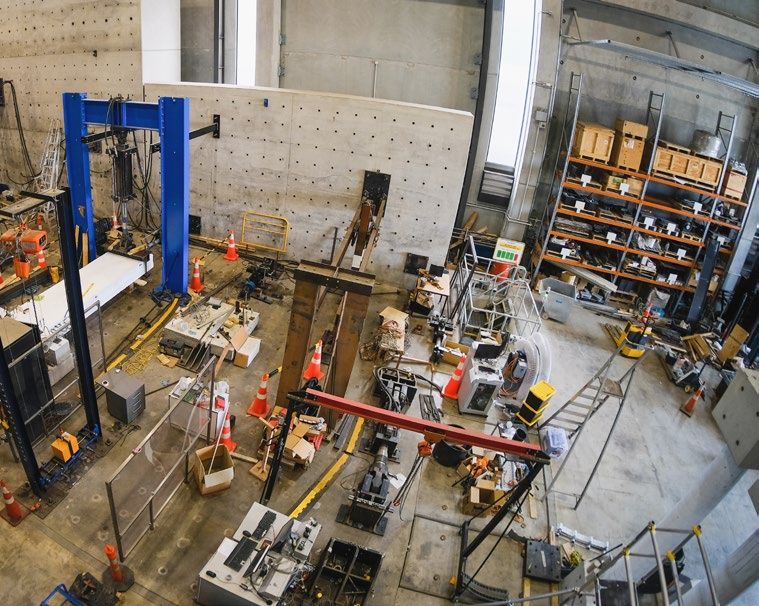
Understanding the ecological
“A conversation with an old lecturer planted the
consequences of human idea to return to uni. I was in my early career and
interventions on the aquatic looking for a new challenge, though I had initially
environment by studying anticipated that it would be through a new job
rather than heading back to study. I thought about
hydraulics and sediment how I enjoyed my research experience throughout
transport processes the fourth year of my undergraduate degree and
knew that it was something that I was good at.
“My PhD research involves an in-depth look at
DR HEIDE
FRIEDRICH cartilage – the smooth covering over the ends of
bones – to see the interactions between individual
collagen fibres that make up the tissue. We are
trying to understand how this changes over time,
so we can learn more about how diseases like
osteoarthritis progress, and how we might replace
these natural materials with high-quality substitute
materials in the event of replacement surgery.
“Research may seem a lot more individual, but
you still need to work well with others. You need
to be brave enough to put your thoughts and
The Hydraulic Engineering Laboratory ideas forward and in doing so, ensure that you are
has a 45m-long flume – New Zealand’s largest creating a safe working environment where others
Making advancements – capable of pumping sediment and water, and feel that they can do the same. These skills aren’t
in fundamental research is used to simulate conditions in rivers, such as unique to one particular industry – they are skills
for life. Being in industry made me feel confident in
for smarter regulation flow and erosion in river beds, and at hydraulic
structures. my ability to manage my time, make independent
of stem cells to improve decisions and ask for help.
cancer treatment The Laboratory for Industry 4.0 engages
with essential industries to develop and test new “I am interested in staying in research for a period of
concepts for the control of distributed automation time, but I am also aware of a growing conversation
DR JENNY systems within the context of the Industrial highlighting a lack of diversity – particularly a lack
MALMSTROM Internet of Things and Cloud Computing. of Māori and Pasifika representation – in STEM
careers. Further to my research I would want to use
The Nanomechanical Research my skills and experience gained to get involved in
Laboratory is unique in its ability to test both initiatives which help to enable and empower other
traditional and hydrated biological materials. It young Māori and Pasifika, preparing them for a
specialises in measuring the properties of small- career in engineering, whether that be in industry or
scale materials and thin films using advanced in academia.”
equipment including the Hysitron TriboIndenter,
MTS XP and Activelife Biodent. EMMA TE TUMANAKO BROWN
Ngāpuhi, Ngai Te Rangi, Ngati Maru
The Light Metals Research Centre has
a dozen academics and over 20 professional Current PhD candidate and Professional Teaching
and doctoral researchers dedicated to research Fellow in Chemical and Materials Engineering
development, technical support, training and
maintaining long-standing industry relationships
in this specialised field.
The Robotics and Intelligent Systems
Pioneers in Inductive Power Laboratory provides expertise in robot
Transfer, the basis of wireless programming, human interaction and intelligent
systems including machine learning, artificial
power technologies of intelligence and speech communication, with
the future applications in healthcare and agriculture.
Te Pūnaha Ātea/the Space Institute is
EMERITUS PROFESSOR a multidisciplinary centre of expertise capable
JOHN BOYS and
PROFESSOR of executing space missions and developing
GRANT COVIC applications, with a goal to further New Zealand's
involvement in space.
The Transportation Research Centre
collaborates with local government, industry
and international research institutes to cover a
broad range of research, from road construction
materials and infrastructure asset management
to traffic studies and public transport.
For a list of available postgraduate
research opportunities, visit:
www.engineering.auckland.ac.nz/
researchprojects
6 www.findathesis.auckland.ac.nz 7
“For my thesis, I am investigating the use of high-level
Our programmes
approaches for designing hardware to be used in the
Square Kilometre Array (SKA) for processing signals
from stars. This involves working with international
collaborators who provide the necessary radio
astronomy algorithms, while I get them to meet the
Our variety of postgraduate programmes reflects the diversity of our faculty and the ever-evolving real-time performance requirements set by the SKA.
engineering industry. Choose from over 20 specialist areas, study full-time or while working, pursue in- “I love being able to learn more about radio
depth research by writing a thesis, or expand your practical skills with a coursework-based qualification. astronomy, a completely different field to what I’ve
previously experienced, and see how our work will be
used to perform science on extremely large data sets.
Postgraduate Certificate in Postgraduate Certificate in Postgraduate Certificate in Light I also really enjoy the opportunity to teach the next
Engineering (PGCertEng) Geothermal Energy Technology Metals Reduction Technology generation of students.
Taught (60 points) (PGCertGeothermTech) (PGCertLMRTech)
“As someone who identifies as transgender and
Full-time (6 months) or part-time (2 years) Taught (60 points) Taught (60 points) non-binary, being a part of groups such as Rainbow
This certificate provides graduate engineers with Full-time (6 months) or part-time (2 years) Full-time (6 months) Engineering and Trans on Campus has proved to be
advanced technical or management foundations This world-recognised programme gives A prestigious and globally respected certificate quite important in finding likeminded individuals
and new industrial perspectives, expanding engineers and scientists practical and applied that equips engineers with highly valuable and able to support me and allow me to become who I
their employability in their sector of choice. skills in the geothermal energy industry, lucrative skills to run light metal smelters across really am. I have since become a leader for Rainbow
A Plastics specialisation is available for those equipping them to pursue diverse roles in this the world. It includes a stimulating three-week Engineering as well as the Rainbow Representative
wishing to pursue further career opportunities in sector. It includes two week-long field trips and a residential course at a working smelter, along for the University’s Postgraduate Student Association.
materials and processing in this field, and can be block structure to fit in with work commitments. with distance learning carried out at home to This has provided me a platform to advocate
completed by distance learning. minimise disruption to your career. for LGBTQIA+ students and be involved with the
www.engineering.auckland.ac.nz/
University’s decision-making processes.
www.engineering.auckland.ac.nz/pgcerteng pgcertgeothermtech www.engineering.auckland.ac.nz/
pgcertlmrtech “A large part of my reasoning for continuing study
here was the people. Even outside of the Rainbow
community, I have met a wide range of people who
have been open to and accepting of who I am. PhD
students who tutored me as an undergraduate
“I am a third-culture kid from the Philippines,
later became incredible role models for me in both
where I worked in a non-profit organisation that
teaching and research. My supervisor has proven to
collaborated with the private sector towards
be incredibly supportive through my transition. While
building disaster-resilient communities. Climate
large institutions can be slow to change, there are
change is going to continue to happen on a
people working very hard to make positive changes
global scale whether we like it or not, and I aim
happen.”
to help empower others to adapt to inevitable
environmental changes through my work. KRYSTINE DAWN SHERWIN
“New Zealand was definitely a factor in my decision Current: PhD in Computer Systems Engineering
to study here. Despite being exposed to natural
hazards, New Zealand remains a rapidly growing
first-world economy, with disaster management in
the forefront of the government’s policies. This is
what motivated me to choose to study here – to not Master of Energy (MEnergy)
Postgraduate Diploma in Engineering Master of Disaster Management
only learn directly from world-recognised research
(PGDipEng) (MDisMgt) Taught or research (120 or 180 points)
and best practices, but to experience first-hand
Taught (120 points) Taught (120 or 180 points) Full-time (1 year) or part-time (2 or 4 years)
how this country continues to develop resilience
within its cities and communities. Full-time (1 year) or part-time (4 years) Full-time (1 year or 18 months) or part-time This programme is ideal for engineering, science
This qualification gives students with a three-year (2 or 3 years) or commerce graduates who want to develop their
“It is also considered one of the safest and most technical, business or policy-related expertise,
engineering bachelors degree an opportunity to Draw from expertise throughout the University
beautiful countries in the world and having lived leading to global, sustainable career pathways,
build on their previous skills, resulting in a well- – Engineering, Development Studies, Science,
here for over a year, I can attest to its beauty and including positions such as energy consultants,
rounded knowledge of the principles, concepts Population Health, Environmental Law, and
safety. You also meet so many people from all walks project managers, or energy modelling analysts.
and ideas that underpin a chosen specialisation. Architecture and Planning – to prepare for
of life! I’ve made long-lasting friendships, and
It is designed to provide a pathway to further leadership roles in disaster risk reduction, www.engineering.auckland.ac.nz/menergy
have received plenty of support as an international
study in a masters programme. response, recovery and resilience.
student, making it easy to adjust to the academic
lifestyle here. www.engineering.auckland.ac.nz/pgdipeng www.engineering.auckland.ac.nz/mdismgt Master of Engineering (ME)
Research (120 or 180 points)
“My home country is one of the most disaster-prone Postgraduate Diploma in Operations Master of Earthquake Engineering Full-time (1 year or 18 months) or
places in the world – at third place, according Research (PGDipOR) (MEqEng) part-time (2 or 3 years)
to the 2018 World Risk Index. It’s imperative to
Taught (120 points) Taught (120 or 180 points) Write a thesis under supervision by leading
be able to adapt to a variety of challenges, build
resilience, and prepare for a climate-defined Full-time (1 year) or part-time (4 years) Full-time (1 year) or part-time (3 or 4 years) academics and researchers in your chosen
future. One of my career goals is to become a The PGDipOR is offered alongside the Faculty A coursework-based programme that fulfils specialisation. You will undertake a stimulating
disaster resilience specialist, and my programme of Science to equip engineers with problem- increasing industry needs for the next generation mix of theoretical and experimental research to
is helping me to do that through multidisciplinary solving skills in the design and management of of leaders, drawing from our internationally- solve real-world problems at the cutting edge of
knowledge and skills. I want to become an active large or complex systems in business, industry recognised expertise in geotechnical and engineering advancement, equipping you for a
promulgator of change and development towards and government. It is of particular interest to structural engineering. career in industry or opening up the potential for
building a disaster resilient Philippines.” those pursuing roles in predictive or prescriptive further study.
www.engineering.auckland.ac.nz/meqeng
analytics in a broad selection of industries. www.engineering.auckland.ac.nz/me
MIGEL ESTOQUE
www.engineering.auckland.ac.nz/pgdipor
Graduate: Master of Disaster Management
8 9
Master of Engineering Project
Admission
Subject PGCert PGDip Taught Research Doctorate
Management (MEPM) masters masters
Taught (120 or 180 points)
Biomedical Engineering r r
and application
Full-time (1 year or 18 months) or part-time
Chemical and Materials Engineering ✔ ✔ ✔ ✔ ✔
(4 or 6 years)
Civil Engineering ✔ ✔ ✔ ✔ ✔
A career-focused qualification that capitalises on
New Zealand’s position as a cultural force in the Computer Systems Engineering ✔ ✔ ✔ ✔ ✔
world of successful start-ups. The MEPM provides Construction Management ✔ ✔ ✔ r r This is a general guide. Please refer to www.auckland.ac.nz/pg-entry-reqs for detailed information.
key management practices as you study towards
an industry-recognised professional certification. Disaster Management ✔ r r
www.engineering.auckland.ac.nz/mepm Earthquake Engineering ✔ r r Admission to postgraduate Doctoral degrees
Electrical and Electronic Engineering ✔ ✔ ✔ ✔ ✔ programmes You must be able to carry out independent
Master of Engineering Management Energy 1
✔ ✔ ✔ ✔ r
research and have completed a significant
(MEMgt) • Admissions for 2021 close on 8 December research project, dissertation or thesis, at
Engineering Management 2
✔ r 2020 (Semester One) and 4 July 2021 university. Acceptance into our doctoral
Taught (120 points)
Engineering Science ✔ ✔ ✔ ✔ ✔ (Semester Two) with the following programme is dependent on the availability of
Full-time (1 year) or part-time (4 years) exceptions: supervision and facilities.
Environmental Engineering ✔ ✔ ✔ ✔ r
This prestigious programme offered by the
• Postgraduate Certificate candidates should • Applicants with New Zealand qualifications
Faculty of Engineering and the University of Food Engineering ✔ ✔ ✔ ✔ r
refer to the programme websites for up-to- must have completed a postgraduate
Auckland Business School is viewed as ‘an MBA Geotechnical Engineering ✔ ✔ r r date information on admission deadlines. bachelors (honours) degree with first class
for engineers’, and provides you with the technical
Geothermal Energy Technology ✔ r r or second class (division 1) honours, or a
foundations, project management skills and • Eligible candidates can apply for a PhD masters degree with first class or second
business acumen needed to pursue leadership Light Metals Reduction Technology ✔ r r throughout the year. class (division 1) honours, in a field related to
roles in technologically-driven companies. Mechanical Engineering ✔ ✔ ✔ ✔ ✔ • Information on your fees is available on your doctoral studies.
www.engineering.auckland.ac.nz/memgt Mechatronics Engineering www.auckland.ac.nz/fees; this is based on
✔ ✔ ✔ ✔ ✔ • Applicants with overseas qualifications
Medical Devices and Technologies ✔ ✔ ✔ r your subject choices and workload. must have completed a masters-level
Master of Engineering Studies (MEngSt)
• English language requirements: We require qualification in a field related to your doctoral
Taught or research (120 or 180 points) Operations Research3 ✔ ✔ ✔
an overall IELTS academic score of 6.5, with studies with a GPE of at least 5.5.
Full-time (1 year or 18 months) or Polymer Engineering ✔ ✔ r r
no bands below 6.0. See www.auckland.
part-time (4 or 6 years) Project Management ✔ ✔ ac.nz/pg-english-reqs for approved
A primarily taught masters with diverse alternatives to IELTS.
How to apply
Software Engineering ✔ ✔ ✔ ✔ ✔
specialisations, allowing you to tailor your study
Transportation Engineering ✔ ✔ ✔ r r • Grades from previous study: Grades or Applying for a non-doctoral
towards your professional goals and interests.
marks achieved at the University of Auckland programme
Gain applied knowledge to pursue roles with
regulatory, management or product development 1 Interfaculty with Science and Business. 2 Interfaculty with Business. 3 Interfaculty with Science. are given a grade point average (GPA). Grades • Follow the step-by-step guide at
r Available as a research area in the associated department obtained at other institutions are converted www.auckland.ac.nz/pg-admission.
scopes. A research option is available for the
Food Engineering, and Medical Devices and to grade point equivalent (GPE) on our scale.
• The Application for Admission is available at
FUNDING YOUR STUDY
Technologies specialisations. See www.gpecalculator.auckland.ac.nz for
www.apply.auckland.ac.nz, where you can
more information.
www.engineering.auckland.ac.nz/mengst also check your application status and see
what supporting documents you will need
Master of Operations Research (MOR) Entry requirements to provide.
400
Research (120 points) NEARLY Postgraduate certificates or • If you applied for an intake in the following
Full-time (1 year) or part-time (2 years) postgraduate diplomas semester, a decision will be made within four
The MOR gives students from a variety of You must have completed an undergraduate weeks. Delays may occur for future semester
backgrounds – including arts, commerce, degree at a recognised tertiary institution, in intakes, during peak admission periods, or if
engineering or science – skills in network design a field relevant to your specialisation. Visit our documents take longer to process.
simulations and dynamic programming to POSTGRADUATE website for GPA or GPE requirements.
$40 MILLION
perform rigorous intellectual analysis, as well as Applying for a PhD programme
solve complex industry problems in healthcare, SCHOLARSHIPS Masters degrees • Make sure you meet all entry requirements
transport, finance, energy, telecommunications,
OFFERED ACROSS THE You will need a GPA, or GPE of 4.0 for the Master and have decided on an area of interest or
government and manufacturing. in postgraduate scholarships are offered UNIVERSITY of Engineering Studies or Master of Engineering potential research topic.
www.engineering.auckland.ac.nz/mor by the University of Auckland each year Project Management. For all other masters • Apply at www.auckland.ac.nz/
programmes, a GPA or GPE of 5.0 is required. applydoctorate.
Doctor of Philosophy (PhD) FIND ONE THAT SUITS YOU AT www.engineering.auckland.ac.nz/scholarships If you don’t meet this criteria, you may begin
Doctoral research your pathway into a masters programme by • Assessment of your doctoral application can
Guaranteed scholarships are available to domestic research students and undertaking our one-year Postgraduate Diploma take eight weeks or longer. You can check
Full-time (3–4 years); a part-time option is
PhD applicants with a qualifying programme from a New Zealand university in Engineering. your application status online and see what
available to domestic students only
supporting documents are required.
The PhD involves undertaking advanced,
who meet GPA requirements: www.auckland.ac.nz/makethegrade • 120-point programme: a four-year
bachelors degree in engineering where the
independent and original research. You will be able Summer Research Scholarships give you a $6,000 tax-free stipend to International students
to pursue a specialisation of your choice under the final year consists of postgraduate-level study
enhance your CV and gain research experience: www.summer.ac.nz relevant to your chosen specialisation A copy of your offer of place from the University
supervision of – and by collaborating with – our
is required to supplement your visa application.
world-class academics, and gain the advanced Doctoral students receive an annual stipend paid into their PReSS accounts • 180-point programme: an undergraduate We recommend starting your University
knowledge needed for specialised industry or for up to four years to cover direct research costs, such as overseas degree in engineering at a university (or application as soon as possible and contacting
consulting positions, or teaching or academia.
conferences: www.auckland.ac.nz/press-accounts similar institution) in a field relevant to your an overseas representative for help at
www.auckland.ac.nz/phd chosen specialisation www.auckland.ac.nz/overseasrep.
10 11
Contact                             Web
      Faculty of Engineering              engineering.auckland.ac.nz
      20 Symonds Street                   facebook.com/uoaengineering
      Auckland, New Zealand               twitter.com/uoaengineering
                                          instagram.com/uoaengineering
      Phone
      0800 61 62 65 (outside Auckland)    Postal
      or 923 1969 (within Auckland)       Faculty of Engineering
      or +64 9 923 1969 (International)   The University of Auckland
                                          Private Bag 92019
      Email                               Auckland 1142
      foe-enquiries@auckland.ac.nz        New Zealand

engineering.auckland.ac.nz

You can also read


