The Framework of Cooperative Problem-based Learning (Co-PBL) to Promote Verbal Creativity in EFL Writing: Is It Feasible? - jurnal arbitrer
←
→
Page content transcription
If your browser does not render page correctly, please read the page content below
JURNAL ARBITRER - VOL. 5 NO. 2 (2018)

                                      Online version available in : http://arbitrer.fib.unand.ac.id

                                           JURNAL ARBITRER
                                            | 2339-1162 (Print) | 2550-1011 (Online) |

Article

The Framework of Cooperative Problem-based
Learning (Co-PBL) to Promote Verbal Creativity in
EFL Writing: Is It Feasible?
M. Ali Ghufron, Siti Ermawati
English Education Department, IKIP PGRI Bojonegoro, East Java, Indonesia

 SUBMISSION TRACK                                               A B S T R A C T
 Recieved: August 27, 2018
 Final Revision: October 4, 2018                                One of the influential factors that could affect students’
 Available Online: October 29, 2018                             writing skill is verbal creativity (VC). As an attempt to
                                                                promote VC in EFL writing, two learning models i.e.
 KEYWORD                                                        cooperative learning and problem-based learning are
                                                                incorporated and modified. This study was aimed at: (1)
 Cooperative learning, problem-based learning,
 Co-PBL, verbal creativity, EFL writing                         describing the structure of the framework of Co-PBL in order
                                                                to promote VC in EFL writing; and (2) evaluating the
 CORRESPONDENCE                                                 feasibility of the framework of Co-PBL in EFL writing class.
 E-mail: ali.ghufron@ikippgribojonegoro.ac.id
                                                                To achieve the goals of this study, a descriptive explanatory
                                                                research was applied. It involves the EFL writing teachers and
                                                                the first and second-grade students of English Education
                                                                Department of a private university in East Java, Indonesia.
                                                                The data were gathered through Focus Group Discussion
                                                                (FGD), observation, semi-structured interview, and
                                                                questionnaire. Incorporating cooperative learning (CL) and
                                                                problem-based learning (PBL) results in the Co-PBL
                                                                framework to guide the students through PBL cycles based on
                                                                CL principles. The Co-PBL framework was also modified by
                                                                inserting learning activities which could promote VC in EFL
                                                                writing in each phase or cycle of PBL. Further, it was also
                                                                confirmed that the Co-PBL framework is feasible to be
                                                                implemented in EFL writing class. These findings, then, might
                                                                have significant implications for EFL writing teachers and
                                                                students.

I. INTRODUCTION                                                          not only for the progression of human
                                                                         civilization, but also for human prosperity.
Education in the 21st century should pay
                                                                         Runco (2004) even argued that creativity is
attention to the development of human
                                                                         more important due to the rapidly increasing
civilization, prosperity, and well-being. One
                                                                         complexity of the world around us, and it can
of the ways that could be implemented is
                                                                         be used as a useful and effective response to
through the integration of creative thinking
                                                                         evolutionary changes.
skill into teaching and learning process. Zhu
                                                                         Due to the importance of creativity, some
et al., (2017) argue that creatvity is extremely
                                                                         efforts had been done by many researchers in
important for human life. It is urgently needed

DOI: https://doi.org/10.25077/ar.5.2.81-93.2018                          Attribution-NonCommercial 4.0 International. Some rights reserved
M. ALI GHUFRON / JURNAL ARBITRER - VOL. 5. NO. 2 (2018)
order to stimulate students’ creativity, point of learning, creating deep interests
including verbal creativity. Verbal creativity among students to learn new knowledge and
is an ability to think creatively and to measure integrate existing ones, and forcing them to
one’s fluency, flexibility, and originality of a think critically and creatively to solve the
verbal form, which deals with words and problem (Boud & Feletti, 1997; Tan, 2003;
sentences. Moreover, verbal creativity is an Woods, Felder, Rugarcia, & Stice, 2000;
ability to form and create new ideas and then Woods, 1996).
combine them into something new referring
to the existing information. The new ideas Some studies had revealed that CL and PBL
reflect fluency, flexibility, and originality that indirectly could stimulate verbal creativity
can be seen in divergent thought revealed skill, and later it also affects on EFL writing
verbally (Munandar, 2009). skills. Some of the studies (see Atkinson,
Dealing with this verbal creativity, some 2003; Chen, 2004; Cole, 2012; Elola &
studies had revealed that verbal creativity Oskoz, 2010; Mahmoud, 2014; Wong, Chin,
plays a critical role in EFL writing skill (see Chen, & Gao, 2009) revealed that CL could
Al-jarf, 2015; Izadi, Mehri; Khoshsima, 2015; help students develop their English language
Pishghadam & Mehr, 2011; Rababah, skills, including EFL writing skills.
Luqman; Melhem, 2014; Rababah, Halim, Furthermore, thare also a number of studies
Mohamed, & Jdaitawi, 2013; Rababah, that support the argument which PBL has a
Alshehab, & Melhem, 2017; Weisi & powerful effect in EFL learning, including
Khaksar, 2015). In order to improve students’ EFL writing (see also Dastgeer, 2015;
EFL writing skill, they must have a high level Iswandari, 2017; Kusmawati & Purwati,
of verbal creativity. Unfortunately, not every 2015; Lin, 2012, 2015; Ng Chin Leong,
student has high level of verbal creativity. 2009). However, there is still no study which
However, verbal creativity can be trained and investigated the integration of cooperative
stimulated through several activities in learning and problem-based learning by
learning. adding and inserting some pedagogical
attempts which directly could influence the
One of the efforts that can be implemented to improvement of verbal creativity in EFL
promote verbal creativity in EFL learning is writing. Further, there is still no study which
by integrating cooperative learning (CL) and focused on integrating cooperative learning
problem-based learning (PBL). Cooperative and problem-based learning (developing Co-
learning is a learning model where students PBL) for promoting verbal creativity in EFL
are working together in small groups to help writing.
each other (Roger & Johnson, 1994). Further,
Roger & Johnson (1994), argue that in a Based on the explanation above, this study
cooperative learning situation, interaction was focused on the modification and
among students is characterized by positive integration of CL and PBL in EFL writing
goal interdependence with individual course. The modification and integration of
accountability. Positive goal interdependence the two learning models was inteded to
requires acceptance by a group that they “sink develop new learning actvitities which could
or swim together”. optimally stimulate verbal creativity skill, and
Meanwhile, problem-based learning (PBL) is later on, it will also affect on EFL writing
a learning model which starts with an skills. The novelty of this study lays not only
unstructured problem that has more than one on the integration of the principles of
answer. Students have to collaboratively learn cooperative learning and problem-based
together through the PBL cycle (Mohd-yusof, learning, but also on the addition and insertion
Helmi, Jamaludin, & Harun, 2011; Yusof; of pedagogical attempts (i.e. vocabulary
Hassan; Jamaludin; Harun, 2012). The boosting, remembering English structures,
unstructured problems are used as the starting questions-answers, etc), in which those
82M. ALI GHUFRON / JURNAL ARBITRER - VOL. 5. NO. 2 (2018)
pedagogical attempts could directly promote rich manifesting the phenomena of interest
verbal creativity in EFL writing. intensely but not extremely (Patton, 2002). At
last, 20 students from the first and second-
II. METHODS grade students were selected. From the 20
students, it was selected 10 students
Research Design
representing each grade level of high, low,
To achieve the goals of this study, a
and medium cumulative grade points to
descriptive explanatory research was applied.
participate in this study.
Descriptive explanatory research is
appropriate to provide a picture of an event,
condition or situation, or to answer the Data Collection Technique
Focus Group Discussion (FGD)
question of how and why. By making use of
Focus Group Discussion (FGD) was
this design, the researcher was basically
condected between selected teachers and
challenged to explain the framework of the
students. This FGD was done after the
modification and the integration of CL and
implementation of the framework in EFL
PBL (hereafter: Co-PBL) in a more accurate
writing class (after tryout 2). It was intended
way and about how feasible the framewok of
to evaluate the feasibility of the framework of
the new model to be implemented in EFL
Co-PBL to be implemented in EFL writing
writing course to stimulate students’verbal
class.
creativity.
Observation
The observation process was done
Participants of the Study
simultaneously with the implementation
This study involved the EFL writing teachers
process. The field-notes was made whether
and the first and second-grade students of
the practice had followed the rules stated in
English Education Department of IKIP PGRI
the lesson plan or not. Theefore, in this phase,
Bojonegoro (Institute of Teacher Training and
some related documents such as syllabus and
Education of PGRI Bojonegoro) in East Java,
lesson plan are needed. Besides, it was also
Indonesia at the even semester in the
used to note some improvisation done during
academic year of 2017/2018. The participants
the implementation process in which it will be
in this study were chosen by using two types
used as a reference in second FGD.
of purposive sampling technique i.e. criterion
Semi-structured Interview
and intensity sampling. Criterion sampling
Semi-structured interview was also conducted
was used to choose the participant from
with the teachers and some students who were
teachers.
chosen purposively. Data from the interviews
were recorded and collected. The responses
According to Patton (2002), criterion
from interview sessions were transcribed in
sampling involves the cases that meet some
Ms Word for analysis by using the coding
predetermined criterion of importance. The
processes. Coding process was used as it is
pre-determined criteria in selecting paticipant
more practical for the researcher to classify
from teachers are that he/she must have
the data into specific categories and terms,
experience in conducting CL and PBL tutorial
related to the study.
in EFL writing class; and he/she is still in
Questionnaire
progress of teaching EFL writing. From these
At the end of learning, the students were also
criteria, there were only 2 teachers who were
given a questionnaire in order to evaluate the
selected in this study. Besides, there were 120
implementation of Co-PBL. The
students who took EFL writing course from
questionnaire uses the Likert scale for
the first and second grade. In selecting the
scoring. The students should mark the
participant from students, the researchers
used intensity purposive sampling which numbers between 1 to 5 (1 = very poor, 5 =
excellent). The results of the questionnaire
involves selecting cases that are information-
were, then, compared with the results of
83M. ALI GHUFRON / JURNAL ARBITRER - VOL. 5. NO. 2 (2018)
qualitative data. According to Patton (2002), gathered. Besides, descriptive statistics were
methods of triangulation often involves also used to analyze quantitative data gained
comparing and integrating data collected from the questionnaires.
through some kind of qualitative methods
with data collected through some kind of III. RESULT AND DISCUSSION
quantitative methods. Therefore, in order to The structure of the framework of Co-PBL
test the consistency of the data obtained to promote verbal creativity in EFL writing
qualitatively from observations and The arrangement of the framework of Co-
interviews, some questionnaires were selected PBL in this study was modified and integrated
according to their relevance to the research based on the basic principles of CL and PBL.
questions (see Creswell & Miller, 2000; The basic basic principles of cooperatie
Creswell, 2012). learning are positive interdependence,
individual accountability, face-to-face
Data Analysis interaction, interpersonal skills, and group
The process of qualitative data analysis was function assessment (Yusof et al., 2012).
inductive and simultaneously conducted with Meanwhile, the basic principles of PBL are
the process of collecting data in the form of divided into 3 phases, i.e. phase 1, phase 2,
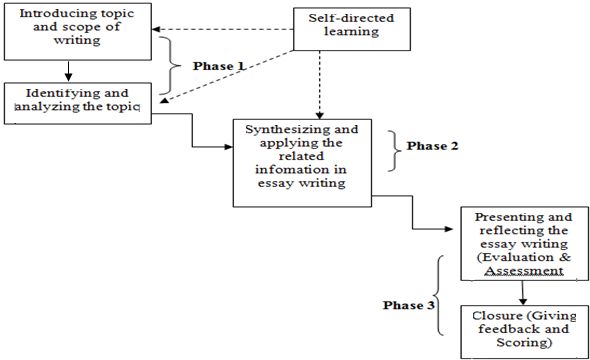
reflection through various techniques of and phase 3 (Yusof et al., 2012). In phase 1,
reflection. Every collected data was interacted there are 2 principles, i.e. introducing the
or compared with other units of data to cross- problem (topics and scope of writing) and
check or develop the validity as well as to identifying and analyzing the topics (through
categorize the data in accordance with the discussion or research). In phase 2, there is
formulated problems. The analysis process only 1 principle, it is synthesizing and
was conducted by applying a modified model applying related information with the topics
which is originally developed by Dey (1993) in essay writing. Then, in phase 3, there are 2
in which the data analysis is a circular process principles, i.e. Presenting and reflecting the
including the activities of describing, essay writing (Evaluation & Assessment) and
classifying, and connecting. The model was closure (giving feedback and scoring). For
modified by adding one more step, it is more detail, see the following figure of PBL
evaluating. The reason is without evaluating framework.
step, it is impossible for the researcher to be
able to make the final decision for the data
Fig 1: The Original Framework of PBL
84M. ALI GHUFRON / JURNAL ARBITRER - VOL. 5. NO. 2 (2018)
From the framework shown in Figure 1, the drawing and speaking, asking and answering
model evolves to the framework shown in questions, and asking the students to create
Figure 2 to emphasize the importance of their own activities. Referring to Figure 2,
ensuring cooperative work among students in there are 3 phases in the Co-PBL cycle for
the small groups and the whole class. Besides, EFL writing class. Phase 1 consists of
it was also modified by adding some activities introduction, identification and analysis.
that specifically can stimulate students’ verbal Phase 2 is the application and solution. Phase
creativity in EFL writing. Those activities 3 is evaluation, assessment, and feedback.
were pedagogical attempts that were This modification to the Co-PBL framework
introduced by Avila (2015). Those learning shown in Figure 2 is necessary to ensure the
steps are remembering English grammar and learning activities and assessment tasks
structure, creating a fictional story, promoting throughout the Co-PBL cycle is aligned and
creative writing, boosting vocabulary through support all the learning outcomes.
screenwriting, sharing a speech, circle of life,
Fig 2: The Framework of Co-PBL with VC in EFL Writing
The learning activities throughout the Co- illustrated in Table 1, because ensuring
PBL cycle are aligned to ensure fulfilment of cooperation and functional teams for students
the basic principles of cooperative learning, as to learn together is crucial.
85M. ALI GHUFRON / JURNAL ARBITRER - VOL. 5. NO. 2 (2018)
Table 1: Teaching and learning activities and assessment tasks aligned to promote VC and CL principles
in Co-PBL
Group
Positive Individual Face-to-face Interpersonal
CL Principles Function
Interdependence Accountability Interaction Skills
Assessment
Introduction of Explain the
topic and scope topic and the
of writing to scope of
students (by writing
teacher)
Individual Preparing to Understanding the In-class
identification discuss the topic topic and take interaction with
of topic and with team notes teacher (Q&A
analysis about the topic
given)
Team Assigning learning Starting discussion In-class Reach Overall
discussion by task to each team based on discussion; consensus of observation
comparing and member; sharing a individual answer; assigning roles topic on each team
Phase 1:
contrasting the speech; vocabulary sharing a speech for each team identification member
Introduction,
results of topic boosting by each based on member; and analysis participation
Identification,
identification team member; individual comparing and within a given
& Analysis
and analysis comparing and perspective; contrasting the time
contrasting the providing the topic
topic identification results of topic identification
and analysis identification and and analysis
analysis
Overall class Each team provides Some students In-class Proper etiquette Overall
discussion the results of topic may be randomly discussion; in discussion, observation
about topic identification and called remembering Q&A to reach on
identification analysis individually; English overall participation
and analysis remembering grammar and consensus of all
(guided by the English grammar structure; students
teacher) and structure; Question and
Question and answer
answer
Team synthesis Taking notes of the Individually Learning in Reach Overall
& application summary of prepare peer team; consensus of observation
to the concepts learning/teaching explaining topic on each team
information understood and notes for team; concepts to identification member
related to the questions on hazy submit individual understand and and analysis participation
topic in essay points to help peer learning asking on hazy within a given
writing learning in team; notes; arranging an points; overall time
making an outline; outline; writing the class
findings important thesis statement in discussion led
Phase 2: points for thesis a complete by designated
Application & statement; peer sentence; writing team
Solution reviewing the first the first draft;
draft revising the first
draft
Individual Writing an outline, Individually In-class and In-class and out- Progress
synthesis & writing the first writing an outline, out-of class of class session checking
application to draft, revising the writing the first session
the information first draft draft, and revising
related to the the first draft
topic in essay
writing
Presenting & Comparing and Individual Presenting the Sincere Peer rating
reflecting the contrasting the feedback from final feedback comments and and feedback
essay writing final draft team member on and discussion feedbacks to on writing
(Assessment & writing led by improve writing performances
Phase 3:
Evaluation) performances designated performances
Evaluation,
team
Assessment, &
Closure Giving feedback Revising the final In-class closure Motivation on In-class
Feedback
(Giving and comments on draft based on team working & session on
feedback and writing comments and conflict improvement
scoring) performances feedbacks management to be made
86M. ALI GHUFRON / JURNAL ARBITRER - VOL. 5. NO. 2 (2018)
The feasibility of the framework of Co-PBL topic that was going to be discussed. It was
in EFL writing class about argumentative essay. The teacher raised
To analyze and evaluate the feasibility of the a problem about the controversial issue
Co-PBL framework in EFL writing class, the dealing with the governement policy of taking
implementation to the first and second grade the results of national examination as the
students who took EFL writing course in major consideration of students’ passing
English Education Department of IKIP PGRI grade. Then, the students in team and
Bojonegoro (Institute of Teacher Training and indvidually identify and analyse the topic.
Education) at the even semester in the After that, the teacher led the overall class
academic year of 2017/2018 was studied. In discussion. The activities were continued to
this part, the implementation of the tryout is the team synthesis and application of what the
described. Trying out was done by students gained from individual, team, and in-
implementing the model of Co-PBL in EFL class discussion about the topic into essay
writing class. The tryout was conducted to get writing. Since the time was over, the teacher
the feasibility of the product. The result of the closed the meeting at that day.
tryout was the data about the feasibility of
model framework of Co-PBL. There were In the second meeting of the tryout 1, the
four techniques in collecting data, i.e. teacher continued the learning activities. The
observation, FGD, semi-structured interview, students were asked to apply the results of
and questionnaire. The data of teaching their team discussion, synthesis, and
learning process was collected by using application of topic into individual writing.
passive participant technique. During the They started writing from the first (rough)
implementation, the researcher draft until the final draft. When the students
simultaneously observed the classroom had met their final draft, they submitted it to
activities. The teaching-learning process was the teacher. After all papers were submitted,
observed and analysed to be evaluated. A the teacher took several papers randomly. The
FGD with the teachers and students was selected ones must be presented by the writer
conducted to reflect the implementation of the in front of the class. Then, the other students
tryout. This discussion was aimed at read the paper carefully to find some improper
evaluating the implementation of the model words and/or phrases, incorrect grammar,
framework of Co-PBL in the class. spelling, and punctuation. The mistakes were
corrected together. The last acivity was the
The tryout implementation for this model teacher assessed and evaluated the papers one
framework of Co-PBL was done for a month by one. However, since this activity needs
(four weeks and four meetings). Each tryout much time, this was done outside the class by
was completed in two meetings. A FGD was the teacher. The results of teacher’s feedbacks
done at the end of the second tryout. However, and evaluation towards the papers were
after each tryout the students were given distributed in another meeting.
questionnaire and inerviewed to reveal their
feedback towards the tryout implementation. During the implementation of tryout 1, the
researcher took notes and observed the class.
Tryout 1 The following is the results of the observation
The tryout 1 was done on April 4, 2018. It was in tryout 1.
Wednesday. The teacher firstly explained the
87M. ALI GHUFRON / JURNAL ARBITRER - VOL. 5. NO. 2 (2018)
Table 2: Observation Checklist and Field-notes of Tryout 1
No. Learning Activities Yes Partially No
1 Introducing the topic and scope of writing √
2 The students individually identify and analyze the topic √
3 Team discussion by comparing and contrasting the results of √
topic identification and analysis
4 Overall class discussion about topic identification and analysis √
(guided by the teacher)
5 Team synthesis & application to the information related to the √
topic in essay writing
6 Individual synthesis & application to the information related to √
the topic in essay writing
7 Presenting & reflecting the essay writing (Assessment & √
Evaluation)
8 Closure (Giving feedback and scoring) √
9 Activities to promote VC: Vocabulary boosting, Questions and √
Answers, Remembering English Grammar & Structure, Creating
a Fictional Story, Promoting creative writing, Sharing a speech,
etc.
Notes:
1. The learning outcomes are suitable with syllabus
2. The teaching and learning activities were in line (suitable) with lesson plan
3. Team working analysis need to be improved
4. Group function assessment was not optimally implemented
5. Closure (giving feedback and scoring) was not completely done in-class activity due to the lack of
the time
Tryout 2 topic in essay writing. However, for overall,
The tryout 2 was started on April 18, 2018. they responded positively to the new
The problem raised was about the government framework of Co-PBL. The following is the
policy that university should implement transcript of the interview:
blended learning for all subjects in teaching
and learning process. The activities were Question:
mostly the same as the explanation in tryout What is your opinion about the teaching
1. However, the tryout 2 were more well- and learning process using the
prepared. After the tryout 1 had finished, the framework of Co-PBL which you’ve
teacher and the researcher took a reflection on already done? Is it applicable in EFL
the process of tryout 1. Based on the writing class?
reflection, it was found some parts that need
to be improved in tryout 2. The parts that need Student 1:
to be improved were the team working Ummm... in my opinion, it was very
analysis, group function assessment, and challenging. We were challenged to
activities that could promote students’ verbal work both in group and individual. For
creativity. me myself, working in a group is a
difficult thing to do. Frankly speaking,
After the tryout 2 had finished, selected I am an introvert student. But, through
participants were interviewed regarding their this kind of activities, I realized that
opinion about the feasibility of the Co-PBL working in a group is very important.
model. Most of them expressed their The hardest thing for me is when we
exicitement during the implementation of the had to write what we had discussed
framework of Co-PBL. Besides, they also into essay writing individually. But, so
admitted that the learning was challenging, far, I can enjoy the learning activities.
motivating, a bit frustrating in certain part, for It is applicable in EFL writing class.
example when they had to individually
synthesize apply the information about the Student 2:
Ya, I think, it really motivates me. I was
88M. ALI GHUFRON / JURNAL ARBITRER - VOL. 5. NO. 2 (2018)
motivated to learn English writing. I unstructured problem, in this case is a
also really enjoyed the activites such as controversial issue or topic, than we
remembering English grammar, had to look for the solution by giving
vocabulary boosting, and so on. It our arguments and we had to persuade
makes me remember the English other people in order to have the same
structures and also memorize a lot of opinion with us. Then, working in a
vocabularies. However, the thing that group is really nice and joyful.
makes me a bit frustrating is writing the
essay individually... (Chuckled...)
The data gained from the interview above,
Student 3: was also triangulated with the results of
Of course, it is applicable and feasible. questionnaire distribution. The following is
To me, it was challenging and the results of questionnaires distribution after
motivating. We were given an the implementation of tryout 2.
Table 3: The Results of Questionnaire Distribution
Excellent Good Average Poor Very Poor
No. Learning Activities 5 4 3 2 1
1 Introducing the topic and scope of writing 75,0% 20,8% 4,2%
The students individually identify and analyze
2 95,8% 4,0%
the topic
Team discussion by comparing and contrasting
3 62,5% 37,5%
the results of topic identification and analysis
Overall class discussion about topic
4 identification and analysis (guided by the 81,7% 18,3%
teacher)
Team synthesis & application to the
5 65,0% 18,3% 16,7%
information related to the topic in essay writing
Individual synthesis & application to the
6 73,3% 23,3% 3,3%
information related to the topic in essay writing
Presenting & reflecting the essay writing
7 94,2% 5,8%
(Assessment & Evaluation)
8 Closure (Giving feedback and scoring) 74,2% 25,8%
Activities to promote VC: Vocabulary
boosting, Questions and Answers,
9 Remembering English Grammar & Structure, 46,7% 28,3% 25,0%
Creating a Fictional Story, Promoting creative
writing, Sharing a speech, etc.
89M. ALI GHUFRON / JURNAL ARBITRER - VOL. 5. NO. 2 (2018)
Table 4: Observation Checklist and Field-notes of Tryout 3
No. Learning Activities Yes Partially No
1 Introducing the topic and scope of writing √
2 The students individually identify and analyze the topic √
Team discussion by comparing and contrasting the results of
3 √
topic identification and analysis
Overall class discussion about topic identification and analysis
4 √
(guided by the teacher)
Team synthesis & application to the information related to the
5 √
topic in essay writing
Individual synthesis & application to the information related to
6 √
the topic in essay writing
Presenting & reflecting the essay writing (Assessment &
7 √
Evaluation)
8 Closure (Giving feedback and scoring) √
Activities to promote VC: Vocabulary boosting, Questions and
Answers, Remembering English Grammar & Structure,
9 √
Creating a Fictional Story, Promoting creative writing, Sharing
a speech, etc.
Notes:
1. The learning outcomes are suitable with syllabus
2. The teaching and learning activities were in line (suitable) with lesson plan
3. Team working analysis worked good
4. Group function assessment was well-implemented
5. Closure (giving feedback and scoring) was not completely done in-class activity due to the lack of
the time
To gain more comprehensive results of stimulated well. This study might have
evaluating the feasibility of the significant implication especially for EFL
implementation of Co-PBL Framework in writing teachers and students. For EFL
EFL writing class, a FGD was also writing teachers, this study can be used as a
implemented after tryout 2 had finished. From reference in developing or modifying certain
the FGD, it was concluded that the framework teaching technique which could improve
of Co-PBL is feasible. It can be implemented students’ verbal creativity since it plays a
in EFL writing class to promote students’ pivotal role in students’ mastery of EFL
verbal creativity. the verbal creativity can be writing. The teachers may also use this
stimulated through some activities that are modification of Co-PBL in their teaching and
integrated into Co-PBL framework, such as: learning process of EFL writing course. For
remembering English grammar and structure, the students, they could be more aware of
promoting creative writing, boosting their verbal creativity skills which affect their
vocabulary through screenwriting, sharing a EFL writing skills.
speech, and asking & answering questions.
These findings is supported by Avila (2015), IV. CONCLUSION
who argued that by implementing some To sum up, it is concluded that integrating
pedagogical attempts, such as remembering cooperative learning (CL) and problem-based
English grammar and structure, creating a learning (PBL) resulted in the Co-PBL
fictional story, promoting creative writing, framework to guide the students through PBL
boosting vocabulary through screenwriting, cycles based on CL principles. The Co-PBL
sharing a speech, circle of life, drawing and framework was also modified by inserting
speaking, asking and answering questions, learning activities or pedagogical attempts
and asking the students to create their own which could promote VC in EFL writing in
activities, the verbal creativity can be
90M. ALI GHUFRON / JURNAL ARBITRER - VOL. 5. NO. 2 (2018)
each phase or cycle of PBL. Further, it was It is also suggested to EFL teachers to
also confirmed that the Co-PBL framework is implement this framework of Co-PBL to
feasible to be implemented in EFL writing stimulate their students’ verbal creativity.
class. The strong emphasis on cooperative Having a high verbal creativity will affect
learning in Co-PBL drives students to learn students’ EFL writing skill (Rababah &
together with their teammates, as well as the Melhem, 2014; Rababah et al., 2013;
whole class. This is a very influential activity Rababah et al., 2017). However, this study
since through teamwork, the students will not might be merely suitable for those are
only try to solve the problem, but also learning in higher education context.
stimulate their verbal creativity.
ACKNOWLEDGEMENT
This research is partly funded by Indonesian Ministry of Research, Technology, and Higher
Education on Penelitian Dosen Pemula (PDP) research scheme of the year 2018 with the
contract number: 078/LPPM-IKIP-PGRI/0.4/2018.
REFERENCES
Al-jarf, R. Discourse and creativity issues in EFL creative writing on Facebook. International
Journal of Signs and Semiotic Systems, 4(1). https://doi.org/10.4018/IJSSS.2015010103,
2015.
Atkinson, D. L2 writing in the post-process era: Introduction. Journal of Second Language
Writing, 12, 2003, 3–15.
Avila, H. A. Creativity in the English class: Activities to promote EFL learning. HOW, 22(2),
2015, 91–103.
Boud, D., & Feletti, G. Changing poblem based learning, in The Challenge of Problem-based
Learning. London, UK: Boud and Feletti Eds, 1997.
Chen, M. L. A study of the effects of cooperative learning strategies on student achievement in
English as a Foreign Language in a Taiwan college. New York: ProQuest Information
and Learning Company, 2004.
Cole, K. S. Promoting cooperative learning in an expository writing course. Journal of
International Education Research -Second Quarter, 8(2), 2012, 113–124.
Creswell, J. W. Educational research: Planning, conducting and evaluating quantitative and
qualitative research (4th ed.). Boston: Pearson Education Inc, 2012.
Creswell, J. W., & Miller, D. M. Determining validity in qualitative inquiry. Theory into
Practice, 39(3), 2000, 124–130.
Dastgeer, D. M. Improving English writing skill: A case of problem based learning. American
Journal of Educational Research , 3(10), 2015, 1315–1319.
Dey, I. Qualitative data analysis: A user-friendly guide for social scientists (Routledge).
London. Retrieved from
http://www.classmatandread.net/class/785wk3/Qualitative_data_analysis.pdf
Elola, I., & Oskoz, A. Collaborative writing: Fostering foreign language and writing
conventions development. Language Learning & Technology, 14(3), 2010, 51–71.
Iswandari, D. C. Effect of environmental problem-based learning on the Indonesian EFL
students’ environment - related Vocabulary Mastery and Writing Ability. Theory and
91M. ALI GHUFRON / JURNAL ARBITRER - VOL. 5. NO. 2 (2018)
Practice in Language Studies, 7(8), 2017, 608–616.
Izadi, Mehri; Khoshsima, H. Creativity in writing : A study of EFL learners' locus of control
creativity in writing : A Study of EFL Learners ’ Locus of Control. International Journal
of Applied Linguistics & English Literature, 4(2), 2015, 81–90.
https://doi.org/10.7575/aiac.ijalel.v.4n.2p.81
Kusmawati, D. P., & Purwati, O. The implementation of problem based learning in teaching
writing descriptive text to the eighth graders. Retain, 3(2), 2015, 1–7.
Lin, L. F. The application of the problem-based learning approach to a second language
learning context. In Proceedings of edmedia: world conference on educational media and
technology, 2012, 2465–2470.
Lin, L. F. The impact of problem based learning on chinese-speaking elementary school
student’s english vocabulary learning and use. System, 55, 2015, 30–42.
Mahmoud, M. M. A. The effectiveness of using the cooperative language learning approach to
enhance EFL writing skills among Saudi university students. Journal of Language
Teaching and Research, 5(3), 2014, 616–625. https://doi.org/10.4304/jltr.5.3.616-625
Mohd-yusof, K., Helmi, S. A., Jamaludin, M. Z., & Harun, N. F. Cooperative problem-based
learning (CPBL): A practical pbl model for a typical course. In International Conference
EDUCON2011, 2011, 12–20.
Munandar, U. Pengembangan kreatifitas anak berbakat (3rd Ed.). Jakarta: Rineka Cipta, 2009.
Ng Chin Leong, P. The power of problem-based learning (PBL) in the EFL classroom.
Polyglossia, 16(2), 2009, 41–48.
Patton, M. Q. Qualitative research and evaluation methods (3rd ed.). Thousand Oaks, CA:
Sage Publications, 2002.
Pishghadam, R., & Mehr, F. J. Learner creativity and performance in written narrative tasks.
World Journal of Education, 1(2), 2011, 115–125. https://doi.org/10.5430/wje.v1n2p115
Rababah, L. M., Alshehab, M. H., & Melhem, N. Z. B. Exploring the factors that hinder
Jordanian students in developing creativity in EFL writing. In International Conference
on Studies in Arts, Humanities and Social Sciences (SAHSS-2017), 2017, 7–11,
https://doi.org/10.17758/EIRAI.F0117427
Rababah, L. M., Halim, A., Mohamed, B., & Jdaitawi, M. T. The level of creativity in English
writing among Jordanian Secondary School students. Arts and Design Studies, 10, 2013,
25–30.
Rababah, L., & Melhem, N. B. Investigation into strategies of creativity in EFL writing in
Jordan. Journal of Education and Practice, 5(23), 2014, 195–206.
Roger, T., & Johnson, D. W. An overview of cooperative learning. In Creativity and
Collaborative Learning, 1994, 1–21.
Runco, M. A. Creativity. Annu Rev Psychol, 55, 2004, 657–687.
Tan, O. S. Problem-based learning innovation: Using problems to power learning in the 21st
Century. Singapore: Thomson Learning, 2003.
Weisi, H., & Khaksar, Z. The effect of hemispheric dominance on Iranian EFL learner’s
creativity in writing. International Journal of English and Education, 4(2), 2015, 383–
397.
92M. ALI GHUFRON / JURNAL ARBITRER - VOL. 5. NO. 2 (2018)
Wong, L.-H., Chin, C.-K., Chen, W., & Gao, P. An Innovative collaborative writing approach
to improve Chinese as L2 pupils' linguistic skills. In Proceedings of International
Conference on Computer-supported Collaborative Learning, 2009, 651–661, Rhodes
Island, Greece.
Woods, D. R. Problem-based learning: Helping your students gain most from PBL (3rd Ed.).
Ontario: D. R. Woods Publishing, 1996.
Woods, D. R., Felder, R. M., Rugarcia, A., & Stice, J. M. The Future of engineering education:
III. Developing critical skills. Chemical Engineering Education, 34(2), 2000, 108–117.
Yusof, K. M., Hassan, S. A. H. S., Jamaludin, M. Z., & Harun, N. F. Cooperative problem-
based learning (CPBL): Framework for integrating cooperative learning and problem-
based learning. In Procedia - Social and Behavioral Sciences, Vol. 56, 2012, 223–232,
https://doi.org/10.1016/j.sbspro.2012.09.649
Zhu, W., Chen, Q., Xia, L., Beaty, R. E., Yang, W., Tian, F., … Qiu, J. Common and distinct
brain networks underlying verbal and visual creativity. Human Brain Mapping, 30, 2017,
2094–2111. https://doi.org/10.1002/hbm.23507
BIOGRAPHY
M. Ali Ghufron is an English lecturer in English Education Department, Faculty of Languages
and Arts Education, Institute of Teacher Training & Education (IKIP) of PGRI Bojonegoro,
East Java, Indonesia. He received his Undergraduate Degree from the same department at the
same University, his Master Degree was from Sebelas Maret University, and his Doctoral
Degree was from Semarang State University, Indonesia. He has experience in teaching English
in some schools, English courses, and universities. His research interests include EFL teaching
methodology, ELT materials development, EFL pre-service and/or in-service teacher’s
professional development, and ICT in EFL classroom. Any queries, please contact him at:
ali.ghufron@ikippgribojonegoro.ac.id
Siti Ermawati is a lecturer in English Education Department, Faculty of Languages and Arts
Education, IKIP PGRI Bojonegoro. She got her undergraduate degree from Universitas Islam
Negeri (UIN) Maulana Malik Ibrahim, Malang. Then, she continued pursuing her Master
degree in Universitas Islam Negeri (UIN) Sunan Kalijaga, Yogyakarta.
93You can also read


