The Indian-Chinese Confrontation in the Himalayas
←
→
Page content transcription
If your browser does not render page correctly, please read the page content below
NO. 39 JULY 2020              Introduction

The Indian-Chinese Confrontation
in the Himalayas
A Stress Test for India’s Strategic Autonomy
Christian Wagner

The confrontation between Indian and Chinese troops in the Himalayas, which has
been ongoing since the beginning of May, has escalated into the most serious crisis
in relations between the two countries in 45 years. On 15 June, for the first time since
1975, 20 Indian and an unknown number of Chinese soldiers were killed in an inci-
dent. The current crisis, unlike previous ones, has wider territorial and political
dimensions. It shakes the previous border regime and strains the relationship of trust
that was laboriously built up between Prime Minister Narendra Modi and President
Xi Jinping. The confrontation is also a test of India’s strategic autonomy. This corner-
stone of Indian foreign policy also includes the claim to an independent role in the
geostrategic tensions between China and the United States in the Indo-Pacific.

The unresolved border issue in the Hima-          more Chinese troops are involved than in
layas has been a burden on Chinese-Indian         previous incidents. Thirdly, China is now
relations for decades. India suffered a mili-     claiming areas, such as the Galwan Valley,
tary defeat in the border war with China          that were previously not disputed. The
in 1962, which still has an impact in many        current confrontation seems to be due to
political discussions today. In the course of     a mixture of regional factors, such as the
their political rapprochement from the late       Kashmir conflict and growing geostrategic
1980s onwards, the current Line of Actual         tensions between China, the United States,
Control (LAC) was established in 1993. How-       and India in the Indo-Pacific.
ever, it is not clearly defined, as there are
competing territorial claims on as many as
18 places.                                        Kashmir and Its Consequences
   The current confrontation in the western
sector of the Ladakh region, which belongs        Many Indian experts see the Modi govern-
to Kashmir, differs in several ways from          ment’s decision in August 2019 to dissolve
earlier ones. Firstly, this time there are ter-   the state of Jammu and Kashmir as a trigger
ritorial violations not just in one, but in       for the current crisis. In the course of the
five places. Secondly, it appears that far        reorganisation of Kashmir, two new union
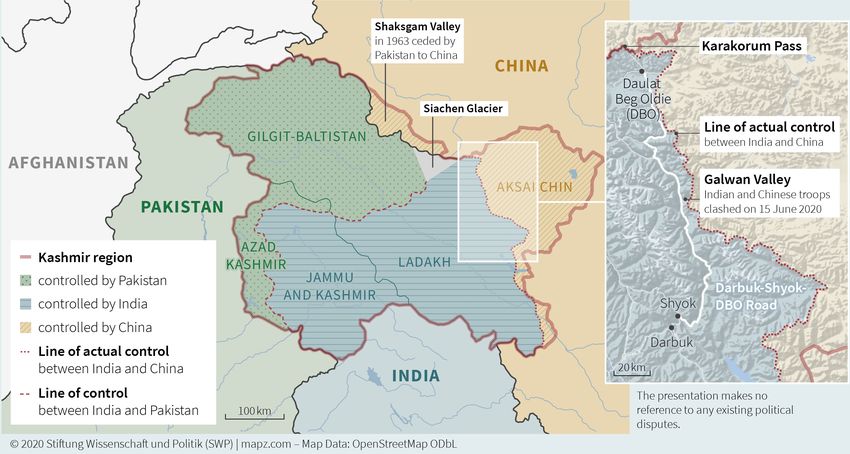
Map

                       territories were created – including Ladakh     the LAC and Shyok River from Darbuk to
                       – which are administered from New Delhi.        Daulat Beg Oldie in northern Ladakh (see
                       In addition to Pakistan, China had protested    map). There, near the Karakorum Pass to
                       against this decision at the time and had       China, India maintains an airfield at an alti-
                       pushed through an informal meeting of the       tude of about 5,000 metres, which is of
                       United Nations Security Council on the In-      utmost importance for the supply of Indian
                       dian decision. China sees its interests being   troops on the Siachen Glacier. The glacier
                       threatened in the Aksai Chin region, which      is the highest war zone in the world, where
                       belongs to Kashmir (see map). The People’s      Indian and Pakistani troops have faced each
                       Republic has occupied this region, which        other since the mid-1980s.
                       contains an important access road to Tibet,
                       since the border war of 1962.
                           Since August 2019, India has continued      India, China, and the United
                       to expand its military infrastructure in        States in the Indo-Pacific
                       Ladakh, while at the same time reaffirming
                       its historical claim to the whole of Kashmir.   The current confrontation is also related to
                       The China-Pakistan Economic Corridor, the       the geopolitical rivalries in the Indo-Pacific
                       largest single project of the Chinese Silk      between China on the one hand, and India
                       Road Initiative, also runs through the Paki-    and the United States on the other. India
                       stani part of Kashmir. The Chinese terri-       refuses to join the Chinese Silk Road Initia-
                       torial violations can thus be seen as a reac-   tive, through which the government in Bei-
                       tion to Indian policy in Kashmir in recent      jing has massively expanded its influence
                       months.                                         in India’s neighbourhood in South Asia and
                           China’s territorial gains to date are a     the Indian Ocean in recent years. This ap-
                       serious strategic problem for India. Chinese    plies not only to Pakistan, which is a stra-
                       control of the Galwan Valley threatens          tegic partner of China, and to countries
                       India’s main supply road, which runs along      such as Sri Lanka, Nepal, and Bangladesh,

      SWP Comment 39
      July 2020

      2
but also to the island states in the Indian Firstly, the border regime, which was
Ocean. established in the 1990s, is being called into
Starting in 2017, India – together with question. Following their rapprochement
Australia, Japan, and the United States – at the end of the 1980s, India and China
revived the Quadrilateral Security Dialogue signed five agreements and developed a
(Quad), which was created in 2007. Since number of confidence-building measures
then, the four states have expanded their with regard to the LAC, such as a ban on
political, economic, and military coopera- the use of firearms in the event of incidents.
tion to address China’s geopolitical ambi- Since 1989, the two states have maintained
tions and its Silk Road Initiative. a joint working group to clarify the border’s
Despite the rapprochement with the alignment. Both sides also appointed spe-
United States and increasing tensions with cial representatives for the border issue –
China, India continues to emphasise its by 2019 they had met 22 times in total.
strategic autonomy. This includes the claim Secondly, the current crisis is a setback
to an independent role in the geopolitical for Prime Minister Modi as well. After the
tensions between China and the United Doklam crisis of 2017, he established close
States in the Indo-Pacific. In recent years, personal relations with President Xi like he
India and China have also repeatedly co- had with no other head of state or govern-
operated, for example in the Shanghai ment. With informal summits in Wuhan
Cooperation Organisation. Within the Quad, in 2018 and Mahabalipuram in 2019, they
India has advocated an inclusive under- sought to overcome the strategic differences
standing of the Indo-Pacific, which, in between their states. Possible territorial
contrast to the United States, has always losses would also be a stress test for Modi’s
included China. nationalist Bharatiya Janata Party (BJP),
In China there is not only resentment since it stands for the territorial unity of
about India’s decision on Kashmir but also the country more strongly than any other
growing criticism of India’s rapprochement party.
with the United States and its closer mili- Thirdly, the crisis once again shows that
tary cooperation. The recent claims on India has few options to put pressure on
areas along the LAC are also partly seen as China. The People’s Republic, with which
“revenge” for the Doklam crisis of 2017. India has its largest trade deficit, has been
At the time, China had pushed ahead with its most important trading partner for
infrastructure projects in an area that years. In 2019 China was the third-largest
Bhutan also claimed; India had prevented market for Indian exports. Chinese technol-
these projects by intervening. From this ogy companies have invested more heavily
perspective, the current incidents at the in Indian start-up companies in recent
LAC are a kind of “punitive action” by years. In November 2019, the Indian gov-
which the Chinese leadership signals its ernment withdrew at the last minute from
dissatisfaction with India’s behaviour. the Regional Comprehensive Economic
Partnership agreement, which would have
increased the trade deficit with China.
Challenges for India’s Even before the crisis, the Indian govern-
China Policy ment had already tightened the conditions
for foreign investors – a move that was
Prime Minister Modi’s statement on 19 June mainly directed against Chinese companies.
that there had been no violation of Indian Nationalist groups associated with the BJP
territory underlined the desire to continue called for a boycott of Chinese goods. They
with the current policy towards China, de- feel encouraged by Prime Minister Modi’s
spite the gravity of the current crisis. How- new economic policy credo of self-reliance.
ever, India’s China policy now faces much The aim is to reduce imports and stimulate
greater challenges. domestic production. As a reaction to the
SWP Comment 39
July 2020
3tensions, the clearance of Chinese imports to act on an equal footing with China, this
to India has been delayed, among other would be a bitter defeat with presumably
things. Indian state companies in turn can- far-reaching domestic and foreign policy
celled orders to Chinese companies. Indian consequences. China, for its part, does not
companies, however, pointed out that they want its successes at the LAC to encourage
were highly dependent on Chinese imports, India to turn to the United States, which it
which could not be compensated for with- has always tried to prevent. This could also
out higher costs. Given the structure of set in motion a militarisation of the Quad,
trade relations, India’s restrictions on Chi- which India has always rejected. Beijing
nese companies could even prove counter- would then have paid dearly for its tactical
© Stiftung Wissenschaft productive. Furthermore, the Indian gov- gains in the Himalayas: with a strategic set-
und Politik, 2020 ernment banned Chinese apps at the end back in the geopolitical tensions with the
All rights reserved of June, and Prime Minister Modi deleted United States and the Quad in the Indo-
his official page on the Chinese platform Pacific.
This Comment reflects
Weibo. In view of its economic and military
the author’s views.
inferiority to China, India will massively
The online version of expand its arms cooperation with European
this publication contains Prospects partners as a result of the crisis. After years
functioning links to other of close military cooperation with France,
SWP texts and other relevant
Despite the looming détente along the LAC, New Delhi will increasingly bring this re-
sources.
both sides are strengthening their military quest to the attention of German policy-
SWP Comments are subject presence in the region. Further escalation makers.
to internal peer review, fact- is threatened not only by incidents such as
checking and copy-editing. the one in the Galwan Valley, but also by
For further information on territorial violations elsewhere along the
our quality control pro-
more than 3,400-kilometre-long border. In
cedures, please visit the SWP
website: https://www.swp- addition, a new dispute is looming between
berlin.org/en/about-swp/ China and Bhutan, which led to the Doklam
quality-management-for- crisis with India in 2017. Pakistan’s involve-
swp-publications/ ment in the conflict would have even
greater potential for escalation.
SWP
Stiftung Wissenschaft und
The big challenge for India and China is
Politik to find a solution that is in line with their
German Institute for tactical and strategic interests. India is in-
International and terested in establishing the status quo ante
Security Affairs and a stable border regime without moving
parts of the LAC to the west. This would
Ludwigkirchplatz 3–4
10719 Berlin allow Modi to continue his current China
Telephone +49 30 880 07-0 policy. The alternative would be to turn
Fax +49 30 880 07-100 more strongly to the United States, as
www.swp-berlin.org demanded by many security experts. How-
swp@swp-berlin.org
ever, this would undermine one of the
ISSN 1861-1761
pillars of Indian foreign policy: the concept
doi: 10.18449/2020C39 of strategic autonomy. For it would also
mean admitting that India alone is not in
(English version of a position to counter the threat from China.
SWP-Aktuell 63/2020) For a nationalist party such as the BJP,
which has taken up the cause of economic
and foreign policy autonomy and the claim
Dr Christian Wagner is Senior Fellow in the Asia Division.
SWP Comment 39
July 2020
4You can also read


