AFRICA The Quest for Political Accountability: Change Agents, Openings and Dead Ends - Heinrich-Böll-Stiftung
←
→
Page content transcription
If your browser does not render page correctly, please read the page content below
Issue 1
                                          May 2018

AFRICA

The Quest for Political Accountability:
Change Agents, Openings and Dead Ends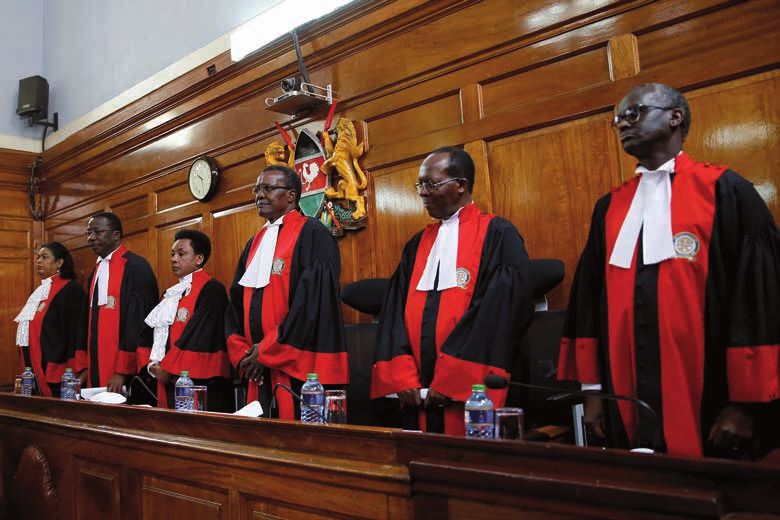
This edition of Perspectives Africa is published jointly by the offices of the Heinrich-Böll-Stiftung in sub-Saharan Africa.

DAKAR
          ABUJA

                         NAIROBI

                     CAPE TOWN

                     Heinrich-Böll-Stiftung
                     The Heinrich Böll Foundation is a publicly funded institution that is affiliated with but
                     intellectually independent from the German Green party. From our headquarters in
                     Berlin and over 30 overseas offices, we promote civic participation in Germany, as well
                     as in more than 60 countries worldwide. Our work in Africa concentrates on promoting
                     civil society, democratic structures, gender democracy and global justice. Together with
                     our partners, we work toward conflict prevention and search for solutions to the chal-
                     lenges of environmental degradation and the depletion of resources. To achieve these
                     goals, we rely on disseminating information, creating a deeper understanding between
                     actors in Africa and Europe, and supporting global dialogue.
Contents

4      Editorial

6		    Zimbabwe After the Coup: Prospects for Real Political Change
       McDonald Lewanika

11		   Interview
		     Kenya’s Judiciary: Agent of Justice under Difficult Circumstances
       Yash Ghai

17     Uganda: Political Organising in a De-facto One-Party State
       Lydia Namubiru

22		   Moving On Up!? Opposition Parties and Political Change in South Africa
       Sithembile Mbete

27		   Advocate Thuli Madonsela: Whispering Truth to Power
       Shameela Seedat

31		   Interview
		     Breathe, for the Battle Will Be Long: Changing Nigeria’s Body Politic
       Patrick O. Okigbo III

36		   Interview
		     The Gambia: One Year After Jammeh, What Has Changed?
       Sheriff Bojang Jr
4   Editorial

                Editorial

                Since the third wave of democratisation          political parties serve as proxies for deep
                swept through the continent in the 1990s,        ethnic cleavages or for the ambitions of
                the majority of African states have replaced     powerful individuals. In countries like South
                military dictatorships and one-party-domi-       Africa, a perceived absence of alternatives
                nant systems with more democratic forms          to the governing party makes abstention
                of governance. Today, 61 percent of sub-         and disengagement seem more meaningful
                Saharan countries are “free” or “partly free”    options than engaging in elections.
                according to Freedom House’s 2018 survey              In such contexts, what do elections
                – although this is down from a high of 71        contribute to accountability? What addi-
                percent in 2008.                                 tional paths to accountability can be dis-
                     By adopting representative democra-         cerned? This edition of Perspectives seeks
                cies founded on multiparty elections, the        to deliberate on such questions, unpacking
                African electorate was promised, finally,        limitations and exploring how actors in the
                responsive and accountable governments,          state, political parties, and civil society have
                for the people and by the people.                been able to make those in government less
                     In a comparative study of electoral gov-    certain about the future balance of power.
                ernance, Shaheen Mozaffar and Andreas            Although these change agents have not
                Schedler (2002) posit that “competitive          always reached their stated objectives, they
                elections are the hallmark of modern rep-        have protected important democratic gains,
                resentative democracy. As the institution-       opened up political possibilities, and initi-
                alised means by which large numbers of           ated reforms that seemed inconceivable
                people participate peacefully in selecting       until they happened.
                and removing governments, they are the                In Zimbabwe, a new leader took power
                primary, albeit not the only, source of dem-     in November 2017. While Robert Mugabe’s
                ocratic legitimacy”.                             departure after 37 years was widely wel-
                     This, they argue, is predicated on two      comed, he was replaced by his former vice-
                conditions. First, there must be “institu-       president in what was no less than a military
                tional certainty” to ensure unbiased rules       coup. That Emmerson Mnangagwa has long
                and procedures. Such institutional impar-        been a member of the political establish-
                tiality results in the second condition: “sub-   ment clearly raises doubts about his desire
                stantive uncertainty” about the outcome.         for meaningful political reform. Sharing
                The prospect of defeat keeps politicians on      these reservations, McDonald Lewanika
                their toes and places the balance of power       nonetheless concludes that “the coup has
                with the electorate.                             opened a crack in the authoritarian wall,
                     The idea that an institutional architec-    allowing people to reimagine what they can
                ture of multiparty democracy would lead          accomplish to widen that crack”.
                to more responsive and accountable gov-               Leaders in other countries managed
                ernments in Africa remains in question. In       to cling to power in 2017. Kenya’s Supreme
                numerous countries, institutional certainty      Court declared the August 8 presidential
                has yet to establish itself, rendering elec-     elections invalid due to irregularities and
                tions a hollow ritual. The corrupting influ-     ordered a new vote. The period that fol-
                ence of money has taken its toll, as it has      lowed was marred by political contempt for
                elsewhere in the world. And even where           the constitution, violence, and a boycott by
                electoral governance has become relatively       the main opposition leader, Raila Odinga,
                entrenched, it may have little sway when         all of which undermined the credibility of
Editorial   5

President Uhuru Kenyatta’s 98 percent vic-       and accountable administration can be
tory in October. Constitutional expert Yash      detected as power changes hands.
Ghai unpacks how this episode highlights              Our interview with Patrick O. Okigbo III,
both the strengths and weaknesses of the         a political campaigner from Nigeria, shows
judiciary in consolidating constitutionalism     that opposition politics can also be a dead
and political accountability.                    end. Osita Chidoka ran a spirited, people-
     In neighbouring Uganda, Yoweri Musev-       driven campaign for Anambra State gover-
eni, who has ruled since 1986, was re-elected    nor in 2017, but his results were less than
in 2016 after polls characterised by vio-        encouraging. Even after the 2015 elections
lence and intimidation. In her article, Lydia    supposedly marked a democratic consoli-
Namubiru outlines how individual activists       dation in Nigeria, a toxic mix of voter apa-
like academic Stella Nyanzi and musician         thy, identity politics and money eliminates
Bobi Wine have, despite the general repres-      “substantive uncertainty” for voters and
sion of dissent, been able to challenge power    undermines the “institutional certainty” of
both from within and without the ballot box.     the elections, thus raising questions about
The challenge that lies ahead, she concludes,    the necessary reforms that would instil their
is to translate the power individual activists   credibility.
hold into effective political movements.              The political events in the Gambia pro-
     In South Africa, Jacob Zuma’s presi-        vide a ray of hope that change is possible
dency posed the most difficult test yet to       even in the most difficult circumstances.
the country’s young democracy. However,          After more than two decades of authoritar-
as unending corruption scandals inflicted        ian rule under President Yahya Jammeh,
significant damage on democratic institu-        the people and opposition parties, with the
tions, and the public’s trust in them, the       help of the diaspora and the regional body
foundations held and may even have been          ECOWAS, leapt into a new era in January
strengthened. This is not least thanks to        2017 when opposition candidate Adama
brave individuals inside the state machin-       Barrow was inaugurated as their new presi-
ery. Filmmaker Shameela Seedat offers a          dent. Sheriff Bojang Jr unpacks how it all
powerful portrait of the country’s public        became possible and reflects on the demo-
protector, Thuli Madonsela, who fearlessly       cratic gains achieved one year later as well
“whispered truth to power” throughout            as the challenges ahead.
the Zuma era. Electoral competition also              In a time when democracy worldwide
increased significantly in the 2016 local gov-   is facing the strongest headwinds since the
ernment polls, with the opposition, led by       end of the Cold War, we hope that the collec-
the Democratic Alliance and the Economic         tion of articles gathered here gives inspira-
Freedom Fighters, wresting power from the        tion to those committed to continuing the
ruling African National Congress (ANC) and       fight for democratic ideals, such as free and
taking over the large metros. It would be        fair elections, free speech, the rule of law,
hard to argue that the 2016 results did not      and political accountability.
also have a bearing on the internal power
struggles in the ANC. Sithembile Mbete           Jochen Luckscheiter
considers whether the opposition’s momen-        Programme Manager
tum can be maintained against a revived
ANC under President Cyril Ramaphosa and          Keren Ben-Zeev
whether indications of more responsive           Deputy Regional Director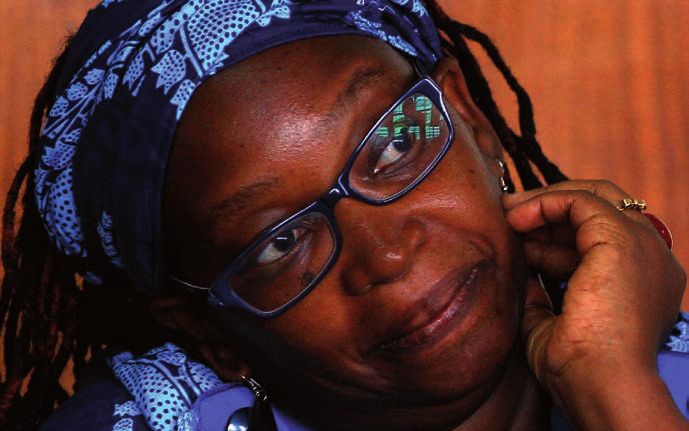
6 Zimbabwe After the Coup: Prospects for Real Political Change
Zimbabwe After the Coup:
Prospects for Real Political Change
McDonald Lewanika
In November 2017, the winds of change
were blowing in Zimbabwe. The political party over Mugabe’s succession. These fights
terrain underwent seismic shifts following were part of the reason for Mnangagwa’s
“Operation Restore Order”, the veto- and sacking and had left in their wake hundreds
of expulsions from Zanu-PF, which in turn
palace-coup1 that led to the resignation
swelled the ranks of the opposition as some
of Robert Mugabe, Zimbabwe’s political
of those expelled either joined or formed
patriarch of thirty-seven years. Mugabe’s opposition parties.4 The main opposition
former vice-president, Emmerson Mnan- parties, fractured and fractious for years due
gagwa, who had been fired from the to splits, were increasingly turning towards
government on 6 November, was the coalition politics as the panacea to defeat
military’s preferred candidate to replace Mugabe and Zanu-PF.5 Outside of political
Mugabe. Mnangagwa became Zimba- parties, civil protests had also been on the
bwe’s new president on November 24.2 rise in 2016, led by informal traders, civil
servants, and campaigns like #Thisflag and
#Tajamuka.
But did these winds blow with enough force As with most transitions, the Novem-
to clear the decks, or only enough to rear- ber 27 coup created a new crisis, in which
range the furniture? Beyond a changing of – as Gramsci would put it – “the old is dying
the guard, could the coup open space for and the new could not be born”, creating
more meaningful political changes in gov- “a great variety of morbid symptoms”.6 In
ernance? If so, how could this change be this respect, Zimbabwe’s future is a dance
supported? Was there a role for the inter- with uncertainty. While this article tries to
national community, for Zimbabweans and explain some of the “morbid symptoms”, it
Zimbabwean institutions? And if this “new promises no full illumination of all the ques-
dispensation” was not the fundamental tions posed above. It offers a perspective
change Zimbabweans sought, where else on Zimbabwe’s prospects for real political
could they turn? change in the aftermath of the November
In February 2018, the death of Morgan 2017 coup, differentiating between a change
McDonald Lewanika is a Tsvangirai brought about more shifts. As in leadership and a change in governance.
development professional and president of the Movement for Democratic
researcher with over 15 years
Change (MDC), Zimbabwe’s largest opposi-
experience working in Zimbabwe,
the southern Africa region and tion party, and Mugabe’s nemesis for twenty A Tale of Two Commissars
parts of Europe. During his
career, McDonald has led and
years, Tsvangirai was the country’s leading and a Return to Factory
managed civil-society coalitions
protagonist for political change.3 With his Settings
and organisations, designed and death, the leadership baton was passed
conducted high-level research- to the next generation in the form of the
based advocacy, and planned and
coordinated national and global 40-year-old firebrand lawyer and career In December 2017, Victor Matemadanda,
campaigns. He is currently pursu- politician Nelson Chamisa. the first political commissar of the post-
ing doctoral studies at the London However, even before these two signifi- Mugabe Zanu-PF, outlined a “culture
School of Economics and Political
Science (LSE) in the department cant developments, serious factional fights change”. Matemadanda was convinced that
of government. had been brewing within the governing those who disliked Zanu-PF had reason to
Zimbabwe After the Coup: Prospects for Real Political Change        7

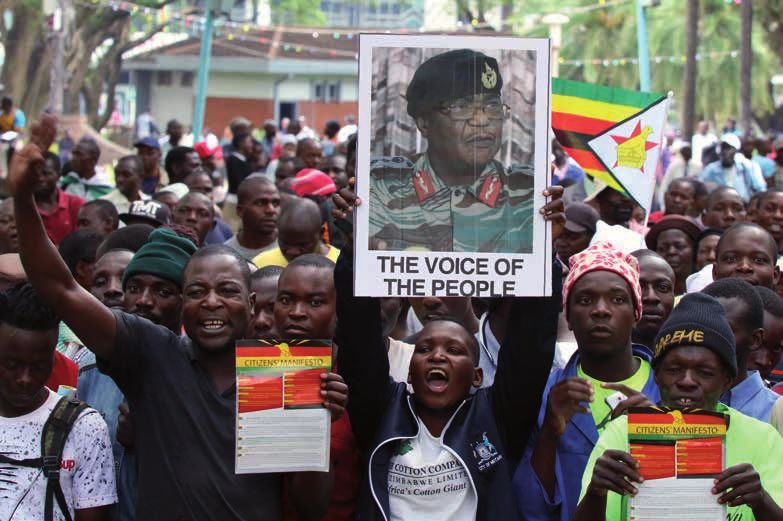
and stated the party’s intention to “sit down      returning to factory settings, focused on the      Voice of the people? A man holds
with them to understand their concerns”.7          capture and retention of power rather than         up a poster of Zimbabwe Defence
                                                                                                      Forces chief Constantino Chiwenga
This was a notable shift from the past when        transformation of the architecture of gov-         at a protest calling for Zimbab-
Zanu-PF had labelled opponents as “sell-           ernance and people’s lives.                        wean President Robert Mugabe
outs”, “puppets of the West” and “imperi-               Zimbabwe has a long history of military       to resign outside the parliament
                                                                                                      in Harare.
alist lapdogs”. President Mnangagwa also           involvement in civilian political contests. It     © REUTERS/ Philimon Bulawayo
exhorted Zanu-PF members to be “servants           was the military that aided Zanu-PF’s efforts
of the people, moved by matters that affect        to centralise power during the 1980s Guku-
the people”. Zanu-PF seemed to be trans-           rahundi massacres and helped to manage
forming after the coup – although some             the 2008 run-off election campaign. After
suspected that this was too good to be true.       2008, Zanu-PF’s commissariat department
    The inclusive approach, while retained         was led and run by retired Air Vice-Marshal
in rhetoric, did not last long in action. At the   Henry Muchena, former Central Intelli-
Zanu-PF Special Congress on 15 December            gence Organisation Deputy-Director Syd-
2017, five days after articulating this “cul-      ney Nyanhongo, and other former security
ture change”, Matemadanda was replaced             officers. Although some of these soldiers
as political commissar by Major-General            and spies were expelled in 2015, follow-
Engelbert Rugeje of the Zimbabwe National          ing allegations that they were aligned with
Army. Rugeje’s entry signalled a shift towards     former Vice-President Joice Mujuru, Rugeje
the entrenchment of militarism in Zanu-PF,         brought them back, making the Zanu-PF
and a return of attention to the Zanu-PF           Commissariat a war room, figuratively and
faithful rather than reaching out to external      literally, ahead of the 2018 elections.
and hitherto adversarial publics. Zanu-PF’s             This account of the Zanu-PF Commis-
capacity to foster fundamental political           sariat is only illustrative of the perverse mil-
change was dealt a heavy blow when Rugeje          itary presence that cuts across all spheres
was given province over the party’s political      of the Zimbabwean state, its subsidiaries,
engine room and election strategy for 2018.        institutions and businesses, forming a com-
This was the telltale sign that Zanu-PF was        plex web that is hard to untangle. Profes-
8   Zimbabwe After the Coup: Prospects for Real Political Change

                                 sors Bratton and Masunungure have shown            Making Change Happen
                                 how this complex was designed to outlast
                                 Mugabe’s political career through penetrat-        This is not to argue that Zanu-PF cannot
                                 ing the organs of the state, corrupting the        change. In fact, change is the most signifi-
                                 economy, and securing a prominent role for         cant conundrum that Zanu-PF faces today.
                                 the military in policy-making.8                    Because the current political conjuncture
                                                                                    demands change, the party has to decon-
                                                                                    struct itself, and a necessary change of
                                 Surfacing Zimbabwe’s Deep                          guard at the top is insufficient to constitute
                                 State                                              meaningful political reform. The new lead-
                                                                                    ership knows this.
                                 “The deep state” is a political term that               This is why President Mnangagwa,
                                 refers to networks of people, typically influ-     having stolen some opposition policies, is
                                 ential members of government agencies or           speaking with a decidedly capitalist accent,
                                 the military, that are involved in the secret      embracing the West, and unashamedly
                                 manipulation or control of elected gov-            pursuing capital with the decidedly neo-
                                 ernments. In pre-coup Zimbabwe, power-             liberal mantra that “Zimbabwe is open for
                                 ful military and business elites, who were         business”. The regime has not hidden the
                                 unelected and unaccountable, ran the show          motivation behind their brand of change
                                 from the shadows and were the real power           (economic or political). The new policies
                                 behind the state’s throne. What the coup           aim to attract investment, not necessar-
                                 facilitated was the surfacing of this deep         ily to democratise the polity and emanci-
                                 state.                                             pate the people. The consolation is that the
                                                                                    deep-state players now have to operate in
                                                                                    the light. To meet the prerequisites of inter-
                                                                                    national finance, the Mnangagwa regime
             In pre-coup Zimbabwe, powerful military and business
                                                                                    has committed to economic and political
                 elites, who were unelected and unaccountable, ran                  reforms, including free, fair and credible
               the show from the shadows and were the real power                    elections.
                behind the state’s throne. What the coup facilitated                     This presents a clear and present oppor-
                                was the surfacing of this deep state.               tunity ahead of the 2018 elections. Rather
                                                                                    than just doubting the regime’s commit-
                                                                                    ment, Zimbabwean civil society, the inter-
                                                                                    national community and various economic,
                                     Despite accusations that the Generation        electoral and political stakeholders must
                                 40 (G40) faction within Zanu-PF had cap-           hold them to their promises. Where the
                                 tured the state, the reality was that, while the   administration makes commitments, it
                                 G40 held sway in the presidency, the coun-         must be supported to fulfil them; where
                                 try was hostage to this deep state. Political      its commitments fall short of international
                                 developments before the coup indicated             standards, it must be persuaded to increase
                                 that the deep state’s proxies and pawns were       them; and where it remains intransigent,
                                 losing the game of politics, forcing it to step    it must be pushed to accept change. This
                                 out of the shadows into the light.                 is the role of civil society, the international
                                     This is exemplified by Constantino             community, and other stakeholders in the
                                 Chiwenga, the former commander of the              quest for real political change.
                                 Defence Forces. Even in a country with two
                                 vice-presidents (and sometimes a prime
                                 minister), General Chiwenga had fancied            Leveraging International
                                 himself the second-most influential man            Goodwill for Institutional
                                 in Zimbabwe, after Robert Mugabe, and is           Reform
                                 reported to have moved around in a car reg-
                                 istered as “Zim 2”.9 Chiwenga’s post-coup
                                 elevation to first deputy-president, the pres-     The international community has demon-
                                 ence of other generals in the cabinet and the      strated a tremendous amount of goodwill
                                 Zanu-PF Politburo, and the takeover of the         towards Mnangagwa. This can be a basis
                                 Politburo by soldiers and spies all signal the     for promoting and supporting real political
                                 emergence of the deep state.                       change, but goodwill alone is not sufficient
Zimbabwe After the Coup: Prospects for Real Political Change 9
to turn the Mnangagwa regime – whose based on realpolitik rather than democratic
members provided aid to Mugabe’s dic- politics. Chamisa’s magnetism and ability to
tatorship and took power through a coup unite will be tested in a field that has three
– into overnight democrats. There must significant opposition alliances – the MDC
also be pressure applied through a clear Alliance, the People’s Rainbow Coalition
political incentive structure that is built on and the Coalition of Democrats – alongside
performance-based trade-offs for political a multitude of candidates from smaller par-
and economic reforms, both on paper and ties all making a play for parliamentary seats
in practice. and the presidency.
The Zimbabwean Constitution, prom- All these parties and candidates share
ulgated in March 2013, is sufficiently the belief that Zanu-PF cannot radically
democratic and progressive to provide transform political and economic govern-
an excellent place to start. Along with the ance in the country. What separates them
requirements for free, fair and credible elec- is their estimations of their own abilities to
tions that follow SADC guidelines and are take the lead and the inadequacies of others.
internationally observed and monitored,
the implementation of the letter and the
spirit of the Constitution can provide rea-
sonable benchmarks for support and pres- The Zimbabwean Constitution, promulgated in
sure from the international community. March 2013, is sufficiently democratic and pro-
gressive to provide an excellent place to start.
Opposition Parties
Since the 2000s, the opposition has sig-
nalled a clear agenda of democratisation The opposition’s potential for creating real
in response to Zanu-PF’s authoritarian political change is stymied by this inability
nationalism. Part of this change agenda was to form a grand coalition with a consensus
encapsulated in the simple slogan “Mugabe candidate. But even if the opposition were
Must Go”. But now that Mugabe is gone to unite, one would be wary of leaving the
and the Mnangagwa regime has started to task of political transformation to politi-
speak of change and pursue international cians, especially charismatic ones, who can
reengagement, the opposition finds itself in prevail by appealing to the masses and man-
need of rebirth to retain their pride of place ufacturing consent outside of established
as change agents. institutions.
Despite speculation that the MDC
would die with Morgan Tsvangirai, Nelson Trusting in “We the People”
Chamisa has slipped neatly into his elder’s
shoes. He shares Tsvangirai’s charisma, Paulo Freire warned that some of those who
and his relative youth and sound intellec- challenge oppression as freedom fighters
tual credentials have captured the MDC become the next oppressors. Politicians and
base, excited the youth (who constitute political parties are in the business of seek-
over 50 percent of registered voters), and ing power. They are known to use prom-
forced the fence-sitting middle-class intel- ises of change in order to persuade voters,
ligentsia (who leaned towards Mnangagwa and then, when they attain power, use it to
because they could not fathom being led by serve parochial interests. These reasonable
an “uneducated” Tsvangirai) to take a sec- grounds for suspicion suggest that mean-
ond look. A Chamisa presidency holds some ingful political change in Zimbabwe is the
potential for transformative political change task of the current generation of citizens.
in Zimbabwe. Unlike Mnangagwa, who has They have the political power to change
had to retain people known to have been the old guard through their votes and the
Mugabe’s henchman, Chamisa can effect potential to protect their choices. But the
change in state personnel and in the mode kind of governance changes that are needed
of governance, drawing on the MDC’s long- goes beyond the polls. Beyond changing the
held social-democratic principles. maestro and orchestra, it means changing
To be clear, Nelson Chamisa is no Nel- the music.
son Mandela, but he has so far been able Therefore, even if there is a change of
to hold together the MDC Alliance that political guard in Zimbabwe, the best poten-
Tsvangirai built – although his ascent was tial for transformative political change lies10 Zimbabwe After the Coup: Prospects for Real Political Change
with a vigilant citizenry, uncaptured by for an unaccustomed and more tight-fitting
political interests, clear on the changes they one. The task is made harder by the fact that
require, brave enough to demand them, Zanu-PF is not just a party, but also a culture
and organised enough to campaign effec- that has developed over decades in power.
tively for them. This kind of citizenry and The best chance for real political change
civil society is burgeoning in Zimbabwe. in Zimbabwe lies in the simple task of every-
Throughout the events of 2016 and Novem- one playing their part and the complex task
ber 2017, Zimbabweans showed that they of coordinating these parts into a formidable
can be mobilised, and only lack organisa- force. The people have the most significant
tion. Organisation, and avoiding capture role to play in fighting for political change
by political parties, is the next great task for beyond leadership change, as this is their
civil society and citizen movements in Zim- interest. But to succeed they need allies,
babwe if they are to act as a counterweight so-called “reformers”, within the state. This
to the state, as well as to capitalist and anti- means not painting the incumbent regime
democratic interests. with one brush, but rather strategically
analysing where power lies and attempting
to influence its disposition. It means ally-
ing with the opposition to control political
The coup has opened a crack in the authoritarian
power, and pushing for reforms beyond the
wall, allowing people to reimagine what they can institutions that moderate power (like elec-
accomplish to widen that crack. tions) to those that moderate the political
and economic elements of people’s lives.
The coup has opened a crack in the
authoritarian wall, allowing people to reim-
Conclusion agine what they can accomplish to widen
that crack. If the people’s movements can
It would be unwise to bet on Zanu-PF be built and organised, civil society will be
reforming itself out of power. To achieve stronger and independent. This can provide
significant political reform, Zanu-PF would the base and the arsenal to push for real
have to shed a comfortable and familiar skin political change in Zimbabwe.
1 A “veto coup” is an unconstitutional seizure of power usually staged by high-ranking military officers to prevent
a civilian government from taking action against their (political, economic or strategic) interests. A “palace coup”
comes from within the structures of a ruling party, with political rivals plotting to unseat, as well as replace, the
incumbent through constitutional means. The coup that removed Robert Mugabe from power in Zimbabwe in
November 2017 was an amalgam of these two types.
2 For an extensive account and analysis of the coup, see “Zimbabwe and Zanu-PF’s Continuing Hegemony: Meet The
New Boss Same As The Old Boss?” on the LSE Africa Blog at blogs.lse.ac.uk/africaatlse.
3 Tsvangirai beat Robert Mugabe in a presidential election in March 2008 but failed to capture state power. Military
interference and alleged results-tempering denied him outright victory, leading to a violent run-off election in June
of that year which returned Mugabe to office.
4 See “Zimbabwe’s Political State of Play Ahead of 2018 Elections” for an account of extant actors, including
Zanu-PF’s factional fights as at August 2017. Available at www.academia.edu/34686956/the_zimbabwean_politi-
cal_state_of_play_ahead_of_2018_elections.
5 For an account of opposition coalition politics in Zimbabwe, see “How to Create a Winning Coalition for #Zimba-
bwe2018” on the LSE Africa Blog at blogs.lse.ac.uk/africaatlse.
6 Gramsci, A. 1971. Selections from the Prison Notebooks of Antonio Gramsci (Quintin Hoare and Geoffrey Nowell
Smith, eds and trans.) International Publishers.
7 Victor Matemadanda, “Culture Change in Zanu-PF”, Sunday Mail, 10 December 2017 at www.sundaymail.
co.zw/a-culture-change-in-zanu-pf.
8 Bratton, M and Masunungure, E. (2008). “Zimbabwe’s Long Agony”. Journal of Democracy, 19(4). 41955.
9 See James Thompson (2017) “‘Zim 2’, A General with Political Aspirations”. Sunday Times, 22 November 2017.
Available at https://www.timeslive.co.za/news/africa/2017-11-22-zim-2-a-general-with-political-aspirations/.Kenya’s Judiciary: Agent of Justice under Difficult Circumstances 11
Kenya’s Judiciary:
Agent of Justice under Difficult Circumstances
Interview
On 1 September 2017, Kenya’s Supreme Court declared the August 8 presidential elec-
tions invalid and ordered a new vote within 60 days. The judges found that the Inde-
pendent Electoral and Boundaries Commission (IEBC) did not conduct the electoral
process in a way that was consistent with the law, and that several irregularities and
illegalities had occurred. The court received much praise for its courage and impartial-
ity, not only in Kenya but throughout Africa and the world. The court’s decision raises
interesting questions about the role of the judiciary in democratic consolidation and
political change.
To unpack these and related questions, Perspectives spoke to Yash Ghai, one of Kenya’s
leading constitutional law experts.
Perspectives: The fact that the Kenyan Supreme Court annulled the re-election of
President Uhuru Kenyatta sent shockwaves around the world. Has the Kenyan judiciary
always been so bold in its approach?
Ghai: No, not at all. The status of the judiciary diminished greatly dur-
ing the regimes of Jomo Kenyatta and Daniel arap Moi.1 Its independ-
ence was effectively removed, with the government giving instructions
to judges, particularly in political matters. In cases between private
parties, decisions were often made on the basis of the highest bribe
paid to judges. The judiciary ceased to be agents of justice.
What turned the situation around?
The drafting and adoption of a new constitution in 2010 played a big
role. Its drafters aimed for a legal framework which would vest sov-
Yash Ghai is a constitutional law
ereignty in the people, promote their role in the making of policies
expert and the former chair of
and laws, protect their political and social rights, and ensure justice in the Constitution of Kenya Review
the community. For these purposes, it sought to remove bribery and Commission. He has advised
various governments and political
other forms of corruption in state and society. The drafters realised parties on constitutional matters
that unless the judiciary was fundamentally reformed the Constitu- and was a consultant on the
tion, however perfect to meet Kenya’s conditions, would be subverted. independence constitutions of the
Pacific island nations of Papua
They invited a number of distinguished judges from Common- New Guinea, Solomon Islands
wealth countries to advise them on the appointment and structure and Vanuatu. He also was the
of the judiciary. Horrified by the conduct of Kenyan judges, the panel UN Secretary-General’s Special
Representative for Human Rights
advised the vetting of existing judges for competence and integrity in Cambodia from 2005 to 2008.
and that future appointments be made by an independent constitu- More recently, he founded the
tional commission. Both these recommendations were implemented, Katiba Institute, which is involved
in litigation protecting rights
which in turn attracted competent and honest judges to the judiciary under the 2010 Constitution of
and got rid of several corrupt judges. Kenya.12 Kenya’s Judiciary: Agent of Justice under Difficult Circumstances
What is the new constitutional role of the judiciary?
The 2010 Constitution represents a radical departure from the earlier
constitutions. It is written to serve the people; it puts serious restric-
tions on the powers of the government and the legislature and strictly
prescribes the powers of the state and how they should be exercised.
But it is to the judiciary that the drafters looked for the safeguarding
of the Constitution in the last resort, and on whom it placed the high-
est responsibility. The Constitution strengthens the independence of
the judiciary through a more representative and independent judicial
service commission, which alone can appoint and dismiss judges. The
judiciary now also enjoys secure financial resources.
According to Article 21 (3), the judiciary, as other state organs, has
the duty to “address the needs of the vulnerable groups within soci-
ety, including women, older members of society,
persons with disabilities, children, youth, mem-
bers of minority or marginalised communities,
The 2010 Constitution represents a radical departure and members of particular ethnic, religious or
from the earlier constitutions. It is written to serve the cultural communities”. Courts have to develop
people; it puts serious restrictions on the powers of the the law where the law does not reflect the pro-
government and the legislature and strictly prescribes the tection of a right.
The Constitution sets other guidelines for
powers of the state and how they should be exercised.
courts in the exercise of their authority. These
include that “justice shall be done to all, irre-
spective of status”. The administration of justice
must be directed to the promotion of the purposes and principles of
the Constitution. Article 47 gives the judiciary a specific role in review-
ing the administrative law and practice of state authorities. The rules
of interpretation – which bind all state and private parties, not merely
the courts – require that the Constitution should be interpreted to pro-
mote its purposes, values and principles; advance the rule of law and
human rights and fundamental freedoms; permit the development of
the law; and contribute to good government.
The Supreme Court and the constitution division of the high court
have done much to clarify the constitutional position on controversial
issues and thus provided very useful guidance on the interpretation
of the Constitution, emphasising its radical and transformative char-
acter.
How easy was it to restore public confidence in the judiciary post-2010?
The bad reputation of the judiciary before 2010 has not been entirely
overcome, but some corrupt judges have been removed and some
excellent ones appointed.
The judiciary has easily become the most favoured and trusted
institution since the new Constitution was enacted, especially with
the appointment of Dr Willy Mutunga as the chief justice and his pol-
icy of reform. In one sense, it is the strongest, most powerful agent of
the state: it is the ultimate interpreter and safeguard of the Constitu-
tion. On the other hand, it is unable on its own to enforce its judg-
ments and instructions, or determine its resources. This dilemma
defines the judiciary and puts a high premium on the wisdom and
integrity of judges.
In many ways, the judiciary is well qualified for the protection of
the Constitution. Its members normally have extensive knowledge of
the law. They are usually appointed through an open process from
a strong group of applicants by an independent commission. Once
appointed, they have secure tenure of office and can be dismissed onlyKenya’s Judiciary: Agent of Justice under Difficult Circumstances 13
after a public hearing and for serious misdemeanour. The process, and Kenya's Supreme Court judges
arrive at the court room before
the reasons, by which they decide cases are transparent and their deci-
delivering the ruling that nullified
sions can be questioned in a higher court. the election.
At the same time, the long delays in court hearings and even longer © REUTERS/Baz Ratner
delays in delivering its judgments have cost the judiciary consider-
able public sympathy. Perhaps in recognition of this, the Constitution
encourages people to settle their disputes in other ways, like other
forms of dispute resolution such as mediation and arbitration.
Nevertheless, several members of the legal profession and the pub-
lic have come out in defence of the judiciary against recent attacks
from members of government and parliamentarians, including the
president, after it has held various government laws and practices
unconstitutional.
How does the judiciary relate to the other two arms of government?
Despite the good efforts of the judiciary, the legislature and the execu-
tive have intensified their disregard of the spirit and letter of the Con-
stitution. The president has gone well beyond his authority when he
has tried to veto the appointment of judges, disregarding the Consti-
tution, which gives him only a formal role in the appointment and
dismissal of judges. The government has often ignored court decisions
– sometimes even encouraged by the attorney general, the chief gov-
ernment lawyer – making the task of the judiciary even more difficult.
President Uhuru Kenyatta has, from the beginning of his first term,
shown no regard for the constitutional status and role of the judiciary.
Despite this, the judiciary has made considerable progress, reach-
ing out to the people in areas where it was impossible to reach a court,14 Kenya’s Judiciary: Agent of Justice under Difficult Circumstances
steadfastly protecting the constitutional rights of the people, and
insisting that the legislatures and the executive must follow the law.
Both the judiciary’s respect of the Constitution and the disregard of it
by the president have been highlighted by the presidential elections
in August and October 2017.
The Supreme Court’s 2017 ruling was not the first time the judiciary got involved with
electoral issues.
That’s correct. Elections in Kenya are not about policies. Instead, they
are about the capture and control of the state in order to illegally amass
as much money and property as possible. Not surprisingly, electoral
laws have been violated ever since independence. For this reason, the
losers of elections almost always challenge the credentials or conduct
of the winners, giving the judiciary hundreds of cases. This practice
has intensified under the new Constitution, both because there are
more seats in the national legislature but also because there is now a
second chamber, the senate, as well as elections for various purposes
in the 47 counties.
The first electoral issue for the Supreme Court – where challenges
in respect of presidential elections begin and end – was in 2013 when
Raila Odinga challenged his defeat against Uhuru Kenyatta at the
hands of the electoral commission. The
decision by the Supreme Court to uphold
the Kenyatta’s election victory was very con-
Both the judiciary’s respect of the Constitution and troversial on legal grounds, and objected to
the disregard of it by the president have been high- by Odinga, but he did eventually accept it.
lighted by the presidential elections in August and Kenyatta and Odinga were again lead-
October 2017. ing candidates in August 2017, where Keny-
atta was again declared the winner with 54
percent of votes. Odinga, who had received
45 percent, challenged the decision again.
This time the Supreme Court declared the elections void on technical
grounds – basically that the conduct of the election departed to such
an extent from the principles of the Constitution and the law that it
could not be allowed to stand – and ordered another election in Octo-
ber. While the 2013 decision did the court considerable harm, in 2017
it was able to redeem itself to some extent.
At first, in a prepared speech, Kenyatta took the court decision well,
but he soon began to denounce, even threaten, the court. Odinga’s
position was that certain improvements in the electoral system must
be made before the elections, and when these were not forthcoming –
or he thought they were not – he withdrew his candidacy. A challenge
to the holding of the October election could not be heard because the
Supreme Court could not muster a quorum – for reasons that are still
obscure, and troubling. A challenge after the event was unsuccessful.
Odinga maintained that he had already won the previous round of
elections, and his party produced figures of which the provenance and
authenticity remain unclear.
How was the judiciary affected by the elections?
Kenyatta eventually won 98 percent of the vote in October, after
Odinga opted out of the process. As before, the response among the
people was largely ethnic. The reaction to Odinga’s defeat was strong
and picked up momentum as Odinga declared that he had already
won the August elections, rendering the October elections unneces-
sary. He declared his intention to be sworn in as “president of the peo-Kenya’s Judiciary: Agent of Justice under Difficult Circumstances 15
ple”, not the state, a position which gathered huge public support and
created a major national crisis. This rather put the judiciary a little
bit in the background while “pure” politics – principally consisting of
insults and not infrequent threats – occupied the central place at least
until Odinga did take the “oath” on 30 January 2018.
What was government’s reaction to the swearing-in of the “people’s president”?
The swearing itself was peaceful, despite government attempts to
prevent Odinga and his supporters – many thousands it seemed –
from accessing the swearing-in venue, Uhuru Park. The high turnout
shocked the president and his government as they realised how lit-
tle influence they would have in areas which support Odinga. Their
reaction therefore was very strong, using the police to arrest several
politicians.
The government blocked off the TV programmes of about five
companies for five days. Interior Cabinet Minister Fred Mitiang’i
“explained” that the media were complicit in an alleged plot by the
opposition to commit a massacre during the swearing-in of the leader
of the opposition, Raila Odinga. The minister also alleged that the
opposition rally on 30 January was intended to “subvert or overthrow
the legally constituted government” without an iota of evidence. The
programmes were restored only after huge protests from the public
and the international community. The high court also ordered the
lifting of the ban. Kenyatta’s family’s TV station was unaffected, but
naturally did not really report the event.
There has been a massive defiance of the judiciary by the govern-
ment and the police. The inspector general of police – who takes his
orders from the president, illegally – has refused to appear before the
court, despite court orders to do so. The TV coverage was not broad-
cast promptly as the court order required.
Did individual opposition politicians remain untouched?
A leading figure in the opposition, Miguna Miguna, was arrested
and hidden in a prison despite the law requiring that those detained
should be able to see family and lawyers. The court, after orders that he
be released were ignored, ordered the inspector general and the inte-
rior minister to bring him before the court. Neither of them appeared.
Instead, Miguna, who suffers from various ailments including asthma,
was produced in a court well away from Nairobi and then deported to
Canada, where he had lived for some years until his return to Kenya
and where he has citizenship. The courts have declared the illegality
of the deportation, but with hardly any effect.
The government has also confiscated the passports of other leaders
of the opposition. This is in violation of the Constitution, which recog-
nises the right of every citizen to necessary documents. To the best of
my information, no one I know is planning to run out of the country.
In fact, they have become quite popular as the general resentment
against the government increases.
You mentioned the role of the police earlier.
The Kenyan police have always been brutal, from colonial times
onwards. But in the last few years under Kenyatta, their conduct has
become outrageous. Numerous teenagers and young male adults have
been killed for no reason whatsoever – certainly none that justifies kill-
ing without trial. These murders are well documented but nothing is16 Kenya’s Judiciary: Agent of Justice under Difficult Circumstances
done about it. The Constitution aims to protect the police from undue
government influence and provides for an independent commission
to review the conduct of the police. However, when Kenyatta became
president, he ensured the passage of a law to assume control over the
police. He has effectively exercised that control. In all these acts, the
president and his colleagues have deliberately ignored the courts. This
seems also an essential element of their strategy: to demean the status
and authority of the judiciary.
What conclusions about the judiciary’s ability to effect lasting change do you draw
from these episodes?
The electoral episodes have highlighted two aspects of the judiciary.
The first is its importance for the protection of the Constitution and
laws. The judiciary is the final authority for the interpretation of the
Constitution. The jurisdiction and rulings of the courts are closely
connected to the rule of law, which is respected in both Kenya and
the West. The stands taken and orders given by the judiciary have
no doubt increased the people’s understanding of the constitutional
order and respect for the judiciary.
On the other hand, the ease with which
the president and his officers have been
able to disregard the orders of the courts
On the other hand, the ease with which the president
shows the judiciary’s limitations to enforce
and his officers have been able to disregard the or- its orders. It depends for implementation
ders of the courts shows the judiciary’s limitations to on the very officers/ institutions that it has
enforce its orders. It depends for implementation on sanctioned. There is no judiciary police in
the very officers/ institutions that it has sanctioned. Kenya which can carry out the orders of
the courts. The relatively passive attitude of
the people to the government regarding its
disregard of judicial orders shows that they
have not fully imbibed the centrality of the judiciary to good govern-
ance and the Constitution, which, in the abstract, they seem to cherish.
The elections episode also shows that ethnicity is more important to
them than the rule of law.
Some key elements of the justice system, like the attorney general,
have given the judiciary very little support in the episodes discussed
here and in other instances preferred to side with the government,
despite its contempt for justice.
1 Jomo Kenyatta was Kenya’s first president after independence, serving from 12 December 1964 until his death on 22
August 1978. Daniel arap Moi succeeded Kenyatta and held the office until 30 December 2002.Uganda: Political Organising in a De-facto One-Party State 17
Uganda: Political Organising in a De-facto
One-Party State
Lydia Namubiru
To start the tale like Yoweri Museveni
would: when the National Resistance ular support for his rebel movement was
Movement (NRM) took power in 1986, to accuse the parties of playing havoc with
Uganda was transformed. Uganda’s democracy. For Museveni, it also
was a deeply personal affair. He had been
However, unlike the peace, security and part of Uganda’s political establishment and
modernisation that Museveni – Uganda’s regional politics for a long time.
president since then – likes to tout, the When he came to power, Museveni set
political shifts have been markedly less about turning Ugandan politics into a “no-
party” system. In the Uganda he attempted
progressive. Over three decades, they have
to build in the 1980s and ’90s, all Ugandans
led to a slow death, or perhaps a descent
were to be happy members of an umbrella
into political coma. This is especially true movement, the NRM, in which political
for political parties, which raises formi- power came from individual merit rather
dable challenges to anyone wanting to than traditional ethnic-based party affili-
affect change in the country. “We didn’t ations. That didn’t work. By 2005, Musev-
appreciate it early enough, but right from eni himself was campaigning for a return
his bush days, one of Museveni’s chief to party-based politics. In a referendum,
enemies was political parties,” argues more than 90 percent of voters ticked “yes”
to the question: “Do you agree to open up
Richard Sewakiryanga, who, as a political
the political space to allow those who wish
analyst and the executive director of the
to join different organisations/parties to do
Uganda National NGO Forum, has fought so to compete for political power?”
to defend the country’s political space.1 Yet, thirteen years into the multiparty
political system, Uganda still isn’t a democ-
Museveni went to war in 1980, following a racy with open political space and contes-
multiparty election that was widely consid- tation. Nearly 70 percent of members of
ered rigged and unfair. Museveni’s Uganda parliament (MPs) are from a single party –
People’s Movement (UPM) won just one that romantic NRM that all Ugandans once
seat in parliament, while 16 UPM members belonged to. The second biggest group of
had been denied the chance to stand for MPs (15 percent) are independents: politi-
election, often on frivolous or even made- cians who chose to run on that “individual Lydia Namubiru is a Kampala-
up grounds.2 This effectively limited the merit” idea first introduced by, once again, based writer, data journalist and
competition to the two traditional parties, the NRM. The third group (8 percent) come researcher who contributes to
Quartz Africa , The New York
Milton Obote’s Uganda People’s Congress from the Forum for Democratic Change Times and BBC World Service.
(UPC) and the Buganda-based Democratic (FDC). Although it is seen as the most sig- She teaches data journalism at
Party (DP), both of which dated back to the nificant opposition party, the FDC is an the African Centre for Media
Excellence in Kampala and
country’s independence struggle. offshoot of the NRM, as Sewakiryanga curates open data on Uganda via
After the UPC handed itself the vast reminds us: “It’s like the Protestant Church an online portal in her steward-
majority of seats, an angry Museveni started to the Catholic Church. It was founded as ship: www.data.ug. Between
these, you’ll find her practicing
a guerrilla war. As Sewakiryanga explains it, the Reform Agenda, an effort to return the feminist politics via her @namlyd
part of Museveni’s strategy to mobilise pop- NRM to what some of its members felt it Twitter handle.18 Uganda: Political Organising in a De-facto One-Party State
Stella Nyanzi stands in the dock had moved away from.” The two traditional sensation with a Facebook page teeming
at Buganda Road court charged political parties, which “short-changed” with trolls and fans alike; and someone who,
with cybercrimes after she posted
profanity-filled denunciations of Museveni during that fateful 1980 election, in an employment dispute, stripped to her
president Yoweri Museveni on are barely visible today. The UPC and DP knickers at the office of her boss, Mahmood
Facebook in Kampala, Uganda. share 19 seats in a parliament of over 430 Mamdani, the celebrated African scholar.
© Reuters/James Akena
members. However, if Ugandans had seen her merely
Hence, Uganda is a multiparty system as an entertaining or confusing intellectual
without differentiable and strong political woman, on 14 February 2017, she became a
parties. How then does one build a mass political force.
movement around any particular politi- On that day, Janet Museveni, the coun-
cal rallying point? Where does one start to try’s minister of education and also the
mobilise people? president’s wife, announced that the gov-
ernment had no money to buy menstrual
hygiene products for school-going girls. It
might not have been a big deal. After all,
How then does one build a mass movement around
the government had never provided such
any particular political rallying point? Where does one items anyway. However, while campaigning
start to mobilise people? There is at least one woman for his fifth re-election, President Musev-
in Uganda who would know something about that. eni had specifically promised to deliver
them to schools as a way to curb the drop-
out rate of girls. This is what made Stella
Nyanzi snap. With language perhaps too
There is at least one woman in Uganda colourful to reproduce here, she turned
who would know something about that. to her popular Facebook page to start a
Until February 2017, Dr Stella Nyanzi was campaign in which she would fundraise
many things: a research fellow at Makerere for the pads and deliver on the president’s
University; an activist for LGBTI rights in campaign promise herself. In the ensuing
a country which in 2013 passed (but later weeks, she launched what NGOs might call
annulled) a law setting life in prison as the a multipronged approach. She used mobile
penalty for some gay acts; a social anthro- money and online crowdfunding to collect
pologist who loved to document resistance funds. She worked with queer and feminist
against the state; a news and social-media networks to collect in-kind donations. SheUganda: Political Organising in a De-facto One-Party State 19
used her online fame to taunt and call out Carol Summers calls “radical rudeness”:
the minister of education at every occasion. Mulumba and other Baganda rebels
Of course, she did this in that uncensored of the late 1940s were disorderly,
language her audience loved. intemperate and obnoxious. What
That last prong was predictably contro- made their rudeness more than just
versial. Ugandans, for all their violent and adolescent immaturity, though, was
turbulent political history, see themselves that it was rooted in an understand-
as polite and hospitable people. Secondly, ing of the significance of social ritu-
although Janet Museveni has been the polit- als, constituted a strategy to disrupt
ical head of a government ministry since them, and was tied to an effort to
2009, she is still branded with her first-lady build new sorts of public sociabil-
persona: Mama Janet, mother of the nation. ity to replace the older elite private
To these sensibilities, Nyanzi’s non-deco- networks.4
rous political speech was an affront. Media
businessman Andrew Mwenda, himself best
known for his “take no prisoners” approach
to political critique, had this to say: To this, Nyanzi responded: “Aw Lawd my Gawd!
It is permissible to call the presi- This woman is totally out of touch with the reality
dent a dictator or corrupt. I find it of the masses her family has misgoverned for
morally reprehensible for Nyanzi to thirty-one years and still counting.”
refer to their sexual organs in a vul-
gar way to express her frustration
with their power though I disagree
that such language should be crim- A chief enemy of the Bataka Union was Cyril
inalised. Mrs Museveni responded Stuart, the Anglican bishop of Uganda, who
to Nyanzi’s insults with grace and had entered an agreement with the colonial
dignity. Instead of seeing this as government in 1948, allowing it mineral
an opportunity for a policy debate, rights on church land. Having been at log-
Nyanzi used (and abused) it to hurl gerheads with the Bataka over this and other
even worse sexually lurid insults at matters, Stuart invited Mulumba to dinner,
her.3 saying there was no reason they could not
be friendly even if they officially disagreed.
To such calls for decorum, Nyanzi responded Mulumba jumped at the opportunity. Not to
on her Facebook page, “Why should I cush- go, but to refuse – and to do so obnoxiously.
ion Uganda’s leaders, yet they neglect He wrote the bishop an 18-page rebuff,
Ugandans? Why should I pad Janet Kataaha with choice words like, “My Lord, you are
Museveni, yet she justified to parliament the crooked”. Mulumba made his response
lies about our government lacking money to public, even though the bishop had sent his
provide sanitary pads to poor Ugandan girls invitation privately.
– although her husband manipulated vot- Nearly seventy years later, Stella Nyanzi,
ers during his presidential campaigns with who understands the significance of social
empty promises of the same pads?” rituals just as well as Mulumba did, gave
Whatever today’s sensibilities might say, the same treatment to a member of the
employing rudeness for political effect has small elite of her own time. Having been
precedent in Ugandan political culture. In at the receiving end of Nyanzi’s e-missives
the 1940s, Baganda youths grew increasingly for weeks, Janet Museveni took to her own
bitter with the colonial government that had Facebook page to release a rare statement: “I
educated them but seemed to actively block have received reports about Dr Stella Nyanzi
their individual progress by locking power insulting me. I don’t know what wrong I
and opportunity within a small circle of committed to deserve that kind of language
Baganda gentry, religious leaders and white and abuse. However, I want to tell Ugandans
colonialists. Organising against that state of that I forgive her.”
affairs, they formed the Bataka Union, with To this, Nyanzi responded: “Aw Lawd my
Semakula Mulumba as its chief propagan- Gawd! This woman is totally out of touch
dist. However, their lack of connections to with the reality of the masses her family
the circles of power also meant they had lit- has misgoverned for thirty-one years and
tle access to resources with which to organ- still counting. Let’s temporarily ignore her
ise. And so, they turned to what historian foolhardy poopooish heretics of postur-You can also read


