THE VOICE OF CONTROL LINE AEROMODELLERS FROM AROUND AUSTRALIA
←
→
Page content transcription
If your browser does not render page correctly, please read the page content below

$2.30

                                   THE VOICE OF CONTROL LINE
                                         AEROMODELLERS FROM
                                          AROUND AUSTRALIA
                                                                             Number 193
                         Produced by the Victorian Control Line Advisory Committee

December 2014
INSIDE THIS ISSUE
Contest Calendars.
                                                      PRODUCTION SPECIFICATIONS
Notices.                                    Please remember when submitting copy that if you
                                            have access to a PC, or suitable typewriter you can
Letters to the Editor.                      save me retyping by giving me your items pre
                                            typed, and please use a good black ribbon for best
Taipan 2.5-BB Series 70 “Experimental”      reproduction.
Around the Clubs.                           Best of all is to send a CD or use Email

Contest Results.                            Contest results should be tab delimited, i.e. use a
                                            single tab between each column of results, if sub-
For Sale and Wanted.                        mitted by disk or email. This makes formatting
                                            much easier on the editor.
COMING                                                                   COMING
                      EVENTS                                                                   EVENTS
                                                                C.L.A.S. CONTROL LINE CONTEST CALENDAR
VICTORIAN CONTROL LINE
                                                                2014
CONTEST CALENDAR 2014/15                                        DATE                   EVENT                        CLUB
DATE      EVENT                                        CLUB     Dec 7         F2B Aerobatics            Doonside (Whalan Reserve)
Dec 14    Speed, Burford A Team Race                            CCMAC-        (Rutley’s Road, Mannering park.)
          and Christmas party.                         CLAMF    KMFC -        (Ku-ring-gai Model Flying Club) - St. Ives
Dec 14    KMAC Club Day and Christmas Party            KMAC                     Showground, Mona Vale Rd, St. Ives.
2015                                                            NACA -        (Northern Area Contest Aeromodellers) - Hunter
Jan 3–6 2015 CLAMF Grand Prix                 CLAMF at Albury                   Sports H.S.,Pacific Hwy, Gateshead. CCMAC at
Jan 25    KMAC Club Day and Novice Combat Invitation KMAC                       Rutley’s Rd, Mannering Park)
Feb 8     Speed, Carrier, Simple Rat Race             CLAMF     SAT-            (Sydney Aeromodelling Team) - “Duck Pond”, Ash
Feb 22    Hearns Trophy and Yeoman Novice             KMAC                      ford Road, Milperra.
Mar 7-9 S. A. State Champs, events TBA              MONARTO     SSME -          (Sydney Society of Model Engineers) - Model Park,
Mar 15 Coreflute Combat, 27 Goodyear, Goodyear. CLAMF                           Luddenham Rd, Luddenham.
Mar 29 KMAC Carnival and Doncaster Novelty            KMAC
Apr 3-6 Victorian State Champs, events TBA CLAMF/KMAC
Apr 11–19 68th Australian National Championships     S.E. QLD
May 17 Warbird Stunt, Speed, Classic B T/R            CLAMF
May 24 Warbirds                                       KMAC
Jun 6,7,8 NSW State Championships, Grass Events      SYDNEY
Jun 14    Classic FAI, Vintage A, F2C/F2F,
                                      1/2A Combat     CLAMF
                                                                2014 Queensland Control Line Calendar
Jun 28    Rat Race Invitation and Club Day            KMAC      All MAAA flyers welcome.
Jul 12    Speed, Classic Stunt, Mini G/Y,
                                          Simple Rat CLAMF      Dec 6         XMAS PARTY ALL C/L Clubs Get Together.
Jul 26    All Aussie Day and Vintage Combat           KMAC      2015
Aug 9     Carrier, 27 Goodyear, Goodyear.             CLAMF     April 9-19,
Sep 13    Speed, Vintage Combat, 2.5cc Rat Race       CLAMF                   56TH QUEENSLAND NATIONALS
Oct 3,4,5 NSW State Champs, Hard Surface events      ALBURY                   Location: VARIOUS LOCATIONS IN SOUTH EAST
Oct 18    Coreflute Combat, F2B, F2F                  CLAMF                                      QUEENSLAND
Nov 8     Speed, Warbird Stunt, Combat (TBA)          CLAMF
Dec 13 Vintage A, Classic B, Classic FAI              CLAMF

Events will be flown in order of printing.

Events in Bold type will be flown over hard surface.
CLAMF Frankston Flying Field, Old Wells Rd, Seaford (Melway      Dec 6th,    Come and Try Control Line Day
97J10), GPS -38.086777,145.148009
10.00am start                                                    Venue: AAC, Unley Road City
Contact :- G. Wilson (03) 9786 8153,
            H. Bailey (03) 9543 2259                             For further info contact:
Email :- clamf@ozemail.com.au                                    Peter Anglberger 8264 4516 or 0448 433 282
Web site :-   http://clamf.aerosports.net.au/
KMAC Stud Rd. Knoxfield.                                         The views and opinions expressed in ACLN do not necessarily
(opposite Caribbean Gardens) (Melway 72 K9) 10.00am start.       reflect those of the Editor or Committees of Clubs or of the
Contact:- Peter Koch 0413222046 or                               members of the Club represented in ACLN but are those of
Steve Vallve 0409935358                                          the respective authors.
Web site :- https://sites.google.com/site/knoxmacv/
                                                                 Any comments, queries or complaints with respect to any
CLAG has monthly fly-ins at the Moe Race Track every first
Sunday of the month.                                             article in this publication should be addressed to the author of
Contact :-Treasurer. Alan Frost                                  the article.
Email:- afrost2@skymesh.com.au                                   The Editor and Committee of Clubs accept no responsibility or
Phone 03 52817350                                                liability for any loss or damage incurred or suffered by anyone
Secretary. Graham Vibert                                         as a result of this publication or in reliance upon or as a result
Phone 03 51346393                                                of acting upon anything contained in this publication.
“A” Class team racing in the mid-late '50s
The Illawarra club was the centre of a hotbed of A Class team racing in the mid-late '50s.
John Abbott, Clyde McDonald, Kevin Cass, Ray Brown and others flew in local events under the old A Class rules until
probably 1958, refusing to change to FAI. I was a Junior at that time, but designed, built and competed with my own
models. My Hi-Aspec' designs were competitive and were flown by others too. There were four progressions in the
design:

The Mk1 was minimalist in all respects, ED Racer powered. I Buskellised the engine with the help of John Abbott. The
cowl was formed from an alloy cover plate liberated from a derelict Walrus at Camden. I was very
proud of this act of daring and although the model was finished overall in red, I never painted over
the chromated finish on the cowl! This would have been late '55 or so. The Racer was my first new
engine.

The Mk2 was a more conventional design of roughly 80sq in. It was to have the Racer, but the en-
gine was badly damaged in a collision with a goal post.
My Dad bought me a new Taifun Tornado and that was used. Most of the local racers used the Tor-
nado, though some were trying the Max-1 15s. Bad idea, fast, but a one tank wonder! The washed
out shot shows me holding the Mk2, alongside Stan Clifton's State Champs placegetter P2V with 2 x
Eta 29s.

The Mk3 was up to around 90sq.in. This was a particularly successful model, which I still have. Enya 15D powered, I
checked the weight recently and it is 17oz with the engine and prop, but missing the outer panel.
Modern building techniques could probably get this down to 15oz all up. I cannot locate the dwgs for this one, though
they must be here somewhere.

The Mk4 was never built.

So, I have the dwgs (exc Mk3) and you are welcome to use them if of any interest. I could sketch the Mk3 from the
model.

Regards
David Owen

                                                     MK 1
                                                                                                             MK 2

                                                                       MK 4

                  Hi Aspec 111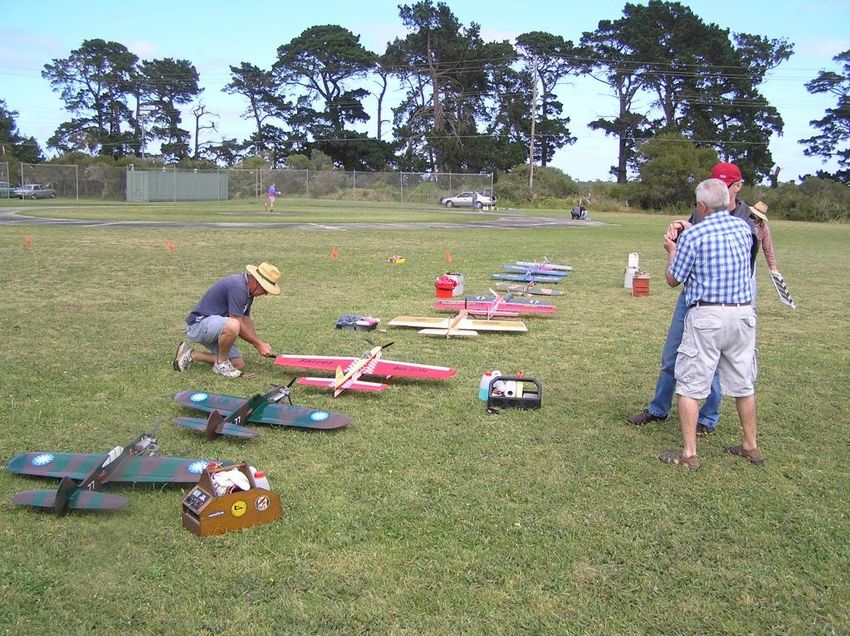
Taipan 2.5-BB Series 70 “Experimental”
Maris Dislers tests the enigmatic Schnuerle-ported version of this famous Australian diesel.

                                                Look Ma... no exhaust port. Actually,
                                                it’s on the other side. If we shot it
                                                from that angle, you wouldn’t be able
                                                to tell this one from a regular produc-
                                                tion engine.
Gordon Burford had a habit of handing out
prototypes and experimental versions of his
engines for testing. Perhaps to experienced
engine men, or average modellers, as a
means of testing their potential and weak-
nesses. Their feedback was invaluable, when
making final production decisions.

Peter Chinn covered the Taipan Tyro and an experimental version of the Taipan 2.5-BB Series 70 engines in his “Latest Engine
News” in Aero Modeller, March 1972. That engine featured a form of Schnuerle porting, which in theory should have been a step
towards improved performance. Peter did not elaborate on the tests which he doubtless conducted, leaving many curious minds
guessing as to how it ran and why it did not go into production. We set about finding out and here’s our report “for the record”.

The first Series 70 2.5cc diesels were introduced late in 1969 and the type was progressively and quite extensively developed over
the next few years before reaching its final “Blackhead” form towards the end of 1972. In fact, only the backplate, gaskets, bear-
ings, prop nut/stud/washer and spraybar nut carried right through. Experimentation apparently progressed in two parallel
streams, for FAI Combat and 2.5cc Rat Racing. The racing experiments aimed at increasing horsepower and airspeed, hence the
Schnuerle porting idea. Around a dozen Schnuerle-ported experimental engines were made, including the one sent to Peter Chinn.
Luckily, we recently got a few bits and pieces from Finn Siegmann, who together with his brother Ib were hot rat racers at that
time and part of the program. With assistance from David Burke of Adelaide Aeromotive (and referring to a known genuine en-
gine) I was able to assemble a precise replica of the type for performance testing.

This experimental version is based on the “Type 2” crankcase (original “Type 1” has no flange for exhaust ring mounting, “Type 3”
has an extra 1mm of metal in front of the rear bearing). The only modification is a boost transfer passage formed by a round-nosed
8mm milling cutter, leaving barely enough metal on the side wall to do the job. Crankshaft is of the type adopted for later produc-
tion, with the flanks of the crankweb milled away either side of a solid crankpin. Connecting rod is milled front & back and the
gudgeon pin is hollow. That’s quite a bit of work to reduce the piston/pin/conrod weight from 10.0g to 9.8g. This engine has the
“stovepipe” venturi (also adopted for later engines) with 6.9 sq mm choke area, down from a generous 11.1 sq mm with the earlier
“bell mouth” type.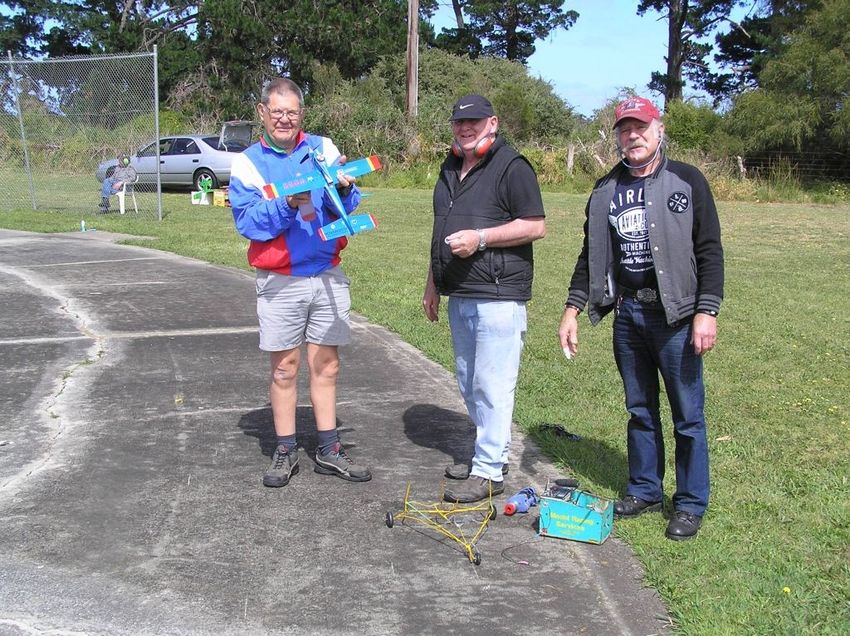
Mimicking Peter Chinn’s photo in March 1972
                                                                         Aero Modeller, our shot shows the third transfer
                                                                         passage and different cylinder porting. Our crank-
                                                                         case was salvaged after extracting a broken cylin-
                                                                         der screw. Note the epoxy filled grooves where a
                                                                         Dremel cut-off disc had cut a slot in the screw
                                                                         shank, broken off almost flush. Heat & pene-
                                                                         trating oil allowed it to be easily removed with a
                                                                         jewellers’ screwdriver.

We have two cylinder types. The first has standard fore-aft transfer
ports and a smaller boost port opposite the single standard (3/32 in.
deep) exhaust port. It’s not Schnuerle porting, as there is no attempt
to direct the incoming charge away from the exhaust port. Its bore
was severely corroded and could not be restored without great
effort. We focused on the second cylinder, which is the same as sent
to Peter Chinn. This has a 1/8 in. exhaust and the two transfer ports,
still steeply inclined, are also angled towards the boost port to pro-
vide the desired loop scavenging pattern.

Note the RH transfer port’s lean towards the boost port (at top).
Something like Super Tigre style ports separated by a third boost
port.

                                                           Production and Experimental (right) piston/conrod assemblies. Light-
                                                           ening attempts were perhaps a last stab at the higher speed vibration
                                                           demon.

                                                                                                                 Earlier crankweb
                                                                                                                 lacks counterbal-
                                                                                                                 ancing of recipro-
                                                                                                                 cating masses.
                                                                                                                 Experimental
                                                                                                                 crankshaft (right)
                                                                                                                 became later pro-
                                                                                                                 duction standard.

Measured port numbers are the same as production engines; Exhaust 138 degrees, transfers/boost 134 degrees, Intake 159 de-
grees (opens 60 ABDC closes 39 ATDC).

On the test bench
David set the engine up essentially as it would have been in 1971. Low cylinder bore taper, dead parallel piston skirt and relatively
loose fit – no modern tricks. It ran in quite easily and proved to be a very happy runner. The lack of hot exhaust goo when adjusting
the needle and a bit less noise made it more pleasant than the production versions. Our test fuel contained 25% castor oil, 30%
ether, 45% kero, with 1.5% ignition improver added. With the stovepipe venturi on board, we were very pleased with its response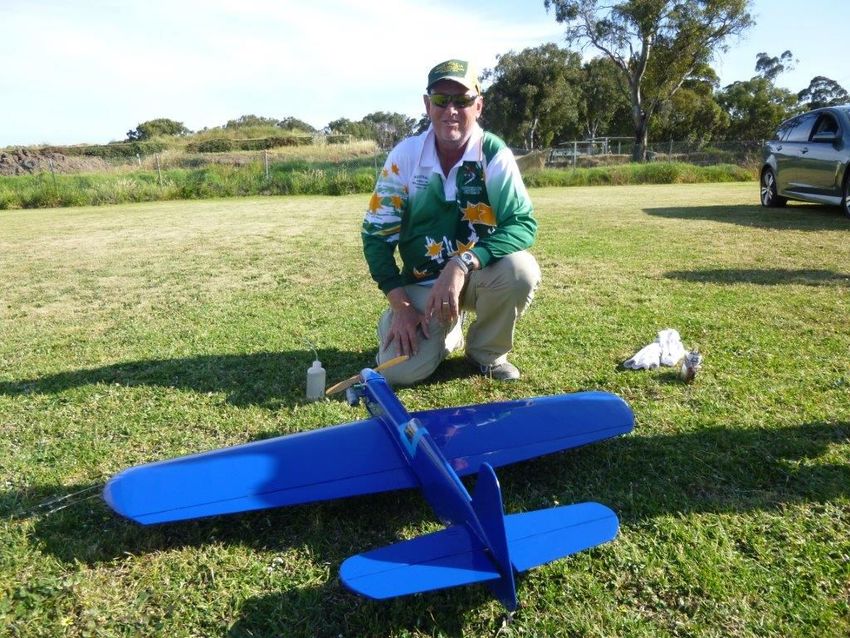
to needle adjustment and consistent running. Restarts were very good. When warm, settings were left alone, one finger choke and
a few winds of the prop until it knocked. Then a good flick and it was running again.

All went well until we fitted the APC 7x5 test propeller. When lightly loaded in that way, engine vibration shot up dramatically, so
we went no further. A second series of tests with the larger bell mouth venturi saw the reliable starts disappear. Frequent false
starts (even with the needle opened up a fair bit) and less consistent running. You could see the quite coarse droplets of fuel
churning about near the spraybar. All signs of being “over carburetted”. That probably gave rise to severe vibration even sooner in
the RPM scale using the APC 8x4 and 7x6 propellers. We called it quits.

I used the RPM values gained with the stovepipe venturi, as the bell mouth type is not strictly correct for this engine as far as we
know. Furthermore, the extra choke area could only coax an extra 100 to 200 RPM at mid-range speeds – nothing at the top or
bottom end. The resulting performance chart shows a fairly flat peak to the power curve, with a maximum of 0.365 BHP around
15,500 RPM. Maximum torque of 28 oz-in occurs well down the scale at around 10,000 RPM.

                     RPM    RPM    RPM
                                                                      Comparisons and conclusions
 Propeller           Test 1 Test 2 Test 3
 APC10x6                8200      8500      8700                      Actual power output varies quite a bit from one production
                                                                      Taipan 2.5-BB Series 70 to the next. As a point of reference,
 APC 10x4               9700    10000     10300
                                                                      I’ve provided data from a really good production engine of
 Graupner 9x5          10100    10800     10800
                                                                      intermediate type (3/32 in. exhaust ports, counterbalanced
 APC 9x6                 -         -      10900                       crankshaft) with both venturi types. Standard production Se-
 APC 9x4               12100    12700     12600                       ries 70’s give their best power in the 13,000-14,000 RPM
 APC 8x6                 -         -      13500                       range, depending on the individual example. The Schnuerle
                                                                      engine needs higher speeds to show a gain of a little more
 Graupner 8x5          13000    13500     13700
                                                                      power.
 APC 8x4               14300    14800     15200
                                                                      So here’s the likely problem. The Schnuerle ported engine
 APC 7x6               14700    15100     15700
                                                                      cannot significantly exploit the potential of its improved scav-
 APC 7x5                 -         -      16400                       enging system, because serious vibration becomes the domi-
                                                                      nant issue. I’m guessing the lighter conrod and gudgeon pin
                                                                      came about once this became apparent, but were not enough
                                                                      to fix it. Serious stuff and our test engine now has a cracked
Test 1 – Production engine with stovepipe venturi
                                                                      crankcase behind the lower stiffening web as a result! A bit
Test 2 – Production engine with bell mouth venturi                    more running and the whole front end could fall off (just ask
Test 3 – Experimental engine with stovepipe venturi                   the Editor about that if you don’t believe me).

                                                                      I’m told the “combat testers” pushing their regular produc-
                                                                      tion engines hard found the same thing. That soon led to the
                                                                      stronger “Type 3” crankcase on subsequent production en-
                                                                      gines. These testers also applauded the smaller stovepipe
                                                                      venturi, which greatly improved consistent running in tight
                                                                      turns.

                                                                      If kept within sensible bounds, I’d rate the Schnuerle ported
                                                                      2.5-BB Series 70 Taipan diesel as superior, but what competi-
                                                                      tive kid would not want to find out how many RPM he could
                                                                      extract from this latest technological marvel? It seems likely
                                                                      that Gordon Burford figured many customers would get into
                                                                      all sorts of bother if that engine went onto the market. How
                                                                      much more experimentation would be needed to find a solu-
                                                                      tion? And of course he was aware of the well advanced devel-
                                                                      opment of the Schnuerle ported 2.5cc racing glowplug en-
                                                                      gine, which did go into production not long afterwards. It
                                                                      seems he wisely stuck to the regular reverse-flow porting, but
                                                                      incorporated the various improvements from these test pro-
                                                                      grams into later production engines.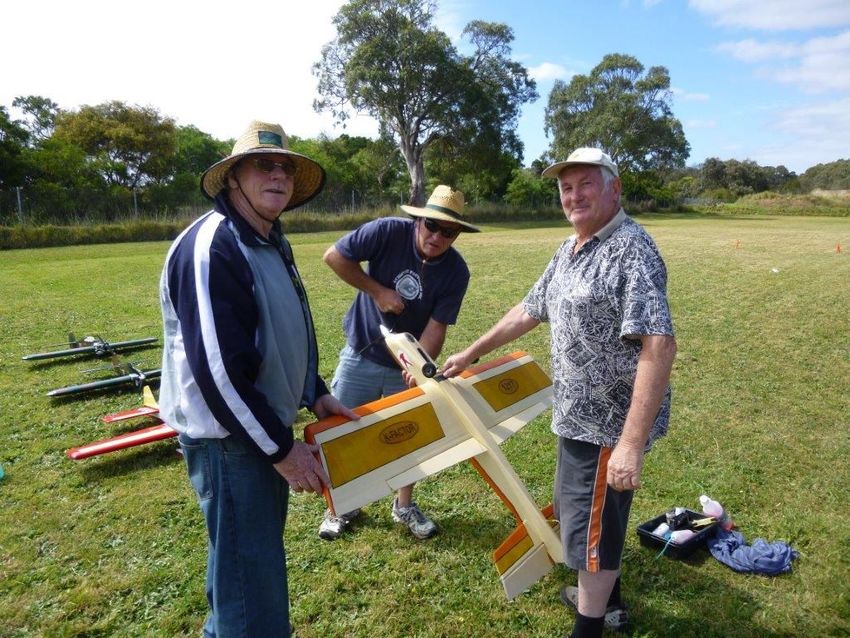
V-shaped crack in crankcase, caused by harsh vibra-
                                                               tion spells “finish for La Musica”. Lack of strength in
                                                               front of the rear bearing was remedied in later
                                                               “Type 3” crankcase which has extra metal in this ar-
                                                               ea.

Editors note.
Here (on the right) is my Taipan that Maris referred to which the
front end fell off.

Maris kindly supplied me with a replacement crankcase and David
Burke fitted helicoils where the cylinder hold down threads had
stripped. The engine has been re-built and is back in use in Burford A
team race.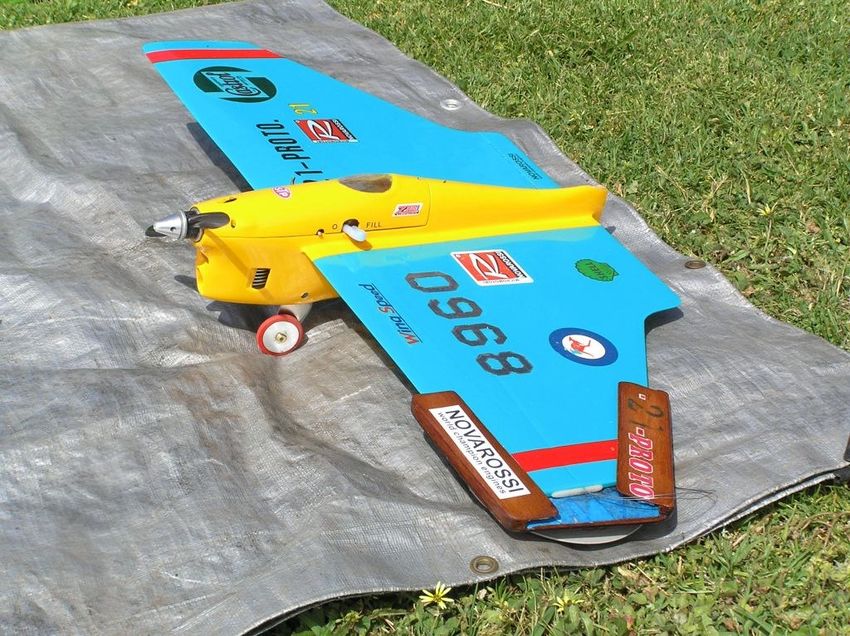
CLAMF Competition Day, 9/11/14
It was a big day down at the Frankston flying field on Sunday, 9 th November.
Stunt was the go with competitions being held for F2B Aerobatics and the long awaited Warbirds competition that was to flown
to the Classic pattern. It seems Classic Stunt was also combined with the Warbirds. It was great to see such a large number of
stunters lined up and ready to fly at CLAMF. Combined Speed and 27 Goodyear were also flown.
Weather was reasonable with a constant southerly breeze that had the unfortunate effect of carrying dust across from the mini
bike track next door. The cars in our field were covered with fine dust and the conditions for running model engines was far from
ideal. Hopefully we can encourage the bikes management to be more pro-active with track watering on future days like this.
Six Warbirds lined up on the freshly mown grass surface. There are lots more models still under construction so next years event
should be a beauty! Can’t wait to get a look at Paul Stein’s when it’s finally finished… Today Paul flew his Nobler instead.
F2B specialist Mark Ellins had his ST-46 P-40 flying very smoothly and it was no surprise that he scored the highest points. John
Hallowell also had the same ST-46 P-40 combination but forgot the reverse wingover (senior moment) in the first round and ran
out of fuel in the overhead eights in round two. There’s always next time!
Andrew Nugent’s very smart silver Mustang and Enya 35 showed the benefits of practice and having everything nicely sorted out.
His third place in the Warbirds reflected that. Was great to see Peter Koch from KMAC at the field. Just a pity a few more didn’t
follow his good example. After all, there are always lots of CLAMF modelers at Knox for their competitions. Peter had a few is-
sues with his Fox 29 Stuka including an early engine cut, but is sure to bounce back better than ever next time. Harry Bailey en-
joyed the day but his Fox 25 P-40 flight was not able to reach full potential.
WARBIRD STUNT (CLASSIC PATERN)

                                            Model      Engine
Mark Ellins           451    423     874    P40        ST 46
Paul Stein            394    436     830    Nobler     Brodak 40    John preps his P40
Andrew Nugent         378    413     791    Mustang    Enya 35      Kittyhawk Warbird
John Hallowell        389    281     670    P40        ST 46        stunt model.
Peter Koch            55     353     408    Stuka      Fox 29
Harry Bailey          223            223    P40        Fox 25

F2B was next. It was flown on the north circle, which gave
some respite from the dust clouds. Again it was Mark Ellins who
showed the way with his smooth flying ex Doug Grinham
‘Jazzer’. Murray Wilson showed his versatility and talent by
putting in two very nice flights with his SV11.
Paul Stein’s Nobler was again in the mix with a flight good
enough to take 3rd place. Peter Koch ‘s Strega wasn’t performing at its best and Andrew Nugent’s effort in flying the F2B pattern
for the first time with his Nobler was worthy of high praise.
 Everyone who flew aerobatics on this memorable day cer-
tainly enjoyed carving up the air into little circles. Thanks to
judges Peter Roberts and Graeme Wilson for doing a top
job..
F2B Aerobatics
                          Rd 1 Rd 2 Best Model
Mark Ellins               1810 1768 1810 Jazzer
Murray Wilson             1628 1627 1628 SV 11
Paul Stein                1589    0 1589 Nobler
Peter Koch                1270 1458 1458 Strega
Andrew Nugent             991     0 991 Nobler

To wind up the day’s program, it was time for 27 Goodyear.
Only three teams took part and two rounds were flown.
Graeme and Murray Wilson recorded a very fast 5.07.22
with a Super Tigre G20D. Paul Stein and Mark Ellins were John, Mark assisting Gavan with a state-of-the-art F2B stunt model
going well until the last tank of the first heat. It was then that Paul noticed the broken fuzz… right behind the wing and severely
hampering the down control. Paul could see the crack from the centre circle… Scary stuff! Harry Bailey and Peter Roberts were
using a Nelson and easily getting all the necessary speed.
The final was a two up and went all the way down to the wire with Harry and
Peter just pipping the Willows at the post by the slender margin of about two
seconds. Top racing, lads!
27 Goodyear Team Race

                        Rd 1           Rd 2          Final    Engine
H.Bailey/P.Roberts      5:39.63        5:46.47       11:26.10 Nelson
G.Wilson/M.Wilson       5:07.22        6:21.03       11:28.25 ST G20D
P.Stein/M.Ellins        5:24.14        DNS                    PAW 15GT              27 Goodyear Team racing with
                                                                                    Wilson/Wilson team ready for
                                                                                    action.
John Hallowell
AUS 1984

Peter Roberts (official stunt judge) adds:
Warbird Stunt
With only a couple of Classic entries it was decided to combine Classic with Warbird Stunt. Mark was high scorer with his ST46
powered Brodak P40 Profile, followed by Paul with his B40 powered Nobler ring in. Andrew and John were also flying Brodak Pro-
file Warbirds, Andrew with an Enya 35 powered Mustang and John with an ST46 P40. Peter had a few problems with a couple of
dodgy engine runs from the Fox 29 in his neat Don Still Stuka, while Harry had a wild ride from his twitchy Fox powered Goldberg
P40 in the gusty conditions.
F2B
The windy conditions were a bit of a challenge, although everyone seemed to cope reasonably well. Once again Mark was top
scorer with a Stalker 61 powered Jazzer. Murray’s ARF SV11 with a Stalker 61 up front stayed in one piece this time! Murray could
be a bit of a dark horse in future stunt comps. Paul handled the wind pretty well with his Brodak40 Nobler, while Peter’s nice
looking PA75 powered ARF Strega seemed to suffer a bit in the windy conditions in spite of all that grunt up front! An-
drew rounded out the comp with his ARF Nobler powered by an OS LA46 which is probably the best bang for buck stunt engines
around.
Peter Roberts

F2C inspired
Proto Speed
model powered
by a Rossi 21
engine.
                                                                                 A great turnout of stunt models and competitors
                                                                                 at CLAMF!

Graeme Wilson
with his new
toy, the vener-
able Topflite
ARF Nobler
during 'shake
down' flight
testing.

                                                                                C/L Speed boys enjoy a
                                                                                relaxed testing session.
U.S. Hard rock maple bearer wood, precision cut and ma-
                                                                 chine sanded.
                                                                 Cost $4 each plus postage. All lengths 12"
                                                                 Sizes: 3/8"x3/8"
                                                                          3/8"x1/2"
ANDREW’S PANS.                                                            1/2"x1/2"
                                                                 Also, I now have a stock of 3/16" sq and 1/4"sq rock ma-
.21 size speed pans (by request no stock at this time), Nelson   ple spars.
style T/R pans and a few 2cc pans. Also available a new T/R pan. All spars are precision sanded with 150 grit.
Julian Reichardt has hand carved a wooden replica/pattern of     $4 each plus postage.
the pan he and Hutton Oddy used back in the 70’s. This will be
                                                                 email: aheath14@australia.edu
suitable for Classic FAI T/R. He has also sent me a copy of their
T/R plan called a FART. (I didn’t name it!!) All pans $25 in the     Production is ending.. Last chance to purchase.
“as cast state” and are cast in AA601 casting Alloy.

         Reichardt/Oddy pan.                                                   Newsletter Editor
                                                                               Harry Bailey.
                                                                               37 Thompson Street
                                                                               Clayton 3168
                                                                               Victoria
                                                                               Email:-
                                                                               hbbailey@optusnet.com.au

Also available to order, prop nuts and shaft extentions, carbies
for most engines, and vintage T/R type tank and bottle valves.
Available now the following full size plans, : Turtle, FART, Sapa-
volov, Timepiece, Picus, Dimple Dumpling, Past, Arrow. All $4
which includes postage in Australia.
Regards,
Andrew Nugent.
andrew.n5@bigpond.com                                                Murray Wilson’s new
PH 9551 1884.                                                        Goodyear model is ready
                                                                     for the British Nationals.
Castor Oil. First pressing/degummed. $45 for 5 litres
                              including container.
Postage based on 6 kg package sent using regular mail to
your postcode from 3018
Contact:- combtkid@hotmail.com
Bank deposit (EFT), Australia Post money orders, Cash &
PayPal (+3..5% fee) payments accepted.

MACCA'S MACHINING & MILLING SERVICES
Tank Valves                                                          Wanted dead Profi F2A crankcase, crankshaft and head for
Filler Bottle Valves                                                 mock-up of F2A fuse [new project all carbon]. Price and de-
Shaft Extensions                                                     tails to jakeandfran@bigpond.com
Engine Plates                                                        If there are any dramas please email me.
Venturies and threaded inserts and general machining.                Thanking you John Jacobsen. 5075
Phone 07 3288 9263
Mobile 0402 295 370
AUSTRALIAN CONTROL LINE NEWS SURFACE
If undeliverable return to:-
G. WILSON
MAIL
P. O. BOX 298
SEAFORD VIC 3198
Printed by Minuteman Press
3/14-16 Hartnett Drive
Seaford, VIC 3198
Phone: 03 9773 5586You can also read


