THEY SHOT OUR CHILDREN' - KILLINGS OF MINORS IN IRAN'S 2019 NOVEMBER PROTESTS - Amnesty International
←
→
Page content transcription
If your browser does not render page correctly, please read the page content below
‘THEY SHOT OUR CHILDREN’
KILLINGS OF MINORS IN IRAN’S 2019 NOVEMBER PROTESTS
Amnesty International is a global movement of more
 than 7 million people who campaign for a world
 where human rights are enjoyed by all.
 Our vision is for every person to enjoy all the rights
 enshrined in the Universal Declaration of Human Rights
 and other international human rights standards.
 We are independent of any government, political
 ideology, economic interest or religion and are funded
 mainly by our membership and public donations.

© Amnesty International 2020
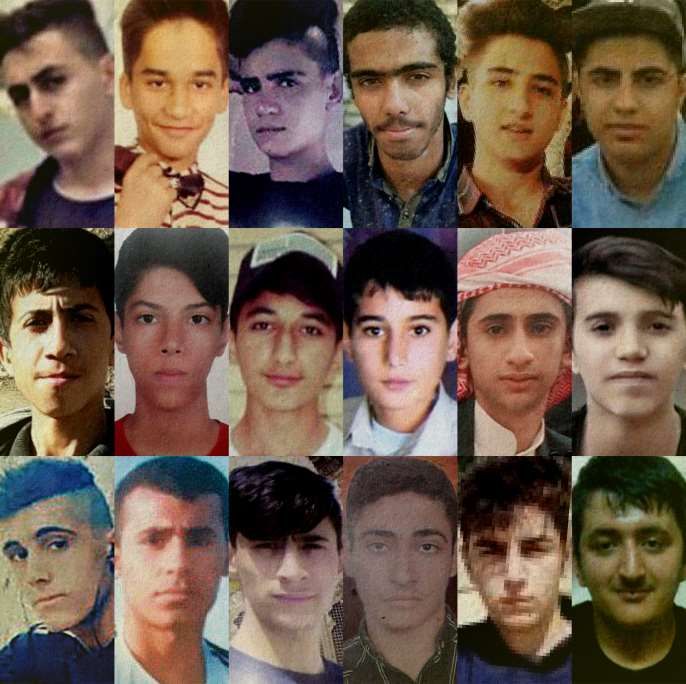
Except where otherwise noted, content in this document is licensed under a Creative Commons   Cover photo: Collage of photographs of some of the children killed by Iran’s security forces during the
(attribution, non-commercial, no derivatives, international 4.0) licence.                     protests of November 2019 © Amnesty International
https://creativecommons.org/licenses/by-nc-nd/4.0/legalcode
For more information please visit the permissions page on our website: www.amnesty.org
Where material is attributed to a copyright owner other than Amnesty International this
material is not subject to the Creative Commons licence.
First published in March 2020
by Amnesty International Ltd
Peter Benenson House, 1 Easton Street
London WC1X 0DW, UK

Index: MDE 13/1894/2020
Original language: English

amnesty.org
CONTENTS

1. EXECUTIVE SUMMARY                                   4

2. METHODOLOGY AND BACKGROUND                          6
2.1 METHODOLOGY                                        6
2.2 BACKGROUND                                         7

3. CHILDREN KILLED                                     8
3.1 OVERVIEW                                           8
3.2 AGES OF CHILDREN KILLED                            8
3.3 GEOGRAPHIC SPREAD AND TIME FRAME OF KILLINGS      15
3.4 CAUSES AND CIRCUMSTANCES OF DEATHS                16

4. STATE COVER-UP AND HARASSMENT                      19
4.1 COVER-UP AND HARASSMENT                           19
4.2 FAILURE TO CONDUCT INDEPENDENT INVESTIGATIONS     20

5. INTERNATIONAL LAW AND STANDARDS                    22

6. RECOMMENDATIONS                                    24

APPENDIX: LIST OF CHILDREN KILLED                     25

‘THEY SHOT OUR CHILDREN’
KILLINGS OF MINORS IN IRAN’S NOVEMBER 2019 PROTESTS
Amnesty International                                  3
1. EXECUTIVE SUMMARY

     “I went through such difficulties to raise my child. I had high
     hopes and dreams for him. It was his birthday just two
     months ago. I just have one wish: I do not want the injustice
     that took away my child to go unpunished. And not just my
     child, but all the children whose blood has been spilled. I
     want the whole world to hear: I have lost my beloved, my
     everything.”
     Relative of a child killed by Iran’s security forces during the protests of November 2019,

Amnesty International has uncovered evidence that at least 23 children were killed by Iranian security forces
in the nationwide protests that took place between 15 and 19 November 2019. The children killed include
22 boys, aged between 12 and 17, and a girl reportedly aged between eight and 12.
These deaths occurred during the repression of protests that erupted across Iran on 15 November 2019
following a sudden government announcement about a fuel price hike. According to credible reports
compiled by Amnesty International, at least 304 people were killed, and thousands injured between 15 and
19 November.
At least 22 of the children were shot dead by Iranian security forces unlawfully firing live ammunition at
unarmed protesters and bystanders, according to the findings. In one child’s case, there are conflicting
reports on the cause of death, with one referring to fatal head injuries sustained by beatings by security
forces and another referring to the firing of metal pellets at the victim’s face from a close distance.
In 10 cases, Amnesty International learned from the description of injuries on the death or burial certificates
it reviewed or information it received from credible sources that the deaths occurred as a result of gunshots
to the head or torso – indicating that the security forces were shooting to kill. In two of the cases, burial
certificates set out in detail the devastating impact on the children’s bodies. One cited injuries including
bleeding, a crushed brain and a shattered skull. The other indicated that the cause of the death was
extensive internal bleeding and a pierced heart and lung.
Twelve of the 23 deaths recorded by Amnesty International took place on 16 November, a further eight on
17 November and three on 18 November. The protests had started on 15 November. The 23 children are
recorded as having been killed in 13 cities in six provinces across the country (Esfahan, Fars, Kermanshah,
Khuzestan, Kurdistan and Tehran), reflecting the widespread nature of the bloody crackdown.
Amnesty International has identified videos broadcast by state TV which specifically suggest that two of the
victims were killed by non-state actors. More generally, the Iranian authorities have made statements or
produced programmes on state TV which attribute responsibility for the majority of the killings in the
November protests to armed “rioters” working for “enemies” of the Islamic Republic of Iran. However,

‘THEY SHOT OUR CHILDREN’
KILLINGS OF MINORS IN IRAN’S NOVEMBER 2019 PROTESTS
Amnesty International                                                                                             4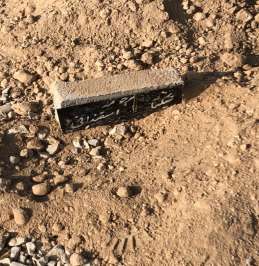
extensive video footage analysed by Amnesty International’s Digital Verification Corps and numerous
eyewitness accounts obtained by the organization provide clear evidence that those using firearms against
unarmed protesters and bystanders belonged to Iran’s security forces.
On 25 February, Amnesty International wrote to Iran’s Minister of Interior Abdolreza Rahmani Fazli to provide
him with the list of the names of the 23 children recorded as killed, along with their ages and places of
death, and to seek the authorities’ comments on the circumstances of their death. As of 3 March, the
organization had received no response.
Consistent with a long-standing pattern of systematic impunity, the Iranian authorities have failed to conduct
independent and impartial investigations into the killings of protesters and bystanders, including these
children, in the November protests and ensure that those suspected of ordering and carrying them out are
prosecuted in fair trials. In fact, the authorities have sought to enforce impunity and silence by orchestrating
a ruthless campaign of harassment to intimidate families and prevent them from speaking out.
Given the gravity of the violations perpetrated and the systematic impunity prevailing in Iran, Amnesty
International has called on member states of the UN Human Rights Council to urgently mandate an inquiry
into the unlawful use of lethal force by Iranian security forces against unarmed protesters and bystanders,
including children, between 15 and 19 November 2019.

‘THEY SHOT OUR CHILDREN’
KILLINGS OF MINORS IN IRAN’S NOVEMBER 2019 PROTESTS
Amnesty International                                                                                              5
2. METHODOLOGY AND
   BACKGROUND

2.1 METHODOLOGY
In the context of its ongoing investigation into the repression of protests in November 2019, Amnesty
International has researched cases of individuals who were killed and reported to have been under the age
of 18 at that time.
It obtained information from credible sources indicating that 23 individuals were under the age of 18 at the
time of their death. In 10 cases, Amnesty International spoke directly to sources impacted by the deaths,
including relatives, neighbours, friends, acquaintances and eyewitnesses. In the remaining cases, the
information was received from human rights activists and journalists based in or outside Iran. In order to
ascertain the credibility and reliability of the information received from human rights activists and journalists,
Amnesty International interviewed them about their sources of information, which typically included relatives,
neighbours, friends, acquaintances and eyewitnesses. The organization then cross-checked the information.
Amnesty International is continuing its efforts to locate and speak to primary sources on these cases and/or
obtain documentary evidence.
In four cases, Amnesty International was able to obtain evidence such as death and burial certificates and
pictures of gravestones confirming the dates of birth and death of the individual concerned. In two cases, it
was able to obtain funeral posters indicating that the deceased was an adolescent. Death and burial
certificates in Iran record the deceased’s dates of birth and death. The dates of birth and death recorded on
the gravestone of the deceased generally reflect the information recorded in their death and burial
certificates. Families are not authorized to bury their loved ones and install gravestones until a burial
certificate has been issued by the Legal Medicine Organization of Iran, a state forensic institute working
under the supervision of the judiciary.
As part of its ongoing investigation into the unlawful use of lethal force during the protests, Amnesty
International analysed extensive video footage, verified by its Digital Verification Corps, which showed Iranian
security forces using firearms against unarmed protesters and bystanders.
It also reviewed official statements published by state-affiliated media outlets in Iran and searched for and
analysed videos that were broadcast by the Islamic Republic of Iran Broadcasting (IRIB) corporation in
relation to the protests of November 2019. These videos included two interviews from December 2019 which
the IRIB conducted with the families of two named children: Sasan Eydivandi and Amirreza Abdollahi.
On 25 February, Amnesty International wrote to Iran’s Minister of Interior Abdolreza Rahmani Fazli to provide
him with the list of the names of the 23 children recorded as killed, along with their ages and places of
death, and to seek the authorities’ comments on the circumstances of their death. As of 3 March, the
organization had received no response.

‘THEY SHOT OUR CHILDREN’
KILLINGS OF MINORS IN IRAN’S NOVEMBER 2019 PROTESTS
Amnesty International                                                                                            6
2.2 BACKGROUND
On 15 November 2019, following a sudden announcement by the government about a significant overnight
rise in the price of fuel, tens of thousands of people across Iran took to the streets in protest. In response,
Iranian security forces used unlawful and excessive lethal force against unarmed protesters and bystanders
to crush the protests.1 According to credible reports compiled by Amnesty International, at least 304 people
were killed, and thousands injured between 15 and 19 November. During this time, the authorities
implemented a near-total internet shutdown to stop people inside Iran from being able to share information
about these crimes with the rest of the world. During and following the protests, the Iranian authorities also
arbitrarily detained thousands of detainees and subjected some to enforced disappearance, torture and
other ill-treatment.2

1
  Amnesty International, Iran: More than 100 protesters believed to be killed as top officials give green light to crush protests, 19 November
2019, www.amnesty.org/en/latest/news/2019/11/iran-more-than-100-protesters-believed-to-be-killed-as-top-officials-give-green-light-to-
crush-protests/
2
  Amnesty International, Iran: Thousands arbitrarily detained and at risk of torture in chilling post-protest crackdown, 16 December 2019,
www.amnesty.org/en/latest/news/2019/12/iran-thousands-arbitrarily-detained-and-at-risk-of-torture-in-chilling-post-protest-crackdown/

‘THEY SHOT OUR CHILDREN’
KILLINGS OF MINORS IN IRAN’S NOVEMBER 2019 PROTESTS
Amnesty International                                                                                                                            7
3. CHILDREN KILLED

     “They [the authorities] shot our children and now they are
     telling us, ‘They are gone and you have to be silent.’ How and
     why could a child of this age fall victim to this [brutality]?
     There is no law and justice in this country. There is nobody to
     answer to us for our children’s death.”
     Relative of a child killed by Iran’s security forces during the protests of November 2019

3.1 OVERVIEW
Amnesty International has uncovered evidence that at least 23 children were killed by Iranian security forces
in the nationwide protests in November last year. The children killed include 22 boys, aged between 12 and
17, and a girl reportedly aged between eight and 12.
At least 22 of the children were shot dead by Iranian security forces unlawfully firing live ammunition at
unarmed protesters and bystanders, according to the findings. In one child’s case, there are conflicting
reports on the cause of death, with one referring to fatal head injuries sustained by beatings by security
forces and another referring to the firing of metal pellets at the victim’s face from a close distance.
In 10 cases, Amnesty International learned from the description of injuries on the death or burial certificates
it reviewed or information it received from credible sources that the deaths occurred as a result of gunshots
to the head or torso – indicating that the security forces were shooting to kill.
In two of the cases, burial certificates set out in detail the devastating impact on the children’s bodies. One
cited injuries including bleeding, a crushed brain and a shattered skull. The other indicated that the cause of
the death was extensive internal bleeding and a pierced heart and lung.
Twelve of the 23 deaths recorded by Amnesty International took place on 16 November, a further eight on
17 November and three on 18 November. The 23 children are recorded as having been killed in 13 cities in
six provinces across the country (Esfahan, Fars, Kermanshah, Khuzestan, Kurdistan and Tehran), reflecting
the widespread nature of the crackdown.
Amnesty International’s information on the 23 children, including their names, pictures and ages, and the
places and circumstances of their deaths are summarized in the Appendix.

3.2 AGES OF CHILDREN KILLED
The youngest victims recorded by Amnesty International were Sayed Ali Mousavi, aged 12, from
Ramhormoz, Khuzestan province; Ali Ghazlavi, aged 12, from Khorramshahr, Khorramshahr province;

‘THEY SHOT OUR CHILDREN’
KILLINGS OF MINORS IN IRAN’S NOVEMBER 2019 PROTESTS
Amnesty International                                                                                             8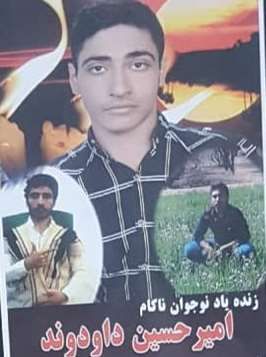
Amirreza Abdollahi, aged 13, from Shahriar, Tehran province; and a girl, reportedly aged between eight and
12, from Mahshahr, Khuzestan province, whose last name is reported as Chan’ani but whose first name
remains unknown.
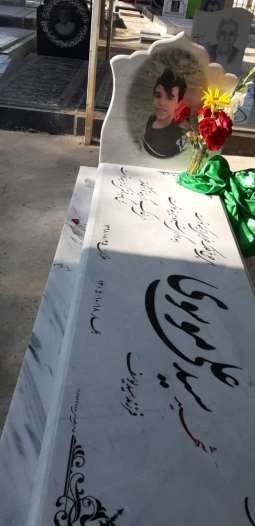
Amnesty International was able to confirm the age of Sayed Ali Mousavi by obtaining a picture of his
gravestone, which noted his dates of birth and death. The age of Amirreza Abdollahi was revealed by the
victim’s father in an interview that was aired by the IRIB in December 2019. In the remaining two cases, the
information was received from a number of local residents in Mahshahr and Khorramshahr. However, the
organization has not yet been able to obtain documentary evidence confirming their names and ages.

    SAYED ALI MOUSAVI

     Gravestone of Sayed Ali Mousavi recording that he was born on 8 January 2007 and that he died on 16 November 2019 © Private

    Sayed Ali Mousavi was fatally shot in his chest by Iranian security forces during a protest in the city of
    Ramhormoz, Khuzestan province, on 16 November 2019, according to an informed source interviewed
    by Amnesty International. The source said that Sayed Ali Mousavi was shot on his way back from school,
    which is located near the headquarters of the governor of the county of Ramhormoz, where the protests
    were taking place. According to the dates of birth and death provided on his gravestone, Sayed Ali
    Mousavi was only 12 years old.
    The information written on the gravestone of Sayed Ali Mousavi indicates that the authorities have
    declared Sayed Ali Mousavi a “martyr” (shaheed). This designation has been granted to some of those
    killed during the November 2019 protests. It generally means that the authorities have acknowledged that
    the deceased was killed during the protests, but claimed that he was either shot accidently by security
    forces or that armed “rioters” working for “enemies” of the Islamic Republic of Iran are responsible for
    the killing. Amnesty International is not aware which explanation has been offered by the authorities in the
    case of Sayed Ali Mousavi.
    Amnesty International has not to date located any video showing non-state actors firing live ammunition at
    unarmed people during the November 2019 protests. Eyewitness accounts obtained consistently note
    that those using firearms against unarmed protesters and bystanders belonged to Iran’s security forces,
    including the special forces of Iran’s police, plain-clothes paramilitary Basij agents and the Revolutionary
    Guards.

‘THEY SHOT OUR CHILDREN’
KILLINGS OF MINORS IN IRAN’S NOVEMBER 2019 PROTESTS
Amnesty International                                                                                                              9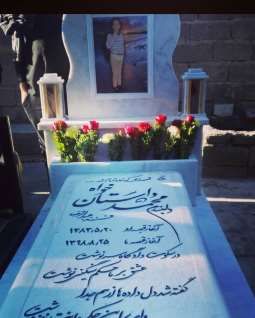
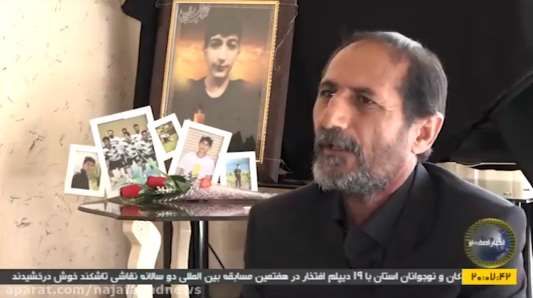
AMIRREZA ABDOLLAHI

                                                                                                 Amirreza Abdollahi was fatally shot on 16
                                                                                                 November 2019 during a protest in the
                                                                                                 county of Shahriar in Tehran province.
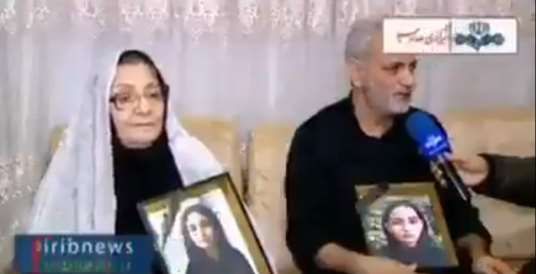
                                                                                                 In a propaganda video aired by the IRIB in
                                                                                                 mid-December 2019, Amirreza Abdollahi’s
                                                                                                 father was shown saying that his son was
                                                                                                 only 13 years old and he had left the house
                                                                                                 for some shopping when he was caught in
                                                                                                 the protests and shot dead. His father added
                                                                                                 that Amirreza Abdollahi had not taken part in
                                                                                                 the protests. However, he was not shown
      A screenshot taken by Amnesty International from an interview with Amirreza                expanding on the circumstances of his son’s
      Abdollahi’s father, aired by the IRIB around mid-December 2019                             death during the interview.
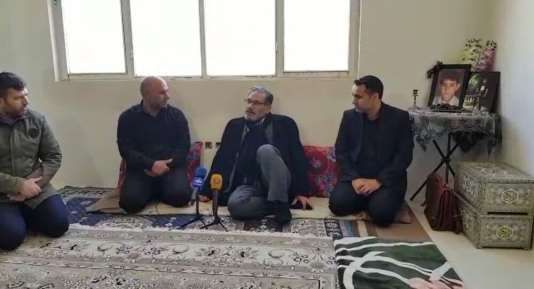
    The Iranian authorities have suggested that Amirreza Abdollahi was killed by unidentified armed “rioters”
    working for “enemies” of the Islamic Republic of Iran. On 12 December 2019, the IRIB showed the
    secretary general of Iran’s Supreme National Security Council, Ali Shamkhani, visiting and talking to the
    family of Amirreza Abdollahi. During the visit, he said: “No one objects to people raising their criticisms in
    different ways. However, sadly, some foreign and opportunistic agents, who are against the people of Iran
    and the independence of the country, took advantage of people’s protests.” 3

      Ali Shamkhani, the secretary general of Iran’s Supreme National Security Council (second from right), visiting the family of Amirreza Abdollahi in December
      2019 © IRNA

    In a media interview following this visit, Ali Shamkhani said that “more than 85% of the victims of the
    recent incidents in Tehran province had not attended any protest and were killed in a suspicious manner
    with firearms and [other] weapons not belonging to state organs.” He added that “this proves that Iran’s
    enemies were involved in a killing project”. 4
    However, extensive video footage analysed by Amnesty International’s Digital Verification Corps and
    numerous eyewitness accounts obtained by Amnesty International provide clear evidence that, across the
    country, including in Tehran province, those using firearms against unarmed protesters and bystanders
    belonged to Iran’s security forces, including the special forces of Iran’s police, plain-clothes paramilitary
    Basij agents and the Revolutionary Guards.

3
 The interview is available in Persian at the following link: www.aparat.com/v/R183j
4
 Islamic Republic News Agency, “Shamkhani visited the families of the victims of recent incidents” (in Persian), 12 December 2019,
www.irna.ir/news/83591316; Khabar Online, “New details about those killed in November 2019 protests in the counties of Tehran
province” (in Persian), 12 December 2019, www.khabaronline.ir/news/1330444

‘THEY SHOT OUR CHILDREN’
KILLINGS OF MINORS IN IRAN’S NOVEMBER 2019 PROTESTS
Amnesty International                                                                                                                                               10
The remaining 19 child deaths during the protests were of children aged between 15 and 17. For three of
these cases, those of Mohammad Dastankhah, Alireza Nouri and Sasan Eydivandi, Amnesty International
was able to obtain photographs of gravestones confirming their ages.
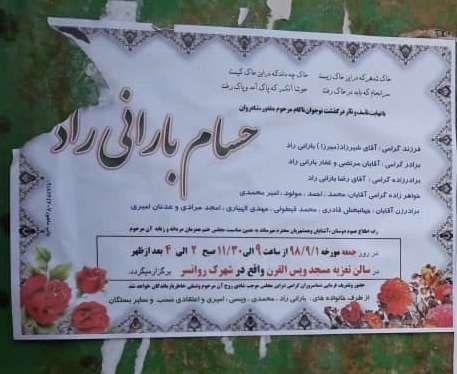
In two other cases, those of Hessam Baranirad and Amirhossein Davoudvand, in addition to receiving
information from informed sources, Amnesty International obtained funeral posters indicating that they were
adolescents.
In the remaining 14 cases, Amnesty International received its information from credible sources indicating
the age of the children. The organization is continuing its efforts to access documentary evidence of the ages
of these victims.
MOHAMMAD DASTANKHAH
Gravestone of Mohammad Dastankhah recording that he was born on Mohammad Dastankhah © Private
10 August 2004 and that he died on 16 November 2019 © Private
Mohammad Dastankhah was shot in the heart on 16 November during a protest in the city of Sadra, Fars
province. According to the dates of birth and death documented on his death and burial certificates,
which are also recorded on his gravestone, he was 15 years old.
According to an informed source interviewed by Amnesty International, Mohammad Dastankhah was shot
on his way back from school by security forces stationed on the rooftop of the office of the Basij in Sadra.
Eyewitness accounts and video footage verified by Amnesty International’s Digital Verification Corps
confirm that, on 16 November, security forces shot at unarmed protesters and bystanders with live
ammunition from this location.
The injuries cited on the burial certificate of Mohammad Dastankhah include extensive internal bleeding
and a pierced heart and lung. The official certificate states, in a phrase consisting of only a few words,
that these injuries resulted from gunshot wounds; however, they do not provide any details on the number
and type of bullets that killed Mohammad Dastankhah.
‘THEY SHOT OUR CHILDREN’
KILLINGS OF MINORS IN IRAN’S NOVEMBER 2019 PROTESTS
Amnesty International 11ALIREZA NOURI
Gravestone of Alireza Nouri recording that he was born on 16 Alireza Nouri © Private
September 2002 and that he died on 17 November 2019 © Private
Alireza Nouri was shot in the head on 17 November during a protest in the city of Shahriar, Tehran
province. According to the dates of birth and death documented on his death and burial certificates,
which are also recorded on his gravestone, he was 17 years old.
The injuries cited on his burial certificate include bleeding, a crushed brain and a shattered skull. The
official certificate briefly states, in a phrase consisting of only a few words, that the injuries resulted from
“a speedy object hitting the head”; however, they do not specify that the object was one or several bullets
discharged from a firearm. An informed source told Amnesty International that the severe injuries seen on
Alireza Nouri’s body were consistent with gunshot wounds and indicated that he had been shot at a close
distance.
SASAN EYDIVANDI
Gravestone of Sasan Eydivandi recording that he was born on 9 Sasan Eydivandi © Private
March 2002 and that he died on 17 November 2019 © Private
Sasan Eydivandi was shot in the heart by Iran’s security forces on 17 November 2019 during a protest in
the area of Yazdanshahr near the city of Najafabad in Esfahan province, according to an informed source
‘THEY SHOT OUR CHILDREN’
KILLINGS OF MINORS IN IRAN’S NOVEMBER 2019 PROTESTS
Amnesty International 12interviewed by Amnesty International. The dates of birth and death recorded on his gravestone confirm
that he was 17 years old.
A propaganda video aired by the IRIB in late December 2019 stated that Sasan Eydivandi was a
bystander who was killed on his way back from school “in a suspicious manner”, suggesting that Iran’s
security forces were not the ones responsible for shooting him.
However, eyewitness accounts from Esfahan province confirm that those firing live ammunition at
unarmed protesters and bystanders on 16 and 17 November 2019 all belonged to Iranian security forces,
including Revolutionary Guards and Basij.
According to an informed source interviewed by Amnesty International, Iranian security and intelligence
officials forced Sasan Eydivandi’s family to bury him late at night in a rushed manner and without an
independent autopsy; this indicates that the authorities were seeking to suppress the truth about the
causes and circumstances of Sasan Eydivandi’s death.
A screenshot taken by Amnesty International from an interview with Sasan Eydivandi’s father, aired on Iran’s state TV in late December 2019
The propaganda video aired by the IRIB in December 2019 included a brief interview with Sasan
Eydivandi’s father in which he said that his son had not taken part in the protests and that “he was not
the type to get involved in riots”.
Amnesty International is concerned that this interview may have been conducted in circumstances of a
coercive nature and included without the father’s consent in the broader video package, which distorted
the causes and circumstances of the killings in the November 2019 protests. The IRIB has a long-
standing record of producing and broadcasting, in co-operation with Iran’s intelligence and security
bodies, coerced statements from victims of human rights violations and their families and including them
in propaganda videos that distort the reality of the human rights violations perpetrated by the authorities
or seek to justify them.
‘THEY SHOT OUR CHILDREN’
KILLINGS OF MINORS IN IRAN’S NOVEMBER 2019 PROTESTS
Amnesty International 13AMIRHOSSEIN DAVOUDVAND
Amnesty International received information
from two informed sources that, on the same
day that Sasan Eydivandi (see above) was
killed, his classmate Amirhossein
Davoudvand, also aged 17, was fatally shot by
Iran’s security forces in the area of
Yazdanshahr near the city of Najafabad in
Esfahan province.
Amnesty International has not been able to
obtain any additional information on the
circumstances of Amirhossein Davoudvand’s
death or access documentation providing his
exact age.
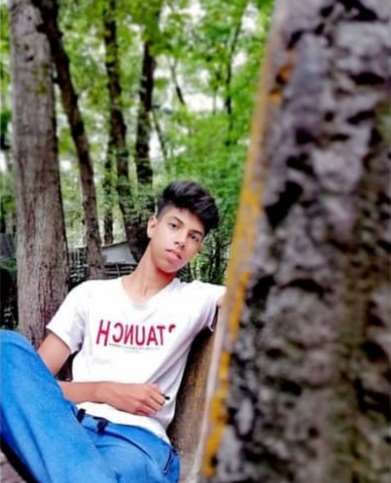
However, the funeral poster of the victim
describes him as being an “adolescent”
(nojavan) at the time of his death.
Funeral poster of Amirhossein Davoudvand referring to him as an
“adolescent” (nojavan) © Private
HESSAM BARANIRAD
Funeral poster of Hessam Baranirad referring to him as an “adolescent” (nojavan) © Private
Hessam Baranirad was shot in the head on 16 November 2019 during a protest in the city of
Kermanshah, Kermanshah province, according to Hengaw Organization for Human Rights, a Kurdish
human rights group which Amnesty International understands received its information from an informed
source inside Iran. Amnesty International was not able to speak to the source directly due to security
concerns. The funeral poster of Hessam Baranirad describes him as being an “adolescent” (nojavan) at
the time of his death.
‘THEY SHOT OUR CHILDREN’
KILLINGS OF MINORS IN IRAN’S NOVEMBER 2019 PROTESTS
Amnesty International 143.3 GEOGRAPHIC SPREAD AND TIME FRAME OF
KILLINGS
Twelve of the 23 deaths recorded by Amnesty International took place on 16 November, a further eight on 17
November and three on 18 November. The protests had started on 15 November. The fact that the vast
majority of the children’s deaths took place over just two days – the second and third of the protests – adds to
the evidence already documented by Amnesty International that Iranian security forces went on a killing spree
to quash dissent at any cost.
Breakdown of deaths of children by date
14
12
10
Number of deaths
8
6
4
2
0
16-Nov 17-Nov 18-Nov
The 23 children are recorded as having been killed in 13 cities in six provinces across the country (Esfahan,
Fars, Kermanshah, Khuzestan, Kurdistan and Tehran), reflecting the widespread nature of the crackdown.
Below is a breakdown, by city and province, of the deaths of children recorded so far by Amnesty
International:
City or county, Province Number of children killed
Ahvaz, Khuzestan 2
Baharestan, Tehran 2
Esfahan, Esfahan 1
Eslam Shahr, Tehran 1
Kermanshah, Kermanshah 2
Khorramshahr, Khuzestan 3
Mahshahr, Khuzestan 3
Ramhormoz, Khuzestan 1
Robatkarim, Tehran 1
Sadra, Fars 2
‘THEY SHOT OUR CHILDREN’
KILLINGS OF MINORS IN IRAN’S NOVEMBER 2019 PROTESTS
Amnesty International 15Sanandaj, Kurdistan 1
Shahriar, Tehran 2
Yazdanshahr, Esfahan 2
TOTAL 23
3.4 CAUSES AND CIRCUMSTANCES OF DEATHS
Evidence uncovered by Amnesty International indicates that at least 22 of the 23 children killed were shot
dead by Iranian security forces unlawfully firing live ammunition at unarmed protesters and bystanders. In
10 cases, Amnesty International learned from the description of injuries on the death or burial certificates it
reviewed or information it received from credible sources that the deaths occurred as a result of gunshots to
the head or torso – indicating that the security forces were shooting to kill. In the remaining 12 cases,
Amnesty International did not have any information on where in their body the children were shot.
In one child’s case, that of Mohsen Mohammadpour from Khorramshahr, Khuzestan province, Amnesty
International received conflicting reports on the cause of death, with one referring to fatal head injuries
sustained by beatings by security forces and another referring to the firing of metal pellets at the victim’s face
from a close distance.
MOHSEN MOHAMMADPOUR
Mohsen Mohammadpour was killed by Iran’s
security forces on 18 November 2019 during a
protest in the city of Khorramshahr, Khuzestan
province, according to an informed local source
who had participated in the protests in
Khorramshahr and was interviewed by Amnesty
International.
The source told Amnesty International that he
was not present at the scene of the incident,
but that he was at the entrance of the hospital
Mohsen Mohammadpour © Private
in Khorramshahr to which Mohsen
Mohammadpour was taken on 18 November
after suffering injuries. He said he learned then
through a close friend hospitalized there at the
same time that Mohsen Mohammadpour had
suffered head injuries as a result of the actions
of security forces.
Amnesty International has been provided with a
video which shows Mohsen Mohammadpour
lying motionless on the ground with his face
covered in blood. While Amnesty International’s
Mohsen Mohammadpour’s grave site © Private
Digital Verification Corps was not able to
independently geolocate this video, it has
confirmed that the video had not appeared online before 18 November 2019. The image is consistent
with reports provided to Amnesty International, including that he sustained trauma to his nose and eyes.
Since November 2019, the Iranian authorities have made statements or produced programmes on state TV
which attribute responsibility for the majority of the killings in the November protests to armed “rioters”
working for “enemies” of the Islamic Republic of Iran. With respect to the cases of children killed, Amnesty
International has identified videos broadcast by the IRIB which specifically suggest that two of the victims,
Amirreza Abdollahi and Sasan Eydivandi, were killed by non-state actors (see the case boxes on these
children above).
However, extensive video footage analysed by Amnesty International’s Digital Verification Corps and
numerous eyewitness accounts obtained by the organization provide clear evidence that those using firearms
‘THEY SHOT OUR CHILDREN’
KILLINGS OF MINORS IN IRAN’S NOVEMBER 2019 PROTESTS
Amnesty International 16against unarmed protesters and bystanders belonged to Iran’s security forces, including the special forces of
Iran’s police, plain-clothes paramilitary Basij agents and the Revolutionary Guards. Amnesty International
has not to date located any video showing non-state actors firing live ammunition at unarmed people during
the November 2019 protests.
In addition to the 23 deaths of children that it has documented, Amnesty International is aware of another
about which there are widespread allegations that it resulted from the use of lethal force by Iranian security
forces. This is the case of a 14-year-old girl from Tehran named Nikta Esfandani who reportedly died on 16
November 2019. The Iranian authorities have explicitly rejected the allegations, first stating that she was
killed by “armed rioters” and then claiming that she died from food poisoning. Amnesty International has not
included this case in its list of children killed during the November 2019 protests as it has not been able to
identify a credible source with first-hand information about her death. However, in its 25 February 2020
letter to Iran’s Minister of Interior Abdolreza Rahmani Fazli, the organization asked that the authorities
provide the results of the investigation into the death of Nikta Esfandani, including any autopsy records
documenting the cause of death.
NIKTA ESFANDANI
Nikta Esfandani © Private Reported grave site of Nikta Esfandani © Private
Nikta Esfandani, a 14-year old girl from Tehran, reportedly died on 16 November 2019.
On or around 26 November 2019, a human rights activist and journalist based outside Iran reported that
Nikta Esfandani was shot in the head by Iran’s security forces in Tehran. The activist added that Nikta
Esfandani’s family had searched for her body for three days and, after they had found her, were forced to
bury her quickly, on 20 November 2019, without an independent autopsy. This report was quickly
circulated on the internet and widely shared on Persian-language mainstream and social media. The
coverage also triggered a reaction from a number of foreign politicians including an EU parliamentarian.
In a written exchange with Amnesty International in late November 2019, the activist reporting the news
said that she had received her information from a close relative of Nikta Esfandani. However, due to
security concerns, it was not possible for Amnesty International to access the source. In early December
2019, Amnesty International received a similar report from another individual who said they received their
information through a classmate of their child, who was a relative of Nikta Esfandani. Finally, in February
2020, Amnesty International learned through a human rights defender that a relative of another victim
buried in the same cemetery as Nikta Esfandani had information indicating that she was killed by Iran’s
security forces during the protests. However, Amnesty International has not yet succeed in its efforts to
locate and speak to this source.
‘THEY SHOT OUR CHILDREN’
KILLINGS OF MINORS IN IRAN’S NOVEMBER 2019 PROTESTS
Amnesty International 17On or around 30 November 2019, state-affiliated media outlets in Iran reported that the IRIB had
discovered that “armed rioters” were responsible for firing live ammunition at Nikta Esfandani. The
reports were accompanied by a video clip showing an interview with a man who introduced himself as the
father of Nikta Esfandani, Mohammad Reza Esfandani. In this interview, Mohammad Reza Esfandani
confirmed that his daughter had died at the age of 14. However, he did not clarify the cause of her death;
he was only shown objecting to the “politicization” of his daughter’s death and saying that she was not
involved in the November protests and was too young to hold any political views.
A screenshot of an interview with a man introduced as Nikta Esfandani’s father, aired by the IRIB on or around 30 November 2019
Several days later, on 3 December 2019, the spokesperson of Iran’s judiciary, Gholamhossein Esmaili,
offered a new and completely different explanation about the case of Nikta Esfandani. He denied that
Nikta Esfandani’s death had resulted from the use of lethal force at all and stated that the Legal Medicine
Organization of Iran had confirmed food poisoning as the cause of her death. 5 However, the authorities
did not provide any forensic evidence to support this statement.
5
Khabar Online, “Spokesperson of judiciary: Nikta Esfandani was not killed; the cause of death was food poisoning” (in Persian), 3
December 2019, www.khabaronline.ir/news/1327270
‘THEY SHOT OUR CHILDREN’
KILLINGS OF MINORS IN IRAN’S NOVEMBER 2019 PROTESTS
Amnesty International 184. STATE COVER-UP AND
HARASSMENT
“His death is an open wound in our hearts. We really don't
know who to call out to for help. If we talk, the security
forces will threaten and harass us. We cannot say anything
here [in Iran]. The atmosphere here is suffocating but we
want our child’s name to stay alive. There are many like him,
and they, too, are like our own children. We don't want their
names to be forgotten. We want the international community
to know what they [the authorities and officials] are doing to
us.”
Relative of a child killed by Iran’s security forces during the protests of November 2019
4.1 COVER-UP AND HARASSMENT
Relatives of the children killed with whom Amnesty International was able to speak described being
subjected to harassment and intimidation, including surveillance and interrogations by intelligence and
security officials. At least one family received veiled death threats against their surviving children and were
warned that “something horrible” would also happen to them if they spoke out.
Such actions correspond with a broader phenomenon by which families of those killed in protests are being
intimidated by the state from talking openly about their deaths. Most have reported being forced to sign
undertakings that they would not speak to the media and would observe restrictions on how they
commemorate their loved ones in order to be able to receive their bodies. In many cases, security and
intelligence officials have placed the families under surveillance and attended their funeral and memorial
ceremonies in order to ensure that the restrictions are observed.
Restrictions imposed on how families may commemorate their loved ones commonly included the following:
• tightly restricting the number of guests they may invite to funeral and memorial services;
• having their loved ones buried at irregular hours in the darkness of the night or early in the
morning;
‘THEY SHOT OUR CHILDREN’
KILLINGS OF MINORS IN IRAN’S NOVEMBER 2019 PROTESTS
Amnesty International 19• prohibiting relatives from making public statements or giving speeches denouncing and disclosing
the truth about the killings;
• limiting the number of funeral posters families may publish and prohibiting the inclusion of phrases
or words indicating the causes and circumstances of death;
• prohibiting large memorial banners in public spaces; and
• prohibiting relatives from sharing images of victims and funeral posters on social media.
Families of children killed have also reported being forced to bury them quickly in the presence of security
and intelligence officials, thereby preventing them from seeking an independent autopsy. Such conduct is
part of a wider pattern of actions taken by officials against families of those killed in the November protests
and appears aimed at suppressing incriminating evidence.
In general, Amnesty International’s research has found that the families of those killed in protests have been
consistently excluded from autopsies undertaken by the state forensic institute and denied access to
information on the circumstances of their deaths, including the types of weapon and ammunition used.
In some cases, officials washed and prepared the bodies of victims for burial without notifying their families
and then handed them the bodies, wrapped in shrouds, just minutes before the scheduled burial, denying
families their right to wash and prepare their loves ones for burial in accordance with their own religious and
cultural traditions. Amnesty International understands that in these cases, security and intelligence officials
generally sought to prevent families from pulling back the shrouds to see the bodies of their loved ones. As a
result, some families say they were not able to see the impact of injuries.
In some cases, the authorities have also refused to hand over the belongings of the victims to their relatives,
including their phones, raising suspicions that they worried these contained evidence of unlawful actions by
the state.
4.2 FAILURE TO CONDUCT INDEPENDENT
INVESTIGATIONS
In early December 2019, President Hassan Rouhani announced that he had appointed a committee
comprised of a legal deputy to the president and the interior and justice ministers “to investigate the situation
of those harmed during recent events and distinguish between [the cases] of those who did not intend to riot
and those who created terror and fear.”
This committee does not meet the requirements of impartiality and independence provided under
international law and standards, particularly considering that the minister of interior heads the National
Security Council, which was the body responsible for deciding on and overseeing the security forces’
response to the protests. According to the UN Principles on the Effective Prevention and Investigation of
Extra-legal, Arbitrary and Summary Executions, members of a commission of inquiry “shall be chosen for
their recognized impartiality, competence and independence as individuals. In particular, they shall be
independent of any institution, agency or person that may be the subject of the inquiry.”6
The committee also fails to meet the standards of transparency and effectiveness. The terms of reference
guiding the committee’s investigation and the procedures to be followed in the investigation are not known.
The committee is not open to the scrutiny of the general public and is not bound to ensure the participation
and protection of family members during the investigation. As far as Amnesty International is aware, the
authorities have not instructed the committee to make public its findings, including their factual and legal
basis.
In another example of impunity, the Iranian authorities have also refused to announce the death toll of those
killed in the November 2019 protests.
Amnesty International understands that some families have filed a complaint with local police upon the
advice of prosecution authorities and been told that, if a suspect is identified, they will be contacted.
However, when seeking updates on the status on their complaints, they have simply been told that the
complaint is in progress.
6
Principles on the Effective Prevention and Investigation of Extra-legal, Arbitrary and Summary Executions, Principle 11.
‘THEY SHOT OUR CHILDREN’
KILLINGS OF MINORS IN IRAN’S NOVEMBER 2019 PROTESTS
Amnesty International 20Relatives of the children killed with whom Amnesty International was able to speak all expressed a strong desire to see the perpetrators charged, arrested, tried and sentenced to appropriate penalties. At the same time, they consistently told Amnesty International that they do not see any prospect of accessing truth, justice and reparations in the Iranian justice system as it lacks independence and impartiality and is under the influence of the very security and intelligence bodies that were involved in the deadly crackdown. ‘THEY SHOT OUR CHILDREN’ KILLINGS OF MINORS IN IRAN’S NOVEMBER 2019 PROTESTS Amnesty International 21
5. INTERNATIONAL LAW
AND STANDARDS

The right not to be arbitrarily deprived of life is a fundamental and universally recognized right, protected in
Article 6 of the International Covenant on Civil and Political Rights, to which Iran is a state party, among
other provisions. Article 6 of the UN Convention on the Rights of the Child, which has also been ratified by
Iran, upholds the inherent right to life of every child and requires state parties “to ensure to the maximum
extent possible the survival and development of the child.” The UN Human Rights Committee has noted that
“the duty to protect the right to life requires States parties to take special measures of protection towards
persons in situation of vulnerability” and that this may include children.7
Police and security forces have a paramount duty to respect and protect the right to life. To this end, the UN
Basic Principles on the Use of Force and Firearms provide that law enforcement officials shall not use
firearms against persons except in self-defence or the defence of others against the imminent threat of death
or serious injury, and that, in any event, “intentional lethal use of firearms may only be made when strictly
unavoidable in order to protect life.”8 Furthermore, international law enforcement standards require that
force of any kind may be used only when there are no other means available that are likely to achieve the
legitimate objective.9 If the force is unavoidable it must be no more than is necessary and proportionate to
achieve the objective, and law enforcement must use it in a manner designed to minimise damage or injury,
must respect and preserve human life and ensure medical aid are provided as soon as possible to those
injured or affected.10
Deaths due to excessive or otherwise unlawful use of lethal force by law enforcement officials violate the right
to life and can constitute extrajudicial executions.

The duty to investigate potentially unlawful deaths is an essential part of upholding the right to life. 11 The
duty gives practical effect to the duties to respect and protect the right to life, and it promotes accountability
and remedy where the substantive right may have been violated. States have a particular duty to investigate
allegations of unlawful killings whenever police have used or appear to have used firearms or other
potentially lethal force outside the immediate context of an armed conflict, for example, when live fire has
been used against demonstrators.12 A failure to respect the duty to investigate is a breach of the right to life.
Investigations and prosecutions are essential to deter future violations and to promote accountability, justice,
the rights to remedy and to the truth, and the rule of law.
According to the UN Minnesota Protocol on the Investigation of Potentially Unlawful Death, “investigations
must, at a minimum, take all reasonable steps to: a) identify the victims; b) recover and preserve all material
probative of the cause of death, the identity of perpetrators and the circumstances surrounding death; c)
identify possible witnesses and obtain their evidence in relation to the death and the circumstances

7
  Human Rights Committee, General Comment 36, UN Doc. CCPR/C/GC/36, para. 23.
8
  Basic Principles on the Use of Force and Firearms by Law Enforcement Officials, adopted by the Eighth UN Congress on the Prevention of
Crime and the Treatment of Offenders, Havana, Cuba, 27 August to 7 September 1990, Principle 9.
9
  Basic Principles on the Use of Force and Firearms by Law Enforcement Officials, Principle 4. See also UN Code of Conduct for Law
Enforcement Officials, adopted by UN General Assembly resolution 34/169 of 17 December 1979, Article 3.
10
   Basic Principles on the Use of Force and Firearms by Law Enforcement Officials, Principle 5.
11
   Human Rights Committee, General Comment 36, UN Doc. CCPR/C/GC/36, para. 27.
12
   Human Rights Committee, General Comment 36, UN Doc. CCPR/C/GC/36, para. 29.

‘THEY SHOT OUR CHILDREN’
KILLINGS OF MINORS IN IRAN’S NOVEMBER 2019 PROTESTS
Amnesty International                                                                                                                 22
surrounding the death; d) determine the cause, manner, place and time of death, and all of the surrounding
circumstances; and e) determine who was involved in the death and their individual responsibility for the
death”.13
The protocol states that participation of the family members is an important element of an effective
investigation: “The state must enable all close relatives to participate effectively in the investigation, though
without compromising its integrity. The relatives of the deceased must be sought… and informed of the
progress of the investigation, during all its phases, in a timely manner… Family members should be
protected from any ill-treatment, intimidation or sanction as a result of their participation in an investigation
or their search for information concerning a deceased”.14

13
   The Minnesota Protocol on the Investigation of Potentially Unlawful Death (2016): The Revised United Nations Manual on the Effective
Prevention and Investigation of Extra-legal, Arbitrary and Summary Executions, para. 25.
14
   The Minnesota Protocol on the Investigation of Potentially Unlawful Death, paras 35-6.

‘THEY SHOT OUR CHILDREN’
KILLINGS OF MINORS IN IRAN’S NOVEMBER 2019 PROTESTS
Amnesty International                                                                                                                     23
6. RECOMMENDATIONS

In line with the findings outlined above, Amnesty International is calling on the Iranian authorities to take the
following actions:
      •      Make public all available information and records regarding the number of those killed during the
             November 2019 protests; their identities and ages; and the location, cause and circumstances of
             their deaths.
      •      Ensure that prompt, thorough, independent and impartial criminal investigations are conducted
             into the killings of protesters and bystanders, including children, in the November 2019 protests
             and that those suspected of criminal responsibility are prosecuted in proceedings that conform to
             international fair trial standards and do not involve seeking or imposing the death penalty.
      •      Protect the families of victims and others seeking truth, justice and reparations on behalf of the
             victims against threats, harassment, intimidation, arbitrary arrests and detentions, and other
             reprisals by state authorities or other actors,
As the Iranian authorities are refusing to open independent, impartial and effective investigations, Amnesty
International calls on member states of the UN Human Rights Council to take the following actions:
      •      Mandate an inquiry into the killings of protesters and bystanders, including children, in the
             November 2019 protests. The inquiry should report on its findings to the Human Rights Council,
             and its report should include recommendations on how to ensure Iran upholds its human rights
             obligations, including in the context of the protests and their aftermath, and on bringing those
             responsible for serious human rights violations to justice in fair trials.
      •      Call on Iran to give full and unrestricted access to those conducting this inquiry, as well as to UN
             officials, including special procedures mandates.

‘THEY SHOT OUR CHILDREN’
KILLINGS OF MINORS IN IRAN’S NOVEMBER 2019 PROTESTS
Amnesty International                                                                                               24
APPENDIX: LIST OF
CHILDREN KILLED
The entries in this appendix provide a summary of the information gathered by Amnesty International on 23
children – 22 boys and one girl – who were killed between 16 and 18 November 2019 by Iran’s security
forces during the nationwide protests that erupted across the country. Each entry specifies the name of the
victim and their age, date and place of death. Where available, the reported location of injuries leading to the
child’s death is also noted.
Due to security concerns, Amnesty International has not revealed the identities and profiles of the individuals
with whom it has spoken. However, the organization has clarified that, in 10 cases, it received its information
by interviewing sources directly impacted by the deaths, including relatives, neighbours, friends,
acquaintances and eyewitnesses, and that in, the other 13 cases, the information was received from human
rights activists and journalists based in or outside Iran. The first category of sources is indicated in the
relevant entries by the phrase “individuals directly impacted” and the second category by the phrase
“human rights activists and journalists”. In order to ascertain the credibility and reliability of the information
received from human rights activists and journalists, Amnesty International interviewed them about their
sources of information, which typically included relatives, neighbours, friends, acquaintances and
eyewitnesses. The organization then cross-checked the information.
All photographs have private copyright. In five cases, those of Ali Ali Dabiri, Ali Ghazlavi, Khaled Ghazlavi,
Chan’ani and Mohammad Reza Ahmadi, Amnesty International has not yet been able to obtain a picture of
the victim.
1. ABOLFAZL SHA’BANI
Age: 16 or 17
Location of death: Baharestan, Tehran province
Date of death: 16 November 2019
Source: Human rights activists and journalists
‘THEY SHOT OUR CHILDREN’
KILLINGS OF MINORS IN IRAN’S NOVEMBER 2019 PROTESTS
Amnesty International 252. AHMAD KHAJEH ALBUALI
Age: 16 or 17
Location of death: Mahshahr, Khuzestan province
Date of death: 18 November 2019
Source: Individuals directly impacted
3. ALI DABIRI
Age: Under 18
Location of death: Sadra, Fars province
Date of death: 16 November 2019
Source: Human rights activists and journalists
4. ALI GHAZLAVI
Age: 12
Location of death: Khorramshahr, Khuzestan province
Date of death: 17 November 2019
Source: Human rights activists and journalists
5. ALIREZA NOURI
Age: 17
Location of death: Shahriar, Tehran province
Date of death: 17 November 2019
Source: Individuals directly impacted
‘THEY SHOT OUR CHILDREN’
KILLINGS OF MINORS IN IRAN’S NOVEMBER 2019 PROTESTS
Amnesty International 266. ALIREZA OSTOVAN
Age: 17
Location of death: Robatkarim, Tehran province
Date of death: 16 November 2019
Source: Human rights activists and journalists
7. AMIRHOSSEIN DAVOUD VAND
Age: 16 or 17
Location of death: Yazdanshahr, Esfahan province
Date of death: 17 November 2019
Source: Individuals directly impacted
‘THEY SHOT OUR CHILDREN’
KILLINGS OF MINORS IN IRAN’S NOVEMBER 2019 PROTESTS
Amnesty International 278. AMIRREZA ABDOLLAHI
Age: 13
Location of death: Shahriar, Tehran province
Date of death: 16 November 2019
Source: Individuals directly impacted
9. ARASH KAHZADI
Age: 16
Location of death: Eslamshahr, Tehran province
Date of death: 18 November 2019
Source: Human rights activists and journalists
‘THEY SHOT OUR CHILDREN’
KILLINGS OF MINORS IN IRAN’S NOVEMBER 2019 PROTESTS
Amnesty International 2810. ARMIN GHADERI
Age: 15
Location of death: Kermanshah, Kermanshah province
Date of death: 16 November 2019
Source: Human rights activists and journalists
11. CHAN’ANI (FIRST NAME UNKNOWN)
Age: 8-12
Location of death: Mahshahr, Khuzestan province
Date of death: 18 November 2019
Source: Human rights activists and journalists
12. HAMZEH ALBEREIHI
Age: 17
Location of death: Ahvaz, Khuzestan province
Date of death: 16 November 2019
Source: Human rights activists and journalists
‘THEY SHOT OUR CHILDREN’
KILLINGS OF MINORS IN IRAN’S NOVEMBER 2019 PROTESTS
Amnesty International 2913. HESSAM BARANIRAD
Age: 17
Location of death: Kermanshah, Kermanshah province
Date of death: 16 November 2019
Source: Human rights activists and journalists
14. KHALED GHAZLAVI
Age: 16
Location of death: Khorramhshahr, Khuzestan
province
Date of death: 16 November 2019
Source: Human rights activists and journalists
15. MEHDI VALIPOUR
Age: 16
Location of death: Baharestan, Tehran province
Date of death: 17 November 2019
Source: Individuals directly impacted
‘THEY SHOT OUR CHILDREN’
KILLINGS OF MINORS IN IRAN’S NOVEMBER 2019 PROTESTS
Amnesty International 3016. MOHAMMAD DASTANKHAH
Age: 15
Location of death: Sadra, Fars province
Date of death: 16 November 2019
Source: Individuals directly impacted
17. MOHAMMAD JAVAD ABEDI
Age: 16
Location of death: Esfahan, Esfahan province
Date of death: 17 November 2019
Source: Individuals directly impacted
‘THEY SHOT OUR CHILDREN’
KILLINGS OF MINORS IN IRAN’S NOVEMBER 2019 PROTESTS
Amnesty International 3118. MOHAMMAD PALANI
Age: 17
Location of death: Kerhmanshah, Kerhmanshah province
Date of death: 17 November 2019
Source: Human rights activists and journalists
19. MOHAMMAD REZA AHMADI
Age: 17
Location of death: Sanandaj, Kurdistan
province
Date of death: 16 November 2019
Source: Human rights activists and journalists
20. MOHSEN MOHAMMADPOUR
Age: 17
Location of death: Khorramshahr, Khuzestan province
Date of death: 16 November 2019
Source: Individuals directly impacted
‘THEY SHOT OUR CHILDREN’
KILLINGS OF MINORS IN IRAN’S NOVEMBER 2019 PROTESTS
Amnesty International 32You can also read


