Three Minute Thesis (3MT) Student Handbook IPFW 3MT Competition - Wednesday, March 15, 2017 5 PM Walb Student Union Classic Ballroom - Purdue ...
←
→
Page content transcription
If your browser does not render page correctly, please read the page content below
Three Minute Thesis (3MT™)
      Student Handbook

       Created by the University of Queensland
         Modified by IPFW with permission

    IPFW 3MT™ Competition
      Wednesday, March 15, 2017
5 PM Walb Student Union Classic Ballroom
2 Table of Contents Overview ................................................................................................................................................................................. 4 What is it? ........................................................................................................................................................................... 4 History................................................................................................................................................................................. 4 Why participate? ................................................................................................................................................................ 4 Prizes ....................................................................................................................................................................................... 5 Workshops .............................................................................................................................................................................. 5 Competition rules and guidelines ........................................................................................................................................ 13 Eligibility ........................................................................................................................................................................... 13 Judging Criteria ................................................................................................................................................................. 13 Rules...................................................................................................................................................................................... 13 Preparing your 3MT™ presentation ................................................................................................................................ 14 Writing your 3MT™ .......................................................................................................................................................... 14 Creating your 3MT™ slide ................................................................................................................................................ 15 Practicing your 3MT™ presentation ................................................................................................................................ 15 Frequently Asked Questions ................................................................................................................................................ 17 2017 Contestants.................................................................................................................................................................. 18 Further information ............................................................................................................................................................. 18 Master of Ceremony ............................................................................................................................................................ 18 Judges ................................................................................................................................................................................... 19
3

Dear Participants, Faculty, and Judges:
Three Minute Thesis (3MT™) is a research communication competition developed by The University of
Queensland in 2008 for their doctoral thesis students. It has become an international competition. University
of Queensland granted IPFW permission to adapt 3MT™ materials designed by their team. The permission
allows IPFW to offer at a master’s level and senior capstone as long as the work is scholarly based. The 3MT™
showcase is viewable to a world-wide audience via you-tube.
3MT™ provides a unique opportunity to profile and celebrate the innovative research and scholarly capstone
projects conducted by senior undergraduate students and graduate students. Our workshops designed to
prepare students for the competition and the 3MT™ event itself provide students with the opportunity to
enhance communication and presentation skills.
The Office of Graduate Studies is thrilled that IPFW is able to offer this competition that has grown so rapidly
worldwide. IPFW values the exceptional work the University of Queensland completed to design 3MT™ and
are deeply appreciative to be given the rights to participate in 3MT™. This event and the supporting
workshops can only be offered to our students because of the commitment and effort of faculty,
administrators, and community members serving on the planning committee.
We hope students take advantage of the opportunities our competition offers. Make time to enjoy
participating in the 3MT™ workshops and presenting at the 2017 3MT™ competition.

 Carol Sternberger, PhD             Brenda Blazier, BS                 Susan Humphrey, BGS
 Director of Graduate Studies and   Administrative Assistant           Graduate Admissions
 Associate Vice Chancellor for                                         Coordinator
 Academic Programs
4

Overview

What is it?
Three Minute Thesis (3MT™) is a research communication competition developed by The University of
Queensland. At IPFW both senior undergraduate students and graduate students have three minutes to
present a compelling oration on their thesis or research topic and its significance. Capstone projects are
accepted for competition on the Fort Wayne campus. These projects must include a level of research and
scholarship. 3MT™ is not an exercise in trivializing or ‘dumbing-down’ research, but challenges students to
consolidate their ideas and research discoveries so they can be presented concisely to a non-specialist
audience.

History
The first 3MT™ was held at The University of Queensland in 2008 with 160 RHD students competing.
Enthusiasm for the 3MT™ concept grew and its adoption by numerous universities led to the development of
an international competition. The inaugural Trans-Tasman 3MT™ was held at UQ in 2010 with 33 universities
participating. In 2011, 43 universities were represented at the Trans-Tasman 3MT™ that was hosted by The
University of Western Australia, and for the first time students from the United States, the United Kingdom,
Canada, and Hong Kong took part in their own regional events. IPFW will host our competition on March 15,
2017.

Why participate?
During your education there is a strong focus on the production of your thesis and/or scholarly work. The
ability to communicate the importance of your research project and articulate your findings is very valuable.
Three Minute Thesis provides you with the opportunity to:
   •   communicate your ideas effectively to the wider community;
   •   describe your research findings to a non-specialist audience;
   •   crystalize your thoughts about your thesis, research project;
   •   increase your profile within the IPFW research community, staff and wider Indiana community; and
   •   network with other graduate and undergraduate students.
5 Prizes The graduate students will compete in either the Thesis category or Non-thesis category. First place winners will be selected for both the Thesis category and the Non-thesis category. The First Place Thesis winner will advance to the April regional competition in Indianapolis at the Midwest Association of Graduate Schools. Monetary prizes will be awarded for: • First Place Thesis • First Place Non-Thesis • Runner-up • People’s Choice There will be only one Runner-up and People’s Choice. Both Thesis and Non-thesis participants will be competing for those awards. People’s Choice Award winners may or may not be First Place or Runner-up Award recipients. Undergraduate students will compete among undergraduate students and will compete for First Place: • Runner-up • People’s Choice People’s Choice Award winners may or may not be First Place or Runner-up Award recipients. Workshops Interactive workshops will be offered throughout the year to assist participants in creating and practicing their presentations. A short description of each workshop is followed by the bios of the presenters. Think Tank: Say It In 6 Friday, September 9, 2016 4:15-5:45pm KT 117 Cram It In: Condensing Knowledge Friday, October 21, 2016 4:15-5:45pm KT 117 Think on your Feet: Improvisation Class Saturday, November 12, 2016 1:00-3:00pm Neff 101 Say What? - Voice Training and Speaking Friday, January 13, 2017 4:30-6:00pm KT 117 Look at This! – Power Point Slide Design Friday, February 3, 2017 4:30-6:00pm KT 117 3MT™ Practice and Constructive Criticism Friday, February 24, 2017 4:30-6:30pm Neff 101 3MT™ Practice and Fine Tuning Friday, March 3, 2017 4:30-6:30pm Neff 101
6

Think Tank: Say It In 6 – Drs. Vamsi Nalam and Carol Sternberger

This is the first of 7 workshops designed to better prepare students for the Three Minute Thesis (3MT™) contest. Think
Tank will introduce students to 3MT™. The workshop is interactive and students will work with students from different
disciplines so that they begin to see the need to tell their story without jargon. You will be challenged to recognize
popular phrases written in scientific terms and rewrite scientific journal entries as terms that you think might have
similar meanings.

                 Vamsi J. Nalam (PhD University of North Texas) is an Assistant Professor of Biology. Dr. Nalam works in
                 the area of molecular plant-microbe/pathogen interactions. He strongly believes that a better
                 understanding of molecular mechanisms underlying plant interactions with insect pests and pathogens
                 holds the key to sustainable agriculture. Dr. Nalam’s research interests include engineering disease
                 resistance in agronomically important plants, plant response to phloem feeding insects and plant
                 defense against pathogens during conditions of abiotic stress.

                 Carol Sternberger (PhD Purdue University) is a Professor and Associate Vice Chancellor for Academic
                 Programs and the Director for Graduate Studies at IPFW. In 1990 she joined the nursing faculty and
                 became department chair in 1998. Her research interests include wearable and mobile technologies
                 to improve healthcare outcomes and instructional technologies for online and classroom teaching
                 environments. Sigma Theta Tau International, the Honor Society of Nursing, recognized her work in
                 technology innovation by awarding her two Pinnacle Awards and her two interactive CD-ROMs
                 received international attention.
7
Cram It In: Condensing Knowledge – Drs. Mark Jordan, John Licato, Sinyoung Park, and Carol
Sternberger
This interactive workshop will familiarize you with the judging criteria and you will have an opportunity to judge some
actual 3MT ™ contestants and you will work with analogies, and practice some major points of your research or project
in lay person’s terms.
Mark Jordan is an associate professor in the IPFW Department of Biology. He came to the university
after completing M.S. and Ph.D. degrees at the University of New Mexico and doing postdoctoral
work at the Zoological Society of London. He has expertise in the molecular and evolutionary
ecology of vertebrate populations, and has worked on reptiles in the Galápagos Islands and
amphibians, reptiles, and fish in the Midwest. He has authored peer-reviewed research in
international journals such as Molecular Ecology¸ Freshwater Biology, and Evolutionary Ecology and
has received funding from a range of organizations undergraduate and graduate students conduct
primary research in his lab that has resulted in their giving presentations at regional and national
scientific meetings and co-authoring peer-reviewed papers.
John Licato is an assistant professor of computer science at IPFW, having received a Ph.D. in
computer science at Rensselaer Polytechnic Institute (RPI). He specializes in AI, Robotics, Cognitive
Modeling, Analogical Reasoning, Philosophy of Logic, Cognitive Computing, and Computational
Models of Reasoning. He is currently directing (and recruiting for!) a new research lab in the
computer science department, called the Analogical Constructivism and Reasoning Lab (ACoRL),
which will initially carry out research in cognitive and developmental robotics.
Sinyoung Park, is an assistant professor in Public Policy at Indiana University-Purdue University Fort
Wayne. She received her PhD in Health Services Research at the University of Florida in 2014, her
MS in Health Administration from the University of Colorado in 2009, and her MPH in Health Policy
and Management from Seoul National University, Korea in 2007. She was actively involved in
research projects related to healthcare expenditures, utilization and patient satisfaction in
Florida Medicaid managed care. This is exemplified by several research works - An
Evaluation of Impact of Provider Service Networks in Florida Medicaid Managed Care on
Healthcare Process and Outcomes and Theoretical Perspective on Integrated Healthcare
Delivery Systems.8
Think on your Feet: Improvisation Class - Erik Sternberger
Why improv for 3MT™? You will see how good you can be with your public speaking that starts in groups and at the
end, once you recover from laughing, you will realize you have told your research story to capture an audience.
Erik Sternberger is an improviser, actor, writer, and animator from Columbus, Ohio. He graduated
from Purdue University with a BS in Computer Graphics and Technology and sometimes uses it to
create animations for FunnyOrDie.com. Erik has studied sketch writing and improv at the legendary
Second City Chicago, is a co-founding member of [redacted] comedy, ensemble at MadLab Theatre
and also performs in the duo Scott & Sternberger. He has previously performed in Chicago with See
You Thursday. His production company Apathetic Revolutionary creates sketch comedy and has
recently won two indi.com Judges Choice awards.9
Say What? - Voice Training and Speaking – Kevin Stoller and Jeff Casazza
What does your posture say to people? You will practice preparing your voice, your presence on stage, and of course,
learning tips to help get over stage fright. Each workshop builds your confidence as they bring you closer to your
performance at the 3MT™ contest.
Kevin Stoller earned his BS in Business and MA in Professional Communication from IPFW. Kevin is the
Basic Course Director and a Continuing Lecturer in the Department of Communication. He seeks to
lead his students to a position of owning their education by creating a learning environment that is
driven by application of concepts and relational support. Kevin seeks to apply the motto “win the right
to be heard” in his leadership as an instructor and as the Basic Course Director.
Jeff Casazza received his M.F.A. in Directing from Florida State University where he worked with Fred
Chappell and Jose Quintero. He teaches multiple courses in Acting, Movement, Voice and History of
Modern Drama. His focus in the teaching of acting is to integrate the performer's skills in acting,
voice and movement. His teaching and research interests include Stanislavski, Meisner and Chekhov;
the Linklater Technique; and Suzuki, Viewpoints, Boal and Margolis Method.
Jeff has directed in a variety of venues including the Steppenwolf and Bailiwick Theatres in Chicago
and he directs a wide range of plays from realism to Shakespeare and more physically based theatre.
Some of his favorite directing credits include The Good Person of Szechuan, Eurydice, The Yellow
Boat, Metamorphoses, Antigone, As Bees in Honey Drown and A Midsummer Night's Dream (which he co-produced with
his wife Karin). He spent four months in London while in graduate school doing a directing internship with Jonathan
Miller on his London and European Touring production of A Midsummer Night's Dream. He regularly travels to Italy
working with a variety of International Artists.10
Look at This! – Power Point Slide Design – Andres Montenegro
Have you been at meetings, presentations, and in classes where you experience Death by PowerPoint? Well, you’ll learn
how to put the WOW in your one slide that you can use to convey your message to the audience and the judges.
Andres Montenegro is assistant professor of Computer Animation at IPFW. In 2006 he earned a Master
of Fine Arts in Digital Arts from the University of Oregon. He coordinates the Modeling and Animation
concentration area of the Department of Visual Communication and Design at the Visual and
Performing Arts College, IPFW. Currently, he is the coordinator of the Professional Advisory Committee
for community outreach of the Department of Visual Communication and Design. In 2010, he
published his article New Aesthetics and Practical Venues for Rendered CGI Images In Studio Art. In July
2013, he participated in the International Animation Festival of Annecy, France. In this event he
obtained a residency award in Paris at DoubleMetre Animation studios for his short animated film The
Little Quest Of Petrovsky. His 3D augmented reality piece The Phenomenological Targets was selected
at the International Digital Media Arts Association show IDEAS_2014. In 2015, he published his article Two
phenomenological notions as expressed in the interactive art contained within Myron Krueger and Jeffrey Shaw's
immersive environment for the International Digital Media Art Association Journal. He is currently a member of the
international Society of Animation Studies (SAS).11
3MT Practice and Constructive Criticism – Susan Anderson, Andres Montenegro, and Drs. Michelle
Kearl, Punya Nachappa, Vamsi J. Nalam, and Carol Sternberger
What do you need to work on for the big day? We may even have a Thesaurus to help to be gone jargon! More tips to
help put the WOW in the slide you have developed for the contest. Remember – it is 3 minutes. Time yourself before
you come to the workshop.
Susan M. Anderson, MS, Head of Public Services, Helmke Library. Ms. Anderson’s career in library
and information science has included work in several academic libraries. She holds an MS in Library
Science from Simmons College, Boston, Massachusetts. She is the recipient of the University of
Chicago Graham School Business and Professional Programs 2014 Excellence in Teaching Award for
her teaching in the Medical Writing and Editing professional certificate program for The University of
Chicago Graham School of Continuing Liberal and Professional Studies. She has been an information
consultant for organizations including the National Library of Medicine, American Medical
Association, American Hospital Association and Physicians against Land Mines. The IPFW librarians’
mission is the integration of information literacy into services and classroom teaching and the support of faculty and
student research.
Michelle Kelsey Kearl (Ph.D., Arizona State University) is an assistant professor of communication with
a specific interest in rhetoric. Dr. Kearl studies social movement rhetoric around issues of sex, gender,
sexuality, and race. Her work has most recently focused on the use of civil rights movement rhetoric
in marriage equality movements in California. Dr. Kearl is working on similar intersectional research
including public controversies around abortion, disability, voter identification laws, and immigration
reform. Dr. Kearl has been teaching public speaking, argumentation, rhetorical theory and criticism,
social movement rhetoric, persuasion, and courses on popular culture for 4 years at IPFW. She is also
affiliated faculty with the Women's Studies program.12
3MT Practice and Fine Tuning: Shannon Johnson, and Drs. Marcia Dixson, Carol Sternberger, and
John O’Connell
Finalize your presentation and tweak your slide. One last chance to get your feedback. 180 seconds!!! Time yourself
before the workshop!
Shannon Fay Johnson is an Associate Librarian at Indiana University-Purdue University Fort Wayne
Helmke Library. She serves as the library liaison to the departments of Nursing, Hospitality, Dental
Education, Radiography, and Human Services. Shannon received her M.L.S. from the Indianapolis
campus of Indiana University in 2006 but has been working at the IPFW Helmke Library since 2000,
first as a student then staff before becoming a member of the library faculty. She is embedded into
the nursing program at IPFW and works closely with the informatics and research faculty to provide
information literacy instruction at both the graduate and undergraduate levels. She is the convener for
the Health Sciences Special Interest Group of Association of College & Research Libraries (ACRL).
Marcia Dixson (PhD University of Iowa) is Associate Professor and Assistant Vice-Chancellor for
Teaching and Learning at Indiana University Purdue University, Fort Wayne (IPFW), IN. She served
as chair of the Department of Communication for ten years following three years as Director of the
Center for the Enhancement of Learning and Teaching and seven years as the Basic Course Director for
the Fundamentals of Speech Communication course. She is also a member of FACET (Indiana
University’s Faculty Colloquium for Excellence in Teaching) Steering Committee, on the editorial board
of Journal of Teaching and Learning with Technology and a contributing editor of the FACET Quick Hits:
Teaching with Technology. Her current research area, communication in the online teaching
environment, has yielded three top panel papers in the Scholarship of Teaching and Learning at the
National Communication Association Conference as well as publications in the Journal of Scholarship of Teaching and
Learning and the Journal of Asynchronous Learning Networks. She has taught numerous graduate and undergraduate
courses in the areas of interpersonal communication, family communication, business and professional communication,
research methods, communication in the classroom, nonverbal communication, relational communication, and the dark
side of communication.
John O’Connell is Dean and Professor of the IPFW College of Visual and Performing Arts. John has
an MFA in directing from the University of Alabama which he received in 1998 after spending 12
years directing, producing, and production stage managing in New York City. Most recently, John
served as Chair of the IPFW Department of Theatre. Before arriving at IPFW in 2007, John was an
associate professor of theatre at Arkansas State University where he supervised the BFA emphasis
in directing. John maintains an active professional directing career freelancing at professional
theatres around the country; Playhouse on the Square in Memphis, TN, American Stage in Florida
and the Oklahoma Shakespearean Festival to name a few. John’s production at Circuit Playhouse
in Memphis of Over The River and Through The Woods garnered 6 Ostrander Nominations
(Memphis Theatre Awards) and received Best Acting Ensemble and one for a Best Supporting Actor. His production of
You Can’t Take It With You also garnered several nominations, again winning two. John was also featured in 2006 on an
episode of MTV’s MADE coaching a young actress who wished to get into her high school production of A Midsummer
Night’s Dream.13
Competition rules and guidelines
Eligibility
Anyone who is an active graduate student or is a senior undergraduate student will be eligible to participate in
3MT™.
Judging Criteria
At every level of the competition each competitor will be judged on the three judging criteria listed below.
Please note that each criterion is equally weighted and has an emphasis on audience.
1. Comprehension: did the presentation help the audience understand the research?
• Did the presenter clearly outline the nature and aims of research?
• Do you know what is significant about this research?
• Did the presentation follow a logical sequence?
2. Engagement: did the oration make the audience want to know more?
• Was the presenter careful not to trivialize or dumb down their research?
• Did the presenter convey enthusiasm for their work?
• Did the presenter capture and maintain their audience's attention?
• Would I like to know more about the speaker's research?
3. Communication style: was the thesis topic and its significance communicated in language appropriate to a
non-specialist audience?
• Did the speaker use sufficient eye contact and vocal range, maintain a steady pace, and a confident
stance? Did the speaker avoid scientific jargon, explain terminology that needed to be used, and
provide adequate background information to illustrate points?
• Did the presenter spend the right amount of time on each element of their presentation – or did they
elaborate for too long or were rushed?
• Did the PowerPoint slide enhance, rather than detract from, their presentation – was it clear, legible,
and concise?
Rules
The following rules have been developed for all 3MT™ competitions.
• A single static PowerPoint slide is permitted (no slide transitions, animations or 'movement' of any
description, the slide is to be presented from the beginning of the oration).
• No additional electronic media (e.g. sound and video files) are permitted.14
• No additional props (e.g. costumes, musical instruments, laboratory equipment) are permitted.
• Presentations are limited to 3 minutes maximum and competitors exceeding 3 minutes are
disqualified.
• Presentations are to be spoken word (e.g. no poems, raps or songs).
• Presentations are to commence from the stage.
• Presentations are considered to have commenced when a presenter starts their presentation through
movement or speech.
• The decision of the adjudicating panel is final.
Preparing your 3MT™ presentation
Even the world’s best public speakers prepare before important presentations. To assist you with your
preparations, please find a few suggestions below that will help you in writing your presentation, creating your
slide and while practicing your verbal presentation.
Writing your 3MT™
1. Write for your audience
One of the judging criteria looks for evidence that you can explain your research to a non-specialist
audience. To do this you may like to:
• avoid jargon and academic language;
• explain concepts and people important to your research - you may know all about Professor
Smith’s theories but your audience may not;
• imagine that you are explaining your research to a close friend or fellow student from another
field; and
• do not dumb down or devalue your research, what you are doing is exciting and you should
convey enthusiasm for your subject.
2. Have a clear outcome in mind
Know what you want your audience to take away from your presentation. Ideally, you would like the
audience to leave with an understanding of what you’re doing and why you’re doing it.
3. Tell a story
You may like to present your 3MT™ like a story, with a beginning, middle and an end. It’s not easy to
condense your research into three minutes, so you may find it easier to break your presentation down
into smaller sections. Try writing an opener to catch their attention, then highlight your different
points, and finally have a summary to restate the importance of your work.
4. What not to do
• Do not write your presentation like an academic paper. Try to use shorter words, shorter
sentences and shorter paragraphs.15
• You can use humor, however be careful not to dumb down your presentation.
5. Revise
You may like to proof your 3MT™ presentation by reading it aloud, firstly to yourself and then to an
audience of friends and family. This allows you to not only check your grammar and writing style, but it
will allow you to receive critical feedback. Don’t be afraid to ask your audience if your presentation
clearly highlights what your research is and why it is important.
Creating your 3MT™ slide
Before you start work on your slide, you should take the following rules into account:
• a single static PowerPoint slide is permitted;
• no slide transitions, animations or 'movement' of any description are permitted;
• your slide is to be presented from the beginning of your oration; and
• no additional electronic media (e.g. sound and video files) are permitted.
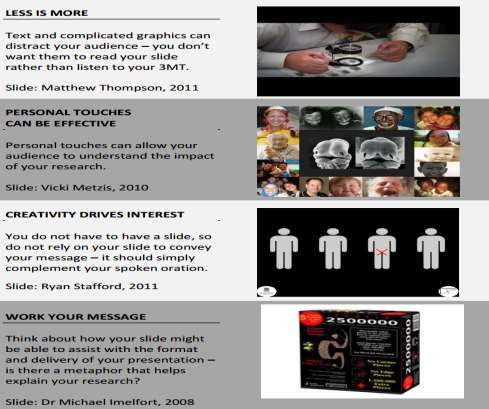
An engaging visual presentation can make or break any oration, so you want your slide to be legible, clear and
concise. You may like to consider some of the following suggestions.
Practicing your 3MT™ presentation
We hope you find the following tips useful as you prepare your 3MT™ oration.
1. Practice, practice, practice
Feeling nervous before you present is natural, and sometimes a little nervousness can even be beneficial
to your overall speech. Nonetheless, it is important to practice so you can present with confidence and
clarity.
2. Vocal range
Speak clearly and use variety in your voice (fast/slow, loud/soft).
• Do not rush - find your rhythm.
• Remember to pause at key points as it gives the audience time to think about what you are saying.
3. Body language
Stand straight and confidently.
Hold your head up and make eye contact.
Never turn your back to the audience.
Practice how you will use your hands and move around the stage. It is okay to move around
energetically if that is your personality, however it is also appropriate for a 3MT™ presentation to be
delivered from a single spot on stage.
Do not make the common mistakes of rolling back and forth on your heels, pacing for no reason or
playing with your hair as these habits are distracting for the audience.16
4. Record yourself
Record and listen to your presentation to hear where you pause, speak too quickly or get it just right. Then
work on your weaknesses and exploit your strengths.
5. Look to the stars!
Watch your role models such as academics, politicians and journalists, and break down their strengths
and weaknesses. Analyze how they engage with their audience.
Visit the 3MT™ website to view presentations by previous 3MT™ finalists.
6. Dress
Dress code is business casual, if you are unsure of how to dress you may like to dress for a job
interview or an important meeting. Jeans, t-shirts, or athletic shoes are not included as business casual
dress.
Do not wear a costume of any kind as this is against the rules (as are any props).
7. Practice using a microphone
While each School/Institute or Faculty competition may vary, at the UQ Final you will have the choice
of a lectern microphone or lapel microphone. If you haven’t used a microphone before, instruction will
be provided.17
Frequently Asked Questions
The University of Queensland developed the following FAQs to assist students wishing to participate in 3MT™.
IPFW has adapted the FAQ for our competition.
Can I present my oration via Skype?
IPFW will not allow remote presentation.
Can I present my oration as a poem, rap or song?
No. While we appreciate everyone has a different presentation style, the purpose of the activity is to
"engage the audience without reducing research to entertainment value alone”. 3MT™ is primarily
about developing a student’s oration skills. It is important that the competition is not seen as
trivializing research or science.
Can I use a laser pointer?
Yes. A laser pointer is not considered a prop. However, the emphasis is on the oration.
Does my slide have to be in PowerPoint?
No, however it is our preferred format as all slides will be collated into a single PowerPoint
presentation form competition.
How many transitions or animations can I have in my slide?
None. The slide must be static and not change in any way during the presentation. Your slide must be
displayed for the duration of your presentation.
Do I have to use a slide?
No. The slide is optional as the emphasis is on the oration.
What happens if my presentation is longer than 3 minutes?
In the IPFW 3MT™ Final, a 20 second warning will be provided to competitors (a colored board held up
by timekeeper) and a bell will sound at the three minute limit. If a presenter continues to speak after
the bell they will be automatically disqualified.
Is there a dress code?
Yes, please dress in business casual as there will be professionals from the region in attendance. Please
note that no costumes are allowed (including hats, masks, Dame Edna specs, etc).
Will I be able to see a countdown-timer at my final?
No, color cards will be used to show 1 minute, 30 seconds, and 15 seconds.
Can I win more than one category?
Yes, it is possible to win a place (First, Runner-Up, etc) and win the People’s Choice award.
Do I need to attend the entire competition?
Yes, supporting fellow students is important.18
2017 Contestants
Further information
3MT™ presentations will be recorded and published to YouTube. The YouTube video publication date will be
approved by the supervising professor.
If you have any queries about 3MT™ please contact your 3MT™ Event Coordinator, Dr. Carol Sternberger or
the Graduate Office by email graduate@ipfw.edu or phone 260-481-6145.
Master of Ceremony
Carol Sternberger (PhD Purdue University) is a Professor and Associate Vice Chancellor for Academic
Programs and the Director for Graduate Studies at IPFW. In 1990 she joined the nursing faculty and
became department chair in 1998. Her research interests include wearable and mobile technologies
to improve healthcare outcomes and instructional technologies for online and classroom teaching
environments. Sigma Theta Tau International, the Honor Society of Nursing, recognized her work in
technology innovation by awarding her two Pinnacle Awards and her two interactive CD-ROMs
received international attention.19
Judges
Vicky L. Carwein is Indiana University- Purdue University Fort Wayne’s (IPFW) ninth chancellor.
Carwein is actively engaged in the community serving on the boards of Parkview Health, Greater Fort
Wayne, Inc., OrthoWorx University/Industry Advisors, the Regional Opportunities Council, Fort
Wayne Philharmonic, and is a member of Quest Club. Nationally, she serves on the National Nuclear
Accrediting Board of the Institute of Nuclear Power of Operations. She received a bachelor’s and
Ph.D. in nursing from Indiana University and a master’s degree in nursing from the University of
California, San Francisco. In 2014, she was honored as one of the top 100 legacy alumni leaders by
the Indiana University School of Nursing. Carwein and her husband, Bill Andrews, a project
management and business development consultant in energy and environmental technology, have a
passion for travel. They have visited all seven continents. Carwein is also an accomplished pianist and
organist.
F. Nelson Peters was re-elected to a fourth term as 1st District Allen County Commissioner in
November 2016. Peters holds a Master's Degree in Public Administration and a Bachelor's Degree in
Public Affairs, both from Indiana University. Peters has served as a member of the Allen County Plan
Commission, the Allen County Community Corrections Board, the Maumee River Basin Commission,
the Convention and Visitor's Bureau, the Fort Wayne/Allen County Economic Development Alliance
Board, the Northeast Indiana Innovation Center and as President of the Allen County Emergency
Management Advisory Board. He and his wife Tammy have two children, Nelson and Chelsea and
reside in northeast Fort Wayne.
Brian Dumford is a Fort Wayne native and a graduate from both IPFW and Indiana Tech. He holds a
BA in Interpersonal & Public Communication from Purdue (IPFW) and an MBA with dual Human
Resources and Entrepreneurship concentrations from Indiana Institute of Technology. Brian has
worked in Human Resources for 20 years in various industries including local government,
aerospace, and wire manufacturing. His roles have included HR Director, Plant HR Manager, and
Personnel Manager. Currently, Brian works as the Talent Development & Training Manager for Fort
Wayne Metals.
Kevin Kilbane has worked in a variety of reporting and editing roles at The News-Sentinel since
joining the newspaper in 1986. He currently works as a reporter covering local schools,
neighborhood issues, and the environment.You can also read


