TREE-RING DATING OF COFFIN WOODS FROM NAEHEUNG-DONG IN GUNSAN, SOUTH KOREA - Brill
←
→
Page content transcription
If your browser does not render page correctly, please read the page content below
IAWA Journal, Vol. 30 (4), 2009: 459– 468

             TREE-RING DATING OF COFFIN WOODS FROM
             NAEHEUNG-DONG IN GUNSAN, SOUTH KOREA

                        Won-Kyu Park1* and Kwang-Hee Lee 2

                                         SUMMARY

       The purpose of this study was to date, using tree rings, wooden coffins
       which were excavated from graves located in Naeheung-dong, Gunsan
       city, in the western coastal area of South Korea. The species of wood
       used for the coffins was identified to belong to the diploxylon group of
       the genus Pinus, most likely Japanese red pine (Pinus densiflora Sieb.
       et Zucc.), one of the major conifers growing in Korea. From thirteen
       graves, six were successfully dated by a master chronology of Japanese
       red pine for Korea. Due to the absence of bark rings or the cambial
       surface (waney edge), the number of sapwood rings had to be estimated
       to obtain the likely cutting dates. The cutting dates of six coffins were
       estimated to be from A.D. 1643 ± 10 to 1660 ± 10. These tree-ring dates
       were at least 100 years younger than expected for this type of graves
       by archeologists.
       Key words: Dendrochronology, Pinus densiflora, coffin, growth ring,
       absolute date.

                                     INTRODUCTION

Annual rings of many tree species can be used to date old buildings and archeological
sites by means of the dendrochronological method (Stokes & Smiley 1968; Baillie
1982). Some species growing in Korean forests have been reported to be several cen-
turies old and thus provide a unique opportunity to develop long tree-ring chronologies
for dating woods in this region (Park et al. 2001). Among them, the wood of Pinus
densiflora Sieb. et Zucc. (Japanese red pine) was the most favored material used in
historical buildings and wooden artifacts in Korea (Park & Lee 2007). As of 2006, the
Japanese red pine chronologies for Korea extend to A.D. 1250 and have been used for
dating mainly historic buildings and furniture (Park et al. 2007a, b).
   Coffins recently excavated from various archeological sites were made of wood
identified as Japanese red pine. A few cases of dendrochronological dating of wooden
coffins (17th–18th centuries) have been reported (Park et al. 2006a, b). Most coffins
were obtained from graves which used a plaster cover (usually thicker than 20 cm) to
protect the wooden coffins from robbery and damage by animals and tree roots. The

1) Division of Wood and Paper Science, School of Forest Resources, Chungbuk National University,
   Cheongju 361-763, South Korea.
2) Department of Forest Products, Graduate School, Chungbuk National University, Cheongju 361-
   763, South Korea.
*) Corresponding author [E-mail: treering@cbnu.ac.kr].

                                                                     Downloaded from Brill.com10/09/2021 10:54:25AM
                                                                                                      via free access
460 IAWA Journal, Vol. 30 (4), 2009
plaster-cover type of grave is known to have become popular in the 17th century, i.e.,
the middle of the Joseon Dynasty (A.D. 1392–1910) of Korea (Park 2005). Before this
time, no plaster cover was used. Here, the first results of tree-ring dating of coffins
without a plaster cover, excavated in a coastal area in western Korea, are presented.
MATERIALS AND METHODS
During the period of excavation of the Naeheung-dong site at the Gunsan city in the
western coastal area of South Korea, the remains of 127 graves were found by the Chung-
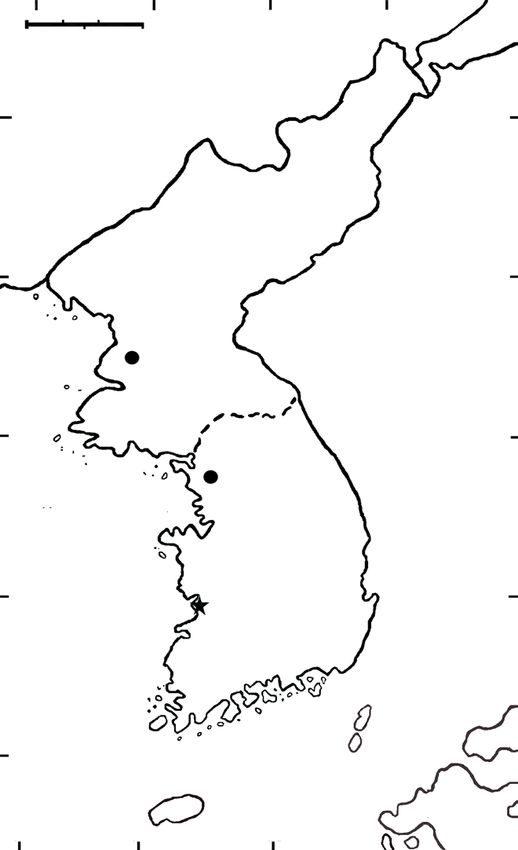
cheong Cultural Properties Research Institute, Gongju, South Korea (Fig. 1, 2). From
124° 126° 128° 130°
13 graves 83 pieces of wood pan-
0 50 100 km els, which had been used to make
Russia
coffins, were collected for dating.
0 50 100 mi
Each grave possessed two coffins
because double coffins (an inner and
42° China 42°
outer coffin) were used as shown in
Figures 3 and 4. After digging the
grave, the outer coffin is first in-
North Korea
serted into the hole and the inner
40° 40°
East Sea coffin, which held the corpse, was
Pyongyang placed in the outer coffin. Then the
lid of the outer coffin was closed and
the burial mound formed above the
38° 38°
Yellow Sea
Seoul
coffins (Fig. 4).
Some portions of the sapwood of
South Korea
the coffin woods were decayed and
no complete set of sapwood rings
36° Gunsan
36°
were found (no bark or cambial face
to indicate the terminal growth ring).
Wood slabs (about 2 cm thick) were
34° 34°
cut with a chain saw and air dried
Japan (Fig. 5). After sanding their sur-
124° 126° 128° 130°
faces, tree-ring widths were meas-
Figure 1. Location of the study site. ured to the nearest 0.01 mm by using
a LINTAB measuring system (Rinn
1996). The boundary between heartwood and sapwood was marked when the color
was distinguishable.
Ring-width plots of individual samples were produced with the TSAP program
(Rinn 1996). These plots were used for visual comparison on a light table to cross-
date by synchronizing the ring-width patterns (Fig. 6). The dating quality was evalu-
ated by statistical methods, student’s t and G values. The t value (a measure of cor-
relation between the ring-width plot of the sample and of the master chronology) is
calculated after detrending the tree-ring series by a 5-year moving average (Baillie &
Pilcher 1973), according to the equation t = r√(n-2)/√(1-r 2) (r = correlation coefficient,
Downloaded from Brill.com10/09/2021 10:54:25AM
via free accessPark & Lee — Dating of historical Korean coffins 461
Figure 2. Excavation site in Naeheung-dong, Gunsan city (Chungcheong Cultural Properties Re-
search Institute 2006).
Figure 3. Double-layered coffin excavated at the Naecheung-dong site (Chungcheong Cultural
Properties Research Institute 2006). The “4” sign indicates the northern direction.
Downloaded from Brill.com10/09/2021 10:54:25AM
via free access462 IAWA Journal, Vol. 30 (4), 2009
Figure 4. Diagram of a double-layered coffin grave (the diamond in the inner coffin represents
the corpse).
false annual ring
Figure 5. A disk sample of coffin wood and its ring structure after being polished.
1000
Ring widths (x100 mm)
100
10
0
0 10 20 30 40 50 60 70 80 90 100
Number of rings
Figure 6. Tree-ring width series from a number of coffin wood panels.
Downloaded from Brill.com10/09/2021 10:54:25AM
via free accessPark & Lee — Dating of historical Korean coffins 463
n = number of years). The G value (‘Gleichläufigkeit’ [in German] or percentage of sign
agreement) was obtained after Eckstein and Bauch (1969). The final dating decision
was performed by graphic comparison between the ring-width plots derived from the
wooden coffins and those of the master chronologies for South Korea.
RESULTS AND DISCUSSION
All woods from all sampled coffins were identified first as hard pines (diploxylon) as
they possessed an abrupt earlywood/latewood transition, vertical and horizontal resin
ducts, window-like pits and dentate thickenings in the ray tracheids (Fig. 7). In Korea,
there are two main hard pines, Pinus densiflora Sieb. et Zucc. (Japanese red pine) and
Pinus thunbergii Parl. (Japanese black pine). It is difficult to separate the woods of
both species (Lee 1997). However, the wood from the coffins is likely P. densiflora
because P. thunbergii was probably not a useful species due to its thin and crooked
stems, though the wood quality of both tree species is similar. Furthermore, the fact
that the coffin woods of the present study were successfully cross-dated with the mas-
ter chronologies of P. densiflora, as described in the following text, suggests a high
likelihood for P. densiflora. The wood of P. densiflora is also frequently mentioned in
historical documents of Korea (Shin 1990) as best material for coffins.
Figure 7. Micrographs of coffin woods (Pinus densiflora).
Downloaded from Brill.com10/09/2021 10:54:25AM
via free access464 IAWA Journal, Vol. 30 (4), 2009
Coffin Key code Innermost ring Outermost ring
No.
Figure 8. Relative placement of the ring patterns of six coffins (black dots represent pith, the num-
ber in parentheses represent heartwood and sapwood rings, gray coloured and hatched bars,
respectively).
Downloaded from Brill.com10/09/2021 10:54:25AM
via free accessPark & Lee — Dating of historical Korean coffins 465
Pinus densiflora occurs naturally in Korea and Japan, but rarely in northeastern China,
covering a wide ecological spectrum (Vidakovic 1991). This species occupies nearly
40% of the forests of Korea, which in turn cover about 65% of the total land area (Lee
1986). Pinus thunbergii occurs in Japan as well as in southern Korea. It grows mainly
in coastal regions (Vidakovic 1991). The limited growing regions and rather short life
span of P. thunbergii prevent the development of long tree-ring chronologies.
A 156-year long site (composite) chronology was made from six graves by averaging
the data of 31 samples. This site chronology cross-dated well with the master chronol-
ogy of P. densiflora for South Korea; it covers the period from A.D. 1492–1647, i.e.,
the latest ring dated to A.D. 1647; the t and G values were 4.9 and 65%, respectively.
Other samples from seven graves could not be dated because they possessed too few
tree rings (mostly less than 60).
The tree-ring dates of the coffin samples from each grave are given in Figure 8. All
samples lacked the complete sapwood. The separation of heartwood and sapwood in the
samples was difficult due to the faded heartwood color of the waterlogged wood. Only
nine among 31 dated samples had a distinct heartwood-sapwood boundary. Fortunately,
at least one sample per each of six graves dated had sapwood rings, which could be
used to determine the approximate cutting dates. The critical step for determining the
cutting date was to estimate the sapwood portion which was lost during the milling
process of the board. The number of sapwood rings in Japanese red pine in South Korea
is age-dependent (Fig. 9; Park et al. 2007b). It increases with increasing tree age until
Number of sapwood rings
100
80
60
40
20
0 50 100 150 200 250 300
Tree age (years)
Figure 9. Number of sapwood rings of Pinus densiflora in South Korea versus tree age.
the age of about 170 years and then becomes constant (75 sapwood rings). The standard
deviation was about 10 years regardless of tree age. Because of the age-dependency of
the number of sapwood rings, the presence of pith is crucial for the estimating process.
Nine samples with a distinct heartwood/sapwood boundary were used to estimate the
cutting dates (Fig. 10).
An example for grave #12 is described here to explain how to estimate sapwood
rings. One sample (NHCF002) from that grave, whose rings dated to A.D. 1492–1590,
included 99 rings. Since this sample had 80 heartwood rings, the tree age from which
the board was cut has been estimated from the age-vs.-sapwood curve (Fig. 9) to be
Downloaded from Brill.com10/09/2021 10:54:25AM
via free access466 IAWA Journal, Vol. 30 (4), 2009
Innermost ring Last year Estimated felling year
Figure 10. Cutting years estimated from sapwood rings (numbers on the left, center and right
bars represent the heartwood rings, sapwood rings remained, and sapwood rings likely lost,
respectively.
150 years. Consequently, the total number of sapwood rings should have been 70, with
51 sapwood rings having been lost during the production of the coffin. Finally, the
estimated cutting year of the NHCF002 sample was determined to be A.D. 1641 ± 10.
The cutting years of two other samples (NHCF031 and NHCF034) of the #12 grave
were estimated as 1642 ± 10 and 1647 ± 10, respectively. The statistical mean of the cut-
ting years derived for these three samples was 1643.3. We used the mean value, 1643,
instead of individual center years (1641, 1642, 1647) because the woods of a grave
were prepared most likely from logs cut in the same year. The mean sapwood bound-
ary has been adopted from Baillie (1995) although the fact that sapwood estimates are
mostly skewed distributions complicates the issue somewhat. Finally, the cutting year
of the wood in the #12 grave was estimated as 1643 ± 10.
The cutting years of another five coffins (#13, #15, #42, #51 and #52) were deter-
mined to be 1644, 1653, 1660, 1658 and 1664, respectively, with ±10 years of error.
These results indicated that the coffins were made during the 1630s–1670s if we as-
sume that the drying and storage periods of the lumber for the coffins were short; these
periods are in fact unknown. When some coffins with known burial dates will become
dendrochronologically dated in the future, these periods can be clarified by measuring
the lag between cutting and burial dates.
Downloaded from Brill.com10/09/2021 10:54:25AM
via free accessPark & Lee — Dating of historical Korean coffins 467
It has been known that the graves containing double coffins but without a plaster
cover were used until the early Joseon Dynasty (the early 16th century) (Park 2005;
Kim 2008); only after this time, coffins were given a cover of plaster (Park 2005).
However, the tree-ring dates of the coffins without a cover of plaster examined in the
present study were at least 100 years younger than the age expected for this type of
graves by the archeologists.
The characteristics of bone remains suggested that the deceased persons belonged to
the laboring class (Chungcheong Cultural Properties Research Institute 2006). Lime,
the raw material of plaster, might not have been available to lower-class people due to
its cost (Park 2005). We think that the lower-class people still had to use plain graves,
i.e., without plaster either for economic reasons or social regulation.
ACKNOWLEDGEMENTS
This work was supported in part by the Korea Research Foundation Grant funded by the Korea
Government (MOEHRD, Basic Research Promotion Fund) (KRF-2007-313-F00043). We thank Mr.
Ki-Jeong Ryu and Ms. Hyeong-Soon Park (Chungcheong Cultural Properties Research Institute) for
providing coffin samples and site photos, and Dr. Frank W. Telewski, Michigan State University, USA
for reading the manuscript and improving the English.
REFERENCES
Baillie, M.G.L. 1982. Tree-ring dating and archaeology. The University of Chicago Press,
Chicago.
Baillie, M.G.L. 1995. A slice through time. B.T. Batsford Ltd., London.
Baillie, M.G.L. & J.R. Pilcher. 1973. A simple cross-dating program for tree-ring research.
Tree-Ring Bull. 33: 7–14.
Chungcheong Cultural Properties Research Institute (ed.). 2006. Report on the excavation of the
Naeheung-dong site, Gunsan. Gongju, South Korea.
Eckstein, D. & J. Bauch. 1969. Beitrag zur Rationalisierung eines dendrochronologischen Ver-
fahrens und zur Analyse seiner Aussagesicherheit. Forstwiss. Centralbl. 88: 230–250.
Kim, W.L. 2008. Research on the tomb culture of the gentry in Seoul and the Gyeonggi Province
during the Joseon Dynasty. PhD dissertation, Korea University. 261 pp.
Lee, P.W. 1997. Properties and utilization of Korean woods (I). Seoul National University Press,
Seoul.
Lee, Y.N. 1986. Korean coniferae. Ewha Womans University Press, Seoul.
Park, H.S. 2005. The tomb styles of the Joseon Dynasty. Geumgang Archaeology 2: 119–151.
Park, W.K., J.K. Choi & Y. Kim. 2006a. Analysis of species and tree-ring dating of coffin woods
excavated at Hopyungri, Namyangju, Korea. J. Conservation Science 18: 105–110.
Park, W.K., Y. Kim & S. Kim. 2007b. Scientific dating and origin analysis of Korean Chests with
a flap door based on dendrochronology. Korean J. Fork Studies 21: 63–93.
Park, W.K., Y. Kim, J.H. Lee & J.W. Seo. 2001. Development of tree-ring chronologies of Pinus
densiflora from Mt. Sorak and dating the year of construction of the Kyunghoe-ru pavilion
in Seoul. J. Korean Physical Society 39: 790–795.
Park, W.K., Y. Kim, J.W. Seo, J.H. Lee & T. Wazny. 2007a. Tree-ring dating of Sinmumun, the
north gate of Kyungbok Palace in Seoul. Tree-Ring Research 63: 105–109.
Park, W.K. & K.H. Lee. 2007. Changes in the species of woods used for Korean ancient and
historic architectures. J. Architectural History 50: 9–28.
Downloaded from Brill.com10/09/2021 10:54:25AM
via free access468 IAWA Journal, Vol. 30 (4), 2009
Park, W.K., D.H. Yoon & S.H. Park. 2006b. Species identification and tree ring dating of coffin
woods excavated at Majeon relic in Jeonju, Korea. J. Wood Science & Technology 34(6):
12–20.
Rinn, F. 1996. TSAP version 2.4-Reference Manual. Frank Rinn Co., Heidelberg.
Shin, E.C. 1990. Sangyeyoram (The funeral rites). Bokyungmunwhasa, Seoul.
Stokes, M.A. & T.L. Smiley. 1968. An introduction to tree-ring dating. The University of Chi-
cago Press, Chicago.
Vidakovic, M. 1991. Conifers-morphology and variation. Graficki zavod Hrvatske, Zagreb.
Downloaded from Brill.com10/09/2021 10:54:25AM
via free accessYou can also read


