TRIENNIAL REVIEW OF INITIAL CASE REVIEWS AND SIGNIFICANT CASE REVIEWS (2018-2021): Impact on practice
←
→
Page content transcription
If your browser does not render page correctly, please read the page content below
TRIENNIAL REVIEW OF INITIAL CASE REVIEWS
AND SIGNIFICANT CASE REVIEWS (2018-2021):
Impact on practice

     Triennial review of initial case reviews and significant case reviews (2018-2021): Impact on practice 1
CONTENTS
       Foreword											 3

       Executive summary of key findings 							                                                      4

       Acknowledgements									 6

       Purpose of the report			 						 7

       Methodology										 8

       Structure of the report 									 9

       Part 1: Overview of notifications, themes and decision-making processes                      10

       Part 2: Recommendations and impact on practice					                                          16

       Part 3: Impact of the Covid-19 pandemic						                                                30

       Part 4: Conclusions										33

       References											36

       Appendix 1: Notifications and child and family characteristics			                            37

       Appendix 2: Survey results								41

       Appendix 3: Factors that support learning and changes in practice			                         47

       Appendix 4: Examples of practice change						                                                48

2 Triennial review of initial case reviews and significant case reviews (2018-2021): Impact on practice
FOREWORD
‘In the context of child protection, a Significant Case Review (SCR) is a multi-agency
process for establishing the facts of, and learning lessons from, a situation where a
child has died or been significantly harmed. SCRs should be seen in the context of a
culture of continuous improvement and should focus on learning and reflection on
day-to-day practices, and the systems within which those practices operate.
An Initial Case Review (ICR) precedes a SCR and is the process through which
child protection committees consider relevant information, determine the course
of action and recommend whether a SCR or other response is required’. National
Guidance for Child Protection Committees Conducting a Significant Case review
(2015)

This report follows on from our two previous triennial reviews. In common with the
findings from those and key messages from serious case review research and reports in
England, the themes in this report will already be familiar to child protection and public
protection committees. Understandably, committees feel frustrated that the themes are
recurring. This has led to questions about the value of reviews and their contribution to
learning and developing child protection practice. It is important however to continue
to highlight the patterns of harm and create opportunities to share learning. This will
help ensure that findings are able to influence wider policy and practice change where
necessary, and not just in the area where harm occurred.

This is our final triennial SCR overview report. With the introduction of the new National
Guidance for Child Protection Committees: Undertaking Learning Reviews (due to be
published in 2021), all ICRs and SCRs will be replaced by Learning Reviews. From 2022,
these will be the focus of our overview reports.

This report also seeks to provide some insight into what supports changes in practice and
what the challenges are when review recommendations have been the catalyst for the
change.

We hope that this and future reports, along with the introduction of more routine updates
through Child Protection Committees Scotland (CPCScotland)1 , the Learning Review
knowledge hub and the Learning Review Liaison Group2 will be used to encourage further
discussion and create more opportunities to disseminate and implement changes from
learning.

1
  CPCSotland is a non-statutory group who work together to develop and drive forward national policies and best practice with
the aim of protecting children and young people.
2
  The Learning Review Liaison Group (comprising Scottish Government, CPCScotland and Care Inspectorate) routinely meets to
discuss thematic findings from learning reviews that have national implications for policy and practice development.

         Triennial review of initial case reviews and significant case reviews (2018-2021): Impact on practice 3
EXECUTIVE SUMMARY OF KEY FINDINGS
The process for undertaking significant case reviews (SCRs), the multi-agency
process for learning lessons from a situation where a child has died or been
significantly harmed, is changing with the introduction of the new Learning
Review Guidance (2021). This is the time to pause and reflect on how the learning
from Initial Case Reviews (ICRs) and SCRs has been implemented and the impact it
has had on practice and policy.
This report presents the findings from review reports submitted to the Care Inspectorate
between 1 April 2018 and 31 March 2021. It includes the key findings from our analysis
of 50 ICRs that did not proceed to a full SCR, 23 SCRs and two thematic learning reviews.
The reviews considered the circumstances of 96 children and young people. Sixty-four
children and young people were the focus of ICRs and 32 were the focus of SCRs.
The report also includes the views and experiences from Child Protection Committee
(CPC) members across Scotland. Surveys were sent to the 28 committees who had
been actively involved with ICRs and SCRs during the timeframe of this report. All CPCs
were invited to participate in the regional focus groups.
Almost 40% of reviews followed the death of a child or young person (28 of 75 reviews).
The most common cause of death was suicide (eight young people), closely followed
by drug-related deaths (seven young people).
Neglect was the main feature in non-fatal reviews, affecting 35 children. While the
majority of children subject to reviews where neglect featured were under 11 years, a
third of the children were aged 12-17 years. Neglect is an issue that can affect children
of all ages.
Information sharing, the role of the person acting as the professional point of contact
in universal services or ‘named person’ and lead professional, quality of assessment and
analysis of risk remain areas identified in review reports for learning and development.
These are familiar themes that have been highlighted in our previous SCR overview
reports and inspections. These areas continue to be addressed through local CPC
improvement plans.
Decision making is inconsistent across Scotland about when and why SCRs are carried
out. We anticipate that the clarity of the new Learning Review Guidance (2021) will
support greater consistency. It provides revised criteria for carrying out learning reviews
and places an emphasis on the additional learning that will be gained from a review.
4 Triennial review of initial case reviews and significant case reviews (2018-2021): Impact on practiceCPCs provided insight into the factors that have an impact on implementing change as
a result of ICR and SCR findings.
The following points provide a summary:
• ICR and SCR recommendations and findings can be catalysts for changes in
practice and organisational culture. CPCs provided helpful examples which are in
Appendix 4.
• Recommendations directed at senior managers and CPCs create opportunities
to influence, lead and implement change. Those which required a multi-agency
solution make the biggest difference to practice.
• Recommendations related to training, closely followed by those relating to
policies, procedures and protocols are considered by CPCs to have the biggest
impact on practice. From a CPC perspective, reports with fewer and more specific
recommendations make the biggest difference to achieving improvement.
• Further development of impact measures would provide an evidence base of the
influence that review findings and recommendations have on practice and on
improving outcomes for children and young people.
• Improvement actions from case reviews that are owned by chief officers and
relevant strategic groups, children’s services and adult services are more likely to
achieve and sustain changes in practice and organisational culture.
• Assorted approaches to disseminating learning from reviews enables learning to be
shared timeously and targeted appropriately at different staff groups across children
and adult services. Effective, ongoing engagement with practitioners, managers and
leaders is key in disseminating learning.
• ICRs and SCRs have played an important role in the development of learning
cultures. Learning reviews will continue to be a significant tool for identifying
learning and contributing to systems development and practice improvements.
• Across the child protection landscape there is a range of work being undertaken to
strengthen and improve child protection practice. This includes the publication of
new guidance, establishment of the learning review liaison group and the learning
review knowledge hub. We anticipate that they will provide opportunities to better
support local and national learning.
Triennial review of initial case reviews and significant case reviews (2018-2021): Impact on practice 5ACKNOWLEDGEMENTS
This report has been developed in collaboration with the Protecting Children
Team from Centre for Excellence for Children’s Care and Protection (CELCIS). The
team was created in 2016 to support the delivery of the national Child Protection
Improvement Programme and provide secretariat support to CPCScotland on
continuous improvement.
We would like to thank the child protection and public protection committees across
Scotland for their contributions to the report. They provided invaluable insights into
their experiences of commissioning and conducting ICRs and SCRs, as well as an
overview of the impact on practice in response to recommendations and findings,
which acted as catalysts for change.
We recognise the complex and difficult circumstances that child protection and public
protection committees have been working through during the Covid-19 pandemic and
we are grateful for their support in the production of this report. We have included a
section on the challenges and opportunities identified in relation to undertaking and
completing ICRs and SCRs during the pandemic.
6 Triennial review of initial case reviews and significant case reviews (2018-2021): Impact on practicePURPOSE OF THE REPORT
As part of a commitment to further improvement, the Care Inspectorate
is required to report publicly on thematic findings from SCRs to provide
independent public assurance on the quality of care for children and young
people, share any learning worthy of dissemination nationally, and support
improvements to child protection practices and policy across Scotland. At a
meeting of the National Child Protection Leadership Group in April 2019, it
was acknowledged that there is inconclusive evidence that case reviews lead
to the improvement of children’s outcomes. The group agreed that further
consideration should be given to how continuous improvement can be
supported.
In previous Care Inspectorate national overview reports the focus has been on the
themes emerging from findings as well as feedback on the consistency and quality
of the review process. From our analysis of ICR and SCR reports that we received,
we were not able to extract material that helped us to understand the impact of the
recommendations on practice.
The process for undertaking and learning from reviews is changing as we move forward
with the new Learning Review Guidance (2021). This is the time to pause and reflect on
how the learning from ICRs and SCRs has been implemented and the impact it has had
on practice and policy. To date, there has been no national overview of the impact of
recommendations and findings from ICRs and SCRs.
The purpose of this report is to:
• provide commentary that can help inform practitioners and agencies in their work to
keep children and young people safe from harm
• provide a national overview of the impact on practice and policy
• highlight the processes that support and challenge change
• consider the implications for practitioners, leaders and policy makers locally
and nationally.
This report builds on the key messages from the Care Inspectorate’s previous triennial
report Learning from Significant Case Reviews (March 2015 to April 2018).
Throughout, we use the term Child Protection Committees (CPCs) for simplicity.
However, we acknowledge that in Scotland some areas have arrangements for a single
public protection committee with a wider remit.
Triennial review of initial case reviews and significant case reviews (2018-2021): Impact on practice 7METHODOLOGY
The Care Inspectorate has been the central collation point for SCRs carried out
by CPCs in Scotland since April 2012 and in June 2017 the role was extended to
include ICRs.
The method we adopted for collating data to inform this report was different from the
approach used in previous triennial reports. In addition to the analysis of the ICRs and
SCRs that the Care Inspectorate received, we invited CPCs to contribute to the report by
sharing their experiences of the ICR and SCR processes. Invitations to contribute were
extended to all 30 child protection and public protection committees across Scotland.
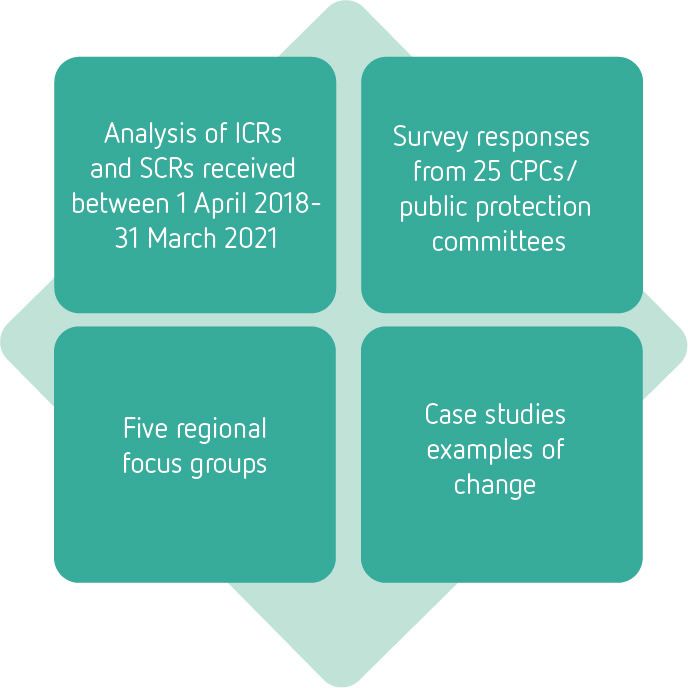
Our approach involved:
• a desk-top review and analysis of the recommendations and themes emerging from
ICRs and SCRs received by the Care Inspectorate between 1 April 2018 and 31
March 2021
• an analysis of survey responses from 25 CPCs which focused on review
recommendations and findings, and the impact on practice
• five focus groups involving 28 CPCs to follow up points emerging from the survey
• an invitation to CPCs to provide case examples to illustrate the impact of ICR and
SCR recommendations and findings on practice.
The surveys were sent to the 28 committees who had been actively involved with ICRs
and SCRs during the timeframe of this report.
8 Triennial review of initial case reviews and significant case reviews (2018-2021): Impact on practiceSTRUCTURE OF THE REPORT
Throughout the report we refer to ‘reviews and reports’. These terms relate
to both the ICRs which did not proceed to a SCR as well as the completed SCR
reports which CPCs sent to us. Where relevant, we comment on whether the
findings are from the ICR or SCR.
Part 1: Overview of notifications, themes and decision-making
processes
This provides an overview of the numbers of cases included in this report and the key
learning points. We also include observations about the rationale for cases that that did
not proceed to a SCR and how learning was disseminated. We draw from our analysis
of the reports received.
Part 2: Recommendations and impact on practice
This section explores the impact ICRs and SCRs had on practice and policy. We
highlight the number, type and quality of findings and recommendations, as well as
what supported and challenged the implementation of recommendations and the
impact on practice. We draw on the learning from ICRs and SCRs and the feedback
from the survey and the focus groups. The survey question set mirrors those used in a
recent study Complexity and Challenge: A triennial analysis of SCRs (2014-2017)
which was published in 2020 and provides helpful comparisons.
Part 3: Impact of the Covid-19 pandemic
This presents information about the impact that the pandemic has had on undertaking
and completing ICRs and SCRs. We summarise feedback through the survey and the
focus groups on what CPCs identified as opportunities and challenges.
Part 4: Conclusions
This section considers the implications for policy and practice and future opportunities.
Triennial review of initial case reviews and significant case reviews (2018-2021): Impact on practice 9PART 1: OVERVIEW OF NOTIFICATIONS, THEMES
AND DECISION-MAKING PROCESSES
Numbers of notifications
Between the 1 April 2018 and the 31 March 2021, the Care Inspectorate received 82
notifications that ICRs had been undertaken, of which 32 were proceeding to a SCR.
Since 2015, the number of ICRs proceeding to SCR has averaged 11 each year. This
means that approximately two thirds of the ICRs do not progress to a SCR.
While there was an increase in the number of notifications in 2018 and 2019, the
proportion proceeding to SCR has remained constant. This reflects the pattern that was
noted in the last triennial report and is consistent with the numbers over a six-year period.
Numbers of ICRs and SCRs
This report includes the key findings from our analysis of 50 ICRs that did not proceed to
a full SCR, 23 SCRs and two thematic learning reviews. The reviews involved 96 children
and young people — 64 children and young people were the focus of ICRs and 32 were
the focus of SCRs.
Between 1 April 2018 and 31 March 2021, 28 CPCs were actively involved in undertaking
ICRs and SCRs or submitting SCRs. A total of 11 SCRs we received and considered for this
report were started before 2018.
Review themes
As in our previous overview reports, there was a number of familiar themes that remain
areas for learning and development across a range of adult and children’s strategic
partnerships and services. We have drawn out some of the key points below.
While Getting it Right for Every Child (GIRFEC) principles have been embedded across
partnerships, there continues to be some confusion about the roles of the named person
service (or person acting as the professional point of contact in universal services) and the
lead professional which is undermining practitioners’ confidence. This is continuing to
result in a lack of a coordinated approach to meeting children and young people’s needs
in some instances.
Appropriate, consistent information-sharing and effective inter-professional
communication remains a challenge and featured in nine SCRs. There were examples in
SCRs that despite local protocols and guidance being in place, professional cultures were
10 Triennial review of initial case reviews and significant case reviews (2018-2021): Impact on practicecontinuing to impact on information-sharing behaviour and attitudes within and across
organisations. One of the impacts of this can be different thresholds for intervention or
a delay in initiating action. For example, inconsistency in recording information from
professional discussions such as Team Around the Child meetings could lead to a lack of
clarity about what had been agreed, planned and progressed.
Neglect continues to be a prominent and contributory feature in a quarter of the ICRs and
SCRs submitted which considered a total of 35 children and young people. As highlighted
in our previous reports, review findings identified missed opportunities to intervene or
to recognise signs or patterns early enough, leaving children unnoticed in neglectful
or harmful situations until a threshold for child protection was reached. Reviews also
identified that social and environmental factors could have implications on how and
when professionals made decisions about when to intervene to protect the child from
further harm.
Good mental health and wellbeing and access to trauma-informed treatment and
prevention services are important for all children and young people. However, our
reviews of ICRs and SCRs identified that the mental health and wellbeing of older children
and young people whose circumstances were subject to review is not addressed
appropriately. For example, young people repeatedly present at emergency departments
with self-harming or possible suicidal behaviour and with no follow-up referral to the
Child and Adolescent Mental Health Service (CAMHS), or to social work prior to discharge.
Themes in relation to assessment and decision making were identified in a number of
the SCRs that we reviewed. These included the quality of assessments, lack of adequate
analysis of the impact of cumulative adverse events on the risk of harm, and the use and
effectiveness of tools and frameworks in the assessment process. These were similar to
the themes and findings we have described in our previous reports.
There were particular examples concerning a lack of coordinated approaches to pre-
and post-birth planning and assessment of babies, and lack of clear communications
and processes for discharge of new-born infants, which were not integrated into child
protection processes. In one example, a vulnerable expectant mother was referred to
midwifery by the professional who identified the pregnancy. However, information
contained in the mother’s record was not shared with midwifery as the professional had
no direct knowledge of the mother’s circumstances. This resulted in a delay in identifying
and assessing the needs of the mother and unborn baby until just before birth. This
adversely impacted upon the child’s plan.
Triennial review of initial case reviews and significant case reviews (2018-2021): Impact on practice 11Other recurring examples related to the lack of a holistic assessment when considering
risks across family groups. The focus tended to be on the behaviours of the adult where
there was parental substance use, domestic abuse, parental mental health concerns or
where there was criminality. There were examples of no joint assessment of the impact
on the child or children in the household being carried out.
Types of significant harm or nature of death
We categorised significant harm or death using the language that was used in the review
reports. Where there was more than one type of harm, we used the primary cause of
harm that initiated the review process. (Please see Appendix 1)
Of the 96 children and young people subject to review processes over the three-year
period, 28 had died. The most common categories of death were suicide (eight young
people) and drug-related incidents (seven young people). We identified variability in the
decision-making about the types of reviews for children and young people who died.
For example, the deaths of four children were attributed to sudden unexpected death
in infancy (SUDI). Only one of these children was subject of a SCR, and the three other
children were subject to a SUDI review instead. Some of the older young people who
died were subject of an ICR only, while others proceeded to a SCR.
One CPC appropriately decided not to progress to a SCR because the young person was
the subject of a death of a looked after child review, a drug related death review in line
with national and local guidance and a police independent review commissioner report.
The new Learning Review guidance (2021) and the National Hub for Reviewing and
Learning from the Deaths of Children and Young People - National Guidance (2021)
promote collaboration between agencies and organisations to reach a decision about the
most suitable review process.
The establishment of the National Hub for reviewing and learning from the deaths of
children and young people will ensure that the death of every child in Scotland will be
subject to a quality review. The National Hub has been tasked with ensuring reviews are
conducted on all deaths of live-born children up to the date of their 18th birthday, or 26th
birthday for care leavers who are in receipt of aftercare or continuing care at the time of
their death. Local governance arrangements will be in place which will determine the
type of review required to be carried out. Learning reviews coordinated through CPCs
will be one of the review mechanisms considered when the learning review criteria have
been met.
As in our previous reports, neglect recurs as the main non-fatal category of significant
harm. Neglect was prevalent in 18 of the reviews and related to 35 children. Five of the
reviews related to family groups. There were 11 ICRs which did not proceed to a SCR
12 Triennial review of initial case reviews and significant case reviews (2018-2021): Impact on practicewhere neglect was identified. While most of the children experiencing neglect were
under 11 years, a third of the children were between 12-17 years of age.
Adolescents
Typically, in our previous overview reports of SCRs the majority of children whose
circumstances led to a review were pre-school age. We found a similar pattern within
this three-year period. In our previous reports, we did not include a full analysis of the
ICRs that did not proceed to a SCR, therefore we are unable to make direct comparisons
with regards to the numbers and age ranges. However, when we reviewed the age range
of the young people who were subject of an ICR that did not proceed to a SCR for this
report, we found that more than a third were aged 12 years and older. We found that
CPCs were less likely to proceed to a SCR for this age group of young people. Later in
the report there is a section that explores the decisions that CPCs made and reasons for
not proceeding to a SCR. Within the total number of ICRs and SCRs, 30 involved young
people aged 12 years and over. In total, 15 of the reviews related to death of a young
person and 15 were related to non-fatal significant harm.
The table below highlights the themes that emerged in relation to adolescents, for
example chronic neglect, mental health, self-harm and suicide, risk of sexual exploitation
and drug-related deaths.
Category of harm: Number of young people aged 12-18 years
Type of harm (non-fatal) ICR only SCR Total
Neglect 9 1 10
Murder/assault on others/risk of harm to others 4 0 4
Sexual abuse/(risk of) CSE 3 0 3
Type of harm (fatal)
Suicide 5 3 8
Drugs related 7 0 7
Accidental 0 1 1
Our recent joint inspections of children in need of care and protection highlighted
that most children and young people were being kept safe as a result of coordinated
responses to risk of significant harm. However, there remains room for improvement,
particularly in addressing the impact of cumulative harm, including domestic abuse, child
sexual exploitation or neglect, and the identification of risk to older young people.
Triennial review of initial case reviews and significant case reviews (2018-2021): Impact on practice 13ICRs that did not proceed to SCRs
“An Initial Case Review is an opportunity for the child protection
committee to consider relevant information, determine the
course of action and recommend whether a Significant Case
review or other response is required”
National Guidance for Child Protection Committees
Conducting a Significant Case review (2015)
The report of the Systems Review Group, Protecting Scotland’s children and young
people: it is still everyone’s job (2017), commented that there were limited learning
opportunities arising from ICRs at a national level. The report considered this to be a
missed opportunity and that learning from ICRs and SCRs should not be considered
in isolation. As a result, since June 2017 CPCs have routinely submitted their ICRs to
the Care Inspectorate. This has provided insight into CPC decision-making processes
when considering whether to progress to a SCR. It has also enabled us to build a picture
nationally about how CPCs are disseminating learning from ICRs that do not proceed to
a SCR at a local level.
CPCs referenced the criteria from the National Guidance for Child Protection
Committees for Conducting a Significant Case Review (2015) when making the
decision on whether or not to proceed to a SCR. The level of detail about the rationale
for the decision was variable across Scotland. However, we have been able to identify
four general overlapping themes.
Rationale for not proceeding to a SCR
Other review ICR findings
The situation The ICR processes and more similar to learning
did not meet the process was immediate learning from previous SCRs
criteria for a SCR comprehensive opportunities were and improvement
in place plans were already
in place
14 Triennial review of initial case reviews and significant case reviews (2018-2021): Impact on practiceJust over half of the ICRs that did not proceed to a SCR were on the grounds that the
circumstances did not meet the criteria. Although the criteria were met in the other ICRs,
other factors contributed to the decision not to proceed to a SCR. It was not always clear
how a decision was reached, particularly when there was disagreement or when many of
the criteria were met and particular weighting had been put on some of the criteria over
others. For example, in a few ICRs while most of the criteria were met, the CPC decided
that it was not in the public interest to proceed to SCR.
Although it was acknowledged that there had been significant harm or that a child had
died, in all of the ICRs not proceeding to SCR, the main reason for not proceeding was
because there were no concerns about the professional and or service involvement or
lack of involvement.
Some ICR reports were comprehensive, and the findings were extensive. In these
circumstances, the decision not to proceed to a SCR was on the basis that learning had
been identified and it was felt that no additional learning would be gained through a SCR.
This approach enabled some areas to quickly gather information, identify learning and
feed it back quickly across the workforce. CPCs considered this helpful because it meant
that the learning was current and had a greater impact. This was particularly prevalent in
relation to reviews that involved adolescents.
The capacity to identify and disseminate learning quickly was important to all CPCs.
This was reflected in the decision-making in a few of the ICRs. While the SCR criteria
may have been met, CPCs sometimes made the decision not to proceed because the
findings were similar to those in previous SCRs, improvement plans were already in
place and changes in policy and practice were under way. In light of the number of
recurring review themes and recommendations, it is not surprising that such decisions
were taken. In several ICRs the reason for not proceeding further included other review
processes being in place, for example a SUDI review, or because the ICR identified single
service recommendations and single agency reviews were deemed the most appropriate
response. However, sometimes the reasons for undertaking alternative reviews, such as
multi-agency learning reviews, independent learning reviews or learning events instead
of a SCR, particularly when the criteria were met, were less clear.
The National Guidance for Child Protection Committees Undertaking Learning Reviews
(due to be published in 2021) which replaces the 2015 national guidance, outlines the
key features, principles and values of learning reviews. These include supportive and
collective learning, proportionality and flexibility with the goal of achieving optimum
learning opportunities from a process that is not overly lengthy. In future national
overview reports, it will be interesting to explore the impact of these on learning
processes, practice change and on outcomes for children and young people.
Triennial review of initial case reviews and significant case reviews (2018-2021): Impact on practice 15PART 2: RECOMMENDATIONS AND IMPACT ON
PRACTICE
The main focus of this section is on how the learning from reviews has influenced
practice. We considered the findings from the survey that CPCs completed, our
discussions with focus groups and have also incorporated aspects our analysis of the ICRs
and SCRs that were sent to us, where appropriate.
Scotland is not in a unique position. Our survey responses were similar to those in
the Complexity and Challenge study, which asked the same questions of Local
Safeguarding Children’s Boards (LSCB) in England.
In this report we focus on learning at a local level and across Scotland, however CPCs
may wish to consider exploring cross-border opportunities to share learning and
experiences in the future.
Our survey responses can be found in Appendix 2 and practice change examples are in
Appendix 4.
Between 1 April 2018 and 31 March 2021, CPCs submitted 23 SCRs and two reports
referred to as ‘learning reviews’ to the Care Inspectorate. Three of the reviews took
a thematic approach rather than on an individual incident or case basis. A total of 15
reviews used the Social Care Institute for Excellence (SCIE) Learning Together model. This
is twice the number using the SCIE approach than was the case in our previous triennial
report. The methodology of the review and how findings were presented did not appear
to have an impact upon how a CPC considered its response to a review and next steps.
Number of SCR recommendations
There were 180 recommendations and findings in the SCRs that we reviewed. Most
reports had between three and 10 recommendations or findings. Three SCRs
contained between 13 and 28 recommendations. In general, however, the numbers
of recommendations and findings in reports have reduced since our previous triennial
report. In response to our survey and focus groups, CPCs told us that reports which
produced fewer and more specific recommendations were most helpful.
16 Triennial review of initial case reviews and significant case reviews (2018-2021): Impact on practice‘The extent to which a recommendation/finding can make
a difference to practice will depend on how specific it
is… If the recommendation/finding is too broad ranging,
then it may be difficult to determine the extent to
which practice has changed as a result of it. As such,
findings/recommendations need to be SMART’.
(survey reponse)
Type of recommendations and findings
To undertake our analysis and description of SCR recommendations and findings, we
used the six broad categories of underlying patterns that were developed by the
Social Care Institute for Excellence (SCIE).
The majority of recommendations focused on management systems closely followed
by professional norms and cultures. A few recommendations related to cognitive and
emotional biases such as lack of professional challenges and insufficient professional
curiosity. Some focused on interactions with families, for example, working with non-
engaging families and professionals’ over optimism about parents’ capacity to change.
We were interested to hear CPC members’ opinions about what type of
recommendations were more likely to influence changes in practice and whether
the recommendation target made any difference. We extracted the types of SCR
recommendations from the reports we had received and included them in the survey
question set. While we separated the types of recommendations to provide illustrations
on the potential to influence change, we acknowledge that it is far more complex and
that change most often happens as a result of a number of contributory actions.
CPCs highlighted that each recommendation, irrespective of who it is targeted at, has
the capacity to deliver substantial changes to practice. One CPC commented that how
learning is shared and how change is managed and implemented should be dependent
on where the change is targeted:
“[at an] individual practitioner level, practitioners can
connect with findings in a review, especially if they are/
have been involved, recognise the practice and/or are
impacted by the findings… They can affect important
changes themselves… [At a] service/agency level …
connection, discussion and exploration of the issues can
Triennial review of initial case reviews and significant case reviews (2018-2021): Impact on practice 17make a difference… Change will only come with breaking
this down to manageable levels and supporting the whole
service/agency to believe and plan how they will influence a
change.”
Nevertheless, change to practice is not without challenge and this is covered later in the
report.
Survey results indicated that multi-agency recommendations made the most difference
to practice followed closely by single-agency recommendations. Our examination of
SCR recommendations showed that the majority were multi-agency in nature. Many of
the reviews noted the key role of health within child protection and we identified that
the majority of single-agency recommendations related to NHS management systems
and cultural practices. Examples included the need to ensure appropriate information-
sharing across primary and acute health services, between health boards and with other
professionals.
Many of the CPCs commented on the importance of leadership and ownership of the
review findings. They felt that when chief officers had oversight of, and monitored
improvement activities, changes in practice were encouraged more effectively and likely
to be more sustainable. Recommendations targeting CPCs and senior managers were
considered as opportunities to influence, lead and implement change.
“Having collective senior management buy-in and the
ability to monitor and see through action plans while
providing the right supportive learning framework for
staff is vital.”
(survey response)
Survey responses indicated that national recommendations had the least impact in
influencing local practice change compared to other targets of recommendations. While
national recommendations had only been made in two reviews, we identified themes
that were common in many reviews across different areas of Scotland. Many of the local
recommendations were related to wider societal issues that we are familiar with, such
as neglect, poverty, mental ill-health and drug use. Change in local practice is more
challenging in the context of these national concerns.
We asked CPCs to identify the type of recommendations that led to changes in practice.
Survey results suggested that the most impact on practice comes from recommendations
related to training, closely followed by recommendations relating to policies, procedures
and protocols. Staff supervision, audits, new approaches to working with families and
achieving culture change were examples highlighted as having some impact on practice.
18 Triennial review of initial case reviews and significant case reviews (2018-2021): Impact on practiceThe least substantial impact was felt to come from recommendations to improve staffing
levels and improvements to IT to support service delivery.
There were a number of recommendations in the reviews we read that related to
training. Survey responses commented on the importance of training as a mechanism for
changing practice. However, CPCs noted challenges in developing consistent approaches
to evaluate the impact that training was having on practice.
“Training tends to improve knowledge but [there is] no
evidence that practice changes significantly as a result.”
(survey response)
“Training is often seen as the solution to many findings
but without support and supervision to follow this up, it
is difficult to see the impact of training on practice.”
(survey response)
The importance placed on training and its benefits are also reflected in the Joint
inspections of services for children and young people in need of care and
protection overview report (2018-2020).
The report highlighted:
“Overall, two thirds of staff surveyed believed their
participation in regular multi-agency training had
strengthened their contribution to joint working.”
We were told by CPCs that changing culture and practice is complex and the ever-
changing landscapes of children’s services and child protection means that improvements
and better outcomes for children and young people do not always happen quickly or in a
linear fashion.
“In some areas, we learn very quickly, make quick wins to
make a substantial difference. In other areas it takes
longer to deliver on the identified priorities and the
recommendations make some difference.”
(survey response)
“Achieving cultural change may take long term investment
and relies on good respectful professional relationships.”
(survey response)
Triennial review of initial case reviews and significant case reviews (2018-2021): Impact on practice 19Summary points – types of recommendations
• Recommendations targeting senior managers and CPCs were considered
as opportunities to influence, lead and implement change.
• Recommendations which required a multi-agency solution were thought to
make the biggest difference to practice.
• Recommendations related to training, closely followed by recommendations
relating to policies, procedures and protocols were considered by CPCs to have
the biggest impact on practice.
• Reports with fewer and more specific recommendations make the biggest
difference to managing and implementing changes in practice.
Monitoring implementation and quality assurance
CPCs told us that they have a range of monitoring and quality assurance systems in place
that help to provide oversight on the implementation of recommendations.
Progress reporting arrangements and red, amber, green (RAG) traffic light systems were
the most popular approaches to monitoring how well change was being implemented,
with CPCs’ annual reporting providing accountability. Most areas mentioned the
importance of quality assurance and SCR sub-groups as a driving force for producing
improvement plans, reports and disseminating learning. Other approaches highlighted by
respondents included:
• practice review oversight sub-groups
• feedback from practitioners
• risk register
• supervision processes
• feedback from children, young people and their families.
In response to a case review consultation exercise undertaken by CELCIS in 2020, a CPC
commented:
“SCRs tend to generate actions and action plans, these
can result in changes to training, policy and process.
However, this does not necessarily lead to improvement.
Where change has been implemented, this needs to be
followed up by qualitative analysis of impact.”
This issue was also highlighted in our focus groups. While monitoring and quality
assurance systems were in place, some CPCs acknowledged that they did not always
provide a qualitative analysis of impact, providing instead quantitative information about
20 Triennial review of initial case reviews and significant case reviews (2018-2021): Impact on practiceactivity being undertaken. CPCs told us that it could sometimes be difficult to monitor
the implementation of practice change from ICR and SCR recommendations and
improvement actions. When recommendations were broken down into manageable
parts, CPCs had more confidence that change would be possible.
We were told that when the monitoring and evaluation of practice improvement was
overseen by the Chief Officers’ Group, services at individual practice and systems level
were held accountable and encouraged to work together to make a difference.
This mirrors the findings of the CELCIS case review consultation, referenced above,
regarding the importance of “ensuring buy in from all parties; creating
local ownership of the change and involving all levels of the
system in the change process”.
Summary points – monitoring implementation and quality
assurance
• CPCs use a variety of monitoring and quality assurance approaches.
However, further analysis and evaluation is required to understand the
impact of training and other improvement activity on practice and
culture change.
• The role of chief officers in the monitoring and evaluation of practice
improvement is critical to supporting and sustaining transformational
change.
Dissemination of learning
CPCs used a wide range of approaches to share learning from ICRs and SCRs. The
majority highlighted training being delivered to disseminate learning and some
shared examples of their experience of using seven-minute briefings, bulletins, action
learning sets, conferences or events based on specific themes. CPCs told us that these
approaches were helpful in sharing learning quickly, developing better understanding of
the learning points, and contributing to attitudinal, culture and practice change at both an
individual practitioner level and at a systems level.
In addition to training, we were told that case management oversight and supervision to
support practitioners to implement required changes in practice that had been identified
from reviews was important. One area told us that multi-agency group supervision had
been used successfully to disseminate learning from reviews.
Triennial review of initial case reviews and significant case reviews (2018-2021): Impact on practice 21“One-to-one supervision is limited to individual learning
and response. Group supervision is seen to be helpful,
with a focus on collective responsibility. Multi-agency
group supervision has been very well received and a
collective approach has continued. The NHS have started
multi-disciplinary group supervision, but it is in its early
stages.”
(focus group participant)
Another area shared an example of supervision and case management as systems for
supporting learning.
“Inter-agency reflective supervision and case management
at senior level is a significant factor within our learning
locally, and work is being done to develop protocols
and guidance to promote and embed this as a shared
framework across the region.”
(focus group participant)
The benefits of using a variety of approaches as per these examples is consistent with the
findings from the CELCIS case review consultation with CPCs. CPCs were not relying on
only one approach for the wider local dissemination of learning but were using a variety
of formats and types of dissemination that supported the various needs of practitioners
and services.
Our analysis of SCR recommendations highlighted that the majority were multi-agency
and focused on the need to have coordinated and informed approaches across services to
impact on a child’s safety, health and wellbeing. Recommendations had implications for
a wide range of different partners and services including adult services, housing services,
mental health and wellbeing services, drugs and alcohol services as well as children’s
services.
Our survey responses suggested that in most areas, messages about learning and
improvement were disseminated appropriately to staff and agencies that make up the
community planning partnership. Supported by CPCs, learning and improvement actions
were shared, for example, across a range of public protection committees, children’s
services strategic groups, health and social care partnerships and corporate parenting
strategic groups.
CPCs were keen to emphasise that learning did not just occur once the review was over
and that the involvement of practitioners throughout the process was a meaningful
approach that ensured that learning happened right from the outset.
22 Triennial review of initial case reviews and significant case reviews (2018-2021): Impact on practice“Bringing practitioners together to share an experience
and a story [means] the learning happens right from the
beginning.”
(survey response)
All of the SCRs we read indicated that practitioners were involved in the process in terms
of gathering information and many of them involved professionals in group discussions
to reflect on practice. The new learning review guidance promotes the engagement with
staff throughout the process and the importance of creating and sustaining a “positive
shared learning culture”. This is “an essential requirement for achieving effective multi-
agency practice”.
We were told that learning was disseminated mainly within the local authority area and
that discussion in CPC regional meetings, national lead officer meetings and CPCScotland
meetings provided opportunities to reflect on the learning from elsewhere and explore
how it might be applied within their own partnership area. In the case review consultation
exercise that CELCIS undertook, CPCs expressed dissatisfaction with the inefficiency of
the limited channels to disseminate learning nationally. They suggested that a more
consistent and nationally coordinated approach would be helpful.
From the focus groups and survey responses, there was some optimism that learning from
reviews was being more widely shared at a national level. The publication of the Care
Inspectorate overview reports, the development of the Learning Review Knowledge Hub
and the recently created learning review liaison group were considered helpful approaches
that facilitated improved communication and dissemination of learning from reviews.
CPCs highlighted that they were uncertain about how national recommendations and
emerging themes from reviews were influencing national policy development, but they
were hopeful that the new structures in place would assist this.
There was confidence in the variety of approaches being used to share learning. However,
CPCs acknowledged that there were challenges and further areas for improvement. These
included routine evaluation of the impact of the dissemination of learning approaches in
supporting, implementing and embedding change.
While it is important to disseminate learning across all partners and at all levels from
front-line staff to senior leaders, we were told that this could be challenging. Reliable
organisational collaboration and cooperation, and good communication providing
consistent and clear messages were reported to support learning and practice change.
Triennial review of initial case reviews and significant case reviews (2018-2021): Impact on practice 23“Where we have seen most success and embedding of
learning in practice changes resulting from SCRs, were
in situations where people are freed up to creatively
respond to challenges in a joined-up, partnership way.
This has the effect, over time, of changing cultures.”
(survey response)
Summary points – dissemination of learning
• Ownership of and commitment to the review process and subsequent
improvement planning by senior leaders reinforced the key learning points
and supported dissemination of learning.
• Learning happens during and after a review. Engagement with practitioners,
managers and leaders is key in disseminating learning.
• Assorted approaches to disseminating learning from reviews enables learning
to be shared in a timely manner and targeted appropriately at different staff
groups across children and adult services.
• While there was some evaluation of the effectiveness of the way in which
learning was being disseminated, further exploration and evaluation of the
impact of the approaches was identified.
• National recommendations and emerging themes from reviews have
the potential to influence national policy development. The establishment
of the learning review liaison group and the learning review knowledge
hub aim to assist how the learning from local reviews is disseminated
nationally.
Impact on practice
Our analysis of review reports did not extend to gathering information about the impact
of the recommendations and findings on practice or systems development. However, we
recognised that key stakeholders were interested in finding out more about the difference
that reviews were making and sharing this information at a national level. In order to
gather information in relation to this, we used the survey and focus groups where CPCs
shared their knowledge and experiences with us.
We were told that review recommendations and findings were acting as catalysts for
change. The survey responses suggested that CPCs were gathering evidence of change
from a variety of sources. Audits, self-evaluation, collation of action plan responses,
consultation with practitioners and making use of performance indicators were among
the most frequently highlighted. However, despite these efforts to evidence the impact
from SCR findings on practice, we were told that this was challenging and required further
consideration.
24 Triennial review of initial case reviews and significant case reviews (2018-2021): Impact on practiceWe asked CPCs to tell us about what supported change and what were the barriers to it.
Commonly reported enablers and barriers are outlined below and in Appendix 3 we have
listed common enablers identified by CPCs.
As highlighted earlier, improvement planning and changes in practice and policy were
more likely to be achieved by supportive and effective leadership from chief officers and
the CPC. The role of the chair of the CPC, lead officer and CPC subgroups were also
viewed as key to ensuring that any findings identified by reviews were considered and
actions or changes to practice were implemented.
“The role of lead officer is pivotal in driving forward
change and improving communication with staff (for
example) setting up better means of communication
such as a staff message board on website and the
introduction of informal chat sessions for all agency
staff on CP issues.”
The role of the (independent) chair is vital in progressing
change with senior partners in COGPP.”
(survey responses)
Several factors relating to review processes were seen to support change. These included
the appointment of a skilled reviewer, timely completion of reviews, engagement of staff
throughout the process and clear recommendations.
“A really participative process where practitioners
feel part of the review at all stages including sharing
findings.”
(survey response)
This practice was also a finding from the case review consultation exercise undertaken by
CELCIS noting it “creates local ownership of change”.
Delays in the review process were a challenge to implementing learning from SCRs and
developing practice. Delays may occur, for example, where the circumstances resulting
in a review are subject to criminal proceedings. However, a new protocol has been
agreed with the Crown Office and Procurator Fiscal Service (COPFS) which is included in
the new learning review guidance. This highlights that criminal proceedings should not
inappropriately adversely affect the progress of a learning review.
Triennial review of initial case reviews and significant case reviews (2018-2021): Impact on practice 25“The amount of time from initiation of ICR/SCR to
completion and recommendations [and] the time taken to
complete the learning process [means that] staff may
have moved on from their post or it may have been some
time from the incident resulting in some detail about
events being lost.”
(survey response)
Improvement plans with specific actions, timescales and clearly identified leads with
responsibilities for progressing specific recommendations or findings were considered by
CPCs to be key to driving change. Some CPCs described specific action plans informed
by a single SCR or ICR while in other areas the learning was collated into an overall
development plan for the CPC. However, the improvement plans were structured and
effective monitoring was seen as crucial in supporting improvement.
Many survey respondents did not feel that SCR conclusions or findings without
recommendations were helpful. It could delay the implementation of improvements if
the CPC had to undertake further internal analysis to agree and plan actions to address
findings.
The importance of improving staff supervision across all disciplines to support and
promote learning and change was noted in ICR and SCR recommendations. Survey
respondents told us that reflective and supportive supervision structures were in use in
some areas, but this practice was not consistent across all disciplines. Some agencies
had a more formalised and robust supervision process for practitioners involved in child
protection work.
We noted a challenge for leaders in smaller local authority areas in which individuals hold
strategic and operational roles. This could mean that prioritising improvement work and
effecting strategic change was challenging, as individuals were faced with balancing that
and the day-to-day operational demands of service delivery.
Working across local authority, health board and police divisional areas which are not co-
terminus was seen as a challenge by some CPCs.
“Multi-agency and cross authority working are both an
enabler and a barrier. For example, in [our area] we
have one health board, one police division and three local
authorities and navigating a consensus to change across
these bodies is not without its challenges.”
(survey response)
26 Triennial review of initial case reviews and significant case reviews (2018-2021): Impact on practiceMany areas recognised the need to ensure that adult protection, child protection and
other public protection activity were intrinsically linked and some areas had established
joint committees under the umbrella of public protection to enhance communication and
achieve a more joined up approach. Other areas had put systems in place to make sure
that routine communication between the various public protection committees in the area
was robust and that cross-cutting issues were acted upon using a joint approach.
Influencing change
Our survey asked if some situations or types of case were harder to learn from than others.
On this question, 63% of respondents agreed, highlighting that some complex and multi-
faceted cases were most difficult to use learning from to influence change. Respondents
mostly referred to cases that involved national and wider societal issues such as neglect,
mental health and transitions from children’s services into adult services.
Survey respondents noted:
“Complex cases where there are a multitude of services
involved with the family and where there has been cross-
authority involvement in the family are potentially more
challenging.”
“Cases involving a young person in transition between
children and adult services are challenging.”
“Buy-in from strategic managers is necessary to influence
change. There may be resistance to change across the
workforce. Commitment and agreement are needed across
the workforce that change is required.”
“It can be difficult to influence change when an
organisational culture shift is required – a move away
from the way things have always been done.”
Implementing change – some examples
Although CPCs expressed frustration that the same learning points and themes recur, our
survey findings and focus group conversations indicated there had been local change of
practice as a result of reviews. CPCs provided examples of changes in practice but were
less confident about their measurements of the impact of these changes on outcomes for
children and young people.
Triennial review of initial case reviews and significant case reviews (2018-2021): Impact on practice 27You can also read


