TVET System in the Sultanate of Oman - An Overview of the - UNESCO
←
→
Page content transcription
If your browser does not render page correctly, please read the page content below

An Overview of the

TVET System
in the Sultanate of Oman

          An Investigation on Modules
       of Work-Based Learning (WBL)
        Programmes Implementation
                     for Youth in Oman
An Overview of the

      TVET System
      in the Sultanate of Oman

              An Investigation on Modules
of Work-Based Learning (WBL) Programmes
         Implementation for Youth in Oman

                                 Dr. Amal Obaid Al-Mujaini

               An Overview of the TVET System in the Sultanate of Oman   |1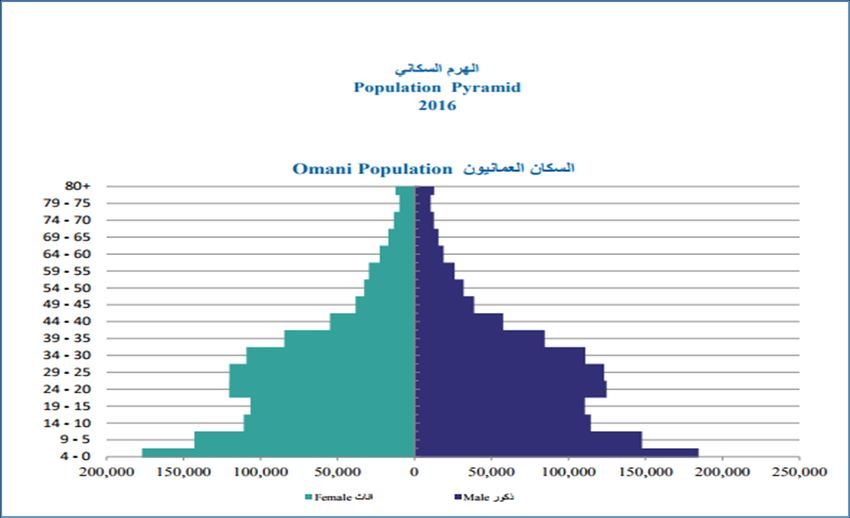
This report, a UNESCO initiative, examines Work-Based Learning programmes for young people in Oman. The information
collected and research conducted follows the methodology and guidelines of UNESCO for the national reports on reviewing
work-based learning programmes for young people in the Arab region. This report aims to support partners in the design and
implementation of relevant Technical and Vocational Education and Training (TVET) policies that can contribute to youth
employment.

Published in 2018 by the UNESCO Regional Bureau for Education in the Arab States - Beirut

© UNESCO 2018

The designations employed and the presentation of material throughout this publication do not imply the expression of any
opinion whatsoever on the part of UNESCO concerning the legal status of any country, territory, city or area or of its authorities,
or concerning the delimitation of its frontiers or boundaries.

The ideas and opinions expressed in this publication are those of the authors; they are not necessarily those of UNESCO and
do not commit the Organization.

Designed by UNESCO

Printed in Lebanon

                                                                       An Overview of the TVET System in the Sultanate of Oman   |2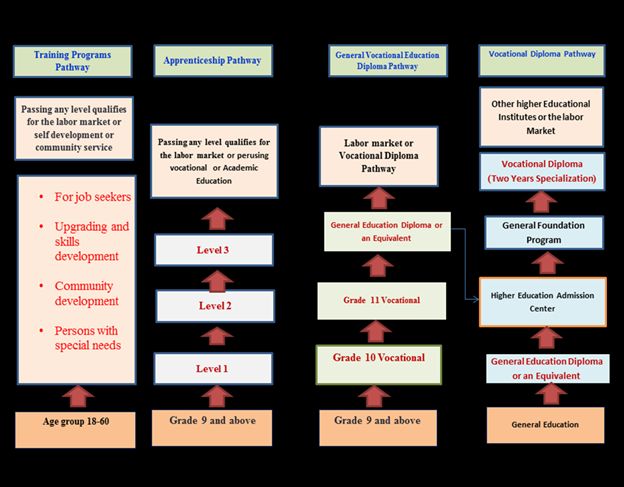
Forward

Work-based learning (WBL) has become a key issue in the international debate on human
capital development. In line with UNESCO’s TVET Strategy (2016-2021), UNESCO promotes
TVET as an integral component of education, which is a human right and a building block for
peace-building and inclusive sustainable development. With its humanistic and holistic
approach to education, UNESCO strives to enhance inclusive education systems where all
individuals benefit from meaningful and lifelong learning, delivered through multiple formal
and informal pathways.

This case study seeks to inform policymakers and practitioners in Oman, including private
sector and civil society about how to design and manage effective work-based learning
programmes targeting young people.

In Oman, TVET’s landscape is changing fast, as new programmes and new roles are emerging.
Changes in TVET are the result of political and structural changes in the overall education and
training system. They are also the result of external social, political and economic factors,
notably youth unemployment, demographic developments, and labour market trends driven
by technological and work processes and organizational changes, as well as geopolitical turmoil
in the region.

In this context, WBL is a powerful driver for expanding and improving the relevance of TVET.
However, realising the potential of WBL requires policymakers and social partners to engage in
partnerships and in close cooperation.

In addition, this case study seeks to provide current information on the state of WBL in Oman
by examining the national context, the nature and extent of WBL, policies and legislations,
employer and employee organizations, resources to improve the quality of WBL programs,
funding, and data on performance of WBL on employment, productivity, growth, and
sustainable development. The report also examines WBL as a vector for access to TVET for
disadvantaged groups including young women.

                                                    An Overview of the TVET System in the Sultanate of Oman   |3
Table of Content
Foreword
List of Figures
List of Tables
List of Abbreviations .................................................................................................................... 6
Section one: The National Context. ............................................................................................ 7
1.1 Oman’s Demography .............................................................................................8
1.2 Oman’s Economy ...................................................................................................9
1.3 Oman’s Labour Market........................................................................................11
1.4 Oman’s Education System ..................................................................................12
1.4.1 Role of Quality Assurance in the System ................................................12
Section Two: The Nature and Extent of Work-Based Learning Programmes, including
Apprenticeships .................................................................................................. 12
2.1 Historical Perspective ..........................................................................................13
2.2 Participation in, and Provision of Work-Based Learning Forms .....................13
2.2.1 Provision of Work-Based Learning by the Directorate-General
of Technological Education sub-sector ...................................................14
2.2.2 Provision of Work-Based Learning by the Directorate-General
of Vocational Education and Training Sub-Sector .................................15
2.2.3 Provision of Work-Based Learning by the Directorate-General of
Occupational Standards and Curriculum Development Sub-Sector ...16
2.2.4 Provision of Work-Based Learning by other Bodies in Coordination
with the Ministry of Manpower. .............................................................18
Section Three: TVET Policies, Legislation and Regulation ............................................................. 18
3.1 Royal Decrees for TVET .......................................................................................19
Section Four: Employer and Employee Organisations ................................................................. 20
4.1 Trade Unions ........................................................................................................21
Section Five: Resources Supporting and Improving Work-Based Learning Programmes,
including Apprenticeships ............................................................................................22
Section Six: Funding Work-Based Learning Programmes, such as Apprenticeship Learning ........23
Section Seven: Evidence, Data and Research Supporting Insights and Conclusions..........................24
7.1 The Conceptual Model ........................................................................................24
Section Eight: Conclusions and ways forward .....................................................................................25
Bibliography ..........................................................................................................................................26
Annex ........................................................................................................................................ 27
An Overview of the TVET System in the Sultanate of Oman |4List of Figures and Tables
Figure 1 Organisonal structure of TVET ................................................................................ 7
Figure 2 The population pyramid of Omanis by the end of 2016 ........................................ 9
Figure 3 Pathways and progression roots ........................................................................... 15
Tables
Table 1 Indicators on demography 2017 ............................................................................. 8
Table 2 Economic Activity or sector Focus in the Next 20 years ..................................... 10
Table 3 Indicators on Oman's Economy............................................................................. 10
Table 4 Women participation growth ................................................................................ 11
Table 5 Women participation by qualification .................................................................. 11
Table 6 Women participation by Skills Level ..................................................................... 11
Table 7 Women participation by age group ...................................................................... 12
Table 8 TVET enrollment in the first year Vs higher education enrollment ..................... 14
Table 9 Percentage of TVET in government-funded higher education institutions ........ 14
Table 10 Areas of study and number of programs provided .............................................. 15
Table 11 Summary of NLP programs .................................................................................... 17
Table 12 Summary of the number and training program type afforded by licensed
providers ................................................................................................................. 17
Table 13 Number of trainees at private training organizations by nationality and training
program type.......................................................................................................... 18
An Overview of the TVET System in the Sultanate of Oman |5List of Abbreviations
TVET Technological Education and Vocational Training
WBL Work Based Learning
MoMP Ministry of Manpower
VET Vocational Education and Training
VTC Vocational Training Centres
OAAA Oman Academic Accreditation Authority
PDO Petroleum Development Oman
OSTC Occupational Standards and Testing Center
NTP National Training Programs
OJT On Job Training
OPAL Oman Society for Petroleum Services
SQU Sultan Qaboos University
DGOSCD Directorate-General of Occupational Standards and Curriculum Development
DGVT The Directorate General of Vocational Training
An Overview of the TVET System in the Sultanate of Oman |6Section One
The National Context
The Ministry of Education in the sultanate of Oman administers the development of education
in all its levels, which starts from 1st grade leading up to 12th grade. Schools outline possible
career paths for students and their requirements. In 12th grade, students register their career
choices and preferred education institutes at the higher education admission centre. The
Centre helps stream students to universities, colleges, technological colleges, and vocational
training centres.
In Oman, the Ministry of Manpower (MoMP) governs the Technological and Vocational
Education and Training (TVET) sector and the sustainability and development of the labour
market. As for the TVET governance and management, the MoMP runs seven Technological
Colleges situated in different governorates of Oman, six Vocational Training Centres, and two
Fishery training institutes. In addition, there are more than 400 private training institutes
scattered across the country near industrial areas. The centre for occupational standards and
testing helps improve graduate’s skills based on the labour market needs.
There are three general directorates (the directorate general for technological education, the
directorate general for vocational training, and the directorate general for Occupational
standards and curricula development) that run under a secretary for the TVET sector who in
turn reports to the Minister of Manpower. Each general directorate oversees a section of the
TVET system as figure 1 below shows:
Figure 1. Organisonal Structure of TVET
Undersecretary for Technological Education and Vocational Training
General Directorate General Directorate for General Directorate for
for Technological Vocational Education and Occupational standards and
Education Training curriculum development
Training Institutes
Vocational
Training Centers
Training Centers
Colleges of
Technology
Fisheries Training Offices of
Institutes Training Services
Training Units
An Overview of the TVET System in the Sultanate of Oman |7Modules of informal apprenticeship and enterprise-based learning are offered and regulated
by the Directorate General for Vocational Training and the Directorate General for
Occupational Standards and Curriculum Development with differences in laws, duration, and
nature of program; as a result, of the following contributing factors;
1.1 Oman’s Demography
Oman occupies about 0.3 million km2 of land. It is located in the south east of the Arabian
Peninsula with Yemen, Kingdom of Saudi Arabia, and United Arab Emirates in the
neighbourhood (UNESCO, 2017). Its coastline is about 3,165 kilometres and embraces three
main seas, including the Sea of Oman, the Arabian Sea, and the Arabian Gulf (Ministry of
Tourism, 2016).
The country comprises of 11 governorates (Muscat, Dhofar, Musandam, Al-Buraimi, Al-
Dhakhilyiah, Al-Batinah North, Al- Batinah South, Al- Sharqiyah North, Al-Sharqiyah South, Al
Dhahirah, Al-Wusta) in which these governorates vary in their physiographic nature (Ministry
of Legal Affairs, 2016).
The country’s current population is about 4.5 million (whereas about 2.9 million males and 1.5
million female) and an additional two million are expatriates. The table below shows the
present size, sex ratio and the natural growth rate of all populations including Omanis and Non-
Omanis.
Table 1. Indicators on Demography 2017
Total population per capita (October 31st 2017) 4,414,051
Omanis 2,427,825
Expatriates: 1,986,226
Natural growth Rate (Omanis) 5.9%
Source: the National Center for Statistics and Information
His majesty Sultan Qaboos bin Said Al-Busaidi, Oman’s leader, emphasizes human resources
building and strategic planning as vital factors of social and economic progress. Sultan Qaboos
made basic education obligatory and free for all Omani. The decree numbered 117/2011 on
the 26th of October 2011 supports human resources building and establishes the national youth
committee, which aims at reinforcing the role of youth in the country’s development.
An Overview of the TVET System in the Sultanate of Oman |8Figure 2. The Population Pyramid of Omanis by the End of 2016
Source: 1 statistical year book 2017
1.2 Oman’s Economy
In 2016, the royal decree number 1/2016 approved the 9th five-year growth plan (2016-2020)
which requires all bodies involved in the economy to submit their strategies and key
performance indicators to achieve the 20 years’ development plan titled Oman 2020. This plan
plays a pivotal role in bridging gaps -if found- or/and gearing between Oman 2020 and the
future vision plan of Oman 2040. There are number of challenges including; the continues flux
of oil prices, geopolitical circumstances, and the rising demand of the labour market for skilled
workers to strive in such a harsh environment. The National Program for Bracing Economic
Diversity (Tanfeeth) was set to ensure succession of the 9th five years growth plan aiming at
achieving real growth rates for the gross domestic product (GDP) so that Omani citizens can
have a decent livelihood and a standard of living. The initiative aims at providing practical
solutions to challenges that may arise while implementing this plan as well as generating more
job opportunities and realistic productive capacity, educational, cultural, and epistemic
development in Oman (Supreme Council for Planning, 2016).
According to the new vision, promising sectors such as transformational industries, tourism,
transportation, logistics services, mining, and fishery should contribute to the Economic
Diversity Process by increasing the percentage of these sectors` participation in the Sultanate
Gross Domestic Product (GDP) and increase investments to generate more job
opportunities )The National Program for Enhancing Economic Diversification (TANFEEDH)
handbook, 2017). Figure 2 shows the current gross value added by the above-mentioned
sectors (National Centre for statistical and information, 2017). The table below shows the
sectors targeted for either Omanization or expansion or both.
An Overview of the TVET System in the Sultanate of Oman |9Table 2. Economic Activity or Sector Focus in the Next 20 years
Sector focus for Stage One
Manufacturing
Logistics
Tourism
Finance
Employment and the Labour Market
Sector for Stage Two
Fisheries
Mining
Source: http://www.tanfeedh.gov.om/en/focus-sectors.php
Figure 2. Gross Value Added by Selected Sectors
2E+10
1.5E+10
OMR
1E+10
5E+09
0
2010 2011 2012 2013 2014
Services Activities Industry Activities Agriculture & Fishing
Table 3. Indicators on Oman's Economy
Major Indicators for Oman Economy
Gross Domestic Product at Current Prices (2014) Mn. R.O. 31,450.8
Gross National Income (GNI) (2014) Mn. R.O. 29,984.8
GNI per Capita (2014) R.O. 7,327.
Total Government Revenue (2014) Mn. R.O 14,107.5
Oil & Gas Revenue as a % of Total (2014) 84.3
Total Government Expenditure(2014) Mn. R.O 15,171.8
petroleum, copper, asbestos,
Natural resources
some marble, limestone,
chromium, gypsum, natural gas
Source: The National Center for Statistics and Information: October 2015 monthly report.
1 Omani Rial equals 2.60 US Dollar
An Overview of the TVET System in the Sultanate of Oman | 101.3 Oman’s Labour Market
The Omani labour market consists of many categories depending on the nature of the job
contract, the governance of the institutes being either private or public sector, and the nature
of the industry. A key player in all sectors is human resources and the capacity and skills to
occupy the demand influx with the appropriate skills level. To achieve those measures, certain
indicators will help draw strategic plans for emerging and submerging industries. However, for
an Islamic Arabic-speaking country like Oman there are certain cultural and social challenges in
effect when drawing economic growth plans. For example, Omanizing, womanizing and
localizing certain jobs require these considerations; specifically, for jobs ‘appropriate for
women. The following tables show female participation in the labour market, private sector
growth, level of qualification, skills level, and age group respectively.
Table 4. Women Participation Growth
Growth rate of Omani women working in the labour market private sector from 2012-2016
Year Number
2012 43958
2016 55964
Growth Rate 0%
Source: Directorate General for Planning and Development 2017, the Working Omani women in the private sector, third edition.
Ministry of Manpower
Table 5. Women Participation by Qualification
Distribution of Omani women working in the labour market private sector by qualification
level by end of 2016
Qualification level Number Percentage %
Above bachelor 422 0.8
bachelor 8081 14.4
Diploma 5468 9.8
Secondary school 25230 45
Below Secondary school 16763 30
Total 55964 100
Source: Directorate General for Planning and Development 2017, the Working Omani women in the private sector, third edition.
Ministry of Manpower
Table 6. Female Participation by Skills Level
Distribution of Omani women working in the private sector by skills level by the end of 2016
Skills level Number Percentage %
Specialists 11465 20.5
Technicians 5310 9.5
Craftsman 29238 52.2
Skilled 2020 3.6
Semi-Skilled 7931 14.2
Total 55964 100
Source: Directorate General for Planning and Development 2017, the Working Omani women in the private sector, third edition.
Ministry of Manpower
An Overview of the TVET System in the Sultanate of Oman | 11Table 7. Female Participation by Age Group
Distribution of Omani women working in the private sector by age group by the end of 2016
Age group Number Percentage %
55-60 1580 2.8
40-54 11131 20
25-39 38655 69.1
18-24 4597 8.1
17-15 - -
Total 55964 100
Source: Directorate General for Planning and Development 2017, the Working Omani women in the private sector, third edition.
Ministry of Manpower
1.4 Oman’s Education System
Educational reforms in general and higher education has been in the forefront of the
government’s agenda of transformation. The first phase of “educational renaissance” lasted
from (1970-1988) through the vision of His Majesty Sultan Qaboos whose focus was to “widen
the accessibility to education” to all locals. The second transformative phase lasted until 2007
and focused on the continuous improvement of the ‘quality of education’ through the
development of basic education curriculum with special emphasis on Grade 1 to 12 (Al Najar,
2016). During this phase, there was also a paradigm shift in curriculum development. Schools
that were teaching the Holy Quran and mathematics developed into conventional schools
teaching all subjects (AlGhassani, 2010). These two phases transformed the educational sector
in Oman from a meagre number of three schools in the early 70s to 1,040 schools educating
517,053 pupils in Oman in 2012. (Department of Statistics and Indicators, 2012).
Oman’s current education system is a three-tiered system comprising of basic, secondary, and
tertiary education. In 1997, the basic education program was introduced and consists of two
cycles; the first cycle covers grades from 1 to 4 and the second cycle covers grades from 5 to
10. During the second cycle, there are two years of post-basic education (secondary education).
Basic and secondary education is obligatory for all children. In addition, there are a number of
prestigious private schools and the majority of schools are private educational establishments
(Ministry of Education, 2017).
The Ministry of Higher Education runs higher education, which is free of charge for all locals. In
1986, the Ministry created the Sultan Qaboos University, which now has six colleges of Applied
Sciences. There are a number of profitable private colleges and universities, which offer higher
education programs.
1.4.1 Role of Quality Assurance in the System
Quality in management, assurance, and control is evident in all aspects of the Omani
educational system. Based on Royal Decree No. (54/2010), the Oman Academic accreditation
authority (OAAA) is bestowed upon the responsibility to develop levels that meet international
standards within the country’s vision. The authority has three main tasks: program
accreditation, institution accreditation, and developing the Omani national qualification
framework, which sets education and training providers’ requirements for each occupation.
However, data about apprenticeship or other forms of work-based learning (WBL) is non-
existent. It is important to note that the qualification framework is still under development.
An Overview of the TVET System in the Sultanate of Oman | 12Section Two
The Nature and Extent of Work-Based Learning Programmes,
Including Apprenticeships
This section highlights existing practices in the TVET education and training system in Oman
that can be categorised as enterprise–based learning, which encompasses apprenticeship and
other forms of on—the-job training and learning for students and employees of different ages.
The notion of linking learning to employment is historical and present in different cultures and
civilizations where an apprentice would observe and practice an occupation until skills mastery.
The literature review on the importance and significance of work-based learning is not the focus
of this section, but rather the practical attempts to incorporate this type of learning to help
identify strengths, weakness, and opportunities for all stakeholders. However, it is important
to have a historical background and overview on enterprise-based learning schemes existing in
Oman.
2.1 Historical Perspective
TVET started in 1967, when the Petroleum Development of Oman (PDO) Company established
the first vocational institute in the country. In the institute, training focused on 77 lower level
vocational and clerical staff. PDO realized there was a real need for vocational education and
training schemes in Oman.
The Renaissance period led by his majesty Sultan Qaboos Ben Said Al-Said ushered the
development of TVET. During the first stage of TVET development, Oman adopted learning
schemes of western countries like the UK and Germany. The TVET sector has aimed to meet
the rapid demands of the labour market in terms of quality and quantity. The current national
systems are the result of local needs and circumstances. Different authorities were responsible
to support the TVET sector until 2001 when the Ministry of Manpower took over. Three
different bylaws were promulgated by ministerial decisions and published for each sub-sector,
which are; technological education, governmental vocational training centres, Fisheries
Institutes, and Private Training Institutes (Ministry of Manpower, 2017).
The country has benefited from outsourced experienced workers of all skills and qualifications
to achieve its strategic goals of social development and economic growth. The focus was set
into parallel directions, which are human development and maintaining a dynamic labour
market, which expatriates have contributed greatly in maintaining.
2.2 Participation in and Provision of Work-Based Learning Forms
The rapid development of the Omani labour market, the changing demographics of the
country, and the increase of youth enrolment in the TVET sector have changed the structure of
TVET. The role of overseeing TVET development has been strategized to be divided into three
main Directorate Generals, which seek to support the labour market, “Omanize it”, and localize
it. The table below shows the first year enrolment in all higher education institutes and TVET
sector.
An Overview of the TVET System in the Sultanate of Oman | 13Table 8. TVET Enrollment in the First Year Vs Higher Education Enrollment
First year Enrolment in: Male Female Total Percentage
All HE 11201 14950 26151 100%
TVET only 6371 4423 10794 41.27%
The percentage of students enrolled in TVET programs is an indicator as well as a short-term
target for the Omani government to increase TVET participation. Another indicator triangulated
to support the above is the percentage of TVET students enrolled in government –funded
higher education institutions in 2013-2014 as shown in the table below.
Table 9. Percentage of TVET Students in Government-Funded Higher Education Institutions
Enrolment in government HE institutions: Total Percentage
All government 69316
TVET only 43525 62.8%
The provision of work-based learning through the TVET sector in Oman can be better analysed
through the four sub-sectors under the supervision of the Ministry of Manpower namely: the
Directorate-General of Technological Education (DGTE), the Directorate-General of Vocational
Training (DGVT), the Directorate-General of Occupational Standards and Curriculum
Development (DGOSCD), and the Occupational Standards and Testing Centre.
2.2.1 Provision of Work-Based Learning by the Directorate-General of Technological Education Sub-
Sector
The DGTE is responsible for the provision of technological education. It directs and supervises
seven collages of technology (CTs), located strategically at different Governorates with a total
current enrolment of 41,043 students (22,461 Male and 18,582 Female) in the academic year
2016/2017(Ministry of Manpower open resources 2017).
The bylaws forbid attaining a qualification without spending nine months on-the-job training in
the private sector. Colleges have different departments for job trainings to ensure professional
training is taking place. Full-time students and part-time students who are mainly employees
are not able to attain the two-year diploma nor the 4-year bachelors’ degree without meeting
this condition.
On-the-job training must be relevant to the student’s area of study. The departments
responsible for on-the-job training secure training opportunities with potential employers. The
colleges’ request trainings relevant to the list of disciplines below.
An Overview of the TVET System in the Sultanate of Oman | 14Table 10. Areas of Study and Number of Programs Provided
Discipline Area Number of Specializations
Engineering 15
Information Technology 7
Business studies 7
Applied Science 6
Fashion Design 1
Photography 1
Pharmacy 1
Total 38
2.2.2 Provision of Work-Based Learning by the Directorate-General of Vocational Education
and Training Sub-Sector
The Directorate General of Vocational Training (DGVT) at the MoMP is accountable for
developing government–funded Vocational Education and Training (VET) in Oman. The DGVT
supervises and directs six Vocational Training Centers (VTCs) and two Fisheries Institutes (FIs)
located at different Governorates of the Sultanate.
Students can follow four different types of pathways such as the apprenticeship pathway, the
training programs pathway, the general vocational education diploma pathway, and the
vocational diploma pathway. The figure below shows the progression of pathways.
Figure 3. Pathways and Progression Roots
An Overview of the TVET System in the Sultanate of Oman | 15According to the bylaws, the apprentice pathway involves a contract signature prior to joining
the vocational institute where the trainee is taught and trained on a set of skills predetermined
by the employer in both the institute and the company. The apprenticeship opportunities are
determined after coordination with the labour department in the Ministry of Manpower. The
training duration per skill level is usually not less than nine months. This pathway has two
partners: the employer and the ministry where the employer provides the practical training
referred to as the on-the-job training, while the Ministry provides the venue for the theoretical
learning. The certification attained in this pathway depends on the duration of the work-based
learning period and the mastery of the pre-set skills set through different types of assessment
agreed upon by the VTC and the employer. The departments of on-the-job training in the main
office and in the vocational institute follow up with students who under training to ensure that
all learning and training outcomes are achieved. The departments help ensure the satisfaction
of the trainer skill mastery, which as mentioned earlier is defined in advance according to the
employers needs and standards.
2.2.3 Provision of Work-Based Learning by the Directorate-General of Occupational Standards and
Curriculum Development Sub-Sector
The DGOSCD is responsible for licencing, regulating, and monitoring performance of training
centres owned by the private sector in Oman. The private training organizations must adhere
to standard requirements to receive a license. These organizations are then closely monitored
to ensure the quality of the training. Furthermore, DGOSCF reviews the training curricula.
The private programs include three training areas:
1. Vocational or craft type programs such as (beauty, reception, catering, cookery,
tailoring, and travel ticketing),
2. Technical/ industrial type programs such as mechanical, carpentry refrigeration and air
conditioning, construction, and vehicles drivers,
3. Business type programs such as administration and finance, money exchange, AutoCAD,
and IT.
The government, through the National Training Programs (NTP) support trainings by the private
sector). These programs comprise three schemes:
1. Training for employment whereby trainees are selected by a private company according
to their skill needs and trained by the private sector and successfully complete the
training, which may ultimately lead to employment by the sponsor company. The
trainee receive a government allowance of OR 150 per month for the duration of the
program. This scheme benefits both parties because it encourages the private sector
to employ locals in order to meet their Omanization targets and provides job seekers
with an opportunity to train and receive an income simultaneously.
2. The on-the-job training scheme is similar in objectives to the aforementioned scheme
but the trainee receives a governmental allowance of OR 150 per month in addition to
larger allowance by the company. The training regime is similar to the well-known dual-
training scheme. The third scheme is designed to train individuals abroad for skills that
are required by the local employers but for which no training programs exist locally. The
government provides a grant for students and the company monitors the progress of
the trainee. Ultimately, the company will employ the successful trainees. Table (7)
below summarizes the previously mentioned and shows the number of trainees
through the (NTP) program 2010 to the present date.
An Overview of the TVET System in the Sultanate of Oman | 16Table 11. Summary of NLP Programs
The Ministry of Manpower introduced the NTP program in order to align the skills of
employees to the skills required by employers in the private sector.
The number of trainees supported by the national training programs from 2010 to 2015
is 10,444 trainees.
Training for Employment On the Job Training (OJT) Training Abroad
Has been operating Provided by employers from A training scheme by which
successfully for many years. the private sector. Duration employers train job seekers
Usually it takes place in of the OJT depends on the abroad in cases where the
private training institutes;the nature of the job and the training is not available
duration of training is 9 trainees qualifications. The locally.
months. The total number of trainee receives a salary
trainees in 2014 was more during the training.
than 3000.
Private training organizations consist of:
1. Private training offices (provide short training services and workshops that consist of a
few hours or days);
2. Private training institutes (which offer training programs up to 9 months and may award
certificates of vocational training for different skill levels);
3. private vocational centers which are owned and run by companies and focus primarily
on training their own recruits;
4. Training units in private education institutions.
The current number of private training providers is about (200) offering programs in
administration, technical, vocational and company specific programs. Table (9) below provides
a summary of the current numbers and training programs currently afforded by licensed
providers.
Table 12. Summary of the Number of Training Program Afforded by Licensed Providers
Classification of Institutes’ Classification by type of trainingCenter Units Offices
Training Training
Institutes Administrative / Technical/ Craftsman services
Business Industrial
Number of 134 36 26 17 9 200
Institutes by type
of training 196
Total number of 422
providers
The table below shows the number of trainees enrolled in 2016:
An Overview of the TVET System in the Sultanate of Oman | 17Table 13. Number of Trainees at Private Training Organizations by Nationality and Training
Program Type.
Omanis 23,703
Expatriates 1,999
Number of trainees successfully completed their training by national program in 2,293
2014
Total number of trainees successfully completing their training in all training 25,702
programs in 2014
The bylaws of this sub-sector in Chapter 5 article 49 E states the elements and period of each
occupational program according to the nature of the program (semi-skilled, skilled or
vocational). The bylaws also mention the occupational designation of the graduates of the
program.
2.2.4 Provision of Work-Based Learning by Other Bodies in Coordination with the Ministry of
Manpower
The Ministry of Manpower in the sultanate of Oman offers different training schemes;
however, a specialized body that is government-owned or has government investments also
provides professional trainings. For example, the Tourism College offers tour guide training
programs and certifications for those who complete the program as a registered tour guide in
the Ministry of Tourism (Oman Tourism College 2017). The national funding for training
authority funds the training. Graduates are then encouraged to work in a tourism agency with
a minim wage of 400 Omani Rials or to start their own business (see brochure in annex).
The Sultan Qaboos University has academic programs that offer other models of WBL. For
example, the medical college and the nursing college have students train in the university that
is located near the students’ campus. Student trainings occur during the academic years of
medical college and for four years during nursing college. International training standards and
international exit levels maintain the quality of these programs.
Formal apprenticeship, internship, informal apprenticeship, and other types of WBL are a
requirement for different programs of different skills level offered by different governmental
bodies in which each body tries to develop sustainability in the sector it is bestowed the
responsibilities and accountability to Omanize with highly reliable skills level.
Demographics of graduates are not be available for all sectors; however, triangulating some
indicators helps us understand the characteristics of these programs such as: retention rates,,
circulation from one employer to another, work progression, and others areas of further study.
An Overview of the TVET System in the Sultanate of Oman | 18Section Three
TVET Policies, Legislation, and Regulation
3.1 Royal Decrees for TVET
The leader of our blessed Renaissance, His Majesty Sultan Qaboos Ben Said vision for this
mother earth giving country derives all acts, policies, legislations and regulations,
Some of the main royal decrees that contribute directly or indirectly in forming strategies.
The Enabler (Royal Decree) Brief description
The establishment of the Ministry of The first structure to regulate labor and
Communications and Social Affairs in TVET in Oman.
December 1970
The establishment of the Ministry of Social Carry’s the role of the previous structure as
Affairs and Labor on 20th May 1972. well as focuses a on youth skills
enhancements to be adequate for the
booming labor market.
Royal Decree 22/75 regarding instituting the Stakeholders contribute to TVET
council for TVET and its role and structure. development including funding as per the
labor act provision at the time.
Royal Decree 26/75 setting specific Social legislations guaranteeing
authorities and equal responsibilities to the rights and protection for laborers
Ministry of Social Affairs and Labor with the ultimate goal to achieve
overall common good.
Planning for the Omani human
resources investment as well as
receiving expatriates’ employment
applications and licensing them.
The establishment of the Ministry of Labor The Ministry of Social Affairs has more
and Vocational Training by Royal Decree authority and responsibility than the
5/90 previous structure working on TVET. The
Ministry of Labor and Vocational Training
carries out the mission and development.
A number of Royal decrees enhancing the development of TVET were issued as per the
Country Renaissance demands.
Source: Manpower from 1970-2010 book
Based on the Royal Decree No. (101/2001), issuing the establishment of the Ministry of
Manpower which will hold labor affairs, technological education, and vocational training and
the Royal Decree No. (90/98), approving the organizational structure of the Ministry of Social
Affairs, Labor and Vocational Training, and the Royal Decree No. (84/2001), issuing amendment
of the directorate's name from technical education to technological education. The three TVET
sub-sectors seek to regulate responsive programs catering for various demands from the labour
market with considerations to the following work legislation developments:
An Overview of the TVET System in the Sultanate of Oman | 19 The Labor Law
Regulatory bylaw for vocational safety and hygiene
Social Insurance Act
The National Power register
Currently, more legislation in Oman supports TVET. The most recent Royal Decrees and
ministerial decisions regarding TVET are:
In 2011, a Ministerial Decree No. (76/2011), establishes the Occupational Standards
and Testing Center (OSTC) which are tasked with the development of occupational
standards system that cater for all types of occupations at all different skill levels.
Bylaws for technological education
Bylaw for vocational education and training
Bylaw amendments for occupational standards and curriculum development
As part of “Omanization,”a number of symposiums are planned for different sectors and
employment services.
Committees from the joint sector for “Omanization” were given target percentages to Omanize
their sectors as part of the country’s growth and “Omanization” plans.
An Overview of the TVET System in the Sultanate of Oman | 20Section Four
Employer and Employee Organisations
4.1 Trade Unions
Oman has constructed a strategy to build a mutual reliable link with the labour market, support
WBL schemes in their developmental stages, actively involve stakeholders with “Omanaization”
plans, and employ the local workforce. The strategy seeks to orient the labour market with an
incubated local force trained to cater to their needs. The three stages have bodies of
representatives, committees’ representatives, trade unions, labour syndicates, and a general
syndicate for labourers in Oman in which each stage has its legal power. Each stage has
contributed to the development of WBL development as part of the ultimate target, which is
“Omanizing” the labour market.
The first stage was enforced by approving and announcing the labour act issued by the royal
decree 34 in the year 1973. The first stage aims to establish effective relationships between
employers and employees, where each employer with a minimum of fifty employees needs to
submit suggestions to the Minister on the establishment of joint representative bodies.
The second stage was scaffold by the labour act issued as per the Royal decree 35 in the year
2003 refereeing to the representative committees provisions which endorsed for labourers at
any institution to establish among themselves representative committees, later known as
sector committees, to voice their affairs that needs to be addressed which are relative to the
state affairs. This stage has worked as a qualitative feedback mainly to draw informative and
strategic decisions regulating the sectors represented afterwards. From 2004 to 2006 the
framework of various economic sectors (oil and gas, communications etc) was established in
the first stage project in addition to a central representative committee for the country’s
labourers.
The third stage contributes to the overall international situation. A constituent assembly of the
General Syndicate for labourers of the Sultanate of Oman attended the convention held on 15th
February 2010 along with other syndicates from Gulf countries and different international
countries to share opinions and innovations on the megatrends affecting their labour markets.
The sector committees are responsible to embrace and contribute in the on-the-job training
and employment of those trained as per their economic sector needs.
An Overview of the TVET System in the Sultanate of Oman | 21Section Five
Resources Supporting and Improving Work-Based Learning
Programmes, including Apprenticeships
Different schemes seek to improve WBL in Oman. The direct support of resources includes:
employing specialists, identifying resources, and training and designing programs and curricula
accordingly. Training providers can directly purchase these resources if they are governmental
agencies or a sponsor from an industry.
Some sectors provide some training equipment to the training provider for the programs it
requests and provide their expertise in forming these programs.
An Overview of the TVET System in the Sultanate of Oman | 22Section Six
Funding Work-Based Learning Programmes,
such as Apprenticeship Learning
The Sultanate of Oman has been paying extra attention to the development of training. A
governmental authority allocates the budget for training. The majority of training funds are
provided by the government. According to a recent bylaw, for on-the-job training funding,
providers must include their financial plan within their framework.
Currently, a separate body provides the training budget for WBL. The body is part of the royal
Decree 48/2016 to establish the National Training Monetary (illegal translation) for Omanis and
to support Omanization plans. However, some labour market institutes contribute financially
to the trainings through the authority or separately.
The Oman Authority for Partnership for Development is another authority example in Oman
that also finances training under In-Country Value schemes
(https://oapfd.om/en/Pages/Home.aspx , 2017).
The program of cooperation between the Ministry of Manpower and the Oman society for
Petroleum services (OPAL) financially supports trainings through the purchase of equipment or
the human capacity building requirements. In this program, funding is r given to all Petroleum
sector stakeholders (labour market, Ministry of Oil and Gas, etc.) to cater for the skills needed
in the sector. In this case, petroleum companies operating in Oman provide the equipment.
However, there is no authority or department to synchronize or store this data for research.
This could be a possible recommendation for future innovations.
An Overview of the TVET System in the Sultanate of Oman | 23Section Seven
Evidence, Data and Research Supporting Insights and Conclusions
The report consists of primary and secondary data collected since the 2011 mandate of the
Ministry of Manpower in Oman to govern TVET. Each sub-sector has adopted quality assurance
strategies and practices to ensure enterprise-based learning is of high quality standards. This
has involved different empirical studies, which involve both qualitative and quantitative
approaches (mixed methods approach). The qualitative approach comprises a content analysis
of the existing literature. A detailed study of the literature will screen the most relevant
variables of the constructs and conduct the Analytical Hierarch Process to prioritise the
variables of interest. The hypothetical research model will be developed in the next section will
be further refined through meta-analysis by linking the dimensions of the report construct
under investigation.
7.1 The Conceptual Model
The conceptual model bases itself on the available models in the three report constructs:
section two of this report provides evidence to demonstrate that enterprise–based learning
principles have been widely practiced in Oman drawing from success stories in Germany and
the UK. The conceptual model links these three body constructs. Each linkage is studied through
semi-structured interviews and questionnaire data analysis to identify gap-analysis and draw
recommendations.
Figure 1. The Conceptual Model
Enabler Mediator Outcome
Competitive Advantage
MoMP+Empolyers
Work-based learning
An Overview of the TVET System in the Sultanate of Oman | 24Section Eight
Conclusions and Ways Forward
Employers must submit retention reports based on requirements they have set with
the training provider.
The training provider has to gather feedback from the company they contracted with
on trainers’ skills level satisfaction after completing the programs
Curricula review has periodically list updates requirements per sector skills
requirement.
Training has to start at an earlier stage not only after high school completion or after
turning 16 years old.
Period review of WBL policies.
Research body for improving TVET and its schemes has to be more active and current.
Globalization of work-based learning as a scheme though may need more research
can provide trainees a wider effective platform for employment, improvements,
innovations, funding, etc.
An Overview of the TVET System in the Sultanate of Oman | 25Bibliography
Al-Ghassani, A.M. (2010). A case study of Oman. In M. Masri, M. Jemni, A. Al-Ghassani
& A.A. Badawi (eds.), Entrepreneurship Education in the Arab States, US, UNESCO,
(pp. 47-72).
Al Najar, N. (2016). View of Education development in Oman, International Journal of
Academic Research in Education and Review, 4(1), 10-18.
Crossman, E. R. F. W. 1959 'A theory of the acquisition of speed-skill' Ergonomics 2,
153-166
Department of Statistics and Indicators. (2012). Educational Indicators 2011/2012,
Oman, Ministry of Education, and Retrieved on 24th October 2017 from:
http://www.ilo.org/Search4/search.do.
Manpower from 1970-2010, 2010. A local book published in celebration of the 40th
national day. Ministry of Manpower.
Ministry of Higher Education, (2017). Universities & Colleges in Oman, Retrieved on
24th October 2017 from: http://mohe.gov.om/InnerPage.aspx?id=30C2284B-7B6D-
49C7-BE63-2DCF29E48905.
Ministry of Manpower, (2017). Organizational structure, Retrieved on 24th October
2017 from: http://mohe.gov.om/InnerPage.aspx?id=30C2284B-7B6D-49C7-BE63-
2DCF29E48905.
Ministry of Tourism, (2017). Organizational structure, Retrieved on 24th October 2017
from: http://mohe.gov.om/InnerPage.aspx?id=30C2284B-7B6D-49C7-BE63-
2DCF29E48905
Holding, D. H. 1965 Principles of Training Oxford: Pergamon. Huey, E.B. 1968 The
Psychology and Pedagogy of Reading Cambridge, Mass: MIT Press
UNESCO, (2017). Recent education reforms in Oman with particular reference to the
status of women and girls, INNODATA, United Nations Educational, Scientific, and
Cultural Organization Report, Retrieved on 14th October 2017 from:
http://www.ibe.unesco.org/fileadmin/user_upload/archive/Publications/innodata/inno
15.pdf.
Tanfeeth hand book
http://timesofoman.com/article/88826/Oman/Government/Oman%27s-economic-
diversification-plan-gets-Royal-approval
http://www.tanfeedh.gov.om/en/
http://www.otc.edu.om/tour-guiding-program.html Oman tourism Guide Oman
tourism College retrieved on 11/11/2017
https://www.artofliving.org/om-en/youth-leadership-training-program-oman
An Overview of the TVET System in the Sultanate of Oman | 26Annex
An Overview of the TVET System in the Sultanate of Oman | 27You can also read


