Vaccine update + safety update - Dr. Naveen Tenneti Executive Director - Safety, Quality and System Preparedness - RACGP
←
→
Page content transcription
If your browser does not render page correctly, please read the page content below
Vaccine update + safety update
Dr. Naveen Tenneti
Executive Director – Safety, Quality and System Preparedness

COVID-19 Vaccination Program, Victorian Department of Health

Wednesday 21 July 2021

                                                     OFFICIAL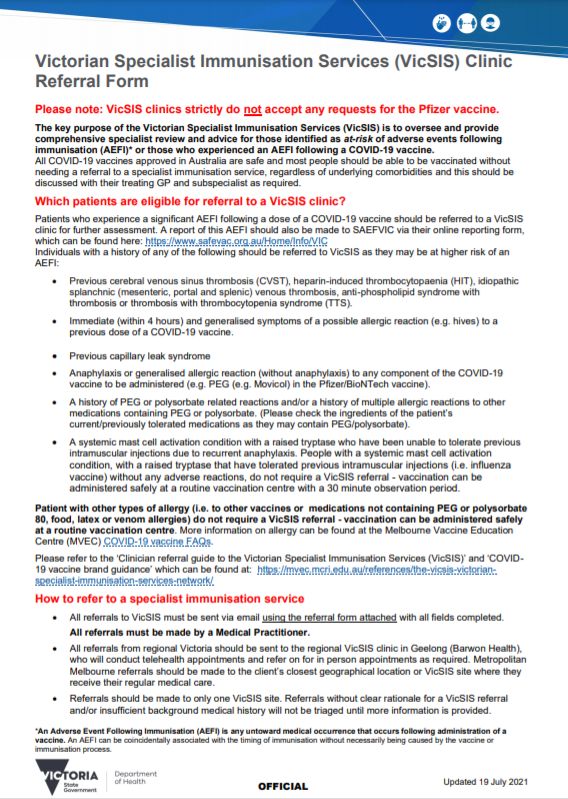
Coordination across the COVID-19 outbreak response is
critical to ensure joined-up activity and clear messaging
The vaccination program is one part of an integrated
                                                                                       Key points of integration and coordination across the
response from the Department
                                                                                       Department’s COVID-19 response include:
                     Leadership & Coordination                                         • Workforce: managing the trade-offs of workforce
                                                                                         capacity at a system-wide level with multiple
 Vaccination                  Prevention                 Containment                     pressures on the system across vaccination, testing
                                                                                         and health services
 Access & Delivery          Quarantine Program            Outbreak control

  Safety & Quality          Border Management            Surveillance testing
                                                                                       • Policy: ensuring a consistent approach to policy
                                                                                         making, including coordination through the Premier,
   Public Trust &           Infection Prevention           Testing network               Ministers and Cabinet for decision making
    Confidence                  and Control
                                                         Testing approaches
                            Public health advice                                       • Communications: consistent and comprehensive
                                                                                         messaging across government and health services to
                             COVID-safe major
                                 events                                                  give clarity and certainty to the public
                                                                                       • Contact centre operations: managing the competing
                               Enablers                                                  pressures on the contact centre with increased
              People, Leadership & Governance (incl. workforce)
                 Community engagement and partnerships                                   demand for vaccinations and broader COVID-19
                             Data & Intelligence
                     Systems and process improvement
                                                                                         information on guidelines and regulations

                                                                                OFFICIAL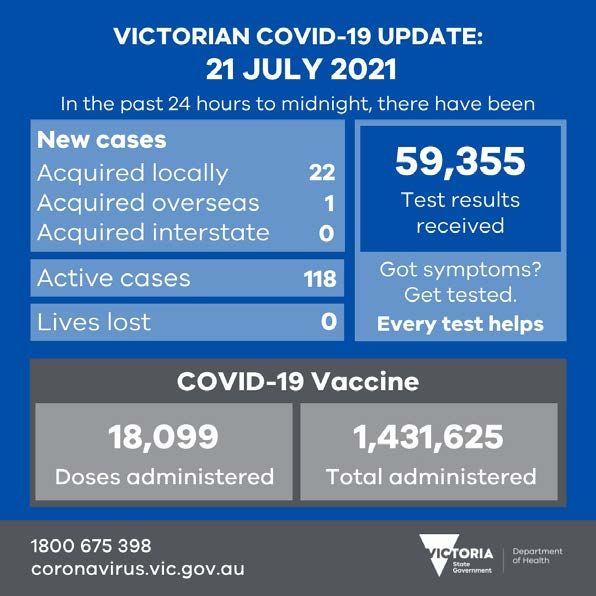
Outbreak update

                    •   There are 118 active cases in Victoria –
                        107 locally acquired and 11 overseas
                        acquired cases.

                    •   Over 19,000 primary close contacts have
                        been identified

                    •   State-wide restrictions extended to at
                        least midnight on 27 July

                    •   Exposure sites are published at:
                        https://www.coronavirus.vic.gov.au/expos
                        ure-sites

                  OFFICIAL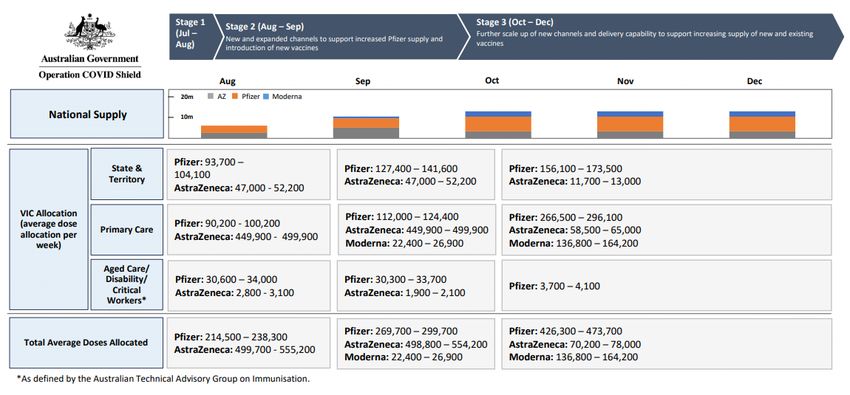
COVID-19 Vaccine update

                                                        1,395,522
                                                          doses
                                                       administered
                                                         in state
                                                          clinics

                                                                                                                   2,877,099
                                                                                                                  total doses
                                                                                                                 administered
                                                        1,308,647
                                                       administered
                                                          through
                                                       primary care
                                                          settings

https://www.health.gov.au/initiatives-and-programs/covid-19-vaccines/australias-covid-19-vaccine-rollout   OFFICIAL
Who can access the vaccine?

                                                                                                                 NDIS
                                                                              All Aboriginal                  participants
                                                                            and Torres Strait               aged 16 years
Phase 1a                     Phase                        All people aged
                                                                             Islander people                 and over and
 groups                    1b groups                          40+ years
                                                                              aged 16 years                 carers of NDIS
                                                                                 and over                   participants of
                                                                                                               any age

                            Under 60 years                                          60 years and over

                            The Pfizer COVID-19
                            vaccine is preferred
                                                                              People aged 60 years and over will be
                                                                               offered the AstraZeneca COVID-19
    The AstraZeneca COVID-19               People under 60 years who           vaccine unless they have a specific
   vaccine is approved for people           received their first dose of            medical condition identified
     under 60 years where the            AstraZeneca COVID-19 vaccine
      benefits of protection                without serious adverse
   outweigh the risk of adverse            events should receive their
               events                             second dose

                                                                OFFICIAL
Prioritisation

Priority Pfizer bookings for people yet to receive their first dose of a COVID-19 vaccine for the following groups,
regardless of age are still available:

• all health care workers (i.e. eligible under Phase 1A and 1B).

• all hotel quarantine and border workers

• household contacts (aged 16 years and over) of hotel quarantine workers and border workers

• residential aged and residential disability care workers and residents.

• Eligible people are encouraged to call the Victorian Coronavirus Hotline on 1800 675 398 to book their
  appointment

• People who have already received a first dose of AstraZeneca should receive a second dose of AstraZeneca.

                                                            OFFICIAL
Allocations by December 2021

                         OFFICIAL
Vaccine Safety

Objectives
1.     Describe the vaccine safety system in Victoria
2.     Understand the incidence of adverse events and common issues to look out for
3.     Understand current and emerging vaccine safety signals and what actions you should take
4.     Understand how to work with the VicSIS network

     OFFICIAL

                                                                     OFFICIAL
Vaccine safety services, Victoria

           Comprehensive integrated vaccine safety clinical management and safety
                                       surveillance

                                                       Multi-faceted data         Active (solicited) post-      Alert Advisory Group (AAG)
 Established national        Clinical follow-up of     interrogation systems in
 leading spontaneous AEFI    reported AEFI                                        vaccination SMS-based
                                                       place & under              survey                        Systematic escalation
 surveillance system                                   development
                             VicSIS adult specialist                                                            pathway for serious AEFI,
 Integrated vaccine safety                                                        SMS sent post                 signal events or issues that
                             immunisation services     Includes background
 surveillance and clinical                                                        vaccination (day 3, 8 & 42)   may bring risk to the COVID
                             established for COVID     rates, & monitoring of
 support services                                                                 asks if the person            vaccination program
                             response                  healthcare datasets (ED,   experienced an AEFI
                                                       Aged care, GP)

                                                          SAFESig

     Spontaneous AEFI          Specialist Clinical     Integrated safety signal   Post-vaccination active             Serious AEFI
       surveillance          Immunisation services            detection                surveillance                 Urgent escalation

                                                              OFFICIAL
Integrated AEFI reporting/surveillance & signal detection

                                                                                                                                   Coordination with TGA
                                                                                                                                   detection, escalation of serious events or signals.
                                                                                                                                   Vaccine safety system – State-wide reporting, signal
                       Vaccine recipient sent SMS on
                      days 3, 8 and 42 post vaccination                                                 AusVaxSafety
                           (capture acute events)                                                          Active (solicited)
                                 Follow-up                                                                   surveillance

                                                                          Report directly/via hotline
                                                                                  (any time)

                                                          Self-managed                                      SAEFVIC
                                                                                                         Spontaneous (passive)
               AEFI                                                                                       reporting for routine
                                                          Nurse on call
                                                                                                        follow-up & surveillance

                                                          GP
                                                                                     Notification

                                                          Emergency
                                                          Department

     NO AEFI                                              Hospital
                                                          Admission                                         SAFESIG
                                                                                                             Data linkage
                                                                                                              Data mining
                                                                                                        Safety signal detection
                                                                OFFICIAL
Integrated clinical care and specialist immunization services
Pre-vaccination consultation Complex patient
• Review for any significant risk • At risk of an adverse event following
• Vaccination education immunisation (see VicSIS eligibility criteria)
• Previously experienced an adverse event (to any
vaccine or to first dose of COVID-19 vaccine )
Possible vaccine
contraindications
Standard vaccine
administration
(first or second dose)
SAEFVIC
No Mild / expected AEFI Serious AEFI VicSIS
AEFI soreness/swelling at injection e.g. Anaphylaxis, seizure,
site, muscle aches, other presentations of Specialist immunisation
headache, allergy (e.g. hives rash) review
• Immunisation clinical review
• Services via Telehealth or F2F
• Appropriate referral for second
vaccination under supervision (as
needed) Supervised vaccine
administration
Follow-up & advice Emergency medical (first or second dose)
attention
• Close monitoring of any • For patients with risk of AEFI, including
further adverse events • Medical intervention allergic reactions
• Key contacts for • Adrenaline (as required) • Vaccination under appropriate
immediate follow up supervision
OFFICIAL • Appropriate referral for second
vaccination (as needed)AEFI reporting & VicSIS referral volume
• High AEFI reporting and VicSIS referral volumes have required mitigation
strategies
Week 2 corresponds to week starting 01 March, week 15 corresponds to week starting 31 May
SAEFVIC “rapid” established for self-
VicSIS referrals are not accepted for vaccine
reporting of minor/common AEFI
brand preference
OFFICIALReporting to SAEFVIC
Priority is always to manage the clinical needs
All medically attended AEFI should be reported so we can monitor the safety of the vaccines
• Medically attended = visit to general practitioner, emergency department, or hospital admission
Reporting serious and significant AEFI
• Report directly to SAEFVIC online
• Open to reports from GPs, nurses, and the public
SAEFVIC is Victoria’s Vaccine • The vaccinee may receive follow up clinical advice
Safety Service. • saefvic.online/aefi_reporter
• Accepts AEFI reports from
HCW & vaccinees Reporting minor/common/expected AEFI
• Provides specialist care to • Patients can self-report using the SAEFVIC rapid report.
patients following AEFI These reports are not clinically reviewed, but feed into overall
surveillance
• saefvic.online/report
OFFICIALVaccine safety data
SAEFVIC is Victoria’s Immunisation Safety Service Top 15 most frequently reported adverse events, per 1000 doses
An AEFI is any untoward medical occurrence that happens following
administration of a vaccine. It can be coincidentally associated with
immunisation, without necessarily being caused by the vaccine
% Medically
Total AEFI reported Rate per 1000 doses
attended AEFI
17,784 6.6 0.4%
AEFI reports per 1000 doses, by Serious AEFI reports per 1000
vaccine brand and dose doses, by vaccine brand and dose
A person may
report >1 symptom
OFFICIALKey vaccine safety signals
Safety signals that are flagged nationally or internationally are monitored through
SAEFVIC and TGA in Australia through a transparent reporting process.
Current safety signals being monitored include:
Thrombosis with Thrombocytopenia (TTS)
Idiopathic thrombocytopenic purpura (ITP)
Guillain-Barre syndrome (GBS)
Myocarditis and pericarditis
Capillary leak syndrome
OFFICIALTTS update
In April 2021, COVID-19 vaccine AstraZeneca was found to be linked with a rare condition involving blood clotting
and low platelet levels, called thrombosis with thrombocytopenia syndrome (TTS).
Pfizer (Comirnaty) is not currently associated with a risk of TTS.
Current policy advice based on ATAGI recommendations:
• People aged 60 and over are recommended to receive the AstraZeneca vaccine
• Pfizer is preferred for individuals under 60 years of age
• People aged 18-59 can choose to receive the AstraZeneca vaccine following a process of informed consent
o ATAGI statement on use of COVID-19 vaccines in an outbreak setting | Australian Government Department of Health
o COVID-19 vaccination – Weighing up the potential benefits against risk of harm from COVID-19 Vaccine AstraZeneca | Australian
Government Department of Health
• People should receive second dose of same vaccine brand (mixed dosing not currently recommended)
• While no risk factors have been identified for TTS, Pfizer preferentially recommended for patients with previous history of
CVST, HIT, idiopathic splanchnic vein thrombosis or antiphospholipid syndrome with thrombosis. Capillary leak syndrome
recently added to this list
OFFICIALTTS update
TTS national update
• Total number of cases: 83 out of 5.4 million doses to date
Victoria TTS cases
• Rate in under 60s: 2.6 cases per 100,000 doses of AstraZeneca
30
• Rate in over 60s: 1.7 cases per 100,000 doses of AstraZeneca
• Majority of cases have occurred after first doses of AZ
• Two Tiers for classification based on CDC working case definition
o Tier 1 = clots in unusual location and low platelet count with or
without antibodies that activate platelets (anti-PF4 antibodies)
o Tier 2 = clots found in common locations and a low platelet
count and anti-PF4 antibodies
• TGA COVID-19 Vaccine Safety Report | 15 July 2021
• CDC Presentation
OFFICIALThe role of primary care in TTS
• People encouraged to seek immediate medical attention after vaccination if they develop:
o Severe or persistent headache or blurred vision
o Shortness of breath, chest pain, leg swelling or persistent abdominal pain
o Unusual skin bruising and/or pinpoint round spots beyond the site of vaccination
• Most common time period for onset of TTS symptoms is 4-42 days after vaccination
• Primary care guidance for identification and initial management for suspected TTS cases was recently released:
• Primary care approach to thrombosis with thrombocytopenia syndrome after COVID-19 AstraZeneca vaccine
• Refer to ED if:
o Acutely unwell e.g. acute neurological deficit, severe abdominal pain, severe bleeding or any other concerning symptoms or
signs
o Have thrombocytopenia (platelets < 150 x 109/L) or D-Dimer ≥ 5 x upper limit of normal
o Blood tests cannot be performed and reviewed within 6 hours
• Repeat initial investigations in 24-48 hours in patients whose results are reassuring but who have persistent
symptoms. This includes patients who have been discharged from ED with reassuring results.
Ref: https://www.health.gov.au/sites/default/files/documents/2021/07/covid-19-vaccination-primary-care-approach-to-thrombosis-with-thrombocytopenia-syndrome-after-covid-19-astrazeneca-
vaccine.pdf
OFFICIALTTS Primary Care Guidance
Primary care approach to thrombosis with thrombocytopenia syndrome after COVID-19
AstraZeneca vaccine link
OFFICIALSafety Update – other safety signals
ITP
• The TGA is evaluating reports of suspected ITP following vaccination and will report further information when it is known.
• To 11 July 2021, the TGA has received 31 reports of suspected ITP.
• TGA concluded a fatal case of ITP in 61yo woman (WA) who had received AZ was likely related to immunisation.
• Vaccinees should be encouraged to seek medical attention if they experience signs and symptoms of ITP e.g. unusual skin
bruising, unusual bleeding, petechiae.
GBS
• The TGA has been closely monitoring reports of GBS since the beginning of the COVID-19 vaccine rollout as it has been
associated with other types immunisations such as influenza vaccines
• To 11 July 2021, the TGA has received 52 reports of suspected GBS in people who have received the AstraZeneca
vaccine. A possible link between GBS and the AstraZeneca vaccine remains under investigation by the TGA and involves
looking more closely at whether these suspected cases meet the clinical criteria for GBS.
• A causal link between GBS and AZ has not been confirmed in Australia or overseas
• People are encouraged to seek medical attention if they experience symptoms that could suggest GBS. This includes
weakness and paralysis in the hands or feet that can progress to the chest and face over a few days or weeks.
OFFICIALSafety Update – other safety signals
Myocarditis and pericarditis
US Advisory Committee on Immunisation Practices (ACIP) have concluded that myocarditis and pericarditis
are likely linked to vaccination, however that the benefits of vaccination outweigh the risks.
• TGA has received 50 cases of suspected myocarditis or pericarditis (to 11 July).
• Appears to affect predominantly males, 18-30 years old and be associated with mRNA vaccines
• Symptoms generally occur within 7 days post vaccination and more commonly after Pfizer Dose 2.
• Myocarditis and pericarditis are much more common with COVID-19 infection and the risks to the heart
can be more severe in this context.
• TGA are working with Pfizer to add warning statement to Product Information
• People are encouraged to seek medical attention if they are experiencing symptoms which could be
consistent with myocarditis or pericarditis e.g. chest pain, shortness of breath or palpitations.
https://www.tga.gov.au/periodic/covid-19-vaccine-weekly-safety-report-15-07-2021
OFFICIALSafety Update – other safety signals
Capillary leak syndrome
Capillary leak syndrome is an extremely rare but severe relapsing-remitting condition where fluid from small
blood vessels (capillaries) leaks into surrounding tissues
On July 15, The TGA weekly report included additional information on capillary leak syndrome.
Internationally 8 cases of capillary leak syndrome following vaccination with AstraZeneca have been reported - with
two of these cases having a prior history of capillary leak syndrome. It is not well understood what triggers a
relapse.
Australia has reported 1 probable case (WA) who sadly died (reported to TGA) of multi-organ failure with signs of
capillary leakage. The Vaccine Safety Investigation Group (VSIG) was unable to establish a causal link as other
causes could not be ruled out
• As a precautionary measure, the sponsor of the AstraZeneca vaccine has included a warning in the Product
Information about capillary leak syndrome and specifically advised that the vaccine should not be used in people
who have a history of this condition.
https://www.tga.gov.au/periodic/covid-19-vaccine-weekly-safety-report/current
OFFICIALVaccination in pregnancy
• ATAGI and RANCOG released a joint statement on 9 June 2021 recommending that pregnant women be vaccinated with
Pfizer vaccine.
• This is due to:
• Pregnant women being at higher risk of severe illness from COVID-19, and their babies have a higher risk of being born
prematurely or being admitted to the Neonatal Intensive Care Unit
• US study of over 35,000 pregnant women showing side effects were similar in pregnant women compared to non-pregnant
women who received the Pfizer vaccine. This research is yet to be carried out for the COVID-19 Vaccine AstraZeneca
• Pregnant women should be routinely offered Pfizer at any stage of pregnancy
• Women who are trying to become pregnant do not need to delay vaccination or avoid becoming pregnant after vaccination
• COVID-19 vaccination may provide indirect protection to babies by transferring antibodies through placenta or breastmilk
• Pregnant women currently not a priority group eligible for vaccination
• ATAGI advise that women who received their first dose of AstraZeneca and are pregnant can receive either dose two of
AstraZeneca or Pfizer, although the latter is preferred.
Joint statement between RANZCOG and ATAGI about COVID-19 vaccination for pregnant women | 09 June 2021
COVID-19 vaccination decision guide for women who are pregnant, breastfeeding or planning pregnancy (health.gov.au)
OFFICIALVaccine intervals
COVID-19 vaccines COVID-19 and Influenza Vaccines
Pfizer The Australian Technical Advisory Group on
• At least 21 days between doses Immunisation has issued updated advice on the relative
• Minimum accepted interval = 19 days timing of administering influenza vaccines and COVID-19
• Complete course within 6 weeks vaccines in 2021.
• If second dose >6 weeks apart, no third dose required
The preferred minimum interval between a dose of
AstraZeneca
influenza vaccine and a dose of either Pfizer/BioNTech
• Non-outbreak setting
o Minimum accepted interval = 4 weeks (Comirnaty) vaccine or Oxford/AstraZeneca vaccine is
o Recommended interval is 12 weeks now 7 days (previously 14 days).
o If second dose > 12 weeks, no third dose or reporting
required In some situations, such as an outbreak, a shorter
o If second dose < 4 weeks, must be reported to interval (including co-administration) is acceptable.
SAEFVIC as administration error
• Outbreak setting
o Recent ATAGI update to AZ intervals in outbreak setting
- interval of between 4 to 8 weeks is reasonable Victorian COVID-19 Vaccination Guidelines
OFFICIALVictorian Specialist Immunisation Services (VicSIS)
Vaccine safety in Victoria is managed under a Department of Health (DH) contract by SAEFVIC, a vaccine safety team based
at the Murdoch Children’s Research Institute (MCRI), Parkville.
VicSIS was established to provide adult specialist immunisation services to support the COVID-19 vaccination program in
Victoria.
VicSIS is made up of eight specialist immunisation clinics
Consultations occur via telehealth or face to face and are either:
• Pre-vaccination: persons at-risk of adverse events following immunisation (AEFI), for
example a history of anaphylaxis, or those who fall into special risk groups.
• Post-vaccination: persons who have experienced an AEFI after a dose of a COVID-19
vaccine and require clinical review prior to second dose or ongoing follow-up
VicSIS also has two allergy-specific services which offer expert opinion, skin prick testing,
challenges and supervised vaccination as required and are coordinated by expert Allergist and
Immunologists.
3360 total consults have been completed across the eight VicSIS clinics with the majority
recommended for routine vaccination.
OFFICIALVictorian Specialist Immunisation Services (VicSIS) Clinics
VicSIS Clinics
There are 8 VicSIS clinics, with two dedicated allergy services and one
regional site.
Alfred Health
Austin Health – allergy services
Monash Health – allergy services
Western Health
Barwon Health - regional lead
Northern Health
Royal Melbourne Hospital
Peter MacCallum Cancer Center
(Royal Children's Hospital) – established immunisation clinic with increased
capacity for the future rollout of COVID-19 vaccination for children and Locations of current VicSIS clinics across metropolitan Melbourne and Geelong
adolescents OFFICIALOFFICIAL
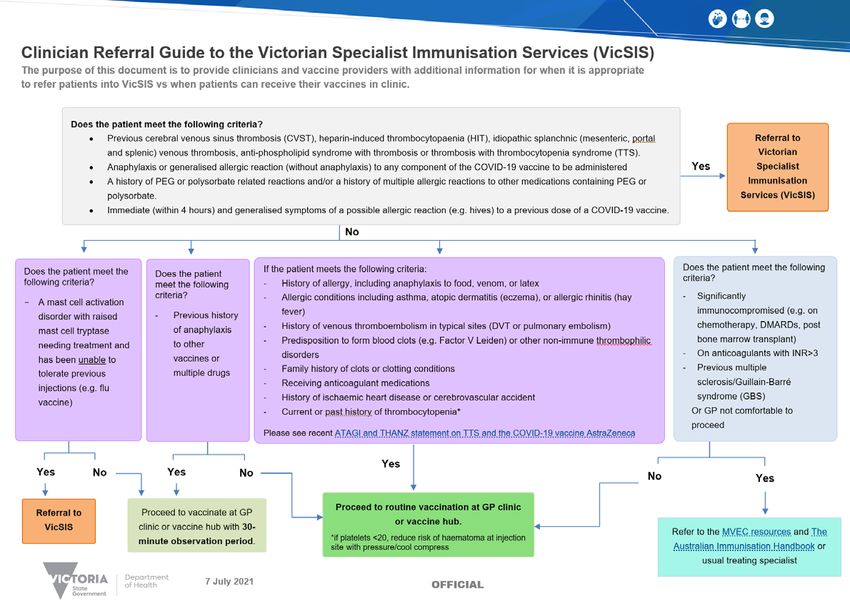
How to refer to VicSIS
Referral to VicSIS Clinics:

• Referral criteria can be found on the front of the VicSIS referral form
  (pictured).

• All referrals are to be made using the live version of the referral form
  available on the VicSIS page on the MVEC website

• Referrals must be made by a Medical Practitioner to the patient’s closest
  geographical location

• Referrals should be made to only one VicSIS site

• VicSIS is experiencing a high volume of referrals at this time and there
  may be significant delays in triaging referrals of up to 4-6 weeks. Please
  communicate this to your patients to help manage expectations

• Referrals without clear rationale for a VicSIS referral and/or insufficient
  background medical history will not be triaged until more information is
  provided
                                                              OFFICIAL
Referrals to VicSIS
• Priority is given to those who have experienced an
adverse event following immunisation (AEFI), and a
report to SAEFVIC should be made as usual.
• Submitting referrals to VicSIS for patients that do not
meet the criteria may delay patients who are able to be
vaccinated safely in the community from doing so. It
also causes delays for other patients who require
VicSIS support
• VicSIS does not accept referrals for COVID-19 vaccine
brand preference
OFFICIALUseful Resources
AIR Reporting: Australian Immunisation Register for health professionals - Services Australia (please remember to upload all vaccinations to the AIR)
Reporting AEFI to SAEFVIC:
• SAEFVIC extended report: saefvic.online/aefi_reporter
• SAEFVIC rapid report: saefvic.online/report
MVEC FAQs: https://mvec.mcri.edu.au/references/covid-19-vaccines-faq/
Commonwealth resource: Weighing up the potential benefits against risk of harm from COVID-19 vaccine AstraZeneca:
https://www.health.gov.au/resources/publications/covid-19-vaccination-weighing-up-the-potential-benefits-against-risk-of-harm-from-covid-19-vaccine-astrazeneca
Current ATAGI vaccination guidelines: https://www.health.gov.au/resources/publications/covid-19-vaccination-atagi-clinical-guidance-on-covid-19-vaccine-in-australia-in-
2021
Current Approach to TTS post AZ: https://www.health.gov.au/sites/default/files/documents/2021/07/covid-19-vaccination-primary-care-approach-to-thrombosis-with-
thrombocytopenia-syndrome-after-covid-19-astrazeneca-vaccine.pdf
Information for COVID-19 Vaccination Providers: https://www.health.gov.au/initiatives-and-programs/covid-19-vaccines/information-for-covid-19-vaccination-providers
Information for COVID-19 Vaccine in an outbreak setting https://www.health.gov.au/news/atagi-statement-on-use-of-covid-19-vaccines-in-an-outbreak-setting
Decision making guide for women who are pregnant, breastfeeding or planning pregnancy: https://www.health.gov.au/resources/publications/covid-19-vaccination-shared-
decision-making-guide-for-women-who-are-pregnant-breastfeeding-or-planning-pregnancy
VicSIS referral form, Clinicians guide to referral to VicSIS and the COVID-19 vaccine Brand Guidance for Clinicians: https://mvec.mcri.edu.au/references/the-vicsis-
victorian-specialist-immunisation-services-network/
OFFICIALThank you for participating tonight
Department of Health and RACGP’s next webinar
Wednesday 18 August, 6pm- 7pm
Topic – Syphilis increase during COVID-19
For the latest information www.dhhs.vic.gov.au/coronavirus
Information is available in 50+ community languages at www.dhhs.vic.gov.au/translations
OFFICIALYou can also read


