VALUER THE SOUTH AFRICAN - THE HISTORY OF THE SOUTH AFRICAN VALUER - SOUTH ...
←
→
Page content transcription
If your browser does not render page correctly, please read the page content below

THE SOUTH AFRICAN
   VALUER                     August 2017, NO. 129

                   The history
                   of The South
                   African Valuer

National Events 2017
Property Valuation Act, 17 of 2014:
draft Regulations
Upcoming Events
Northern Branch
Country Seminar
15 & 16 September
Venue: Faircity Roodevallei

Southern Branch
Country Seminar
27 October
Venue: TBC

Northern Branch
MPRA Seminar
3 November
Venue: TBC

      Register on www.saiv.org.za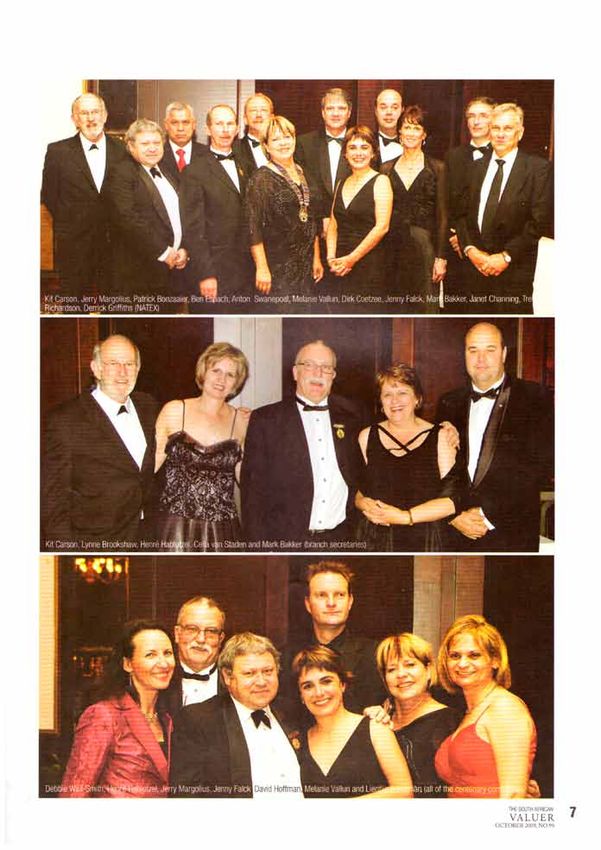
V P R E S I D E N T ’S
                                                            LETTER
      THE SOUTH AFRICAN
     INSTITUTE OF VALUERS

                                                             G
                                                                        reetings fellow valuers.
NATIONAL EXECUTIVE
OFFICE BEARERS 2017/2018                                                As you read this, spring is upon us and
PRESIDENT                                                               another winter has passed – ‘Spring is
Patrick O’Connell
                                                             sprung and the grass is riz’. Similarly, a new year has
VICE PRESIDENT
Tracey Myers                                                 commenced in the world of the SAIV.
LEGAL AND CONSTITUTION
Derrick Griffiths (portfolio head), Adrian Vallun
MANAGEMENT AND FINANCE                              Our National AGM held in Durban this year was a resounding
Thys Beukes (portfolio head), Tracy Kuyk,           success. It was well attended by a number of esteemed Fellows, past Presidents and
Tracey Myers, Mark Bakker, Patrick O’Connell
MARKETING, SOCIAL MEDIA                             loyal members. Preceding the AGM, your National Executive met for two days on Institute
AND PUBLICATIONS                                    business with dedicated time set aside for the review of our strategy and SWOT analysis.
Tracey Myers (portfolio head), Rene Snyman,
Mark Bakker, Thys Beukes
                                                    The analysis shows that we are progressing well in bringing the SAIV to our members and
PROFESSIONAL LIAISON                                introducing value-adds to them.
Patrick O’Connell (CBE, VAs, IAAO, WAVO
and SAGI)
General Secretary (SACPVP, REIB, IVSC, REIZ         The most recent initiative of which we are tremendously proud is the provision of an online
and SERVICES SETA)
                                                    pre-recorded webinar with Q&A sections afterwards. If this sounds strange to you, visit our
Tracey Myers (RICS)
Adrian (AfRES)                                      website, www.saiv.org.za, to learn more. The reason that this is so important is that it affords
MEMBERSHIP AND DEMOGRAPHICS                         you, the member, the opportunity to earn CET points from your office. This not only ticks the
Adrian Vallun (portfolio head), Rene Snyman
EDUCATION AND CET PROGRAMMES                        box from the SACPVP’s perspective, but for those of you who are RICS members, it ticks the
Tracy Kuyk (portfolio head), Derrick Griffiths      additional box of Formal CPDs because there is a ‘test’ and outcome attached to it. I have
                                                    every confidence that this will prove to be popular.
GENERAL SECRETARY’S OFFICE

                                                    The next step is to look into live webinars with interactive audience participation – all from your
GENERAL SECRETARY
PO Box 35500, Menlo Park, 0102                      office desk! The purpose of this is to make your CET life easier and more effective. The seminars
t. 086 100 SAIV
                                                    and workshops will still be hosted so that we do not lose our networking opportunities.
f. 086 657 3164
e. gen@saiv.org.za
www.saiv.org.za                                     Following the National AGM, your new National Executive is made up as follows:
                                                    Patrick O’Connell			 KZN Branch and President
ACCOUNTS
                                                    Tracey Myers			Northern Branch and Vice President
e. accountsdesk@saiv.org.za
                                                    Adrian Vallun			Northern Branch
MEMBERSHIP
                                                    Derrick Griffiths			Northern Branch
e. membership@saiv.org.za                           Thys Beukes			       Central Branch
OTHER QUERIES                                       Mark Bakker			Eastern Cape Branch
e. info@saiv.org.za                                 Tracy Kuyk				Southern Branch
                                                    Rene Snyman			       Southern Branch
SAIV BRANCHES
CENTRAL BRANCH
                                                    Congratulations to all of you and thank you for making yourselves available to serve the SAIV
t. 053 831 6500        f. 086 657 3023
e. central@saiv.org.za                              and its members.
EASTERN CAPE BRANCH
                                                    A special word of thanks must go to Trevor Richardson who has elected to step down from
t. 041 396 1400        f. 086 657 3003
e. east@saiv.org.za                                 Natex and his role as Treasurer in order to make way for new plates at the dinner table, so
KWAZULU-NATAL BRANCH                                to speak. Trevor, thank you for steering the SAIV’s finances so well through some truly trying
t. 081 428 4137        f. 086 657 3031
e. kwzn@saiv.org.za                                 periods. You have fulfilled this role in an exemplary manner and the committee takes comfort
NORTHERN BRANCH                                     in the fact that the finances have been handed over to Thys Beukes in superb condition.
t. 012 348 1752        f. 086 657 3201
e. north@saiv.org.za
                                                    Thank you my friend, you have done well.
SOUTHERN BRANCH
t. 081 405 8402        f. 086 730 9193
                                                    In closing, welcome to Penny van Dalen who has joined us as Financial Administration Clerk
e. south@saiv.org.za
                                                    in the General Secretary’s Office, working closely with Anne-Marie Delport and our GS,
                                                    Melanie Vallun.

                                                    Patrick O’Connell                                                               THE SOUTH AFRICAN
                                                                                                                                    VALUER
                                                                                                                                    AUGUST 2017, NO 129   1
V E d i t o r ’s n o t e

                                 T
                                          he editor’s message at the beginning of a publication enables
                                          the editor to draw the attention of readers to certain articles in
                                          the issue. This is, however, not the ‘usual’ issue of The South
                                  African Valuer because it is the last of its kind – after just over 40
                                  years it will morph into a different publication.

                          In July 2005 when I first produced ‘the Valuer’ Saul du Toit was the president of the
                          Institute. There have been many presidents since then, but Saul was the first of many
                          helpful, willing people who stand out in my mind. I would like to mention in particular
                          Melanie Vallun who, through thick and thin, guided me in her inimitable way, through
                          the ways of the Institute; Derrick Griffiths for unfailingly contributing ‘Blast from the
                          past’, the scholarly ‘Legal Beagle’ and other articles; Janet Channing for clear and well-
                          written articles on mSCOA and, before that, CoGTA; Ben Espach for so many articles
                          on the MPRA, amongst others, and especially for advice on some tricky situations; the
                          specialist writers and, of course, the Fellows who shared invaluable wisdom gleaned
                          from decades of professional practice.

                          During the twelve years in which I have been associated with the Institute of Valuers
                          I have met and worked with many friendly, interesting and knowledgeable people.
                          Although I am not a valuer, I have come to identify with the Institute and have learnt a
                          lot about the valuation profession. In 2009 my husband and I attended the centenary
                          celebrations of the Institute (the oldest in South Africa) in Cape Town. It was clear to
                          see the high regard in which the Institute and its senior members are held. May this
                          continue for another hundred years!

                          I have so enjoyed producing 48 issues of The South African Valuer. I trust that these,
                          together with the earlier issues, will be kept and used for reference purposes.

                          So the only thing left is for me to say “totsiens, hamba kahle, ‘so long, farewell, auf
                          Wiedersehen, goodbye…’”.

                          And, in the language of the Institute’s motto - SINE INCLINATIONE – the meaning of
                          which is more relevant today than it ever was,
                          Ave atque vale

                                                   Patricia Leitich

                                                   patriciarosa@telkomsa.net
                                                   patricialeitich@gmail.com
                                                   011 442 5644

    THE SOUTH AFRICAN
    VALUER
2   AUGUST 2017, NO 129
The SA Valuer Editorial Panel:
Thys Beukes (Central Branch)
053 831 6500 / 071 600 5327
Mark Bakker (Eastern Cape Branch)
                                            CONTENTS
041 396 1400 / 083 227 3496
Janet Channing (KwaZulu-Natal
Branch)
033 343 2868 / 082 570 5834
                                           August 2017, no. 129
Tracey Myers (Northern Branch)
011 721 7141 / 083 408 1755
Dean Ward (Southern Branch)                 1   President’s letter
021 400 9915 / 082 714 9490
                                            2   Editor’s note
Editor and advertising:
Patricia Leitich                            4   Cover story: The history of The South African Valuer
patriciarosa@telkomsa.net
                                           9    National events 2017
                                                Agricultural land reform: KwaZulu-Natal Agricultural Union or Kwanalu, by Sandy la Marque
The editor welcomes contributions
(by way of letters or articles) that are
                                           17   Draft Regulations, Property Valuation Act 17 of 2014, by Janet Channing
appropriate and that address an is-
                                                Comments on the Draft Regulations by the SAIV
sue that is topical or of strategic con-
cern to the sector as a whole. These       25   The effect of electric vehicles on fuel filling stations, by Robrecht Tryhou
should be submitted to the editor at
patricialeitich@telkomsa.net for pos-      29   TUHF presents to the Institute of Valuers AGM in Eastern Cape, by Khumbulani Chikomo
sible publication. Please, use the SA
Valuer as your platform to promote         31   The importance of sectional title legislation for valuers, by Maryna Botha
dialogue between SAIV members.
                                           33   Legal beagle: The expert valuer and legal procedure, by Derrick Griffiths
The information and data presented
in the SA Valuer are recorded in           38   Relief for owners of landlocked land
good faith, using sources believed              Public purpose and public interest re expropriation of property
to be reliable.                                 Prescription of E-toll debt, Schindlers

The views and opinions expressed           42   John Loos writes
in the SA Valuer are not necessarily
                                                Long-term adaptation to increasing urban land scarcity continues
those of the SAIV, notwithstanding
                                                2017 second consecutive year of real house price correction?
                                                Major Gauteng residential regions
the fact the SA Valuer is the official
                                                Two most expensive markets: Atlantic Seaboard and City Bowl still strongest
publication of the SAIV. Neither are
                                                Residential property buying by foreigners
they representative of the opinions
                                                Mining town performances
of the editor. Copyright applies to
                                                Holiday town house price performance
all material contained in this issue
and reproduction in whatever form          51   The future is near, by Graeme Codrington
is not permitted without the written
authorisation of the editor.               52   SAIBPP Convention

                                           53   AI News: More than 600 attend International Valuation Conference in Ottawa

                                           54   SAIV at home
                                                Fellow in focus: Kenneth William Kahts
                                                Henré Habluzel reminisces
                                                Celia van Staden's SAI
                                                What is this on my table??? - Lynne Brookshaw
                                                General Secretary’s news
                                                          Membership stats
                                                	Diary of upcoming events
                                                In Memoriam

                                           65   Professional Directory

                                                COVER: Covers of past issues - January 1984, March 1992, September 2003,
                                                       October 2009, May 2016, November 2016

                                                                                                                              THE SOUTH AFRICAN
                                                                                                                              VALUER
                                                                                                                              AUGUST 2017, NO 129   3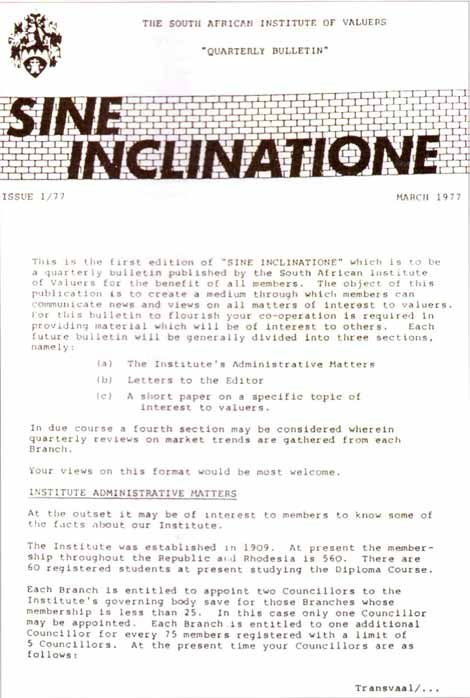
Cover story

    V The history of The South
               African Valuer

              T
                          his was first published in the July 2009 issue of this journal
                          (with the exception of the section from July 2005 to end).

    The first known publication by the newly established South         Over the next 33 years, information was given to members
    African Institute of Valuers was its ‘Official year book and       by way of the Presidential and Branch Annual Reports,
    Diary 1912-13’. The earliest available report, presented at the    occasional newsletters from the same sources and at Branch
    2nd Annual General Meeting of members of the Institute on          and General meetings.
    12 October 1911 reads: “Tentative negotiations have, in the
    past, taken place with the S.A. Accountant and Auditor, of         The 1947 Journal and Year Book (edited by the General
    which it was suggested that one page in each issue should          Secretary, Mr HS Clark) was next on the list and consisted
    deal with Institute matters. No arrangement was, however,          of 53 pages including advertisements. Item 6 of the Council’s
    concluded although some members agreed to subscribe for            published report for the year ended 31 March 1947 states:
    the publication.                                                   “In accordance with resolution (the) Annual General Meeting
                                                                       on 22/5/1946 states, this first issue is being made, which it is
    After resuscitation of the Institute in 1941 it was hoped to       hoped will be the forerunner of regular annual publications,
    arrange for the issue of a regular periodical (monthly or          although it is probable that subsequent issues may be
    quarterly) in collaboration with the Institute of Estate Agents    somewhat shorter.”
    & Auctioneers of South Africa. Paper shortage through war
    conditions, and uncertainty regarding the cost to members          There were never regular annual publications and the next
    of such a periodical, resulted in postponement of the project      was a 24-page brochure simply entitled ‘The South African
    as a joint venture. No record exists of any further publications   Institute of Valuers’ and containing basic Institute information
    until 1943 when a booklet containing the Presidential              – Council Members and Branch Executives 1949-50, Objects,
    Address – subject Appraisers and Appraisement – delivered          President’s Report, Training Scheme, List of Members and
    at the Annual General Meeting on 29 November 1943 by Mr            Tariff. The membership was given as 366 at 31 March 1949,
    CC Silberbauer, was printed. This was marked ‘For private          when the Institute celebrated its 40th anniversary.
    circulation only’ and ran to eleven pages.
                                                                       A similar brochure was issued for 1951-2 and this one was
    A tantalising small window on the past is contained in two         semi-bilingual.
    letters found amongst Mr Henry Hermann’s papers. These
    are dated 5 April 1944 from Dr E Landsberg of Cape Town            The 1957 Journal was completely bilingual, containing 15
    and 5 May 1944 from Mr HS Clark (as Secretary of the               pages of tables, measurements and formulae in addition to
    Institute), both addressed to Mr Hermann and relate to the         the tariff, a few articles on aspects of valuation and arbitration
    proposed publication of a monthly magazine – apparently to         and court proceedings and the usual Institute information.
    be issued by the Institute of Estate Agents and Auctioneers of     This issue is distinguished by the use of the wrong crest –
    South Africa and the SAIV. Dr Landsberg quoted, for editing        obviously not having been spotted by the proof reader! As a
    and producing 650–700 copies – to be sent, post free, to           result it was in Institute of Estate Agents and Auctioneers of
    the members of both Institutes – the sum of twenty eight           SA crest which appeared (four times).
    pounds per monthly edition. This worked out at a mere ten
    shillings and six pence for twelve copies and the magazine         In 1963 the Journal (fully bilingual and with the correct crest),
    would (at the outset) consist of four foolscap pages, without      apart from articles entitled ‘Leaseback’ and ‘The Valuer as
    advertisements. Regrettably, we have no record as to why it        an Expert Witness’ and some definitions of value, was more
    did not get off the ground.                                        or less restricted to Institute affairs. Numerous papers were

    THE SOUTH AFRICAN
    VALUER
4   AUGUST 2017, NO 129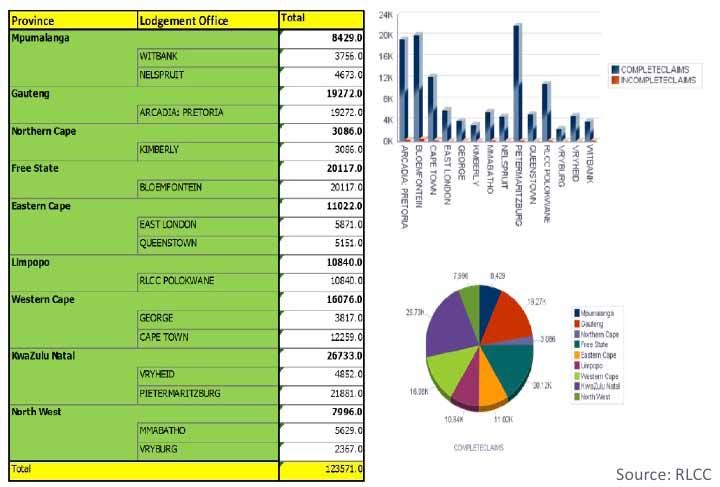
obtained by the editor but these were circularised                            canvassed in June 1972. As a result, the service
separately piecemeal over a period of about a year.                           was reduced from 1 January 1973, to cases
They covered a wide range of valuation types and                              dealing with valuations and property matters
related subjects, most were prepared by members,                              only, This, of course, meant that cases were
but in the case of specialised, unusual subjects                              selected, were sometimes few and far between
such as surface mines, plantations and even                                   and that issues were thus not received regularly
livestock, by non-members.                                                    each month.
                                                           CC Silberbauer

The 1963 issue was the last of that style of Brochure/                        In 1973 the Papers and Publication Committee
Journal and in 1968 an information booklet entitled                           (a new name) advised the Council that it had not
‘National Diploma in Valuations’ appeared. This                               implemented the 1970 decision to use applicants
contained     the   syllabus,   general    instructions                       papers since, after study of all those submitted, it
and useful general information regarding ‘The                                 felt they were not suitable for the purpose. At the
Valuer, what he does and what he earns’.                                      request of the General Secretary, the American
Copies of each Brochure/Journal were always                HS Clark           Institute of Real Estate Appraisers had sent
sent to banks, trust and insurance companies,                                 some 200 pages of photocopies of articles on
other financial institutions, as well as provincial                           condominiums (sectional titles). These were bein g
and government departments – all potential                                    studied by the Committee chairman (Mr LJ Heller)
client groups.                                                                and if thought worthwhile, a copy would be sent to
                                                                              each Branch Secretary.
The Council was concerned about this general
communications gap and, at its meeting in June                                In 1974, there was talk of issuing an Annual Journal
                                                           JH Hermann
1970, ‘a standing committee, to deal with all                                 but this did not come to anything The Council was
publications, was formed. It was felt that this                               told that there was a possibility of getting free
matter could take the form of papers to be sent                               copies (for all members) of the Institute of Estate
to members for which they could be charged a                                  Agents magazine to which the then President of the
fee, together with their subscription accounts                                Institute, Mr J Hermann, was invited to contribute
each year’.                                                                   an article on the aims and objects of the Institute
                                                                              to the Institute. The Institute of Estate Agents
It was suggested that some of the best papers,             LJ Heller          had also offered to publish regular articles about
submitted by applicants for membership should                                 the Institute. The matter was pursued and the
be considered for circularisation to all members                              magazine (The Agent) was later sent, free of charge,
and the matter was left for the new Publications                              to all members. In 1975, the Court Decisions and
Committee to consider. A year later, the council                              Papers and Publications Committees merged
appointed a second standing committee ‘to                                     as the Publications and Service Committee. The
examine court decisions and decide suitability                                Cape Branch reported that it had formed a Service
thereof for distribution’. These had been distributed on                      Promotion Committee and appealed for a national
                                                           AM Hyatt
odd occasions over the years but only on an irregular                         effort to improve this essential avenue. Detailed and
basis. This committee arranged for Prentice Hall                              comprehensive proposals had been submitted by
Services to send regular monthly copies of their Local                        a Councillor from the Cape and a long and fruitful
Government Legal Service to all members as from                               debate resulted in the proposals being adopted.
1 January 1972, at a cost of R5 per annum per member
– the Institute paid half and debited members with the                        In 1976 the Cape appealed for the proposals to
balance. The service covered other subjects as well                           be implemented and it was decided to ‘utilise the
as property and valuation cases.                           Patricia Leitich
                                                                              publication, The Agent, as a service to members
                                                                              and that a newsletter by periodically prepared by the
In pursuance of the Council’s decision to check                               Publication and Service Committee and circulated
members’ opinions as to whether (or not) this                                 (sic) amongst members” – this was the seed from
service   should    continue,   all   members     were                        which the Institute’s quarterly journal grew.

                                                                                                                      THE SOUTH AFRICAN
                                                                                                                      VALUER
                                                                                                                      AUGUST 2017, NO 129   5
SINE INCLINATIONE                                                “11.1 Sine Inclinatione (pic of page 83)
    In March 1977 Issue 1/77 of a ‘Quarterly Bulletin’, consisting
    of six pages was sent to all members of the SAIV. “The           A report and ‘Sine Inclinatione’ for the current quarter were
    name ‘Sine Inclinatione’ is the Institute’s heraldic motto       tabled. Mr Hyatt advised the meeting that quarterly Bulletins
    (which means ‘without bias’ and refers to the fact that that     will be issued and he stressed that the success of the Bulletin
    is the manner in which members approach their valuation).        could only be through contributions made by Councillors and
    The Editor Mr A.M. (Mike) Hyatt who was President for            Members. One Councillor spoke about the tremendous effort
    1979-80, carried the burden singlehanded and the birth           made by Mr Hyatt, but that was all. As Mr Redhill said in his
    of this publication is somewhat nonchalantly reported in         1977 Presidential report: ‘Members will only get out of it what
    the 1977 Council Minutes, as the opening of the following        they put in’.
    extract shows:

    THE SOUTH AFRICAN
    VALUER
6   AUGUST 2017, NO 129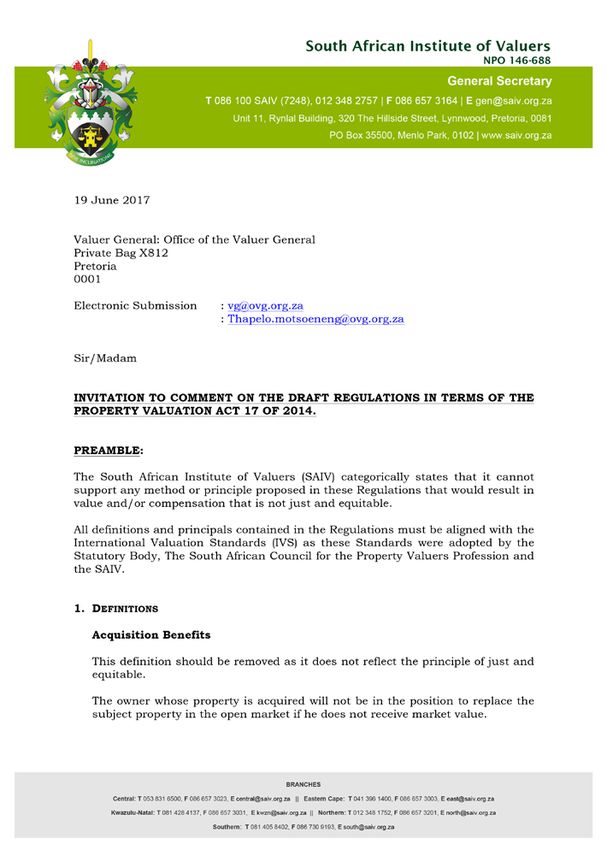
In the first issue Mr Redhill’s presidential message read:         active advertising policy. The South African Valuer became a
“Everything has to start somewhere and a regular Bulletin from     respected publication. Mr Jonker’s views on some valuation
your Institute may well be the forerunner of a local magazine      matters were often controversial but he did a fine job and
or journal which our profession so badly needs. The Institute      he can be proud of what he achieved. Initially articles were
has issued journals from time to time, but they have invariably    mainly sourced from overseas publications from bodies like
been ‘one-man’ publications and such a person is always            the New Zealand Institute of Valuers, The Australian Institute
hard to find.                                                      of Valuers and Land Administrators, the American Institute of
                                                                   Real Estate Appraisers, etc.
“I would like to congratulate the Publication and Service
committee on this first Bulletin and to hope sincerely that it     In June 1990 Mr Jonker was succeeded by Messrs Henré
progresses to the stage where the mail is eagerly sifted at        Hablutzel and John Hermann as joint editors. The journal
each quarter by members in anticipation of the next issue.         continued to grow, including more and more local articles as
In order to keep such a publication alive there must be            interest in the profession increased. Mr Hablutzel continued
interaction between the editors and members. It is essential       as editor until March 2005 when the volume of articles and
that members continually contribute to it. It may be a gripe,      the demand for the journal had grown to such an extent that
or it may be an article on some aspect of valuing. It may          it could no longer be managed ‘in house’.
even be a cry for help with a valuation problem which is
causing difficulty, but only communication will keep it alive      Patricia Leitich took over as editor in July 2005. The journal
and you, the member, can do this.” [The current editor would       was produced quarterly each year.
like to echo this sentiment.]
                                                                   Although it was intended that the journal should be self-
Mike Hyatt continued to do a superb job until June 1981, when      sustainable, advertisers who were loyal at first began to
pressure of work forced him to look for a successor. The Cape      fall away because of the journal’s low circulation figures; in
Branch offered to assume responsibility for the bulletin from      the later years the entries in the Professional Directory also
July 1981 and it appeared ‘under new management’ from              declined as some members felt that there was little point in
Issue No.2/81 of August 1981. The editors were Messrs. RS          advertising to their own profession. The Institute therefore
Marten, JH Hermann and DA Heel. February 1982 (No.2/82)            started to subsidise the production and distribution of the
has an editorial (redaksioneel) indicating that the Council        journal from mid-2008.
had decided that Sine Inclinatione was to be produced by
a sub-committee of the Cape Branch. Mr AJ Jonker was the           The number of pages increased gradually over the years from
member of that committee who took the editorial ‘chair’. He        28 in 2005 to 40 pages, 58 pages and once to 80 pages, but
remained there until he too found that pressure of work forced     averaging at around 50.
him to resign in June 1990, successors being Messrs CH
Hablutzel (Jnr) and JH Hermann.                                    In January 2006 a tribute to John Hermann, the oldest serving
                                                                   member of the Institute, who had passed away the previous
Under Mr Jonker’s guidance, the publication flourished and         month, written by Henré Hablutzel was published. Both these
the last of what might be called ‘cyclostyled’ issues appeared     gentlemen were previous editors of the journal and both past
in August 1983. Council authorised the editorial staff to use      presidents of the Institute. The passing of prominent members
their discretion and the style, name and format were changed.      of the Institute was acknowledged over the years and tributes
The first issue of the newly named The South African Valuer        written: in 2007 Chris Smal, another past president of the
appeared in January 1984 under the now familiar cover title,       Institute and contributor to the journal; Valmond Ghyoot,
alongside the Institute’s crest and name. This was a printed       educator, in 2012; Steyn Rivett-Carnac in 2014, Courtney
publication and the title appeared in Afrikaans in alternate       Redhill in 2016; and Emil Weichardt in 2017, amongst others.
issues, Most of the material was in English as a result of the
editor’s constant appeals for articles and material in Afrikaans   In 2009, the centenary year of the Institute, The South African
having apparently fallen upon deaf ears. Advertisements have       Valuer welcomed the Institute’s first lady president, Melanie
appeared, on occasions, but not regularly. The new editors         Vallun. The October issue of that year sported the word ‘Valuer’
had the National Executive’s authority to pursue a more            embossed in gold and the articles captured the festivities of

                                                                                                                     THE SOUTH AFRICAN
                                                                                                                     VALUER
                                                                                                                     AUGUST 2017, NO 129   7
the centenary celebrations in Cape Town with photographs of          In 2015 the Institute signed a Memorandum of U
    the gala dinner and details of the other events.                     with the Royal Institution of Chartered Surveyors; in 2016
                                                                         MoUs were signed with the Real Estate Institute of Zimbabwe
    The covers of the journal varied greatly over the years,             and the Green Building Council of South Africa.
    depending on the cover story. This reflected what was taking
    place within the Institute, such as the biennial change of           The appointment of South Africa’s first Valuer-General in May
    president, the many seminars and workshops; and sometimes            2015 was also recorded.
    matters of significance in the country, such as transformation
    and the sponsoring of students to enable them to attend              In 2015 the National Executive decided that, in order to save
    the Institute’s seminars, workshops and the annual practical         costs, the journal would no longer be printed. The increasing
    workschool; the building of windfarms, progress in agriculture       price of printing and paper and the unreliability of Post Office
    or ‘green’ building. Regular articles kept members informed          deliveries (which resulted in many journals never reaching
    of new legislation and changes to existing legislation which         the adressees, and the postage costs being wasted) were
    affected them. Some regular contributions were written by            the main reasons for this. The last printed issue was No 120
    members and others by attorneys or advocates, specialists            of May 2015; all issues after that were distributed digitally.
    in their fields. Articles on developments in the local property      This method of distribution was found to have an unforeseen
    market appeared regularly.                                           disadvantage because some members, in particular retired
                                                                         members who no longer check their emails daily, were
    In early 2011 the World Association of Valuation Organisations       inclined to forget to download and read the journal.
    (WAVO) announced an initiative to focus on the importance
    of valuations. This was to be in the form of an International        The South African Valuer, together with the minute books of
    Valuation and Appraisal Week, from 1 to 6 November. The              Natex and the branches, and more recently the SAIV website
    SAIV endorsed this initiative and various workshops and              and emailed newsletters, has recorded the activities of the
    campaigns were held throughout South Africa. Both the                Institute and its members. There is no doubt that many will be
    Southern and Northern Branches of the Institute held                 sorry to see it change.
    one-day seminars during the first week of November; the
    presentations were written up in The South African Valuer.           As is stated earlier, “In the first issue Mr Redhill’s presidential
    The Northern Branch has continued this initiative and what           message read: ‘Everything has to start somewhere and a
    has become known as ‘the MPRA’ (Municipal Property Rates             regular Bulletin from your Institute may well be the forerunner
    Act) Seminar takes place during the first week of November           of a local magazine or journal which our profession so badly
    each year and is reported in the following issue of the journal.     needs.’” This The South African Valuer has certainly achieved.

    The National Executive decided in February 2011 to relocate
    the General Secretary’s office to Pretoria permanently with
    Melanie Vallun first as the Acting General Secretary and
    later as General Secretary, on a full-time basis. The July
    2010 issue of the journal and all subsequent issues carried a
    section ‘From the General Secretary’s office’ which dealt with
    in-house matters and advised members about upcoming
    events in all five branches. In addition, members were given
    detailed information of membership numbers of the Institute.

    Members who were elevated to Fellows and Life Fellows
    of the Institute, and those who received Certificates of
    Commendation appeared on the pages of the journal. In
    the final six issues Fellows who had been members of the
    Institute for many years were invited to tell their stories. These
    proved to be most enlightening and fine stories about South
    African valuation history.

    THE SOUTH AFRICAN
    VALUER
8   AUGUST 2017, NO 129
V National events 2017
T
he National Executive Meeting, National Annual General
Meeting and National Seminar took place from 24 to 26 May
and were presented by the KwaZulu-Natal Branch of the SAIV
at Makaranga Garden Lodge, Kloof, KZN.
On 25 May President Patrick O’Connell, delivered his The Institute’s express thanks are extended to these folk for
report for the year ended 28 February 2017. the role played at branch level in support of the objectives of
the branches and the General Secretary.
Members of the South African Institute of Valuers, it is with
pleasure that I present to you my President’s report for the The General Secretary’s office was manned by Anne-Marie
year under review. Delport and Charleen Joubert under the direction of our
General Secretary, Melanie Vallun. Thank you Melanie, to you
1. NATIONAL EXECUTIVE and your team who aim to provide a professional secretarial
The National Executive of the Institute was ably represented and administrative service to our members, which I know has
across all regions by the following members: been somewhat trying at times over the year. Your efforts
From the Southern Branch: Ali Sue Smith, Tracy Kuyk and are appreciated by me, the Natex team and members of the
Farrell October Institute at large.
From the Northern Branch: Gerrie Minnaar, Tracey Myers
(Vice President), Derrick Griffiths, Edwin Schoeman and 3. MEMBERSHIP
Adrian Vallun The membership of the SAIV still represents approximately
From the Central Branch: Thys Beukes 55% of all registered valuers in the country, and for the period
From the Eastern Cape Branch: Mark Bakker under review ended at 1164 members, some 2.27% down on
From the KZN Branch: Patrick O’Connell (President) and the previous year (which was 1191members).
Trevor Richardson (Co-opted Member of Natex to manage
the Finance Portfolio). We believe that this decrease in membership still strongly
tracks the reduction in registered persons at the SACPVP and
To my Natex team, thank you for your selfless efforts is largely a result of financial implications of individuals and
throughout the year and for making yourselves available to the perceived educational barriers to entry for new members
serve our members. In addition to this, thanks must also be to the profession. This is a matter which I am engaging the
expressed to the KZN Branch for hosting this AGM, our Natex SACPVP on and remains a work in progress.
meetings and the seminar tomorrow.
There was one nomination for elevation to Life Member of the
I would in particular, on behalf of Natex and the members, SAIV, this being Mark Bakker, Chairman of the Eastern Cape
personally like to thank Graham Allen, Trevor Richardson and Branch and immediate past President of the SAIV.
Nicole Ellis of the KZN Branch who went to great lengths to
put all of this together. There were five of our members who passed away during the
year under review.
2. THE SAIV SECRETARIAT 1) Purdon Gilmore on 23 April 2016 from the Southern Branch;
The branches of our Institute were ably managed by our 2)
Courtney Redhill on 13 June 2016 from the
branch Secretaries: Northern Branch;
Southern Branch – Denise Liebenberg 3)
Danie Janse van Rensburg on August 2016 from the
Northern Branch – Anne-Marie Delport Northern Branch;
Central Branch – Thys Beukes 4) Belinda van Rosenveldt on 20 November from the 2015
Eastern Cape Branch – Mark Bakker Central Branch and
KZN Branch – Nicole Ellis.
THE SOUTH AFRICAN
VALUER
AUGUST 2017, NO 129 95)
Johan (JC) Fourie on 29 November 2016 from the 7. SACPVP
Northern Branch. The Institute continues to engage with the SACPVP through
both our General Secretary at an operational level and myself
In addition to the above, we were made aware of the most with their President, Mr. Molefi Kubuzi. It is encouraging to
recent passing of two members, Emile Weichardt and Dylan see how our relationship with the SACPVP is growing back to
Hayward. Whilst these do not fall within the reporting period, the levels of the days of yore, where we almost acted as one.
I have included them in my report because of their closeness I have discussed with Mr. Kubuzie
to the SAIV. 1) Reservation of work
2) Diminishing numbers
4. FINANCES 3) Training and
The finances of the Institute are most professionally managed 4) Technology in valuations and the impact on the human
by our Treasurer, Trevor Richardson. The year under review element.
was yet again quite challenging and developments in our
country and economy certainly did not make things easier. This was the first of many meetings to come which I have all
confidence shall bode well for us as an organisation.
Trevor will elaborate more on this when he presents the
Institute’s financial position later on in the meeting. You should by now be well aware that the CET requirement
of the SACPVP has increased to 50 hours from the previous
5. SUBSCRIPTIONS FOR 2017/2018 40 hours, both over a five-year period. Please familiarise
The increase in the annual subscription for the forthcoming yourselves with these CET requirements as the SAIV does
year has been contained at 6%. This we have managed not issue CET certification; we merely provide the platform to
to do in the face of reduced membership and increasing obtain CET hours/points and confirmation thereof, which it is
annual costs. Please know well that every effort was made your responsibility to submit to the Council.
over the past three days of Natex meetings to keep these
fees contained. 8. The South African Valuer
The SA Valuer remains our flagship publication which we are
The new subscriptions for members will therefore now be indeed proud of. For the year under review we published four
R2 270 including VAT and for student members R570 including issues of this publication and, as you may have noticed, these
VAT. Invoices will be sent out shortly and in these trying times, have been in digital format. The reason for this is twofold:
if you consider that you may find difficulty in meeting this to free ourselves of the reliance on the unpredictable ‘snail
obligation, please make contact with our GS Office to make mail’ system and secondly, to recognise that we have a young
payment arrangements. base of members who work off mobile devices in a paperless
society. This radical move for the SAIV appears not to have
6. EDUCATION met much resistance from our members for which we are
Education is, in my view, the one pillar where the South African thankful, as this is one of the areas where we can expect to
Institute of Valuers stands head and shoulders above its see cost savings in time to come.
colleague voluntary associations. To this end, the branches
of the Institute contributed significantly in the delivery of To Patricia Leitich, thank you for your efforts with this
workshops and seminars over the year, which not only aids the publication (and for your patience with me in submitting my
broadening of one’s professional perspective, but also affords letter for each issue) as well as to the editorial panel who set
our professional community the opportunity to network with, or aside much of their personal time to ensure the correctness
re-connect with, other like-minded professionals. of the product being disseminated amongst our members.
Unfortunately the Institute no longer hosts the annual Practical To our members, thank you for your support of the publication
Workschool which has been taken in-house by the SACPVP and for the many articles which are submitted for insertion.
which now runs it on their own. The concern in terms of general Please don’t stop now, it just keeps getting better.
feedback from students is that there is more focus on the theory
and not the practical elements of the profession. We will continue
to engage with the SACPVP on this as an interested party.
THE SOUTH AFRICAN
VALUER
10 AUGUST 2017, NO 1299. WEBSITE In the evening 39 people attended the National Dinner at Quo
Our website is gaining traction all the time and finally evolving Restaurant. The dinner was preceded by the Fellows Gathering.
into a valuable tool for our members, as envisaged in our Mark Bakker, who was elevated to Life Member on 18 November
strategy plan. The registration for events is working well as 2016, was handed his certificate at the dinner (below).
is the downloading of the CET confirmation letters which are
ever important in the world of the SACPVP. Further exciting
enhancements to the website include:
• Webinars – both pre-recorded and live
• We are investigating an online payment process for
instances such as workshops and seminars, and to tie in
with the webinars.
• We are furthermore investigating the introduction of the
SAIV into the world of social media, which will bring the
SAIV to your fingertips on your smartphones.
10. MEMORANDUMS OF UNDERSTANDING
During the year under review, we renewed our MoU’s with:
• The Royal Institution of Chartered Surveyors (RICS) and
• The PVA and BVA voluntary associations.
Furthermore, we entered into a new association by way of
an MoU with the Real Estate Institute of Zimbabwe (REIZ),
another of our strategies of engaging cross-border. Both
their current President, Siza Masuku, and immediate past John Waldeck, Ben Espach, Dean Ward and Kit Carson
President, Mhlanguli Mpofu, were guests at our function in
May last year in Cape Town and I spent considerable time with
Siza at the RICS Africa Summit in Sandton in February this
year, to which I was graciously invited by RICS Africa General
Manager TC Chetty. In addition to this, our General Secretary
attended the REIZ Winter Workschool in my absence last July
where she extended membership of our organisation to their
members. This was met with gracious acceptance.
As a Natex, we are very proud of these associations and the
fact that we are growing our name, aims and objectives in
broader circles. EFT: Melanie Vallun, Adrian Vallun FRONT: Heather Donald, Tracey Myers,
L
Cherry Douglas, Tracy Kuyk, Mark Bakker, Derrick Griffiths BACK: Thys
Beukes, Dean Ward, Trevor Richardson, Patrick O’Connell
11. CLOSURE
Ladies and Gentlemen, in closure, it has been a good year for
the SAIV and the best is yet to come. Thank you for your time
and attendance here.
I move my report for adoption.
THE SOUTH AFRICAN
VALUER
AUGUST 2017, NO 129 11Mills Fitchet was represented at the dinner not only by their
partners, but they also sponsored a number of colleagues
who had recently passed their exams to attend the dinner.
Diners were entertained by Cheryl Engel, and Myles Buxton
who conducted the wine tasting.
The National Seminar was held the following day and was
attended by 46 people, made up of members, student
members and non-members. The theme of the seminar was Busisiwe Radebe, an economist with the Nedbank
‘Life is like a box of chocolates – something for everyone’. Group Economic Unit, representing the banking
sector, presented the possible scenarios for the
The five speakers came from a wide range of environments,
SA economy.
sectors and industries.
Representing the built environment, Trish Emmett of Dr Justin Barnes, chairman of B&M Analysts, was the
Emmett & Emmett Architects revealed the purpose representative of the industrial sector. Justin explained
and dedication that she has put into some of the firm’s the research which his company has conducted into the
key projects that have resulted in the preservation and CTFL (clothing, textiles, footwear and leather) sector and
enhancement of historical architecture in Durban. In her the influences that are driving retail trends and economic
presentation Trish introduced the valuation aspect of models at an international and local level. B&M Analysts is
restored buildings; this elicited comment and contributions a leader in industry policy development, benchmarking and
from the floor. The firm focuses primarily on conservation clustering methodologies, and world-class manufacturing.
and restoration projects to contemporary designs in the
fields of education, commercial, residential, industrial and
religious buildings; it has completed many award winning
projects in the Greater Durban area.
The agricultural sector was represented by Sandy la
Marque, Chief Executive Officer of KWANALU (KwaZulu-
Natal Agricultural Union). Sandy represents Kwanalu on
issue management and matters which the members have
Christine Platt, a member of Citiscope’s board of identified as key to the strategy of the union. She described
directors, also represented the built environment. Christine several of the key issues including: transformation and rural
is the former president of the Commonwealth Association development; safety and security; applications for fracking
of Planners and a leading activist and theorist on the and food security.
global urban scene. Christine informed the delegates
about the influence on local town planning practice by the
guidelines set by various world bodies, including the UN.
She highlighted the short time lines within which authorities
have to implement policies to cope with rapid global
urbanisation.Agricultural land reform
KwaZulu-Natal Agricultural Union or Kwanalu
The KwaZulu-Natal Agricultural Union represents all farmers The outcome of the most recent cases of farm murders in KZN
in KZN. Kwanalu’s strategic focus is to provide leadership on shows that of a total of 45 cases, 31 were found guilty and
all key agricultural issues to commercial farmers (of all sizes) sentenced, 9 are awaiting trial, one case has been withdrawn,
and related agricultural organisations in KZN. The union was one accused is deceased, two cases remain undetected and
established in 1890 and amalgamated in 1997 with all farmers two are under investigation. SAPS response and justice is
in KZN. noteworthy. Most court sentences were severe sentences
ranging from 10 years, 15 years, life plus 15 years, 20 years,
Its constitution gives guiding principles, with equal representation 25 years and in one case of two victims - 80 years.
for its broad collective base of farmers’ associations and
affiliates, commodities, agri business and educational
institutions. The collective membership is over 47 000. It is a A positive attitude causes a chain of
non-profit organisation with voluntary membership. reaction of positive thoughts, events
and outcomes. It is a catalyst and it
Kwanalu lobbies on behalf of its members in management sparks extraordinary results.
issues such as natural resources, labour and social investment, Wade Boggs
commercial policy, transformation and rural development, rural
safety and security, and communication and image building, as
Kwanulu is totally opposed to fracking, as illustrated below.
well as organisational and other general areas.
Kwanalu Safety and Security Desk
The desk represents Kwanalu on the provincial structures
and the National Safety Committee on matters such as stock
theft, non-ferrous metals, murders, attacks, etc. It gathers
details and statistics of crime, submissions for proactive action
and operational planning, advises and assists members with
continuation of service and follow up; it liaises with media and
stakeholders.
Kwanalu Guideline Documents cover land invasion, access
protocol, amongst other matters. The Desk provides expert
evidence in court cases and analysis of farm attacks Have we had success? YES! Collective action has resulted
and murders. in: KZN Northern vs Rhino Oil and Gas / Pasa / Minister -
judgment set aside numerous points with costs. KZN
Midlands vs Minister / ROG / PASA - interdict granted.
choolchildren illustrated their
S
opposition to fracking.
THE SOUTH AFRICAN
VALUER
AUGUST 2017, NO 129 13The pillars of land reform And now
Economic, political and social pressure is rising. Economic
growth is slow. Poverty and inequality casts a shadow. The
ruling party is under rising political pressure. Businesses are
in decline – with farming particularly hard hit. The rural poor
struggle to secure the necessities of life against severe drought,
water shortages, etc.
Land reform promises more than it delivers. Expectations
are rising on the back of government promises to accelerate
Source: www.landreformfutures.org and expand land reform. Much of the rural land that has
been transferred is not benefiting the new owners. Failures in
Land reform future scenarios agriculture intensify, bringing worries about food security.
www.landreformfutures.org
Land legislative and policy environment
• Reopening of restitution (MP Bill)
• Expropriation Bill
• Expropriation without compensation
• Strengthening of relative rights (50/50)
• Redistribution and tenure issues
• Draft Valuation Regulations - Property Valuation Act
• Draft Regulations of Agricultural Land Holdings Bill
This has brought about insecurity of tenure/title deeds, etc
leading to lack of investment, conflict , threat of food security,
and safety and security issues.
THE SOUTH AFRICAN
VALUER
14 AUGUST 2017, NO 129
www.landreformfutures.orgRestitution status prior to reopening of the Impact
land claims According to K Nzimande of the Department of Rural
Between 1998 and 2017 (19 years) two presidential deadlines Development and Land Reform, “only 25% of all land acquired
were not adhered to. By 2011 an estimated13 000 farms were by government within land redistribution and restitution in
in the freezer box. Little or no progress has been made in the KZN is in production; 75% is lying fallow, unproductive and
past seven years and land is not available for redistribution. infrastructure is deteriorating. Of the 25% in production, only
The uncertainty of claims has led to losses in investment in the about 20% (5% of total) is at a level of production of around
sector which has had a negative impact on production. The 60%, the rest is thus producing less than 60% of its potential”.
Land Claims Court track record is extremely poor; claims take
years and are expensive, often unaffordable. The reopening Compromise involves participating in the debate, being
of restitution has led to further court action. proactive, providing solutions or alternative models,
negotiating and hard bargaining, having a legal mandate,
respecting property rights, and being economic and social. It
Outstanding and status
also involves a media campaign.
Restitution of Land Rights Commission
Radical economic transformation is about people. Land
reform has made transferring land the only measure of
success. We need initiatives which are designed to improve
people’s lives, where land is but one of the components of
rural transformation. We must build trust through social
compacts, working tirelessly to improve our standing in the
rural communities through pragmatic projects.
Kwanalu Vice President, Phinias Gumede and farmers.
Kwanalu Rural Development Desk
This desk deals with farmer engagement and facilitates
linkages, training, capacity building and projects.
THE SOUTH AFRICAN
Farmers attending information and training sessions
VALUER
AUGUST 2017, NO 129 15As at 19 january 2016, 123,571 land claims had
been lodged
The world will not be destroyed by those who do evil,
but by those who watch them without doing anything.
Albert Einstein
Practical application - farmer and community-
led interventions
Kwanalu
Our goal is to produce top-quality commercial farmers to The voice of Agriculture:
secure the future of agriculture in South Africa. Die stem van Landbou:
Izwe Lezokulima in
KwaZulu-Natal
Kwanalu strives for “A
united and prosperous
agricultural sector”.
Sandy la Marque is the Chief Executive Officer of KWANALU. She
represents Kwanalu on issues of management and matters which
arry Gwala Agri, Umati, Weenen, Elandslaagte, Bothas Pass, individual
H the members have identified as key to the strategy of the union.
farmers, and others Email.info@kwanalu.co.za
033-3429393
THE SOUTH AFRICAN
VALUER
16 AUGUST 2017, NO 129V draf T reGulaTioNs, ProPerTy
valuaTioN acT 17 of 2014
T
he land is everything.” With the current property ownership
patterns tied to the previous injustices of apartheid,
Government is under pressure to deliver an effective and
meaningful land reform programme.
As part of our Government’s land reform process, the The proposed draft Regulations prescribe the determination
Department of Rural Development and Land Reform, under of value for the purposes of section 12(1)(a) as the current use
the auspices of the Property Valuation Act, 2014 (Act 17 of value + market value divided by 2 less historical acquisition
2014), has established an entity identified as The Office of benefits and state subsidies.
the Valuer General (OVG). The primary aim of the OVG is
to determine just and equitable compensation through the ‘Current use value’ is defined as the net present value of cash
valuation of property and movables as per instruction for the inflows or other benefits that the property generates for the
purposes of land reform. owner under lawful use. The ‘use value’ will largely be based
on the difference between market value and the income the
The OVG has received public comments about its proposed property generates for the owner. In this instance the Valuer
methodology to calculate the value of land identified for land General takes cognisance of the manner in which the property
reform. The proposed tenets for the determination of value has been productively managed. Was the property used as
are contained in the Draft Regulations, Property Valuation a productive agricultural unit or was the registered owner
Act 17 of 2014. The Act mandates the Valuer General to an ‘absentee landlord’ who used the property for ‘lifestyle
determine a value, based on the market value, in combination purposes’ rather than ‘livelihood’?
with the current use value, as stipulated in section 25(3)
of the Constitution, when calculating just and equitable There are a number of serious questions which are being
compensation. addressed through the draft regulation consultation process:
Is the proposed approach of valuing the ‘jockey’ as well as
The Valuer General conducted a series of workshops across the ‘horse’ fair to landowners who acquired their properties
the country to consult with industry professionals. The at market value? Has due consideration been taken of the
workshops were well attended with constructive engagements interests of bondholders who extended loans on the basis of
by the various stakeholders. market value?
To date, land reform has been a lengthy process from the
towN/ProviNcE DatE
initial lodging of a claim to the successful registration and
Durban (KZN) 19 June 2017
occupation by the beneficiaries. One of the challenges of the
East London (EC) 21 June 2017
proposed ‘current use value’ is for a landowner to practise
Cape Town (WC) 23 June 2017
unsustainable agricultural practices towards the end of a land
Pretoria (Gauteng) 6 June 2017 reform negotiation process to ‘inflate’ the current use value.
The establishment of the Office of the Valuer General was
originally triggered by alleged ‘golden parachutes’ or inflated
land prices paid by the state to willing sellers at the inception
of the land reform process, mid-1990s. The challenge of the
use of ‘current use value’ is that farmers may be pressured
to abandon sustainable agricultural practices to ensure they
receive a fair valuation for their land.
THE SOUTH AFRICAN
VALUER
AUGUST 2017, NO 129 17In a country where we experienced a contraction of the
agricultural sector last year owing to the drought in the
2015/2016 production season for summer grains and oil-
seed crops, these are real and pressing considerations.
The net effect of any compromising agricultural practices
would be inherited by the land reform beneficiaries. Due care
should be taken to ensure that the emerging landowners
are not burdened by receiving land that has been severely
degraded or overgrazed by intensive use.
All of these are legitimate considerations and questions which
deserve thorough investigation and debate. It is imperative
that the nature of the land itself and what is required for
sustainable agricultural processes is not overlooked by the
political debate. The OVG has undertaken to continue to
engage with the profession towards finalising and resolving
the Regulations. These will provide a clear way forward for the
valuation of properties for just and equitable compensation
for the purposes of land reform.
All written comments were submitted to the OVG by
19th June 2017.
Janet Channing (BA MPhil NDPV) is the
managing director of MetGovis (Pty) Ltd
and a professional valuer. She brings a
wealth of experience in local government
support and is always at the forefront on
commentary regarding new legislation.
Janet is a specialist in municipal valuation
and rating issues.
www.metgovis.co.za
Tel: 033 – 343 2868 or
email: janet@metgovis.co.za
THE SOUTH AFRICAN
VALUER
18 AUGUST 2017, NO 129Comments on the Draft Regulations by the SAIV
THE SOUTH AFRICAN
VALUER
AUGUST 2017, NO 129 19THE SOUTH AFRICAN
VALUER
20 AUGUST 2017, NO 129THE SOUTH AFRICAN VALUER AUGUST 2017, NO 129 21
THE SOUTH AFRICAN
     VALUER
22   AUGUST 2017, NO 129
THE SOUTH AFRICAN VALUER AUGUST 2017, NO 129 23
THE SOUTH AFRICAN
     VALUER
24   AUGUST 2017, NO 129
V The effect of electric
vehicles on fuel filling
stations
W
e are at the beginning stage of electric vehicles (EVs)
taking over the internal combustion engine car. Together
with many other emerging technologies this will materially
change the car landscape forever.
An EV can be charged at home, the office, a shopping combination of new technologies will provide for substantial
centre, effectively any parking space with sufficient electricity exponential improvements and change in the next ten years.
supply, and will most of the time not need a fuel filling station
any more. What effect will this have on fuel sales volumes, Below are some announcements and news article headlines
income, sustainability and value of existing fuel filling stations from the past month showing the accelerating exponential
in South Africa? Should current 2017 valuations already take trend.
this disruptive future trend into account? • China Is About to Bury Elon Musk in Batteries. (Bloomberg.
28 June 2017). As Tesla’s Elon Musk races to finish building
The adoption of electric vehicles in South Africa and most the world’s biggest battery factory in the Nevada desert, and
countries has been slow until now. The main reasons are will announce by the end of 2017 the locations for up to four
affordability, battery distance range and battery charging additional factories, Chinese companies plan to complete
speed. However this will change substantially in the next few the construction of a large number of battery factories by
years. 2021. China plans to have five million electric vehicles in
China by 2020.
Accelerating exponential disruptive change • The first Tesla 3 has rolled out from Tesla’s full scale
Recently almost weekly announcements are made which will production plant in July 2017. The Tesla 3 is the more
cumulatively materially change the car industry. The affordable brother of the Tesla S and Tesla X. The Tesla 3
most important of these are the development of massive sells at $35 000, achieves 350km of range on a charge and
manufacturing plants for the production of batteries and the can accelerate 0-100km in 5.5 seconds. The Tesla S has a
results of increasing competition between new and old car range of 500km and can accelerate 0-100km in a ludicrously
manufacturers. fast 2.5 seconds
• Volvo (Swedish brand now Chinese owned) announced on
New car companies include Tesla, Apple, Google and various 5 July that within 2 years their whole line will have electric
US and Chinese companies. Old car companies include engines and will no longer manufacture petrol-powered
BMW, Nissan, GM, Audi, Volkswagen and many others who cars after 2019.
have various new or improved electric vehicles in the pipeline. • Britain to ban new petrol and diesel cars from 2040. The
From Nissan’s Leaf 2018 250-km range and GM’s Chevrolet mayors of Paris, Madrid, Mexico City and Athens have
Bolt 2017 350+km range, to Audi’s proposed e-tron series said they plan to ban diesel vehicles from city centres by
(often called Tesla killers in Germany), to Jaguar’s I PACE 2025. The French government aims to end the sale of new
Concept ‘which will bring thrilling Jaguar performance’ to gasoline and diesel vehicles in France by 2040. (Reuters. 26
electric vehicles from mid-2018. July 2017)
• Electric cars will be as cheap as petrol models by 2025.
The fierce competition (in many cases for survival), government Battery manufacturing capacity will triple in the next four
incentives and regulations in various countries, and the years. (Bloomberg. 6 July 2017)
THE SOUTH AFRICAN
VALUER
AUGUST 2017, NO 129 25You can also read


