WHY ARE PEOPLE PROTESTING IN COLOMBIA?
←
→
Page content transcription
If your browser does not render page correctly, please read the page content below

WHY ARE PEOPLE PROTESTING IN
         COLOMBIA?
         Protes,Structural Violence, and ESCER in Colombia

Since April 28, 2021, there have been multiple      Agreement, were some of the reasons that
and massive social protests in hundreds of          drove citizens to take to the streets.
cities and municipalities in Colombia to express
citizens’ widespread social discontent in the       Likewise, the National Strike responds to some
face of the critical socioeconomic situation, the   structural causes related to ongoing violations
illogical and inefficient measures taken by the     of      Economic,     Social,   Cultural,   and
Colombian government in this regard, and non-       Environmental Rights (ESCER). The failure to
compliance with peace commitments.                  fulfill these rights has been aggravated by the
                                                    pandemic and the deepening of the social and
While it is true that the regressive tax reform     economic crisis that the COVID-19 health
proposal presented by the Ministry of Finance       emergency has brought on. Below are some
[1] was the trigger that prompted citizens to       figures and data on poverty, inequality, hunger,
take to the streets, other elements such as         unemployment, health, and the particular
growing poverty, unemployment, inequality,          situation of women in Colombia before and
racism, lack of educational opportunities for       after the pandemic, as elements of analysis to
young people,  the health reform, [2] the murder
       THE SECRET                                   understand the relationship between the failure
of social leaders and ex-combatants who signed      to satisfy ESCER and the social outcry in the
 BEHIND THIS TRAVEL
the Peace Agreement, as well as intentional         country.
non-compliance with the Peace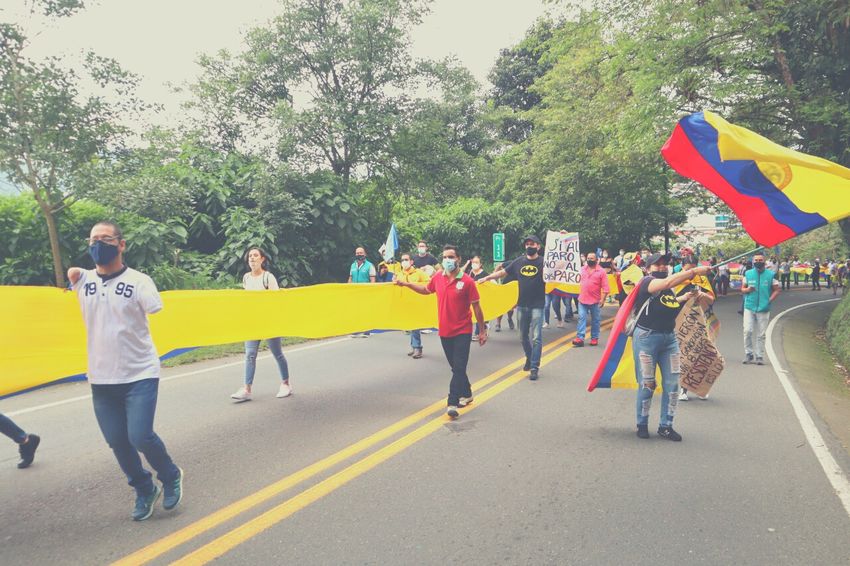
1. MONETARY POVERTY:                                 establishes that States must ensure that all
                                                     people have access to sufficient food to be
According to the National Administrative             protected from hunger and undernourishment.
Department of Statistics (DANE, 2021), 35.7%         However, even before the pandemic, food
of the Colombian population was living in            insecurity, undernourishment, and malnutrition
monetary poverty in 2019. In 2020, this figure       were the reality of hundreds of households, a
increased to 42.5% (21 million people). This         situation that has been aggravated by lockdown
means that there were 3.5 million more people        measures, job losses, business failure, and the
living in poverty in 2020 than in 2019. [3]          inability to access basic resources. [9]
Likewise, in 2020, records indicated that 15.1%
of Colombians were living in extreme poverty         Even with the existence of regular and
(7.5 million people), [4] 2.78 million more than     extraordinary food security programs at the
in 2019 [5].                                         national and territorial levels during the
                                                     pandemic, [10] the situation of hunger is
                                                     alarming. During the lockdown, hundreds of red
2. INEQUALITY:                                       rags were hung on the windows of homes across
                                                     the country as a sign of hunger. In February
In 2019, the Economic Commission for Latin           2021, the DANE’s Social Pulse survey found
America and the Caribbean (ECLAC) noted that         that 2.4 million households in the country live
Colombia is the second most unequal country in       on less than three meals a day (1.6 million
Latin America, Brazil. [6] Likewise, the 2020        families who, at the beginning of the quarantine
report on the Regional Development Index for         could eat three meals a day, can no longer do
Latin America (IDERE LATAM, for its acronym          so). Of those 2.4 million households, 179,174
in Spanish) stated that Colombia is the country      live on one meal a day and 23,701 are
with the greatest inequalities within its national   sometimes unable to receive even one plate of
territory, which means that no other country in      food a day.
Latin America has such large gaps between its
regions in terms of levels of development. [7] In
addition, inequality in Colombia increased           4. UNEMPLOYMENT:
during the pandemic. The country’s Gini
coefficient was 0.526 in 2019, and it reached
                                                     The unemployment rate in April 2019 was
0.544 in 2020. [8]
                                                     10.3%, equivalent to 2.5 million unemployed
                                                     people. [11] By April 2020, the unemployment
3. HUNGER:                                           rate had increased to 19.8%, with 4 million
                                                     people unemployed and an especially high rate
                                                     among women, given that highly feminized jobs
The International Covenant on Economic,
                                                     (care work, domestic work, hairdressing) and
Social, and Cultural Rights (ICESCR) recognizes
                                                     sectors with high female participation (tourism,
the right to adequate food in Article 11 and
                                                     transport, trade) were the first to be affected
by the pandemic. In 2021, there was a slight       regulatory agent, and the right to health
improvement in the unemployment rate (15.1%)       becomes a commodity. [17]
with 3.6 million unemployed people. [12]
                                                   The pandemic exposed the fragility of the
One of the main motivations of the National        health system. Lack of timely access to COVID-
Strike precisely has to do with the lack of job    19 diagnosis and medical care, misinformation
opportunities for young people. According to       about vaccines, and the delay in vaccines'
the DANE, the youth unemployment rate was          arrival and distribution, coupled with a
23.9% in the first quarter of 2021, with 1.6       shortage of intensive care units (ICUs)
million young people unemployed, 92,000 more       nationally, are areas of great concern. Added
than in November 2019. [13] Meanwhile, rural
employment is declining; although the
agricultural sector is fundamental to the                "THE PANDEMIC
country’s economy, the DANE recorded 4.6
million people employed in rural areas,
                                                          EXPOSED THE
compared to 4.1 million reported in May 2020.           FRAGILITY OF THE
[14]                                                    HEALTH SYSTEM"
Finally, it should be noted that informality is
                                                   to this are the precarious conditions of health
growing. As of March 2021, informal
                                                   workers, reflected in the increase in working
employment had risen to 49% (DANE, 2021).
                                                   hours and workload and the decrease in wages.
This population does not have a fixed
                                                   These phenomena are only a small sample of
remuneration, labor guarantees, or social
                                                   critical structural conditions, such as the
protection      (pension   contributions    and
                                                   following: more than 43% of health personnel
affiliation to Occupational Risk Administrators,
                                                   have a type of indirect labor relationship, that
known as ARLs for their acronym in Spanish, or
                                                   is, through third parties, which enables greater
public health insurance entities, known as EPSs
                                                   violation of labor rights; many institutions did
                                                   not provide biosafety-related PPE for staff; and
                                                   measures to increase workload or reduce wages
5. HEALTH:                                         could not be addressed effectively. As of
                                                   October 2020, 229 health workers had already
                                                   died from COVID-19. [18]
In Colombia, the health system already
reflected deficiencies before the pandemic in
terms of the availability, quality, and
                                                   6. WOMEN:
accessibility of different services, as the
Committee on Economic, Social, and Cultural
Rights (CESCR) had found in its last review on     There are 22.6 million women in Colombia,
Colombia. [15] The number of complaints and        representing 51.2% of the country’s total
tutelas (a Colombian legal mechanism to            population. [19] Despite being the majority,
protect fundamental rights) are high and           women face a wide range of structural
increasing. There is no priority health care for   inequalities, which are reflected in barriers and
vulnerable population, [16] and the insurance      gaps in the workplace; in power and decision-
model established by Law 100 of 1993 handed        making spaces; and in access to education,
over health service management to health           health, and sexual and reproductive rights,
companies. The State thus disappears as a          among others. [20]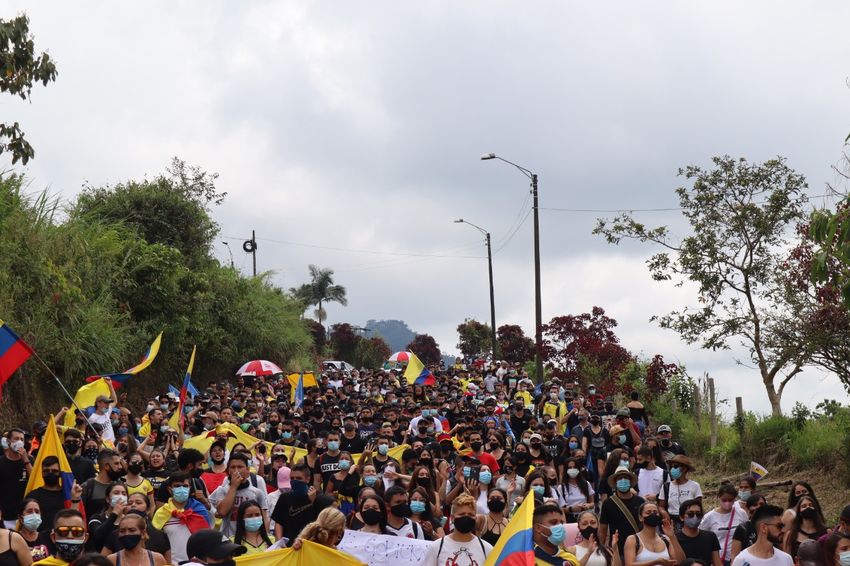
In the economic and labor domain, nearly 3 out   CITAS BIBLIOGRAFICAS
of 10 Colombian women aged 15 and over have
no income of their own, as opposed to 1 in 10
                                                 [1] The “Sustainable Solidarity Law” tax reform bill
men. The unemployment rate in April 2021 was     submitted by the national government to Congress
12.1% for men and 19.1% for women. Of the        on April 15, 2021 aimed to raise approximately 23
456,000      people    who  came     out    of   trillion Colombian pesos (approximately US$6.3
                                                 billion) through measures such as the following: the
unemployment, 410,000 are men and just           collection of value-added tax (VAT) on basic
46,000 are women, meaning that for every 10      consumer products such as utilities (water,
men who obtained employment, only one            electricity, and gas), funeral services, electronic
                                                 products such as computers (which had been
woman could do so. [21] In addition, women
                                                 previously exempt), and tolls within cities, among
receive 12.1% lower pay for their work than      other         regressive      measures.        See:
men. Unpaid domestic and care work (UDCW) is     https://bit.ly/3iLDHxZ
mostly performed by women, who devote 78%
of their annual time to care work, while men
                                                 [2] Bill 010 of 2020 proposed a health reform that,
spend only 22% of their hours on these tasks.    according to various academics, organizations, and
This disproportionate distribution decreases     movements in the health sector, would deepen the
women’s time to exercise other rights, such as   privatization of the health system and market
                                                 model and would not improve the conditions of
studying, working formally, or enjoying rest,    health workers, access to health services, or the
self-care, and recreation.                       financial state of clinics and hospitals. To read the
                                                 bill, see: https://bit.ly/3zzxQ4T
Finally, the lockdown measures resulted in an
                                                 [3] It is estimated that more than 21 million people
increased risk of experiencing gender-based      subsist on less than $331,688 COP per month
violence (GBV); between March 2020 and           (approx. US$90).
February 2021, calls to hotlines to help with
                                                 [4] According to the DANE, Colombians who live on
these cases increased 84%. Feminicides have
                                                 less than $145,004 COP per month (approx.
also increased. According to the Attorney        US$90).
General’s Office, 147 women were victims of
feminicide in 2020, although civil society       [5] DANE, April 29, 2021. Comunicado de prensa
                                                 sobre pobreza monetaria Año 2020. Available at:
organizations estimate that there were 217       https://bit.ly/2U5fLve
victimis. [22]
                                                 [6] OECD et al. (2019). Latin American Economic
                                                 Outlook 2019: Development in transition. Available
                                                 at: https://bit.ly/3xP9h25

                                                 [7] Universidad de los Andes. May 2020. Covid-19.
                                                 Sus efectos de pobreza y desigualdad en Colombia.
         Colombian Platform for Human Rights,    Available at: https://bit.ly/3gw94v8
                Democracy, and Development
                                                 [8] DANE, op. cit
(Plataforma Colombiana de Derechos Humanos,
                     Democracia y Desarrollo)    [9] Chaverra, T. et al (2020). El hambre en tiempos
                                   June 2021     de COVID-19: Exacerbación de un problema oculto.
                                                 Salutem Scientia Spiritus 2020; 6:174-180.
                                                 Available at: https://bit.ly/3zJdHJZ

                                                 [10] Dejusticia. (2020). Políticas, hambre y Covid-
19.   Del     miedo   a        la   acción.   Available   at:   o communicate the Technical Secretary of the Platform,
https://bit.ly/2SB4zGy                                          please contac us at plataformaco@gmail.com or the
                                                                following numbers:
[11] El Espectador, May 31, 2021, Tasa de desempleo en
Colombia se ubicó en 15,1 % en abril de 2021. Available         Viva la Ciudadanía - Aura Rodríguez
at: https://bit.ly/3wESDC6                                      Secretaria técnica
                                                                aura.rodriguez@viva.org
[12] DANE, May 31, 2021, Comunicado de prensa Gran              Tel: 3167405749
Encuesta Integrada de Hogares (GEIH) abril 2021.
Available at: https://bit.ly/3zxOCkV                            Vanessa Cárdenas
                                                                Profesional de apoyo
[13] La República, May 13, 2021, El desempleo juvenil se        apoyoplataformadesc@gmail.com
ubicó en 23,9% y contó con 1,6 millones de personas en          Tel:3153540997
marzo. Available at: https://bit.ly/3vBDn82
                                                                Paola Almonacid
[14] Morales, A. (2020). El desempleo: una pandemia que         Apoyo administrativo
azota a Colombia. Universidad EAN.                              plataformaco@gmail.com
Available at: https://bit.ly/2TKBcSk                            Tel:3144249194

[15] PCDHDD. Resumen ejecutivo del informe alterno              Sandra Gutiérrez
de la sociedad civil al VI informe del Estado colombiano        Comunicaciones
al comité DESC. Available at: https://bit.ly/3gHwc8J            comunicacionesPCDHDD@gmail.com
                                                                Tel:3183886892
[16] Defensoría del Pueblo. Informe Alterno al Sexto
Informe del Estado Colombiano ante el Comité de
Derechos Económicos, Sociales y Culturales 2010                 Sigannos en redes sociales a través:
-2015. Available at: https://bit.ly/3zBvgvd
                                                                     Facebook: PlataformaDesc
[17] Jiménez, W. (2009). El derecho a la salud. Una
búsqueda inacabada para la sociedad colombiana.                      Instragram: plataformadesc
Available at: https://bit.ly/3wF0QGq
                                                                     Twitter: PlataformaDesc
[18] Cfr. Infobae. Los héroes que hemos perdido.
Personal de Salud fallecido por Covid-19 - Infobae.com               Youtube: Plataforma Colombiana

[19] DANE, Censo Nacional de Población y Vivienda,                   https://ddhhcolombia.org.co/
2018.
                                                                     plataformaco@gmail.com
[20] DANE; CPEM; UN WOMEN. (2020). Informe
Mujeres y hombres: brechas de género en Colombia.                    Cl. 54 #10-82, Bogotá/
Available at: https://bit.ly/3zu3uAK

[21] El Espectador, op. cit.

[22] United Nations Population Fund (UNFPA).
Comunicado Día Internacional de la Mujer 2021.
Available at: https://bit.ly/3wFiTMG
  See: Sisma Mujer (2021). Boletín No. 25. Día
Internacional por los derechos de las mujeres. Available
at: https://bit.ly/2SdDucg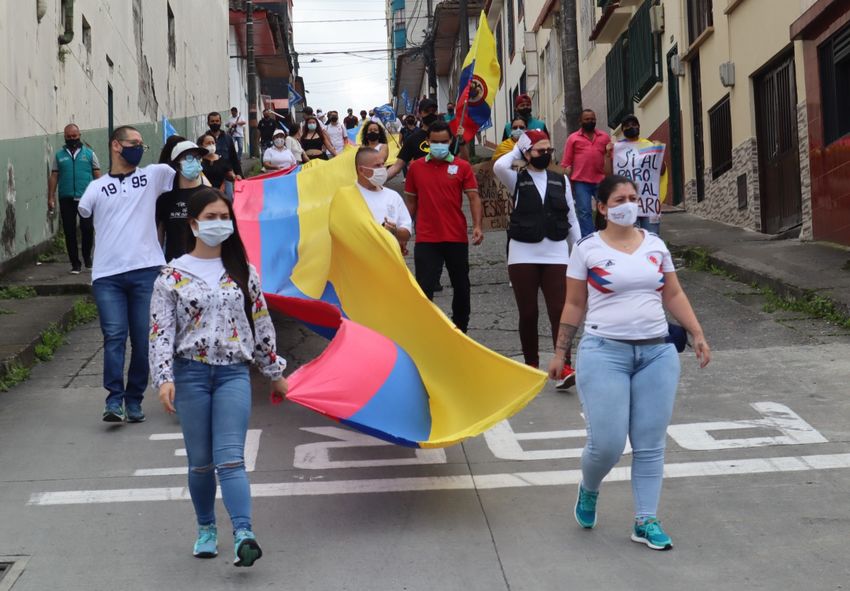



You can also read


