With Fracture Liaison services - Make the FIRST break the LAST
←
→
Page content transcription
If your browser does not render page correctly, please read the page content below
Make the
                                                                FIRST break

Make the FIRST break the LAST
                                                                   the LAST
                                                     FRACTURE    LIAISON SERVICES

               with
Fracture Liaison Services

          Stop the unnecessary suffering — implement FLS by 2015              1
Make the
FIRST break
the LAST
FRACTURE LIAISON SERVICES
Executive
Summary
Osteoporosis Canada
urges all jurisdictions
to implement FLS by
2015
Introduction
E
ach year, hundreds of thousands of Canadians needlessly
experience debilitating fractures because the underlying
cause of their broken bones — osteoporosis — was undetected
and untreated1-4. These fractures impose a tremendous burden
on ageing Canadians, our health care and social systems, and the
national economy as a whole1. This expert report examines the
magnitude of this burden and describes a cost-effective model of
care that has been proven to minimize the impact of osteoporosis
and repeat fractures.
Unnecessary Pain and Suffering
Approximately half of all patients who suffer a hip fracture warned
us they were coming; they had previously broken another bone —
a ‘signal’ fracture — before breaking their hip5-8. Effective drug
treatments can reduce future fracture risk by 50% for patients
presenting with fragility fractures9. These treatments have been
available for 20 years and yet, 80% of Canadians who suffer a
2 Stop the unnecessary suffering — implement FLS by 2015
Make the
FIRST break
the LAST
FRACTURE LIAISON SERVICES
fragility fracture still do not receive treatment
Table of Contents
for their underlying osteoporosis2, 3, 10. This is
the post-fracture osteoporosis care gap which
is allowing the cycle of recurring fractures to
continue at great expense to both patients’
quality of life and the healthcare system.
The post-fracture osteoporosis
care gap in Canada............................................ 4
Unnecessary Expenditures
The total cost of osteoporosis in Canada was The human and economic burden of
$2.3 billion in 20101. This is not surprising given osteoporosis in Canada..................................... 4
that the 30,000 Canadians who experience a
The post-fracture osteoporosis care gap................ 5
hip fracture each year11 spend an average of 23
days12 in hospital and rehabilitation centres at an Why the care gap exists.................................... 6
average acute care cost of $20,000 per patient1.
Nearly a quarter of these end up in long-term Clinically effective and cost-effective
care facilities13, 14 leading to $600 million in annual systems of post-fracture care............................... 7
costs1 with additional costs attributable to the
170,000 other fragility fractures per year of the A business case for access to Fracture
spine, wrist, shoulder, pelvis and other bones11, 15. Liaison Services throughout Canada..................... 10
As Canada’s baby boomers continue to age,
the impact of this very common bone disease Clinically effective care needs to be
is only set to increase. Unfortunately, Canada cost-effective care........................................ 10
is still lacking a systematic approach to reduce A generic business case template for
the incidence, burden and cost of osteoporotic Fracture Liaison Services in Canada.................... 12
fragility fractures.
Key steps to implement a Fracture
The Cost Effective Solution — Closing Liaison Service............................................... 13
the Gap with Fracture Liaison Services
A growing number of innovators in Canada16-21
Delivering globally endorsed
and abroad22-26 are establishing Fracture Liaison
standards of care............................................ 14
Services (FLS). FLS ensures that all patients
who present with a ‘signal’ fracture receive the
Summary and Recommendations......................... 15
osteoporosis care they need to prevent future
fragility fractures. The results are irrefutable: FLS
References.................................................... 17
significantly reduces the incidence and disability
of repeat fractures and has been proven to be
Appendices
cost-effective. The comprehensive set of appendices below are available to
download from osteoporosis.ca/FLS
The Benefits of FLS A. The human face of osteoporosis
• Improved quality of life and enhanced B. Fracture incidence and costs by province
C. Best practices for post-fracture osteoporosis care: Fracture
independence of seniors
Liaison Services
• Reduced incidence of avoidable — and
D. Other models of post-fracture osteoporosis care
often life-threatening — fractures E. Generic Fracture Liaison Service business plan template
• Reduced disruption to patient flow in the F. Potential cost savings of FLS by province
health care system by: G. How to start and expand Fracture Liaison Services
— decreasing pressure on already scarce H. Step by step guide to setting up a Fracture Liaison Service
orthopaedic resources I. Algorithms for FLS by fracture type (including templates for
— freeing up capacity for elective form letters to Primary Care Providers).
surgery J. Other practical tools for FLS
— decreasing pressure on long-term care K. Fracture Liaison Service online resources
beds and demand for home care L. International Osteoporosis Foundation Capture the Fracture
Best Practice Framework
• Significant cost-savings
Stop the unnecessary suffering — implement FLS by 2015 3
Make the
                               The post-fracture osteoporosis care gap is:
           FIRST break         n Allowing countless Canadians to needlessly suffer debilitating and life threatening repeat fractures
              the LAST         n A huge financial burden on healthcare budgets
FRACTURE    LIAISON SERVICES   n Readily eliminated by broad implementation of Fracture Liaison Services

The post-fracture osteoporosis
care gap in Canada
A preventable burden
on older Canadians
and healthcare
budgets

In 2011,
Osteoporosis
Canada published
the White Paper                The human and economic burden                      The rest will experience a significant
                               of osteoporosis in Canada                          reduction in their quality of life35-37.

                               C
— Towards a                           anada is entering a period of rapid             The total number of fragility fractures
Fracture-Free                         ageing. By 2031 almost a quarter            occurring in Canada is in the order of
                                      of our population will be seniors as        200,000 cases per year among women and
Future27 — which               compared to 15% in 201128. Among these,            men11, 15. To put this in context for women,
highlighted                    at least 1 in 3 women and 1 in 5 men will          this considerably exceeds the combined
                               suffer a fragility fracture in their lifetime      number of heart attacks, strokes and new
a nationwide                   due to osteoporosis29-31. A fragility fracture     diagnoses of breast cancer annually (figure
post-fracture                  is one occurring spontaneously or following        1)11, 15, 38, 39.
                               minor trauma such as a cough, a sneeze                 In 2010, osteoporosis was estimated
osteoporosis                   or a fall from standing height or less32.          to cost $2.3 billion in Canada1. The acute
care gap that                  Fragility fractures, which occur mostly at         care cost of treating a single hip fracture
                               the hip, wrist, upper arm, pelvis or spine,        is $20,000. The total length of stay for hip
is leaving older               make osteoporosis the most common                  fracture patients in Canada is of the order
Canadians                      chronic bone disease33 and a major source          23 days12. For the 15%-25% of hip fracture
                               of diminished productivity and quality             patients who subsequently require admission
needlessly at                  of life. Osteoporosis affects not only             to a nursing home13, 14 the total cost of care
risk of suffering              those afflicted with the disease, but their        including costs for long-term care facilities
                               families, friends, employers and caregivers        is over $44,000 in the first year for each
future fractures.              as well. Appendix A illustrates the faces of       fracture40. A summary of the direct costs
                               osteoporosis.                                      for fracture care at the provincial level is
                                   The most devastating of all fragility          provided in Appendix B.
                               fractures are hip fractures. About 30,000              In 2007/8, fractures caused by
                               Canadians break their hip every year11; of         osteoporosis were responsible for >57,000
                               these, 28% of women and 37% of men will            acute care admissions and >830,000
                               die within the first year after fracture34.        hospitalisation days1. For individuals

4      Stop the unnecessary suffering — implement FLS by 2015
Make the
                                                                                                                  FIRST break
                                                                                                                     the LAST
Figure 1. Incidence of osteoporotic fracture, heart attack,                                            FRACTURE    LIAISON SERVICES

stroke and breast cancer in Canadian women11, 15, 38, 39
                                                                      fractures occur. This is the
                                                                      post-fracture osteoporosis
                                                                      care gap.
                                                                          Even though bone             Simply put,
                                                                      mineral density (BMD)
                                                                      testing is widely available;     half of all
                                                                      even though we can reduce
                                                                      fracture risk by 30-70%          hip fracture
                                                                      within the first year of
                                                                      treatment with a broad           patients had
                                                                      range of highly effective
                                                                      medicines; even though           already warned
                                                                      these medications are
                                                                      funded by provincial drug        us they were
                                                                      plans; even though the 2010
                                                                      Osteoporosis Canada Clinical     coming
                                                                      Practice Guidelines9 clearly
                                                                      state that individuals aged
                                                                      over 50 who have suffered a
                                                                      fragility fracture should be
aged 50-69 years, over 3 million work days         assessed for risk factors for osteoporosis and
were missed, with days spent in hospital or        fracture, nevertheless, >80% who fracture are
receiving home care accounting for 90% of          neither assessed nor treated. A pervasive care
working days lost. Care givers lost a total of     gap is still evident across Canada2-4, 10, 45-61.
$69 million in wages. Furthermore, 47% of              This 80% post-fracture osteoporosis care
fracture sufferers who participated in the         gap is in stark contrast to the excellent rates
Canadian Multicentre Osteoporosis Study            of secondary preventive care offered to heart
(CaMos) reported using informal care provided      attack victims62 as shown in figure 2. Given
by family members or friends41.                    the major impact of osteoporotic fractures on
    Osteoporosis imposes a tremendous              individuals and healthcare budgets, we need
financial burden on our healthcare system,         to care for victims of ‘bone attacks’ just as
fracture patients and their families.              well as we do victims of heart attacks.
Enhancing patient flow in Canadian hospitals
has been the subject of considerable activity
in recent years42-44. Fragility fractures create
a patient flow burden in terms of unscheduled      Figure 2. Secondary preventive care after
acute care bed occupancy and subsequent
                                                                                                       At least
                                                   fragility fractures compared to heart
demand for placement into alternative-level-
                                                   attacks10, 62                                       1 in 3
of-care environments.
                                                                                                       women and
The post-fracture osteoporosis                                                                         1 in 5 men
care gap
                                                                                                       will suffer
Individuals who suffer a fragility fracture are
at substantially increased risk of suffering                                                           a broken
second and subsequent fractures. Crucially,
half of all patients who suffer a hip fracture
                                                                                                       bone from
had previously broken another bone — a                                                                 osteoporosis
‘signal’ fracture — before breaking their
hip5-8. In other words, half of hip fracture                                                           in their
patients had already warned us they were
coming when they had their signal fracture.
                                                                                                       lifetime
Unfortunately, for the vast majority,
osteoporosis is not diagnosed when ‘signal’

                                             Stop the unnecessary suffering — implement FLS by 2015                             5
Make the
            FIRST break
               the LAST
 FRACTURE    LIAISON SERVICES

                                Why the care gap exists                          ‘signal’ fracture7 — created an opportunity
                                                                                 for osteoporosis assessment and treatment.
                                A significant body of work has been
                                                                                 Each time this opportunity was missed,
Broken bones                    undertaken in Canada and internationally
                                                                                 the patient was left needlessly at risk and
                                to understand why the post-fracture
                                                                                 continued to suffer subsequent fractures
from osteoporosis               osteoporosis care gap exists and how it can
                                                                                 until finally devastated by a hip fracture.
                                be eliminated63-70. Put simply, there is a
are more common                 disconnect between the management of the
                                                                                 This is why the post-fracture osteoporosis
                                                                                 care gap must be eliminated.
than heart attack,              fracture, usually by orthopaedic services,
                                                                                      Osteoporosis Canada is committed
                                and recognition and management of the
                                                                                 to working with all key stakeholders in
stroke and breast               underlying osteoporosis (BMD testing and/or
                                                                                 Canada — policy makers, professionals in
                                osteoporosis treatment) as follows71:
cancer combined                   •		The fracture is treated as an acute
                                                                                 all relevant areas of medicine, patients
                                                                                 and their families — to eliminate this
                                      event by the orthopaedic surgeon or
                                                                                 unnecessary care gap which is costing
                                      emergency physician who provide the
                                                                                 older Canadians and the national economy
                                      best of immediate care for the fracture
                                                                                 so much. The purpose of this paper,
                                      itself.
                                                                                 Make the FIRST break the LAST with
                                  • The patient also treats their fracture as
                                                                                 Fracture Liaison Services, is to provide
                                      an acute event as he or she is unaware
                                                                                 practical guidance on the implementation
                                      of his or her bone fragility/failure (a
                                                                                 of a clinically effective and cost-effective
                                      man who suffers a heart attack from
                                                                                 healthcare delivery solution that has been
                                      shovelling snow blames his heart, not
                                                                                 proven to close the care gap within Canada
                                      the snow bank — but a patient who
                                                                                 and many other countries. Widespread
                                      breaks his/her wrist from a simple fall
                                                                                 implementation of Fracture Liaison
                                      blames the floor).
                                                                                 Services, described in the next section, will
                                  • Thus, the opportunity for post-fracture
                                                                                 significantly reduce the incidence of repeat
                                      intervention is missed.
                                                                                 fractures and will create the infrastructure
                                      Figure 3 provides an illustration of the
                                                                                 to deliver post-fracture care in accordance
                                multi-decade ‘osteoporotic career’ suffered
                                                                                 with Osteoporosis Canada’s Clinical Practice
                                by an individual who experiences several
                                                                                 Guidelines9. This will also ensure that
                                fragility fractures before breaking their hip.
                                                                                 Canadian fracture patients receive globally
                                It is self-evident that every fracture which
                                                                                 endorsed standards of care73.
                                occurred before the hip fracture — every

                                              Figure 3. Osteoporosis and fragility fractures throughout the life course72

      Each and every
      fracture was a missed
      opportunity to diagnose
      and treat osteoporosis
      to prevent the
      subsequent fractures

 6      Stop the unnecessary suffering — implement FLS by 2015
Make
                                                                                                                      Make the
                                                                                                                           the
                                                                                                                 FIRST
                                                                                                                 FIRSTbreak
                                                                                                                        break
                                                                                                                    the LAST
                                                                                                                    the LAST
                                                                                                          FRACTURE
                                                                                                          FRACTURE   LIAISON
                                                                                                                     LIAISON SERVICES
                                                                                                                             SERVICES

Clinically effective
and cost-effective systems
of post-fracture care
Fracture Liaison Services
are proven to close the
care gap and reduce costs

Fracture Liaison Services are:
1. Systems of post-fracture care
2. Proven to be highly effective in
   reducing repeat fractures
3. Proven to be highly cost-effective
4. Eliminating the post-fracture
   osteoporosis care gap throughout
   the world

I
   n 2011, Canadian investigators undertook                  over 50 years of age who present with
   a systematic review describing clinical                   fragility fractures will be assessed for
   models intended to close the post-fracture                risk factors for osteoporosis and future     The risk of
osteoporosis care gap74. Sixty-five percent of               fractures.                                   having a
the world’s literature described the critical              • Investigation: As per 2010
role of dedicated personnel to proactively                   Osteoporosis Canada Guidelines, those        fracture from
identify patients, to facilitate BMD testing                 at risk will undergo BMD testing.            osteporosis
and to initiate osteoporosis treatment.                    • Initiation: Where appropriate,
These service models have been referred                      osteoporosis treatment will be initiated
                                                                                                          can be
to by a range of terms16, 17, 20, 22-26, 66, 75-117. In      by the FLS.                                  reduced and
accordance with major international post-                                                                 valuable
fracture care initiatives, this document will                 These objectives are often referred to
use the term Fracture Liaison Service (FLS)32,            as the 3 “i’s”. The FLS will employ dedicated   healthcare
73, 118, 119
             .                                            personnel, usually a nurse practitioner (NP)    dollars saved
       The main objectives of a FLS include:              or a registered nurse (RN), to coordinate
   • Identification: All men and women                    the fracture patient’s care. The NP can

                                                     Stop the unnecessary suffering — implement FLS by 2015                       7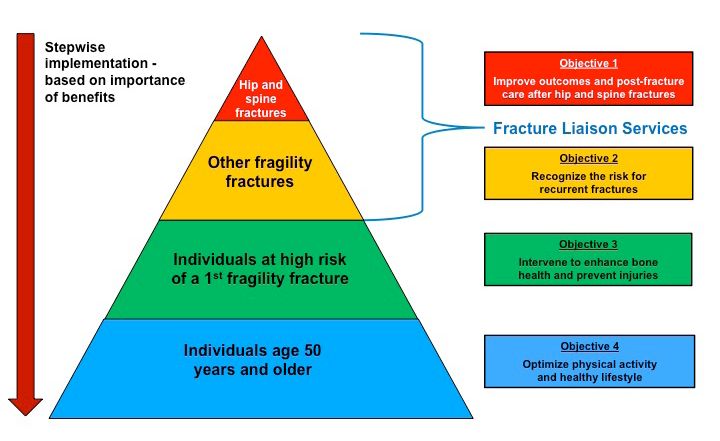
Make the
           FIRST break
              the LAST
FRACTURE    LIAISON SERVICES

                                       provide all 3 i’s§ whereas the RN can only provide the first 2 (leaving
                                       the initiation of treatment to the primary care provider). The FLS
                                       nurse(s) will work according to pre-agreed protocols within the
                                       particular institution, with input from a physician with expertise in
                                       osteoporosis.
                                           In 2013, investigators from Australia published a systematic
                                       review and meta-analysis on post-fracture models of care which
                                       provides a useful framework for classification66. Models of varying
                                       intensity were classified as Types A to D, the description and
                                       outcomes for which are summarised in table 1.

                                       Table 1. Post-fracture models of care and improvement in patient
                                       care outcomes66

                                           Model Description                        Proportion receiving Proportion receiving
                                           		                                          BMD testing*      osteoporosis treatment

                                            Status       Manitoba statistics for
                                            Quo54        major osteoporotic                13%                          8%
                                                         fractures (2007/2008)

                                                         Only provides osteo-
                                            Type D       porosis education to
                                              (Zero      the fracture patient.           No study on
                                            i model)     Primary care provider           BMD testing                    8%
                                                         (PCP) is not alerted or
The Fracture Liaison Service                             educated.

(FLS) model of care has been                             1. Identification
                                                         The PCP is alerted that
shown within Canada and many                             a fracture has occurred
                                            Type C
other countries to eliminate the           (1 i model)
                                                         and further assessment
                                                         is needed. Leaves                43%                         23%
post-fracture osteoporosis care                          the investigation and
                                                         initiation of treatment
gap, reducing the incidence of                           to the PCP.

repeat fractures and resulting                           1. Identification
                                                         2. Investigation
in significant cost savings.
Osteoporosis Canada calls for
                                            Type B
                                           (2 i model)
                                                         Leaves the initiation of
                                                         treatment for fragility        60%                          41%
                                                         fracture patients to
implementation of FLS across all                         the PCP.

Canadian provinces as a matter                           1. Identification
                                                         2. Investigation

                                                                                                                  46%
of urgency.                                 Type A
                                                                                      79%
                                                         3. Initiation
                                           (3 i model)   of osteoporosis
                                                         treatment where
                                                         appropriate.

    A Fracture Liaison Service (3 i    * Although BMD testing is an important aspect of post-fracture care, in and of itself it cannot
    model) to identify, investigate,   impact the rate of repeat fractures. Osteoporosis medication is necessary in order to reduce the
                                       rate of repeat fractures.
    and initiate appropriate
    osteoporosis treatment must           Type A models deliver the 3 i’s i.e. identification, investigation
    be the standard of care across     and initiation; Type B models deliver the 2 i’s i.e. identification
                                       and investigation; Type C models deliver 1 i i.e. identification;
    Canada. Osteoporosis Canada        Type D models could be classified as ‘Zero i’ models given that
    urges all jurisdictions to
    implement FLS by 2015.             §
                                        At the time of printing, Ontario nurse practitioners can prescribe osteoporosis medications but
                                       cannot requisition spine x-rays or BMDs independently. This is likely to change in the near future
                                       as a result of recent legislative changes.

8      Stop the unnecessary suffering — implement FLS by 2015
Make the
                                                                                                                  FIRST break
                                                                                                                     the LAST
                                                                                                       FRACTURE    LIAISON SERVICES

no proactive case-finding occurs. The clear              a 17% increase during the same time
message from this analysis is that greater               period in England109, where only 37%
effectiveness is achieved by more intensive              of localities operated an FLS by late
models of post-fracture care.                            2010120. The Glasgow FLS has provided
    A Type B model can be easily expanded                comprehensive care for all fracture
to a Type A model within the same                        patients aged 50 and over since 200024, 25.
infrastructure. There may also be hybrid                In addition to reducing fracture rates,
models that combine both NPs and RNs that          Fracture Liaison Services have been shown
may prove to be more cost-effective (the           to be highly cost-effective in Canada17,
lower costing RNs could do the work for            Australia23, the United Kingdom25, 121 and the
identification and investigation, leaving the      United States85. These analyses are described
higher costing NPs to deliver initiation).         in the next section titled ‘A business case for
    The Ganda systematic review reported           access to Fracture Liaison Services throughout
that FLS significantly reduce repeat fracture      Canada’.
rates66. Key findings included:                         More details on the Type A and Type B FLS
  • St. Michael’s Hospital, Toronto:               models considered in the systematic review
     Modelling of the FLS program reported a       and meta-analysis66 are provided in Appendix
     9% reduction of secondary hip fracture        C. A more comprehensive evaluation of the
     rates within the first year of operation16,   cost-effectiveness of FLS is also provided in
     17
        .                                          Appendix C. An overview of Type C and Type
                                                                                                       Broken bones
  • Concord FLS, Sydney, Australia: Repeat         D FLS models (interventions which have been         can be
     fracture rates over a 4 year period           found to be less effective in closing the post-     warning signs
     were reduced by 80%; there were 4.1%          fracture care gap in the meta-analysis66)
     new fractures in the intervention group       is provided in Appendix D. Surprisingly,            of osteoporosis
     compared to 19.7% in the control group22.     educational-based interventions (Type D - Zero
  • Glasgow FLS, Scotland, UK: Between             i), the traditional solution for such care gaps,
     1998 and 2008, hip fracture rates in          are found to be consistently ineffective at
     Glasgow decreased by 7.3% compared to         having any impact on the post-fracture care gap.

                                             Stop the unnecessary suffering — implement FLS by 2015                             9
Make the
           FIRST break
              the LAST
FRACTURE    LIAISON SERVICES

A business case
for access to
Fracture Liaison
Services
throughout
Canada
    The most expensive
    approach to post-fracture
    osteoporosis care is to
    allow the care gap to
    persist. Cost-effectiveness
    studies from FLS within
    Canada and in other
    countries demonstrate that
    FLS is associated with lower
    costs than the status quo.

                               Clinically effective care needs to
                                                                                Toronto established that a hospital which
                               be cost-effective care                           hired an FLS coordinator who manages
                               As increasing demands are placed upon the
Doing                          capacity of Canada’s healthcare system by
                                                                                500 patients with fragility fractures
                                                                                annually could reduce the number of
post-fracture                  an ageing population, a finite budget must       secondary hip fractures by 9% in the
                               be deployed in the most cost-effective
osteoporosis                   way. For a new model of care to be broadly
                                                                                first year, with net hospital cost savings
                                                                                of $48,950 (2004 Canadian dollars)16, 17.
care well is a                 adopted, the model must improve outcomes         Greater savings were anticipated after
                               in the most cost-effective way possible.         the first year and when additional costs
lot cheaper                    In this regard, FLS has been demonstrated        such as rehabilitation and dependency
than doing it                  consistently in Canada and other countries       costs are considered.
                               to do precisely that.
occasionally,                                                                n Edmonton: A formal health-economic
or not at all                  FLS within Canada:                              evaluation of a coordinator to improve
                                                                               osteoporosis treatment after hip fracture
                               n Toronto: The Osteoporosis Exemplary           found that for every 100 patients
                                 Care Program at St. Michael’s Hospital in     assessed, 6 fractures (including 4 hip

10 Stop the unnecessary suffering — implement FLS by 2015
Make the
FIRST break
the LAST
FRACTURE LIAISON SERVICES
fractures) were prevented, 4 quality- osteoporosis care to just hip fracture
adjusted life years were gained, and patients. As the program proved
$260,000 (2006 Canadian dollars) was
saved by the healthcare system18, 19.
effective, more time and resources were ‘Fracture
allocated to provide care for patients
The intervention cost was just $56 per with fragility fractures at any skeletal prevention
patient and the intervention would break site, and subsequently a structured
even within two years. A similar analysis primary fracture prevention strategy was
makes sense
which evaluated a nurse coordinating implemented. In 2009, 7 years after a in Kaiser
management after wrist fracture reported fully integrated Healthy Bones Program
a cost per patient of $4420, 21. was in place at all 11 Kaiser Southern because it is
California medical centres, hip fracture considerably
FLS in other countries: rates had been reduced by more than
40%26. A 2013 publication from leading less expensive
health system CEOs in the United States
n Australia: A formal cost-effectiveness
analysis of the Concord FLS in Sydney, highlighted the Healthy Bones Program
to prevent a hip
Australia reported that the cost of the FLS as an effective strategy to lower costs, fracture than
was less than AU$150 (CN$146) per patient improve quality and engage patients125.
per year over the 10 year modelling
to manage it,
period23. Furthermore, the incremental FLS in government policy: simple as that.’124
costs per quality adjusted life year (QALY)
Richard Dell MD, Orthopaedic
gained (incremental cost-effectiveness n Department of Health, England: In 2009, Lead, Kaiser Healthy Bones
ratio - ICER) were AU$17,291 (CN$16,772), the Department of Health published Falls Program, U.S.A.
which is well below the Australian and fractures: Effective interventions
accepted maximum willingness to pay for in health and social care126. The
one QALY gained of AU$50,000 (CN$48,500). policy called for a top-down approach
to fracture care and prevention as
n United Kingdom: The Glasgow FLS24 advocated in figure 4 of this document.
has provided comprehensive care for FLS was highlighted as the mechanism to
the 1 million residents of Glasgow since
the turn of the century. In excess of
50,000 consecutive fracture patients
have been assessed by the FLS. A formal
cost-effectiveness analysis reported
that, for every 1,000 patients managed
by FLS versus ‘usual care’ in the UK, 18
fractures were prevented, including 11
hip fractures, and GBP21,000 (CN$33,600)
was saved25. The authors calculated
that universal access to FLS could be
provided across the UK for just 0.6% of
the annual cost of hip fracture to the UK
economy122.
n United States of America: The Kaiser
Permanente Healthy Bones Program
is arguably the most comprehensive
fragility fracture prevention program in
the world26, 84, 85, 89, 123. The Healthy Bones
Program was led by orthopaedic surgeons
with a highly focused objective from the
project outset; to reduce the incidence
of hip fracture by 20% in 5 years124. The
program was developed in an incremental
fashion, initially providing post-fracture
Stop the unnecessary suffering — implement FLS by 2015 11Make the
FIRST break
the LAST
FRACTURE LIAISON SERVICES
deliver a response to the first fracture to and strongly recommends Type A models
prevent the next fracture. A subsequent as the preferred FLS for implementation in
economic evaluation concluded that Canada.
Fracture Liaison localities operating an FLS would save
GBP56,000 (CN$89,600) for each year’s A generic business case template
Services have cohort of fracture patients managed over for Fracture Liaison Services in
a 5 year period, compared to localities
Canada
been shown not operating an FLS121. In 2012,
To support implementation efforts, a
secondary fracture prevention indicators
to be highly were introduced into the UK general generic FLS business plan template for
use in the Canadian healthcare system is
practitioners’ contract with government,
cost-effective with the intention of improving the long- provided in Appendix E and potential cost
savings from implementation of FLS by
term care of osteoporosis for fragility
in Canada fracture patients127. province in Appendix F.
The cost-effectiveness analyses of FLS Echoing Kaiser’s Healthy Bones Program,
described above are based primarily upon Osteoporosis Canada’s White Paper calls for
Type A models reviewed previously66. It is Canada to target those individuals who have
important to recognise that Type A and Type already suffered fractures for osteoporosis
B models outperformed the less intensive intervention because they are at highest risk
Type C and Type D models by a considerable of suffering more fractures27. As indicated in
margin, in terms of the proportion of the Osteoporosis Canada ‘fracture pyramid’
fracture patients undergoing bone density in figure 4, FLS provides the healthcare
testing and those who received treatment delivery solution to close the post-fracture
for osteoporosis. Thus, Osteoporosis Canada care gap.
refers to Type A and Type B models as FLS,
Figure 4. A systematic approach to fragility fracture prevention for Canada27
28%
of women and
37%
of men who
suffer a hip
fracture will
die within
the following
year
12 Stop the unnecessary suffering — implement FLS by 2015Make the
FIRST break
the LAST
FRACTURE LIAISON SERVICES
Key steps to
implement a
Fracture
Liaison
Service
Y
ear after year, across Canada, determined by local policy makers and healthcare professionals.
considerable financial resources are The globally endorsed standards for FLS developed in 2013 by the
being committed to fund the costs International Osteoporosis Foundation – with input from Osteoporosis
of treating fragility fractures. Canada is Canada – provide a very useful starting point for service design73. A
spending $600 million per year on direct costs detailed description of practical steps in the initial development of an
associated with hip fracture care alone1. If FLS is provided in Appendices G and H. Algorithms by fracture type
this persistent drain on healthcare resources and other practical tools for FLS are available in Appendices I to K.
is to be reduced, plans must be developed – in
every province – to fund fracture prevention
through the implementation of FLS models of Figure 5. The scope of an FLS can be expanded as time and
care. resources permit73
Osteoporosis Canada recognises that
provincial Ministries of Health may elect to
stage implementation of FLS. One staged
implementation strategy consists of initially
targeting just hip fracture patients then all
patients admitted with fragility fractures to
hospital and finally those patients managed
completely in the out-patient setting, as
illustrated in figure 5. An alternate strategy
would be to establish an initial centre of
excellence within the province which could
subsequently expedite sharing of best
practice with other centres that receive
fracture patients. In order to improve quality
of post-fracture care for all fragility fracture
patients – and so maximise associated cost
savings – the most rapid path which leads
to province-wide access to FLS must be
The vast majority of local healthcare systems in Canada currently lack an FLS. Every
provincial Ministry of Health must develop a plan to establish FLS across their province.
Stop the unnecessary suffering — implement FLS by 2015 13Make the
FIRST break
the LAST
FRACTURE LIAISON SERVICES
Making the
First break
the Last is
an achievable
goal through
the widespread
implementation
of FLS
Delivering globally endorsed
standards of care
T
his decade has seen the development of initiatives • Empower Change: For those who already have
intended to catalyse implementation of FLS by an operating FLS, the BPF is a tool to empower
leading organizations across the world. All of the clinical champions and healthcare administrators
following organizations explicitly endorse widespread to rationally evaluate and enhance provision of
implementation of FLS: secondary fracture prevention in their healthcare
• International Osteoporosis Foundation: ‘Capture system in the context of globally-endorsed
the Fracture’ Campaign73, 118, 119, 128 standards.
• American Society for Bone and Mineral Research: • Guidance: For those healthcare systems that
Task Force on Secondary Fracture Prevention32 have yet to establish an FLS, the BPF describes
• U.S. National Bone Health Alliance: Fracture the essential and aspirational elements of
Prevention CENTRAL129 service delivery and can thus inform the business
These organizations have developed extensive planning process for new FLS in a very specific
resources intended to share best practice and support way.
those healthcare systems that are yet to broadly • Recognition and fine-tuning: The BPF also offers
implement FLS128-130. leaders of established FLS an objective means
During 2012-13, the IOF developed internationally to identify where their service delivers optimal
endorsed standards of best practice for FLS73. Given the care — and to be recognised internationally for
variation in structure of healthcare systems throughout excellence — and identifies opportunities to
the world, IOF consulted with leading experts from refine the delivery and scope of care that could
many countries who have established FLS in their further improve outcomes.
localities and undertook beta-testing to ensure that The second point is most relevant in Canada
the standards were internationally relevant and fit-for- where very few centres currently offer FLS. The BPF
purpose. Osteoporosis Canada was a contributor to this standards provide a practical road-map for those
process. The IOF Best Practice Framework (BPF) sets an designing services from scratch to ensure that the FLS
international benchmark for FLS, which defines essential model they develop will be successful in improving
and aspirational elements of service delivery. IOF cites outcomes (reducing fractures and their associated
the reasons for creation of the BPF as131: costs). More details are available in Appendix L.
14 Stop the unnecessary suffering — implement FLS by 2015Make the
FIRST break
Summary and Recommendations FRACTURE
the LAST
LIAISON SERVICES
C
urrently, the vast majority of Canadians do not receive the globally endorsed
standards of post-fracture care advocated by Osteoporosis Canada. This care gap A nationwide
can be readily eliminated by broad implementation of Fracture Liaison Services. FLS
have been shown within Canada and throughout the world to eliminate the post-fracture
post-fracture
osteoporosis care gap, reduce the incidence of repeat fractures and significantly reduce osteoporosis
their associated costs to the healthcare system. FLS have been shown to be highly cost-
effective in Canada17, Australia23, the United Kingdom25, 121 and the United States85.
care gap exists
throughout
A Fracture Liaison Service (3 i model) to identify, investigate, Canada which is
and initiate appropriate osteoporosis treatment must be the leaving Canadians
standard of care across Canada. Osteoporosis Canada urges
all jurisdictions to implement FLS by 2015.
needlessly at
risk of suffering
Consensus exists amongst all relevant healthcare professionals and their organizations
on the need for implementation of FLS in all provinces — and patients desperately
future fractures
want and need better care. Osteoporosis Canada calls upon all policy makers in and resulting
every province with responsibility for the care of fragility fracture patients to work
collaboratively to bring an end to avoidable fragility fractures. This opportunity to better in an enormous
care for our senior citizens and to save precious healthcare dollars is far too good to miss. avoidable
expenditure on
fracture care.
Access to Fracture
Liaison Services
for all Canadians
will transform the
delivery of post-
fracture care and
result in significant
financial savings.
By implementing Fracture Liaison Services across our provinces
we can make their FIRST break their LAST!
Stop the unnecessary suffering — implement FLS by 2015 15Make the
FIRST break
the LAST
FRACTURE LIAISON SERVICES
ACKNOWLEDGEMENTS
Make the FIRST break the LAST with Fracture Liaison Services is the product of a diverse team of volunteers
who all share a common objective: to make FLS the standard of care in Canada.
The FLS Working Group has generously donated their time and expertise to help ensure that the recommendations
in this report are pragmatic, achievable and in the best interests of Canadian taxpayers. They are to be
commended for their valuable contributions.
FLS Working Group
Chair:
Meera Jain, MSc, PhD, Ontario
Diane Thériault, MD, FRCPC, CCD, Nova Scotia
Ravi Jain, MA, MHSc, CHE, Ontario
Chief Scientific Officer, Fracture Liaison Services
Brendan Lewis, MD, FRCSC, Newfoundland and Labrador
Marg MacDonell, Past Chair, Canadian Osteoporosis Patient
Members: Network, Manitoba
Marie-Claude Beaulieu, MD, CCFP, Québec Sarah Nixon-Jackle, RN, BScN, NCMP, Saskatchewan
Earl Bogoch, MD, FRCSC, Ontario Brenda Payne, RN, BN, MN, CEC, Nova Scotia
Jennifer Fletcher, MD, FRCSC, New Brunswick Irene Polidoulis, MD, CCFP, FCFP, Ontario
Heather Frame, MD, BSc(Med), FCFP, Manitoba Carla Purcell, BScN, RN, CMSN(C), Nova Scotia
Larry Funnell, Chair, Canadian Osteoporosis Patient Network, Christine MacNearney, BSc, MD, Prince Edward Island
British Columbia Nashater Sanghera, BComm, CA, CPA, British Columbia
David Hanley, MD, FRCPC, Alberta Government Relations Officer, Fracture Liaison Services
Brigadier General (Retired) Hilary Jaeger, MSc, MD, CHE, Ontario Sonia Singh, MD, MHSc, British Columbia
A special acknowledgement goes to Paul Mitchell, Synthesis Medical NZ Limited, for his invaluable assistance in
creating this document.
Dedicated to the
hundreds of thousands
of Canadians who
needlessly fracture
and suffer each
year because their
osteoporosis goes
undiagnosed and
untreated.
16 Stop the unnecessary suffering — implement FLS by 2015Make the
FIRST break
the LAST
References FRACTURE LIAISON SERVICES
1. Tarride JE, Hopkins RB, Leslie WD, et al. The orthopaedic environment. J Bone Joint Surg European guidance for the diagnosis
burden of illness of osteoporosis in Canada. Am. Jan 2006;88(1):25-34. and management of osteoporosis in
Osteoporos Int. Nov 2012;23(11):2591-2600. 17. Sander B, Elliot-Gibson V, Beaton DE, Bogoch postmenopausal women. Osteoporos Int.
2. Papaioannou A, Giangregorio L, Kvern ER, Maetzel A. A coordinator program in post- Oct 19 2012.
B, Boulos P, Ioannidis G, Adachi JD. The fracture osteoporosis management improves 32. Eisman JA, Bogoch ER, Dell R, et
osteoporosis care gap in Canada. BMC outcomes and saves costs. J Bone Joint Surg al. Making the first fracture the last
Musculoskelet Disord. Apr 6 2004;5:11. Am. Jun 2008;90(6):1197-1205. fracture: ASBMR task force report on
3. Papaioannou A, Kennedy CC, Ioannidis G, et 18. Majumdar SR, Beaupre LA, Harley CH, secondary fracture prevention. J Bone
al. The osteoporosis care gap in men with et al. Use of a case manager to improve Miner Res. Oct 2012;27(10):2039-2046.
fragility fractures: the Canadian Multicentre osteoporosis treatment after hip fracture: 33. Mauck KF, Clarke BL. Diagnosis,
Osteoporosis Study. Osteoporos Int. Apr results of a randomized controlled trial. Arch screening, prevention, and treatment
2008;19(4):581-587. Intern Med. Oct 22 2007;167(19):2110-2115. of osteoporosis. Mayo Clin Proc. May
4. Fraser LA, Ioannidis G, Adachi JD, et al. 19. Majumdar SR, Lier DA, Beaupre LA, et al. 2006;81(5):662-672.
Fragility fractures and the osteoporosis care Osteoporosis case manager for patients with 34. Jiang HX, Majumdar SR, Dick DA, et al.
gap in women: the Canadian Multicentre hip fractures: results of a cost-effectiveness Development and initial validation of
Osteoporosis Study. Osteoporos Int. Mar analysis conducted alongside a randomized a risk score for predicting in-hospital
2011;22(3):789-796. trial. Arch Intern Med. Jan 12 2009;169(1):25- and 1-year mortality in patients with
5. Gallagher JC, Melton LJ, Riggs BL, Bergstrath 31. hip fractures. J Bone Miner Res. Mar
E. Epidemiology of fractures of the proximal 20. Majumdar SR, Johnson JA, Bellerose D, et 2005;20(3):494-500.
femur in Rochester, Minnesota. Clin Orthop al. Nurse case-manager vs multifaceted 35. Papaioannou A, Kennedy CC, Ioannidis G,
Relat Res. Jul-Aug 1980(150):163-171. intervention to improve quality of et al. The impact of incident fractures
6. McLellan A, Reid D, Forbes K, et al. osteoporosis care after wrist fracture: on health-related quality of life: 5 years
Effectiveness of Strategies for the Secondary randomized controlled pilot study. Osteoporos of data from the Canadian Multicentre
Prevention of Osteoporotic Fractures Int. Jan 2011;22(1):223-230. Osteoporosis Study. Osteoporos Int. May
in Scotland (CEPS 99/03): NHS Quality 21. Majumdar SR, Johnson JA, McAlister FA, et 2009;20(5):703-714.
Improvement Scotland; 2004. al. Multifaceted intervention to improve 36. Adachi JD, Ioannidis G, Pickard L, et al.
7. Port L, Center J, Briffa NK, Nguyen T, diagnosis and treatment of osteoporosis The association between osteoporotic
Cumming R, Eisman J. Osteoporotic fracture: in patients with recent wrist fracture: a fractures and health-related quality of
missed opportunity for intervention. randomized controlled trial. CMAJ. Feb 26 life as measured by the Health Utilities
Osteoporos Int. Sep 2003;14(9):780-784. 2008;178(5):569-575. Index in the Canadian Multicentre
8. Edwards BJ, Bunta AD, Simonelli C, Bolander 22. Lih A, Nandapalan H, Kim M, et al. Targeted Osteoporosis Study (CaMos). Osteoporos
M, Fitzpatrick LA. Prior fractures are common intervention reduces refracture rates Int. Nov 2003;14(11):895-904.
in patients with subsequent hip fractures. Clin in patients with incident non-vertebral 37. Adachi JD, Loannidis G, Berger C,
Orthop Relat Res. Aug 2007;461:226-230. osteoporotic fractures: a 4-year prospective et al. The influence of osteoporotic
9. Papaioannou A, Morin S, Cheung AM, et al. controlled study. Osteoporos Int. Mar fractures on health-related quality of
2010 clinical practice guidelines for the 2011;22(3):849-858. life in community-dwelling men and
diagnosis and management of osteoporosis 23. Cooper MS, Palmer AJ, Seibel MJ. Cost- women across Canada. Osteoporos Int.
in Canada: summary. CMAJ. Nov 23 effectiveness of the Concord Minimal Trauma 2001;12(11):903-908.
2010;182(17):1864-1873. Fracture Liaison service, a prospective, 38. Public Health Agency of Canada. 2009
10. Bessette L, Ste-Marie LG, Jean S, et al. The controlled fracture prevention study. Tracking Heart Disease and Stroke in
care gap in diagnosis and treatment of women Osteoporos Int. Jan 2012;23(1):97-107. Canada. Ottawa, Ontario 2009.
with a fragility fracture. Osteoporos Int. Jan 24. McLellan AR, Gallacher SJ, Fraser M, 39. Canadian Cancer Society/National
2008;19(1):79-86. McQuillian C. The fracture liaison service: Cancer Institute of Canada. Canadian
11. Leslie WD, O’Donnell S, Lagace C, et al. success of a program for the evaluation Cancer Statistics. Toronto, Canada 2007.
Population-based Canadian hip fracture rates and management of patients with 40. Wiktorowicz ME, Goeree R, Papaioannou
with international comparisons. Osteoporos osteoporotic fracture. Osteoporos Int. Dec A, Adachi JD, Papadimitropoulos E.
Int. Aug 2010;21(8):1317-1322. 2003;14(12):1028-1034. Economic implications of hip fracture:
12. Lefaivre KA, Macadam SA, Davidson DJ, 25. McLellan AR, Wolowacz SE, Zimovetz EA, health service use, institutional care
Gandhi R, Chan H, Broekhuyse HM. Length of et al. Fracture liaison services for the and cost in Canada. Osteoporos Int.
stay, mortality, morbidity and delay to surgery evaluation and management of patients with 2001;12(4):271-278.
in hip fractures. J Bone Joint Surg Br. Jul osteoporotic fracture: a cost-effectiveness 41. Kaffashian S, Raina P, Oremus M, et al.
2009;91(7):922-927. evaluation based on data collected over 8 The burden of osteoporotic fractures
13. Jaglal S. Osteoporotic fractures: incidence years of service provision. Osteoporos Int. Jul beyond acute care: the Canadian
and impact. In: Williams J, Badley E, eds. 2011;22(7):2083-2098. Multicentre Osteoporosis Study (CaMos).
Patterns in Health Care in Ontario: Arthritis 26. Dell R. Fracture prevention in Kaiser Age Ageing. Sep 2011;40(5):602-607.
and Related Conditions. Toronto; 1998:143- Permanente Southern California. Osteoporos 42. Evans B, Potvin C, Johnson G, et al.
156. Int. Aug 2011;22 Suppl 3:457-460. Enhancing patient flow in an acute
14. Papaioannou A, Wiktorowicz M, Adachi JD, 27. Osteoporosis Canada. Osteoporosis: Towards a care hospital: successful strategies at
et al. Mortality, Independence in Living, and fracture free future. Toronto 2011. the Juravinski Hospital. Healthc Q.
Re-fracture, One Year Following Hip Fracture 28. Statistics Canada. Population Projections for 2011;14(3):66-74.
in Canadians. J Soc Obstet Gynaecol Can. Canada, Provinces and Territories 2009 to 43. Schull MJ, Vermeulen MJ, Stukel TA,
2000;22(8):591-597. 2036. Ottawa, Ontario 2010. et al. Evaluating the effect of clinical
15. Burge R, Dawson-Hughes B, Solomon DH, 29. van Staa TP, Dennison EM, Leufkens HG, decision units on patient flow in seven
Wong JB, King A, Tosteson A. Incidence and Cooper C. Epidemiology of fractures in Canadian emergency departments. Acad
economic burden of osteoporosis-related England and Wales. Bone. Dec 2001;29(6):517- Emerg Med. Jul 2012;19(7):828-836.
fractures in the United States, 2005-2025. J 522. 44. Lin D, Patrick J, Labeau F. Estimating the
Bone Miner Res. Mar 2007;22(3):465-475. 30. Office of the Surgeon General. Bone Health waiting time of multi-priority emergency
16. Bogoch ER, Elliot-Gibson V, Beaton DE, Jamal and Osteoporosis: A Report of the Surgeon patients with downstream blocking.
SA, Josse RG, Murray TM. Effective initiation General. In: US Department of Health and Health Care Manag Sci. May 21 2013.
of osteoporosis diagnosis and treatment Human Services, ed. Washington; 2004. 45. Khan SA, de Geus C, Holroyd B, Russell
for patients with a fragility fracture in an 31. Kanis JA, McCloskey EV, Johansson H, et al. AS. Osteoporosis follow-up after wrist
Stop the unnecessary suffering — implement FLS by 2015 17Make the
FIRST break
the LAST
FRACTURE LIAISON SERVICES
References
fractures following minor trauma. Arch Intern of use in Quebec. BMC Musculoskelet Disord. clinic: 1-year results and 3-month
Med. May 28 2001;161(10):1309-1312. 2005;6:33. compliance. Bone. Jun 2007;40(6):1643-
46. Juby AG, De Geus-Wenceslau CM. Evaluation 61. Perreault S, Dragomir A, Desgagne A, et al. 1649.
of osteoporosis treatment in seniors after hip Trends and determinants of antiresorptive 77. Boudou L, Gerbay B, Chopin F, Ollagnier
fracture. Osteoporos Int. Mar 2002;13(3):205- drug use for osteoporosis among elderly E, Collet P, Thomas T. Management of
210. women. Pharmacoepidemiol Drug Saf. Oct osteoporosis in fracture liaison service
47. Cree MW, Juby AG, Carriere KC. Mortality and 2005;14(10):685-695. associated with long-term adherence
morbidity associated with osteoporosis drug 62. Austin PC, Tu JV, Ko DT, Alter DA. Factors to treatment. Osteoporos Int. Jul
treatment following hip fracture. Osteoporos associated with the use of evidence-based 2011;22(7):2099-2106.
Int. Sep 2003;14(9):722-727. therapies after discharge among elderly 78. Carpintero P, Gil-Garay E, Hernandez-
48. Meadows LM, Mrkonjic LA, O’Brien MD, patients with myocardial infarction. CMAJ. Vaquero D, Ferrer H, Munuera L.
Tink W. The importance of communication Oct 21 2008;179(9):901-908. Interventions to improve inpatient
in secondary fragility fracture treatment 63. Elliot-Gibson V, Bogoch ER, Jamal SA, Beaton osteoporosis management following
and prevention. Osteoporos Int. Feb DE. Practice patterns in the diagnosis and first osteoporotic fracture: the PREVENT
2007;18(2):159-166. treatment of osteoporosis after a fragility project. Arch Orthop Trauma Surg. Feb
49. Singh S, Foster R, Khan KM. Accident or fracture: a systematic review. Osteoporos Int. 2009;129(2):245-250.
osteoporosis?: Survey of community follow-up Oct 2004;15(10):767-778. 79. Chandran M, Tan MZ, Cheen M, Tan SB,
after low-trauma fracture. Can Fam Physician. 64. Giangregorio L, Papaioannou A, Cranney A, Leong M, Lau TC. Secondary prevention
Apr 2011;57(4):e128-133. Zytaruk N, Adachi JD. Fragility fractures and of osteoporotic fractures-an “OPTIMAL”
50. Ashe MC, McKay HA, Janssen P, Guy P, Khan the osteoporosis care gap: an international model of care from Singapore.
KM. Improving osteoporosis management in phenomenon. Semin Arthritis Rheum. Apr Osteoporos Int. Apr 25 2013.
at-risk fracture clinic patients. J Am Geriatr 2006;35(5):293-305. 80. Che M, Ettinger B, Liang J, Pressman
Soc. Apr 2005;53(4):727-728. 65. Little EA, Eccles MP. A systematic review of AR, Johnston J. Outcomes of a disease-
51. Davis JC, Ashe MC, Guy P, Khan KM. the effectiveness of interventions to improve management program for patients with
Undertreatment after hip fracture: post-fracture investigation and management recent osteoporotic fracture. Osteoporos
a retrospective study of osteoporosis of patients at risk of osteoporosis. Implement Int. 2006;17(6):847-854.
overlooked. J Am Geriatr Soc. Jun Sci. 2010;5:80. 81. Chevalley T, Hoffmeyer P, Bonjour
2006;54(6):1019-1020. 66. Ganda K, Puech M, Chen JS, et al. Models JP, Rizzoli R. An osteoporosis clinical
52. Metge CJ, Leslie WD, Manness LJ, et al. of care for the secondary prevention of pathway for the medical management
Postfracture care for older women: gaps osteoporotic fractures: a systematic review of patients with low-trauma fracture.
between optimal care and actual care. Can and meta-analysis. Osteoporos Int. Jul 25 Osteoporos Int. 2002;13(6):450-455.
Fam Physician. Sep 2008;54(9):1270-1276. 2012. 82. Clunie G, Stephenson S. Implementing
53. Leslie WD, Brennan SL, Prior HJ, Lix LM, 67. Dreinhofer KE, Anderson M, Feron JM, et al. and running a fracture liaison service:
Metge C, Elias B. The post-fracture care gap Multinational survey of osteoporotic fracture An integrated clinical service providing a
among Canadian First Nations peoples: a management. Osteoporos Int. Mar 2005;16 comprehensive bone health assessment
retrospective cohort study. Osteoporos Int. Suppl 2:S44-53. at the point of fracture management.
Mar 2012;23(3):929-936. 68. Chami G, Jeys L, Freudmann M, Connor L, Journal of Orthopaedic Nursing.
54. Leslie WD, Giangregorio LM, Yogendran M, et Siddiqi M. Are osteoporotic fractures being 2008;12:156-162.
al. A population-based analysis of the post- adequately investigated? A questionnaire of 83. Collinge C, LeBus G, Gardner MJ, Gehrig
fracture care gap 1996-2008: the situation GP & orthopaedic surgeons. BMC Fam Pract. L. Osteoporosis in orthopaedic trauma
is not improving. Osteoporos Int. May 2006;7:7. patients: a diagnosis and treatment
2012;23(5):1623-1629. 69. Chakravarthy J, Ali A, Iyengar S, Porter K. protocol. J Orthop Trauma. Sep
55. Petrella RJ, Jones TJ. Do patients receive Secondary prevention of fragility fractures 2008;22(8):541-547; discussion 548-549.
recommended treatment of osteoporosis by orthopaedic teams in the UK: a national 84. Dell RM, Greene D, Anderson D, Williams
following hip fracture in primary care? BMC survey. Int J Clin Pract. Mar 2008;62(3):382- K. Osteoporosis disease management:
Fam Pract. 2006;7:31. 387. What every orthopaedic surgeon should
56. Hajcsar EE, Hawker G, Bogoch ER. 70. Kurup HV, Andrew JG. Secondary prevention know. J Bone Joint Surg Am. Nov 2009;91
Investigation and treatment of osteoporosis in of osteoporosis after Colles fracture: Current Suppl 6:79-86.
patients with fragility fractures. CMAJ. Oct 3 practice. Joint Bone Spine. Jan 2008;75(1):50- 85. Dell R, Greene D, Schelkun SR, Williams
2000;163(7):819-822. 52. K. Osteoporosis disease management:
57. Byszewski A, Lemay G, Molnar F, Azad N, 71. Harrington J. Dilemmas in providing the role of the orthopaedic surgeon. J
McMartin SE. Closing the osteoporosis care osteoporosis care for fragility fracture Bone Joint Surg Am. Nov 2008;90 Suppl
gap in hip fracture patients: an opportunity patients. US Musculoskeletal Review - Touch 4:188-194.
to decrease recurrent fractures and hospital Briefings. December 2006 2006;II:64-65. 86. Edwards BJ, Bunta AD, Madison LD,
admissions. J Osteoporos. 2011;2011:404969. 72. British Orthopaedic Association, British et al. An osteoporosis and fracture
58. Hamel ME, Sebaldt RJ, Siminoski K, et Geriatrics Society. The care of patients with intervention program increases the
al. Influence of fracture history and bone fragility fracture 2007. diagnosis and treatment for osteoporosis
mineral density testing on the treatment of 73. Akesson K, Marsh D, Mitchell PJ, et al. Capture for patients with minimal trauma
osteoporosis in two non-academic community the Fracture: a Best Practice Framework and fractures. Jt Comm J Qual Patient Saf.
centers. Osteoporos Int. Feb 2005;16(2):208- global campaign to break the fragility fracture May 2005;31(5):267-274.
215. cycle. Osteoporos Int. Apr 16 2013. 87. Geisinger Health System. Osteoporosis.
59. Jaglal SB, Cameron C, Hawker GA, et al. 74. Sale JE, Beaton D, Posen J, Elliot-Gibson V, http://www.geisinger.org/professionals/
Development of an integrated-care delivery Bogoch E. Systematic review on interventions services/osteo/index.html. Accessed 21-
model for post-fracture care in Ontario, to improve osteoporosis investigation and 01-2013.
Canada. Osteoporos Int. 2006;17(9):1337- treatment in fragility fracture patients. 88. Giles M, Van Der Kallen J, Parker V, et al.
1345. Osteoporos Int. Jul 2011;22(7):2067-2082. A team approach: implementing a model
60. Vanasse A, Dagenais P, Niyonsenga T, Gregoire 75. Astrand J, Nilsson J, Thorngren KG. Screening of care for preventing osteoporosis
JP, Courteau J, Hemiari A. Bone mineral for osteoporosis reduced new fracture related fractures. Osteoporos Int. Aug
density measurement and osteoporosis incidence by almost half. Acta Orthop. Dec 2011;22(8):2321-2328.
treatment after a fragility fracture in older 2012;83(6):661-665. 89. Greene D, Dell RM. Outcomes of an
adults: regional variation and determinants 76. Blonk MC, Erdtsieck RJ, Wernekinck MG, osteoporosis disease-management
Schoon EJ. The fracture and osteoporosis
18 Stop the unnecessary suffering — implement FLS by 2015Make the
FIRST break
the LAST
FRACTURE LIAISON SERVICES
program managed by nurse practitioners. J shoulder fracture. A comparison of two experience: the Belfast experience.
Am Acad Nurse Pract. Jun 2010;22(6):326-329. centres in the United Kingdom. Injury. Sep Rheumatol Int. Aug 2005;25(6):489-490.
90. Harrington JT, Lease J. System-based 2005;36(9):1080-1084. 117. Yoon RS, Macaulay W, Torres G, et al.
coordination of postfracture osteoporosis 103. Newman ED, Ayoub WT, Starkey RH, Assessment of inpatient fragility fracture
care compared with traditional approaches. Diehl JM, Wood GC. Osteoporosis education and outpatient follow-up at an
Arthritis Care Res (Hoboken). Nov disease management in a rural health urban tertiary care institution. Endocr
2010;62(11):1646-1649. care population: hip fracture reduction Pract. Jan-Feb 2008;14(1):58-68.
91. Harrington JT, Lease J. Osteoporosis disease and reduced costs in postmenopausal 118. International Osteoporosis Foundation.
management for fragility fracture patients: women after 5 years. Osteoporos Int. Apr Capture the Fracture: A global campaign
new understandings based on three years’ 2003;14(2):146-151. to break the fragility fracture cycle.
experience with an osteoporosis care service. 104. Partnership for Progress in Bone Health. Nyon 2012.
Arthritis Rheum. Dec 15 2007;57(8):1502- Models for Success. http://www. 119. Marsh D, Akesson K, Beaton DE, et al.
1506. partnershipforprogress.org/models.asp#. Coordinator-based systems for secondary
92. Harrington JT, Deal CL. Successes and failures Accessed 21-01-2013. prevention in fragility fracture patients.
in improving osteoporosis care after fragility 105. Premaor MO, Pilbrow L, Tonkin C, Adams Osteoporos Int. Jul 2011;22(7):2051-
fracture: results of a multiple-site clinical M, Parker RA, Compston J. Low rates of 2065.
improvement project. Arthritis Rheum. Oct treatment in postmenopausal women with 120. Royal College of Physicians’ Clinical
15 2006;55(5):724-728. a history of low trauma fractures: results of Effectiveness and Evaluation Unit. Falling
93. Harrington JT, Barash HL, Day S, Lease audit in a Fracture Liaison Service. QJM. Jan standards, broken promises: Report
J. Redesigning the care of fragility 2010;103(1):33-40. of the national audit of falls and bone
fracture patients to improve osteoporosis 106. Queally JM, Kiernan C, Shaikh M, Rowan health in older people 2010. 2011.
management: a health care improvement F, Bennett D. Initiation of osteoporosis 121. Department of Health. Fracture
project. Arthritis Rheum. Apr 15 assessment in the fracture clinic results prevention services: an economic
2005;53(2):198-204. in improved osteoporosis management: a evaluation.; 2009.
94. Huntjens KM, van Geel TA, Blonk MC, et al. randomised controlled trial. Osteoporos Int. 122. Cooper C, Mitchell P, Kanis JA. Breaking
Implementation of osteoporosis guidelines: a Dec 15 2012. the fragility fracture cycle. Osteoporos
survey of five large fracture liaison services 107. Rozental TD, Makhni EC, Day CS, Bouxsein Int. Jul 2011;22(7):2049-2050.
in the Netherlands. Osteoporos Int. Jul ML. Improving evaluation and treatment for 123. Cheng H, Gary LC, Curtis JR, et al.
2011;22(7):2129-2135. osteoporosis following distal radial fractures. Estimated prevalence and patterns of
95. Huntjens KM, van Geel TC, Geusens PP, et A prospective randomized intervention. J presumed osteoporosis among older
al. Impact of guideline implementation by a Bone Joint Surg Am. May 2008;90(5):953- Americans based on Medicare data.
fracture nurse on subsequent fractures and 961. Osteoporos Int. Sep 2009;20(9):1507-
mortality in patients presenting with non- 108. Schurink M, Hegeman JH, Kreeftenberg HG, 1515.
vertebral fractures. Injury. Sep 2011;42 Suppl Ten Duis HJ. Follow-up for osteoporosis in 124. Dell R. Osteoporosis: Breaking Bones
4:S39-43. older patients three years after a fracture. Is Not Inevitable. In: Harrington JT,
96. Inderjeeth CA, Glennon DA, Poland KE, et al. Neth J Med. Feb 2007;65(2):71-74. Newman ED, eds. Great Health Care:
A multimodal intervention to improve fragility 109. Skelton D, Neil F. NHS Greater Glasgow and Making It Happen. New York, New York:
fracture management in patients presenting Clyde Strategy for Osteoporosis and Falls Springer; 2012:113-122.
to emergency departments. Med J Aust. Aug 2 Prevention 2006-2010: An evaluation 2007- 125. Cosgrove DM, Fisher M, Gabow P, et al.
2010;193(3):149-153. 2009 2009. Ten strategies to lower costs, improve
97. Kuo I, Ong C, Simmons L, Bliuc D, Eisman 110. Stone D. Managing osteoporosis in a quality, and engage patients: the view
J, Center J. Successful direct intervention rural community. Nurs Times. Jun 12-18 from leading health system CEOs. Health
for osteoporosis in patients with minimal 2012;108(24):25-27. Aff (Millwood). Feb 2013;32(2):321-327.
trauma fractures. Osteoporos Int. Dec 111. Sugi MT, Sheridan K, Lewis L, et al. 126. Department of Health. Falls and
2007;18(12):1633-1639. Active Referral Intervention following fractures: Effective interventions in
98. Langridge CR, McQuillian C, Watson WS, Fragility Fractures Leads to Enhanced health and social care. In: Department of
Walker B, Mitchell L, Gallacher SJ. Refracture Osteoporosis Follow-Up Care. J Osteoporos. Health, ed; 2009.
following fracture liaison service assessment 2012;2012:234381. 127. NHS Commissioning Board, British Medical
illustrates the requirement for integrated falls 112. Vaile J, Sullivan L, Bennett C, Bleasel J. First Association, NHS Employers. Quality and
and fracture services. Calcif Tissue Int. Aug Fracture Project: addressing the osteoporosis Outcomes Framework guidance for GMS
2007;81(2):85-91. care gap. Intern Med J. Oct 2007;37(10):717- contract 2013/14 2013.
99. McLellan AR. Risk Factors Associated with 720. 128. International Osteoporosis Foundation.
Secondary Fractures & Mortality in Fracture 113. van Helden S, Cauberg E, Geusens P, Capture the Fracture: Break the
Patients Managed by a Fracture Liaison Winkes B, van der Weijden T, Brink P. worldwide fragility fracture cycle.
Service. ASBMR 31st Annual Meeting. San The fracture and osteoporosis outpatient http://www.capturethefracture.org/.
Diego, California, USA; 2011. clinic: an effective strategy for improving Accessed 21 June 2013.
100. McLellan AR, Fraser M. 8 year Fracture & implementation of an osteoporosis guideline. 129. National Bone Health Alliance. Fracture
Mortality Outcomes of the Fracture Liaison J Eval Clin Pract. Oct 2007;13(5):801-805. Prevention CENTRAL. http://www.nbha.
Service That Provides Systematic Assessment 114. Wallace I, Callachand F, Elliott J, Gardiner org/fpc. Accessed 27 June 2013.
for Prevention of Secondary Fractures to P. An evaluation of an enhanced fracture 130. Eisman JA, Bogoch ER, Dell R, et
All Patients Age 50+ With New Low-trauma liaison service as the optimal model for al. Appendix A to ‘Making the First
Fractures. ASBMR 30th Annual Meeting. secondary prevention of osteoporosis. JRSM Fracture the Last Fracture’: ASBMR Task
Montréal, Quebéc, Canada; 2010. Short Rep. 2011;2(2):8. Force Report on Secondary Fracture
101. Mulherin D, Williams S, Smith JA, Edwards 115. Ward SE, Laughren JJ, Escott BG, Elliot- Prevention. http://onlinelibrary.wiley.
J, Sheeran TP, Price T. Identification of Gibson V, Bogoch ER, Beaton DE. A program com/doi/10.1002/jbmr.1698/suppinfo.
risk factors for future fracture in patients with a dedicated coordinator improved Accessed 1 November 2012.
following distal forearm fracture. Osteoporos chart documentation of osteoporosis after 131. International Osteoporosis Foundation.
Int. Sep 2003;14(9):757-760. fragility fracture. Osteoporos Int. Aug Capture the Fracture: Best
102. Murray AW, McQuillan C, Kennon B, 2007;18(8):1127-1136. Practice Framework. http://www.
Gallacher SJ. Osteoporosis risk assessment 116. Wright SA, McNally C, Beringer T, Marsh capturethefracture.org/best-practice-
and treatment intervention after hip or D, Finch MB. Osteoporosis fracture liaison framework. Accessed 27 June 2013.
Stop the unnecessary suffering — implement FLS by 2015 19You can also read


