Indian Health Service Epidemiology (EPI) Fellowship - Program Summary 2019-2020 - Create
←
→
Page content transcription
If your browser does not render page correctly, please read the page content below
2019-2020
    Indian Health Service
Epidemiology (EPI) Fellowship

     Program Summary

      Applications due March 1, 2019

                                       1
2019-2020 EPI Fellowship Program Summary
Injury Prevention Epidemiology Fellowship Description
The IHS Injury Prevention Epidemiology (EPI) Fellowship provides practical knowledge and skills for injury and
violence prevention practitioners working in American Indian and Alaska Native (AI/AN) communities. Building
on the IHS Injury Prevention Program Short Courses, and prior experiences of the participants, the Fellowship
offers advanced training in:
o injury epidemiology
o field work
o program evaluation
o report writing and presentation skills
Fellowship participants develop their skills by working on individual data collection and assessment projects to:
o define or provide context about an injury or violence problem, or
o evaluate an IP intervention or program
EPI Fellowship Program Goals
The goal of the EPI Fellowship is to provide advanced training and experience managing a project to injury and
violence prevention practitioners working with AI/AN communities. The Fellowship prepares participants to:
Describe evidence-based strategies to prevent or reduce injury (e.g., motor vehicle crashes, falls,
fire/burns, opioid overdose) or violence (e.g., intimate partner violence, child abuse/neglect, suicide)
Design data collection forms
Develop a data collection and analysis plan for use in documenting a problem or evaluating an intervention
Analyze and interpret injury data
Summarize results in a project report
Present results of a project or study at a scientific meeting
Prerequisites and Financial Support
All of the following prerequisites must be completed or obtained by the time of application:
A Bachelor’s degree or higher degree
At least 3 years of experience in public health
At least 2 years of experience working in injury or violence prevention
Completion of the IHS Introduction to IP (Level I) Course, or equivalent (e.g., the 1-week IP overview
course at Johns Hopkins University)
Completion of the IP Intermediate (Level II) or equivalent coursework (e.g., an injury epidemiology course
at a school of public health)
Broadband internet access at home or work
Applicants can be employed by tribes, tribal organizations, or the IHS. Arrangements can also be made to
accept participants from other federal, state, or local agencies (e.g., state or local health departments; urban
Indian research centers; US Coast Guard; NIOSH). Applicants from tribes who have compacted under the Self-
Governance provisions of Public Law 93-638 will be considered along with those from non-compacting tribes.
IHS Area Offices will provide the funding for Fellowship participants’ travel, per diem, and tuition for required
course work, with the exception of participants from self-governance compact tribes that have taken their
training shares from IHS. These tribes are responsible for paying all travel, per diem, and tuition expenses for
their participants. Financial arrangements for non-IHS candidates are considered on a case-by-case basis.
22019-2020 EPI Fellowship Program Summary
Fellowship Project, Report, and Presentation
Fellowship participants are required to complete a project related to an injury or violence problem among
American Indians/Alaska Natives. EPI Fellowship projects can focus on unintentional injury or intentional
violence and should emphasize data collection and analysis (e.g., epidemiology, surveillance, cost, evaluation).
These projects involve data collection and assessment to:
define or provide context about an injury or violence problem, or
evaluate an IP intervention or program.
Please see Appendix A for a list of select EPI Fellowship project titles. In the online application, applicants are
required to describe their project. In doing so, applicants must:
Consult with their supervisor and the Area IP Specialist (or designee)
Describe their proposed project (e.g., purpose, importance, methods, Tribal approval requirements,
and local mentor options)
Identify with whom the project has been discussed
Limited funding from IHS Area Injury Prevention Programs might be available to support projects (please
discuss funding opportunities with your IHS Area IP Specialist, or designee) prior to completing an application.
All Fellowship participants will develop a project report, and present the results of their projects in Rockville,
MD in June 2020 (dates TBD) at the IHS Fellowship Symposium, attended by IHS staff, injury prevention
program consultants, and other guests. Each presentation is 12 minutes with 3 minutes for questions.
Curriculum Schedule and Time Commitment
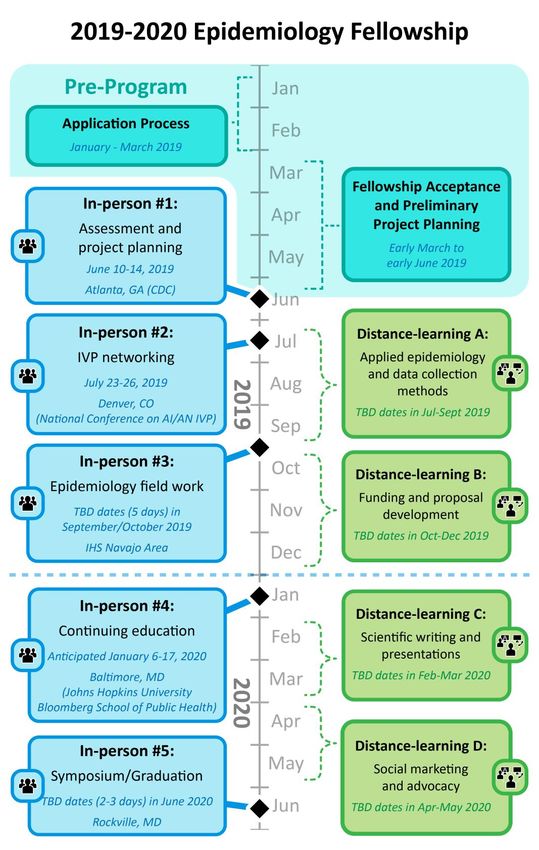
Fellowship participants will attend five in-person sessions away from their job sites (approximately 5 weeks),
and will participate in four distance-learning sessions conducted to enhance professional development. The
current order and timing of in-person and distance-learning sessions (subject to modification) are listed in the
table below.
In-person Distance-learning
1. Assessment and project planning: June 10-14, 2019; Atlanta, GA A. Applied epidemiology and data
collection methods: TBD dates
2. Networking at National Conference on AI/AN Injury and
Jul-Sept 2019
Violence Prevention: July 23-26, 2019: Denver, CO
B. Funding and proposal
3. Epidemiology field work: TBD dates (5-days) September or
development: TBD dates Oct-Dec
October 2019; IHS Navajo Area
2019
4. Continuing education at Johns Hopkins University Bloomberg C. Scientific writing and
School of Public Health (Winter Institute): anticipated January 6- presentations: TBD dates Feb-
17, 2020; Baltimore, MD Mar 2020
5. Symposium/Graduation: TBD dates (2-3 days) June 2020; D. Social marketing and advocacy:
Rockville, MD TBD dates Apr-May 2020
For a more detailed summary of in-person and distance-learning sessions, and a program timeline, please refer
to Appendices B and C. Learning objectives for the sessions will align with select Core Competencies for Injury
and Violence Prevention Practitioners, developed for the injury/violence field, available here.
Fellowship participation requires approximately 5-10 hours per week of work related to your project (including
participation in and completing ‘homework’ assignments for distance-learning sessions). Participants will also
write a project report and prepare a project presentation. Time to complete these activities may be required
while you are at work and/or at home.
32019-2020 EPI Fellowship Program Summary
Mentors
Each Fellowship participant will have a local project mentor (throughout the program), and access to external
advisors. Both the mentor and external advisors will be available to provide advice and guidance.
The local mentor can be an IHS Injury Prevention Specialist, or a community member with experience or
special expertise in the project topic. The local mentor’s role is to assist the Fellow in identifying a topic and
developing a project or study outline, establishing timelines, meeting deadlines, and providing guidance in the
design, implementation, and evaluation of the research project. Fellowship participants will be matched with
an external advisor, based on project topics and areas of expertise required for the project.
Overview of Online Application
To apply to participate in the EPI Fellowship, you will complete a multi-part online application.
The application is divided into several parts (see preview in Appendix D), some of which require additional
information (e.g., prerequisite documentation, letters of support):
A. Background Information about You
B. Background Information about Your Work
C. Your Commitment and Motivations
D. Project Description
E. Letters of Support (from direct supervisor and Area Injury Prevention Specialist a)
F. Prerequisite Supporting Documentation
G. Final Checklist and Submission
a
See list at www.ihs.gov/MedicalPrograms/InjuryPrevention (click on “IHS and Tribal Contacts”).
Applicants should use this link to initiate their online application.
Online applications can be completed over several days (i.e., all questions do not need to be answered in one
sitting). However, by 9:00 pm EST (5:00 pm Alaska Standard Time) on Friday, March 1, 2019, all questions
must be answered, and all supporting documentation must be provided (e.g., proof of prerequisites, letters of
support), prior to clicking on the ‘complete my application’ step (the final page of the online application).
The 2019-2020 EPI Fellowship will be facilitated by an academic advisor team contracted by the IHS Injury
Prevention Program from the University of North Carolina at Chapel Hill’s Gillings School of Global Public
Health. The UNC team, led by Dr. Carolyn Crump and Mr. Robert Letourneau, MPH, will work in consultation
with the IHS IP Program Manager (Holly Billie, MPH). For additional questions, please contact Holly Billie, MPH,
IHS IP Program Manager at 301-443-8620 or Holly.Billie@ihs.gov.
42019-2020 EPI Fellowship Program Summary
Appendix A: Fellowship Project Examples
Projects completed for the IHS Injury Prevention Epidemiology Fellowship should emphasize data collection
and analysis (e.g., epidemiology, surveillance, cost, evaluation). These projects involve data collection and
assessment to: define or provide context about an injury or violence problem occurring at an AI/AN tribe or
community; or evaluate an IP intervention. Projects from 1987 to 2015 have focused on unintentional injury,
intentional injury, and/or other topics, including:
Unintentional Injury Project Topics: Unintentional Injury Project Topics (continued):
Animal Injuries Pedestrian
Athletic Injuries Playground Safety
Bicycle Safety Substance Use
Carbon Monoxide Workplace Injuries
Drowning
Falls Intentional Injury (Violence) Project Topics:
Fire/Burns Assault (general)
Firearm Child Abuse/Neglect
Home Safety (general) Domestic Violence (general)
Motor Vehicle Homicide
o Child Passenger Safety Suicide
o Cost Youth Violence
o Crash Surveillance
o Driving Under the Influence Other Injury Project Topics:
o Helmet Use Emergency/Medical Response
o Law Enforcement Injury Prevention/Control (general)
o Livestock Control Injury Surveillance (Cost, Data Sources,
o Roadway Modification Descriptive Studies)
o Seat Belt Use
Tables 1 to 3 list recent EPI Fellowship Projects (2007-2015) by type of injury (e.g., unintentional, intentional,
other) and injury topic, including project title, year (of Fellowship start), and Fellowship participant name.
Table 1. Unintentional Injury IHS EPI Fellowship Projects.
Project title Year Name
Falls
Elder falls prevention. 2015 Alyssa Bernido
A home safety assessment to reduce fall injuries. 2011 Tim Balderrama
Elder Falls Prevention: A Self-Assessment Tool for Evaluating Level of Program
2007 Susan E.C. Ducore
Development in California Tribal Health Programs.
Motor Vehicle (Child Passenger Safety)
Promoting child passenger safety 2015 Marc Matteson
Motor Vehicle (Cost)
Direct Medical Costs of Motor Vehicle Related Hospitalizations. 2007 Siona Willie
Motor Vehicle (Crash Surveillance)
Causes of motor vehicle crashes on Navajo Route 12 2011 Jacey McCurtain
Haxton Way: A Descriptive Study of Motor Vehicle Crashes and Potential Stephanie Peebles
2007
Interventions- Lummi Indian Reservation, Washington. Coffey
Motor Vehicle (Driving Under the Influence)
Developing a MADD Chapter on Fort Berthold Indian Reservation: Challenges Dr. Verlee K. White
2007
in Changing a Community Norm. Calfe-Sayler
52019-2020 EPI Fellowship Program Summary
Table 1. Unintentional Injury IHS EPI Fellowship Projects.
Project title Year Name
Motor Vehicle (Law Enforcement)
Improving traffic law enforcement in Oklahoma: Cross-deputizing BIA and
2011 Dustin Joplin
Tribal police officers.
Motor Vehicle (Livestock Control)
The Grass is Greener: A Descriptive Study of Animal-Car Crashes 1999-2005
2007 Elisa DuBreuil
on US 163 in Kayenta Service Unit, Navajo Nation.
Motor Vehicle (Seat belt Use)
Increasing awareness and enforcement of a Tribal seatbelt law. 2011 Molly Madson
Substance Use
Tracking Methamphetamine Data. 2007 Belinda Aungie
Workplace Injuries
Commercial fishing income and injury rates in Southwest Alaska. 2011 Bryan Reed
Table 2. Intentional Injury HS Epidemiology Fellowship Projects.
Project title Year Name
Assault (general)
Reducing assault recidivism among 15 to 34 year old males from a South
2011 Martin Stephens
Dakota Sioux Tribe.
Suicide
Youth suicide risk reduction. 2015 Martha Maynes
Suicide intervention among Alaska Native people: an evaluation of ASIST. 2011 Hillary Strayer
The value of medical records in exploring risk factors for suicide. 2007 Bonny M. Weed
Table 3. Other IHS EPI Fellowship Projects.
Project title Year Name
Emergency/Medical Response
A Global Positioning System to improve emergency response at the Tohono
2011 Travis Bowser
O'odham Nation.
Injury Prevention/Control (General)
Albuquerque Area injury interventions. 2015 Jerrod Moore
Building injury control capacity among California Tribes: Evaluating the Area's
2011 Lisa Nakagawa
mini-grant program.
Injury Surveillance (Cost)
Epidemiology and costs of injuries at CRIT. 2015 Isaac Ampadu
Injury Surveillance (Data Sources)
IP data for IP coalition. 2015 Katie Tompkins
62019-2020 EPI Fellowship Program Summary
Appendix B: In-person and Distance-learning Summary and Program Timeline
1. Project Planning
March to June 2019
Following acceptance to participate in the 2019-2020 EPI Fellowship class, participants will complete the
following activities prior to the first in-person academic session:
o Complete skill assessments and pre-program evaluation survey.
o Begin working with local mentor.
o Review a summary of Fellowship expectations.
o Refine project ideas and conduct project planning (e.g., begin literature search).
2. Assessment and Project Planning: In-person #1
June 10-14, 2019; Atlanta, GA
This session focuses on the planning required for EPI Fellowship projects, including a review of
epidemiologic approaches, ethical issues in data collection and reporting, and finding data and information
related to projects. Learning outcomes include, but are not limited to:
Review of concepts from IHS IP Short-Courses (Levels 1 and 2).
Review concepts related to epidemiology and biostatistics.
Identify sources of data for descriptive and analytic studies related to I/V surveillance and/or
evaluation.
Understand data collection ethics and review processes in Tribal communities.
Obtain information from subject-matter experts regarding leading IV issues in AI/AN communities.
Complete a literature search using the Internet.
Finalize a project plan.
Present project summary to Fellowship participants.
3. Networking at National Conference on AI/AN Injury and Violence Prevention: In-person #2
July 23-26, 2019: Denver, CO
This session allows Fellowship participants to attend the first-ever National Conference on AI/AN Injury and
Violence Prevention and to provide project updates. Learning outcomes include, but are not limited to:
Identify, attend, and apply learning from projects conducted by injury/violence prevention experts.
Present project update to Fellowship participants.
Obtain input about Fellowship projects.
4. Applied Epidemiology and Data Collection Methods: Distance-learning A
TBD dates in late Summer 2019 (July to September)
This module will provide an overview of concepts related to applied epidemiology and data collection
methods. Learning outcomes: TBD.
5. Epidemiology Field Work: In-person #3
TBD dates in September or October, 2019; IHS Navajo Area.
This session is designed to enhance skills in conducting field work in injury prevention. Fellowship
participants work in teams to address issues identified by the host Tribal Nation and IHS Area staff.
Findings and recommendations will be presented to Tribal leaders and IHS Area staff. Learning outcomes
include, but are not limited to:
o Describe major injury issues facing the host Area.
o Use digital photography to document injury hazards and programs.
o List the steps in organizing and conducting a focus group.
o Prepare and administer a structured questionnaire for key informant interviews.
o Prepare a group presentation and written report for Tribal members.
72019-2020 EPI Fellowship Program Summary
6. Funding and Proposal Development: Distance-learning B
TBD dates in late 2019 (October to December)
This module will provide an overview of concepts related to funding sources and preparing funding
applications. Learning outcomes include, but are not limited to:
o Locate sources of funding for injury prevention projects.
o Describe proposal development steps.
o Identify common errors in proposal writing.
7. Continuing Education at Johns Hopkins University (Winter Institute): In-person #4
Anticipated January 6 to 17, 2020; Baltimore, MD
Fellowship participants will attend 2-3 courses offered during the 2-week Winter Institute at the Johns
Hopkins University Bloomberg School of Public Health. Graduate credit is awarded for participants
completing all course requirements. Learning outcomes will vary based on courses selected.
8. Scientific Writing and Presentations: Distance-learning C
TBD dates in Winter 2020 (February to March)
This module will provide an overview of scientific writing and development of presentation slides. Tips for
delivery of oral presentations and preparing a report or manuscript will be described. Learning outcomes
include, but are not limited to:
o Prepare effective oral presentations using PowerPoint.
o Describe format and sections required in a project report.
o Create a written project abstract suitable for submission to conferences and publications.
o Identify the steps in submitting an article for publication.
9. Social Marketing and Advocacy: Distance-learning D
TBD dates in Spring 2020 (April to May)
This module will provide an overview of concepts related to social marketing and advocacy for injury and
violence prevention efforts. Learning outcomes: TBD.
10. Fellowship Symposium: In-person #5
TBD dates in June 2020; Rockville, MD
During this 2-day session, the class of 2019-2020 Fellowship participants will participate in a symposium
practice session, where they will practice their presentation in front of their peers and IHS staff.
Participants will also present the results of their project to IHS Headquarters and Area staff, and Tribal
leaders, at a formal symposium session. Learning outcomes include, but are not limited to:
o Identify strengths and weaknesses in oral scientific presentations.
o Present a 12-minute summary of their completed injury prevention projects before a national
audience.
82019-2020 EPI Fellowship Program Summary
Appendix C: Program Timeline
92019-2020 EPI Fellowship Program Summary
Appendix D: Preview of Fellowship Application Questions
The online application for the 2019-2020 EPI Fellowship Program will require you to provide the following
information, by category:
A. Background Information about You
1. First and Last Name
2. Preferred Mailing Address (include street/PO, city, state, zip)
3. Preferred Telephone Number
4. Email Address
5. Fax (if applicable)
6. If you are an enrolled member of a tribe, name the Tribe(s),
B. Background Information about Your Work and Training
1. Current job title/position
2. Length of time in this position
3. Name of the Tribe/Organization/Agency employing you
4. If you work for a tribe, please indicate if that tribe has compacted or contracted its Environmental
Health services? (Responses: Yes, No, Not Sure, Not applicable to me)
5. Brief description of your primary job responsibilities
6. Description of your experiences to prevent injury or violence, including professional or volunteer work
you have completed, and when you completed this work (e.g., years).
7. List of injury or violence prevention training you have obtained and dates completed.
Note: Examples include: IHS Injury Prevention Levels 1, 2, or 3; IHS Fellowship; grant-writing workshops; NHTSA
child passenger safety technician or instructor; IHS Tribal IP Cooperative Agreements Program workshops.
8. Please upload a copy of your resume or CV.
C. Your Commitment and Motivations
1. Description of your commitment to participate in all components of the program (e.g., completing
your project, attending all in-person sessions and distance-based modules).
Note: In addition to the approximate 5 weeks from work to travel to attend in-person academic sessions (refer to
timeline in EPI Fellowship Program Summary), participation requires approximately 5-10 hours per week of work
related to your project. This includes participation in several distance-based learning modules (which may include
‘homework’ assignments) throughout the program duration. You will also write a project report and prepare a
project presentation. Time to complete these activities may be required while you are at work and/or at home.
2. Description of why you want to participate in the IHS EPI Fellowship.
Note: Consider describing the following in your response: why you believe this advanced training is important to
you, your job, and your community; what you want to accomplish; how you might use this training in the future.
D. Description of Your Project
1. Project title.
2. Description of why the project is important (i.e., why you chose the topic).
3. Description of methods (i.e., steps, actions) necessary to complete your project.
4. List of people with whom have you discussed the project (names, titles)
5. Description of tribal approvals necessary for you to obtain to conduct your project (if unknown,
indicate so). Note: If unknown, determining this will be required prior to the first in-person session.
6. Name and title of whom have you identified as your local project mentor.
102019-2020 EPI Fellowship Program Summary
E. Letters of Support
Please upload electronic copies of letters of support from the following:
1. IHS Area, District, or Local injury prevention specialist (this can be your local mentor).
This letter should discuss the applicant’s qualifications and ability to complete the Fellowship work, including
completion of an individual project. The letter should state that the Specialist supports your applying to the
Fellowship; supports your project idea; and will be available to assist you in working on your project.
2. Your supervisor.
This letter should state why the applicant is a good candidate for the Fellowship and why the training will be of
value. The supervisor needs to state that she or he will allow the applicant to fully participate in all components
of the fellowship, including a total of approximately 5 weeks of travel for in-person academic sessions,
participation in several distance-based online learning modules, and approximately 5-10 hours per week for
project-related activities. Letters for applicants from compacted tribes that have obtained their training shares
from IHS should indicate agreement to bear the expenses associated with the Fellowship program (e.g., travel,
registration, course credit).
F. Pre-requisite Supporting Documentation
Please upload an electronic copy of the following documents:
1. Proof of your Bachelor’s Degree, or higher (e.g., diploma, final transcript).
2. Certificates of completion (or other similar proof of completion) for:
a. IHS Introduction to Injury Prevention (Level I) Course, or equivalent
b. IHS Intermediate Injury prevention (level II) Course or equivalent
11You can also read


