2019 2020 SECONDARY SCHOOLS COURSE SELECTION & PLANNING GUIDE - 2020 secondary schools course selection & planning guide
←
→
Page content transcription
If your browser does not render page correctly, please read the page content below
2019 - 2020

       SECONDARY SCHOOLS
COURSE SELECTION & PLANNING GUIDE

                                    .on.ca
2019-2020

                                                    Our Mission
                                                    is to enable all students to reach high
                                                    levels of achievement and to acquire the
                                                    knowledge, skills and values they need
                                                    to become responsible members of a
                                                    democratic society.

                  We Value
                      Each and every student
                      A strong public education system
                      A partnership of students, schools, family and community
                      The uniqueness and diversity of our students and our community
                      The commitment and skills of our staff
                      Equity, innovation, accountability and accessibility
                      Learning environments that are safe, nurturing, positive and respectful

                  Strategic Directions
                      Make every school an effective school
                      Build leadership within a culture of adaptability, openness and resilience
                      Form strong and effective relationships and partnerships
                      Build environmentally sustainable schools that inspire teaching and learning
                      Identify disadvantage and intervene effectively

                                                                                                                                .on.ca

                                                      ACKNOWLEDGEMENTS

   Project Manager: Choices 2019-2020                                              Special thanks to:
            Peter Gazzellone                                  Katie Ferguson                             Ava Szczurko
           Program Coordinator                              Assistant Coordinator            Re-Engagement Counsellor and Support
Guidance, Career & Adolescent Development               Guidance and Student Success            for School College Work Initiatives

                                      CHOICES© Toronto District School Board February, 2019
 Disclaimer: Every effort has been made to ensure that all information in this guide is as accurate as possible as of time of publishing.
Introduction
Dear Student,
High school is an exciting time in your educational career, as you explore new opportunities, begin
planning for your future and prepare to graduate. Completing your Ontario Secondary School
Diploma is an important milestone in your life and will prepare you for success as you move
forward along whatever post-secondary path you choose.
Throughout your time in high school, your parents/guardians, teachers and guidance counsellors
are all here to help and to provide you with the information and tools you need to make informed
decisions and achieve success.
This Choices guide is full of comprehensive information about the variety of learning opportunities
available to you at the TDSB and includes an outline of the step-by-step course selection process.
Please use this resource for assistance as you research and determine your path forward in high school and beyond.
I wish you great success for the future.

John Malloy
Director of Education
Table of Contents
                                                                                                 PAGE                                                                                                            PAGE

Getting Started................................................................................. 5             Cooperative Education................................................................. 47
Creating Pathways to Success ................................................... 6                             English .................................................................................................. 47

Building Character......................................................................... 9                  English as a Second Language and
                                                                                                               English Literacy Development ................................................. 47
Build Your Future............................................................................. 10
                                                                                                               First Nations, Métis and Inuit Studies.................................... 47
Policies & Practice - Equity & Inclusion ................................ 11                                   French as a Second Language................................................... 47
Policies & Practice - Special Education.................................. 12                                   Guidance and Career Education............................................... 48
Assessment & Evaluation of Student Achievement ....... 13                                                      Health and Physical Education ................................................. 48

Reporting ............................................................................................ 14      Interdisciplinary Studies.............................................................. 48

Alternative Learning Opportunities ...................................... 15                                   Mathematics ...................................................................................... 48
                                                                                                               Native Languages............................................................................ 48
Re-Engagement Opportunities................................................ 19
                                                                                                               Science.................................................................................................. 48
Specialized Programs.................................................................... 22
                                                                                                               Social Sciences and the Humanities....................................... 49
Specialist High Skills Major Programs................................... 24
                                                                                                               Technological Education.............................................................. 49
Other Programs................................................................................ 25                      Communications Technology ............................................. 49
Specific Program Information                                                                                           Computer Technology ........................................................... 49
        Cooperative Education........................................................... 26                            Construction Technology....................................................... 49
        Apprenticeship (OYAP)............................................................ 27                           Green Industries........................................................................ 50

        Technology.................................................................................. 28                Hairstyling and Aesthetics .................................................... 50
                                                                                                                       Health Care ................................................................................. 50
CHOICES PLANNING GUIDE
                                                                                                                       Hospitality and Tourism ......................................................... 50
Diploma & Certificate Requirements..................................... 31
                                                                                                                       Manufacturing Technology................................................... 50
Understanding Course Codes and Descriptors................. 33
                                                                                                                       Technological Design.............................................................. 51
Pathways Charts............................................................................... 34
                                                                                                                       Transportation Technology................................................... 51
Course Types...................................................................................... 37          Translations........................................................................................ 52
Things to Consider.......................................................................... 39
Completing Your Online Course Selection.......................... 40

Course Descriptors & List of Course Codes
Alternative (Non-Credit) Courses............................................... 43
The Arts ................................................................................................ 44
Business Studies .............................................................................. 45
Canadian and World Studies...................................................... 45
Classical Studies and International Languages................ 46
Computer Studies............................................................................ 47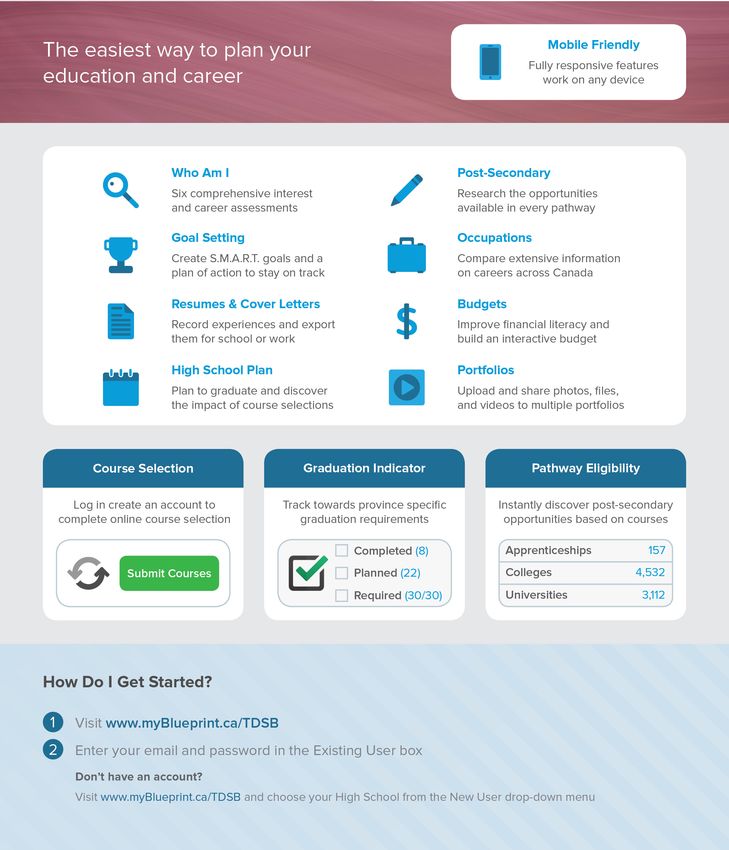
Getting Started
Choices: Secondary Schools Course Selection & Planning Guide is published online annually to encourage parents/guardians*
and students to keep themselves informed about the opportunities available to them, both in and beyond secondary school.
It is the goal of this publication to provide information that will help with the decision-making process that must occur around
the course selection process.

 Planning Guide                                                        Ontario Guidance Program
There is a course selection planning section to assist students       Ontario Schools, Kindergarten to Grade 12: Policy and Program
and their parents/guardians with the course selection process.        Requirements, 2016 (often referred to as OS), describes the
Students are encouraged to use this guide and keep it,                three areas of learning that constitute the Ontario guidance
where possible, in their career/life portfolio. Also visit            and career education program, as follows:
www.myBlueprint.ca/tdsb.                                                • Student development – the development of habits and
                                                                      		 skills necessary for learning.
 Course Selection Process
                                                                        • Interpersonal development – the development of the
Course selection for students under the age of 18 must be             		 knowledge and skills needed in getting along with
made with parental approval. Therefore, keeping in touch              		others.
with the school’s guidance counsellor is of great importance.
                                                                        •   Career development – the development of the
Consideration of the student’s achievement for the past
                                                                      		    knowledge and skills needed to set short-term and
several years and the advice of the school, aid in choosing
                                                                      		    long-term goals in planning for the future. (Creating
a program.
                                                                      		    Pathways to Success, page 4)
 Course Selection Sheet or                                            Creating Pathways to Success: An Education and Career/Life
                                                                      Planning Program for Ontario Schools – Policy and Program
 myBlueprint Online                                                   Requirements, Kindergarten to Grade 12, 2013 (referred to as CPS)
Program selection for September will be made in January               is designed to support all three areas of learning as they relate
or February. Course selection will take place either via              to education and career/life planning. This is a school-wide
myBlueprint (online) or by course selection sheet. Courses            program delivered through instruction linked to the curriculum
offered at your secondary school will be listed on myBlueprint        and through broader school programs and activities. This
and on the course selection sheet (if being used). Planning           program is designed to support students in becoming
on myBlueprint or on a course selection sheet is important            competent, successful and contributing members of society.
and students should take it seriously. An Individual Pathway          The focus of the program enables students to complete
Plan (IPP) needs to be completed each year and regularly              secondary school in four years and make a successful transition
reviewed, as plans and destinations may change over time. It is       to their initial postsecondary destination.
the responsibility of all students and their parents/guardians        The program’s effectiveness will be determined by monitoring
to complete course selections by the date prescribed by the           the implementation and finding evidence of the program in
school. Subsequent modifications to a student’s program will          students’ Individual Pathways Plan (IPP), gauging students’
be made for sound educational reasons only. Please note that          awareness of personal strengths and needs and gathering
where enrolment is insufficient, a course may be withdrawn            evidence from exit surveys completed by students. (Creating
or cancelled.                                                         Pathways to Success, page 40)
 Learning to 18                                                       For additional information, visit
                                                                      www.tdsb.on.ca/HighSchool/Guidance
Ontario Ministry of Education requires students to attend
school until they reach the age of 18 or until they have
obtained an Ontario Secondary School Diploma (OSSD).

                       Choices 2019 - 2020 Secondary Schools Course Selection & Planning Guide
                                        is available at www.tdsb.on.ca/choices

* Where parent/guardian is found, it is inclusive of caregivers and a significant adult.

Toronto District School Board                                                                   Choices 2019–2020                   5
Creating Pathways to Success
 An Education and Career/Life Planning                          Program Framework
 Program to Support Student Success*
                                                               The framework of the Education and Career/Life Planning
 Program Goals                                                 Program is a four-step inquiry process based on four questions
                                                               linked to four areas of learning—Who am I? (Knowing Yourself);
What students believe about themselves and their               What are my opportunities? (Exploring Opportunities); Who
opportunities, and what their peers and the adults in          do I want to become? (Making Decisions and Setting Goals);
their lives believe about them, significantly influences the   and What is my plan for achieving my goals? (Achieving
choices they make and the degree to which they are able        Goals and Making Transitions). The steps are not necessarily
to achieve their goals. The new education and career/life      sequential—throughout their school years and throughout
planning policy for Ontario schools is based on the belief     their lives, students will continually explore, assess, and reassess
that all students can be successful, that success comes in     their knowledge of themselves, their opportunities, their
many forms, and that there are many different pathways         goals, and their plans for achieving their goals.
to success. The policy is founded on a vision in which all
students leave secondary school with a clear plan for           Individual Pathways Plan (IPP)
their initial postsecondary destination— whether it be
apprenticeship training, college, community living,            Students will need to create and maintain an Individual
university, or the workplace—and with the confidence           Pathways Plan (IPP) during Grades 7 to 12. The IPP becomes
that they can revise their plans as they, and the work         the planning tool for course selection, goal setting and
around them, change. This vision sees students as the          postsecondary destination planning.
architects of their lives.                                     The Toronto District School Board has provided its
The goals of the Education and Career/Life Planning            students with an electronic version of the IPP through
Program are to:                                                www.myBlueprint.ca/tdsb. The IPP Tracker provides
                                                               grade-specific activities to complete in order to build an
 • ensure that students develop the knowledge and skills       effective education plan annually.
		 they need to make informed education and career/life
		choices;                                                      Postsecondary Transition Planning
 • provide classroom and school-wide opportunities for this
		 learning; and                                               As students move through secondary school, they need to
                                                               begin to focus on an initial destination with regard to education,
 • engage parents and the broader community in the             training, the workplace or community living. During the course
		 development, implementation, and evaluation of the          selection process, students research and select their courses
		 program, to support students in their learning.             in order to reach this initial destination. Their plan needs to
                                                               reflect their achievement, information on postsecondary
                                                               opportunities, a financial plan, employment opportunities,
                                                               job search skills and career exploration and experiential
                                                               learning opportunities.

                                               Who am I?

           What is my plan                  EDUCATION                 What are my
            for achieving                  AND CAREER/               opportunities?
              my goals?                   LIFE PLANNING

                                             Who do I
                                          want to become?                * Creating Pathways to Success: An Education and Career/Life
                                                                            Planning Program for Ontario Schools– Policy and Program
                                                                        requirements, Kindergarten to Grade 12, 2013 (referred to as CPS)

Toronto District School Board                                                                Choices 2019–2020                         6
Creating Pathways to Success
Message to Parents/Guardians
Use these four inquiry questions to have conversations with your child. Encourage them to discover their interests, explore
opportunities open to them, create future goals and construct a plan for how to achieve them.

                 EDUCATION AND CAREER/LIFE PLANNING: A FOUR-STEP INQUIRY PROCESS
   Inquiry Question            Area of Learning (Knowledge and Skills)

   Who am I?                           Knowing Yourself
                                       To help answer the question “Who am I?”, students will:
                                       • identify the characteristics that describe who they are, and create and maintain a personal
                                         profile that reflects those characteristics (e.g., interests, strengths, intelligences,
                                         accomplishments, values, and skills, including the learning skills and work habits
                                         evaluated on the provincial report cards and the Essential Skills described in the Ontario
                                         Skills Passport);
                                       • identify factors that have shaped who they are and that are likely to shape their profile
                                         over time;
                                       • reflect on how the characteristics described in their profile influence their thoughts and
                                         actions, and how those thoughts and actions may in turn affect their development as a
                                         learner, their relationships, and their education and career/life choices.

   What are                            Exploring Opportunities
                                       To help answer the question “What are my opportunities?”, students will:
   my                                  • explore the concept of “opportunity” and how the choices they make can open
                                         pathways for them;
   opportunities?                      • identify co-curricular and community-based opportunities (e.g., recreational, social,
                                         leadership, volunteer, part-time employment);
                                       • investigate a variety of fields of work, occupations, and jobs, as well as the potential
                                         impact of local and global trends (e.g., demographic, technological, economic,
                                         social) on the opportunities available to them;
                                       • investigate the preparation required for a variety of co-curricular and community-
                                         based opportunities, occupations, and jobs (i.e., acquiring the necessary experience,
                                         education/training, and specific skills, including the Essential Skills and work habits
                                         documented in the OSP) and how this preparation can be obtained.

   Who do                              Making Decisions and Setting Goals
                                       To help answer the question “Who do I want to become?”, students will:
   I want                              • identify the demands, rewards, and other features of the various opportunities they
                                          have explored, and reflect on the fit between those features and the characteristics
   to become?                             they have described in their personal profile;
                                       • based on the connections they identify, use a decision-making process to determine
                                         personal and interpersonal goals as well as education and career/life goals;
                                       • review and revise their goals in light of any changes that may arise in their personal
                                         profile and in the opportunities that are available to them.

   What is                             Achieving Goals and Making Transitions
                                       To help answer the question “What is my plan for achieving my goals?”, students will:
   my plan for                         • create a plan that identifies in detail the steps required to achieve the goals they
                                         have set;
   achieving                           • identify the resources required to implement their plan;

   my goals?                           • identify potential obstacles and challenges they may encounter in implementing
                                         their plan, and devise possible solutions.
                                                                                                (Creating Pathways to Success, page 15)

Toronto District School Board                                                                    Choices 2019–2020                     7
The Journey: myBlueprint
                                    myBlueprint* is an online resource available to all TDSB students (Grade 7 to 12)
                                    and families that lets you plan high school courses, complete the Individual
                                    Pathways Plan (IPP), research postsecondary opportunities and occupations,
                                    build a resume or cover letter, discover interests and learning styles and lots more.

      *as provided by myBlueprint

Toronto District School Board                                                       Choices 2019–2020                 8
Building Character
 Build Character
Character development at the TDSB is about helping students learn and practice positive character attributes. When we build
good character, we build strong communities. In the school community, character development is woven into programs and
practices and it becomes a way of life. Student success is dependent on a safe, caring and inclusive learning environment where
all students feel valued. This starts by teaching our students about the value of character – respecting themselves and each other,
making positive contributions to their school and community and thinking critically and creatively.
Character Development:
• Develops the whole student                                                  • Engages students in their learning
• Contributes to a healthy, safe and orderly school environment               • Is Universal
• Creates a collaborative school where the teaching and learning              • Is Respectful
  can be the focus                                                            • Strives for an ever growing depth of self-awareness,
• Provides high expectations for learning and behaviour                          self-discipline and understanding

Go to: www.tdsb.on.ca/Character

 Student Success
Student Success is about meeting
the individual learning needs of each
and every student. This includes
understanding their learning style,
capitalizing on their strengths, abilities
and interests. Schools are providing
students with more opportunities to
customize their high school experience.
Every secondary school in Ontario now
has a team comprised of a principal,
a Student Success teacher, special
education teacher, and a guidance
counsellor. Together, they:
• Identify and support students
• Provide more options for learning
• Monitor student progress
Other opportunities to support Student
Success include:

		 Grade 8 to 9 Transition
		 Student Success Teams
		 Credit Recovery/Rescue
		 Dual Credit Program
		 Expanded Co-op Credits/OYAP
		 Specialist High Skills Major
		 Student Voice
How do I find out more? If you are
interested in any of these programs
contact your guidance counsellor and/
or Student Success Teacher to find out
which opportunity may be available at
your school.
More information is available at:
www.edu.gov.on.ca/MoreStudentSuccess

Toronto District School Board                                                                 Choices 2019–2020                 9
Build Your Future
 Career/Life Development                                                     What is a Job?
A career is your path through life. It includes education,                  A job is the position a person holds doing specific duties.
learning, different jobs, work (paid and unpaid), family life,              For example, consider the occupation of a doctor. The doctor’s
friendships, community activities and leisure activities. Career            job is working at Toronto General Hospital. People usually
development requires students to understand themselves                      change jobs more often than they change occupations.
and opportunities in both the world and workplace so that
when presented with opportunities they are prepared to
make decisions about their future.                                           What is an Occupation?
Career development requires students to learn how to                        An occupation is similar work for which people usually have
make informed choices to ensure their successful transition                 similar responsibilities and develop a common set of skills
from elementary to secondary school and from secondary                      and knowledge. Occupational titles include: cashier, chef,
school to further education, training, and work. It involves                insurance agent, nurse, teacher, etc.
understanding self, goal setting, decision making and
opportunity awareness.
                                                                             What is a Career?
The workplace is rapidly changing. As existing jobs become
more complex and new jobs demand increased levels of                        A career is your life path or life story in progress. It includes,
education, career development is more critical than ever before.            learning, work (paid and unpaid), family life, friendships,
The reality is that the challenges and opportunities faced by students      community and leisure activities.
in this century are unlike those of any previous generation, and that
all students today require specific knowledge and skills in education                                 Go to
and career/life planning to support them in making sound choices                        www.tdsb.on.ca/BUILDYOURFUTURE
throughout their lives. (Creating Pathways to Success, page 6)

                                                                High Five

1   Change
    Is Constant
 We change constantly,
                              2    Learning
                                   Is Ongoing
                               Graduating from
                                                            3    Focus on the
                                                                 Journey
                                                            Travelling through
                                                                                          4   Follow
                                                                                              Your Heart
                                                                                          Dreaming about your
                                                                                                                      5   Access
                                                                                                                          Your Allies
                                                                                                                      The journey of life is
 and so does the world         high school or a             life is like travelling       future can help you         not taken alone. Life
 around us — including         post-secondary               down a road: having           to understand what          is like a team sport, and
 the working world.            program doesn’t mean         a destination gives           you really want in life.    your team members
 Chances are that a            that your education is       direction, but most           Knowing what you            are your friends,
 single occupation will        complete. Education          of the time is spent          want and keeping it         family, teachers, and
 no longer take workers        is not limited to            moving along. Pay             in mind can give you        neighbours. Any of
 from the beginning to         classrooms in a school.
                                                            attention to the              the motivation you          them can be willing
 the end of their working      Opportunities to learn
 lives. Adaptability is an
                                                            journey, with all of          need to deal with life’s    and helpful allies
                               are everywhere! Learn
 important skill to carry                                   its pitfalls, sidetracks,     challenges. Listen to       when it comes to
                               to recognize them and
 into the world of work.       make your learning a         opportunities, and            your inner voice.           deciding what steps
                               lifelong experience.         highways to new                                           to take on life’s path.
                                                            destinations.

Toronto District School Board                                                                           Choices 2019–2020                   10
Policies & Practice
Equity & Inclusion in Education
The Toronto District School Board has policies and procedures to ensure that students have equity of access to learning
opportunities. For students to achieve their full potential, the education system must be free from discrimination and must
provide all students with a safe and secure environment so that they can participate fully and responsibly in the educational
experience. The implementation of these principles influences all aspects of school life. It promotes a school climate that
encourages all students to strive for high standards, affirms the worth of all students, and helps them strengthen their sense of
identity and develop a positive self-image. It encourages staff and students to value and show respect for diversity in the school
and in the larger community.
Learning activities are designed to help students develop a respect for human rights and dignity and to develop a sense of
personal, social, and civic responsibility. These activities reflect diverse points of view and experiences and enable students to
learn about the contributions of a variety of peoples, in the past and the present, to the development of Canada. Students are
encouraged to think critically about aspects of their own and their peers’ backgrounds and to become more sensitive to the
experiences and perceptions of others.
TDSB Equity All TDSB Schools Adhere to the following Ministry Policies:
Foundation Statement • Ontario Schools, Kindergarten to Grade 12: Policy and Program Requirements, 2016 (OS),
The TDSB values the contribution which outlines all policy related to secondary education in the province of
of all members of our diverse Ontario.
community of students, staff, parents • Creating Pathways to Success: An Education and Career/Life Planning Program for
and community groups to our Ontario Schools, 2013 (CPS), which describes the career development policy
mission and goals. We believe that designed to help students achieve their personal goals and become competent,
equity of opportunity, and equity successful and contributing members of society (page 2).
of access to our programs, services, • Curriculum policy documents, which outline the requirements for study in
and resources are critical to the each subject available in Grades 9 and 10 and Grades 11 and 12.
achievement of successful outcomes • Growing Success: Assessment, Evaluation, and Reporting in Ontario Schools, First Edition,
for all those whom we serve, and for Covering Grades 1 to 12 (2010).
those who serve our school system.
• Ontario First Nation, Métis and Inuit Education Policy Framework (2007)
The diploma requirements for students is carefully outlined in the centre section
Caring & Safe Schools of this publication called 2017-2018 Choices Planning Guide. Students and their
parents/guardians are responsible for ensuring that they adhere to these requirements,
The Toronto District School Board is and that they give careful consideration each year to the educational planning
committed to creating school learning process. All Ministry of Education documents are available at www.edu.gov.on.ca.
environments that are caring, safe,
peaceful, nurturing, positive, and
respectful and that enable all students TDSB Urban Indigenous Education Centre
to reach their full potential. The Urban Indigenous Education Centre offers a range of services for First
When a school has a positive climate, all Nation, Métis and Inuit students and families, including wholistic approaches
members of the school community that enhance Aboriginal student success and well-being. It also
feel safe, included and accepted; positive provides ongoing guidance and support for TDSB staff that
behaviours and interactions with each work with Aboriginal students and communities. The Centre
other are actively promoted. Students utilizes a wholistic approach to enhance the overall achievement
are expected to demonstrate respect of First Nation, Métis and Inuit students throughout the TDSB.
for human rights and social justice and It also provides ongoing guidance and support for TDSB staff
promote the values they need to become that work with Aboriginal students and community members.
responsible members of society. The Urban Indigenous Education Centre seeks to create more inclusive
Caring & Safe Schools information is teaching and learning environments that enhance the education of all
available on the Toronto District School students in the TDSB by promoting the infusion of Aboriginal perspectives,
Board website at: www.tdsb.on.ca click histories and cultures across the curriculum for all students.
on High School and go to Caring and For more information: www.tdsb.on.ca/AboriginalEducation
Safe Schools.
The Board code of Conduct is available at:
www.tdsb.on.ca/AboutUs/Polices,proceduresForms/Detail.aspx?docid=1714
Toronto District School Board Choices 2019–2020 11Policies & Practice
Special Education Programs Students who have an
IEP or an IPRC designation
Recognizing the needs of exceptional students and designing programs that respond
generally receive the
effectively to these needs are important and challenging aspects of program planning
following support:
to which the Toronto District School Board staff are committed. The Board provides a
wide range of program options for students with special needs, including the Learning ACCOMMODATION
Strategies Course (GLE) for students with an Individual Education Plan (IEP).
The process of changing, for
After an Identification, Placement, and Review Committee (IPRC) identifies a student individual students, the way the
as exceptional, an Individual Education Plan (IEP) is developed and maintained for that curriculum is delivered to them in
student. An IEP may also be prepared for students who are receiving Special Education ways that are appropriate to their
programs and services but who have not been formally identified as exceptional by identified learning needs. These
an IPRC. may be in the form of
individualized teaching and
The IEP is based on a thorough analysis of the student’s strengths, needs, and interests.
assessment strategies, human
It will identify what the student is expected to learn and will explain how the Special
supports, and/or individualized
Education program and services will help him or her achieve those learning goals and equipment. Accommodations
expectations. The IEP will also outline a coordinated plan for supporting students when allow the student to participate
making transitions. Further information can be obtained from the secondary school in learning without any changes
Special Education personnel or from the Guidance or Student Services department or to the knowledge and skills
www.tdsb.on.ca/HighSchool/SpecialEducation. the student is expected to
demonstrate.
SEAC - Special Education Advisory Committee MODIFICATION
This committee consists of representatives from local associations, community Modifications are changes
representatives, and trustees all appointed by the TDSB. SEAC members are made in the age-appropriate
available as a resource for parents of students with exceptional needs. All interested grade-level expectations for
parents, guardians and members of the public are invited to attend SEAC meetings. a subject or course in order to
Further information concerning SEAC can be obtained by visiting: meet a student’s learning needs.
Such changes may reflect a
www.tdsb.on.ca/HighSchool/Special Education > click Special Education
decrease in the number or
Advisory Committee (SEAC) complexity of expectations.
Student Planners
Many schools use student planners as important communication vehicles. Planners contain valuable information regarding
upcoming events, Code of Conduct, examination protocol and information regarding co-curricular and extra-curricular activities.
These publications are extremely useful time management tools and where available, their use needs to be encouraged.
Student planners also contain TDSB common pages about the homework policy, code of online conduct, etc.
For more information, visit www.tdsb.on.ca/AboutUs/Calendar/StudentPlanners
TDSB Student Senate Captivate • Motivate • Initiate
The TDSB Student Senate is a group of 20 democratically elected students from all over TDSB.
The Senate's main goal is to bring a student voice to the Boardroom.
There are monthly regional meetings in the TDSB regions/quadrants. Through these meetings students
The Voice of Every Student
can voice their opinions and ideas. The student voice then goes through the Senate and into the
Boardroom through two Student Trustees.
Student Senate also hosts events, such as the Elections Conference and Grade 9 and 10 Leadership Retreat. The Senate and
student voice has initiated items including the Student Leadership Policy, SAC Handbook, Homework Moratorium Policy.
Get involved! Attend the meetings and events and learn more about the opportunities that Senate can offer.
Visit www.tdsb.on.ca/High-School/TDSB-Student-Senate or join the TDSB Student Senate Facebook group.
Toronto District School Board Choices 2019–2020 12Assessment & Evaluation of Student Achievement
Levels of Achievement Not all things that count can be counted.
The achievement chart identifies Not all things that are counted count.
four levels of achievement,
defined as follows: Our responsibility as educators is to be accountable for things that count.
Level 4 (80 to 100%) identifies Growing Success: Assessment, Evaluation, and Reporting in Ontario Schools, First Edition,
achievement that surpasses the Covering Grades 1 to 12 (2016) clarifies, coordinates, and consolidates the various
provincial standard. The student aspects of the policy, with the aim of maintaining high standards, improving
demonstrates the specified student learning, and benefiting students, parents/guardians and teachers in
knowledge and skills with a high elementary and secondary schools across the province.
degree of effectiveness.
The Seven Fundamental Principles of Assessment and Evaluation:
Level 3 (70 to 79%) represents the
provincial standard for achievement. To ensure that assessment, evaluation, and reporting are valid and reliable, and
The student demonstrates the that they lead to the improvement of learning for all students, teachers use
specified knowledge and skills practices and procedures that:
with considerable effectiveness. • are fair, transparent, and equitable for all students;
Level 2 (60 to 69%) represents • support all students, including those with special education needs, those
achievement that approaches who are learning the language of instruction (English or French), and
the provincial standard. The those who are First Nation, Métis, or Inuit;
student demonstrates the
specified knowledge and skills • are carefully planned to relate to the curriculum expectations and learning
with some effectiveness. Students goals and, as much as possible, to the interests, learning styles and
performing at this level need to preferences, needs, and experiences of all students;
work on identified learning gaps • are communicated clearly to students and parents/guardians at the
to ensure future success. beginning of the school year or course and at other appropriate points
Level 1 (50 to 59%) represents throughout the school year or course;
achievement that falls much • are ongoing, varied in nature, and administered over a period of time to
below the provincial standard. The provide multiple opportunities for students to demonstrate the full range
student demonstrates the specified of their learning;
knowledge and skills with limited
• provide ongoing descriptive feedback that is clear, specific, meaningful,
effectiveness.
and timely to support improved learning and achievement;
Below 50: The student has not
demonstrated the required • develop students’ self-assessment skills to enable them to assess their own
knowledge and skills. Extensive learning, set specific goals, and plan next steps for their learning.
remediation is required. Assessment & Evaluation
The primary purpose of assessment and evaluation is to improve student learning.
Assessment is the process of gathering information that accurately reflects how
Academic Honesty well a student is achieving the curriculum expectations in a subject or course.
It is the intention of the TDSB to Assessment is seen as both assessment for learning, a process which determines
provide a consistent and fair approach where students are in their learning and where they need to go, and assessment
to dealing with instances of academic as learning which focuses on the explicit fostering of students’ capacity over time
dishonesty, specifically with plagiarism to be their own best assessors.
and cheating. To ensure academic
honesty and avoid instances of Evaluation refers to the process of judging the quality of student learning on the
plagiarism, it is the student’s basis of established performance standards and assigning a value to represent
responsibility to understand what that quality (Note Levels of Achievement). Evaluation accurately summarizes and
actions constitute plagiarism, as communicates to parents/guardians, other teachers, employers, institutions of
well as the penalties that correspond further education, and students themselves what students know and can do with
to academic dishonesty and plagiarism. respect to the overall curriculum expectations. Evaluation is based on assessment
Direction to staff and students on this of learning that provides evidence of student achievement at strategic times
issue are described in the Academic throughout the grade/course, often at the end of a period of learning.
Honesty Procedure (PR 613) found at As referenced from Growing Success. For the entire document, visit
the Policies, Procedures and Forms www.edu.gov.on.ca/eng/policyfunding/GrowSuccess.pdf.
www.tdsb.on.ca/AboutUs/
Policies,ProceduresForms
Toronto District School Board Choices 2019–2020 13Reporting
The Credit System
Ontario
is included for studentStudent Transcript
and parent/guardian comment.
A credit is granted when a course that has been scheduled
for a minimum of 110 hours is successfully completed (a • The Ontario Student Transcript (OST) is a provincially
mark of 50% or more). “Scheduled time” is defined as the time standardized document which provides a comprehensive
during which students participate in planned learning record of a student’s achievement in secondary school.
activities designed to lead to the achievement of the curriculum Copies are available to students upon request.
expectations of the course. • The credits that a student has earned towards fulfillment
of the requirements for the graduation diploma will be
Failure to Complete Courses recorded on the OST, regardless of how or where the
credits were earned.
If a student has completed a course, but has failed to achieve
the curriculum expectations at a passing level, no credit will • In Grades 9 and 10 only the successfully completed
be granted. At this time, staff will determine the best way courses are recorded on the OST.
to enable the student to earn a credit for the course, in • In Grades 11 and 12 all withdrawals, repeats and
consultation with the student and parents/guardians. This successful courses are recorded on the OST.
may be done at summer school, through an individualized
!
remediation program, credit recovery or by repeating the
entire course.
Attendance
Withdrawal from a Course
Regular attendance at school is critical for
If a student in a Grade 11 or 12 course withdraws after five students’ learning and achievement of course
instructional days following the issue of the second to last expectations. Students are required to attend school
provincial report card, the withdrawal is recorded on the until they reach the age of 18 or graduate. Where, in the
Ontario Student Transcript (OST). The percentage grade at Principal’s judgment, a student’s frequent absences
the time of the withdrawal is recorded. If a student withdraws from school are jeopardizing his or her successful
before the five instructional days following the issue of the completion of a course, staff will communicate with
second to last provincial report card, the withdrawal is not the student and parents/guardians to explain the
recorded on the OST. (The Ontario Student Transcript (2010), potential consequences of the absences, and to
page 12) discuss steps that could be taken to improve student
attendance.
Provincial Report Card
The standard Provincial Report Card includes the following
information:
• each course that the student is studying;
Ontario Student Record
• the student’s mark expressed as a percentage grade, along • The Ontario Student Record folder (OSR) is the official
with the course median; record for a student. The OSR is created when a student
enters the Ontario school system and moves with the
• number of classes missed and times late for class;
student from school to school. Every Ontario school
• the student’s achievement in six learning skills; keeps an OSR for each student enrolled.
• an anecdotal comment from each subject teacher • The OSR is created under the authority of the Education
with a focus on what students have learned, including Act, and the contents of the OSR are protected under the
significant strengths, and identified next steps. Freedom of Information and Protection of Privacy Act.
The report card will include information with respect to a Parents/guardians and the student may examine the
student’s Individual Education Plan (IEP) where appropriate. contents of the OSR on request, with the assistance of
The report card will also indicate whether a course has been the principal or designated administrator.
adapted to meet the needs of students who are • The OSR folder contains achievement results, credits
learning English as a Second Language or need assistance earned, and other information important to the
with English Literacy Development. education of the student.
Student progress is generally reported at mid-term or
mid-semester and completion of the year. A Response Form
is included for student and parent/guardian comment. A summary of credits earned to date, including a break-down of
compulsory and optional credits, is provided at the end of the final report card of the year or semester.
Toronto District School Board Choices 2019–2020 14Alternative Learning Opportunities
School Profiles Alternative Schools
on the web:
The following chart provides an overview of the alternative learning experiences available to students in the
www.tdsb.on.ca
TDSB. The environments vary and are aimed at providing students with an alternative educational
experience suited to their learning styles/preferences and/or needs. Each of the schools and programs
Click on differs in their approach to student learning and program structure. Some admission criteria has been
Find Your School
included to help guide interested students to an appropriate choice. For more specific admission
requirements, please contact the school or program directly or access school profiles. For more
Alternative Schools information, go to www.tdsb.on.ca click on Find Your School and then Alternative Schools.
Alternative Learning Environments Phone Profile
ALPHA II Alternative School 416-393-0501 Student directed learning; Grades 7 to 12
(ASE I) Alternative Scarborough Education 416-396-6914 Self-directed and motivated learners;
semestered Grades 11 to 12
Avondale Secondary Alternative School 416-395-4542 Flexible, individualized program for self-directed
students; non semestered Grades 9 to 12
EdVance Adolescent Program - BCALC 416-394-7130 18 to 20 year olds; earned a minimum of 5 credits
CALC 416-393-9740
EALC 416-395-3225
YALC 416-395-3350
SCAS 416-396-6921
City School 416-393-1470 Student-centered, small, supportive community
of academic learners; semestered; Grades 9 to 12
Contact Alternative School 416-393-1455 Retention and re-entry program; 16 years and older
Grades 9 to 12; quadmestered
Delphi Secondary Alternative School 416-396-6919 Problem-based learning for highly motivated
students; Grades 9 to 12; semestered
East York Alternative Secondary School 416-396-2925 Small, flexible, student-centered, restorative,
community school; for 16-20 year olds; Grades 10 to
12; semestered
Inglenook Community School 416-393-0560 Small, intimate, community-focused
environment; semestered; Grades 10 and 12
Oasis Alternative Secondary School
a) Oasis Arts and Social Change Program 416-393-9830 Several unique continuous-intake programs,
b) Oasis Triangle Program 416-393-8443 meeting a variety of needs; 16 to 20 years old;
c) Oasis Skateboard Factory 416-393-0845 Grades 9 to 12; semestered
Parkview Alternative School 416-396-5592 Quadmester program; for 16 to 20 year olds; Limited
Co-op Program 416-396-3321 Applied/College Courses; Grades 9 to 12
(S.E.E.) School of Experential Education 416-394-6990 Focus on re-engagement; small, caring community;
14-20 year olds; grades 9-12; semestered
SEED Alternative School 416-393-0564 Small, highly academic program; university and
college preparation for Grades 11 and 12; semestered.
(S.O.L.E.) School of Life Experience 416-393-0756 Semestered academic personalized alternative;
Grades 10 to 12; Blended and e-Learning options
Subway Academy I 416-393-9466 Academic focus, wide range of compulsory and
interest courses, small school community; Grades 9
to 12; semestered
Subway Academy II 416-393-1445 Flexible individualized program for senior
students; semestered; minimum 18 credits
The Student School 416-393-9639 Semestered blended learning model with individual
support; Grades 11 and 12
West End Alternative School 416-393-0660 Semestered; minimum 8 credits; Grades 10 to 12
Year Round Alternative Centres
a) Etobicoke - 160 Silverhill Dr. 416-394-2120 Grades 9 to 12 courses are offered (dependent on
b) North East - 2900 Don Mills Rd. 416-395-5300 need) in 9 to 10 week quads throughout the year for
students 16 to 18 years old; quadmestered
c) North West - 425 Patricia Ave. 416-395-4824
d) South East - 720 Midland Ave. 416-396-4552
Toronto District School Board Choices 2019–2020 15Alternative Learning Opportunities
requires day school students to obtain
Credit Recovery permission from the day school to enrol
Summer School
Students may enroll in a credit recovery in night school credit courses. The Toronto District School Board
program if one is offered at the school Credit courses are open to all high offers credit courses under the
through a referral from the Student school students and adults with current OSS curriculum guidelines. Course
Success Team. Credit Recovery provides pre-requisites. Students may take a new selections must be made in accordance
opportunity to get a credit without credit, or re-take a course previously with the Ministry of Education
repeating the entire course. Credit taken to upgrade a mark. Students curriculum guidelines. Parents and
Rescue provides support to students cannot enrol in a course if they are taking students must consult with their day
by way of intervention to attempt to the course in day school. school guidance counsellor regarding
rescue the credit before the student fails. course selections and pre-requisite
See your guidance counsellor for details. courses. Adults wishing to enrol in
For more information, go to
summer school courses at our two
www.CreditPrograms.ca
Music Certification adult high schools must have earned
the pre-requisite in Ontario. Courses
The Ministry of Education allows Other Ways of Meeting taken out of province or in Ontario
students who complete appropriate prior to 2004 are not accepted as
Royal Conservatory of Music (RCM), Diploma Requirements pre-requisites in summer school.
“Certificates” to be granted credits The following types of courses are
Although most students complete the
under OS, section 7.3.4. offered:
majority of their studies in a secondary
The two external credits pertaining to school, credits towards the Ontario Regular Credit Courses: Open to all
RCM - Toronto are as follows: Secondary School Diploma may be high school students and adults with
RCM Grade 7 Practical & Level 6 or 7 earned in a variety of other ways. These current pre-requisites. Students may
Theory = AMX3M (1 credit) include e-Learning, Continuing Education, take a new credit, or re-take a course
RCM Grade 8 Practical & Level 8 Independent Learning Centre (ILC), previously taken to upgrade a mark.
Theory = AMX4M (1 credit) private schools , etc. See your guidance
counsellor for more information. Remedial Credit Courses: Open to all
Please note the following: high school students who completed
• External credits cannot be used as the the course during the previous school
compulsory art credit requirement. Prior Learning Assessment year and earned a final mark of at least
• A maximum of two external credits & Recognition (PLAR) 35% but below 50%. Students who
can be awarded to students taking have successfully completed the credit
music programs outside the school. The PLAR “challenge process” allows with a mark of 50% or higher are not
• The mark assigned for AMX3M or adolescent students who have gained eligible for remedial credit courses.
AMX4M is the average of the RCM knowledge and skills outside secondary
practical and the RCM theory/ school, in both formal and informal ways
rudiments marks. to obtain credits (OS, section 7.2.5). The For Summer School information,
prior learning is evaluated against the visit www.CreditPrograms.ca
• There are restrictions on the number
expectations outlined in the provincial
of additional in-school music credits click on Going to High School
curriculum policy documents for the
a student can earn in Grade 12 and/or
through PLAR. Students should purpose of granting credit. The PLAR
check with a guidance counsellor. policy states:
• Students may earn a maximum of
four credits, including a maximum
Night School of two credits in any one discipline.
The Toronto District School Board offers • Students can only challenge courses
night school credit courses under the that are taught in TDSB schools.
OSS curriculum guidelines. Course • Students may challenge only Grades
selections must be made in accordance 10, 11 and 12 courses.
with the Ministry of Education • The PLAR challenge process includes
curriculum guidelines. Parents and a formal test (70%) and other
students must consult with their day assessments (30%).
school guidance counsellor regarding • PLAR occurs annually each winter.
course selections and pre-requisite • For more information about the
courses. The Ministry of Education PLAR application and process,
see your guidance counsellor.
Toronto District School Board Choices 2019–2020 16Alternative Learning Opportunities
Dual Credit Programs School Within A College Program (SWAC)
SWAC is a Ministry initiative partnering the Toronto District
The Dual Credit Programs provide students the unique School Board with local community colleges to offer
opportunity to experience new and varied learning that secondary students the opportunity to earn secondary
appeals to their interests, strengths, and learning profile. school credits and dual credit ‘General Education’ college
Upon successful completion of the college-delivered course, credits with the continued goal for our students to
students earn both a college and secondary school credit. complete an Ontario Secondary School Diploma (OSSD).
A maximum of four optional credits may count toward the To be eligible for this program, students must be between
OSSD for approved college courses or Level 1 in-school the ages of 17 to 20, have completed 22 or more credits,
apprenticeship training. passed the Literacy Test and be in a position to graduate.
Students must have the potential to succeed in college and
For more details on program offerings and the application
will be choosing the apprenticeship or college pathway
process, please contact your school Student Success Team,
upon graduation.
guidance counsellor or visit
www.tdsb.on.ca/programs/dualcredit Students spend a semester in secondary school courses
(including credit recovery) as well as college-delivered dual
Below is a sample of dual credit courses that were previously credit courses. Students participate in this comprehensive
offered. Each year courses may change pending SCWI (School program five days per week for one semester on a college
College - Work Initiative) and Ministry funding and approval. campus. For more information, please contact your Student
Arts/Communications Technology Success Team and/or Guidance Counsellor.
George Brown 2D Digital Art www.tdsb.on.ca/High-School/Going-to-High-School/
Humber Acting for Film and Television Specialized-Schools-and-Programs/School-Within-a-College
Centennial Art and Design Portfolio Development
Humber Broadcast Equipment
Seneca Composition and Creativity Centennial College Success
Seneca Computer Applications Centennial Dynamics of Global Tourism
George Brown Digital Art and Design George Brown Forensic Psychology
Seneca Digital Art and Design Humber Indigenous Perspectives (on Music, Film & Media)
Centennial Digital Photography and Image Editing Seneca Interpersonal Communication Skills
Seneca Drawing George Brown Introduction to Psychology
Seneca Fashion Design (& Illustration) Seneca Introduction to Psychology
George Brown Fashion Design (Intro to Sewing & Drafting) George Brown Introduction to Sociology
George Brown Film Studies Seneca Introduction to Sociology
George Brown Good Vibrations: The Evolution of Popular Music Humber Introduction to Sociology
Centennial Growing Up Digital Seneca Leadership in Society
Humber Illustration (Life Drawing) Humber Popular Culture
Humber Introduction to Studio Production Centennial Principles of Psychology
Humber Lighting Technology Seneca Principles of Psychology
George Brown Modelling and Animation Humber Psychology
Humber Modelling and Animation Seneca Psychology and Group Dynamics
Centennial Network Technologies Humber Skills for Success (Digital Culture)
George Brown Performing Arts Career Studies Centennial Sociology (Exploring Identity)
Seneca The Beat Generation George Brown Speaking with Confidence
Seneca Theory and Practice of Film and Television George Brown Visual Gestural Communication
Centennial Web Page Design Trades/Transport and Industrial Technologies
Business/Finance/Sales and Service Seneca Aeronautics
Seneca Accounting Basics Centennial Automotive Basic Skills
Seneca Accounting Basics II Humber Baker
Centennial Customer Service George Brown Baking and Pastry
Humber Introduction to Business Centennial Baking Techniques (Principles & Practices)
Seneca Introduction to Marketing Humber Blueprint Reading
George Brown Project Management Humber Building Systems
Seneca CAD Fundamentals
Health/Natural and Applied Sciences Humber Child Development
Seneca Anatomy and Physiology (Nursing) Seneca CNC Manual Programming
Centennial Body Treatments (Makeup/Pedicures & Manicures) George Brown Construction Health, Safety Awareness
Seneca Forensic Science Humber Cook
Centennial Health Care in Canada Humber Culinary Techniques
George Brown Health Literacy: From Individual to Communities Seneca Engineering Drawing
Humber Introduction Spa Management George Brown General Machining Principles and Practice
Seneca Make-Up (Beauty and Glamour Makeup Techniques) Centennial Heavy Duty Equipment Technician
Humber Make-Up (Cosmetic Application) Humber Home Renovation (Safety)
Seneca Nutrition: Making Better Choices Humber Horticulture
Humber Promoting Health and Safety (ECE) Humber Hospitality and Tourism
Humber Sociology of Sport George Brown Mathematics for Building Technology
Humber Methods of Construction
Social Sciences and Human Services George Brown Special Event Planning and Delivery
George Brown Aboriginal People and Canadian Society - Introduction Seneca Sprinklers (Fire Protection)
Centennial Canadian Criminal Justice Systems George Brown Trends and Issues in Tourism
Humber Canadian Criminal Justice Systems Centennial Truck and Coach Technician
Humber College Seminar (Educational Planning) George Brown Welding
Toronto District School Board Choices 2019–2020 17You can also read


