EXPLORING THE IMPACT OF STUDENT
MOBILITY AND EXTRACURRICULAR
ENGAGEMENT ON ACADEMIC PERFORMANCE
AND GRADUATE OUTCOMES
←
→
Page content transcription
If your browser does not render page correctly, please read the page content below

EXPLORING THE IMPACT OF STUDENT MOBILITY AND EXTRACURRICULAR ENGAGEMENT ON ACADEMIC PERFORMANCE AND GRADUATE OUTCOMES

Research undertaken by Universitas 21

Authors:
Dr Avril Brandon
Caroline Hetherington
Professor Bairbre Redmond
Published April 2020
Research completed between November 2018 and January 2020

Acknowledgments
This project could not have been delivered without the support of the U21 network of universities, in particular
all those who provided data sets and/or recruited interview participants. We are most grateful for your
assistance.
Our special thanks to:
Colleagues at the National University of Singapore for sharing their graduate employment study. Professor
Barbara Dooley, Professor Ian Holliday, Dr Dino Willox and Professor Joanne Wright for their academic
expertise and support with the reserach. University College Dublin for hosting the researchers.
Contents

GLOSSARY OF TERMS										5

CURRENCY CONVERSIONS									5

EXECUTIVE SUMMARY										6
  Rationale for Study    									                                      6
  Reviewing the Existing Literature								6
  Structuring the Research									7
  Research Findings										8
  Conclusions											10

CHAPTER 1: INTRODUCTION									11

CHAPTER 2: REVIEWING THE LITERATURE							13
  2.1 Introduction											13
  2.2 Studying Abroad										13
     2.2.1 Who Studies Abroad?									15
  2.3 Extracurricular Engagement								15
  2.4 Employability										16
  2.5 The CareerEDGE Model of Graduate Employability					17

CHAPTER 3: ANALYSIS OF GRADUATE OUTCOMES FOR
STUDY ABROAD AND NON-STUDY ABROAD PARTICIPANTS					19
  3.1 Study Overview										19
  3.2 Respondent Overview									20
  3.3. Quantitative Data Analysis								22
     3.3.1 Annual Salary: Study Abroad and Non-Study Abroad Graduates		 22
     3.3.2 Salary Differences by Gender							30
  3.4 Academic Performance									34
     3.4.1 Gender Differences in Academic Performance					39

CHAPTER 4: EXPLORING STUDENTS’ EXPERIENCES OF
STUDYING ABROAD AND EXTRACURRICULAR ENGAGEMENT				41
  4.1 Study Overview										41
  4.2 Methodology										41

                                                                             3
4.2.1 Participants 41
4.2.2 Procedure and Analysis 41
4.3 Findings 44
4.3.1 Why students choose to study abroad 44
4.3.2 The perceived benefits of studying abroad 46
4.3.3 Barriers to studying abroad 51
4.3.4 Why students choose to engage in extracurricular activities 52
4.3.5 Perceived benefits of extracurricular engagement 55
4.3.6 Whether extracurricular activities promote internationalisation 59
4.3.7 Are extracurricular activities undervalued? 60
CHAPTER 5: DISCUSSION 62
5.1 Introduction 62
5.2 Employment Outcomes 62
5.3 Gender Salary Differences 63
5.4 Academic Performance 63
5.5. The Importance of Reflection 64
5.6 Strengths and Limitations 65
5.7 Future Directions 66
5.8 Conclusion 67
REFERENCES 68
4Glossary of Terms
ERASMUS European Community Action Scheme for the Mobility of University Students
The term extracurricular activity, as used in this research, refers to activities
that students voluntarily engage in that are separate from their programme of
study. The term does not encompass internships or professional work experi-
Extracurricular/
ence that may be a mandatory, credited part of the students’ curriculum, or
Co-curricular activity
paid work. In the literature, the terms extracurricular and co-curricular may be
used interchangeably, but this study has chosen to use the term extracurricular
throughout.
HEAR Higher Education Achievement Report
HEI Higher Education Institutions
IIE Institute of International Education
NAFSA Association of International Educators
OECD Organisation for Economic Co-operation and Development
OME Outbound Mobility Experience
SAP Study abroad programmes
Study abroad programmes (SAP) are negotiated arrangements between HEI,
Study abroad
which enable students to study at an international partner university for up to a
programmes
year
Currency Conversions
Where currencies have been converted into US Dollars for the purpose of the comparison, the following
exchange rate was used (unless otherwise stated):
Currency Symbol Exchange value on 26 August 2019
British Pound £ 1.00
Euro € 1.10
US Dollar $ 1.22
Singapore Dollar S$ 1.70
5Executive Summary
Rationale for Study capital, participation in study abroad programmes
may be seen as a significant personal and professional
As part of the suite of initiatives and resources provided investment. Accordingly, there has been a proliferation
to its members, Universitas 21 (U21) supports the of study abroad programmes, with a range of initiatives,
enhancement of both the quantity and quality of from local to international, proposed or established to
international mobility opportunities for students between incentivise universities and students to participate. In
member universities in its network. Study abroad has tandem, there has also been a growing body of research
recognised benefits for the personal growth of students on associated personal, academic and professional
that can complement and enrich the disciplinary impact outcomes.
on their university education, not least improving their
attractiveness to employers. There is also a growing need, While research with study abroad participants has largely
both in the U21 network and across higher education in reported beneficial outcomes of studying abroad (for
general, to identify and provide parallel opportunities example, citing its perceived positive impact on securing
for students who for a variety of reasons cannot or do employment and enhancing attractiveness to employers),
not want to study abroad during their time at university, studies with employers have had more nuanced findings.
so that they too can graduate with broadly developed Rather than viewing the study abroad experience as
personal and academic attributes, preparing them inherently beneficial, employers have focused on what
for the world of work. The primary rationale for U21’s an international mobility experience signals about the
development of this research has been to seek robust candidate. To that end, they suggested that it may
evidence of the impact on students’ development be indicative of particular desirable personality traits
and readiness for employment of both study abroad within job applicants. Most critically, they noted the
experiences and of home-based extracurricular importance of participants’ ability to reflect on and
experiences1. By exploring both of these experiences reframe their experiences in order to make them relevant
for students, the network hopes to use the insights in professional contexts. The quantitative component of
gained in the research to fund and develop effective the present study was informed by the work of Lim et.
projects, shared initiatives and resources that will al. (2016) at the National University of Singapore, which
support the enhancement of the graduate attributes and through analysis of Graduate Employment Survey (GES)
competitiveness of its students in the workplace, whether data examined graduates’ starting salary, duration of
or not they have been able to study abroad during their their first job search, and academic performance at
time at university. graduation. Lim et. al. reported that engagement in study
abroad programmes increased the monthly salary of
Reviewing the Existing Literature graduates’ first job in business, science, and arts and
social sciences faculties. This was particularly pronounced
As participation in higher education has grown, students
when graduating grade point was included in analysis.
have increasingly sought to differentiate themselves
from their peers when entering the professional arena. Though studying abroad may be advantageous when
Previous literature suggests that this is done in two main seeking employment, our literature review highlighted
ways – by participating in a study abroad programme the selection bias that may occur among those who
and/or by engaging in extracurricular activities. An participate. Differences between those who study abroad
advance review of the existing research in the area and those who cannot or choose not to may relate to
revealed key findings which informed the design and myriad factors, including socioeconomic status, health
direction of the research. and familial circumstances. Reflecting this, previous
research illustrates study abroad participants as a
Studying abroad is often portrayed as the frontrunner
demographically unique group – one that is highly
in improving student employability. With the need for
privileged, in receipt of higher academic grades, holds
graduates to view and market themselves as human
1
The term extracurricular activity, as used in this research, refers to activities that students voluntarily engage in that are separate to their programme of study. It does not encompass
internships or professional work experience that may be a mandatory, credited part of the students’ curriculum, or paid work. In the literature, the term extracurricular and co-curricular
may be used interchangeably, but this study has chosen to use the term extracurricular throughout.
6higher ‘mobility capital’ (for example, parents with to gain students’ perspectives, while also examining
higher education, parents who have lived abroad etc.), is trends in large datasets. By doing so, it was possible to
younger than their non-study abroad counterparts and is create a greater understanding of the issue and assess
disproportionately female. Accordingly, studying abroad in which ways student perceptions align or fail to align
may be simply inaccessible to many students. with the quantitative outcomes. Further, as extracurricular
activities are not monitored within quantitative data, the
These students may instead seek to use extracurricular
use of qualitative interviews allowed the researchers to
activities, for example, participating in societies, clubs,
address their impact.
sports teams or voluntary work as a way to stand
out from their peers. While limited research exists Quantitative Research
regarding the impact of extracurricular engagement
Informed by the research conducted by Lim and
on employability, that which does indicates beneficial
colleagues (National University of Singapore), the present
results; notably, high academic achievement and high
study collected First Destinations Survey data from two
levels of engagement with extracurricular activities
U21 member universities. Using this data, the researchers
have been positively linked to job suitability and
examined the differences in salary, graduate pathway
employability attributes. However, despite these findings,
and academic performance between those who had
studies suggest that extracurricular activities may be
studied abroad (study abroad cohort) and those who
undervalued by students, particularly when compared
had not (non-study abroad cohort).2
to studying abroad. As a result, they afford them little
weight when considering their contribution to future
Qualitative Research
employability. This may impact their ability to reframe
their experiences in order to make them professionally Semi-structured interviews were conducted with 23
relevant. undergraduate, postgraduate and recently graduated
students. Sixteen participants had studied abroad.
Although studying abroad and extracurricular activities Every participant had engaged in an extracurricular
are described as beneficial for employability, the activity. To explore the impact of studying abroad and
definition of ‘employability’ remains a much disputed extracurricular engagement on graduate employability
concept. If employability is measured solely in terms and academic performance, participants were asked
of whether the graduate has secured employment, it a open-ended questions, for example, what they
provides only a vague indication of what the student considered to be the benefit of their respective activity. To
has gained during university. Rather, employability is not make tangible the concept of employability, the present
merely about developing the experience to get a job, but study referred to the CareerEDGE Model of Graduate
instead, it emphasises the development of critical and Employability (Dacre, Pool and Sewell, 2007) as a means
reflective abilities with a view to empowering the learner of analysing interview data. This model is built on the
to do a job. Under this framework, employability includes premise that several fundamental components must be
the capability of graduates to present their skillset and present to achieve full employability potential. Among
attributes to employers, recognising and demonstrating these, the model prioritises reflection and evaluation,
their human capital. This understanding of employability echoing the earlier findings of employer-based research.
was adopted for the current project. The researchers examined whether participants discussed
meeting each of the components within the model, and
Structuring the Research whether they demonstrated a level of self-reflection and
evaluation when describing their experience.
The present study utilised a mixed-methods design,
capturing both student voices and numerical data.
This allowed the researchers to explore the nuances of
studying abroad and extracurricular engagement, and
2
First Destinations data are self-reported at both participating universities; therefore, the terms ‘study abroad cohort’ and ‘non-study abroad cohort’ in this context refer only to
those students whose data were available to the researchers, not all registered students or graduates from an institution.
7Research Findings may become more visible in longer-term outcomes, for
example, how quickly graduates progress in their careers,
Quantitative Findings: Employment and or within their overall job satisfaction ratings. Without
Initial Salary Levels further longitudinal research, it cannot be definitely stated
Using the First Destinations data, the researchers whether studying abroad impacts graduates’ earning
observed that the study abroad cohorts at both potential, positively or negatively in the medium- and
universities were more likely to be female, and to be living long-term.
abroad post-graduation. These cohorts were marginally
more likely to be pursuing further education, while a Quantitative Findings: Gender Differences
greater number of non-study abroad graduates reported The researchers explored whether gender may impact
being in full-time employment. Looking to the average initial post-qualifying salary levels, having found a
annual starting salary of those in full-time employment, larger proportion of females in the study abroad
the study abroad cohort reported having a marginally group. A significant finding in this study is that, in both
lower salary on average in comparison to the non- study abroad and non-study abroad cohorts at both
study abroad cohort in both universities examined. This universities, females in their first job post-qualification
disparity became more varied when subject area was earned less than their male counterparts on average,
considered. across all disciplines. When discipline-specific differences
• In both universities, graduates of business, life were analysed, the differences between cohorts and
sciences, and health sciences from study abroad genders were less clear-cut.
cohorts showed a lower initial income in their first job • In University A the researchers observed that across
post-graduation than the non-study abroad cohort. all disciplines, in the study abroad cohort initially
• Conversely, graduates of arts and humanities from earned less than males in the non-study abroad
the study abroad cohort reported higher initial cohort.
earnings than the non-study abroad cohort. • Among males at University B, graduates of social
• In University A, graduates of social science and earth sciences and sciences from the study abroad
science from the study abroad cohort reported cohort reported earning more than those who had
lower earnings than the non-study abroad cohort; not; however, in the fields of business, arts and
conversely, in University B, graduates of social humanities, engineering and health sciences, the
science and science reported higher earnings. reverse was reported.
• In University B, engineering graduates who had • In all disciplines (with the exception of engineering)
studied abroad earned less than those who had not at University A, females in the study abroad cohort
studied abroad. were earning less than those in the non-study
abroad cohort. In University B, this was true only
The differences in earnings immediately post-graduation within health sciences and business, with the female
need to be viewed with caution, remembering in study abroad cohort in social science, arts and
particular that First Destination data are self-reported humanities, science and engineering reporting
and do not represent the position of all graduates higher earnings than the non-study abroad cohort.
in a cohort. It is also suggested that study abroad
programmes may be selected by students in lieu of
internships or work experience opportunities, which may
impact on immediate post-graduation earing powers.
Finally, the benefits of studying abroad on employment
8Quantitative Findings: of personal independence and autonomy, accompanied
by an increased self-confidence, beyond that which they
Academic Performance
would have achieved had they stayed at home. Unlike
Looking to academic performance upon graduation, studying abroad, employability was less frequently
the data indicated that graduates who had studied cited as a reason to engage in extracurricular activities
abroad received higher qualifications on average. At both (although, for both kinds of activities, some students
universities, graduates who had studied abroad were realised the employability benefits retrospectively).
more likely to report receiving a first class honours award, Rather, a motivation observed in students choosing
while non-study abroad graduates were more likely to extracurricular activities was the desire to ‘give back’
receive a lower second class honours, third class honours and to support or contribute to causes they considered
or pass award. important. Some study abroad students also spoke of
‘giving back’ on their return from abroad, wanting to
Qualitative Findings support other students considering studying abroad, or
to become more involved with international students on
The semi-structured qualitative interviews gave the
their home campus.
opportunity for the researchers to further explore
in greater depth the meaning of the impact of both Importantly, the research revealed differences in the
study abroad and/or extracurricular activities on the participants’ depth of perception of the benefits of their
participants. experiences. Indeed, varying capacities to reflect on
and evaluate their experiences was a recurring factor
Although participants were not specifically asked about
throughout the interviews. Specifically, differences were
their definition of employability, they generally appeared
observed in levels of personal awareness emerging
to perceive studying abroad as having increased their
between participants who had been encouraged/
appeal to employers. Participants opined that studying
facilitated to recognise and appraise the personal
abroad demonstrated for them a motivation to step
impact and wider benefits of both study abroad and
outside their comfort zone. Further, employability was
extracurricular activities, and those who had not.
also cited as an impetus when deciding to participate
in a study abroad programme, and the researchers Interestingly, although students who had studied abroad
observed that many of the benefits discussed were appeared to prioritise that experience, the benefits
addressed within the CareerEDGE Model of Graduate of extracurricular engagement were also seen by the
Employability. In contrast, there appeared to be less value researchers to address the employability components
placed on extracurricular engagement, with students of the CareerEDGE model. Moreover, students who
regarding their mobility experience as providing them had undertaken extracurricular activities appeared
with superior personal and/or professional development. to be very open and able to view their experiences
This suggests that extracurricular activities in general may through a reflective lens. To that end, the time spent
be undervalued by students, and as a result, they may not by students reflecting on what they had learned and
fully ‘market’ the nature or the impact of such experiences gained from their experiences emerged as a differential
during job applications and interviews. factor in the degree of merit that participants afforded
to the respective activities. Where students had a clear
Both participants who had studied abroad and those who
understanding of what they had achieved, and judged
had engaged in extracurricular activities spoke of wide-
that their self-esteem, self-confidence and self-efficacy
ranging benefits gained as a result of these activities.
had been improved, their ability to apply their skills to a
These included increased self-esteem and self-efficacy; a
professional context appeared to be greater. In contrast,
stronger sense of self; emotional intelligence; and generic
without this reflection, it appeared more difficult for a
skills such as adaptability and communication skills. Some
student, particularly a young student, to be able to assess
study abroad students also spoke of gaining a new sense
9how much the life experience had impacted on them and Conversely, extracurricular activities appeared to provide
enhanced their employability skills, and ultimately, how a space that may often inherently generate reflection
best to articulate this to an employer. and personal growth. While studying abroad may be
assumed to result in employment benefits, students
Looking to academic performance, engagement in
who participated in extracurricular activities appeared
extracurricular activities was described as supplementing
to be more confident in discussing tangible benefits
academic learning and providing opportunities for
and outcomes. As a result, the researchers found both
experiential learning outside of the formal curriculum that
study abroad and home-based extracurricular activities
may not have been otherwise available. Equally, study
to be highly advantageous for the participants. For
abroad experiences were lauded for allowing exposure to
U21, this study offers much food for thought, not least
a new education system, new module opportunities, novel
how best to use these evidenced-based findings to
teaching styles and different classroom environments.
support good practices across the network for both
However, study abroad participants often noted
study abroad students and those who engage in home-
challenges when returning to their home university and
based extracurricular activities. Most particularly, these
reintegrating with home academics. Notably, difficulties
results strongly support the development of informed
arose when transferring grades between study abroad
approaches that ensure that students are provided with
and home universities.
planned environments in which they can recognise,
appreciate and assimilate the impact of their experiences.
Conclusions Building on this study, a reflective toolkit is in development
The study concludes that most students who opt to within the U21 network as a resource that will facilitate
undertake certain activities during their studies that place greater reflection and evaluation among returning
them into new, challenging and uncertain situations students from periods of study abroad.
emerge with overall gains. As per the CareerEDGE
The students’ experiences of extracurricular activities is
employability model, this appears to be particularly true
especially heartening as it points the way to alternatives
when students are supported to analyse and reflect on
approaches for creating transformative experiences
how these activities have impacted them personally and
for students who cannot travel abroad. It also suggests
professionally.
that further exploration should take place into how the
The researchers posit that lower levels of reflection collaborative power of the U21 network of worldwide
and evaluation during and following study abroad universities could support online, virtual collaborations for
experiences may fail to maximise the students’ awareness these students, allowing them to share their home-based
of the deeper beneficial outcomes of these opportunities. extracurricular experiences with other students, thereby
Opportunities for reflection and evaluation may be giving their work an extra international dimension.
created in a number of ways, such as a planned re-
introduction reflection workshop upon return from
studying abroad, through the support of a peer mentor
who has previously studied abroad, or directly with a
skilled mentor in the international or career/employability
offices. Critically, reflection and evaluation exercises must
be a planned part of their development as students,
rather than hoping that such reflection will happen
spontaneously or by means of a un-mentored learning
journal.
10Chapter 1: Introduction
Academic qualifications are no longer the only readiness for the world of work, to those gained from
guarantee of student success post-graduation, nor are study abroad.
they necessarily the primary focus of employers (Small,
While limited research exists regarding the impact of
Shacklock and Marchant, 2018). Academic grades may
extracurricular engagement on employability, that
also be of decreasing significance, with employers
which does indicates beneficial results such as increased
suggesting that the grades achieved may reflect
confidence, communication skills and the development
university leniency and are therefore not comparable
of social networks (Milner, Cousins and McGowan,
across candidates due to varied standards across
2016; Stuart et al., 2018). However, despite the shared
universities. Tomlinson (2012) asserted that as a result of
proposed merits of these activities, extracurricular
universities’ over-emphasis on academia and under-
activities may tend to be perceived as a ‘secondary
emphasis on practical learning, they fail to prepare
option’ to studying abroad, and there has been a
graduates for the labour market adequately. Reflecting
paucity of research examining whether the benefits of
this, the QS report ‘The Global Skills Gap In The 21st
extracurricular engagement are, in fact, comparable to
Century’, reported that employers feel there is a gap
those for studying abroad. The current research aims
between graduates’ skills and those required on the
to address this deficit by exploring the impact of study
workforce (QS, 2019a). Such a gap was visible in every
abroad participation and extracurricular engagement on
country surveyed. The QS analysis (2019a) found that
graduate outcomes.
the five skills prioritised by employers were: problem-
solving; teamwork; communication; adaptability and Universitas 21 (U21) is the largest global universities
interpersonal skills. These results are broadly comparable network, representing research-intensive universities
with the Graduate Outlook Survey3 (GOS; Matthews, across 19 countries, with a total of over 1 million students.
2016), which found that 58.3% of employers who The enhancement of both the quantity and quality
recruited graduates in 2014 prioritised interpersonal of international mobility opportunities for students
and communication skills (written and oral) as the most between member universities is a key objective of the
important criteria4. network. Accordingly, the primary rationale for U21’s
development of the current research has been to seek
The participation of students in study abroad
robust evidence of the impact on students’ development
programmes is increasingly cited as a key to developing
and readiness for employment of both study abroad
sought-after skills and enhancing employability (Di Pietro,
and extracurricular experiences. By exploring both of
2019; Petzold, 2017). Indeed, studying abroad is frequently
these experiences for students, the network hopes to use
described as a front-runner in improving students’
the insights gained in the research to fund and develop
graduate prospects. However, for a considerable number
effective projects, shared initiatives and resources that will
of students, participation in a study abroad programme
support the enhancement of the graduate attributes and
may not be a possibility, and these students will remain
competitiveness of its students in the workplace, whether
on their home campus for the duration of their studies.
or not they have been able to study abroad in their time
Therefore, alongside examining the impact of study
at university.
abroad on students, the current study also includes
students’ views on the perceived impacts of extra- The current research utilises a mixed-methods design.
curricular activities, such as participating in societies, This design reflects Dacre Pool and Sewell’s (2007)
clubs, sports teams or voluntary work (all traditional argument that to quantitatively measure post-graduate
home-based options for students). Taking this focus employability solely as the acquisition of a job provides
has allowed the study to explore whether these home- only a vague indication of a student’s learning and
based opportunities have the comparable capacity to readiness for the workplace. A mixed-methods design
enhance students’ graduate capabilities, particularly their enables the study to include student’s voices through a
3
Results taken from 2015 survey; no subsequent data available.
4
Recruiters could nominate more than one selection criterion.
11qualitative discussion of employability related skills (self-
confidence, self-efficacy, reflection, etc.), and quantitative
graduate outcome survey data on current employment
status, salary, and academic performance. This report
used data from approximately 50 per cent of the current
27 U21 universities, with qualitative data provided via
semi-structured telephone interviews with students from
ten U21 universities across a wide global spread. The
quantitative component of the research used large First
Destinations datasets from two U21 universities. Its design
has been informed by a study conducted by Lim et al.,
(2016) at the National University of Singapore (NUS),
another U21 member.
12Chapter 2: Reviewing the Literature
2.1 Introduction been proposed or established to incentivise universities
and students to engage in mobility programmes. These
Increased participation in higher education and the include the ‘Generation Study Abroad’ programme,
realisation that an academic qualification is no longer launched by the Institute of International Education (IIE)
enough to secure employment has led students to in 2014 (Institute of International Education, 2019), and
seek to differentiate themselves from their classmates more recently, the Senator Paul Simon Study Abroad
(Donald, Ashleigh and Baruch, 2018; Milner, Cousins Program Act, which was re-introduced to the United
and McGowan, 2016). There is now a greater pressure States Congress in April 2019 (NAFSA, 2019). In Europe,
on students to gain additional employability and the ERASMUS (EuRopean Community Action Scheme
transferable skills while at university. Two such proposed for the Mobility of University Students) remains a major
ways to gain these skills and ‘stand out’ from the crowd mobilising force for university students, uniting over 4,000
are participation in a study abroad programme and academic institutions and companies across 33 countries
engagement in extracurricular activities. Notably, (Böttcher et al., 2016; Janson, Schomburg and Teichler,
participants in the QS ‘Global Skills Gap’ report (2019a) 2009). By 2020, the European Union (EU) aims to increase
who prioritised employing graduates from highly ranked the proportion of EU graduates who complete study or
HEI were the most satisfied with graduates’ skills. The training abroad to 20 per cent (Council of the European
second most satisfied group was employers who focused Union, 2011, as cited by OECD, 2018).
on graduates that had participated in demonstrable
extracurricular activities. They were followed by In response to the increased student engagement in study
employers who prioritised students with international abroad programmes, there has also been a growing
experience. This chapter reviews the contemporary body of research on participation outcomes (Coelen and
literature regarding study abroad, extracurricular Gribble, 2019; Farrugia and Sanger, 2017; Potts, 2015;
activities, and graduate employability to provide an Streitwieser and Light, 2018). Longitudinal research is
informed backdrop to the presentation and discussion of challenging as graduates enter a new phase of their lives
the research findings. and disengage from their university. However, large-scale
tracer studies have reported benefits of study abroad
2.2 Studying Abroad participation in terms of ‘self’ attribute development and
employment outcomes (Paige et al., 2009; Teichler, 2012;
“Studying abroad is an opportunity to access quality Teichler and Janson, 2007). In research conducted with
education, acquire skills that may not be taught at home former ERASMUS students, participants asserted that
and get closer to labour markets that offer higher returns their study abroad experience had helped them to secure
on education. Studying abroad is also seen as a way to their first job; 87 per cent felt that it had enhanced their
improve employability in increasingly globalised labour employability; 73 per cent stated that it had helped them
markets.” (OECD, 2018) to develop a skill set that influenced their career path;
The participation of students in study abroad and 61 per cent noted that it had contributed directly
programmes is considered to be one of the most visible to their current or previous employment (Nunan, 2006).
features of Comprehensive Internationalisation in higher Weirs-Jenssen (2011) also reported that study abroad
education (Courtois, 2016; Wiers-Jenssen, 2011) and is participants felt the experience had eased their transition
increasingly cited as a key to enhancing employability (Di from university to work, placing them in a better position
Pietro, 2019; Petzold, 2017). Study abroad programmes to secure employment quickly following graduation.
(SAP) are negotiated arrangements between HEI, which In contrast, Teichler and Janson’s (2007) research with
enable students to study at an international partner former ERASMUS participants, carried out some years
university for up to a year (Lim et al., 2016). Highlighting after their study abroad experience, found that this cohort
the perceived value of studying abroad, a range of did not believe, retrospectively, that studying abroad had
local, regional, national and international initiatives have been advantageous for their early career income, rather,
13some considered it to be of declining professional value. potential employers of the value of those skills may be
This longer-term perspective points to the need for more more difficult, and graduate applicants must have the
longitudinal research in the area. ability to market themselves and their skillset (Gardner,
Steglitz and Gross, 2009; Potts, 2015). In the absence of
While the studies above suggest that study abroad
an adequate ‘sales pitch’ by graduates, employers may
is generally and inherently beneficial, research with
undervalue the study abroad experience. Gardner et al.
employers has presented more nuanced findings.
(2009) suggested that the undervaluing of study abroad
Results of the 2011 QS Global Employer Survey5, including
programmes by employers may reflect their limited
over 10,000 corporate recruiters internationally, found
knowledge of what studying abroad entails, as well as the
that 60 per cent of employers award ‘extra credit’ for
poor presentation of the study abroad experience by job
international experiences, and more than 80 per cent
candidates. Graduate descriptions of ‘travelogues’ which
actively seek graduates who have studied abroad
highlight the non-academic sides of studying abroad,
(Molony, Sowter and Potts, 2011). However, additional
can also leave employers questioning the work-related
research suggests that these benefits are not specifically
substance or application of the experience. Indeed,
related to the details of the applicant’s study abroad
Petzold (2017) reported that employers weigh good
experience, but rather that studying abroad may
academic performance and relevant work experience
act as a positive signal for employers, indicating
more favourably than participation in a study abroad
particular desirable personality traits in applicants
programme. This suggests that a disparity exists between
(Aasland and Wiers-Jenssen, 2001; Potts, 2015). With the
an employer’s actual attitudes toward studying abroad
need for graduates to market themselves as human
and its widespread perceived value in the employment
capital, international experiences may be seen as a
market.
personal and professional investment, particularly
in the development of emotional intelligence, self- Most recently, Green, King, and Gallagher (2019)
confidence, and communication. These qualities may conducted interviews with 14 recent graduates who
overlap with common recruitment criteria, as outlined had participated in study abroad programmes or
in the CareerEDGE model of employability in section international internships (Outbound Mobility Experiences;
2.5 (Crossman and Clarke, 2010; Dacre Pool and Sewell, OMEs)6, and eight employers of recent graduates7.
2007; Petzold, 2017; Potts, 2015; Weirs-Jenssen, 2011). They reported that both graduates and employers
Thus, students who study abroad are perceived to felt that OMEs propelled personal growth, developing
have a different skill set than those who do not and this adaptability, problem-solving, interpersonal skills,
distinction may be influential in the job market. Reflecting independence, and organisation skills. All graduates
this, a study carried out by the Collegiate Employment thought that OMEs had helped them to secure
Research Institute reported that studying abroad was their current position andsignalled the desirable
seen to demonstrate the following desirable skills: qualities they possess. In contrast, some participating
independent working/autonomy; willingness to undertake employers advised that OMEs alone did not guarantee
unfamiliar tasks; inclination for taking risks; ability to employability, and felt it was more valuable for mid-
apply information in different contexts; problem-solving career than early-career. Some feared that overseas
skills; and the ability to work under pressure (Di Pietro, experience diminished locally relevant knowledge and
2015; Gardner, Steglitz and Gross, 2009; TenHaken, 2014). skills, while others viewed new OME graduates as ‘flight
Notably, these may reflect some of the generic skills listed risks’. All new graduates and employers described
in the CareerEDGE model of employability (Dacre Pool the OME as beneficial for employability once in the
and Sewell, 2007). workplace, citing increased confidence, risk-taking,
and a willingness to step outside one’s comfort zone.
Achieving new skills while studying abroad is one
However, employers added that the value placed on
potential gain from the experience, but persuading
OMEs might vary across the globe. Neither employers nor
5
Sampling employers in 116 countries across five continents.
6
The present research did not include students who had completed international internships.
7
Participants were based in Australia.
14graduates prioritised studying abroad over international This was largely consistent across subject areas and
internships or vice versa; however, they suggested that countries. Similarly, Stroud (2010), reported that American
longer periods abroad provided greater time, space, students’ intent to travel abroad was positively related
and opportunities to gain value from the experience. Of to being female, attending university more than 100
particular relevance to the current study, Green, King, and miles from home, and expressing interest in improving
Gallagher (2019) asserted that the key to employability intercultural competencies. Conversely, planning to
was graduates’ ability to reflect on the experience and pursue postgraduate studies, living with family during
reframe their travel experiences to make them relevant in university and majoring in engineering and professional
professional contexts. areas such as architecture and medicine had a negative
impact on intent to travel abroad.
2.2.1 Who Studies Abroad?
Participation in study abroad programmes may be 2.3 Extracurricular Engagement
significantly impacted by selection bias. If the underlying For a great number of students, studying aboard may
characteristics of students who study abroad differ not be a possibility f or financial reasons or because
systematically from those who do not, measuring of familial circumstances; other students may want to
outcomes for individuals within these programmes complete their education entirely in their home institution.
may be confounded by extraneous variables. Such For many of these students, another way to enhance their
differences may relate to socioeconomic status, health, overall university experience and/or their employability
responsibilities in the home, professional ambitions, profile may be through extracurricular engagement, for
personality traits, and attitudes to moving abroad (Lim et example, participating in societies, clubs, sports teams,
al., 2016; Petzold, 2017). or voluntary work. This reflects the concept of ‘life-wide/
life-long learning’, recognising that many experiences
A comparative study of ERASMUS and non-ERASMUS
can contribute to students’ skillset development and
students concluded that the decision to study abroad
that learning can occur across a multitude of sites
was impacted by the students’ personal preferences and
(Watson, 2011). Evidencing the increasing value of
socioeconomic status (Böttcher et al., 2016). Similarly,
extracurricular activities in higher education, there has
a UK sample, among whom the study abroad cohort
been a proliferation of non-academic award schemes
represented a highly privileged group, frequently used
at a national and university level (for example, the
the opportunity to delay the onset of a career and
Higher Education Achievement Record [HEAR] in the UK).
prolong the student lifestyle (Waters and Brooks, 2010).
These awards recognise the additional activities that
Weirs-Jenssen (2011) found that within a Nordic sample, undergraduate students have undertaken throughout
study abroad students were on average, predominantly the university, recording academic performance,
female and slightly younger than non-study abroad involvement in university clubs and societies, voluntary
students. Students who had studied abroad had a higher work, prizes, and employability awards (HEAR, 2019).
‘mobility capital’, meaning they were more likely to have In the increasingly competitive employment market,
parents with higher education or had lived abroad, or these awards act as a valuable resource for graduates,
to have had previous experiences abroad (Ibid.). These enabling them to distinguish themselves from their
students also had higher average academic scores when peer group (Stevenson and Clegg, 2011). Looking to
graduating from second-level education. This remained perceptions of extracurricular awards, Watson (2011)
when controlling for university programme. reported that although students are likely to value the
process and the final certificate product, employers
Reflecting these gender findings, Böttcher et al. (2016)
are more likely to value the process of participation to
reported that in a sample of 199,488 participants across
enable students to articulate and evidence their skills and
2,551 universities, female students were consistently over-
experience.
represented relative to their numbers in higher education.
15Limited research exists regarding the impact of difficulties, remaining unable to access extracurricular
extracurricular engagement on employability (Milner, activities. In acknowledgement of this, Milner et al.
Cousins and McGowan, 2016), however existing studies (2016) argue that future programmes which aim to
indicate beneficial results. Stuart et al. (2008) reported develop student employability through extracurricular
that participation in extracurricular activities impacted the engagement must consider strategies for increasing
development of confidence and effective communication inclusion and diverse participation. Of particular interest
skills for young students and the development of social in this study is whether extracurricular engagement
networks for mature students. The authors concluded that is valued as highly as studying abroad. Previous
increased university support for extracurricular activities research suggests that extracurricular activities may be
would improve graduate employability, increase student undervalued by students and consequently, they afford
satisfaction with university, and cultivate an enhanced them little weight when considering their contribution to
sense of belonging within the university community future employability (Watson, 2011). As a result, students
(Ibid.). These findings were supported by Brewis, Russell, may not document these activities when discussing their
and Holdsworth (2010), who reported that 51 per cent of skills (Milner, Cousins and McGowan, 2016).
employed graduates under the age of 30 felt that their
voluntary engagement had helped them to find a job. 2.4 Employability
More recently, Pinto and Ramalheira (2017) examined Higher education institutions (HEI) worldwide are under
the link between academic performance, gender, and increasing pressure to produce employable graduates,
extracurricular engagement on perceived employability. who will ultimately contribute to the economic growth
The effects of gender were insignificant; however, high and development of their nation (Andrews and Higson,
academic achievement and high levels of engagement 2008; Cranmer, 2006; Small, Shacklock and Marchant,
with extracurricular activities were positively linked to job 2018). To that end, the onus is on HEI to send graduates to
suitability and employability attributes (Ibid.). the labour market who are work-ready (Balta, Coughlan
and Hobson, 2012; Courtois, 2019; Huang and Turner,
Similarly, to study abroad participation, Tchibozo
2018; Matherly and Tillman, 2020). Within an increasingly
(2007, as cited in Milner, Cousins and McGowan, 2016)
competitive global labour market, the relationship
reported that engagement in extracurricular activities
between education and employability has become a
facilitated graduates’ successful transition into the
dichotomous and tenuous concept, with many graduates
working environment. Differences were also observed in
un- or under-employed (Donald, Ashleigh and Baruch,
the type of extracurricular activities that demographic
2018). As a consequence, the employability agenda has
cohorts became involved with. Younger and middle-class
become one of the most important developments in
students were more likely to engage with their Students’
higher education in the past decade (Pegg, Waldock,
Union, while older students were more likely to engage in
Hendy-Isaac and Lawton, 2012; Small, Shacklock and
career-related activities (Ibid.).
Marchant, 2018).
Milner et al. (2016) examined undergraduate perceptions
The work-readiness of graduates is an expected,
of the role that extracurricular activities play in developing
demonstrable outcome for many degree programmes,
employability skills. Though extracurricular activities were
with associated characteristics including knowledge
viewed favourably by students in terms of CV building and
and transferable skills specific to the chosen degree
enhancing employability, students reported challenges in
(Oliver and Jorre de St Jorre, 2018; Small, Shacklock and
balancing extracurricular commitments with academic
Marchant, 2018). Ultimately, the degree programme
workload. Again, this may result in extracurricular
has minimal effect on a graduate obtaining a job, but
activities being limited to a specific cohort of participating
a large effect on their ability to do the job; the most
students, with others, such as those who have paid
desirable graduate outcome sought by employers being
employment, parental or caring duties or personal health
employability. As such, employability has come to play a
16key role in informing government labour market policies
2.5 The CareerEDGE Model of
(Small, Shacklock and Marchant, 2018; Tomlinson, 2012).
Graduate Employability
‘Employability’ remains a much-disputed concept that A challenge in defining employability is that it is a
is open to myriad micro-interpretations (Milner, Cousins continuously evolving concept as more and more factors
and McGowan, 2016). The UK Department of Education become relevant to employers. Additionally, Bowers-
and Employment defines employability as: Brown and Harvey (2003) note that with the growth
of employment related mobility (i.e., relocating to new
“The capability to move self-sufficiently within the countries for work), there is a growing need for a model
labour market to realise potential through sustainable of generic skills that are recognised internationally.
employment. For the individual, employability depends on Three primary models have been developed regarding
the knowledge, skills and attitudes they possess, the way employability: (i) the DOTS model8 (Hillage and Pollard,
they use those assets and present them to employers and 1998; Law and Watts, 1977); (ii) the USEM model9 (Knight
the context (personal circumstances and labour market and Yorke, 2002); and (iii) the CareerEDGE model (Dacre
environment) within which they seek work.” Pool and Sewell, 2007). While the USEM model remains a
(Small, Shacklock and Marchant, 2018, p. 149). well-known and respected model in the field, Dacre, Pool
If employability is measured in the terms of whether a and Sewell (2007) suggest that it does not necessarily
graduate has secured employment within a set-period of explain to non-experts (particularly students themselves)
time since graduating, it provides only a vague indication what is meant by employability. Equally, they opine that
of what the student has gained (Dacre Pool and Sewell, the DOTS model fails to account for job satisfaction –
2007). This reflects Harvey’s (2003) definition, which that a graduate may secure employment in their degree
asserts that employability is not merely about developing field, but be unsatisfied with the work. To address this,
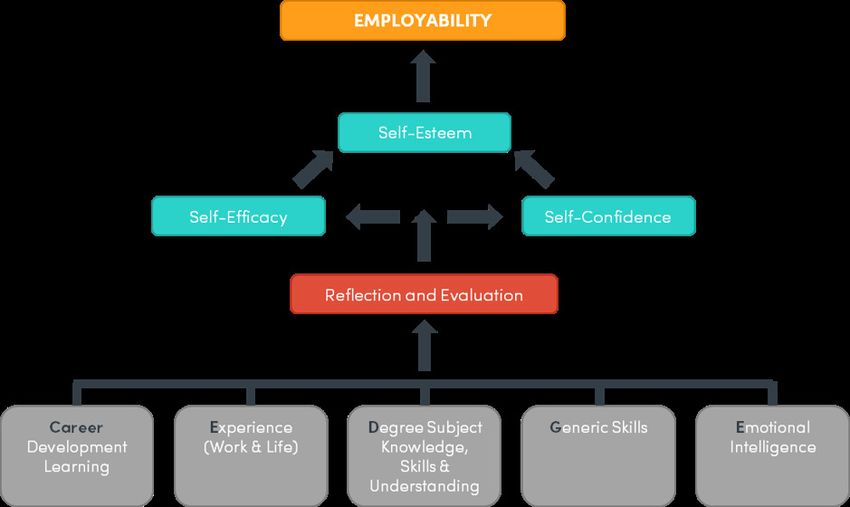
the experience to get a job or to progress within a the CareerEDGE model (see Figure 1) aims to explain
current career; but rather, employability emphasises the meaning and suggested directions for interaction
the development of critical and reflective abilities to between the components, while noting that the removal
empower the learner to do a job. Under this framework, of one will significantly disadvantage the graduate’s
employability includes the capability of graduates to employability. As the most recent model of the three, it
present their skillset and attributes to employers, ‘selling’, draws on the DOTS and USEM models. The CareerEDGE
or marketing themselves as human capital. model considers that when students address the bottom
five components and engage in reflection and evaluation,
The studies reviewed indicate that the nature of they develop strong ‘self’ attributes - self-efficacy,
employability has shifted with increased participation self-esteem; and self-confidence. The extent to which
in higher education, rising student debt, and the they meet these criteria determines employability. The
globally expanded labour market. While previous importance of reflection and evaluation is supported by
employment relationships reflected a ‘job for life’, new the findings of Green, King, and Gallagher (2019).
employment relationships are more akin to a contract-
like economic exchange. As a result, employers are
placing growing importance on an employee’s capacity
to respond to rapid change in the workplace. Now,
national, organisational, and individual prosperity lies
in individuals’ capacities to take personal responsibility
and initiative, continuously up-skill, and to be flexible and
adaptable (Small, Shacklock and Marchant, 2018).
8
Decision-making; Opportunity awareness; Transition learning; Self-awareness.
9
Understanding; Skills; Efficacy beliefs; Metacognition
17Figure 1: CareerEDGE Model of Graduate Employability
(adapted from Dacre, Pool and Sewell, 2007)
In addition to work and life experience broadly, and While the CareerEDGEmodel prioritises reflection and
knowledge, skills and understanding specific to the evaluation as fundamental components in graduate
degree programme, the CareerEDGE model includes employability, it fails to explicitly address interpersonal
career development learning, which is a graduate’s qualities. Although they may fall within the ‘emotional
ability to ‘market’ their skills. Generic skills reflect the intelligence’ category, Small, Shacklock and Marchant
Pedagogy for Employability Group (2004, as cited (2018) assert that interpersonal skills should be a stand-
in Dacre Pool and Sewell, 2007), who compiled a list alone component. In support of this argument, they
based on research carried out over the previous 25 note that recent research, (for example Matthews et
years. The group suggest that employers expect to find al. 2016), has found that employers value interpersonal
the following generic skills in graduates: imagination/ skills as an important recruitment criterion. Additionally,
creativity; adaptability/flexibility; willingness to learn; Small, Shacklock and Marchant (2018) question
independent working/autonomy; teamwork abilities; whether younger or less-experienced students will
ability to manage others; ability to work under pressure; have fully developed emotional intelligence to achieve
good communication skills (oral and written); numeracy competitiveness in the labour market.
skills; attention to detail; time management; assumption
of responsibility; decision-making skills; planning/
organising; and the ability to use new technologies.
18Chapter 3: Analysis of Graduate
Outcomes for Study Abroad and
Non-Study Abroad Participants
3.1 Study Overview salary of the graduates’ first job following graduation; the
length of time that they were searching for their first job;
The theory of human capital (Becker, 1964) views and their academic performance at graduation. Using
expenditures on education, training, medical care, etc., Propensity Score Matching, wherein comparisons are
as ‘investments in human capital’: acquired and useful made between like-for-like participants, the researchers
abilities for members of the society, which can raise found that engagement in study abroad programmes
earnings, improve health, or add to a person’s overall increased the monthly salary of graduates’ first job
productivity over his/her lifetime. As such, if we regard by an average of S$190.40 (approximately €124; $137;
studying abroad as an investment in human capital, it can £112) in business, science, and arts and social sciences
be hypothesised that it should bring economic benefits faculties. Salary increases were particularly pronounced
in terms of employment and wages for those who study for students graduating with a Cumulative Average Point
abroad. Further, as part of the signalling theory (Spence, (CAP) above 4.5 and between 3.5 and 4.0 on a 5-point
1973), it can also be hypothesised that studying abroad scale. A moderate effect was observed for students with a
may signal strong candidate attributes to employers, CAP between 4.0 and 4.5.
potentially resulting in higher salaries for those who study
abroad (Liwiński, 2017). Such a positive impact on salary The current study aimed to explore the differences in
level was observed in research conducted by Lim et al. salary, graduate pathway (whether graduates were
(2016) with Singaporean graduates. pursuing further education or in full-time employment,
etc.) and academic performance between those who had
To examine the impact of studying abroad on graduate studied abroad and those who had not. Self-report First
employability outcomes, Lim et al. (2016) analysed Destinations graduate survey data from students who
a dataset in excess of 3,000 National University of had completed undergraduate degrees was provided by
Singapore alumni who were undergraduates between two European member universities (termed University A
2007 and 2013. The sample was obtained by merging and University B). This research received ethical approval
information about the students’ participation in study from the Human Research Ethics Committee at University
abroad programmes with Graduate Employment Survey College Dublin.
(GES) responses. Three outcomes were examined: the
19You can also read


