SPA Family Handbook 2019-2020
←
→
Page content transcription
If your browser does not render page correctly, please read the page content below
SPA Family Handbook
                                         2019-2020

SPA Handbook & Courses Catalog 2019-2020                  1
SCHOOL INFORMATION
Contra Costa School of Performing Arts
2730 Mitchell Drive
Walnut Creek, CA 94598
Phone: 925-235-1130
Website: www.cocospa.org

MISSION
The mission of Contra Costa School of Performing Arts is to
provide a distinguished, conservatory experience in performing
arts within a college and career preparatory setting. We believe in
fostering a culture of excellence with the core values of rigor,
relevance, resilience, and relationships.

 TABLE OF CONTENTS                                                      Page #
 RIGOR          SPA Graduate Profile                                          3
                               What is Academic Rigor?                        4
                               Curriculum                                     5
 RELEVANCE                     What is Relevance?                             7
                               Academic Program                               8
                               Grading Policies                              10
                               College Entrance Requirements                 11
                               Promotion/Graduation Requirements             12
                               Scope and Sequence of Study: Academics        13
                               Scope and Sequence of Study: Arts             14
 RESILIENCE                    10 Ways to Build Resilience                   15
                               Attendance                                    16
                               Mental Health Support                         19
                               Extracurricular Eligibility                   20
                               Positive Behavior Program                     21
                               Restorative Practices                         22
                               Student Behavior and Discipline               22
                               Behavior Consequences                         25
                               Technology Use at SPA                         29
 RELATIONSHIPS                 How to Build Better Relationships             30
                               Directory                                     31
                               Admissions                                    32
                               Campus Supervision                            33
                               Other Important Information                   34

SPA Handbook & Courses Catalog 2019-2020                                 2
SPA Graduate Profile

                     Rigor                              Relevance
     ●   Thinks critically and creatively to   ●   Develops personal, academic, and
         solve problems                            technical skill sets to adapt to
                                                   change
     ●   Listens actively and responds
         respectfully to constructive          ●   Demonstrates a willingness to
         criticism, feedback and the               embrace failures and to persist in
         perspectives of others                    the face of adversity

     ●   Analyzes, evaluates, and
         integrates information and
         concepts across disciplines

               Resilience                           Relationships
     •   Applies 21st century skills           •   Embraces diversity to create cross-
         (learning, literacy, and life)            cultural understanding
         throughout various disciplines to
         participate and prepare for a         •   Engages effectively within diverse
         globalized world                          teams as contributors and leaders

     •   Uses resources to advocate for
         self and others in order to make
         choices based on integrity and
         self-reflection across disciplines

SPA Handbook & Courses Catalog 2019-2020                                           3
Rigor
What is Academic Rigor?
   ● Academic rigor is the degree to which students are being intellectually challenged.
   ● Rigorous instruction should motivate each student
                                                            Within classrooms, there
     to develop high expectations for academic              should be ample evidence of
     progress.                                              students wrestling with new
   ● Academic rigor is facilitated by well-planned          content as they build the
     instruction but driven by student interest, learning   stamina required to reach
     styles, and vigorous effort.                           higher levels of thinking.
                                                            Without the opportunity to
   ● Rigor results in the development of critical and       struggle with a problem or
     creative thinking and problem-solving skills.          decision, for instance, students
   ● Rigorous instruction generates achievement,            may attain surface-level
                                                            knowledge of a concept, but be
     inquiry, and innovation.
                                                            unable to utilize that
   ● Rigorous teaching and learning cultivates the          knowledge in meaningful ways.
     capacity of children to set learning goals, self-                 Robert J. Marzano
     monitor their learning, and persist through
     challenging academic tasks.
   ● Rigorous instruction means engaging students in developmentally appropriate content
     that allows them to connect prior knowledge with new learning, and leads them to asking
     more questions, and discovering more information.

SPA Handbook & Courses Catalog 2019-2020                                                   4
CURRICULUM PROGRAM: Academics
SPA offers a unique combination of a college preparatory curriculum and an immersive arts education.
SPA believes students benefit directly from arts integrated programs due to the intrinsic demands of
integrated coursework. When integration is intentional, students must use creativity, problem solving,
and collaboration to be effective in their work. Integrated work is rigorous, demanding that a student be
able to comprehend multiple ideas and concepts in the creation of a summative outcome. Our curriculum
is founded in the following principles:
⮚ Personalized Learning
⮚ Personalized learning is intended to facilitate the academic success of each student by first
determining the learning needs, interests, and aspirations of individual students, and then
providing learning experiences that are customized—to a greater or lesser extent—for each
student. To accomplish this goal, SPA teachers, counselors, and other educational specialists will
employ a wide variety of educational methods, from intentionally cultivating strong and trusting
student-adult relationships to modifying assignments and instructional strategies in the classroom
to entirely redesigning the ways in which students are grouped and taught in a school. SPA will
leverage the bell schedule and educational technology (specifically the Summit Learning Platform
- summitlearning.org) to further enhance the personalized learning opportunities during the
school day.
⮚ Arts Integration
⮚ Arts Integration is an approach to teaching in which students construct and demonstrate
understanding through an art form. Students engage in a creative process which connects an art
form and another subject area and meets evolving objectives in both. Arts integration provides
multiple ways for students to make sense of what they learn (construct understanding) and make
their learning visible (demonstrate understanding). It goes beyond the initial step of helping
students learn and recall information to challenging students to take the information and facts
they have learned and do something with them to build deeper understanding.
⮚ Project Based Learning
⮚ PBL is a teaching method in which students gain knowledge and skills by working for an extended
period of time to investigate and respond to an engaging and complex question, problem, or
challenge. The project is focused on student learning goals, including standards-based content and
skills such as critical thinking/problem solving, collaboration, and self-management. The project
features real-world context, tasks and tools, quality standards, or impact – or speaks to students’
personal concerns, interests, and issues in their lives. Students make some decisions about the
project, including how they work and what they create. Students give, receive, and use feedback to
improve their process and products. Students make their project work public by explaining,
displaying and/or presenting it to people beyond the classroom.
SPA Handbook & Courses Catalog 2019-2020 5CURRICULUM PROGRAM: Arts
SPA offers pre-professional style training in 5 Arts Majors: Dance, Instrumental Music, Production and Design,
Theatre and Vocal Music. SPA arts classes are led by highly skilled and passionate Teaching Artists and are deeply
rooted in the idea that all students can thrive and succeed with proper training and opportunity. At SPA, we strive
to create highly skilled artists who are creative, passionate and contributing members to their craft and the world
in which they live.
Theatre – Students majoring in Theatre will be exposed to the foundations of the Theatre,
inclusive of its past and influences and relative to our world today. Theatre majors will take
intensive core classes based on specific topics within their chosen track. Before students graduate
with a Theatre major, they will be able to generate and conceptualize artistic ideas and work,
develop and refine artistic work for presentation, interpret intent and meaning in artistic work and
relate artistic ideas and works with societal, cultural and historical context to deepen
understanding.
Dance – SPA’s Dance Department is a pre-professional training program that believes dance is a
vital mode of inquiry, which provides young artists with the tools to think critically and creatively
about the world around them. We are rooted in a core curriculum of classical ballet, modern, and
contemporary techniques, complemented by courses in improvisation, composition, repertory,
dance history, and somatic movement practices. During their time at SPA, dance majors will
participate in a robust performance season and have the opportunity to work with renowned guest
artists, dance educators, and choreographers. Emphasizing a strong technical foundation, but also
imagination, intuition, and experimentation, our goal is to provide students with a rigorous and
well-rounded arts education, preparing them for a professional dance career or post-secondary
study in dance.
Vocal Music – Student Vocal Music majors will develop skill as both solo performers and as
members of the choral ensemble. Before students graduate, they will receive a rigorous and widely
used curriculum that includes healthy vocal technique, introduction to vocal pedagogy, music
theory, lyric diction, music and opera history, performance experience, and overall musicianship.
Vocal Majors will be able to express themselves artistically over a cross-section of repertoire they
have learned throughout their conservatory experience and equipped with the necessary skills and
training to excel in a college conservatory of music.
Instrumental Music – Students in the Instrumental Music major will be able to work
collaboratively and as leaders in musical interpretation, demonstrating an understanding of
compositional processes, aesthetic properties of music, and the ways these shape, and are shaped,
by artistic and cultural forces. Before students graduate from the Instrumental major, they will be
able to demonstrate an ability to sight-read, hear, identify, and work conceptually with the
elements of music such as rhythm, melody, harmony, structure, timbre, and texture and express
themselves artistically over a cross-section of the repertory they have learned throughout their
conservatory experience.
Production & Design – Student Production and Design majors will experience a program of
study intended to prepare them for production and design or theatre business management majors
in college in addition to pre-professional training for a career in design, technology, or management
in the entertainment industry. SPA’s Production and Design majors will graduate critically engaged
and technologically sophisticated students in the fields of scenery, costumes, stage and theatre
business management, lighting, and sound.
Arts Transfers
All major changes will only be accepted the between Dec 9-13, 2019 and May 18-22, 2020. Notify your
arts teacher, request the transfer paperwork and follow the process outlined. All requests must go
through current and potential directors and administration. Arts transfers are not guaranteed. No arts
transfers are accepted in the 11th and 12th grade years.
SPA Handbook & Courses Catalog 2019-2020 6Relevance
What is Relevance?
● Individual choices: A student with a personal interest in
hiking and the outdoors might select Theodore Roosevelt to Relevance makes rigor
study because he was a naturalist and conservationist who led possible.
scientific expeditions and helped establish the first national Dr. Bill Dagget
parks.
● Product choices: A student interested in music and Your purpose is to make your
technology might produce an audio podcast in the style of an
old radio-news program or presidential address. audience see what you saw,
● Varied content: Students might be allowed to choose an area hear what you hear, feel
of personal interest—e.g., politics, environmentalism, science, technology—and monitor
what you felt. news reports
Relevant detail,in those
areas as relevant events unfold. couched in concrete, colorful
● Cultural connections: During lessons on imperialism and colonialism, students from different cultural
language, is the best way to
backgrounds might choose to write essays that explore the effects of imperialism and colonialism from the
standpoint of their racial, ancestral, or cultural heritage. recreate the incident as it
● Skill acquisition: While students are learning history, science, orhappened and
mathematics, to picture
for example, it are
they foralso
acquiring technology skills that will be useful in adult life. the audience.
● Practical context: Students might be asked to follow a favorite sports team and conduct
Dale mathematical
Carnegie
analyses using team statistics.
● Current events: In a unit on presidential elections in a social-studies course, students might be asked to
monitor campaign advertising on radio, television, and the internet, and then research the accuracy of the
statements being made.
● Community connections: Teachers might ask students to study local politics, interview elected officials,
and put together a citizen-action proposal that will be presented to the city or town council.
● Career aspirations: While learning about business and economics, students also learn whether the career
path is a good fit for them, and they acquire practical skills that will help them when they enter the workforce.
SPA Handbook & Courses Catalog 2019-2020 7ACADEMIC PROGRAM
SPA’s courses are based on state-approved curriculum and specified materials. Student grades are based
on their performance relative to this curriculum.
Our grades reflect our values:
● Cognitive skills (deep, thinking skills) are the best measure of student growth and achievement
● Content (information) understanding is either learned or not learned and it needs to be mastered
● Growth is the outcome we desire and therefore we should value growth and the student’s best
work
Grades show both the competencies students have as well as the growth they have made. We believe that
our students will be growing and improving in their abilities throughout the year, and we want their
grades to reflect and celebrate that. Thus:
● 80% of a course's grade are graded based on a student’s cognitive skills in projects.
Students must complete every project to pass a class. If a student does not complete a project or
the cognitive skill average for a course is below 70%, then the student will have an incomplete
grade. He/she can change the Incomplete into a letter grade by completing any overdue projects
and improving in his/her cognitive skill scores.
● Cognitive Skills are deeper learning skills that each project is built around.
o Examples of cognitive skills are:
▪ Justifying/constructing an explanation
▪ Identifying patterns and relationships
o Passing Scores for cognitive skills at every grade level are as follow:
Grade 70% (C-) 85% (B) 100% (A+)
Level
6 2 3 4
7 2.5 3.5 4.5
8 3 4 5
9 3.5 4.5 5.5.
10 4 5 6
11 4.5 5.5 6.5
12 5 6 7
● 20% of a student's grade reflects the mastery of content in a course. This is split between
Power Focus Areas (worth 14%) and Additional Focus Areas (worth 6%). Power Focus Areas are
required to complete or else a course will be considered Incomplete. Additional Focus Areas are
important to a full understanding of the course but are not required; students can pass the course
without completing Additional Focus Areas. Students show mastery by passing content
assessments.
● Content is discreet pieces of information that we believe students need to know. Specific content
is associated with each project.
● The breakdown in Math courses is: 15% Projects, 70% Unit Assessments, 10% Portfolio
Problems and 5% Additional Focus Areas
SPA Handbook & Courses Catalog 2019-2020 8Mastery Learning
The goal of mastery learning approaches is to have all students learn instructional material at roughly
equivalent, high levels. Instructors break down course material into manageable units and create
formative tests for students to take on each of the units. Students receive individualized instruction as
necessary so that they all master course material. Allowing students the opportunity to achieve mastery
of content at different time intervals has proven to be an effective method of increasing student learning.
Mastery Learning maintains that students must achieve a level of mastery (i.e. 80% on a knowledge test)
in prerequisite knowledge before moving forward to learn subsequent information. If a student does not
achieve mastery on the test, they are given additional support in learning and reviewing the information,
then tested again. This cycle will continue until the learner accomplishes mastery and may move on to
the next stage.
Every student will earn a final grade at the end of the year. These grades will fall in the following range:
● 90% and up is an A
● 80% and up is a B
● 70% and up is a C
● Below 70% is an Incomplete/Off Track
o We do not give “D/Fs” because colleges do not accept them and neither should we
o A student will earn an Incomplete if:
● he/she fails to turn in 100% of projects
● he/she fails to pass of all his/her power focus areas
● he/she has an average cognitive skill below grade level
Academic Advancement
Students must pass each class with a C- or above in order to earn course credit and to advance to the next
grade level. High school students who do not pass any core academic class will be required to attend
summer school or to makeup the course online. Parents and students are responsible for making such
arrangements and for the cost of these online courses. School Administration must approve makeup
courses.
Academic Advising and Support
The school administration and school counselor provide academic counseling. Parental involvement is
encouraged. Meetings may be scheduled to advise students about their academic progress and eligibility
for college admission. Students should consult with their teachers for subject specific academic support.
Academic Interventions (SSTs)
If at any point in the year a student is failing to meet our rigorous academic standards a student may be
referred for an SST.
⮚ Student Success Team Meetings (SSTs)
SSTs are school-based problem solving team meetings that review lack of academic progress,
behavioral concerns, attendance/truancy issues, parent and/or teacher concerns, and
recommend alternative strategies/interventions to be implemented in the regular classroom.
Teams may consist of school administrators, classroom teachers, parents, students, and special
education personnel. The composition of the teams may vary according to student needs. A
student can be referred for an SST by a teacher or parent by contacting the School Counselor.
⮚ Student Success Team (SST) Process
Step 1: Student is referred to the Student Success Team. Reason for referral is stated.
Step 2: Data is collected in response to the concern. This can be done through a cume file
review, PLP review, parent interview, teacher interviews, work samples, and/or discipline
history
SPA Handbook & Courses Catalog 2019-2020 9Step 3: SST 1 is scheduled and held. During the meeting, student strengths are identified;
concerns are clarified; action plan is developed, timelines are established for appropriate
implementation of interventions. Follow-up meeting is scheduled.
Step 4: The SST action plan is implemented. Updated information is provided to the SST
Coordinator.
Step 5: The SST reconvenes to review the results of the recommended action plan.
Step 6:
▪ If the recommended action plan is successful, interventions are continued and SST
on student closes.
▪ If there is some progress, interventions continue and are monitored; interventions
are changed or modified as needed; follow-up meeting date is established.
▪ If there is no progress made, SST II is scheduled. Meeting date is established. New
Action plan is implemented and monitored.
Books and Supplies
All Chromebooks, chargers, texts, and other supplies furnished by SPA will remain school property.
Parents will be billed for lost and/or damaged Chromebooks, chargers, texts, and other supplies.
Additionally, students will be responsible for providing personal supplies, such as paper, note pads,
notebooks, pens and pencils. Students are also responsible for supplies for specific arts specialties, such
as dance shoes, musical instruments and visual arts supplies. Teachers will list of all required materials in
their course syllabi. Unpaid debts will result in the inability to register for classes the following academic
year or inability to participate in graduation activities at the end of 12th grade.
Cumulative Records and Transcripts
Families who want copies of cumulative records or transcripts need to put in a request to the Registrar and the
school will have up to 5 days to complete the request. A nominal fee for copy charges may be applied. Please
contact Christina Bendoyro to complete a request: christina.bendoyro@cocospa.org.
GRADING POLICIES
Online Grading System
SPA utilizes an online grade reporting system (PowerSchool) with our learning management system, Summit’s
Personalized Learning Platform (PLP). Both students and parents will have access to grades and progress towards
a student’s goals. There is an expectation that families keep track of their child’s grades by accessing PowerSchool
and the PLP regularly.
Grading Scale
Letter grade Percentage GPA points
A+ 97-100 4
A 93-96 4
A- 90-92 4
B+ 87-89 3
B 83-86 3
B- 80-82 3
C+ 77-79 2
C 73-76 2
C- 70-72 2
Incomplete/F 69- 0
In AP classes, grades are weighted; an A will translate into a 5.0 GPA, a B will be a 4.0, and so.
Please note that SPA does not give credit for grades below 70% so if a student earns a D letter grade at
SPA its credit equivalent is that of an F.
SPA Handbook & Courses Catalog 2019-2020 10Progress Reports/Report Cards
Progress reports will be given to students to take home at the end of the first, second and third grading
periods. Progress reports are handed to students at school. Final report cards will be mailed at the end of
the year. Interim reports can be viewed daily in the PLP for academic courses and PowerSchool for the
arts courses.
Incomplete/Off Track Grades
A grade of "Incomplete/Off Track" in any course will require the development of a Class Completion
Contract, which must be approved by the teacher, parent, and mentor. Contracts will be reviewed and
updated on a regular basis by the teacher and support team. When the student completes the work
outlined on the Contract, the student is assigned a grade for the course. However, if the scholar leaves
SPA, or the summer school term elapses after the development of the Contract, the course grade will be
recorded as "F" and no credits will be awarded.
Academic Honesty
At SPA, we value academic integrity. All students are expected to complete their academic assignments
and examinations with honor. Unless a teacher gives explicit instructions to the contrary, all assignments
in class or out of class must be entirely the student’s own work. Copying or sharing any assignment
constitutes cheating and may result in failure on that assignment for the student(s) involved. Plagiarism
will also result in a failing grade on the assignment. A student plagiarizes when he or she submits work as
his or her own that is taken from other sources without naming that source. There is no tolerance for
cheating or plagiarizing at SPA; students caught will be disciplined. Continued incidents may result in
course failure.
Modified Grading
SPA’s courses are based on state-approved curriculum and specified materials. Student grades reflect
their performance relative to this curriculum. From time-to-time, students may need accommodations to
SPA’s curriculum. This could be due to illness, disability, approved extended absences and other
circumstances. Only students who are not receiving a high school diploma and demonstrate significant
academic delays will have modified assignments.
COLLEGE ENTRANCE REQUIREMENTS
Subjects (a-g) CSU Entrance UC Entrance SPA Requirements
Requirements Requirements
Social Science (a) 2 years 2 years 3 years
English (b) 4 years 4 years 4 years
Mathematics (c) 3 years/4 recommended 3 years/4 recommended 3 years (or through
Algebra 1 is required Algebra 1 is required Algebra II)
Algebra 1 is required
Science (d) 2 years 2 years/3 recommended 3 years
Foreign Language 2 years 2 years/3 recommended: 3 years (or through
(e) Spanish III)
Performing Arts 1 year 1 year 1 year
(f)
Electives (g) 1 year or extra from the 1 year or extra from the 4 years
a-f list a-f list
SPA Handbook & Courses Catalog 2019-2020 11PROMOTION/GRADUATION REQUIREMENTS
Middle School Promotion Units High School Graduation Units
Requirements Requirements
Social Three years including Social 30 Three years including World 30
Science Science 6, Social Science 7, History, US History, US
and Social Science 8 Government
English Three years including 30 Four years including English 40
English 6, English 7, and 9, English 10, English 11 (or
English 8 AP Language), English 12 (or
AP Literature)
Math Three years including Math 30 Three years including 30
6, Math 7, Pre-Algebra or Algebra I, Geometry, Algebra
Algebra I II
Science Three years including 30 Three years including 30
Science 6, Science 7, and Biology, Chemistry,
Science 8 Environmental Science (or
AP Environmental Science)
World Three years of Spanish 30
Languages including Spanish I, II, III
Physical Three years including Mind 30 Health and Wellness 10
Education and Body 6, 7 and Health
and Wellness 8
Performing Three years of course work 30 Four years of course work in 90
Arts in chosen major chosen major
Two years of coursework 20
including other arts courses,
Economics and/or The
Senior Process
Total 180 Total 280
Middle School Promotion Activities
To participate in middle school promotion activities, students shall have attained passing grades in all
courses. Promotion activities are considered a reward and privilege by SPA. Excessive disciplinary
referrals due to behavior or attendance problems could result in a loss of some or all of the promotion
activities.
High School Graduation Activities
To participate in high school graduation activities, students need to meet or
exceed SPA’s graduation requirements. Graduation activities are considered
a reward and privilege by SPA. Excessive disciplinary referrals due to
behavior or attendance problems could result in a loss of some or all the
graduation activities.
SPA Handbook & Courses Catalog 2019-2020 12Scope and Sequence of Study: Academics
6th – 12th grade
SUBJECT 6th grade 7th grade 8th grade 9th grade 10th 11th grade 12th grade
grade
Social Social Social Social World US History AP Gov
Science Studies 6 Studies 7 Studies 8 History or
AP
US History
English English 6 English 7 English 8 English English English 11 English
9 10 or 12
AP or
Language AP
Literature
Math Math 6 Math 7 Math 8 Algebra I Geometry Algebra II
or or or or
Math 8 Algebra I Geometry Algebra II
Science Science 6 Science 7 Science 8 Biology Chemistry Environmental
Science
or
AP
Environmental
Science
World Spanish I Spanish Spanish III
Language or II
Spanish or
II Spanish
III
Performing Arts Arts Arts Arts Arts Arts Arts Major
Arts Major Major Major Major Major Major Courses
Courses Courses Courses Courses Courses Courses
Physical Mind & Mind & Health & Health &
Education Body Body Wellness Wellness
Electives Economics
and
The
Senior
Process
SPA Handbook & Courses Catalog 2019-2020 13Scope and Sequence of Study: Arts
6th – 12th grade
The Artist-Scholar Credo
As an artist-scholar at SPA:
● I humble myself by entering each space with the mind of the beginner.
● I believe that talent is not a substitute for training.
● I understand that disappointment and discomfort can lead towards mastery and self-discovery.
● I commit myself to the creation of meaningful, shared experiences.
● I am always auditioning.
MIDDLE SCHOOL HIGH SCHOOL
SUBJECT Level I Level II 9th Grade 10th Grade 11th Grade 12th Grade
Jazz Band II or Chamber Orchestra
Instrumental Orchestra Musicianship Musicianship Musicianship Musicianship
CLASSES CLASSES
Music I II III IV
Jazz Band I Contemporary Combos
SUBJECT Level I Level II 9th Grade 10th Grade 11th Grade 12th Grade
Bel Canto I Bel Canto II
Concert Concert
Vocal Music CLASSES CLASSES Musicianship Musicianship Musicianship AP Music
Choir 1 Choir 2
I II III Theory
Conservatory Chorale
SUBJECT Level I Level II 9th Grade 10th Grade 11th Grade 12th Grade
Intro to Film Film
Art
Design Art History Technologies Technologies
Techniques
Production & Intro to I II
CLASSES CLASSES
Design Illustration Intro to
Performance
Production Stagecraft I & II
& Film Seminar I & II
Level
SUBJECT Level I 9th Grade 10th Grade 11th Grade 12th Grade
II/III
Intro to Chance
Intro. to Physical Intermediate Acting the Theatre/
Scene Theatre & Scene Study Classics Advanced
Intro. Study Meisner Adaptation
Theatre CLASSES to CLASSES
Stage Craft for Actors Contemporary Drama I
Theatre Level III
MS The Actor’s
Theatre World of the Directing &
Ensemble Prepares-
History Play Dramaturgy
Monologues
SUBJECT Level I Level II 9th Grade 10th Grade 11th Grade 12th Grade
Ballet III Ballet IV Ballet V
Modern & Modern & Modern & Modern &
Dance CLASSES Dance I Dance II CLASSES Contemporary Contemporary Contemporary Contemporary
III IV V III
Composition & Repertory
SPA Handbook & Courses Catalog 2019-2020 14Resilience
10 Ways to Build Resilience
1. Make connections. Good relationships with
If you think you can do a
close family members, friends or others are
thing or think you can’t do
important.
a thing, you’re right.
2. Avoid seeing crises as insurmountable
Henry Ford
problems. You can't change the fact that highly
stressful events happen, but you can change The price of success is hard
how you interpret and respond to these events. work, dedication to the job
3. Accept that change is a part of at hand, and the
living. Accepting circumstances that cannot be determination that
changed can help you focus on circumstances whether we win or lose, we
that you can alter. have applied the best of
4. Move toward your goals. Develop some ourselves to the task at
realistic goals. Do something regularly — even hand.
if it seems like a small accomplishment — that Vince Lombardi
enables you to move toward your goals.
5. Take decisive actions. Take decisive actions, rather than detaching completely
from problems and stresses and wishing they would just go away.
6. Look for opportunities for self-discovery. People often learn something about
themselves and may find that they have grown in some respect as a result of their
struggle with loss.
7. Nurture a positive view of yourself. Developing confidence in your ability to solve
problems and trusting your instincts helps build resilience.
8. Keep things in perspective. Even when facing very painful events, try to consider
the stressful situation in a broader context and keep a long-term perspective.
9. Maintain a hopeful outlook. An optimistic outlook enables you to expect that good
things will happen in your life.
10. Take care of yourself. Taking care of yourself helps to keep your mind and
body primed to deal with situations that require resilience.
SPA Handbook & Courses Catalog 2019-2020 15ATTENDANCE
Regular attendance at school is necessary for academic achievement. All absences negatively impact the
educational progress of students. Classroom instruction, discussion, interaction, and activities are critical
components of learning and are difficult to adequately replace or duplicate when a student is absent from
school. Therefore, discretionary absences and appointments should not be scheduled during school
hours.
Absences
It is also important to mention that, like all public schools, SPA’s State funding is based on Average Daily
Attendance (“ADA”). The school ADA rate is negatively impacted every time a student is absent from an
entire day of school, regardless of whether the absence was excused or unexcused (in other words, we
lose money to support the school when a student does not show up for at least part of the day). We
greatly appreciate families bearing this in mind when making plans.
Excusing Absences
Students are expected to provide communication (via EMAIL or phone call) from a parent/guardian
indicating the reason for the absence within 3 school days of their return to school.
o attendance@cocospa.org
o 925-235-1130
Families need to present the following information in their communication:
1. State if clearing an absence or tardy.
2. Give student’s name (please spell the last name).
3. Give student’s grade.
4. State name and relationship to student.
5. State the date(s) or time(s) of absence.
6. Give a specific reason for the absence.
7. Name the person picking up the student if it’s a request for early release.
All absences need to be cleared within 72 hours or become unexcused absences. At three
unexcused absences, your student will be identified as habitual truant and the SARB (Student Attendance
Review Board) process will begin. The only absences that will be considered as excusable are: illness,
medical, bereavement, Dr.’s appointments, court appearances, and religious observances. The following
are not excusable absences: vacations and family business.
It is the responsibility of the family to contact teachers directly or utilize the PLP, PowerSchool and/or
the school website to obtain missed work. All absences will be recorded, and can be checked, in
PowerSchool.
If you receive a communication stating your student was absent in one or more classes on a particular
day and you believe there is an error, please contact the office via phone or email
(attendance@cocospa.org).
Repeated absences may result in referral to the Student Attendance Review Board (SARB), which will
meet monthly at the Contra Costa County Office of Education. The Contra County District Attorney’s
Office is present. to address attendance issues. Consequences may include, but are not limited to, loss of
school privileges, attendance contracts, schedule adjustments, eligibility adjustments, and exploration of
alternative educational opportunities and filings with the court(SARB). In addition to SARB, Site based
attendance meetings will occur with the Dean of Students prior to a SARB referral.
Any Student who attains 10 more excused absences in a school year is considered chronically absent by
the state of California. Students at SPA who accrue 8 excused absences, the family will be required to
meet with the Dean of Students, to address and will be required to submit medical verification from a
Doctor or licensed therapist. If additional absences continue absent verification for ongoing health
SPA Handbook & Courses Catalog 2019-2020 16concerns the family will be required to submit documentation for each absence or the absence will be
marked unexcused and the Truancy process will be implemented including SARB referral.
Tardiness
Any student who arrives to school or class after the start of the day and/or class, will be marked “Tardy.”
Tardiness will be recorded in PowerSchool.
Students who receive 5 or more cumulative tardies may be assigned to Saturday School or receive after
school detention for one hour for every 5th tardy. A student who fails to attend detention may either have
their detention doubled or receive in-school detention for the entire day. Students with excessive tardies
may be required to attend a SART meeting with the Dean and Students and their parents or guardians. An
attendance contract may be implemented.
All tardies need to be excused within 72 hours or will be considered unexcused.
Extended Absences
Extended absences during the school year are highly discouraged. If these are unavoidable, parents must
contact the Registrar to make appropriate arrangements. The school reserves the right to require
enrollment in summer school and/or online courses to complete missed coursework if the absence is
longer than 15 days. If a student is unable to complete necessary makeup work, he/she may not be
promoted to the next course level. These absences will be marked unexcused except for bereavement
and medical emergency. Family trips, vacations, etc. will be considered unexcused and can lead to your
student being identified as truant.
Truancy
Students are defined as habitual truants when they achieve three days of unexcused absence. Students
who are truant will be required with their guardians to attend a school attendance meeting with the Dean
of Students and in some cases may be placed on an attendance contract. Students who continue to be
truant maybe referred to the County School Attendance Review Board (SARB).
Unexcused Absences
Below is a description of California's strict attendance laws.
California defines a student as truant if he or she has any combination of:
■ Three unexcused absences;
■ Three unexcused tardies; and/or
■ Three absences exceeding 30 minutes.
California defines a student as chronically truant – for which more severe penalties are imposed – as a
student who misses school, or is tardy, on 5 or more occasions.
Leaving School Early/Removing Students from Class
Families are strongly discouraged from taking students out of school early. Families who need their
student to leave school early should contact the office via phone or email (attendance@cocospa.org). The
pre-approved designee will then be allowed to pick the student up from SPA. Please contact the school at
least 24 hours prior.
Make-Up Work
Students and parents can follow a student’s progress on the PLP even while absent. In the event of an
unplanned absence, upon a student’s return, he/she should meet with his/her Spotlight Mentor to create
goals around missed work and to remain on pace with the course.
SPA Handbook & Courses Catalog 2019-2020 17Independent Study Contract Guidelines
It is imperative that students attend school daily. Lost classroom time is difficult to replace and directly
impacts the school’s ADA/funding. However, if students need an extended absence (5-15 days) during
the school year, an Independent Study Contract must be requested. The contract prevents a student from
falling behind and gives him/her attendance credit. If work is not received by the scheduled deadline, the
contract will be considered incomplete and voided. The student will not receive attendance
credit. Parent must notify administration prior to the absence.
A discussion of Independent study contracts, SHORT TERM only - 1 day to a maximum of 15, and the
paperwork/procedures needed will happen with the Registrar. Families need to notify the school as soon
as possible, preferably two weeks prior to travel. Failure to complete the independent study contract and
submit required documentation upon return will result in both lost credit for the school work and the
days will be marked as unexcused absences and can lead to a student being identified as truant.
Home and Hospital Instruction
SPA does not offer Home and Hospital Instruction. Per the California Department of Education: “Existing
law requires each person subject to compulsory education to attend full-time school or continuation
school. The Home and Hospital Instruction Program serves students who incur a temporary disability,
which makes attendance in the regular day classes or alternative education program impossible or
inadvisable. The district in which the home or residential health facility is located is responsible
for instructing and educating pupils who must be hospitalized or remain at home due to a
temporary but extended illness or disability. There is no provision in statute that specifically
addresses instructional content; however, the goal of home or hospital instruction should be
maintenance of the pupil's former level of performance while recovering.” For more information, please
visit: https://www.cde.ca.gov/sp/eo/hh/
To obtain Home and Hospital Instruction, you must enroll in your district of residence and arrange this
service through them.
Attendance Awards Program
One of our main objectives is to meet with each student and discuss what factors may be impacting
student attendance. So far some of the trends we have noticed are listed below:
● Parents commute
● Siblings being dropped off at other schools
● Parents citing medical issues with little to no medical documentation: anxiety, depression, refusal
to attend for migraines/headaches
● Physical ailments from other family members/ live in relatives disrupt drop off
schedule/attendance
To combat these issues the school administration has decided to roll out an Attendance Reward program
so that students with perfect/mostly perfect attendance are recognized and students whose attendance
improves are rewarded.
Middle School Attendance Rewards Program
● There will be a Rally that will be put on School Leadership and during this rally it will end with
Attendance Prizes being given.
● Each week a student who has perfect attendance will enter their name into a raffle during their
Spotlight. In order to qualify, they cannot have any tardies or absences in any class for the entire
week.
○ Prizes will include a SPA Season Pass, donated items from parents that could include:
Earbuds, Gift Cards ranging from $5-$25 dollars, $50 ShineBucks to be used as school
SPA Handbook & Courses Catalog 2019-2020 18money for items, merch, and a Day with admin/staff and off-campus lunch with
Admin/Favorite School Staff.
● There is also a possibility of giving students 30 minutes of free time instead of a Movie or a
Classroom activity indoor/outdoor
● To encourage the system a spotlight announcement will be made at the start of the school year
along with a section in the school newsletter.
● Certificates and Awards will be given to students with Perfect Attendance and Students with most
improved Attendance
○ The students recognized will be determined by SART Team and Spotlight teachers
○ If an entire Spotlight has an over 95% ADA for the month, at the end of the month they get
popcorn and movie pass on a Friday.
High School Attendance Rewards Program
● Since SPA operates as a conservatory and high school students need to be prepared for real-world
outcomes and be clear about expectations and outcomes with students and parents. Moving
forward, seven unexcused absences a semester should mean course failure- unless medically
excused.
● Incentives for high schoolers should be meaningful and can include items listed below:
○ A day for off-campus lunch and an extra 15 minutes given for lunch-Parent permission slip
must be signed.
○ The students with perfect attendance can have their names drawn and the first student can
be selected to DJ for lunch one day or can pass and choose a different prize. Similar to MS
prizes
○ Student Drivers can use their prize to park in the visitor spot for a week.
● The High School Spotlight(s) with the best attendance at the end of the semester should receive a
movie night and pizza in the theater after school. ADA should be 96% or better. Medically
excused/Bereavements will not impact ADA.
MENTAL HEALTH SUPPORT
SPA takes the mental health and well-being of our students very seriously. As such, we recognize the
importance of providing students with access to mental health support and resources across life
domains, including home and school. Students may request a check-in with a school mental health
professional (guidance counselor or school psychologist) via email or a written request for check-in.
Parent(s)/guardian(s) may request additional counseling resources via email by contacting Leticia
Ramos, guidance counselor (leticia.becerra-ramos@cocospa.org) or Karissa (Lexie) Pivirotto-Britton,
school psychologist (karissa.pivirotto-britton@cocospa.org). Parent(s)/guardian(s) should be aware that
all information discussed in sessions between providers and students is confidential, except in cases
where the student discloses the intent to harm themselves or others, or if they report experiencing abuse
or neglect.
Please visit the Student Services webpage via the SPA website (https://karissapivirotto-
b.wixsite.com/student-services) for additional information regarding local and national mental health
resources.
Suicide Prevention and Intervention Policy
SPA provides all staff with annual training that includes warning signs and procedures for safely
supporting students expressing suicidal thoughts or ideation. Trained mental health school staff are on-
site throughout the school day to respond to these crisis situations, maintain student safety while
evaluating next steps, and refer students to the appropriate outside mental health resources as necessary.
SPA Handbook & Courses Catalog 2019-2020 19Additionally, students at SPA are provided with a comprehensive health education program that
promotes healthy mental, emotional, and social development through developing problem-solving skills,
coping skills, and positive self-esteem. Suicide awareness and prevention are also incorporated into
health education curriculum at the secondary level.
Please refer to SPA Board Policy 7.042017 for more information.
EXTRACURRICULAR ELIGIBILITY
SPA’s eligibility policy for extracurricular activities (such as productions, clubs and organizations) will be
based on academic performance, attendance and citizenship. In the case of productions, the eligibility
policy will be used during the audition process and throughout the run of the production. Administration
reserves the right to evaluate ineligibility on a case-by-case basis.
Academic Performance
Students at SPA will be eligible to audition for performances and participate in extracurricular activities
provided they maintain good academic standing.
Attendance
Students at SPA are expected to attend both academic and arts classes regularly and on time. Students
will be eligible for extracurricular activities provided they maintain normal attendance. In certain cases,
excessive tardiness or absenteeism may lead to a student being classified as ineligible to participate in
extra-curricular activities.
Citizenship
Students at SPA are expected to be good citizens and follow the policies and expectations described in the
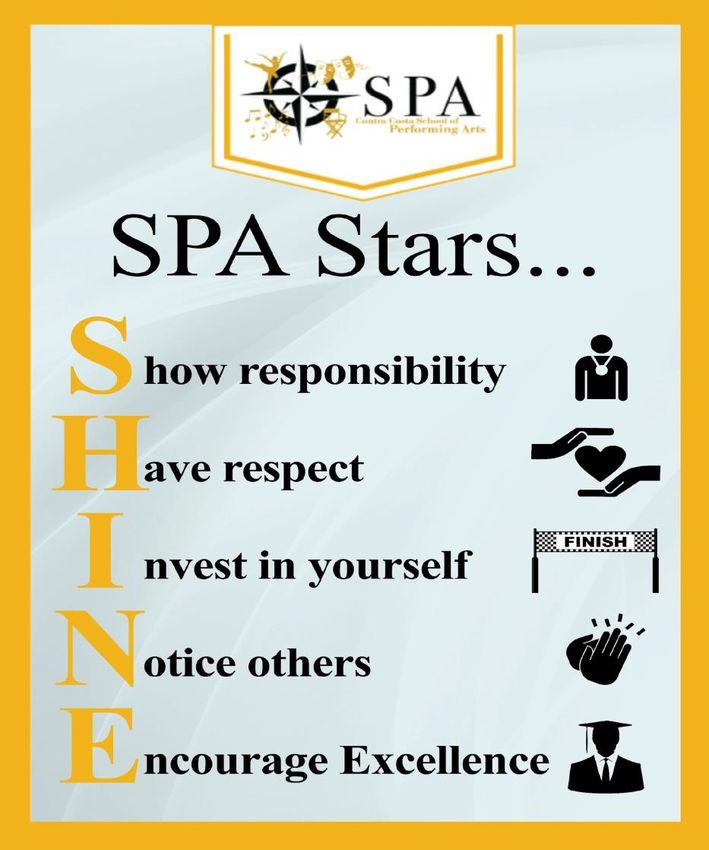
SPA Family Handbook and the SHINE motto. Additionally, students should follow the expectations and
policies dictated by their academic and arts teachers.
Performance Eligibility Waiver Policy
Should students find themselves in an ineligible status for any reason, they will be afforded (1) one
opportunity to appeal the eligibility decision during the academic year. This appeal must be done through
a formal application to the appropriate Artistic Director. Each appeal will be handled on a case-by-case
basis, and the appeal itself is in no way a guarantee of a reversal. Each situation will be considered
carefully, which will consist of both academic and arts teachers under the guidance of administration.
Students who demonstrate eligibility repeated may be required to have a meeting with the Director of
Student Services-Counseling in addition to the appropriate Artistic Director.
Work Permits
Student work and Entertainment Industry permits will only be signed off by the school if the student is in
good standing at SPA. Good standing is defined as:
a. Not identified as a truant or chronically absent
b. Making satisfactory progress on the PLP – no incompletes
c. Has not been suspended from school
SPA Handbook & Courses Catalog 2019-2020 20POSITIVE BEHAVIOR PROGRAM What is the Positive Behavior System or PBS at SPA? One of the foremost advances in school-wide discipline is the emphasis on school-wide systems of support that include proactive strategies for defining, teaching, and supporting appropriate student behaviors to create positive school environments. Instead of using a piecemeal approach of individual behavioral management plans, a continuum of positive behavior support for all students within a school is implemented in areas including the classroom and non-classroom settings (such as hallways, virtual space, and restrooms). Positive Behavior System (PBS) is a proactive approach to establishing the behavioral supports and social culture needed for all students in a school to achieve social, emotional and academic success. Attention is focused on creating and sustaining primary (school-wide), secondary (classroom), and tertiary (individual) systems of support that improve lifestyle results (personal, health, social, family, work, recreation) for all youth by making targeted misbehavior less effective, efficient, and relevant, and desired behavior more functional. Why is it so important to focus on teaching positive social behaviors? Frequently, the question is asked, “Why should we have to teach kids to be good? They already know what they are supposed to do. Why can we not just expect good behavior?” In the past, school-wide discipline has focused mainly on reacting to specific student misbehavior by implementing punishment- based strategies including reprimands, loss of privileges, office referrals, suspensions, and expulsions. Research has shown that the implementation of punishment, especially when it is used inconsistently and in the absence of other positive strategies, is ineffective. Introducing, modeling, and reinforcing positive social behavior is a crucial step of a student’s educational experience. Teaching behavioral expectations and rewarding students for following them is a much more positive approach than waiting for misbehavior to occur before responding. The purpose of school- wide PBS is to establish a climate in which appropriate behavior is the norm. How will this work at SPA? The goal of SPA’s Positive Behavior Program is that our Stars will SHINE at SPA and in our community! SPA Handbook & Courses Catalog 2019-2020 21
RESTORATIVE PRACTICES
Restorative Practices (RP) is a movement grounded in principles designed to create powerful
relationships, which are central to building and sustaining thriving communities. RP represents a
paradigm shift that, when wrongdoings occur, focuses on the harm done rather than the rule broken, and
seeks the restoration of relationships. RP is a reflective practice that encourages personal responsibility,
giving voice to the person harmed, as well as the person who caused the harm. RP aids in the embracing
of cultural differences by offering an equitable process whereby all members of a community feel valued
and heard, and in turn, are more likely to bring their “best self” to the community.

In 2025, our incoming cohort of 6th graders will graduate from our school. When they look back on their
seven-year experience we want them to say that they were exposed to life’s realities in the Arts – that
they participated in internships, engaged with real artists and professionals. We want to hear them
reflect with pride on the struggles and challenges they overcame on their way to their academic and
artistic achievements. We want our graduating seniors to speak with confidence about what is coming
next, we want to hear them say that feel ready, that they have the skills they need to be active, creative,
informed and contributing members of the community.

We want our students to describe our school community as a place where they always know what is
expected of them, that the guidelines are clear and teachers are consistent in communicating and
upholding them. We want our students to say that they are held to high standards and to recognize that
their teachers push them and demand their best because they respect them and want the best for them.

We know that we need to be in productive, caring partnership with the families of the young people in
our school community. In 2025 when our incoming 6th graders are getting ready to graduate, we want
their families to reflect positively on their experiences in our school. We want them to:
   ● describe how connected they felt, that they had meaningful relationships with teachers, staff and
        school leaders who were accessible and committed to clear and consistent communication.
   ● recognize the unique social and cultural diversity from which their students benefit from our
        school, and to value the personalized learning approach that calls for meaningful demonstration of
        content and skill mastery – not just high scores on a test.
   ● celebrate our school’s emphasis on maintaining and restoring healthy relationships and creating a
        strong community.
   ● say that they always felt heard and respected, even when a disagreement was not resolved to their
        liking.
   ● recognize and celebrate that their students felt safe, happy and engaged when they were in our
        care.

STUDENT BEHAVIOR AND DISCIPLINE
SPA has gone through a transformative period for the past year that has lead us to become more
reflective on how innovative we, as a school, can be in the realms of discipline, community, and school
culture. SPA is implementing a more comprehensive Restorative Justice/Practices system to better meet
the needs of our community and create a system that allows for reparations, reform, and a space for
students to feel safe enough to express themselves honestly. At SPA we want to cater to the needs of
students on an equitable level and tried to provide a safe, caring, therapeutic environment for students
with different levels of emotional and academic needs.
Because SPA has a diverse population with diverse needs, the Student Services team has created a tier
system that allows for an appropriate response to the levels of different types of behavior, as well as
piloting a Youth Council program that will take place twice a week during Spotlight. We want to ensure
that every student develops the skills they need to navigate social challenges and becomes a contributing

SPA Handbook & Courses Catalog 2019-2020                                                             22
member to the SPA community. One of the ways we are going to do this is by creating a Restorative
Justice Manual to assist teachers build relationships in the classroom that foster a sense of belonging and
redirect student behaviors.
The goal of PBS and RP as SPA is to support students in a positive and meaningful way while reducing
negative behavior. Our program is to ensure that student behavior supports an environment in which
academic achievement and artistic excellence can flourish. SPA staff will communicate these expectations
to our student body. Our response to student transgressions is not simply intended to deliver
punishments for breaking rules, it is founded on the practice of community building, self-assessment, and
self-discipline. All students will be afforded the full extent of their due process rights.
Site administration will determine whether the consequence should include, but not be limited to,
Restorative practices, community service, detention, and or suspension. Community service may include,
but is not limited to, work performed on school grounds during school or non-school hours in the areas of
beautification, campus betterment, and teacher or peer assistance programs. Law enforcement agencies
may be notified at the discretion of the administration. If the nature of the offense makes an alternative
education placement or expulsion recommendation appropriate, the student will be suspended five days
for the infraction.
A student may be suspended on the first offense if it is determined that the pupil's presence causes a
danger to persons or property or threatens to disrupt the instructional process. SPA is committed to
implementing Restorative reentry practices upon the student’s return from suspension to repair
relations and reintegrate the student into the school community.
The school suspension and expulsion policy (see SPA Charter Petition Element 10) closely mirrors the
language of Education Code Section 48900 et seq. SPA is committed to annual review of policies and
procedures surrounding suspensions and expulsions and, as necessary, modification of the lists of
offenses for which students are subject to suspension or expulsion. Suspended or expelled students shall
be excluded from all school and school-related activities.
A student identified as an individual with disabilities or for whom SPA has a basis of knowledge of a
suspected disability pursuant to the Individuals with Disabilities Education Improvement Act of 2004
(“IDEIA”) or who is qualified for services under Section 504 of the Rehabilitation Act of 1973 (“Section
504”) is subject to the same grounds for suspension and expulsion and is accorded the same due process
procedures applicable to general education students except when federal and state law mandates
additional or different procedures. SPA will follow all applicable federal and state laws including but not
limited to the California Education Code, when imposing any form of discipline on a student identified as
an individual with disabilities or for whom SPA has a basis of knowledge of a suspected disability or who
is otherwise qualified for such services or protections in according due process to such students.
Youth Council
SPA is also initiating its first ever Youth Council - a peer to peer restorative justice program. Youth will
work together as an alternative to suspension, early intervention for escalating behaviors, and mediating
peer conflict. The purpose of the Youth Council will be to repair harm and build competencies that help
create safer schools.
Goals of the Youth Council:
• Increasing accountability of youth
• Assisting all those involved to move forward successfully
• Determining a fair and restorative sanction
• Supervising the sanction and monitor the outcome
SPA Handbook & Courses Catalog 2019-2020 23You can also read


