2019 EU Elections THE RESULTS- WHAT DOES THE NEW EUROPEAN PARLIAMENT MEAN FOR BUSINESS? - The EU Lobby
←
→
Page content transcription
If your browser does not render page correctly, please read the page content below
2019 EU Elections
             THE RESULTS –
WHAT DOES THE NEW EUROPEAN PARLIAMENT
          MEAN FOR BUSINESS?
                May 2019
The pro-EU centre fragments but holds
                            Elections to the European Parliament took place between 23 and 26 May. These
                            elections will determine the composition of the European Parliament for the next five
                            years, and will provide an important indication of the direction of the European
                            Commission. Later this week, European Council President Donald Tusk will convene an
                            extraordinary summit of European heads of government to have the first discussions on
                            the President of the European Commission.

                            The two largest parties of the European Parliament since its first elections in 1979 – the
                            centre-right European People’s Party (EPP) and the Socialists & Democrats (S&D) –
                            have for the first time lost the ability to form a majority on their own, losing seats across
                            Europe. The winners of the elections are the liberals, greens and Eurosceptics. The
                            Liberals (ALDE) increased their seats in Parliament with the inclusion of French President
                            Macron’s La République en Marche.

                            The Greens, who increased their share of seats and saw surprise gains in France,
                            Germany and Ireland, are describing a ‘Green Wave’ in Europe. Eurosceptic parties
                            are also on the rise, with Marine Le Pen’s Rassemblement national winning 22 seats
                            and beating Macron for share of the popular vote. In Italy, Eurosceptic party League,
                            led by Matteo Salvini, has come on top, with 28 seats, up from 5 in 2014.
SUMMARY EU ELECTIONS 2019

                            Turnout rose across the European Union, with figures rising in almost all Member States.
                            The total turnout is estimated to be 51%, up from 42.6% in 2014. Turnout in European
                            elections has long been a concern of the European Institutions, for fear that low
                            turnout contributes to the perceived lack of legitimacy of the European Union.

                            The next European Parliament will be more fractious and unpredictable. A stable
                            political climate in 2019-2024 in Brussels is achievable, but will require a greater
                            allocation of resources for interest representatives. No longer will it suffice to target
                            selected political groups to influence legislation.

                            Shifting our focus to what’s next…
                            With the elections results in, attention now turns to the allocation of political
                            responsibilities in the European Institutions.

                            Decisions must be made as to who will lead the European Commission, the European
                            Council, the European Parliament and the European Central Bank.

                            Within the European Parliament, opaque political bargaining will now commence to
                            determine composition and leadership of various committees.

                            Within the European Commission, the leadership will determine the political direction of
                            the next Commission as well as the prioritization of key files. As all eyes watch this post,
                            the technical levels in the Commission are already well underway with preparatory
                            work for the legislative proposals that will be sent to the Council and the European
                            Parliament later this year.

                            Early advocacy activity should focus on tracking these appointments in the European
                            Parliament, political intelligence gathering on internal horse-trading, and scenario
                            planning to prepare for the autumn onslaught.

                            Business should also focus on the allocation of the committee coordinator positions
                            within each political group, whose behind closed door impact in coordinating a
                            group’s position quietly determines the shape of the European Parliament’s legislative
                            positions.
RESULTS SUMMARY
      Losses for the traditional political blocks, and gains for other groups (Liberals, Greens,
      Eurosceptics) will mean that the European Parliament is more colourful than ever. A majority
      of the Parliament is still pro-European but the usual two party majority (S&D and EPP) looks to
      be replaced by a four party majority (EPP, S&D, ALDE and the Greens )
      Note that all data in this note is extracted from https://www.election-results.eu/

                                         ALDE&R, 105
                                                                  EPP, 179
                         Greens/EFA, 69

                                                                                            ECR, 63

                                                                                                  EFDD, 54
                  S&D, 153

                                                                                                      ENF, 58

                                                                                            Non-attached, 8
        GUE/NGL, 38
                                                                                                      Others, 24

2019-2024
                                                                                                         +23
  -12            -43          +17               +41         -39       -12             +9                 Europe of Nations
                                                                                                         and Freedom
 European       Socialist &   Greens -      Alliance of     European European        European
 United Left-   Democrats     European      Liberals and    People’s Conservatives   Freedom             ENF
                                                                                                                          -13
 Nordic Green                 Free          Democrats for   Party    and             and Direct                    Independent
 Left           S&D           Alliance      Europe                   Reformists      Democracy
                                                            EPP                                                    NI
 GUE/NGL                      Greens        ALDE&R                   ECR             EFDD

                                                                                                                             Other

38              153               69             105                   179                   63          54          58      8 24

2014-2019

 51                    189                 52         68                   219                      71          45        35 21

                                                                            Source: https://www.election-results.eu/
CHALLENGES AND HOW TO OVERCOME THEM
The Eurosceptic wave is big, Brexit timeline looms over Many new Members without
but it’s no tsunami the election results ties to any political groups
We’re off to a rocky start in
A lot of uncertainty on Less party politics means less
the autumn, with a lot of
whether these MEPs will predictability but bears the
anti-EU rhetoric and
contribute to policy making chance for to more fact-
disruption with UK MEPs
and cooperate cross-party based policy making
pulling out
Don’t jump the gun and Prepare for the UK leaving
Meet the new kids on the
avoid engaging without by already meeting some of
block and establish yourself
calculating potential the key MEPs on the
as an issue expert
reputational risks “waiting list”
It’s high time for New kids on the block New power relations with no
single issue politics replace old industry allies majority for the big groups
MEPs can be loose cannons Brain drain and onboarding S&D and EPP are in search
and unpredictable outside of new staff likely to cause a of a new king-maker - who it
their issue expertise slow start with delays & will be remains uncertain…
confusion
Engage once Committee Meet with new key MEPs for Engage with MEPs from
membership is clear and your topics and invest in ALDE&R, Greens and ECR on
educate single issue building relationships with a strategic basis depending
politicians your key issues them early on on the dossier
Spitzenkandidaten process Maintain good relations with
The Rise of the Greens
under scrutiny the “oldies”
Likely that Greens will take Power struggle after the It’s easy to lose sight of your
ownership of all climate- major losses of the EPP; existing partners with many
related dossiers will likely Commission Presidency new MEPs around
mean tough regulation unlikely to be agreed soon
Meet the relevant MEPs Reintroduce yourself to key
Monitor the political
early on to explain what’s allies who are serving
developments closely but
feasible and what isn’t; another term, find out about
stay impartial in order not to
showcase your their agenda and see how
scare any potential allies off
commitments you can supportThe European Elections in Austria
After the political scandal around the current Austrian government, 59.8% of Austrian voters
turned out to cast their vote in the 2019 European Parliament elections.
The governing center-right ÖVP (EPP) gained 35.4% of the votes, surging ahead of the center-left
SPÖ (S&D) which landed at 23.5%. The populist FPÖ (ENF) lost votes and won 17.3% of the votes.
The Greens celebrated a political comeback with 13.6% and the Liberal NEOS (ALDE&R) gained
8.4%.
Surveys suggested that the EU elections were utilised by many voters to also set a sign for local
politics, however the political scandal around the former Minister for Interior did now affect the
ruling parties’ majority.
Once the UK leaves the EU later this year, Austria will be attributed an additional seat in the
European Parliament. This seat will likely go to a Green MEP.
35 2
EPP 7
S&D 5
ENF 3
GREENS/EFA 2
ALDE&R 1The European Elections in Belgium
As expected, Belgium registered the highest voter turnout in the European Parliament elections
2019 with a turnout of almost 90%. This is because all Belgian citizens over the age of 18 and
residing in Belgium are automatically registered on the electoral rolls and are subject to
compulsory voting.
The big winners of the 2019 European elections are the Vlaams Belang which scored a huge win
in the northern Dutch-speaking region of Flanders. The far-right party jumps from 1 to 3 seats in the
European Parliament. In the French-speaking southern region of Wallonia the Green party posted
the largest gain and will now hold 2 seats. More established parties in both Flanders and Wallonia
suffered setbacks with the liberals Open VLD and MR losing ground in both regions and the
Socialist Party PS in Wallonia.
Perhaps most interestingly for Belgium a new party the far-left PTB gained its first European
Parliament seat and will sit with the GUE/NGL political group. Unusually for Belgium the party
campaigns nationwide rather than solely in one of the language communities.
The results in the European elections also held true in the federal election also held on 26 March
2019. Will the former lead party in the previous coalition government the New Flemish Alliance (N-
VA) remains the largest party it lost ground to Vlaams Belang. With the socialists in both Flanders
and Wallonia also falling back slightly at the PTB’s benefit coalition discussions, also protracted in
Belgium, can be expected to be trickier than ever.
35 2
EPP 4
ALDE&R 4
GREENS/EFA 3
S&D 3
ENF 3
ECR 3
GUE/NGL 1The European Elections in Bulgaria
Bulgarian voter turnout was amongst the lowest EU-wide at a mere 32%. The ruling party GERB
(EPP) and the oppositional Bulgarian Socialist Party (S&D) as well as the Movement For Rights and
Freedoms Party, including VMRO Party, will send Parliamentarians to Brussels.
GERB (ruling, moderate conservative party, EPP member) won 31.07% amounting to 6 MEPs.
Those may are Mariya Gabriel, Andrey Kovachev, Andrey Novakov, Eva Maydell, Asim Ademov
and Alexander Yordanov. Since Mariya Gabriel is expected to assume a post in the new College
of European Commissioners, Lilyana Pavlova is expected to become a MEP in the near future too
and be promoted from the “waiting list”.
The ruling coalition consisting of GERB and several nationalistic factions won 8 out of 17 MEP
seats, which means they still hold the majority support among the general audience. This will
provide additional legitimacy to the otherwise shaky government. Due to the not-so-great
success of the Socialists, anti-government coalitions and snap elections unlikely at this stage
ahead of the October elections.
Bulgarian EPP MEPs are expected to focus on EU security, border security, EU funds and will
propagate unified Europe without segmentation. They will continue the efforts for Bulgarian
accession in the Eurozone and Schengen, abolishing the CVM reports for Bulgaria. In general,
they are expected to vote with Germany and France.
EPP 7
S&D 5
ALDE&R 3
ECR 2
)The European Elections in Croatia
In only Croatia’s second full European Parliament election, having elected MEPs for the first time
in 2013 following accession to the EU, Croatians again turned out in larger numbers, with around
a 5% increase from 2014 to 30% in 2019.
The European elections ended up being a relative surprise for the governing Croatian
Democratic Union (EPP). Prior to the publication of the results the HDZ was expected to increase
its share of the Croatian delegation from 4 MEPs to 5. However, it turned out to be the opposition
Croatian Democratic Party (S&D) that increased its representation in the European Parliament,
increasing its MEPs from 2 to 3 partly at the expense of the HDZ which failed to pick up a new
seat. The twist of fate for the Croatian Democratic Party comes unexpectedly with the party
having been driven by internal power struggles in recent times. Its string showing perhaps
provides indications that Davor Bernadic its leader is being successful in helping the party turn
over a new page in its history.
Elsewhere, Mislav Kolakusic a former Commercial Court judge was elected as an independent
pushing an anti-corruption agenda. Kolaskusic has already announced that he plans to run in the
upcoming Presidential (December 2019) and general elections due in 2020.
Croatia to a large extent bucked the EU wide trend of a rise in nationalist/populist forces and will
send mostly centre-right and centre-left MEPs to Brussels.
35 2
EPP 4
S&D 3
OTHERS 2
ECR 1
ALDE&R 1The European Elections in Cyprus
Turnout in Cyprus was marginally higher than it was in the previous European Elections in 2014,
going up from 44% to 45%. As one of the EU’s smallest Member States, Cyprus will send 6 MEPs to
Brussels.
In Cyprus, both the 2014 and 2019 elections have produced the exact same distribution of seats:
four seats evenly split between the Democratic Rally (EPP) and the Progressive Party of Working
People (GUE/NGL), and two seats split between the Democratic Party (S&D) and Movement for
Social Democrats (S&D). However, it is worth noting that the ruling Democratic Rally’s share of the
vote dropped from 37.8% in 2014 to 29% this year. Despite earlier predictions, the far-right party
ELAM didn’t secure a seat in the election, even though it doubled its vote share.
Whilst party politics remained largely unchanged, the vote produced a landmark moment with
the election of Niyazi Kızılyürek (AKEL) – the first Turkish Cypriot politician in the country’s history.
Following failed attempts to unify the island, Cyprus entered the EU as a divided territory in 2004.
Until now, the nation’s six MEPs have always been Greek Cypriot.
Kizilyurek advocates unification to both sides of the ethnic divide. The latest UN-brokered
unification talks failed at a summit in 2017, with subsequent efforts stalling in the early stages. The
European elections come at a time of rising tensions with Turkey due to disputed energy drilling
rights in the Mediterranean. An estimated 5,600 voters crossed the UN-patrolled ceasefire line to
cast ballots in the government-controlled south. Cypriot President Anastasiades welcomed the
active participation of Turkish Cypriots in the island’s political life.
EPP 2
S&D 2
GUE/NGL 2The European Elections in Czech Republic
Turnout increased in the Czech Republic from an historic low in 2014 of 18% by a full 11
percentage points to 29%.
A total of 7 Czech political parties or movements secured their seats in the new European
Parliament, when almost all of them lean to the center-right or far-right political spectrum. The
turnout at the elections, which took place on May 24 and 25, was significantly higher (by 10%) in
comparison to the elections in 2014.
The governing populist movement ANO (ALDE) has won the elections with 21.18 percent, adding
six parliamentary seats. ODS (ECR), a center-right party, strengthen its position and will have four
MEPs, closely followed by Pirates and STAN + TOP09 (EPP), each with thee mandates. Pirates
haven’t clarified yet, which political Group will join, but most probably it’s either Greens or ALDE.
The hard Eurosceptic party SPD (ENG) together with Christian democrats KDU- ČSL, (EPP) and the
communist Party KSČM (GUE/NGL) will have their representants in the European Parliament too.
ČSSD, the Czech social democratic party, has failed. The government party did not exceed the 5
percent threshold for the first time in history of the European elections and so it’s without a
mandate.
The Czech Republic splits 21 seats out of a total of 751 in the European Parliament, from which10
MEPs were re-elected and 11 are newcomers.
35 2
ALDE&R 6
EPP 5
ECR 4
OTHERS 3
ENF 2
GUE/NGL 1The European Elections in Denmark
In Denmark the 2019 elections saw an increase in turnout from 2014 of 10% with 66% of voters
casting their ballot.
The Danish People’s Party (ex-ENI) was the biggest loser in Denmark, indicating a decline support
for anti-European populist politics which bucked a wider trend across the EU. The party lost 3
seats from 2014. The Social Democrats (S&D) maintained its 3 seats, and its position as the second
largest party in the European Parliament from Denmark.
The Liberal Party (Venstre) increased its share of the vote considerably, coming top in Denmark,
and gaining an extra seat in Parliament, bringing their total to 3 seats. The Radical Liberals, the
party of Competition Commissioner Margrethe Vestager, also rose in the polls, increasing its
representation from 1 seat in 2014, to 2 seats.
Following the election success of ALDE and La République en Marche in France, Margrethe
Vestager reiterated her interest in the Presidency of the European Commission. While she has the
support of the liberals, and has made a name for herself as an effective administrator in her
current role as the EU’s Competition Commissioner, it is uncertain if the European Council would
support her, especially since conservative and socialist-led governments would prefer to see a
Commission President from their political family. It is possible however, that Verstager could
emerge as a centrist compromise candidate.
35 2
ALDE&R 5
S&D 3
GREENS/EFA 2
GUE/NGL 1
EPP 1
ECR 1The European Elections in Estonia The Estonian turnout for the European Parliament elections 2019 was 37.6%, staying roughly the same as in the previous elections in 2014. Being one of the smallest Member States of the EU, Estonia sends 6 MEPs to Brussel; this will increase to 7 when the UK leaves the EU. The outcome of the European Parliament elections as a whole was not unexpected in Estonia. The liberal Reform Party won the elections and received two seats in the European Parliament, imitating the results of the national general elections in March 2019. Furthermore, the European elections were a great success for the Social Democratic Party as they gained enough votes to secure themselves an additional seat. As the Social Democrats did well in the elections, Estonia will initially send only four parties to Brussels instead of the five in the previous term. However, when the UK leaves the EU, the conservative party Isanmaa will gain one more seat in the European Parliament. The election results do not add a lot to the internal power relations in the European Parliament due to Estonia’s small delegation of MEPs, but might have been a determining factor for the country’s next European Commissioner. One of the current Vice-President of the Commission and the Commissioner for the Digital Single Market, Andrus Ansip, secured a seat in the European Parliament with his Reform Party which will sit with ALDE. Whilst Ansip has ruled himself out as he thinks that Estonia should nominate a female candidate to contribute to addressing gender representation in the College of Commissioners, his election makes a second term even more unlikely. ALDE&R 3 S&D 2 OTHERS 1
The European Elections in Finland
The turnout for the European Parliament election in Finland was 42.7%, a notable increase of
three percent in comparison to the previous elections in 2014.

Overall, the European election outcome was unexpected in Finland as it varies significantly from
the results of the general elections held only a month before in April 2019 where the Social
Democrats and the nationalist True Finns were the top two parties. Despite coming only fifth in
the general election the Green League where the surprise package finishing second and
increasing their representation in the European Parliament from 1 to 2 seats, with an additional
seat to be added following the UK’s departure from the EU. The National Coalition Party
managed to keep its top position in the polls and its 3 seats.

It appears that the consequences of having a general and a European election so close to each
other saw the campaign dominated by the ongoing discussions to form the next national
government, rather than by European issues. As a result the Social Democrats (SDP) managed
only to retain their 2 seats, where they would have expected to make gains. The other major
player in the coalition negotiations, the formerly governing Centre Party, lost one of its 3 seats.
Surprisingly, the True Finns, who finished second in the general election but have been excluded
from coalition negotiations, also failed to increase their representation,. It seems that the right
wing voters have been less active in the European elections in comparison to the national
Parliamentary elections.

Finland adds to the list of Member States where the green parties gained ground. Like in
Germany and Austria, the Green League are thought to have gained votes from the Social
Democrats. Heidi Hautala from the Greens is a notable Finnish MEP who will return to Brussels for
the next term. She is a veteran politician in her own party, but also experienced MEP considered
as the 11th most influential MEP during the 2014-2019 term.

              EPP                                                                   3

         ALDE&R                                                                     3

             ECR                                              2

    GREENS/EFA                                                2

             S&D                                              2

       GUE/NGL                          1
The European Elections in France
With a record voter turnout of 50.12%, the French have proofed the forecasts wrong. The surge in
participation was mainly observed in the departments where the far-right Rassemblement
National (RN) is in the lead, thus contributing to make the populist party the winner of these
elections. President Emmanuel Macron’s La République en Marche, came in at a close 0.9%
difference behind RN as the second largest party in these elections. The green group, Europe
Ecologie les Verts, which came third, succeeded in its challenge by becoming the first political
force on the left and gaining 4% more votes than in the 2014 European elections.
Les Républicains obtained their worst results in the European elections since 1979 by convincing
only 8.4% of voters. This political disallowance, attributed to the president of Les Républicains,
Laurent Wauquiez, should lead to a profound transformation of the party in favour of the
moderates and liberals. Le Parti Socialiste, led by Raphaël Glucksmann, reached 6.1% and came
in after La France Insoumise, which reached 6.3%, below the results of the last presidential
elections. Amongst the small parties, Le Parti Animaliste achieved a surprise score with 2.1% of the
votes, while the yellow vest lists failed to exceed 1% of the votes.
The European elections reflect the French political restructuring that began during the last
presidential elections: an increase of moderates to 24.9% (La République en Marche, UDI / +15%
compared to 2014), a stabilization of the left despite its divisions at 31.7% (EELV, LFI, PS,
Generation.s, PCF), a right-wing sovereignist bloc at 26.8% (RN and Debout la France / - 1.8%
compared to 2014) and the isolation of Les Républicains with 8.4% (-12% compared to 2014).
Overall, the pro-European parties obtained 58% of the votes, against 35.6% of the votes for the
left-wing and right-wing Eurosceptic parties. Supporters of Frexit obtained only 1.8% of the votes.
ENF 22
ALDE&R 21
GREENS 12
EPP 8
GUE/NGL 6
)
S&D 5The European Elections in Germany
61.4% of German voters went to the polls for the 2019 European elections in a remarkable surge
compared to a mere 48.1% voter turnout in the 2014 elections.
The CDU/CSU (EPP) remained the largest party in Germany, with 28.7% of the vote and 29 seats,
despite losing around 5 seats since 2014. The Greens are however the clear winners with 20.5% of
the vote and 21 seats, surpassing the SPD (S&D), who returned 15.6% of the vote and 16 seats,
one of their worst result in years. Climate change was the topic that dominated the debate and
the lack of a clear position or track record from the CDU/CSU and SPD on this topic is regarded
as one of the main reasons for the success of the Greens. The populist Alternative für Deutschland
(AfD), returned 11% of the vote and 11 seats. A surprising 10.5% share of the vote went to smaller
and single-issue parties like the newly-established pan-European party Volt, the Animal Protection
Party (Tierschutzpartei), the family party (Familienpartei) and the Pirates (Die Piraten) who each
secured one seat in the European Parliament. The Left and the Liberals tied at 5%.
For the first time in history, there will be more Green MEPs in the European Parliament than SPD
MEPs. This shift could indicate an end to lenient climate policies and a tightening of rules for
businesses under this mandate. The newly elected Green MEPs are likely to make climate change
the center of their policymaking meaning that industry will need to go the extra mile to showcase
its commitments while also educating the new MEPs about issues outside their focus of work. The
fact that 9 seats are attributed to single-issue parties will likely also create new dynamics and
brings along the question as to whether these single-issue politicians will be willing to adapt
stances on issues outside their usual field of interest. This will be especially interesting when the
new European Parliament committee allocation will be decided in the coming weeks.
With an eye on the top jobs in Brussels the CDU/CSU’s weak showing in Germany will in turn
weaken the chances of the EPP’s German Spitzenkandidat for the European Commission
Presidency. Domestically the CDU is also in the middle of the handover of power from Angela
Merkel to her anointed successor Annegret Kramp-Karrenbauer and the fallout from a YouTubers
attack on its record, the video for which now has over 12 million views.
EPP 29
GREENS/EFA 22
S&D 16
EFDD 11
ALDE&R 7
GUE/NGL 5
OTHERS 4
NI 2The European Elections in Greece
The Greek turnout for the European Parliament elections was 58.7%, a slightly lower figure than
the previous elections in 2014 (59.91%).
The conservative party New Democracy (EPP) secured over 33% of the vote, increasing their
seats from 5 to 8, and beating the far-left ruling party Syriza (GUE/NGL), which only secured 23.8%
and maintained its 6 seats. After these devastating results for the party, Greek Prime Minister Alexis
Tsipras announced a snap general election that will be held at the beginning of July, four months
earlier than expected. Movement for Change (S&D) lost 2 seats while and Greece’s main
Euroskeptic party, the neo-fascist Golden Dawn lost a considerable number of votes, from 9.4% in
2014 to 4.8% in 2019, securing only 2 seats.
Economic issues played a major role in the campaign. New Democracy leader Kyriakos
Mitsotakis has pledged a restart of the economy, promising a lower tax for businesses and lower
income tax on farmers. The agreement over the renaming of the Republic of North Macedonia
last June might have also affected the ruling party Syriza. Although applauded internationally,
the deal was highly criticised by the conservatives as part of their efforts to appeal to nationalist
voters globally. As such, the New Democracy party is anticipated to win the next parliamentary
elections in July.
EPP 8
GUE/NGL 6
NI 4
S&D 2
OTHERS 1The European Elections in Hungary
In Hungary, voter turnout hit 43.3% setting a record high since the country joined the EU in 2004.
Prime Minister Viktor Orbán’s Fidesz lead coalition secured 52.33% of the vote, up from 51% in
2014. Orbán, whose party won 13 seats, said that the result was a mandate from Hungarian
voters to do three things: stop migration in Europe, defend a Europe of nations, and defend
Europe's Christian culture. “We will work together with everyone who wants to stop migration”
Orbán said.
The centre-left Democratic Coalition (DK) won second place in the election with 16.2% of the
vote, followed by Momentum, a liberal party entering the European Parliament for the first time
with 9.9%. Amongst the smaller parties, the Socialists (MSZP) and far-right Jobbik secured 6.7% and
6.4% respectively.
The Fidesz party currently sits with the centre-right European People’s Party (EPP) in the European
Parliament. In recent times Fidesz has clashed with the EPP’s leadership over Hungary’s record on
the rule of law under Orbán, including its successful campain to force the Central European
University (CEU) out of Budapest. However, it took a domestic media campaign condemning the
current EPP President of the European Commission for the EPP to suspend Fdesz’s membership.
Although suspended from internal EPP meetings Fidesz has not been expelled and as it stands will
sit with the EPP lending the group 13 seats.
Orbán’s post-election rhetoric suggests that Fidesz may choose not to sit with the EPP preferring
to align with more right-wing parties like Italy’s Lega Nord in a new group. In taking 13 seats from 35 2
the EPP this would almost half the deficit between the S&D (148) and the EPP (178) putting
pressure on the EPP’s ability to asserts its position as the largest political group. Orbán will no
doubt attempt to leverage this to his advantage.
EPP 13
S&D 5
ALDE&R 2
OTHERS 1The European Elections in Ireland
Turnout in Ireland dipped below 50% in 2019 falling from 52% in 2014 to 49%.
The biggest shock in Ireland was the success of the Greens, who had previously held no MEP
seats, and only hold two seats in the Dáil Éireann, the national parliament - out of 158 members).
Winning 15% of the vote, the Greens returned 2 MEPs. Reflective of the shock nature of this result,
Fine Gael (EPP) Prime Minister Leo Varadkar even made a statement declaring that his
government had received the message that Irish people are concerned about the environment,
and that government policy would be adapted accordingly.
The governing party Fine Gael (EPP) kept the same number of seats in the European Parliament -
4 seats - independent candidates returned 2 MEPs, as did Sinn Féin. As such, Sinn Féin lost one
MEP, and also perfomed poorly in the local elections, happening simultaneously in Ireland.
Fianna Fáil (ALDE) returned 1 seat, the same as in 2014, however the new MEP is likely to stay
within ALDE, unlike his predecessor who defected to the conservative ECR group.
A small country, Ireland is unlikely to be decisive in the major decisions ahead, however the Irish
have held important positions in the past, and there are rumours that current Agriculture
Commissioner Phil Hogan is on manoeuvres to take the more prestigious title of Trade
Commissioner; a portfolio that is expected to be particularly contentious in 2019-2024.
35 2
EPP 5
GREENS/EFA 2
GUE/NGL 2
OTHERS 2 Due to recounts in Ireland, the final
allocation of seats has not yet been
confirmed. Please note that the below
shows provisional results only.The European Elections in Italy
Turnout was 56.1%, down from 58.7 % in the last European election in 2014, making Italy one of the
few countries where voter engagement decreased.
Compared to the European election in 2014, the situation is completely changed. The 2018 Italian
general election was characterised by a strong showing for populist parties and this result was
reflected in the 2019 European election with the junior coalition partner League expected to take
29 MEPs to Brussels, putting it on a par with the UK's Brexit party and the CDU/CSU in Germany.
Conversely, the senor coalition partner Five Stars Movement collapsed compared to the peaks
reached in the national elections of 2018 losing six million voters.
From an EU perspective, there will be a huge change with the Leagues 28 seats going to the
right-wing ENI political group compared to the 5 they had in the past mandate, followed by the
S&D (PD) with 19 and EFDD (5 Stars Movement), with 14 seats. Only 7 seats are expected to go to
the EPP, with 5 for the ECR. The Liberals, Greens and far-left GUE are not expected to have any
Italian representative in the European Parliament.
Italy is the only large EU Member State country where populists achieved a majority of the votes
and seats. As these parties, the League and M5S, do not belong to the established political
groups, Italy’s influence on the European Parliament and Commission is at its lowest ebb. The
League, under Salvini may be vocal, but will not be able to exert influence.
ENF 28
S&D 19
EFDD 14
EPP 7
ECR 5The European Elections in Latvia
Turnout in the 2019 European elections in Latvia increased from 33.6% from 30%, but remains
substantially lower than recorded in the country’s first European elections polls - 40% in 2004 and
54% in 2009.
The big winner is New Unity, which polled just 6.7% in Latvia’s 2018 general election, but posted
26.24% in 2019. New Unity’s Valdis Dombrovskis, is the current Latvian European Commissioner for
the Euro, Social Dialogue and Financial Services. Polls indicate that the Dombrovskis factor
played strong and is largely responsible for New Unity’s electoral success. Latvian President
Raimonds Vējonis will have significant influence in nominating the country’s next commissioner.
He has stated repeatedly that Dombrovskis represents “the only Latvian politician capable of
securing a prominent Commission position in the economic sphere”.
However, the race for the Latvian nomination may still prove tricky for Dombrovskis with Roberts
Zile and his National Alliance (NA) having secured a higher than expected 16.4%. Zile is a well
regarded long-serving MEP who has positioned himself as one of the leading voices in the group
of European Conservatives and Reformists (ECR). That being said, this is also Zile’s main weakness
as Dombrovskis represents the European People’s Party (EPP), the largest group in the European
Parliament.
The social democratic party, Harmony, lead by former Mayor of Riga Nils Ušakovs achieved
second place with 17.5%, up from 13% in 2014. For the first time since 2004, Latvia has elected a
liberal party likely to join the ranks of the Alliance for Liberals and Democrats in Europe (ALDE).
Support for the Latvian Russian Union (LKS) has proved resilient, with long-serving MEP Tatjana
Zdanoka securing re-election, she is likely to remain with the Greens-European Free Alliance
(Greens-EFA) in the next European Parliament.
S&D 2
EPP 2
ECR 2
GREENS/EFA 1
OTHERS 1The European Elections in Lithuania
Turnout reached a new high of 53.1% in Lithuania, as the country held European elections in
conjuncture with the second round of its Presidential Election. Victorious Presidential candidate
Nauseda ran as an independent so its difficult to judge what effect this had on the European
elections. But its clear that the decision to combine these two elections boosted voter turnout.
Once more, Lithuanians will send a highly fragmented delegation of MEPs to Brussels. The
Homeland Union, an EPP-affiliated party has edged ahead of its rivals and will claim three seats in
2019-2024. Where did the additional votes come from? Some votes certainly stemmed from the
collapse of support for the right-wing Tvarka ir teisingumas (TT) who secured 2 seats in 2014. But
Lithuanian media also speculate that the Homeland Union benefitted form a poor performance
from the liberal LRLS who dropped form 16% of the vote to 6%.
Performance of other parties largely mirrors achievements in 2014, with socialists coming in
second on 16%, Greens & Farmers Union (LVZS) becoming the third party with 12.8%, and the
Labour Party (DP) dropping a few percentage points to 9.2%.
EPP 3
S&D 2
GREENS
/EFA
2
ALDE&R 2
ECR 1
OTHERS 1The European Elections in Luxembourg
Turnout in Luxembourg for the 2019 European elections decline by 2% from the 2014 elections with
84% of registered voters going to the polls.
The governing party in Luxembourg, the Democratic Party (ALDE), led by Prime Minister Xavier
Bettel, won the European elections, increasing its share of the vote from 14% to 21% (from one
seat to two seats). This is the first time ever that the Democratic Party has won the largest vote in
the European elections.
The Democratic Party beat the Christian Social People’s Party (EPP), the party of former Prime
Minister and current European Commission President Jean-Claude Juncker. They lost a
considerable share of the vote (from 37% to 21%) and lost 1 MEP - from 3 to 2. The Green Party
and Socialist Workers’ Party (S&D) each kept the same number of MEPs with one each.
Due to the small size of Luxembourg, the sheer numbers of the results will not significantly impact
the formation of the European Parliament. However, being a founding Member State,
Luxembourg has always punched above its weight, and has had three European Commission
Presidents. Indeed, Xavier Bettel’s voice in the European Council could also be influential in
pushing for a liberal Commission President, or at least another top job – and he goes to the
Council with the renewed support of the Luxembourgish people, demonstrated in the elections.
EPP 2
ALDE&R 2
GREENS/EFA 1
S&D 1The European Elections in Malta Malta’s turnout for the 2019 elections was 72.6%, two points below the turnout for the 2014 elections – a steadily decreasing trend in the country since the early 2000s. This was the first time that 16- and 17-year-olds were able to vote in the elections, with Malta being only one of two EU member states to lower the voting age below 18, the other being Austria. The Labour Party achieved surprisingly good results, securing roughly 55% of the majority vote. It was an historic election for the party, as it was the election victory with the widest margin ever recorded in Maltese democracy. Part of this can be attributed to the new, young voter demographic, which was decidedly pro-Labour. In comparison, the Nationalist Party had a very poor result compared to polling, returning 38% of the vote, and 2 seats. After a successful and historically large victory for the Labour Party, the Prime Minister, Joseph Muscat, warned his fellow party members to not let hubris cloud the work they have yet to accomplish. The S&D has four seats with the reelection of current Labour MEPs Miriam Dalli and Alfred Sant, as well as the election of two new members, Alex Agius Saliba and Josianne Cutajar. The EPP claimed the other two seats with the reelection of the Nationalist Party MEPs, Roberta Metsola and David Casa. The most notable result of the elections is the return of Miriam Dalli who was unanimously chosen as the head of the Labour MEP delegation. In her previous term, she was best known for her progressive alliances to climate and migration policies. S&D 4 EPP 2
The European Elections in The Netherlands
The turnout in the Netherlands increased from 37% in 2014 to 42% in 2019, the highest in 25 years.

Pro-European parties have won the European elections in the Netherlands with the Labour Party (S&D), led
by the Spitzenkandidat and current European Commission First Vice-President Frans Timmermans, as the big
winner: the Labour Party increased it percentage of the vote share from 9.4% to 18.1% since 2014.
Timmermans was able to mobilise pro-European voters with his character and pro-European narrative.

It was a mixed bag for the liberal parties (ALDE), with D66 seeing a decrease (15.5% to 6.3%) but the VVD
party gaining a slight increase in share, from 12% to 15%. The Christian Democrats/CDA (EPP) dropped their
share from 15.2% to 12.3%.

The Greens increased their vote share from 7% to 10%, while the right-wing Eurosceptics FvD (running for the
first time) rose from nothing to 12% of the vote. FvD’s electoral gain was, however, lower than expected,
appearing to have taken votes from Geert Wilders’ nationalist party PVV (ENF). PVV has, for now, lost its
seats in the European Parliament. The same is true for the Eurosceptic Socialist Party (GUE/NGL): it aired a
negative campaign video about Mr. Timmermans, which appears to have backfired.

The Netherlands is one of the Member States where the Socialists – who across Europe have suffered losses –
gained considerably, rising from fifth place to first. While the success of the Labour Party may be owed
partially to the high-profile Spitzenkandidat Frans Timmermans, he may struggle to win the support of the
European Council and the Parliament to become the Commission President, not least on account of the
relatively weak overall performance of the S&D, and the European Council composition leaning more
rightward than to the left.

After Brexit, the Netherlands would get three additional seats in Parliament. Early speculation suggests that
the PVV, VVD and FvD would each get one additional seat.

           S&D                                                                            6

      ALDE&R                                                                              6

           ECR                                                               5

            EPP                                                  4

 GREENS/EFA                                          3

    GUE/NGL                 1

       OTHERS               1
The European Elections in Poland It was either a case of a successful political campaign that mobilised voters, or a sign of greater awareness of the European Union, but in any case, these elections are clearly different. Turnout in Poland increased from 24% in 2014 to 45.7% in 2019. The majority of the Polish votes were secured between the two largest parties in Poland. Poland’s ruling Law and Justice (PiS) party won the elections with 43.1% of the votes thereby returning 24 MEPs. The analysis of the distribution of votes shows that the number of voters increased particularly in rural areas, where Law and Justice receives the biggest support in general. Voters over 40 were also a driving force of the elections and contributed to the success of Law and Justice. With a general election due no later than November 2019 the result suggests that PiS’ Eurosceptic platform and policy including confrontations with the European Commission on the rule of law has not dented its base of support. The opposition, European Coalition (KE), received 38.4% of the vote - 21 seats. Two other parties barely reached the threshold to have seats in the European Parliament. Pro-European Wiosna (‘spring’) gained 6.7% - 3 seats - and the right-wing Konfederacja gained 6.20% - 3 seats. Grzegorz Schetyna, the leader of European Coalition said that only the first half of the match is lost, underlining the unity and determination to win in national elections in the autumn. All the smaller groups, including leftist ‘Left together’ and the anti-EU ‘Confederation’, did not reach the required 5% threshold. At the EU level the PiS are now the strongest force in the conservative European Conservative and Reformist (ECR) political group, with the previously dominant UK Conservative Party returning only 4 MEPs. With the ECR as a whole falling from 77 to 58 and now no longer the largest group to the right of the EPP due to the rise of European Alliance of Peoples' and Nations, PiS will face difficult decisions as to the strategic future of the group. Should the PiS elect to keep the group together it could act as a bulwark to consolidation of populist and nationalist forces on the right of the European Parliament. ECR 26 EPP 17 S&D 8
The European Elections in Portugal
Turnout among the Portuguese continued a downwards trajectory in 2019 falling from 34% to 31%
having fallen by a similar amount from 2009 to 2014.

Despite the overall losses for socialist parties in Europe in these elections, Portugal was one of the
countries where they gained: the Socialist Party (in government) not only remained at the top of
the country’s results, but kept the same vote share, and increased their number of MEPs from 8
seats to 10 seats.

The Social Democrats (EPP) lost one MEP, from 7 seats down to 6 seats. Other left-wing parties
kept similar numbers of seats, and for the first time a new party – People Animals Nature – got an
MEP. This is similar to Germany, where a number of new, less traditional parties (Animal Protection
Party) entered the European Parliament for the first time.

The strength of the Socialist result in Portugal, together with the fact that this party is in power,
could reinforce the case of Prime Minister António Costa in the European Council – together with
Pedro Sánchez in Spain – to lobby for Socialist candidates for the major offices and portfolios in
the European Commission and the other EU institutions.

                                                                                                         35   2

            S&D                                                                        9

            EPP                                                         7

      GUE/NGL                                   4

  GREENS/EFA            1
The European Elections in Romania
Turnout in Romania for the European elections edged over the 50% threshold for the first time in
2019 increasing from 32% in 2014 to 52%.
Strong turnout figures may well be linked to a referendum on justice reforms that was organised
to coincide with the European elections. The referendum on justice reforms linked to the
socialist governments efforts to weaken the justice system to make it harder to prosecute high-
level corruption also provided the political context to the European elections. Indeed the
governing Social Democratic Party (PSD) lost 8 seats, down from 16, which allowed the
National Liberal Party to take top spot in the polls with 27% of the vote and 10 seats. The biggest
winners on the night were the new liberal Save Romania Union & Romania Together (Alliance
2020) which secured 22.28% of the vote, almost overtaking the SPD (22.56%). The Alliance will
send 8 MEPS to Brussels on the back of a historic showing and will be a middle sized force in
ALDE.
The poor showing from the PSD is unlikely to further enamour it within its parent political group in
Brussels, the Socialists & Democrats (S&D), with its candidate for the European Commission
President warning Romania that the EU is ready to escalate its actions on respecting the rule of
law.
With power finely balanced in Brussels the S&D could have used the seats that the PSD lost and
it is possible that the political group will look to sanction the party. It will certainly not help the
PSD’s case that its leader Liviu Dragnea was sentenced to three and a half years in in prison on
Monday 27 May, just a day after the European elections.
EPP 14
S&D 9
ALDE&R 8
ECR 1The European Elections in Slovakia
The overall turnout for the 2019 European Parliament elections in Slovakia was higher than
previous years. In comparison with the previous elections in 2014 (13,05%), in 2019, the
turnout was 22,74%, which is the highest since Slovakia joined the EU in 2004. First analysis of
the polls suggests that one of the decisive factors for a higher turnout was voters’
mobilisation against populists with turnover increasing mainly in urban areas.
The 2019 EU election was a success for the newly formed pro-European coalition of
Progressive Slovakia (PS) and Spolu (center-right and liberal political parties), which stood
behind the Slovak President–elect Zuzana Čaputová. Progressive Slovakia and Spolu will
each return 2 MEPs, however they will not sit together in the European Parliament but will be
split between ALDE and the EPP respectively.
The ruling centre-left SMER-SD finished second reinforcing a decline for the political party in
Slovakia, falling from 4 MEPs in 2014-2019 to 3 in 2019-2024. The governing party’s fortunes
have waned following the murder of investigative journalist Ján Kuciak in February 2018,
despite the resignation of then Prime Minister Robert Fico.
Slovakia was not immune to the strong showing of nationalist and populist forces with
Kotleba (Peoples’ Party Our Slovakia) (L’S Naše Slovensko) taking 2 seats. The Liberal
Eurosceptic party Freedom and Solidarity (SaS) also won 2 seats.
Two of the new Slovakian MEPs from the pro-European coalition, Michal Wiezik (SPOLU) and
Martin Hojsík (PS) are noted environmental activists. Only two incumbent MEPs will return to
Brussels Monika Beňová (SMER-SD) and Ivan Štefanec (KDH).
S&D 3
EPP 3
ECR 3
ALDE&R 2
OTHERS 2The European Elections in Slovenia
Voter turnout in the European Parliament elections in Slovenia has risen to 28.29%, which is an
increase compared to a mere 24.55% turnout in 2014, but still low in EU-wide comparison.
In Slovenia, the right joint list of Democrats (S&D) and People’s Party (EPP) won the EU elections
with the Liberals making gains, shifting the overall balance of power to the left.
Interestingly, the latest public opinion poll has perfectly predicted how the 8 Slovenian seats in EU
parliament will be split – the SDS+SLS list got 3 MEPs, Social democrats (SD) and Marjan Šarec List
(LMŠ) got each 2 seats and the opposition New Slovenia got 1 MEP.
MEP’s Milan Zver, Romana Tomc and Franc Bogovič won re-election on the SDS+SLS slate and
Tanja Fajon was re-elected MEP for the SD. Ljudmila Novak is returning to Brussels after four years
as the deputy for the NSi. The remaining three are novices – Milan Brglez for the SD, Irena Joveva
and Klemen Grošelj for the LMŠ.
EPP 4
S&D 2
ALDE&R 2
)The European Elections in Spain
In Spain, turnout was much higher than in 2014: 64%, up from 46%. Participation was strong due
partly to the fact that the European vote coincided with municipal and, in some cases, regional
elections. It was the second highest turnout in Spain’s history, only surpassed by the first elections
after joining the EEC, held in 1987.
In Spain the socialist party (PSOE) maintained their strong showing which saw the party top the
polls in the April 2019 general election beating the centre-right Popular Party (PP) by over 12
percentage points. With 20 seats, PSOE will be the largest national party in the centre-left S&D
political group in the European Parliament due to the relative decline of the Italian, German,
French and UK members. PSOE will therefore be in a position to demand positions of influence
within the European Parliament and perhaps even the European Commission’s college of
Commissioners. Senior officials from the Spanish government take it for granted that Josep Borrell,
currently foreign minister and the top socialist MEP, is the country’s nominee for an EU top job and
he will most likely aim for a vice-presidency in the European Commission.
The other parties that have gained representation in the European Parliament are liberal
Ciudadanos, which earned seven MEPs (up from 2) and 12% of the vote, followed by the leftist
Unidas Podemos, with six MEPs and 10,5% of the vote and the far-right Vox party, which entered
in the European Parliament for the first time, earning 6% of the vote and three MEPs, less than
what had been forecast. This suggests that some of the voters who switched to Vox at the
general elections may have returned to the PP on these elections.
Spain is currently represented by 54 members of the European Parliament, and will gain an
additional 5 after Brexit.
S&D 20
EPP 12
ALDE&R 8
GUE/NGL 6
OTHERS 5
GREENS/EFA 3The European Elections in Sweden
55.27% of Swedish turned out to cast their vote in the 2019 European Parliament elections.
The successes in other parts of Europe for Liberal and Green parties were not as noticeable in
Sweden. The Green Party is down two seats. Nevertheless the party's election results of 11.4% are
still considered a great victory, given that the figures just a few months ago pointed towards
around 6%.
Support for the Liberal Party was halved, but it has kept one MEP. The conflict around the top
candidate, who was replaced late in the process, damaged the party’s result in the election. For
Prime Minister Stefan Löfven, it is a relief that the Liberals remain in the European Parliament, as it
reduces the likelihood of a government crisis.
The Moderate and Christian Democrat parties (both EPP) will gain one more seat each. The
Sweden Democrats, an anti-immigration party in the ECR group, went up almost six percentage
points and will gain one seat.
EPP 6
S&D 5
ECR 3
ALDE&R 3
GREENS 2
)
GUE/NGL 1The European Elections in the United Kingdom
Turnout in the UK increased slightly in 2019 from 35.5% to 37%.
Against the backdrop of the ongoing process of withdrawing from the EU the pro-leave Brexit
Party has topped the polls taking 31.7% of the vote and returning 29 MEPs to the European
Parliament. Pro-leave groups are using the result as further justification that the UK should get on
with leaving the EU and deliver Brexit even if this means exiting without a Withdrawal Agreement.
The strong showing by the Brexit Party has come partly at the expense of the traditional major
political parties in the British system. Both the Labour Party and the governing Conservative Party
lost seats, 10 and 16 respectively - suggesting that the Labour Party has been punished for failing
to take a clear position on Brexit and the Conservatives for the infighting that has precipitated
the resignation of the Conservative Prime Minister Theresa May. It is likely that the Conservatives
losses will give further weight to the leadership campaigns of prominent Brexiteers including
former Foreign Secretary Boris Johnson and former Brexit Secretary Dominic Raab, which is likely
to increase the odds of the UK leaving without a deal.
However, the losses of the Labour and Conservative parties cannot be attributed solely to the
performance of the Brexit Party with the centrist Liberal Democrats and the Greens both profiting
at their expense, retuning 16 and 7 MEPs respectively. In fact remain supporting parties achieved
a larger share of the vote than those in the leave column and it is likely that the calls for a second
referendum on Brexit will increase in volume. Although with the Conservative Party in government
the prospects of referendum are small.
From an EU perspective the results, whilst disappointing in respect to the election of 29 vocal
Brexit Party Eurosceptics, are probably a relief. The decline in the Labour Party’s representation
within the Socialists & Democrats (S&D) means that its presence will have less of an impact on the
balance of power between the largest political groups the S&D and the EPP. Although ALDE will
be artificially strengthened by the 16 Liberal Democrats.
EFDD 29
ALDE&R 16
GREENS/EFA 11
S&D 10
ECR 4
GUE/NGL 1
NI 1
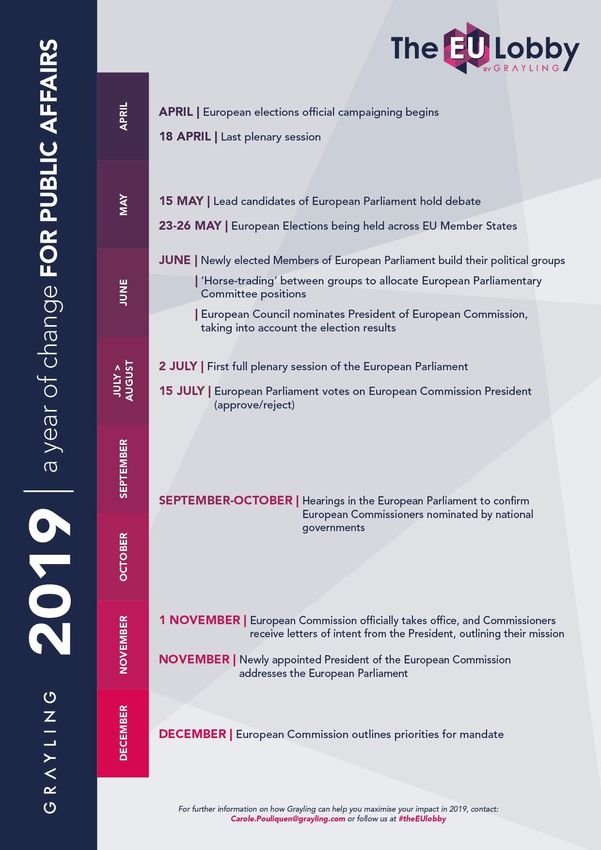
OTHERS 1NEXT STEPS TIMELINE XXXX.
You can also read


