UNIVERSITY OF CAPE TOWN 2019 UNDERGRADUATE PROSPECTUS
←
→
Page content transcription
If your browser does not render page correctly, please read the page content below

2019 UNDERGRADUATE
        PROSPECTUS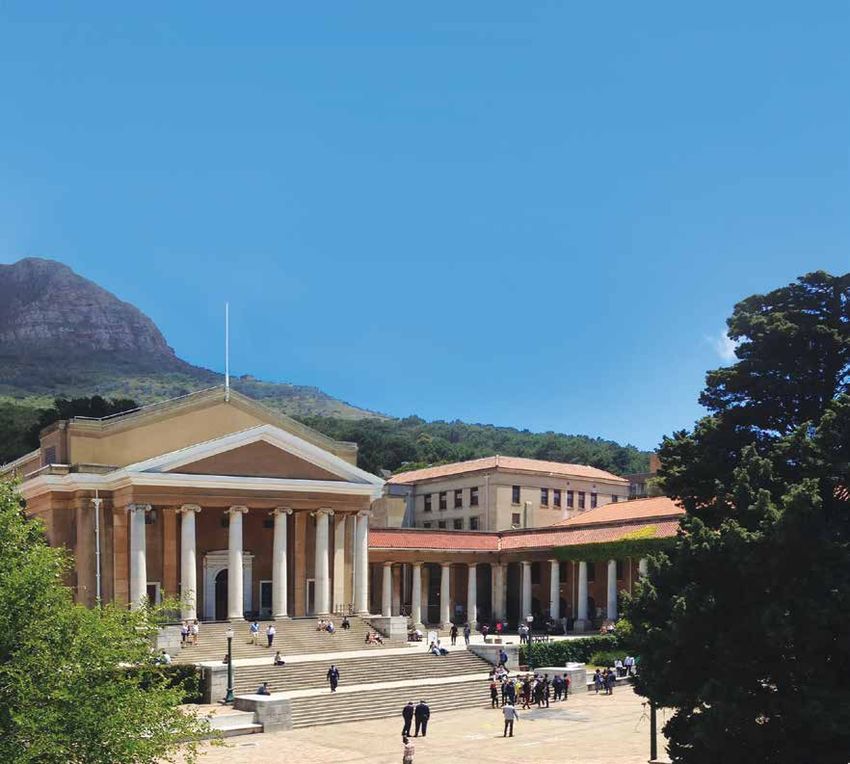
1

CONTENTS
 Message from the Vice-Chancellor                  2
 Using this Prospectus                             4
 About Cape Town and UCT                           5
 Visiting the University                           7
 Application and Admission to UCT                  8
 Faculty of Commerce                              16
 Faculty of Engineering & the Built Environment   22
 Faculty of Health Sciences                       28
 Faculty of Humanities                            38
 Faculty of Law                                   49
 Faculty of Science                               53
 Student Housing                                  58
 Sports, Student Clubs and Student Societies      61
 International Students                           63
 Tuition Fees & Residence Costs                   66
 Funding your studies                             68
 Student Life at UCT                              70
 Key Dates                                        72
 Contact information                              73

2

    MESSAGE                                                                             committees, the Students’ Representative
                                                                                        Council (SRC) and Student Parliament.
                                                                                                                                          UMYALEZO OVELA
    FROM                                                                                Fourth, we will prepare you for the
                                                                                        globalised world of work. We shape
                                                                                                                                          KWISEKELA-NTLOKO
    THE VICE-                                                                           opportunities for students to engage
                                                                                        internationally with student groups.
                                                                                                                                          LEYUNIVESITHI
    CHANCELLOR                                                                          You will study with students from over
                                                                                        a hundred different countries, and you
                                                                                        will make new and lasting friendships.
                                                                                                                                          Wamkelekile kwiYunivesithi yaseKapa. Ndiyavuya uceba ukuza
                                                                                                                                          kufunda e-UCT (University of Cape Town), neliziko elaziwa ngemfundo
    Welcome to the University of Cape Town. I am                                        There are curricular opportunities for            nangemfundiso ekudidi oluphezulu, nokuzinikela ekuthatheni
    delighted that you are considering studying at                                      learning about global issues. There are           inxaxheba kwimiceli-mngeni yoluntu ngophando namanyathelo ayo
    UCT, an institution renowned for the quality                                        also opportunities to spend some of               okuzibandakanya kwiingxaki zoluntu.
    of its teaching and learning, and for its commitment to           your time studying at a university abroad.
    engaging with society’s challenges through research and                                                                               I-UCT ibonelela ngoluhlu oluphangaleleyo lweenkqubo zezidanga
    active citizenship.                                               Fifth, to support you, we offer a range of student services,        zokuqala (undergraduate) nezilandelayo (postgraduate) kumasebe
                                                                      including services and facilities for students with disabilities,   amathandathu: EzoRhwebo (Commerce), UbuNjineli neeNdawo
    UCT offers a full range of undergraduate and postgraduate         the student wellness service, HIV/Aids prevention and               Ezakhiweyo (Engineering & the Built Environment), ezeMpilo (Health
    programmes in six faculties: Commerce, Engineering & the          treatment, and a career development office. There are also          sciences), ezoLuntu (Humanities), ezoMthetho (Law) nezeNzululwazi
    Built Environment, Health Sciences, Humanities, Law and           dozens of sports clubs, cultural societies and social activities    (Science). Iinkqubo zethu zezidanga zokuqala ziyilwe ngenyameko
    Science. Our undergraduate programmes have been carefully         to enable your all-round development and ensure you have            ukuqinisekisa ukuba umfundi ngamnye uzilungele ngokupheleleyo
    designed to ensure that each student is well prepared for the     lots of fun. We also have many academic support programmes          iimeko zemisebenzi yenkulungwane yama-21.
    work environment of the 21st century.                             to assist students from disadvantaged backgrounds.
                                                                                                                                          Nazi ezinye izizathu zokukhetha i-UCT:
    Here are some reasons why you should opt to study at UCT.         We recognise that tertiary education is expensive and               Okokuqala, uzakuba nethuba lokufumana isidanga esamkelwa
    First, you will have the opportunity to get an internationally    even unaffordable for many. We undertake to provide                 kumazwe ngamazwe ehlabathi. Uninzi lwabafundi abathweswe
    recognised qualification. Many of our graduates have jobs         financial assistance to ensure that any student who excels          izidanga yiUCT bafumana amathuba emisebenzi bengekakulungeli
    before they qualify and almost all have jobs within a few         academically, whether poor or middle class, will be able to         ukusebenza (besaphekwa) kwaye phantse bonke baqeshwa emva
    months after graduating, unless they choose for a specific        afford to come to UCT.                                              kweenyangana nje ezimbalwa bethweswe izidanga, ngaphandle
    reason not to enter formal employment.                                                                                                kokuba banazizathu zimbi zokunganqweneli ngqesho.
                                                                      This Prospectus will help you explore requirements for
    Second, we will expose you to some of the best researchers        different degrees, financial aid options, and provides              Okwesibini, sikunxulumanisa noompondo zihlanjiwe bokuhlohla
    and teachers in the world. The quality of your education is       information about admission testing, accommodation and              neengcali eziphum’izandla kwilizwe jikelele. Imfundo oyizuzayo
    directly related to the quality of the faculty staff teaching     more. If you still have questions, please call UCT’s admissions     ihambelana ngqo nezinga ezikulo iinkcubabuchopho ezikuhlohlayo.
    you. At UCT, researchers of outstanding quality teach, and        office for help.                                                    E-UCT, oompondo zihlanjiwe babaphandi bayafundisa, zize iinkcuba-
    teachers of outstanding quality do research, so that the latest                                                                       buchopho zenze uphando ukuze baphefumlelane ngowona
    scholarly work, teaching methods and practical experience         We are keen to attract talented, motivated students and,            mkhombandlela wokufunda nokufundisa.
    are incorporated into your curriculum.                            in particular, students who care about society and the
                                                                      environment. We encourage you to choose UCT. It will                Okwesithathu, siphuhlisa iinkokheli zengomso. Imfundo yalapha
    Third, we aim to prepare leaders for life. You will acquire an    change your life!                                                   ikulungiselela iimfuno zobomi nezixhobo zokulola ubunkokheli
    education that extends beyond the classroom curriculum. At                                                                            bakho ngokuzibandakanya nemibutho ngemibutho, iiklabhu, iikomiti
    UCT you will have the opportunity to hone your leadership         Yours sincerely                                                     zeendawo zokuhlal zabafundi, iBhunga Elimele Abafundi (SRC)
    skills through engagement in societies, clubs, residence          Dr Max Price, Vice-Chancellor                                       nePalamente yabaFundi (Students Parliament).
3

Okwesine, sikuphekela ukusebenza naphina ehlabathini. Siqulunqa       BOODSKAP                                                        jou leierskapsvaardighede deur jou betrokkenheid by
                                                                                                                                      verenigings, klubs, koshuiskomitees, die Studenteraad (SR)
amathuba okuba abafundi bazibandakanye noogxa babo bamazwe
ngamazwe. Uza kufunda uze wakhe ubuhlobo namakhulu-khulu              VAN DIE                                                         en die Studenteparlement te slyp.

abafundi abaphuma mbombo zone zehlabathi. Akwakho namathuba
okufunda ngemiba yehlabathi nawokuya phesheya ngezifundo.             VISE-KANSELIER                                                  Vierdens sal ons jou voorberei vir werk in die internasionale
                                                                                                                                      veld. Ons skep geleenthede vir studente om internasionaal
                                                                                                                                      met studentegroepe te skakel. Jy sal saam met studente
Okwesihlanu, nokujolise ukuxhasa wena, sinoluhlu lweenkonzo           Welkom by die Universiteit van Kaapstad (UK). Ek Is bly jy      van meer as ’n honderd verskillende lande studeer, en jy
zabafundi, njengezibonelelo kubafundi abakhubazekileyo, inkonzo       oorweeg dit om aan hierdie universiteit te studeer, ’n in-      sal nuwe en standhoudende vriendskappe smee. Daar
engempilo yabafundi (student wellness service), i-ofisi yonyango      stelling welbekend vir die gehalte van sy onderrig en opleid-   is ook geleenthede in die leerplanne vir studies oor
nothintelo lwesifo sengculazi (HIV ne-Aids) kunye neyophuhliso        ing, asook sy verbintenis tot die aanpak van samelewing-        wêreldkwessies.
lwezakhono zomsebenzi (Careers service).                              suitdagings deur navorsing en aktieweburgerskap.
                                                                                                                                      Vyfdens bied ons, om jou te ondersteun, ’n reeks
Kukwakho nentlaninge yamaqela yezemidlalo, ezamasiko nezithethe       UK bied ’n volle reeks van voorgraadse en nagraadse             studentedienste; waaronder dienste en geriewe vir
nezoluntu nokuhlala ukuze uphuhle ngokupheleleyo kwaye siqinisekise   studierigtings in ses fakulteite aan: Handel, Ingenieurswese    studente met gestremdhede, die studente-welstandsdiens,
ukuba wonwabile. Sikwanoluhlu lweenkqubo zenkxaso ukukhawulelana      en die Beboude Omgewing, Gesondheidswetenskappe,                MIV/Vigs-voorkoming en -behandeling, en ’n loopbaan-
neemfuno zabafundi abasuka kumakhaya angathathi ntweni.               Geesteswetenskappe, Regswese en Natuurwetenskappe.              ontwikkelingskantoor. Daar is boonop tientalle sportklubs,
                                                                      Ons voorgraadse leerplanne is sorgvuldig ontwerp om             kulturele verenigings en sosiale aktiwiteite om jou in staat
Siyazi ukuba imfundo ephakamileyo ayifikeleleki kwabaninzi.           te verseker dat elke student goed voorberei is vir die          te stel om volledig te ontwikkel en hope pret te hê. Ons
Sinikeza ngenkxaso-mali ukuqinisekisa ukuba nawuphi na umfundi        werksomgewing van die 21ste eeu.                                het ook talle akademiese ondersteuningsprogramme om
osebenza ngemfezeko nokuba uphuma khikhaya elifumileyo okanye                                                                         studente uit benadeelde agtergronde te help.
elingathanth’intweni unakho ukufunda e-UCT.                           Hier is ʼn paar belangrike redes waarom jy behoort te kies
                                                                      om aan die UK te studeer. Eerstens sal jy die geleentheid       Ons besef dat baie nie tersiêre onderrig kan bekostig nie
Lo mpoposho ushicilelweyo ukhawulelana nawe ukuphonononga             kry om ’n internasionaal erkende kwalifikasie te verwerf.       en onderneem om finansiële hulp te verleen om seker te
uluhlu lwezidanga, inkxaso-mali, nolwazi malunga novavanyo            Baie van ons gegradueerdes het reeds werk voordat hulle         maak dat enige student wat akademies goedgekeur is, of
lolwamkelo (admission testing), indawo yokuhlala nokunye. Ukuba       kwalifiseer en byna almal kry werk binne ’n paar maande         hy/sy nou arm of van die middelklas is, in staat sal wees
usenayo imibuzo, nceda uqhakamshelane ne-ofisi yolwamkelo ye-UCT.     nadat hulle graad gekry het, behalwe as hulle om ’n             om dit te kan bekostig om na UK te kom.
                                                                      spesifieke rede verkies om nie formele indiensneming te
Sinomdla wokutsala abafundi abanezakhono, intshisakalo,               betree nie.                                                     Hierdie Prospektus is saamgestel om jou te help om
ingakumbi abafundi abazikhathazayo ngoluntu nangokusingqongileyo.                                                                     verskillende graadvereistes en opsies rondom finansiële
Siyakukhuthaza ukuba usizame, singakutshintshela ubomi!               Tweedens sal ons jou blootstel aan van die beste                hulp te ondersoek, asook om inligting te verskaf oor
                                                                      navorsers en dosente ter wêreld. Die gehalte van jou            toelatingstoetse, huisvesting, en dies meer. As jy steeds
Ozithobileyo                                                          onderrig hou regstreeks verband met die gehalte van die         vrae sou hê, skakel asseblief UK se toelatingskantoor vir
Gqr. Max Price, Isekela-Ntloko                                        fakulteitspersoneel wat jou onderrig. By UK gee navorsers       bystand.
                                                                      van hoogstaande gehalte klas en doen dosente van
                                                                      hoogstaande gehalte navorsing. Die jongste navorsingswerk,      Ons is gretig om talentvolle, gemotiveerde studente te
                                                                      onderrigmetodes en praktiese ondervinding word dus in           trek, en veral studente wat waarde aan maatskaplike
                                                                      jou leerplan geïnkorporeer.                                     geregtigheid en betrokke burgerskap heg. Ons moedig jou
                                                                                                                                      aan om UK te kies. Dit sal jou lewe verander!
                                                                      Derdens mik ons daarna om toekomstige leiers te kweek.
                                                                      Jy sal ’n opvoeding verkry wat wyer as die klaskamer-           Dr. Max Price
                                                                      leerplan strek. By UK sal jy die geleentheid kry om             Vise-kanselier
4

    USING
      THIS PROSPECTUS
      This prospectus is a guide for school-leavers and others who are interested   Applicant status: Once you have submitted your application, you can
      in studying for a first qualification at the University of Cape Town. It      check the progress of your application on the UCT website. You will need
       introduces you to life at UCT, describing the campus and detailing the       to use your applicant number or personal details to access information.
        services and facilities we provide for students.
                                                                                    Disadvantage factor: This is a percentage, between 0 and 10%, by which
        Details of all undergraduate programmes offered are provided.               we adjust the FPS of South African NSC candidates to arrive at the WPS.
        We recommend that you also visit the websites of faculties and              The disadvantage factor is in turn derived from factors related to the
         departments in which you may be interested. To help you understand         disadvantage experienced by applicants in their school and at home.
         the contents of this prospectus, we list below some of the terms that
          we use in this prospectus and what we mean by these terms.                Early conditional offer: This is an offer of admission, made during
                                                                                    the course of the year preceding admission, which is conditional on
           Admission Points Score (APS): This is the measure of your                performance in your final school examinations. Early conditional offers are
           academic achievement based on your school-leaving results (or an         not made to all applicants. An early conditional offer will be withdrawn if
            acceptable equivalent). The APS either on its own or (as in some        the conditions for admission are not met.
            faculties) combined with your NBT scores produces a Faculty Points
             Score (FPS) which we use to rank applicants.                           Faculty Points Score (FPS): This is the score we use to rank applicants.
                                                                                    In two faculties it combines the APS and NBT scores. In other faculties it
              Admissions selection criteria: We use these to select whom            is the APS.
              we will accept to study at UCT. First, we decide who has met
               the (minimum) admission requirements. Then, we apply the             Faculty: A faculty is a grouping of departments that offers specific degree
               admissions selection criteria for the programme concerned.           and diploma programmes. There are six faculties at UCT. Students register
                                                                                    in a faculty.
                Applicant: You (A person who applies to study for a degree,
                diploma or certificate). Once you register at UCT, you become       Matriculation / Matriculation Endorsement: If you obtain a NSC
                 a student.                                                         endorsed for bachelors degree study you do not need a matriculation
                                                                                    certificate or a certificate of exemption. If your school-leaving certificate is
                  Application fee: This is the fee required as part of your         from another examining authority you will need to obtain a matriculation
                  application. It is non-refundable, even if your application is    exemption certificate.
                   unsuccessful.
                                                                                    Minimum Admission requirements: What you must have: for example,
                    Applicant number: An alpha-numeric number will be               Mathematics is required for admission to some programmes. These are
                    allocated to you to identify and track your application. It     necessary requirements you must meet, but are not necessarily sufficient
                     normally consists of the first three consonants of your        for entry.
                     surname, and the first three characters of your first
                      name, followed by a unique three digit number. It is          National Benchmark Tests (NBT): All applicants to undergraduate
                       important that you quote this number in any subsequent       programmes living in, or at school in, South Africa, and all Health Sciences
                        correspondence that you have with us.                       applicants, must write the NBTs. The NBTs comprise of three tests.
5

National Senior Certificate (NSC): Since 2008, South African school-leavers            School subject requirements: The subjects and ratings that you must
write the NSC examinations. This may be under the auspices of one of                   obtain to be considered for admission for a particular degree or diploma
three examining authorities: The Department of Basic Education (DBE), the              programme. Obtaining the NSC with bachelors endorsement and meeting
Independent Examinations Board (IEB) or the South African Comprehensive                the minimum admission requirement does not guarantee admission to
Assessment Institute (SACAI). Scores in this prospectus are calculated for             the University.
NSC applicants.
                                                                                       Undergraduate: A university student registered for a first degree or an
Programme: Students enter a degree, diploma or certificate programme,                  undergraduate diploma. This Prospectus is intended for you if you wish
which is a combination of subjects that have been constructed to provide               to be admitted to an undergraduate programme at UCT.
you with a particular knowledge and skills base, and leads to a qualification.
                                                                                       Weighted Points Score (WPS): For South African
Redress Category: The redress category is derived, for South African                   NSC applicants only, this is the faculty
applicants only, from the racial classification of their parents during Apartheid.     points score weighted by the
                                                                                       disadvantage factor applicable
Registration: If you are offered a study place, you must sign up before the start      to each applicant.
of the first term. We call this registration. Registration gives you student status,
commits you to a certain programme, and to pay fees for it.

    Glossary and abbreviations of common application-related terms

     A Level            Advanced Level
     AL                 Academic Literacy
     AP                 Advanced Programme
     APS                Admission Points Score
     AS Level           Advanced Subsidiary Level
     FPS                Faculty Points Score
     GCSE               General Certificate of Secondary Education
     IB SL              International Baccalaureate Standard Level
     IB HL              International Baccalaureate Higher Level
     IGCSE              International General Certificate of Secondary Education
     MedPS              Medical Points Score
     NBT                National Benchmark Tests
     NSC                National Senior Certificate
     NSSC               Namibian Senior School Certificate
     OL                 Ordinary Level
     QL                 Quantitative Literacy
     WPS                Weighted Points Score
     ZIMSEC             Zimbabwean Schools Examination Council
6

    ABOUT
                 CAPE TOWN & UCT
    One of the most popular destinations in the world, Cape Town
    has it all. With beaches, mountains, forests and UCT on your
    doorstep, Cape Town is an historic, cosmopolitan city with a
    vibrant contemporary culture of music and art, as well as a host
    of sport and leisure activities.

    The University’s main campus lies on the lower slopes of Devil’s
    Peak in the Cape Peninsula. The Peninsula and its environs
    feature some of the most breathtaking scenery in the world and
    offer you a unique natural environment to explore during your
    leisure time. Many sports are offered at the University and there
    is an active cultural life, both on campus and in and around
    the city. Cape Town forms the hub of the Western Cape, and it
    is the centre of politics, business, industry and services in the
    region. This region provides an ideal ‘laboratory’ for much of the
    University’s teaching and research.

    The University of Cape Town is the oldest university in South
    Africa and is one of the leading research universities on the
    African continent. UCT has over 29 000 students, of whom
    30% are postgraduate students. Some 5 500 degrees and
    diplomas are awarded each year in our six faculties: Commerce,
    Engineering & the Built Environment, Health Sciences,
    Humanities, Law, and Science. We pride ourself on our diverse
    student body, which reflects the many cultures and backgrounds
    of the region. We welcome international students and
    are currently home to over 5 000 international
    students from over 100 countries.

    UCT has a tradition of academic excellence and
    research that is respected world-wide. Past
    students include five Nobel Laureates –
    Max Theiler, Alan Cormack, Sir Aaron Klug,
    Ralph Bunche and, most recently, J M Coetzee.
7

VISITING
                       THE UNIVERSITY
This Prospectus can only give you a flavour of life at UCT. If       School talks to Grade 11 and 12 pupils                        Parents’ Orientation events are held annually for both local
you can visit the campus before applying, please do so. There        •   Grade 9 subject-choice talks (at schools)                 parents, and parents of students from outside of Cape Town.
are many opportunities for applicants and their parents to           •   Campus tours scheduled for 10h00 and 14h00 daily;         For more information about visiting UCT or the services listed
visit the University to find out more about us, our degree               booking on 021 650 4556 is essential                      above, contact:
programmes and our facilities.                                       •   Career evenings
                                                                     •   Career exhibitions
                                                                     •   Assistance with the application procedure                              The Admissions Office:
UCT Open Day: 21 April 2018                                          •   Provision of application forms for those unable to
Our annual Open Day is aimed at high school students in                  apply online                                                           Tel:     021 650 2128
Grades 10, 11 and 12, their families, teachers and guidance          •   UCT evenings for applicants and parents                                Email:   admissions-ug@uct.ac.za
counsellors. All faculties take part in the event, offering talks,   •   Advice on study options available at UCT.                              Website: www.uct.ac.za
tours, exhibitions, performances and other events. Detailed
information will be sent to schools and will also be on the
UCT website (www.uct.ac.za).                                         Parents’ Orientation
                                                                     Parents of new undergraduate students are invited to attend
From time to time, we host events which are specific to              Parents’ Orientation each year. The programme allows for
particular disciplines, or faculties.                                parents to be addressed by the Vice-Chancellor, and
                                                                     meet the Deans. In addition, parents will be
                                                                     exposed to therange of facilities on
The Admissions Office                                                offer at UCT, including transport
You are invited to visit the Admissions Office between 08h30         and security arrangements in
(except for Thursdays, when we open at 09h30) and 16h30              place for students.
daily. Access information by either meeting with a student
recruitment officer, or collecting a copy of our prospectus.
8

    APPLICATION AND ADMISSION TO UCT
    ADMISSIONS POLICY
    Our admissions policy is designed to ensure that             Redress on the basis of disadvantage                                        These are the four designated redress categories used to give
    top achievers are offered places at UCT, and to ensure                                                                                   effect to our admissions policy.
    a diverse student body by incorporating measures for         As our South African history has been, and in many cases continues to       •    Redress category 1: An applicant with at least one parent
    redress and measures to ensure that the incoming             be, one of gross inequality usually structured along racial lines, a key         classified as Black under apartheid
    cohort increasingly reflects the demographic diversity       element of our admissions policy is to provide for redress for South        •    Redress category 2: An applicant with at least one parent
    of our country.                                              African citizens and permanent residents on the basis of disadvantage.           classified as Coloured (but the other not as Black) under
                                                                 To do this we look at the school the applicant attends/attended and              apartheid
    We start by                                                  his/her family background. This yields a disadvantage factor, expressed     •    Redress category 3: An applicant with at least one parent
    •    setting minimum levels of academic achievement          as a percentage between 0% and 10% (or for the MBChB, between 0%                 classified as Indian (but the other not as Black or Coloured)
         for each programme, below which we will not offer       and 20%). We add this percentage of the FPS to the FPS to derive the             under apartheid
         a place;                                                weighted (for redress) Faculty Point Score (WPS).                           •    Redress category 4: An applicant with at least one parent
    •    setting the class size for each programme and setting                                                                                    classified as Chinese (but the other not as Black, Coloured or
         an aspirational demographic enrolment target for        In other words if the disadvantage factor is 7%, we calculate the                Indian) under apartheid
         each programme; and                                     WPS as follows: WPS = FPS + (7% X FPS)
    •    determining selection methods                           If there is a zero redress factor (no school or family disadvantage or an
                                                                 international applicant) then the factor is 0% and WPS = FPS +0 = FPS       Selections methods
    The Faculty Points Score                                                                                                                 When making offers, we:
                                                                 Redress for diversity                                                       •  select a proportion of the class using the unweighted FPS;
    The Faculty Points Score (FPS) (calculated in different                                                                                     this we call Band A.
    ways to meet the needs of each faculty) is used to rank      We categorise all South African applicants (not international               •  select a proportion (usually a bigger proportion) of the class
    the best applicants; a small number of applicants will be    applicants) according to the categorisation of their parents’ race under       using the weighted score – the WPS – in which we make a
    offered places on the basis of the FPS.                      apartheid. This allows us to have a proxy for the applicant’s race.            significant allowance for school and/or family disadvantage
                                                                          We use these categories to give priority in making selection          and this we call Band B.
                                                                              decisions to ensure that we meet the diversity targets we      •  select the remaining members of the class in FPS rank order
                                                                                 set for each class.                                            from redress categories in order to
                                                                                                                                                constitute each class for
                                                                                                                                                diversity; this we call Band C.
9

HOW TO APPLY
                                                               IMPORTANT DATES
Apply online at http://applyonline.uct.ac.za.                  APRIL 2018:                                          30 NOVEMBER 2018
Alternatively, contact the Admissions Office for an            •    2019 applications open in early April.          •   Last date on which we can make an offer
application form. You will get directions on how to complete                                                            to an international undergraduate applicant
the form. You must submit only one application. Your           30 SEPTEMBER 2018:                                       requiring a study visa.
application allows you to choose two programmes. It is in      •    Applications close
your interest to seek advice about your programme choices,     •    Applications for housing close                  31 DECEMBER 2018:
since this selection may affect your chances of admission.                                                          •    All final transcripts and non-NSC school-
                                                               1 OCTOBER 2018 :                                          leaving results (except CIE, ZIMSEC and
When you apply to UCT, your application will be dealt with     •   Final date to submit the Health Sciences’             NSSC) must be submitted as certified paper
by the Admissions Office and by the Faculty that offers your       Personal Report or CV                                 documents.
choice of study. You can contact the Admissions Office at      •   Final date to submit the Bachelor of
any time before or during the application process, and we          Architectural Studies (BAS) and Bachelor         15 JANUARY 2019
will be happy to give you help or advice.                          of Fine Art (BA(FA)) portfolios                  •    Final CIE results from the November 2018
                                                                                                                         session are due.
     You can contact us:                                       13 OCTOBER 2018 :
     By post:         The Admissions Office                    •    National Benchmark Tests must be written        26 JANUARY 2019
                                                                    no later than 13 October 2018                   •    University residences open.
                      The University of Cape Town
                                                                                                                    •    Parents’ orientation.
                      Private Bag X3
                                                               31 OCTOBER 2018:
                      Rondebosch 7701                          •    For applicants finishing secondary school       28 JANUARY 2019
                                                                    in 2018, all grade 12 interim results, or       •    Parents’ orientation.
     By telephone:      021 650 2128
                                                                    predicted scores in the case of non-NSC
     By email:          admissions-ug@uct.ac.za                     candidates, are due.                            11 FEBRUARY 2019
     On the website:    www.uct.ac.za                          •    You may change choices, as you wish,            •    Classes start.
     On Twitter:        @uctadmissions                              until 31 October 2018. After this date your
                                                                    programme choices may only be changed
     In person:         Admissions Office, Level 4,                 with the prior permission of the faculty to
                        Masingene Building,                         which you wish to apply.
                        Cross Campus Road,                     •    Interim and past transcripts for transferring
                        Middle Campus,                              applicants are due
                        Rondebosch, UCT
10
What is the application fee? Your application will have one of several statuses while it is being processed. These include:
South African and SADC applicants must pay a non-refundable application fee of R100. • Application submitted: typically shortly after we first receive your application
International students are required to pay an application fee of R300. Application fees will • Decision deferred: for any number of reasons, we may not be able to take a decision to admit or
not be refunded under any circumstances. Paying your application fee does not mean you will deny an application yet because we do not have enough information. An example would be that the
be offered a place to study at UCT. applicant’s performance at school Is not yet strong enough to attract an offer of admission
• Conditional offer: we have made an offer of admission, based on certain conditions being met
Currently registered UCT students and UCT graduates do not pay an application fee, unless applying for • Firm offer: we have made a firm offer of admission, without any conditions
admission to a programme offered by the Graduate School of Business. • Deny: the application Is unsuccessful
• Waitlisted: you have met all the criteria for admission, but we are unable to admit because, for example,
What happens when your application has been submitted? the applicant pool Is very competitive
You will get an email acknowledgement setting out what you have to do next. If you apply
by completing a paper application form, and you do not have an email address, we will write Early conditional offers
to you acknowledging receipt, asking you to check the data we have captured from your Conditional offers are offers of admission which are dependent on you meeting one or more conditions.
form. Once we have your application our faculties will consider it and all updates/decisions We will specify such conditions to you in our communication. We make conditional offers throughout the
will be sent to your email account. application cycle.
When we acknowledge receipt of your application, we will give you your applicant number, and a username For NSC applicants, conditional offers will usually (but not necessarily) be made only once two sets of
(which is also your applicant number) and password for access to Student Self-Service. At any stage you will internal school examination results and the NBT results are available. Conditional offers will only be
be able to track the status of your application, using these log-in credentials. confirmed once the final FPS and NBT results are available, and provided both the FPS and NBT results
confirm that the admission criteria have been satisfied.
However, if all of your applications are cancelled/denied, you will no longer have access to Student
Self-Service. Please use your applicant number when you contact us as it will help us track your For applicants doing international school-leaving qualifications, we typically require all possible submissions
application. You may check the status of your application and update your application, as required, at before final school-leaving results are available. Examples of important submissions to support conditional
www.studentsonline.uct.ac.za. offers are predicted scores, IGCSE results and SAT results.
GENERAL ELIGIBILITY FOR ADMISSION TO UNDERGRADUATE PROGRAMMES
In order to be considered for admission to a programme, an applicant must, in the first instance, • Applicants with non-South African school-leaving certificates must have met the
be eligible for consideration. As an undergraduate applicant to UCT you must be aware of the requirements for matriculation exemption.
following, and satisfy criteria which apply to you. • All applicants, in the final school-leaving assessment, must have achieved the minimum
• National Senior Certificate applicants must, for admission to higher certificate, diploma or criteria for admission to the programme/s of their choice. These include:
degree programmes have met the NSC requirements for such endorsement. - the required APS, FPS, WPS or MedPS as it may apply to the programme of choice
• If you do not meet the minimum requirements for university admission but you are 23 years - performance levels specified for required school subjects
or older and have a Grade 12 (school-leaving) certificate, you may qualify for a mature age - performances in the applicable components of the NBTs
exemption. If you fall into this category, you should discuss the possibility of conditional - any other requirements, as outlined in the faculty sections, that may be applicable to
exemption with the relevant faculty office. Applicants with mature age exemption are not specific programmes
considered for programmes offered in the Faculties of Health Sciences and Law.11
SCORE CALCULATIONS FOR NATIONAL EXAMPLES OF POINTS SCORE CALCULATIONS FOR NSC APPLICANTS
SENIOR CERTIFICATE APPLICANTS ONLY
1. FACULTIES OF COMMERCE, ENGINEERING & THE BUILT ENVIRONMENT, HUMANITIES AND LAW
For applicants writing the National Senior Certificate we use an Admission In these faculties the FPS is calculated out of 600.
Points Score (APS), a Faculty Points Score (FPS) and, in the case of South African English Home Language 75% = 75 pts
applicants, a Weighted Points Score (WPS) to assess your performance at school. In isiXhosa First Additional Language 70% = 70 pts
addition, only for admission to the MBChB programme, we also use a MedPS. The Mathematics 84% = 84 pts
scores are described in detail below. Life Sciences 86% = 86 pts
Geography 79% = 79 pts
The percentages achieved in NSC examinations (preliminary and final examinations) will Accounting 69% = 69 pts
be allocated an admissions score equal to that percentage. Life Orientation 80% = 0 pts
Total = 463/600
FPS = 463
TO CALCULATE YOUR APS (a score out of a maximum of 600), add the six best
subject percentages, excluding Life Orientation and scores for AP subjects, but including Use the disadvantage factor to derive the weighted score:
English and any other required subject(s) for the relevant programme. (In other words, for the purpose of this example the disadvantage factor is 10%.
for a programme where Mathematics and Physical Sciences are required, take the scores Disadvantage factor = 10% (46)
for English, Mathematics, Physical Sciences and the next best three subjects other than WPS = 509 (463+46)
Life Orientation to calculate your APS.) Results below 40% for any subject do not attract [for South African applicants only]
a score. In order to determine which subjects are required for admission to particular
programmes, please refer to the faculty sections that follow. 2. FACULTY OF HEALTH SCIENCES
2.1 MBChB applications only: The MedPs is calculated out of 1000.
This includes the FPS (900) and the Personal Report (100).
TO CALCULATE YOUR FPS, the APS will be adjusted as described below in the English Home Language 75% = 75 pts
calculation examples. Two faculties (Health Sciences and Science) adjust the APS when isiXhosa First Additional Language 70% = 70 pts
calculating the FPS. For the rest (Commerce, Engineering & the Built Environment, Mathematics 84% = 84 pts
Humanities and Law), the APS equals the FPS. Life Sciences 86% = 86 pts
Physical Sciences 79% = 79 pts
In order to calculate the FPS for the Faculty of Science, double the scores achieved Accounting 69% = 69 pts
for Mathematics and Physical Sciences (a score out of a maximum of 800). Where Life Orientation 80% = 0 pts
an applicant has not completed Physical Sciences, Information Technology or Life APS = 463/600
Sciences may be doubled (this is only allowed for certain majors as stipulated in the NBT Scores of: AL: 55%
faculty entry). QL: 60%
MAT: 50%
When calculating the FPS for the Faculty of Health Sciences (a score out of a maximum NBTs = 165/300
of 900), simply add the sum of the three NBT scores to the APS. In the same faculty, for
application to the MBChB programme, a MedPs Is calculated by adding the score of the FPS = 628/900 ( APS + NBTs)
Personal Report to the FPS, creating a score out of 1000. PR = 65/100
MedPS = 693/1000 (FPS + PR)
Use the disadvantage factor to derive the weighted score:
FOR SOUTH AFRICAN APPLICANTS ONLY, in order to calculate the WPS, adjust
for the purpose of this example the disadvantage factor is 20%.
the FPS by the disadvantage factor applicable to you. This is a percentage between 0%
Add Disadvantage factor of 20% = 20% x MedPS = 20% x 693 = 139
and 10%, except for applications for admission to the MBChB programme, where the
WPS = 832 (693 + 139)
range is between 0% and 20%.
[for South African applicants only]12
2.2 HEALTH AND REHABILITATION SCIENCES applications only: 3. FACULTY OF SCIENCE
The FPS is calculated out of 900. The FPS is calculated out of 800.
English Home Language 75% = 75 pts English Home Language 75% = 75 pts
isiXhosa First Additional Language 70% = 70 pts isiXhosa First Additional Language 70% = 70 pts
Mathematics 84% = 84 pts Mathematics 84% = 84 pts
Life Sciences 86% = 86 pts Physical Sciences 86% = 86 pts
Physical Sciences 79% = 79 pts Geography 79% = 79 pts
Accounting 69% = 69 pts Accounting 69% = 69 pts
Life Orientation 80% = 0 pts Life Orientation 80% = 0 pts
APS = 463/600 APS = 463/600
NBT Scores of: AL: 55%
QL: 60% Scores for Mathematics and Physical Sciences are doubled; therefore, 170 (84+86)
MAT: 50% is added to the APS:
Make a total 165/300, added to 463 FPS = 633 /800
FPS = 628/900
Use the disadvantage factor to derive the weighted score: for the purpose of this example the Use the disadvantage factor to derive the weighted score: for the purpose of this example the
disadvantage factor is 20%. disadvantage factor is 0%.
Add 20% as follows: Disadvantage factor = 20% x FPS = 20% x 628 = 135.6 Disadvantage factor = 0%
WPS = 764 (628+135.6) WPS = 633 (633+0)
[for South African applicants only] [for South African applicants only]
An additional 10 points are added if you have passed a third official South African language
at Home or First Additional Language Level.
SCORE CALCULATION FOR SELECTED NON-SOUTH AFRICAN EXAMINING AUTHORITIES
ADMISSION POINTS TABLE The table alongside is an indication of how we rate results
for subjects, taken at various levels, for some school-leaving
Points IGCSE NSSC HL AS LEVELS A LEVELS IB SL IB HL qualifications. In some faculties we do not use an APS for
10 A 7 admission, but subject requirements are published as minimum
requirements, and applications are considered individually.
9 B 6
8 1 A C 7 5
7 2 B D 6 4
6 A 3 C E 5 3
5 B D 4
4 C Ewww.nbt.ac.za 13
Current UCT students applying for
undergraduate transfers
If you are currently registered for an undergraduate
Applicants repeating NSC subjects
Applicants who are repeating one or more NSC
subjects will be assessed individually based on faculty
NATIONAL
programme at UCT, and wish to transfer to another
faculty other than Health Sciences or another
requirements. BENCHMARK TESTS
programme in your faculty, you are not required to English proficiency
submit a new application but must consult with the All international students for whom English is not a Admissions and placement tests have been used at UCT for over 30
faculty that you wish to transfer to. If you wish to first/home language or have not passed English at years. The National Benchmark Tests (NBTs) are administered by the
transfer to the Faculty of Health Sciences, you must Grade 12, AS-level, IGCSE or NSSC level or equivalent, Centre for Educational Testing for Access and Placement on behalf of
apply online on or before 30 September. must provide proof of English language proficiency. Universities South Africa (CETAP).
Applicants are required to achieve one of the
Transferring Students following: All undergraduate applicants who are normally resident or at school in
If you are studying at, or completed studies at, 1. A score of at least 51% for the Academic Literacy South Africa must write the NBT, and all applicants to programmes in
another higher education institution, you will be (AL) component of the National Benchmark Tests Health Sciences must write the NBT wherever they reside.
considered on the basis of your school-leaving (NBTs)
results and your higher education results. In addition, 2. A pass in the TOEFL (Test of English as a Foreign All applicants write the Academic and Quantitative Literacy test
transferring applicants are required to write the NBTs, Language) with a score of at least 570 on the (described below) and all applicants to Commerce, Engineering & the
and may be asked to submit a letter of motivation. paper-based test, or 230 on the computer-based Built Environment, Health Sciences, and Science faculties also write the
test; or 88 on the internet-based test Mathematics test (described below). Information regarding the use of the
To be considered for admission, you must have met 3. An overall band score of 7.0 (with no individual test scores in each faculty can be found in the faculty pages.
the school-leaving requirements and have a good element of the test scoring below 6.0) on the
academic record and satisfactory conduct from your International English Language Testing System What are the National Benchmark Tests?
previous institution. (IELTS) The National Benchmark Tests are three multiple-choice tests written as a
4. A score of 64 on the Pearson PTE Academic test. combined Academic Literacy and Quantitative Literacy test and a separate
You will need to submit an interim academic The tests must be taken at your own expense, Mathematics test. The Academic and Quantitative Literacy Test (AQL) is a three-
transcript and a certificate of good conduct with your before submitting an application. hour test which consists of an Academic Literacy (AL) section and a Quantitative
application, and your final, year-end transcript as soon Literacy (QL) section. The results of the two sections of the test are reported
as they are available and no later These are the minimum levels of separately.
than 31 December 2018. English proficiency required for
consideration for admission The Academic Literacy (AL) Test tests your capacity to engage successfully with
to UCT. the demands of academic study in the language of instruction which is English at
UCT. The Quantitative Literacy (QL) Test targets your ability to manage situations
or solve problems in a real context that is relevant to higher education study,
using basic quantitative information that may be presented verbally, graphically,
in tabular or symbolic form. The Mathematics Test is a three hour test which
targets a writer’s ability related to mathematical concepts formally regarded
as part of the secondary school curriculum relevant for Higher Education
studies.
Who writes what?
Applicants to the Faculties of Humanities and Law write the Academic and
Quantitative Literacy test only. Applicants to Commerce, Engineering &
the Built Environment, Health Sciences and Science write the Academic and
Quantitative Literacy test as well as the Mathematics test. The completion of
the Mathematics syllabus is not a prerequisite for writing the Mathematics Test.14
REGISTERING FOR YOUR In summary, our advice to you is to: hearing or mobility/physically impaired, have a learning disability,
NATIONAL BENCHMARK TESTS • register to write the NBTs as early as possible but no later or have a chronic illness that requires special accommodations.
than 13 October 2018 Time concessions, readers, scribes, and braille versions of the
It is compulsory to write the NBTs if you: • ensure that you show up to write the NBTs on the date for tests have been made available.
• apply for admission to an undergraduate programme of which you registered, as you are liable for the fees
study (whatever your previous studies), and live in South regardless of whether you write or not
Africa, attend secondary school in South Africa, or if you • rewrite the NBTs if you feel you did not do yourself justice How to register for NBTs
apply for admission to the Faculty of Health Sciences at the first attempt. Note that you are only allowed to You may register online.at www.nbt.ac.za.
(wherever you may reside) write the NBTs at most twice in any test cycle. After reading the general information and the
• we expect you to write the NBTs, in English, as early as FAQs, select the ‘Book a test’ option and follow
possible in 2018, preferably in the June/July period. Writing If you think you have valid reasons for not writing the NBTs by all instructions. Note that you will need your
the NBTs later will mean that we receive your results 13 October 2018 you may apply before 30 September 2018 to SA identity number or passport number in order
later, and that we are only able to make decisions on your the Admissions Office, admissions-ug@uct.ac.za for permission to register.
application later. to write the NBTs later. Permission will only be granted if there
is a valid reason as to why you will not be able to write the NBTs If you encounter problems during the registration
You must write the NBTs by 13 October 2018. If you fail to do before 13 October 2018. process, call 021 650 3523 or send an email to
so, we are unable to consider you for an early conditional offer. nbt@uct.ac.za for assistance.
In addition, we are unable to consider you for admission in 2019 How are the test results used?
if you write the NBTs in January 2019, or after the release of the The test results are used in addition to school-leaving The NBT Project is staffed
NSC results. academic performance and do not replace the use of from 08:00 to 16:00 weekdays
school-leaving results. In the case of Engineering & the Built and from 07:00 to 10:00
Environment and Health Sciences, the National Benchmark Test on national test days.
results make up a specific proportion of a school-leaver’s overall
The tests begin at 08h00 at many venues
Faculty Points Score. (See the Faculty specific section in this throughout South Africa. The Academic and
prospectus for more information). The NBT results may also Quantitative Literacy (AQL) test is written in the
be used to decide admission to an extended or foundation morning session and the Mathematics (MAT)
programme. test in the afternoon.
Can I write the NBTs outside of South Africa? If both tests are written, you will probably complete
Writing the NBTs in a remote venue, or outside of South Africa them at about 16h00. They must also be written
Remote sessions are run when someone is unable to write at an at the same sitting. Testing dates and venues are
institution that generally facilitates the National Benchmark available on the NBT web site at www.nbt.ac.za.
Test sessions. Alternatively please call the NBT Project.
Usually, these are for test writers in another country or in an area
too remote to be able to make a trip of a reasonable distance to
the nearest testing centre. Should you wish to request a remote
venue, please contact the NBT Project at nbtremote@uct.ac.za.
Provision for candidates with disabilities
Provision is made for test writers with disabilities. We have
successfully accommodated writers who are blind, visually,15
DEGREE Benchmark Performance Levels
Benchmark Academic Literacy Quantitative Literacy Mathematics
Performance Levels Minimum Maximum Minimum Maximum Minimum Maximum
May I write the NBTs more Proficient 68 100 70 100 69 100
than once? Intermediate 39 67 40 69 35 68
You may attempt the NBTs at most
Basic 0 38 0 39 0 34
twice in one test cycle. But:
• you will have to register for each
attempt; DEGREE Benchmark Performance Levels Split into Upper and Lower Boundaries*
• you will have to pay the NBT test fee each time you do so;
• you will receive one unique registration number for all Benchmark Academic Literacy Quantitative Literacy Mathematics
NBT attempts; Performance Levels Minimum Maximum Minimum Maximum Minimum Maximum
• if you write a second time and you are doing all three Proficient Upper 84 100 85 100 85 100
tests, you must rewrite all three tests; Proficient Lower 68 83 70 84 69 84
• we will use your best NBT results for each of AL, QL and MAT.
Intermediate Upper 54 67 55 69 52 68
Intermediate Lower 39 53 40 54 35 51
What must you take to the tests?
• your identity book or passport Basic Upper 19 38 20 39 17 34
• lunch (not all centres are close to shops) Basic Lower 0 18 0 19 0 16
• HB pencil and eraser
• bus/train/taxi fare for returning home
DIPLOMA and HIGHER CERTIFICATE Benchmark Performance Levels
• please note that you will not be allowed to use
calculators in any of the tests. Benchmark Academic Literacy Quantitative Literacy Mathematics
Performance Levels Minimum Maximum Minimum Maximum Minimum Maximum
Venues for the tests for admission to UCT in 2018
Proficient 61 100 66 100 67 100
Please check & confirm venues on the website at www.nbt.ac.za. The
testing venues will be clearly sign posted on the days the tests are Intermediate 33 60 34 65 38 66
written. The NBT Project reserves the right to change the venue as Basic 0 32 0 33 0 37
circumstances require.
How do you get your test results?
DIPLOMA and HIGHER CERTIFICATE Benchmark Performance Levels Split into Upper and Lower Boundaries*
About four weeks after writing, you may access your results on the Academic Literacy Quantitative Literacy Mathematics
Benchmark
NBT website. Log on using your South African ID number. Your scores Performance Levels Minimum Maximum Minimum Maximum Minimum Maximum
will also be sent to UCT for use in processing your application.
Proficient Upper 81 100 83 100 84 100
Proficient Lower 61 80 66 82 67 83
NBT contact information Intermediate Upper 47 60 50 65 51 66
Website: www.nbt.ac.za Intermediate Lower 33 46 34 49 35 50
Email: nbt@uct.ac.za or Tel: 021 650 3523 Basic Upper 16 32 17 33 17 34
Facebook: www.facebook.com/nationalbenchmarktest
Basic Lower 0 15 0 16 0 16
Twitter: www.twitter.com/cetap_uct
* Equated scores are reported as a whole number percentage (i.e., rounded, with zero decimal places)16
www.commerce.uct.ac.za
FACULTY OF
COMMERCE
ABOUT THE FACULTY
UCT’s Commerce degrees and diplomas prepare you for the employment needs of the We do not expect students new to university to finalise their specialisation choices before being exposed
expanding world of business and professional financial services and equip you to participate in the to the disciplines at a tertiary level, so the more similar the specialisation, the more flexibility students
global economy. have to move around as they discover where their strengths and interests lie. In the early stages of the
degree, you may choose to move from one option to another, one specialisation to another or even
A UCT Commerce degree will give you the education to enable you to succeed in a rapidly changing change degrees.
environment, whether you want to work locally or internationally, change jobs or even careers.
WHAT WE OFFER
entrepreneurship, recognising that many students will ultimately run Managers, Entrepreneurs, Lenders, Financial Analysts and the
The faculty offers two undergraduate degrees and one level 7 their own businesses. Public Sector. Accountants analyse businesses and communicate
advanced diploma that is only available to graduates or those with information to stakeholders. It is NOT necessary to have done
appropriate work experience. Education Development Unit (EDU Commerce) Accounting at school if you wish to do Accounting at UCT, although
www.commerce.uct.ac.za/EDU/ you must have done Mathematics and English.
BACHELOR OF BUSINESS SCIENCE (BBUSSC) The Education Development Unit (EDU) is focused on enhancing
& BACHELOR OF COMMERCE (BCOM) the teaching and learning environment in the Commerce Faculty. An Accounting specialisation is useful for anyone who wishes to
Academic Development (AD) is situated in the EDU and is an equity prepare for a career in business or in the accounting profession. An
Both degrees allow for a variety of specialisations to cater for both programme. It has been designed to enable equity students with accounting qualification will prepare you to work in any size or type
the interests of our students and the employment needs of our a disadvantage factor greater than 1.0 to complete Commerce of organisation and in any employment section in any country.
country. The first year curriculum is more or less common as all degrees over either a standard or extended period offering a range of
Commerce graduates need a solid academic foundation in core additional interventions. The duration of the degree will be determined The General Accounting option is designed for the student who does
subject areas: Accounting, Information Systems, Economics, Business by the Commerce Faculty admission requirements. The same exit not wish to qualify as a Chartered Accountant (CA). Graduates become
Law, Mathematics, Business Statistics, Mathematical Statistics, Critical standards certificate will be applied whatever the duration of the general managers, tax advisors, internal auditors or business advisors.
thinking (Evidenced based management) and Business Ethics. Both degree and the qualification (and thus the degree certificate) will be The CA option is designed for students who intend to qualify as
degrees are offered in the standard form or as academic development the same. Chartered Accountants. Graduates become members of management
programmes tailored for students who may have experienced gaps or teams, financial advisors, or partners in auditing practices.
disparities in their educational or life experience. The BBusSc is a four- If you are offered a place in Commerce you can choose either degree
year qualification, and the BCom is a three-year qualification. BCom or BBusSc and any specialisation for which you meet the The Accounting and Law option is designed for students who are
entrance requirements. interested in a law career with a commercial background and may
The certificate will stipulate whether you have graduated with a wish to continue with an LLB degree.
BCom or BBusSc and the area of specialisation. All BBuSc students
also take courses in the functional areas of Finance, Marketing and Areas of study offered in both degrees Actuarial Science
People Management. In their final year, students take a course Accounting www.commerce.uct.ac.za/Managementstudies/actuarialscience/
in Strategic Thinking that integrates all the courses covered in www.commerce.uct.ac.za/accounting This is intended for students with a strong numerate ability who wish
the previous years of study. This course also includes exposure to Accounting is the language of business used by Investors, Financial to enter the actuarial or allied professions.17
DEGREE SPECIALISATIONS AT A GLANCE Economics
www.commerce.uct.ac.za/Economics/
All Economics options give a good grounding in the areas of
Bachelor of Business Science in Actuarial Science
expertise that professional economists and managers need,
Discipline: Actuarial Science
such as formulating economic policy, general economic
Specialisation: Actuarial Science
and financial analysis and the management of portfolios. The
Quantitative Finance
Economics specialisation is designed for students who wish to
Bachelor of Business Science experience a broad fundamental education in Commerce or who
Specialisation: Finance want to become professional economists.
Finance with Accounting
Computer Science We offer the following Economics options:
Information Systems • Politics, Philosophy & Economics (PPE): this focuses
Economics on the special problems, both practical and ethical, raised
Economics with Law for developing countries by the globalisation of trade and
Marketing markets. Economics & Statistics: this is oriented towards
Organisational Psychology quantitative economics and statistical methods, providing
Analytics students with the skills to analyse and interpret economic and
financial data.
Bachelor of Commerce in Actuarial Science
Discipline: Actuarial Science • Economics with Finance: this focuses on financial issues and
Specialisation: Actuarial Science provides students with the skills needed to operate in the world
Quantitative Finance of finance.
Bachelor of Commerce • Economics with Law: this is intended for students who are
Discipline: Financial Accounting
interested in a law career with a commercial background, or who
Specialisation: General Accounting
may wish to continue with an LLB degree.
Chartered Accountant
Accounting with Law
Information Systems
www.commerce.uct.ac.za/InformationSystems/
Discipline: Information Systems
The Information Systems discipline investigates how computers and
Specialisation: Information Systems
communication technologies can be used to address the information
Information Systems and
needs of modern organisations. The curriculum deals not only with the
Computer Science
information technologies but also imparts students with the skills to
Discipline: Economics analyse user requirements and develop information systems. The
Specialisation: Philosophy, Politics and Economics Information Systems curriculum allows students to cover this
Economics and Finance exciting and expanding field.
Economics and Statistics
Economics with Law This specialisation maintains a balance between the technical
(hardware and software) aspects of information systems and
Discipline: Management Studies the human side of the discipline. There is a demand for qualified
Specialisation: Management Studies Information Systems professionals.18
dmission
These a be read in
must OVERVIEW OF REQUIREMENTS
Finance criteria tion with the
conj u n c
www.commerce.uct.ac.za/FinanceandTax/ entitled
Students in this discipline either continue section d Admission The selection instruments we use for Commerce are:
ion an
to complete the CA qualification on Applicat CT on p. 8. • Academic results (usually school-leaving examinations), the actual percentages obtained;
to U
completion of the degree or enter into the • Performance in the National Benchmark Tests (only the AL and QL components are considered, though
areas of investment or corporate finance. Mathematics must also be written);
• Performance (usually in the school-leaving examination) in Mathematics and English.
Statistical Sciences
www.stats.uct.ac.za CRITERIA FOR ADMISSION TO A COMMERCE DEGREE VIA MAINSTREAM OR
Statistical Sciences is the scientific application of
mathematical principles to the collection, analysis, and presentation of
ACADEMIC DEVELOPMENT DEGREES
data. Business Statistics is intended for students who want to have a The following are guidelines and do not guarantee admission.
more applied approach to statistics. Mathematical Statistics is intended
for students with a very strong numerate ability. Mainstream
Applicants who are made an offer of admission to a the faculty are entitled to register for ANY specialisation in
Management Studies the Faculty for which they meet the entrance criteria. Thus, if we have made an offer for a BCom and their final
www.commerce.uct.ac.za/Pages/School-of-Management-Studies NSC results meet the entrance criteria for BBusSc Actuarial Science, they will be eligible to register for BBusSc
The specialisation in Management Studies offers students a wide range of Actuarial Science should they desire to do so.
choice in subject areas whilst requiring them to complete the general core
courses required of the first three years of the Business Science degree. We Academic Development (Places are limited by capacity)
believe that the flexibility and academic rigour of this degree will make it South African Black, Chinese, Coloured or Indian applicants with a disadvantage factor
very attractive to students and employers; it enables students to make greater than 1.0 may apply for admission to Academic Development (AD) programmes.
the most of their individual strengths and interests.
We may also offer places on AD specialisations to equity candidates not meeting
The degree, offered over a minimum of 3 years, requires students the admission requirements for mainstream programmes, whose NBT results
to complete 18 prescribed courses, including a minimum of a indicate potential.
full year of mathematics, as well as 9 or more courses from a
basket of approved electives ranging from Marketing to Politics to
Statistical Sciences to Spanish to Environmental and Geographical
sciences. Of this total of 27 courses, 7 are required to be at a
3rd year level, so students will liaise with an advisor to plan their
curriculum.
ADVANCED DIPLOMA IN ACTUARIAL
SCIENCE
The Advanced Diploma in Actuarial Science offers high calibre
graduates from other disciplines a fast track route to an
actuarial qualification. Successful completion of the
diploma may allow the student entry into
the Honours programme in Actuarial Science.You can also read


