COURSE PLANNING GUIDE - 2020-2021 Our Mission: Working together to develop inquiring, caring and global-minded learners who achieve - Blaine ...
←
→
Page content transcription
If your browser does not render page correctly, please read the page content below
2020-2021
         COURSE
     PLANNING GUIDE
    Our Mission: Working together to develop inquiring, caring and global-minded learners who achieve
                  excellence through rigorous 21st century curriculum and assessment.
1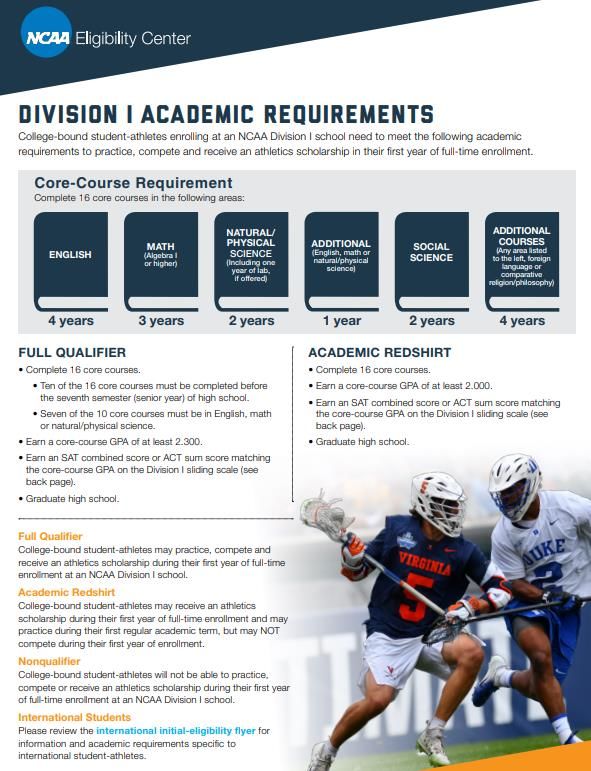
Wood River High School                 Phone: 208-578-5020
     1250 Fox Acres Road                   Counseling Office Phone: 208-578-5024
       Hailey, ID 83333                    Counseling Office Fax: 208-578-5122

                             TABLE OF CONTENTS
    Principal Welcome                                           3
    High School Profile/Graduation Requirements                 4
    WRHS Information                                            5-7
    Advanced Opportunities                                      8
    NCAA Eligibility Requirements                               9-13
    Daily Schedule                                              14
    COURSE OFFERINGS
    Academic Support                                            15
    Architecture/Engineering                                    16-17
    Art/Ceramics                                                17-18
    Business, Finance, Media                                    19-21
    Communications                                              22
    Dual Immersion                                              23-24
    Electives                                                   25
    English                                                     26-29
    Family and Consumer Science                                 30
    Health                                                      31
    Information Technology                                      31-32
    Mathematics                                                 33-36
    Medical and Health Professions                              37-38
    Music – Band, Choir, Orchestra                              39-41
    Performing Arts                                             42
    Physical Education                                          43
    Residential Construction                                    44
    Science                                                     45-47
    Social Sciences                                             48-51
    World Languages                                             52-55
    Career and Technical Education                              56-57
    Post-Secondary/College Entrance Information                 58
    Career Fields & Career Clusters                             59-60
    College Testing Information                                 61
    Four Year Plan/Registration Form                            62-63
    Electives Selection Forms                                   64-65

2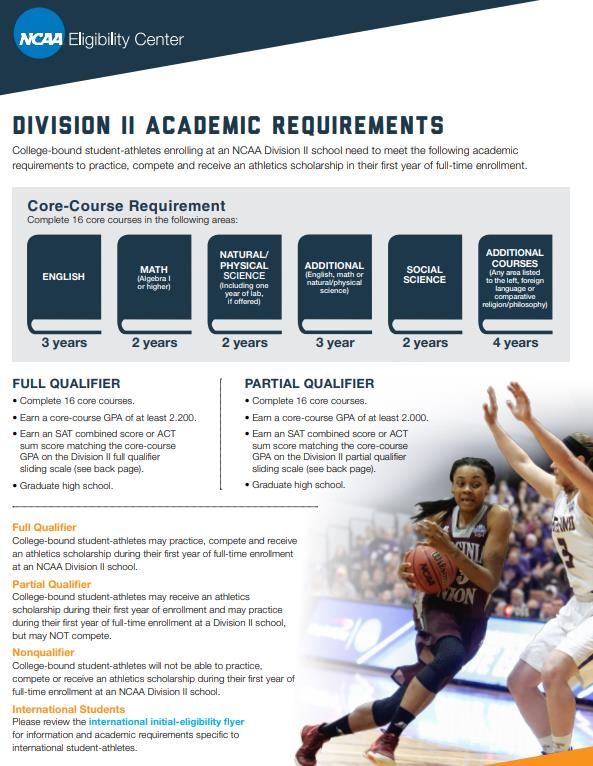
Spring 2020

Wood River High School Students and Parents,

Wood River High School faculty and staff are excited to welcome you and look forward to helping
you grow, academically and socially, in the upcoming year. To do this, we begin with developing a
schedule for our students that reflect strong academic rigor, while seeking to inspire and engage
learning in an environment of genuine growth and development. The WRHS Staff is focused on
building positive relationships with students, developing relevancy and increasing rigor for every
student.
So, what should you expect from WRHS? I’ll answer that with three questions every student (and
parent) should ask:
           1. What am I learning?
           2. Why am I learning this?
           3. How will I know when I have learned it?
These questions are essential in defining Student Engagement, and our teachers continue to review
and upgrade curriculum so these questions are at the forefront of learning at WRHS. We encourage
every parent to use these questions when talking to their child. Equally, we encourage parents to ask
these questions with teachers to get involved in the learning process.
In the following pages, our Planning Guide provides you with the information needed to select
courses for next year. Please pay close attention to prerequisites and course descriptions in order to
make the best choices for the upcoming school year. All students will be scheduled by computer and
will be able to pick up their final schedules at registration in August. Our administration and
counselors work together to ensure students have classes that not only meet graduation
requirements, but also accommodates the multitude of activities in which our students participate.
Because of this, it is critical that you identify alternate class choices in the event a selection is not
available.
We look forward to working with you next year and your classes reflect your commitment to
achievement. We also know that students who choose to participate in some form of extracurricular
activity are more successful in their schoolwork and graduate at a much higher rate than those
students who do not find a team or activity to join. Whether it is a sport, a club, drama or debate, get
involved and take ownership of your own learning.

                                                                Mr. John Pearce
                                                                Principal

3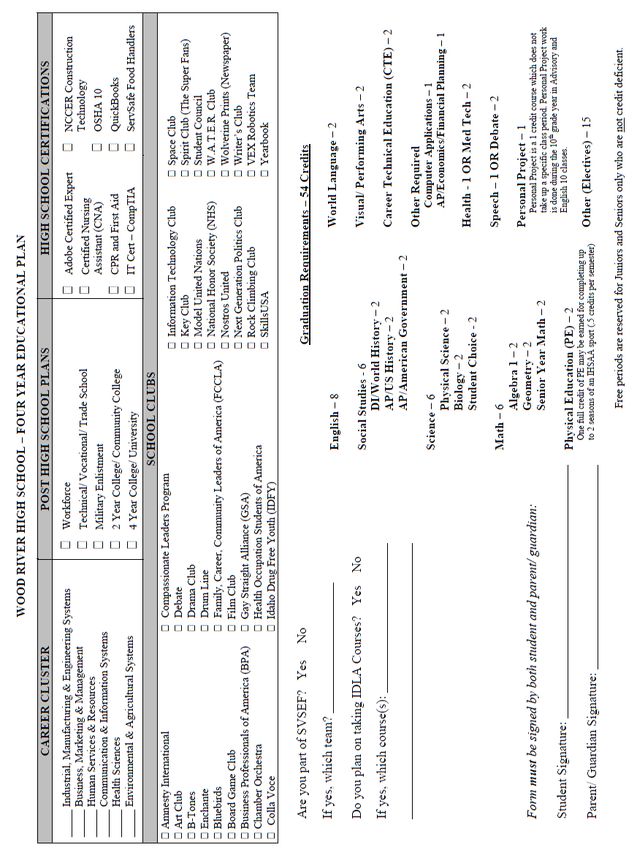
High School Profile
Wood River High School is a comprehensive, four-year public school serving the students of Blaine
County. WRHS is accredited through the Northwest Association of Accredited Schools.
School Year: The school year consists of two semesters, eighty-five days each. Each class is awarded
one semester credit, which is equal to ½ a Carnegie unit.
 Principal: John Pearce                           Bookkeeper: Elizabeth Zellers
 Assistant Principals:                            Counselors:
            Julia Grafft (9th/10th Grade)                  Jeff Ford (A-Go)
            Keith Nelson (11th/12th Grade)                 Amanda LaChance (Gr-Pa)
 Athletic Director: Kevin Stilling                         Debbie Greenberg (Pe-Z)
 Secretary: Katrina Kolman                        College Counselors: Liz Clark (A-G)
 Attendance Secretary: Kim Richards                                    Kristen Swafford (H-Z)
 Registrar: Alyssa Wilson                         Social Worker: Julie Carney
                                                  School Nurse: Kathie Gouley

                                    Graduation Requirements
                        English                                         8
                        Science                                         6
                        World History                                   2
                        Math*                                           6
                        US History                                      2
                        Am Gov’t                                        2
                        Personal Project                                1
                        Economics                                       1
                        CTE: Computer Applications + 2                  3
                        Health*                                         1
                        PE*                                             2
                        Speech*                                         1
                        Humanities: 2 World Languages & 2               4
                        Visual/Performing Arts
                        Electives                                          15
                          Total                                            54
    Civics Test and College Admissions Test (ACT or SAT) must be take prior to education.
    *Passing Algebra I and Geometry are required for graduation.
    *Two credits of math are required in the 12th grade.
    *Two credits of Debate will fulfill the speech requirement.
    *Medical Technology A & B will fulfill the Health requirement.
    *Wood River High School requires two PE class credits as a graduation requirement. A student athlete
    may satisfy a maximum of one of the required two PE credits by participating in IHSAA
    sporting activities. One-half PE credit will be issued after the completion of each sport season if the
    student meets the following minimum criteria:
    1) Completes the sport season in good standing and receives a Freshman, Junior Varsity or
        Varsity certificate.
    2) Attends 90% of scheduled events (including scheduled practices and formal competitions).

4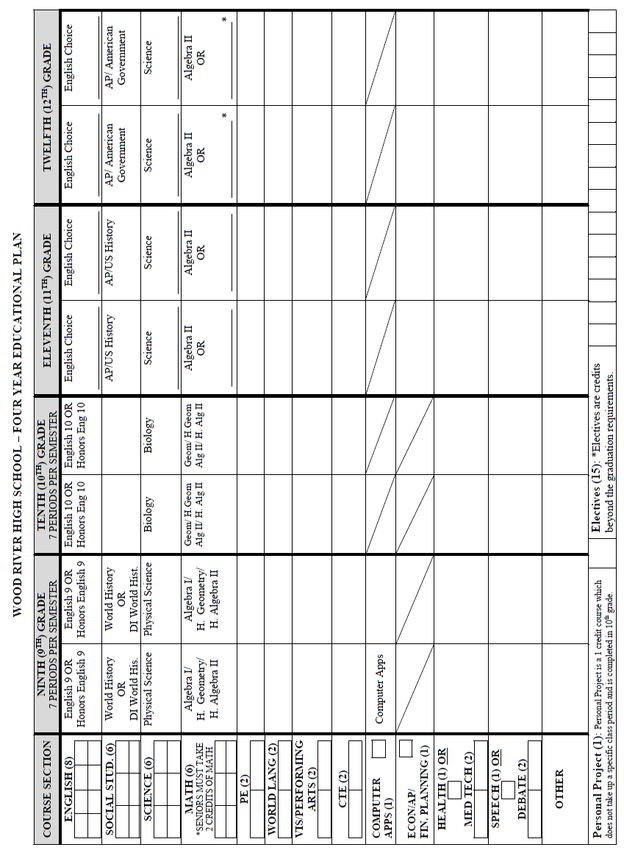
State Tests
All 9th & 10th grade students will take the ISAT English Language Arts and Math tests in the spring.
Students in the 11th grade must take the ISAT Science test and the state-required college entrance exam (ACT
or SAT). Students also must take and pass the Civics Test prior to graduation. Specific graduation
requirements and proficiency levels will be available in the counseling office.
Grade Placement
In order to move to the next grade level, a student must successfully complete the following credits for
placement:
12th Grade: 38 credits 11th Grade: 24 credits 10th Grade: 10 credits
Registration times will be made according to grade placement. Freshman and sophomores will not have free
periods.
Personal Project – Fulfills State Senior Project Requirement
Personal Project allows students to expand their knowledge base and apply the new knowledge to a
project. Near the end of the course, students will present their project activities and expanded learning
to a panel of teachers. Traditionally done sophomore year of high school, transfer students or any
other student who has not completed Personal Project by the end of sophomore year will
automatically be enrolled until completed.
Grading Scale
Grades Unweighted GPA Points Weighted GPA Points
A = 100-90 4.0 5.0
B = 89-80 3.0 4.0
C = 79-70 2.0 3.0
D = 69-60 1.0 2.0
F = 59-below 0.0 0.0
I = Incomplete
IDLA Registration Process
Idaho Digital Learning Academy (IDLA) is a state-sponsored, accredited, online school created to
provide students with greater access to a wide variety of courses taught by highly qualified
faculty.
IDLA works in partnership with Idaho school districts to offer online courses to students. This increases
access and equity for students statewide.
In order to sign up for an Idaho Digital Learning course, students must be enrolled with the local school
and have completed all necessary prerequisites for the class prior to enrollment. To enroll in an IDLA
course, students must first meet with their counselor to determine if they qualify for this option. Parent
approval is also required.
Credit for an IDLA course is granted through the local school of any grade and credits students earned.
These grades and credits will be part of a student’s official transcript.
Fees are $75 per class payable online to IDLA after registration, prior to the start of class. If a student is
enrolled in six academic classes, he/she can use Advanced Opportunities funds to pay for the course. If a
student fails to pass an IDLA course which is funded by Advanced Opportunities funds, the student will
not have access to additional Advanced Opportunities funds until he/she has successfully passed an IDLA
course.
For additional information and a list of available classes and session dates, please see assigned counselor.
5
Incomplete Grades
Students who receive an “INC” (Incomplete) on their grade report for a semester will be responsible to
clear up incomplete grades with their teachers. Incomplete grades not resolved by the end of the next
semester will result in an F.
Honor Roll
Honor roll will be calculated on the day that report cards are printed after the end of the semester. No
changes will be made to the published list after that date. Any student who has an incomplete at that time
will not be added to the honor roll. Students must have five 1-credit classes and a weighted GPA of 3.25 or
higher to be eligible. IDLA classes that have not been completed will not be counted.
National Honor Society
This organization recognizes student's excellence in scholarship, character, leadership, and service. Each
member is required to maintain a cumulative grade point average of 3.5 or higher as well as meet
community service requirements. Students may be asked to participate during sophomore, junior, and/or
senior year.
Valedictorian and Salutatorian Designation
Graduating Class of 2021
Valedictorian and Salutatorian will be determined by overall GPA. Grades from advanced placement
courses will be factored into the GPA using a 5.0 grading scale and calculated into the overall
determination.
All other graduating classes
Student academic achievement will be recognized during graduation using the Laude System. Each
student in the Laude system will receive a cord and notification in the graduation program.
Magna Cum Laude – 4.0 +
Summa Cum Laude – 3.8 – 3.99
With Honors – 3.5 – 3.79
Class Changes and Withdrawal Procedures
Class changes will be made on or before the first week of the semester. After that, any class changes or
drops may result in a grade of W/F (withdraw/fail) and be factored into the student’s GPA. All changes
require counselor, teacher, administrator, and parent approval. Class changes after the first week of the
semester will be made only if one of the following is applicable:
Improper Placement
Previous Class Failure
Earned online credit for the class being changed over summer
Has not met class pre-requisites
Incomplete schedule/ missing classes
Remediation course required
Student is at a credit deficit
A change is needed to meet graduation requirements
Student is requesting an IDLA class (W/F)
Extenuating circumstances at the determination of administration
Movement from AP/Honors to regular classes must be initiated by student and/or teacher with normal
approval (counselor, administrator, parent, etc and both teachers) until the end of the first month of the
semester.
6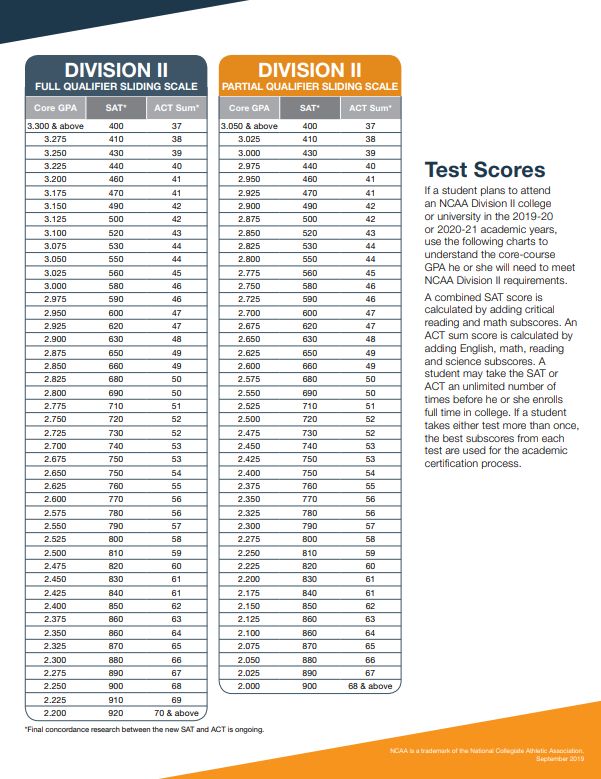
Early Completion
In accordance with Board Policy 616: If a student is considering early completion of graduation
requirements from Wood River High School, the student must meet with his/her counselor for
application and deadline dates. The Blaine County School District No. 61 board will permit early
graduation under unusual and unique circumstances for students who would benefit from early
graduation. Any high school student who completes the required number of credits and other exiting
standards required by both the state and the district and elects to graduate prior to completing eight (8)
semesters or twelve (12) trimesters of high school work must have the endorsement of the Principal. It is
recommended that planning for early graduation begin during the student’s freshman year.

The student and parent/guardian will meet with the counselor, who will review the student’s transcript
and counsel the student. The counselor will determine, based on credits earned, whether the student
will complete the required number of semester credits and core of instruction prior to the proposed
early graduation date.

The counselor will inform the principal of the request and supply all pertinent information. The principal
will determine whether to approve or deny the early graduation request. Early graduates may participate
in the regular spring commencement ceremony.

Schoology Access
Parents can access their students’ attendance, grades, etc. by logging into Schoology found on
www.blaineschools.org. Password and user name is obtained by applying online or from school
secretaries. For more information, please contact Wood River High School at 208-578-5020.

Scoir Access
Scoir is WRHS’s college application management system. All students will register for a Scoir
account and parents will be invited to also create a Scoir account so they can view and participate
in their student’s college planning process. Scoir has replaced Naviance for purposes of sending
transcripts, letters of recommendation, and other school-based supplemental materials to colleges.
It provides a means for students to manage their college list, track due dates, and know which
materials colleges require. In the 9th – 11th grades, students will use Scoir to track their school and
community involvements, as well as search for potential jobs/careers of interest for the future.
Scoir registration will take place in Advisory classes and can also be done in the College & Career
offices. If you have questions about this, please contact the College & Career Office at 208-578-
5029.
Transfer Courses
Official Transcripts will be reviewed and credit and grades will be granted based on alignment with current
curriculum.

Pre-registration Process
Students will meet as groups with counselors and Advisory teachers to review graduation
requirements and instruction for their four-year graduation plan and post high school options.
Students and parents should review the transcript and requirements when selecting courses for the
upcoming school year.

7

Advanced Opportunities
Fast Forward
The Fast Forward program provides every student attending an Idaho public school an allocation of
$4,125.00 to use towards Advanced Opportunities in grades 7-12. The program was expanded by the
Legislature in 2016 through the passing of House Bill 458. The fund can be used for:
Overload Courses: An overload course is a high school level course that is taken in excess of the
student’s regular school day. These courses are offered online, during the summertime, and after
school. In the event that student incurs a cost for such courses, the Fast Forward program can pay up
to $225.00 for the cost of the course. Overload courses must be above and beyond the full course
load offered by the student’s local school.
Dual Credits: Dual credit are courses taken by high school students that are transcribed on their high
school and college transcripts. The Fast Forward program can pay for up to $75.00 per credit, and in
most cases, the cost of these credits is $65.00 each. Student who fail dual credit courses cannot
access additional Fast Forward funds until he/she successfully passes a dual credit course. Dual Credit
courses can also be taken online, by virtual conferencing, or in some cases students can go directly to
the college/university campus. More information on specific Idaho colleges and universities can be
found in the Links tab.
Exams: Student can utilize Fast Forward funds to pay for a variety of college-credit bearing or
professional technical exams. These include Advanced Placement (AP), International Baccalaureate
(IB), College Level Examination Program (CLEP), or Career & Technical Education (CTE) exams. A full
list of qualifying exams is available in the Resource Files. If a student withdraws from an AP course,
and therefore the AP exam, after the designated deadline, he or she will be required to refund
Wood River High School fees associated with this exam.
Early Graduation Scholarship: Early Graduation Scholarships are available for students who graduate at
least one full year early. These scholarships are equal to 35% of the Average Daily Attendance (ADA) for
a given school year. This equates to roughly $1,500.00.
Scholarships can be used at Idaho public post-secondary institutions. The awarded amount will double
for students who graduate two years early and will triple for students who graduate three years early. If
a student elects not to attend a college or university immediately after high school, they will have up to
28 months to utilize the scholarship before it expires.
8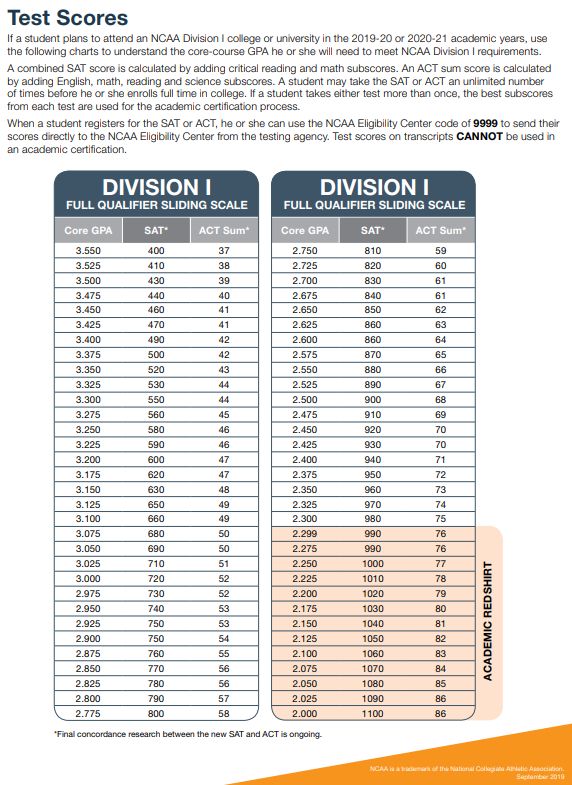
9
10
11
12
NCAA requires the equivalent of 32 WRHS credits for athletic eligibility. The following is a list of current NCAA-
approved courses at WRHS:

                English
                  English 9 (and Honors), 10 (and Honors), 11, 12
                  Speech & Adaptive Speech
                  Debate & Advanced Debate (1 unit= 2 WRHS credits, total can be counted for debate)
                  AP English Language & Composition
                  AP English Literature
                  College English (101 & 175)

                Mathematics
                  Algebra 1
                  Algebra 2
                  Geometry
                  Honors Algebra 2
                  Honors Geometry
                  Pre-Calculus
                  College Algebra
                  AP Statistics
                  AP Calculus AB & AP Calculus BC

                Natural/Physical Sciences
                  Physical Science
                  AP Biology & Biology
                  AP Physics I/II & Applied Physics
                  AP Environmental Science
                  Applied Chemistry & Chemistry
                  Electives: Astronomy, Environmental Science, Project-Based Science, Zoology

                Social Sciences
                  AP American Government & American Government
                  AP US History & US History
                  World History & DI World History
                  Economics
                  AP Macroeconomics & AP Microeconomics
                  AP Psychology
                  Sociology & Psychology
                  War in the Modern World
                  DI Hispanic Culture and Society
                  DI Human Rights and Social Order

                World Languages
                  French 1, 2, 3, 4, 5, 6
                  Spanish 1, 2, 3, 4, 5
                  AP Spanish Language

            Courses NOT on this list have not been approved for NCAA eligibility purposes.
                If you have additional questions, talk with your counselor and visit the NCAA website at:
                              http://web1.ncaa.org/ECWR2/NCAA_EMS/NCAA.jsp

13
2020-2021 TENTATIVE DAILY SCHEDULE 14
Academic Support

GATE Pass
       Open to:        9, 10, 11, 12
       Credit:         1 Elective Credit – Pass/Fail Grade
       Prerequisite:   GATE identified students or former GRIIT students OR any student concurrently
                       enrolled in AP, honors, dual credit or accelerated track, 3.5 GPA minimum
                       recommended for non-GATE students
       Content:        This class was designed to provide social, emotional, and academic support for
                       students enrolled in and familiar with rigorous course loads. Students in this class have
                       taken AP/advanced courses and understand the challenge and work commitment
                       required to be successful in them. It is also a “homeroom” of sorts for GATE students
                       to get connected with the GATE Coordinator - no GPA minimum or prior AP
                       experience is required for GATE students. Study time, collaboration with like-minded
                       peers, and one-on-one mentoring with GATE Coordinator happens in this course.
                       Common topics discussed include growth mindset, motivation, perfectionism, stress
                       management, underachievement, and organizational strategies. Connections to school
                       resources such as college & career counseling, test preparation, & social workers are
                       also facilitated.

G.R.I.I.T.: Growing Rigor, Initiative, Integrity and Tenacity
       Open to:        9, 10, 11, 12
       Credit:         1 Elective Credit – Pass/Fail Grade
       Prerequisite:   Concurrent enrollment in AP, honors, dual credit, or advanced opportunity class. OR
                       Counselor/teacher recommendation for other “challenge” circumstances. Conversation
                       with GRIIT teacher required
       Content:        This class was designed to provide social, emotional, and academic support for
                       advanced opportunity students taking rigorous course loads for the first time or who
                       were enrolled in GRIIT formerly and wish to continue their advanced courses.
                       Students in this class want to challenge themselves and are willing to work hard, but
                       may feel hesitant about venturing into such rigorous coursework. This class provides a
                       safe, encouraging environment with ample study time for advanced classes,
                       collaboration with like-minded peers, and one-on-one mentoring with the GRIIT
                       teacher. Group lessons and guest speakers once a week on topics such as growth
                       mindset, self-regulation, self-advocacy, and finding purpose. A blend of study skills
                       and character development are explicitly taught. Connections to school and
                       community resources such as college & career counseling, test preparation, and social
                       workers are also facilitated.

PASS
       Open to:        9, 10, 11, 12
       Credit:         1 Elective Credit – Pass/Fail Grade
       Prerequisite:   None
       Content:        This study hall course is designed for students who need extra academic support
                       and/or who need to complete Personal Project.

15
Architecture & Engineering Academy
Fundamentals of Engineering
Open to: 9, 10, 11, 12
Credit: 1 CTE Credit
Content: This course prepares students to understand and apply technological concepts and
processes that are the cornerstone for the high school technology program. Group and
individual activities engage students in creating ideas, developing innovations, and
engineering practical solutions. Technology content, resources, and
laboratory/classroom activities apply student applications of science, mathematics,
and other school subjects in authentic situations.
Engineering I, II, III
Open to: 9, 10, 11, 12
Credit: 1 CTE Credit
Prerequisite: Fundamentals of Engineering
Content: Engineering scope, content, and professional practices are presented through practical
applications. Students in engineering teams apply technology, science, and
mathematics concepts and skills to solve engineering design problems and innovate
designs. Students research, develop, test, and analyze engineering designs using criteria
such as design effectiveness, public safety, human factors, and ethics.
Architecture I
Open to: 9, 10, 11, 12
Credit: 1 CTE Credit
Prerequisite: Fundamentals of Engineering
Content: Architecture is an art and a creative endeavor, and students will learn the design
principles of architecture. Students will use the design process to create original ideas
and models of their own and create a portfolio of their work.
Architecture II
Open to: 10, 11, 12
Credit: 1 CTE Credit
Prerequisite: Architecture I
Content: Students will design a sustainable neighborhood and build a model for it. Green
Regulation is impacting and will continue to impact design decisions as it relates to
energy performance, material selection and manufacturer location.
Architecture III
Open to: 10, 11, 12
Credit: 1 CTE Credit
Prerequisite: Architecture II
Content: Students will create an analytique “architectural art” of a structure of their choice and
design and build a model for a home using sustainable and green design concepts.
16Robotics Engineering
Open to: 9, 10, 11, 12
Credit: 1 CTE Credit
Prerequisite: Fundamentals of Engineering
Content: This is a course in the design, use and technology of robots as used in competition
robotics. Students will design robots using mechanical devices and explore computer
controlled applications. Electronic components and electro-mechanical devices will be
studied and used in model development. Basic programming languages will be
introduced. The students will be working in teams of 3 to 5 students for the whole
semester designing, building, programming, solid modeling and documenting the
process of creating a robot for competitions. Students are expected to work as a team
to accomplish all of these tasks as a group. All students are expected to travel to six
tournaments during the winter season.
Art/Ceramics
Intro to Art
Open to: 9, 10, 11, 12
Credit: 1 Humanities/Visual Arts Credit
Content: This class is designed for those who have not yet taken a high school art class. The focus is on
building drawing and painting skills while developing a strong understanding of the concepts
of art and design. Students will generate unique, original works of art with skills acquired
through this course.
Studio Art
Open to: 9, 10, 11, 12
Credit: 1 Humanities/Visual Arts Credit
Prerequisite: Suggested course – Intro to Art
Content: Studio Art is designed for students who want to explore their creative artistic talents. In this
class students will continue developing their skills working with a variety of different drawing
and painting media. Projects are designed to encourage students to be original, insightful and
innovative while discovering their inner voice working through genre such as drawing, painting
collage, printmaking and mixed media. Assignments vary each semester thus enabling
students to take this class more than once.
Pre-AP Studio Art
Open to: 10, 11, 12
Credit: 1 year course - 2 Humanities/Visual Arts Credits
Prerequisite: Highly recommended courses – Intro to Art and Studio Art
Content: Pre-AP Studio Art is an advanced course for students who have a strong skill set and a clear
artistic vision. Due to the quality and amount of pieces required for the AP College Board Studio
Art portfolio ‘exam’, students have the option of completing the class over 2 years beginning
with PreAP the first year, followed by AP Studio Art the second. The emphasis of the class is to
develop a significant body of art that focuses on a sustained investigation of a specific concept
that is student generated.
17AP Studio Art
Open to: 11, 12
Credit: 1 Humanities/Visual Arts Credits per semester
Prerequisite: High recommended course – Pre-AP Studio Art
Content: AP Studio Art is fast-paced class designed for serious students who strive to perform at a
college level. The focus of this class is to challenge one’s art making abilities through the
completion of a series of original artwork, either 2-D or 3-D, that reflects on the student’s
personal style. Students must be focused, self-motivated and dedicated to the
advancement of their art making skills and concepts.
Ceramics I
Open to: 9, 10, 11, 12
Credit: 1 Humanities/Visual Arts Credit
Content: Students will learn the vocabulary of a clay studio, as well as learn hand-building and glazing
techniques. Students will use both additive and subtractive methods of construction, creating
both functional and sculptural pieces. As time allows, students may have the opportunity to
learn to throw on the potter’s wheel.
Ceramics II
Open to: 9, 10, 11, 12
Credit: 1 Humanities/Visual Arts Credit
Prerequisite: Ceramics I
Content: Ceramics II is an extension of Ceramics I. It is designed for students with a solid background in
constructing with clay and/or wheel throwing skills. Students will engage in projects that
challenge and refine their creative capacity and technical ability.
18Business, Finance and Media Academy
Computer Applications
Open to: 9, 10
Credit: 1 CTE Credit (Required for freshmen)
Content: The focus of this course is to present advanced computer technologies to students that will
help prepare them for the rest of high school and beyond. Technologies include – Digital
photography and video, cloud computing, and a sampling of other evolving computer
technologies. In addition, this course provides extensive instruction as well as certification
opportunities in Microsoft Office 2016—Word, Excel and PowerPoint.
Graphic Design and Page Layout
Open to: 9, 10, 11, 12
Credit: 1 CTE/Visual Art Credit
Content: This course is designed to acquaint students with the principles and terminology associated
with graphic design, page layout and digital photography. Emerging graphics technology and
digital photography will be used extensively. Students will receive training and complete
projects in graphic design, digital photography, brochures, announcements, newsletters,
flyers, and newspaper and magazine layouts. Adobe Creative Cloud and other software will
be used. This class is highly suggested for students wishing to be in the Yearbook class.
Business Computer Applications
Open to: 9, 10, 11, 12
Credit: 1 CTE Credit – 3 Dual Credits available
Prerequisite: Computer Applications
Content: This is a project-based course covering advanced skills in Microsoft Office 2016. Creating
good job hunting skills such as resume and cover letter writing are included in this
course. Class project examples include: brochures, business cards, budget reports, pivot
tables, database queries, and presentations. Students taking this course may choose the
option of doing Microsoft Office Specialist certifications instead of the dual-credit option if
they choose to at the beginning of the course. This would entail completing a minimum of
three certifications in addition to one they may have certified for in Computer Applications
as a freshman.
CSI equivalent - Information Science and Data Management (BUSA 215)
Financial Planning Economics
Open to: 11, 12
Credit: 1 CTE or Economics Credit – 3 Dual Credits available
This course fulfills the state Economics requirement to graduate from high school.
Content: This course studies personal financial planning and economics. Topics to include: goal
setting, budgeting, tax planning, housing, consumer credit, buying automobiles, insurance
protection, retirement planning, business cycle, investing, scarcity, monetary policy, fiscal
policy, macro/micro economics, supply and demand, industrialization, the U.S. economy
as compared to other economies throughout the world, and many other economics
topics. Projects encourage students to apply course concepts to their own situations.
CSI equivalent – Financial Planning (FINA-102)
19Business Management
Open to: 10, 11, 12
Credit: 1 CTE Credit
Content: In this course, students are introduced to characteristics of entrepreneurship, determine
what type of person makes a good entrepreneur and how to become a successful
entrepreneur. The course is designed to introduce students to essential business and
marketing competencies required for business operations. Units of instruction include
general business and management principles, leadership, salesmanship, marketing/
entrepreneurship, human resources, public speaking, and the use of accounting
information for making business decisions. A business plan is the final project.
Digital Photography and Portfolio
Open to: 9, 10, 11, 12
Credit: 1 CTE or Visual Arts Credit
Content: In today‘s competitive world, it is essential that individuals market themselves through a
digital display of their work. Digital Photography and Portfolios provides a variety of
learning opportunities. These include expanding the students’ knowledge of the
fundamentals of digital photography, digital video, web design, interactive media, portfolio
building and the use of online tools and programs. Various methods will be explored for
displaying student work with the intention of self-promotion (both digital and print media
will be utilized). This class offers skills that will help you be successful in other classes such
as Personal Project, English, Speech, etc. This class will help students market themselves
when applying for a job or college as Digital Photography/Digital Portfolios offers skills that
can be used in many different types of 21st Century work environments.
Yearbook Publications
Open to: 9, 10, 11, 12
Credit: 1 CTE or Visual Arts Credit
Content: Students will publish and market the yearbook. The course will focus on allowing
students to gain experience in various activities including photography, computer
layout and design, copywriting, selling and advertising. Ideally students should be
enrolled for two consecutive semesters.
Accounting A: Forensic Accounting & Fraud Investigation
Open to: 10, 11, 12
Credit: 1 CTE Credit
Content: Students will solve financial crimes as part of an investigative team. They will learn to
look for fraud clues in financial statements, identify red flags that indicate fraud,
process evidence from financial crime scene, and spot when someone is lying!
Students will learn the entry-level basics of accounting along the way to finding
interesting and new career opportunities in the forensic accounting field.
Accounting B: Quickbooks Pro
Open to: 10, 11, 12
Credit: 1 CTE Credit
Prerequisite: Accounting A
Content: Learn Intuit’s small business bookkeeping software that works with the same user
friendliness as Quicken. Create and track payable and receivable accounts and
invoices, gather aging information, and create your own budgets and reports on data
using preset of customized business transactions.
20Multimedia
Open to: 9, 10, 11, 12
Credit: 1 CTE or Visual Arts Credit
Content: This course is designed to introduce students to a wide variety of media including
graphics, animations, video, sound, etc. Modern software and applications are
used in the class preparing students for real world opportunities. Students will use
their creativity daily to create multimedia projects that students can be proud of
and take ownership in. Projects are often completed independently and in group
settings.
Video Productions
Open to: 9, 10, 11, 12
Credit: 1 CTE or Visual Arts Credit
Content: This course will introduce students to basic video production techniques. This will
include techniques in storytelling, storyboarding, filming, editing, exporting and file
types, equipment use, and delivery on multiple platforms. Students will get a very
hands-on approach by creating several smaller projects and move to larger scale
projects. This class is a prerequisite for the fast paced environment of Video
Production II which will be geared toward broadcasting the school news.
Video Productions II
Open to: 10, 11, 12
Credit: 1 CTE or Visual Arts Credit
Prerequisite: Video Productions
Content: Students will participate in the production of Wood River High School’s news
program. Intensive video production is required for the class. Students will have
extensive exposure to storyboarding, camera use, editing techniques, and video
structure. Students will explore presenting ideas and formulating stories using audio,
video and other forms of media while meeting the rigorous production deadlines of
the class.
Web Design I
Open to: 9, 10, 11, 12
Credit: 1 CTE or Visual Arts Credit
Content: This course will introduce students to the design, creation, and maintenance of
individual web pages and entire websites. Page creation will range from using
modern software to an introduction to HTML. Graphic editing programs will be used
to prepare graphics for delivery on the web. Animations will be created and used to
further enhance webpages. This is a project based class ranging from smaller
projects to a large scale culminating project.
Web Design II
Open to: 10, 11, 12
Credit: 1 CTE or Visual Arts Credit
Prerequisite: Web Design I
Content: In this class, students continue exploring web development and design, and
expand their skills regarding animation, graphic editing and programming. New
skills will include database interface and relational database management. Students
will expand their knowledge of HTML, CSS, Javascript and SQL to create robust,
interactive, user friendly web pages. This is a project based class ranging from
smaller projects to a large scale culminating project.
21Communications
Speech
Open to: 9, 10, 11, 12
Credit: 1 Speech Credit – Required for Graduation
Content: Speech class emphasizes responsible communication skills to better prepare
students for listening and speaking opportunities in classrooms and the real
world. Students meet the Idaho state guidelines for this required course through
preparing, delivering and evaluating informative, persuasive and manuscript speeches
appropriate to a variety of audiences and for different purposes.
Debate A & B
Open to: 9, 10, 11, 12
Credit: 1 Elective Credit – Completion of both semesters fulfills the speech requirement*
Content: Debate focuses on developing research skills for rational arguments based upon
documented evidence and sound reasoning, speaking clearly and concisely, and
evaluating arguments and evidence from listening to debates. Participation in
team-based events is required as they learn how to impact their world through
communication. *Students who want to earn the Speech credit must compete a
minimum of two tournaments in Debate A and a minimum of three tournaments in
Debate B.
Advanced Debate A & B
Open to: 10, 11, 12
Credit: 1 Elective Credit – Pass/Fail Grade
Prerequisite: Debate A & B
Content: Debate provides the avenue for students to develop critical, lifelong communication
skills. In this advanced debate course students will focus on theory, strategies and
skills to further develop their potential as debaters and communicators. Competition is
a requirement.
22Dual Immersion (DI)
Dual Immersion Course Offerings and Progression
Spanish Courses
Students will enter whichever level they tested into on the 8th grade AAPPL language test or continue in the
progression they started in high school.
DI Humanities Courses
All DI Humanities and electives courses are conducted in Spanish.
Spanish Courses DI Humanities Courses
9th Grade Spanish 5 DI World History
AP Spanish Language and Culture DI Human Rights and Social Order
10th Grade
DI Electives DI Hispanic Culture and Society
11th/12th Grade DI Electives
10th DI Electives
DI Human Rights and Social Order – 1 credit
DI Hispanic Culture and Society – 1 credit
In order to qualify for the following classes a student must pass AP Spanish Language and Culture:
Advanced Spanish Language through Film and Art – 1 credit
Advanced Spanish Language through Modern and Classic Literature – 1 credit
DI Being Bilingual Pays – 1 credit
DI Completion
In order to be acknowledged during graduation as having successfully completed the DI program at WRHS
and wear the DI cord, students must meet the following criteria:
Pass both semesters of AP Spanish Language and Culture
o To get to AP Spanish, students must have passed through the appropriate lower level classes.
Pass at least five semesters of DI Humanities courses (electives count as Humanities credits)
It is important to sustain consistent and continuous study in order to become more proficient in another
language. Therefore, we do NOT recommend skipping years or semesters of language courses.
DI World History
Open to: 9
Credit: 2 World History Credits – Required for Graduation
Content: This is a 2 semester course that is taught to all 9th grade students, but the content is
delivered in Spanish. World History will cover the critical events, people, and themes
of history in both the western and eastern hemispheres. The primary objective of this
course is to develop world citizens through an understanding of world historical
events and world culture.
23DI Human Rights and Social Order
Open to: 10, 11, 12
Credit: 1 Elective Credit
Content: What are your human rights and why are human rights important? This one-
semester course explores the Universal Declaration of Human Rights and current
social issues around the world. Students will discover ways to affect change in their
own lives and pursue social justice.
DI Hispanic Culture and Society
Open to: 10, 11, 12
Credit: 1 Elective Credit
Content: This is a semester long DI elective course where all the content will be delivered in
Spanish. Students will explore the culture and history of various Hispanic
countries/regions in order to have a better understanding of those societies today.
Themes such as music, art customs, daily life, education, and literature may be
included.
Advanced Spanish Language through Film and Art
Open to: 10, 11, 12
Credit: 1 Humanities Credit per semester
Prerequisite: AP Spanish Language and Culture A & B
Content: In this one semester course, students will view Spanish language films and become
familiar with the works of various famous Spanish and Latin American artists as they
expand vocabulary, develop grammar, and further their proficiency in reading, writing,
listening, and speaking. Both the films and art will be used as a basis for classroom
discussions, debates, and writing activities.
Advanced Spanish Language through Modern and Classic Literature
Open to: 10, 11, 12
Credit: 1 Humanities Credit per semester
Prerequisite: AP Spanish Language and Culture A & B
Content: In this one semester course, students will read and analyze a variety of texts written by
authors from Spain and Latin America. The selections will promote cultural discussions
and provide opportunities to expand vocabulary and grammar while simultaneously
improving proficiency in reading, writing, listening, and speaking skills.
DI Being Bilingual Pays
Open to: 12
Credit: 1 Elective Credit
Prerequisite: AP Spanish Language
Content: Put your bilingualism to use and save money. Whether heading off to college or to the
workforce, this course could earn you college credit for language skills and launch you
into a bilingual career. Course work includes preparation for the Spanish CLEP exam
(up to 16 college credits) and Idaho Court Interpreter Training & Certification Program.
24Electives
Leadership (Student Council)
Open to: 9, 10, 11, 12
Credit: 1 Elective Credit
Content: Elected Student Council Officers are required to enroll in this course, per the Constitution of
WRHS. The purpose of this course is to teach leadership skills and offer the students realistic
opportunities in which they can put these to work. Students will practice and share SEL
lessons and activities in class and with other Advisories. An essential part of this class is
“hands on, minds on” experiential learning. While the students are learning content, they are
working on school and community projects that make the theoretical material relevant.
Peer Tutor
Open to: 11, 12
Credit: 1 Elective Credit
Content: Students will support their peers in subject-specific courses. Students will be expected to
tutor their peers during the assigned class.
Special Services Peer Tutor
Open to: 11, 12
Credit: 1 Elective Credit
Content: Students will support Special Services by working with special needs peers in subject-
specific courses. Students will be trained to serve as a Special Services Peer Tutor.
Work-Based Learning
Open to: 11, 12
Credit: 1 Elective Credit
Content: Students can sign up for one class of Work-Based Learning (either 1st or 7th hour). Proof
of employment must be provided within five days of the start of the semester. To earn
one elective credit, a student must work an average of 10 hours per week. Students
must have proof of employment, must remain employed for the whole semester, and
provide a monthly pay stub. Failure to provide any of the above within five days of each
month will result in being dropped from the class, another class added, and no WBL
credit will be given. If driving to work, students must have a valid driver’s license and
proof of insurance. (See Registrar in Counseling Office for more information.)
25English
9th Grade 10th Grade 11th Grade 12th Grade
English 9 A & B English 10 A & B 11th/12th Offerings 11th/12th Offerings
AP Language & AP Language &
Honors English 9 Honors English 10
Composition Composition
A&B A&B
A&B A&B
College English 101 &
Creative Writing Creative Writing Creative Writing
175
AP English Literature
Mythology Mythology Mythology
A&B
Creative Writing
Mythology
English 9 A & B
Open to: 9
Credit: 1 English credit per semester
Content: Students will read novels, short stories, plays, and poetry to develop a sense of
historical and scientific context and to acquire knowledge of applications to their
own lives. Written work includes writing paragraphs and essays, as well as an
introduction to research writing.
Honors English 9 A & B
Open to: 9
Credit: 1 English credit per semester
Prerequisite: Proficient on STAR Reading
Content: Students will read novels, short stories, plays, and poetry to develop a sense of
historical and scientific context and to acquire knowledge of applications to their
own lives. Written work includes writing paragraphs and essays, as well as an
introduction to research writing. This course is designed to introduce the rigor of AP
and focus more on depth & complexity in the content area.
English 10 A & B
Open to: 10
Credit: 1 English credit per semester
Content: Students will study world literature focusing on the individual’s decision-making,
relationships with others, and role in society. Students will improve their writing
fluency through various written assignments (paragraphs, academic essays, responses
to literature and literary analyses). They will improve their vocabulary and continue
knowledge of English grammar.
26Honors English 10 A & B
Open to: 10
Credit: 1 English credit per semester
Prerequisite: Proficient on STAR Reading
Content: Students will study world literature focusing on the individual’s decision- making,
relationships with others, and role in society. Students will improve their writing
fluency through various written assignments (paragraphs, academic essays, responses
to literature and literary analyses). They will improve their vocabulary and continue
knowledge of English grammar. This course is designed to introduce the rigor of AP
and focus more on depth & complexity in the content area.
American Literature
Open to: 11, 12
Credit: 1 English credit per semester
Content: Students will study American literature from its foundation to the present while
expanding and improving their writing skills by writing for different academic and
business situations. Students will examine their personal beliefs and argue their
opinions in writing using literature as a basis for support.
British Literature
Open to: 11, 12
Credit: 1 English credit per semester
Content: Students will study British literature while expanding on their academic writing skills,
and write for academic and business settings. Students will also examine their personal
beliefs and argue their opinions in writing using literature as a basis for support.
Latinx Literature
Open to: 11, 12
Credit: 1 English credit per semester
Content: Students will study Latinx literature from its foundation to the present, while expanding
on their academic writing skills, and write for academic and business settings. Students
will also examine their personal beliefs and argue their opinions in writing using
literature as a basis for support.
Science Fiction and Dystopian Literature
Open to: 11, 12
Credit: 1 English credit per semester
Content: Students will study science fiction and dystopian literature from its foundation to the
present, while expanding on their academic writing skills, and write for academic and
business settings. Students will also examine their personal beliefs and argue their
opinions in writing using literature as a basis for support.
AP English Language and Composition A & B
Open to: 11, 12
Credit: 1 English credit per semester
Prerequisite: It is strongly recommended that students have earned A’s or B’s in all previous English
classes.
Content: Students will read and analyze a variety of published essays and study rhetorical devices
used by published authors. Students will learn to effectively communicate through their
writing, demonstrating college level writing skills. The course focuses on non-fictional
prose, but students will also read selections of American literature. This course prepares
students for the AP Language and Composition exam in May.
27AP English Literature A & B
Open to: 12
Credit: 1 English credit per semester
Prerequisite: Students who have passed English 11 or AP Language and Composition. It is
recommended that students earned A’s or B’s in all previous English classes.
Content: Students who have passed English 11 or AP Language and Composition. It is
recommended that students earned A’s or B’s in all previous English classes. This
course engages students in the careful reading and critical analysis of literature.
Through the close reading of selected texts, students deepen their understanding
of the ways writers use language to provide both meaning and pleasure for their
readers. This course prepares students for the AP exam in May.
College English
Open to: 12
Credit: 1 English credit per semester – Dual Credit available
Prerequisite: AP Language and Composition or 11th English A & B
Content: College English 101: Workshop on strategies for generating ideas for writing, for
planning and organizing material, and for revising and editing; intended to prepare
students for the demands of college writing. The course will introduce research
techniques, documentation styles, and argumentative strategies. Emphasis is placed on
analyzing data and incorporating research findings into documented argumentative
essays. Upon completion, students should be able to summarize, paraphrase, interpret,
and synthesize information from primary and secondary sources using standard
research format and style. If taking the dual credit option, three college English 101
credits can be earned.
College English 175: Introduction to the terminology, techniques, and formal
characteristics of literary genres with an emphasis on literary analysis. The overall
course will focus on writing that involves literature-based research and documentation.
Emphasis is placed on critical reading and thinking and the analysis and interpretation of
prose, poetry, and drama: plot, characterization, theme, cultural context, etc. Upon
completion, students should be able to construct mechanically sound, documented
essays and research papers that analyze and respond to literary works. If taking the dual
credit option, three college English 175 credits can be earned.
Mythology
Open to: 9, 10, 11, 12
Credit: 1 Elective Credit
Content: In this course, students will study the roots and philosophies of classical and native cultures.
This class may be taken more than once in a school year.
Creative Writing
Open to: 9, 10, 11, 12
Credit: 1 Elective Credit
Content: This course will provide students intensive exposure to, and practice with, the crafting of
fiction and non-fiction. This class may be taken more than once in a school year.
28OTHER 11TH/12TH ENGLISH OFFERINGS THAT MAY BE OFFERED IN THE FUTURE
Diversity and Multicultural Literature
Open to: 11, 12
Credit: 1 English credit per semester
Content: Students will study literature from many different backgrounds, cultures, and countries
while expanding on their academic writing skills, and write for academic and business
settings. Students will also examine their personal beliefs and argue their opinions in
writing using literature as a basis for support.
Genres in Literature
Open to: 11, 12
Credit: 1 English credit per semester
Content: Students will study a variety of genres, for example, drama, adventure, mystery, fantasy,
science fiction, memoir, while expanding on their academic writing skills, and write for
academic and business settings. Students will also examine their personal beliefs and
argue their opinions in writing using literature as a basis for support.
Young Adult Classic Comparative
Open to: 11, 12
Credit: 1 English credit per semester
Content: Students will study young adult literature and how it compares to the classics. Students
will also expand on their academic writing skills, and write for academic and business
settings. Students will also examine their personal beliefs and argue their opinions in
writing using literature as a basis for support.
Literature of War and Politics
Open to: 11, 12
Credit: 1 English credit per semester
Content: Students will study literature of war and politics from its foundation to the present,
while expanding on their academic writing skills, and write for academic and business
settings. Students will also examine their personal beliefs and argue their opinions in
writing using literature as a basis for support.
29Family and Consumer Science
~ Culinary Arts Academy ~
Teen Living
Open to: 9
Credit: 1 CTE Credit
Content: This course will focus in the areas of: families, teen issues, relationships, nutrition and
cooking, basic sewing skills, money, career choices and leadership skills. This is a great
course to start towards the Culinary Arts Academy. Students have a choice to be involved in
FCCLA (Family, Career and Community Leaders of America).
Nutrition and Foods
Open to: 10, 11, 12
Credit: 1 CTE Credit
Content: This course emphasizes the areas of: basic food preparation, food safety, meal
management, nutrition, personal lifestyles, consumer skills, and career options. Food
demonstration is a course requirement. This course is a prerequisite Culinary Arts I.
Students have a choice to be involved in FCCLA.
Fashion and Sewing
Open to: 9, 10, 11, 12
Credit: 1 CTE Credit
Content: Fashion and Sewing exposes students to sewing skills involving the usage of a sewing
machine, serger, embroidery machine, and hand sewing. Students can be creative with
fashion trends, recycle and redesign, project runway, knitting, crocheting, and mending.
Students have a choice to be involved in FCCLA and compete in various fashion and sewing
competitions. This class may be repeated to build and acquire skills in all areas of the
fashion and sewing industry.
Culinary Arts I A & B
Open to: 11, 12
Credit: 1 CTE Credit per semester –Idaho Food Safety Certification; CTE Culinary Arts Certification
Prerequisite: Nutrition & Foods with A/B grade and/or Teacher Approval
Content: Culinary Arts provides students with a foundation in professional food preparation and the
food service industry. The class reinforces basic skills, food safety, sanitation, business
management, service techniques and employable food service skills. FCCLA (Family, Career
and Community Leaders of America) is an integral part of this class and includes various
projects and cooking competitions. Culinary Arts may articulate to a culinary arts program at
a post-secondary technical college.
Culinary Arts II A & B
Open to: 12
Credit: 1 CTE Credit per semester –Idaho Food Safety Certification; CTE Culinary Arts Certification
Prerequisite: Culinary Arts I and/or Teacher Approval
Content: Work credit with an approved restaurant or school services, Tasty Tuesday Treats, and
FCCLA snack bar.
30Health
Health
Open to: 10, 11, 12
Credit: 1 Health Credit—State Graduation Requirement
Content: In this course, students will explore, evaluate and discuss a variety of topics that may
positively or negatively influence their physical, mental, emotional and social well-
being. Topics include, but are not limited to, fitness and nutrition, non-infectious
diseases, hands only CPR and AED use, stress management, self-esteem, mental
health, reproductive systems, contraception, drugs and alcohol.
Information Technology Academy
Exploring Computer Science
Open to: 9, 10, 11, 12
Credit: 1 CTE Credit
Content: This course covers the foundation for several CTE Career Pathways within Information
Systems and Technology. Students will learn a basic understanding of What a
Computer is as well as Hardware, Software, Troubleshooting, Networks, and the
Internet. They will develop concepts that include basic HTML/Web Design, an
introduction to Programming, Video Game Design and Mobile App Development. It
also covers Career Exploration and prepares students for greater opportunities in
Computer Science.
Game Design
Open to: 9, 10, 11, 12
Credit: 1 CTE Credit
Prerequisite: Computer Apps or IT Applications
Content: Students will explore Game Design industries and learn the skills necessary to build
games and apps in a 2D environment. Programming, graphic design, storytelling,
marketing and project management are some of the skills students will learn in this
course. This is a project based class ranging from smaller individual projects to a large
scale group project. This course may be taken multiple times to allow time and
opportunity for students to expand their skills and knowledge and eventually move
into 3D designs.
Computer Technician Fundamentals I
Open to: 10, 11, 12
Credit: 1 CTE Credit per semester
Prerequisite: Exploring Computer Science
Content: This course focuses on the essential IT skills and knowledge needed to perform tasks
commonly performed by IT professionals such as safely setting up a basic workstation,
installing basic hardware and software and establishing basic network connectivity;
identify and correct compatibility issues; identify and prevent basic security risks; and
practice basic support techniques on computing devices. For the final exam, students
will take an industry Certification Exam appropriate for their level of study.
31Computer Technician Fundamentals II
Open to: 10, 11, 12
Credit: 1 CTE Credit per semester
Prerequisite: Computer Technician Fundamentals I
Content: This course focuses on the essential IT skills and knowledge needed to perform tasks
commonly performed by IT professionals such as safely setting up a basic workstation,
installing basic hardware and software and establishing basic network connectivity;
identify and correct compatibility issues; identify and prevent basic security risks; and
practice basic support techniques on computing devices. For the final exam, students
will take an industry Certification Exam appropriate for their level of study.
Introductory Programming and Problem Solving
Open to: 11, 12
Credit: 1 CTE Credit per semester – Dual Credit available
Prerequisite: Grade of C or better in Algebra II; no previous coding or computer science experience
required
Content: Introductory Programming and Problem Solving is a great opportunity for students to
become computer literate and to gain experience with coding. This course provides
fundamental computer science skills and experience to students in all areas of study.
The purpose of this class is to give students enough computing background to go on to
learn to use different programming environments effectively, particularly those that
require programming. Students who do not wish to earn dual credit may take the class
for one semester.
UI Dual Credit: CS112 Computational Thinking and Problem Solving
AP Computer Science Principles
Open to: 10, 11, 12
Credit: 1 CTE Credit per semester
Prerequisite: Computer Apps or IT Applications
Content: The yearlong course introduces students to the foundational concepts of computer
science and challenges them to explore how computing and technology can impact
the world. The AP Program designed AP Computer Science Principles with the goal of
creating leaders in computer science fields and attracting and engaging those who are
traditionally underrepresented with essential computing tools and multidisciplinary
opportunities.
32You can also read


