2019-2020 Fourth Year Course Catalog - Cooper Medical School
←
→
Page content transcription
If your browser does not render page correctly, please read the page content below
2019-2020
Fourth Year Course Catalog

                             Cooper Medical School of Rowan University
                                        401 South Broadway
                                      Camden, NJ 08103-1506
                                            (856) 361-2800
                                    http://www.rowan.edu/coopermed
CMSRU Fourth Year Course Catalog
                                        Table of Contents

 COURSE NAME                                                                PAGE
Clerkships Required
Chronic Care                                                                6
Emergency Medicine                                                          7

Clerkships in Critical Care
Critical Care Medicine                                                      8
Surgical Critical Care                                                      9
Pediatric Critical Care                                                     10

Sub-Internships
Family Medicine                                                             11
Internal Medicine                                                           12
Obstetrics & Gynecology                                                     13
Orthopaedic Surgery                                                         14
Pediatrics                                                                  15
Psychiatry                                                                  16
Surgery                                                                     17
Urology                                                                     18
Vascular Surgery                                                            19

Electives
Addiction Medicine
        Addiction Medicine- 2 weeks                                         20

Administration
       Healthcare Administration- 2 weeks                                   21
       Healthcare Administration- 4 weeks                                   22

ALG Case Writing
       ALG Case Writing                                                     23

Allergy-Immunology
        Allergy-Immunology                                                  24

Anesthesiology
       Anesthesia                                                           25

Behavioral Medicine
       Integrated Behavioral Medicine Across Medical Disciplines- 2 weeks   26

Dermatology
      Dermatology- 2 weeks                                                  27
      Dermatology- 4 weeks                                                  28

 CMSRU Fourth Year Course Catalog 2019-2020                                        Page 2
 revised 3.11.19
CMSRU Fourth Year Course Catalog
                                        Table of Contents

 COURSE NAME                                                        PAGE

Emergency Medicine
      Emergency Medicine Pediatrics                                 29
      Emergency Medicine Ultrasound                                 30

Family Medicine
       Complementary and Alternative Medicine                       31

Genetics
       Medical Genetics- 2 weeks                                    32
       Medical Genetics- 4 weeks                                    33

Global Health
        Global Health- 2 weeks                                      34
        Global Health- 4 weeks                                      35

Internal Medicine
        Cardiology                                                  36
        Endocrinology- 2 weeks                                      37
        Endocrinology- 4 weeks                                      38
        Gastroenterology- 2 weeks                                   39
        Gastroenterology- 4 weeks                                   40
        Hematology Oncology                                         41
        Infectious Diseases- 2 weeks                                42
        Infectious Diseases- 4 weeks                                43
        Nephrology- 2 weeks                                         44
        Nephrology- 4 weeks                                         45
        Primary Care- 2 weeks                                       46
        Pulmonary- 2 weeks                                          47
        Pulmonary- 4 weeks                                          48
        Rheumatology- 2 weeks                                       49
        Rheumatology- 4 weeks                                       50

Medical Humanities
       Life in Medicine                                             51

Medical Informatics
       Medical Informatics                                          52

Neurology
       Advanced Neurology                                           53
       Teleneurology                                                54

 CMSRU Fourth Year Course Catalog 2019-2020                                Page 3
 revised 3.11.19
CMSRU Fourth Year Course Catalog
                                        Table of Contents

 COURSE NAME                                                        PAGE

Obesity Medicine
       Obesity Medicine                                             55

Obstetrics & Gynecology
       Gynecologic Oncology                                         56
       Inter-professional Learning in Obstetrics                    57
       Maternal Fetal Medicine                                      58
       Urogynecology                                                59

Oncology
       Introduction to Clinical Oncology                            60

Orthopaedic Surgery
       Orthopaedic Surgery                                          61

Pathology
       Pathology                                                    62

Pediatrics
        Pediatric Ambulatory- 2 weeks                               63
        Pediatric Ambulatory- 4 weeks                               64
        Pediatric Child Development Center- 4 weeks                 65
        Pediatric Hematology-Oncology- 2 weeks                      66
        Neonatal Critical Care                                      67
        Pediatric Neurology                                         68

Physical Medicine & Rehabilitation
        PM&R                                                        69

Psychiatry
        Psychiatry Adult Outpatient                                 70
        Psychiatry Inpatient                                        71

Radiation Oncology
        Radiation Oncology- 2 weeks                                 72
        Radiation Oncology- 4 weeks                                 73

Radiology
       Diagnostic Radiology- 2 weeks                                74
       Interventional Radiology- 2 weeks                            75
       Musculoskeletal Radiology- 2 weeks                           76
       Neuroradiology- 2 weeks                                      77
       Nuclear Medicine- 2 weeks                                    78

 CMSRU Fourth Year Course Catalog 2019-2020                                Page 4
 revised 3.11.19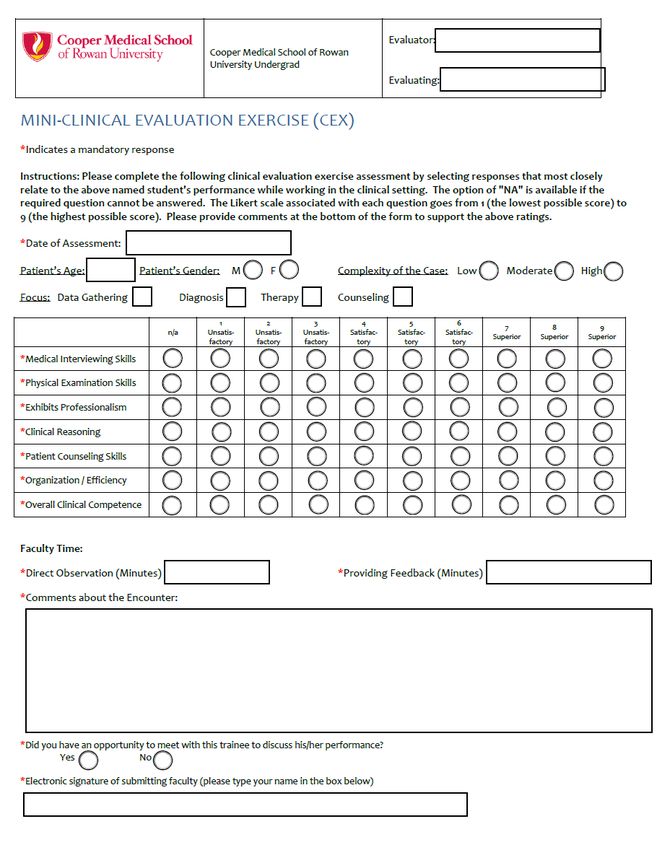
CMSRU Fourth Year Course Catalog
Table of Contents
COURSE NAME PAGE
Pediatric Radiology- 2 weeks 79
Women's Imaging- 2 weeks 80
Reading
Reading- 1 week 81
Reading- 2 weeks 82
Research
Research- 2 weeks 83
Research- 4 weeks 84
Surgery
Cardiovascular & Thoracic Surgery 85
Colon & Rectal Surgery 86
General Surgery 87
Neurosurgery- 2 weeks 88
Neurosurgery- 4 weeks 89
Neurosurgery for Primary Care- 2 weeks 90
Otolaryngology, Head & Neck Surgery 91
Plastic Surgery 92
Trauma 93
Appendix
M4 Assessment Forms
Formative Mini-Clinical Evaluation Exercise (CEX) 94
Phase 2 Mid-Clerkship Formative Feedback Certification 95
M4 Topic Presentation Scoring Sheet 96
M4 Oral Case Presentation Scoring Sheet 97
M4 Summative Assessment 98-99
CMSRU Fourth Year Course Catalog 2019-2020 Page 5
revised 3.11.19Fourth Year Course: Course number: Location:
02200 Cooper University Hospital
Clerkship- Interprofessional Care of Chronic
Conditions
Clerkship Director: Clerkship Faculty: Clerkship Contact: Contact Information:
Elisabeth Siegert, MD Internal Medicine
Faculty; Betty Ann Girouard (856) 342-2000; Ext 100 9636
Assistant Clerkship Directors: Hematology/Oncology girouard-bettyann@cooperhealth.edu
Danielle Behrens, DO Faculty; PM&R Faculty;
Alexandra Lane, MD Palliative Care Faculty;
Rohini Kumar, MD Surgery Faculty; Family
John Robertson, MD and Community
Rohit Patel, MD Medicine Faculty
Samuel Hardy, MD
Blocks Available: Duration (weeks): Hours / week: Maximum students / block:
9 in block 2; 10 in blocks 1, 3 and 6; 11 in
All 4 Weeks 40 blocks 4, 5, 7-10
Lectures / Seminars: Outpatient: Inpatient: Residents:
Yes Yes Yes Yes
Night call: Weekends: Lab: Exam required:
No No No No
Must be present for First Day of Rotation / Orientation:
Yes
Course Overview:
During the Interprofessional Care of Chronic Conditions Clerkship, the student is expected to:
● Acquire knowledge about the types and cultural context of chronic illness, the cultural factors affecting world view and
health care system factors.
● Acquire knowledge and articulate the roles of the interprofessional team members in these evaluation and
management processes.
● Acquire the technical skills required to provide care for patients with chronic conditions and identify/differentiate acute illness
from “acuteonchronic” exacerbation in patients with chronic morbidity.
● Act as an interprofessional health care team member for patients, reviewing the care plan with the patient, and identifying
appropriate resources in their follow up care plan.
● Develop the attitudes and values that will foster and support well-coordinated, compassionate, inter- professional, patient
centered care;
● Obtain the foundation for high quality interprofessional care of chronic conditions for advanced study during post-graduate
training.
Course Content & Outline:
Orientation
You MUST attend orientation or you will not be allowed to begin the rotation. Please come to the assigned conference room for the start
of the clerkship orientation at 9am, unless told otherwise. If there is a change to the time and location of the orientation, you will be
notified beforehand. Clerkship directors will review the objectives for the clerkship with the students during the Orientation.
Clinical Rotations
Students must attend ALL assigned sessions at their clinical site. Students must show up on time for these sessions. Unexcused absences
or being repeatedly late for sessions can lead to the final grade being lowered or a grade of FAIL being assigned. Simply attending the
sessions will not lead to a high pass grade. At a minimum, students will be expected to serve as a team member involved in the patient’s
care and must show the following:
a. Ability to identify the range of goals of care for patients with chronic conditions compared to those with acute conditions.
b. Ability to differentiate acute illness from acute-on-chronic exacerbation of chronic condition
c. Develop a medical plan of care which meets the goals of the patient
d. Work in a team atmosphere with faculty, residents, nurses, etc.
e. Show enthusiasm
f. Work hard
CMSRU Fourth Year Course Catalog 2019-2020 Page 6
revised 3.11.19Fourth Year Course: Course number: Location:
02400 Cooper University Hospital
Clerkship - Emergency Medicine
Clerkship Directors: Clerkship Faculty: Clerkship Contact Information:
Contact:
Sundip Patel, MD Emergency Medicine Jillian Torres (856) 342-2352
Alexis Pelletier-Bui, MD Faculty torres-jillian@cooperhealth.edu
Blocks Available: Duration (weeks): Hours / week: Maximum students / block:
All 4 50-60 Max of 12 students/block
(includes visiting students i.e. if 6 CMSRU
students then can take 6 visiting students for
that block)
Lectures / Seminars: Outpatient: Inpatient: Residents:
Yes Yes - ED No Yes
Night call: Weekends: Lab: Exam required:
Yes Yes No Yes
Must be present for First Day of Rotation / Orientation:
Yes
Course Overview:
During the Emergency Medicine Clerkship, you are expected to see patients and perform chief complaint driven history and physical
exams. You will be expected to come up with a differential diagnosis, formulate a plan, and then follow up on all test results. During
the Emergency Medicine clerkship, we expect you to:
Acquire basic knowledge about the pathogenesis, presentation, evaluation and management of conditions commonly
treated by Emergency Medicine physicians
Acquire the technical skills required to provide care for Emergency Medicine patients
Present patients in a clear and succinct fashion
Act as the primary caregiver for patients, reviewing test results with the patient, and arranging either appropriate follow-
up care or admission to the hospital
Develop the attitudes and values that will foster and support safe, compassionate, professional, patient-centered care
Obtain the foundation in Emergency Medicine for advanced study during the fourth year and in post-graduate training
Course Content & Outline:
Orientation
You MUST attend orientation or you will not be allowed to participate in the rotation. Please come to the Emergency Department
Conference Room located in Kelemen Room 152 in the hospital for the start of the clerkship orientation at 8 am, unless told otherwise.
If you are unsure of where the conference room is, stop by the EM administrative office in Kelemen 152 or the emergency room and
someone will show you where the conference room is. If there is a change to the time and location of the orientation, you will be
notified beforehand.
Clinical Shifts
Students must attend ALL assigned shifts at Cooper University Hospital. Students must show up on time for these shifts. Unexcused
absences or being repeatedly late for shifts can lead to the final grade being lowered or a grade of Unsatisfactory being assigned.
Simply attending the shifts will not lead to a high pass grade. At a minimum, students will be expected to serve as a patient's
primary caregiver and must demonstrate the following:
a. The ability to take a focused history and physical pertaining to the chief complaint
b. The ability to develop an appropriate differential diagnosis with consideration of disease processes that can
cause severe morbidity or mortality
c. The ability to develop an appropriate treatment plan
d. Teamwork with faculty, residents, nurses, etc.
e. Enthusiasm
f. Hard Work
CMSRU Fourth Year Course Catalog 2019-2020 Page 7
revised 3.11.19Fourth Year Course: Course number: Location:
02300 Cooper University Hospital
Clerkship - Critical Care Medicine Intensive Care Unit
Clerkship Director: Clerkship Faculty: Clerkship Contact: Contact Information:
(856) 968-7801
Dawn M. Kennedy-Little, DO Critical Care Faculty Serena Mayer Mayer-serena@CooperHealth.edu
Blocks Available: Duration (weeks): Hours / week: Maximum students / block:
All except block 1 4 Weeks 60 4-6
Lectures / Seminars: Outpatient: Inpatient: Residents:
Yes No Yes Yes
Night call: Weekends: Lab: Exam required:
Yes Yes No No
Must be present for First Day of Rotation / Orientation:
Yes
Course Overview:
This required clerkship is designed to introduce the student to the systematic resuscitation, evaluation and management of the critically ill
patient as well as the ethical issues which frequently accompany these situations, all within the context of the core competencies.
During the Critical Care Medicine clerkship, we expect you to:
Acquire basic knowledge about the pathogenesis, presentation, evaluation and management of conditions commonly treated by
Critical Care physicians;
Present patients in a clear and succinct fashion;
Acquire the technical skills required to provide care for Critical Care patients;
Act as the primary caregiver for patients, reviewing test results with the patient, and arranging appropriate consultations and
additional care as needed;
Develop the attitudes and values that will foster and support safe, compassionate, professional, patient-centered care;
Obtain the foundation in Critical Care for advanced study during post-graduate training.
Course Content & Outline:
Orientation
Please review the orientation and detailed information on the website for Critical Care Operations,
http://criticalcare.cooperhealth.org/operations. Please see syllabus for username and password. Report to the Edward D. Viner Intensive
Care Unit (Medical-Surgical Intensive Care Unit), located on the on the 4th floor of the Roberts Pavilion of Cooper Hospital, at 8:30 AM. If you
are unsure of where the ICU is, stop by the Cooper University Hospital Information Desk on the ground floor of the Roberts Pavilion and
someone will direct you. After entering the Viner ICU, stop at the front ICU desk and ask for a critical care fellow/resident and/or wait until
8:45 AM for the ICU Huddle meeting at the white board adjacent to the front desk. Additionally, an in-person orientation will occur at 1 PM
every Monday of the clerkship, unless told otherwise. Different topics are covered each Monday for review. If there is a change in the time
or location of the orientation, you will be notified beforehand.
Clinical Shifts
Students must attend ALL assigned shifts while on the Critical Care rotation. Students must show up on time for these shifts. Unexcused
absences or being repeatedly late for shifts can lead to a lower final grade or a grade of Unsatisfactory Remediable. At a minimum, students
will be expected to serve as a patient's primary caregiver and must show the following:
a. Ability to take a focused history and physical pertaining to the chief complaint
b. Develop an appropriate differential diagnosis with consideration of disease processes that can cause severe morbidity or mortality
c. Develop an appropriate treatment plan
d. Work in a team atmosphere with faculty, residents, nurses, etc.
e. Show enthusiasm
f. Work hard
CMSRU Fourth Year Course Catalog 2019-2020 Page 8
revised 3.11.19Fourth Year Course: Course number: Location:
02900 Cooper University Health Care
Clerkship - Surgical Critical Care
Clerkship Director: Clerkship Faculty: Clerkship Contact: Contact Information:
Salina Wydo, MD, FACS Trauma Surgery Karen Orlando (856) 963-3985
Faculty orlando-karen@cooperhealth.edu
Blocks Available: Duration (weeks): Hours / week: Maximum students / block:
All 4 Weeks 40+ 4
Lectures / Seminars: Outpatient: Inpatient: Residents:
Yes No Yes Yes
Night call: Weekends: Lab: Exam required:
Yes Yes No Yes
Must be present for First Day of Rotation / Orientation:
Yes
Course Overview:
During the Surgical Critical Care Clerkship, the student will become familiar with the intensive care setting. The student will be exposed to
and will participate in the acute resuscitation of the acutely injured patient, as well as pre-, intra-, and post-operative care of the critically ill.
Course Content & Outline:
Students will function as members of the Surgical Critical Care team with house staff, fellows and attendings. They will learn the
fundamentals of hemodynamic monitoring and interventions used to optimize hemodynamic functions; the pathophysiology of the
various forms of shock and therapeutic interventions; the aspects of pre- and post-operative care of the medically complex surgical
patient, fundaments of ventilator function and management; and specific aspects of multisystem organ dysfunction.
Orientation
You MUST attend orientation or you will not be allowed to participate in the rotation. Orientation is generally held after Morning Report on
the first day of the rotation. If there is a change to the time and location of the orientation, you will be notified beforehand.
Conferences
The division has several conferences per week. Students will be required to attend Morning Report daily at 8 am in the trauma conference
room - located in the Division of Trauma suite, on 2nd floor Kelemen (next door to cafeteria).. The division also has Journal Club every
Wednesday following Morning Report and attendance is mandatory. Conferences are mandatory barring an active trauma in the Trauma
Admitting Area. In addition, students will be exposed to several Department of Surgery academic meetings during their time on the service.
Departmental Morbidity and Mortality report is a weekly event, Tuesday at 7 AM. Students are expected to attend barring any patient
emergencies.
CMSRU Fourth Year Course Catalog 2019-2020 Page 9
revised 3.11.19Fourth Year Course: Course number: Location:
Cooper University
02302 Hospital
Clerkship – Pediatric Critical Care Kelemen building 6th Fr.
PICU
Clerkship Director: Clerkship Faculty: Clerkship Contact Information:
Contact: (856) 342-2265
Renata Ostrowicki, MD PCCM Faculty Mary Mondatsos mondatsos-
mary@cooperhealth.edu
Blocks Available: Duration (weeks): Hours / week: Maximum students /
block:
All 4 weeks 52
1 (No visiting students)
Lectures / Seminars: Outpatient: Inpatient: Residents:
Yes No Yes Yes
Night call: Weekends: Lab: Exam required:
Yes No No No
Must be present for First Day of Rotation / Orientation:
Yes
Course Overview:
This elective rotation in the PICU is a four (4) week experience structured to develop the student’s decision making, organizational and
critical thinking and learn to apply physiology based knowledge to disease states in a clinical setting. The elective is available to 4th year
students only.
Clerkship Content & Outline:
Description of Activities
The PICU Attending will change weekly and you will be exposed to a variety of teaching styles and clinical experiences.
Day 1 report to Kelemen Building 6th floor PICU to meet with PICU residents and learn about PICU patients during morning resident
sign out.
1. The student will report to the PICU (Kelemen Building 6th floor One Cooper Plaza), at 7:30 am or before; providing enough
time to pre-round and examine their patients and be ready to present for morning rounds 8:30 am.
2. The students will prepare daily progress notes on their patients under direct supervision of the residents and faculty. The
student will carry a maximum of 2 patients.
3. The student will attend and participate in teaching sessions on am rounds with faulty and time permitting, didactic sessions
with faculty after rounds.
4. Student will attend PICU mock code, one-two per month and review basic principles of PALS.
5. Students are expected to stay for three short calls where they stay in the PICU until 11:00 pm, 2 Friday nights and one week
night evening to experience the presentation of acute PICU admissions. This follows the intern work hour rules.
6. Students will attend all weekly resident lectures and morning report. In addition, they will attend the Wed 12 noon Pediatric
Grand Rounds (E&R building 2nd floor) and Thursday Noon Chief Rounds (E& R Building 1st floor).
7. Students are welcome to practice with supervision of faculty and/or nursing staff: peripheral IV placement, Foley catheter
placement, or nasogastric tube placement.
8. By end of rotation between 3rd and 4th week, the student is to pick a topic pertinent to the PICU rotation and prepare a 10
minute PowerPoint presentation for the team. This presentation will account for 25% of the final grade and will be
evaluated using the M4 topic presentation rubric which is included at the end of this syllabus.
CMSRU Fourth Year Course Catalog 2019-2020 Page 10
revised 3.11.19Fourth Year Course: Course number: Location:
Sub-Internship - Family Medicine 02500 Family Medicine Offices
Clerkship Directors: Clerkship Faculty: Clerkship Contact: Contact Information:
Nirandra Mahamitra, MD Family Medicine Ryekisha Roark (856) 757-7790
Danielle Nordone, DO Faculty roark-ryekisha@cooperhealth.edu
Blocks Available: Duration (weeks): Hours / week: Maximum students / block:
1
1, 2, 3, 7, 8, 9 4 Weeks 40 (CMSRU
Students Only)
Lectures / Seminars: Outpatient: Inpatient: Residents:
Yes Yes No No
Night call: Weekends: Lab: Exam required:
No No No No
Must be present for First Day of Rotation / Orientation:
Yes
Course Overview:
Students are required to work with a Family Medicine physician in an outpatient office for four weeks.
Students will see assigned patients and obtain a history, perform a focused physical examination and develop a
differential diagnosis.
Students will learn coordination of care; communication with patients, families, specialists and other health care
providers.
Student will attend all conferences with their assigned attending physician.
Students will serve as an integral part of the office team.
Students will meet with the course director at mid-rotation to discuss their experiences.
Students will complete an evidence based medicine project submitted to the Clerkship Director by the end of the
rotation. Students will select a clinical question pertinent to their experiences in a Family Medicine office. They
will search and evaluate the literature. The submitted project will include a summary of the pertinent history and
physical findings, a statement of the question that arose, a brief summary of the article which tries to answer the
question, the strengths and weaknesses of the article and a summary of findings and whether this changes
management of the patient.
Course Content & Outline:
Clerkship Schedule
You will be assigned to rotate in a Family Medicine office. You will have a preceptor for weekly office hours. You will also
attend formal conferences and didactic activities. Additionally, you will have self-directed learning time.
Self-directed learning time is unscheduled time during the Monday-Friday week. You control the use of this time. If you use it
with self-discipline and maturity, it will enhance your sub-internship experience immensely. There are a number of fruitful uses
of SDL time, including:
Follow your patients to consultations, procedures, the inpatient setting, or even to make home visits.
Pursue areas of personal interest. However, don't settle for simply observing procedures or being a “fly on the wall.”
You should seek out active learning opportunities whenever possible. Work with the clerkship director to arrange
these
Read or study. While it is important that you study systematically, this is probably the least effective use of SDL time.
Studying is better done during evenings and weekends.
CMSRU Fourth Year Course Catalog 2019-2020 Page 11
revised 3.11.19Fourth Year Course: Course number: Location:
Sub-Internship - Internal Medicine 02301 Cooper University Hospital
Clerkship Director: Clerkship Faculty: Clerkship Contact: Contact Information:
Ritesh Patel, MD Faculty, Division of Betty Ann Girouard (856) 342-2000; Ext. 100 9636
Hospital Medicine girouard-bettyann@cooperhealth.edu
Blocks Available: Duration (weeks): Hours / week: Maximum students / block:
All 4 Weeks 60 6
Lectures / Seminars: Outpatient: Inpatient: Residents:
Yes No Yes Yes
Night call: Weekends: Lab: Exam required:
Yes Yes No No
Must be present for First Day of Rotation / Orientation:
Yes
Course Overview:
During the Internal Medicine Sub-Internship, the student will gain sufficient understanding of the evaluation and management
of patients and be able to provide comprehensive primary care management of these conditions.
Course Content & Outline:
During the Internal Medicine Sub-Internship, we expect you to:
Acquire basic knowledge about the pathogenesis, presentation, evaluation and management of conditions commonly
encountered in the Hospital setting
Present patients in a clear and succinct fashion
Act as the primary caregiver for patients, reviewing test results with the patient, and arranging appropriate follow-up
care
Develop the attitudes and values that will foster and support safe, compassionate, professional, patient-centered
care;
Obtain the foundation in Inpatient Internal Medicine for advanced study during post-graduate training.
Orientation
You MUST attend orientation or you will not be allowed to begin the rotation. Students are required to be in the Cooper
hospital cafeteria at 8am the first day of the rotation, unless otherwise noted. If there is a change to time and location, they will
be notified via email. During orientation, students will be made aware of the workflow on the General Medicine floor, their
patient care responsibilities, and requirements that must be completed for their clerkship. During this orientation, their weekly
schedule including assignment to various floor teams will be determined.
Clinical Shifts
A maximum of six students will be assigned for medicine sub internship monthly. They are required to work along with floor
teams, including any of the following services: HA, HB, HC, HD, HE, non-resident, or night float. During their day rotation, they
are also required to round one day of the weekend. They are required to work one week (5 nights) as a part of their rotation
during which they will work closely with night admitting team. The schedule for your 4 weeks will be given to you during your
orientation.
CMSRU Fourth Year Course Catalog 2019-2020 Page 12
revised 3.11.19Fourth Year Course: Course number: Location:
02600 Cooper University Hospital
Sub-Internship - Obstetrics & Gynecology
Clerkship Director: Clerkship Faculty: Clerkship Contact: Contact Information:
Joseph LaMotta, MD
Faculty, Division of Dawn Maziarz (856) 342-3006
Assistant Clerkship Director: Obstetrics & maziarz-dawn@cooperhealth.edu
Tuan Dinh, MD Gynecology
Blocks Available: Duration (weeks): Hours / week: Maximum students / block:
All 4 Weeks 60 2
Lectures / Seminars: Outpatient: Inpatient: Residents:
Yes No Yes Yes
Night call: Weekends: Lab: Exam required:
Yes Yes No Yes
Must be present for First Day of Rotation / Orientation:
Yes
Course Overview:
Acquire basic knowledge about the pathogenesis, presentation, evaluation and management of conditions commonly
encountered in obstetrics and gynecology
Present patients in a clear and succinct fashion
Appropriately review test results with the patient, and arranging appropriate follow-up care
Develop the attitudes and values that will foster and support safe, compassionate, professional, patient-centered care;
Obtain the foundation in obstetrics and gynecology for advanced study during post-graduate training.
Course Content & Outline:
Orientation
You will obtain an orientation packet from the education coordinator prior to the start of the sub-internship. You will be made
aware of the work flow in obstetrics and gynecology for the labor floor, triage, antepartum and postpartum units, gynecology
service and general gynecology. You will have patient care responsibilities assigned and requirements that have to be completed for
the sub-internship. Your weekly schedule will be in one of the following ways:
1. The entire four weeks on the labor floor
2. The entire four weeks on the general gynecology service
3. A combination of two weeks each on any two of the following: the Obstetrics service/labor floor, the general gynecology service or
night float
4. If the student requests, it is possible to do the entire four weeks at night with the night float team
You will work on any service under the direct supervision of the Chief Resident on that service. Your reporting time on the first day
is at 6:30 am on Dorrance 6 in the resident work lounge.
Clinical Shifts
A maximum of two students will be assigned for obstetrics and gynecology sub internship monthly depending on whether anyone
requests night float. They are required to work in the services led by Chief Residents. Rounds are conducted every morning so that
all patients are seen before 6:30 am morning sign out on Dorrance 6 in the resident work lounge. During the four week rotation,
the student has to do one weekend call of 16 hours. This can be on Friday evening, Saturday or Sunday. The night float rotation
will follow the night float team with the sub-intern arriving at 6:30 pm daily and finishing after board sign out at 6:30 am from
Sunday through Friday (6 days). The night float sub-intern will not do a weekend call.
CMSRU Fourth Year Course Catalog 2019-2020 Page 13
revised 3.11.19Fourth Year Course: Course number: Location:
03503 Cooper University Hospital
Sub-Internship – Orthopaedics
Clerkship Co-Directors: Clerkship Faculty: Clerkship Contact
Contact: Information:
Mark Pollard, MD Faculty, Lauren Jaconetti (856) 342-3436
Department of Jaconetti-lauren@cooperhealth.edu
David Fuller, MD Orthopaedic Lisa Torrence (856) 342-3206
Surgery Torrence-lisa@CooperHealth.edu
Blocks Available: Duration (weeks): Hours / week: Maximum students / block:
All 4 weeks 40 Hrs. 5 students per block
Lectures / Seminars: Outpatient: Inpatient: Residents:
Yes Yes Yes Yes
Night call: Weekends: Lab: Exam required:
Yes Yes No No
Must be present for First Day of Rotation / Orientation:
Yes
Course Overview:
The student will develop skills in handling common Orthopaedic Illnesses as they relate to the inpatient unit. As such, the student will be
given the opportunity to take on primary responsibility for the patient under faculty/resident supervision.
Clerkship Content & Outline:
Orientation:
Monday morning, meet with Program Coordinator, 3 Cooper Plaza, Ste: 410
Obtain daily rotation schedule including main OR and ambulatory locations
Obtain Epic online training, badge ID and Parking Privileges, if applicable
Clerkship Schedule:
When at Cooper University Hospital, 7:00 am sign-out Pavilion-7. You may be assigned 1-4 patients by the overnight Orthopaedic resident
team, and will follow them until discharge. Student is encouraged to meet with residents prior to seeing their patients. After sign-out, you
will gather the information you need to write a SOAP note on each of your patients before rounds begin:
You will talk to the patient/parents/nurses about what has happened overnight and in the morning
Do a focused physical exam
Read pertinent notes on Epic
Form an assessment and plan on your own
The senior residents will pre-round on all the in-patients before rounds, so discuss your plan with them after they see your patients and
before rounds.
During rounds, the student presents his/her H&P, summarizes what happened with the patient since admission, including his/her
assessment and plan.
When you write your note in EPIC, the type is “Student” the service is “Cooper Orthopaedic” The Smart Texts “CUH
At Discharge, you will complete the discharge Instructions, get a signature and provide the patient with medical prescription
If you have a Cooper Orthopaedic patient who was hospitalized for more than 48 hours, you will write a discharge summary
using format that an intern will email you. Ask the senior resident who you should email the summary to.
Participate and/or attend conference including rounds, lectures, residents’ lectures and Grand Rounds.
CMSRU Fourth Year Course Catalog 2019-2020 Page 14
revised 3.11.19Fourth Year Course: Course Number: Location:
Sub-Internship- Pediatrics 02701 Cooper University Hospital
Clerkship Director: Clerkship Faculty: Clerkship Contact: Contact Information:
Debrah Meislich, M.D. Sean Krulish, D.O Ramonita Ortiz (856) 757-7904
Aubri Milano, M.D. Jeanne Lanzo ortiz-ramonita@cooperhealth.edu
Elective Director: Charlotte Nussbaum,
M.D.
William R. Graessle, M.D.
Blocks Available: Duration (weeks): Hours/week: Maximum students / block:
Max of 2 students/block (1 CMSRU
All 4 weeks 60 - 80 per block; 1 visiting student per block
– depending on availability)
Lectures / Seminars: Outpatient: Inpatient: Residents:
Yes No Yes Yes
Night call: Weekends: Lab: Exam Required:
Yes- one week of night float No No No
Must be present for First Day of Rotation / Orientation:
Yes
Course Overview:
During the Pediatric Sub-Internship, the student will develop skills in handling common pediatric illnesses as they relate to the
inpatient unit. As such, the student will be given the opportunity to take on primary responsibility for the patient under faculty
supervision
Course Content & Outline:
During the Pediatric Sub-Internship, we expect you to:
Become familiar with the clinical presentation of common diseases that affect the pediatric patient
Develop treatment and management plans for the pediatric patient
Develop skills in communicating with pediatric patients and their families in terms that they can understand.
Orientation
You MUST attend orientation or you will not be allowed to participate in the rotation. The student should report for morning
sign-out at 7 am on the first morning of the rotation. This usually occurs in the Charlotte Tobiason conference room on the 6th
floor Kelemen (just across from the Kelemen elevators). The senior resident phone is (856) 968-8544. If there is a change to
the time and location of the orientation, you will be notified beforehand.
Clerkship Schedule
The schedule for sub-internship is three weeks of 6:30 AM – 7:00 PM;
one week of 7:00 PM – 7:00 AM.
6:30 AM sign-out on Kelemen 6 north. You will be assigned 1 – 4 patients; assigned by the overnight pediatric resident team
and follow them until discharge.
CMSRU Fourth Year Course Catalog 2019-2020 Page 15
revised 3.11.19Fourth Year Course: Course number: Location:
02801 Cooper University Hospital
Sub-Internship- Psychiatry
Clerkship Director: Clerkship Faculty: Clerkship Contact: Contact Information:
Francis Aguilar, MD Psychiatry Faculty Mychelle Brown (856) 342-2000; Ext. 100-9638
brown-mychelle@cooperhealth.edu
Blocks Available: Duration (weeks): Hours / week: Maximum students / block:
All 4 weeks 40+ 1
Lectures / Seminars: Outpatient: Inpatient: Residents:
No Yes Yes Yes
Night call: Weekends: Lab: Exam required:
No Yes No No
Must be present for First Day of Rotation / Orientation:
Yes
Course Overview:
During the Psychiatry Sub-internship, the student is expected to:
Acquire basic knowledge about the pathogenesis, presentation, evaluation and management of conditions commonly encountered
in psychiatry clinics/hospital setting
Present patients in a clear and succinct fashion
Act as the primary caregiver for patients, reviewing test results with the patient, and arranging appropriate follow-up care
Develop the attitudes and values that will foster and support safe, compassionate, professional, patient-centered care;
Obtain the foundation in Inpatient Psychiatry for advanced study during post-graduate training.
Develop the attitudes and values that will foster and support safe, compassionate, professional, patient-centered care.
Develop an appreciation for the demands of inpatient training.
Course Content & Outline:
Orientation
You MUST attend orientation or you will not be allowed to begin the rotation. The location and timing will be arranged with the Sub-
internship director and coordinator at least a week before your starting of the rotation. During orientation, students will be made aware of
the workflow, patient care responsibilities, location(s) that they have to travel to, and requirements that must be completed for their Sub-
internship.
Clinical Shifts
A maximum of five students will be assigned to the psychiatry sub-internship monthly. This can include inpatient and/or outpatient sites.
Some outpatient sites are affiliated with Cooper and involve a 30 minute drive from the Cooper Medical School of Rowan University Complex.
On call coverage/shadowing are expected for at least two Saturdays (from 7:30am to 3:30pm) during the month. On call during weekdays till
10pm is optional. The schedule for your 4 weeks will be given to you during your orientation.
EBM presentation during last week to Sub-internship Director
Students will be encouraged and guided to create a clinical question, emerging from their current floor experience in PICO format (P: patient,
population or problem; I: intervention, prognostic factor or exposure; c: comparison or intervention; and O: outcome measured). They will
search and evaluate the literature. At the end of rotation, they will create a succinct presentation reflecting their understanding from
available evidence.
Here is a summary of what is expected for the 10 minute EBM presentation.
1. Must be 10 minutes or less. Can be PowerPoint or oral presentation
2. Very brief summary of pertinent history and physical findings in case
3. State the question that arose in the case
4. Very brief summary of the article that tries to answer the question
5. Strength and weaknesses of the article
6. Summary of findings and whether it changes your management
CMSRU Fourth Year Course Catalog 2019-2020 Page 16
revised 3.11.19Fourth Year Course: Course number: Location:
02901 Cooper University Hospital
Sub-Internship- Surgery
Clerkship Director: Clerkship Faculty: Clerkship Contact: Contact Information:
Lisa Reid, MD Frank Spitz, MD Karen Orlando (856) 963-3985
Umur Atabek, MD orlando-karen@cooperhealth.edu
Kristin Brill, MD
Frank Koniges, MD
Lisa Reid, MD
Robert Simons, MD
Blocks Available: Duration (weeks): Hours / week: Maximum students / block:
All 4 weeks 40+ 2
Lectures / Seminars: Outpatient: Inpatient: Residents:
No No Yes Yes
Night call: Weekends: Lab: Exam required:
Yes Yes No No
Must be present for First Day of Rotation / Orientation:
Yes
Course Overview:
The student will become familiar with the clinical presentation of surgical diseases of the GI tract, abdominal wall, endocrine
system, breast, etc., their evaluation and management. A detailed understanding of the relevant anatomy, physiology and
pathology will also be acquired.
Course Content & Outline:
During the General Surgery Sub-Internship, we expect you to:
The student will make relevant findings in obtaining the history and physical examination of patients with general
surgical disease.
The student will articulate an appropriate differential diagnosis for patients with acute and chronic general surgical
conditions.
The student will demonstrate cost-effective use of diagnostic modalities in assessing patients with general surgical
disease.
The student will develop and participate in the implementation of appropriate patient management plans.
The student will participate in the Divisional conferences, including Morbidity & Mortality and patient management
conferences.
Description of Activities
At the conclusion of the rotation, an evaluation of the student will be made by the course director based on the student’s
overall performance.
CMSRU Fourth Year Course Catalog 2019-2020 Page 17
revised 3.11.19Fourth Year Course: Course number: Location:
04200 Cooper University Hospital
Sub-Internship- Urology
Clerkship Co- Clerkship Faculty: Clerkship Contact Information:
Directors: Contact:
Jeffrey Tomaszewski, M.D. Faculty, Karen Orlando (856) 963-3985
Allen Seftel, M.D. Division of Urology orlando-karen@cooperhealth.edu
Blocks Available: Duration (weeks): Hours / week: Maximum students / block:
All 4 weeks 40 2
Lectures / Seminars: Outpatient: Inpatient: Residents:
Yes Yes Yes Yes
Night call: Weekends: Lab: Exam required:
Yes Yes No No
Must be present for First Day of Rotation / Orientation:
Yes
Course Overview:
This course is designed for students to become familiar with the clinical presentation of urologic diseases, their evaluation and
management. A detailed understanding of the relevant anatomy, physiology and pathology will also be acquired.
Clerkship Content & Outline:
During the Urology Sub –Internship, we expect you to:
• Acquire basic knowledge about the pathogenesis, presentation, evaluation and management of conditions
commonly encountered in Urology
• Present patients in a clear and succinct fashion
• Develop and participate in the implementation of appropriate patient management plans
• Develop the attitudes and values that will foster and support safe, compassionate, professional, patient-
centered care
• Obtain a foundation in Urology for advanced study during post-graduate training
Orientation
You MUST attend orientation or you will not be allowed to begin the rotation. Students are required to be in the Cooper
hospital cafeteria at 645am the first day of the rotation, unless otherwise noted. If there is a change to time and location, you
will be notified via email. During orientation, students will be made aware of the workflow, your patient care responsibilities,
and requirements that must be completed for the sub-internship.
Clinical Work
Students will be working with Urology faculty, residents, and nurse practitioners in the inpatient, outpatient, and operating
room settings. You will get a better idea of your schedule for your 4 weeks during orientation.
CMSRU Fourth Year Course Catalog 2019-2020 Page 18
revised 3.11.19Fourth Year Course: Course number: Location:
02990 Cooper University Hospital
Sub-Internship- Vascular Surgery
Clerkship Director: Clerkship Faculty: Clerkship Contact: Contact Information:
Philip Batista, MD
Philip Batista, MD Jeffrey Carpenter, MD Karen Orlando (856) 963-3985
Joseph Lombardi, MD orlando-karen@cooperhealth.edu
Jose Trani, MD
Blocks Available: Duration (weeks): Hours / week: Maximum students / block:
All 4 weeks 60 1
Lectures / Seminars: Outpatient: Inpatient: Residents:
Yes Yes Yes Yes
Night call: Weekends: Lab: Exam required:
No Yes No No
Must be present for First Day of Rotation / Orientation:
Yes
Course Overview:
The student will gain sufficient understanding of the evaluation and management of patients with vascular diseases to enable
comprehensive primary care management of these conditions. Students will:
The student will make relevant findings in obtaining the history and physical examination of patients with vascular
disease.
The student will articulate an appropriate differential diagnosis for patients with acute and chronic vascular
conditions.
The student will demonstrate cost-effective use of diagnostic modalities in assessing patients with vascular disease.
The student will develop and participate in the implementation of appropriate patient management plans.
The student will participate in the Divisional conferences, including Morbidity & Mortality, Interesting Cases, and
exploration of special topics in vascular disease.
Course Content & Outline:
Description of Activities
The student will be an integral member of the Vascular Surgery Service at Cooper Hospital. Rounds usually start at 6:00 AM on
weekdays. The student will attend operative, interventional and diagnostic procedures on patients on the service. The student
will evaluate consults, both in the Emergency Department and in the hospital. In addition, the student will attend the faculties’
office hours.
The student will perform history and physical examinations on patients admitted to the service. The student will perform
focused exams on patients who are seen in consultation. The student will develop differential diagnoses for these patients and
will formulate a plan for further evaluation and management. Any missed time during the rotation will require remediation
targeted at resolving the specific deficiency in the student’s experience.
Any missed time during the rotation will require remediation targeted at resolving the specific deficiency in the student’s experience.
Orientation
Monday, 7 – 9 AM in the Departmental Offices, 3 Cooper Plaza, #411.
CMSRU Fourth Year Course Catalog 2019-2020 Page 19
revised 3.11.19Fourth Year Course: Course number: Location:
Addiction Medicine 02502 Project H.O.P.E., and Urban Health
Institute Addictions Clinic
Elective Co-Directors: Elective Faculty: Elective Contact: Contact Information:
Kaitlan Baston, MD, MSc and Family Medicine Sue Liu (215) 964-3540
Susan Liu, MA, MPA liu@rowan.edu
Blocks Available: Duration (weeks): Hours / week: Maximum students / block:
First half of each Block 2 weeks 40 1
Lectures / Seminars: Outpatient: Inpatient: Residents:
TBD Yes No No
Night call: Weekends: Lab: Exam required:
No No No No
Must be present for First Day of Rotation / Orientation:
Yes
Course Overview:
In this elective, you will gain an understanding of the delivery of care for individuals with substance use disorders, with specific
attention to patients with opioid addiction and dependence. Students will be exposed to medication-assisted treatment programs
using buprenorphine in both Project H.O.P.E., a Federally Qualified Health Center for the homeless, and the Addictions Clinic of the
Urban Health Institute at 3 Cooper Plaza. You will develop an understanding of the clinical management of patients with addictions
within the primary care setting and an addictions treatment clinic, and will understand the relevant limitations and parallel needs
within each clinical environment in order to impact efficacy and outcomes. You will be expected to demonstrate competency in the
medical interview, treatment planning, and interdisciplinary care coordination for dual diagnosis, complex patients, and other special
patient subpopulations. You will also become familiar with the value of team based care for patients with addictions by working
alongside physicians, nurse practitioners, case managers, and behaviorists in providing holistic care for this patient population.
Course Content & Outline:
Orientation
Students will meet with Sue Liu (CMSRU 350) on the first date of the elective, (time to be coordinated in advance), unless otherwise
notified. During this meeting, you will review course objectives, schedule, student expectations, patient care responsibilities, and
other pertinent information regarding your elective experience.
Course Schedule
This elective meets Monday through Friday, from 8:00am - 5:00pm. This schedule is subject to change based on the availability of
evening clinical hours or other community based learning opportunities.
Patient Care Responsibility
Students will be expected to be an active part of the care team for patients with substance use disorders and other complex
needs. They will work under the supervision of the course director and alongside other staff members around patient care
needs.
Students are to have knowledge of adult primary care delivery and will be expected to perform the following for patients
with substance use disorders:
o Full intake history and addictions history
o Medication history review
o Review of systems and physical examination
o Patient screening assessments and development of treatment plan
o Symptom and treatment management for patients in crisis
CMSRU Fourth Year Course Catalog 2019-2020 Page 20
revised 3.11.19Fourth Year Course: Course number: Location:
03102 Cooper University Health Care
Healthcare Administration- 2 weeks
Elective Director: Elective Faculty: Elective Contact: Contact Information:
Eric Kupersmith, MD (856) 968-7490
Joseph Montella, MD, MS, CPE Nicole Fox, MD Lisa Bariana bariana-lisa@cooperhealth.edu
Deepa Velayadikot, MD
Blocks Available: Duration (weeks): Hours / week: Maximum students / block:
All, except Blocks 1 & 2 2 Weeks 30 1
Lectures / Seminars: Outpatient: Inpatient: Residents:
Medical students may interact with
Yes No No Administrative fellow and/or residents
Night call: Weekends: Lab: Exam required:
No exam, but submission of a journal
No No No will be required
Must be present for First Day of Rotation / Orientation:
Yes
Orientation will be scheduled based on availability of Dr. Montella on or near the first day of the rotation.
Course Overview:
This course will provide a high level overview of healthcare administration within an Academic Medical Center and large
physician practice. It is designed to give the student an insight into the “behind-the-scenes” (and not so behind the scenes)
world of delivering care. It will also introduce the student to the role of medical administrators (both physician and non-
physician) in providing the structure and processes required to achieve outstanding patient outcomes.
Course Content & Outline:
As the delivery of medical care becomes more complex due to advances in medical technology, regulations from government and
insurers, and focus on population health, it is important for the student to understand the role that medical administrators (physician
and non-physician) play in reconciling these elements to provide patient care. The role of the medical administrator impacts the
following in a hospital system:
Hospital throughput Supply chain management
Infection prevention Hospital and outpatient operations
Regulatory readiness (including physician Financial stability of the organization
credentialing and evaluations)
Physician burnout Care transitions from in-hospital to out of hospital
Access to care in the outpatient setting Informatics
Patient Safety Readmissions
Documentation and coding Utilization Review
This elective is designed to explore these areas occurs through one-on-one meetings with administrators, attending group meetings,
and discussion of articles.
Prior to starting the rotation, the student will read “Nine common leadership styles: Which type of leader are you?” They
should be prepared to discuss this article on the first day of the rotation during their meeting with the elective director (or
designee) as well as discuss their specific interest and goals for the rotation. The elective director (or designee) will review
their upcoming schedules with the students to see what types of meetings and events the student would like to participate in
during the elective in order to develop a customized rotation schedule.
Additional weekly one-on-one sessions with faculty on various topics related to administration will be scheduled throughout
the rotation.
The student will keep a journal of each meeting they attend with observations and tactics they observed from these. The
student will keep this as a resource to apply throughout their career. The student will also submit a copy to the elective
director at the end of the rotation no later than one week after the close of the rotation. Failure to submit will result in an
incomplete grade.
Selected readings (see syllabus and on Blackboard)
The rotation will be during the weekday during normal business hours 8am-5pm. No weekend, nights or holidays required.
CMSRU Fourth Year Course Catalog 2019-2020 Page 21
revised 3.11.19Fourth Year Course: Course number: Location:
03101 Cooper University Health Care
Healthcare Administration- 4 weeks
Elective Director: Elective Faculty: Elective Contact: Contact Information:
Eric Kupersmith, MD (856) 968-7490
Joseph Montella, MD, MD, CPE Nicole Fox, MD Lisa Bariana bariana-lisa@cooperhealth.edu
Deepa Velayadikot, MD
Blocks Available: Duration (weeks): Hours / week: Maximum students / block:
All, except Blocks 1 & 2 4 Weeks 30 1
Lectures / Seminars: Outpatient: Inpatient: Residents:
Medical students may interact with
Yes No No Administrative fellow and/or
residents
Night call: Weekends: Lab: Exam required:
No exam, but a presentation or short
No No No paper and submission of a journal will
be required
Must be present for First Day of Rotation / Orientation:
Yes
Orientation will be scheduled based on availability of Dr. Montella on or near the first day of the rotation.
Course Overview:
This course will provide a high level overview of healthcare administration within an Academic Medical Center and large
physician practice. It is designed to give the student an insight into the “behind-the-scenes” (and not so behind the scenes)
world of delivering care. It will also introduce the student to the role of medical administrators (both physician and non-
physician) in providing the structure and processes required to achieve outstanding patient outcomes.
Course Content & Outline:
As the delivery of medical care becomes more complex due to advances in medical technology, regulations from government and
insurers, and focus on population health, it is important for the student to understand the role that medical administrators (physician
and non-physician) play in reconciling these elements to provide patient care. The role of the medical administrator impacts the
following in a hospital system:
Hospital throughput Supply chain management
Infection prevention Hospital and outpatient operations
Regulatory readiness (including physician Financial stability of the organization
credentialing and evaluations)
Physician burnout Care transitions from in-hospital to out of hospital
Access to care in the outpatient setting Informatics
Patient Safety Readmissions
Documentation and coding Utilization Review
This elective is designed to explore these areas occurs through one-on-one meetings with administrators, attending group meetings,
and discussion of articles.
Prior to starting the rotation, the student will read “Nine common leadership styles: Which type of leader are you?” They
should be prepared to discuss this article on the first day of the rotation during their meeting with the elective director (or
designee) as well as discuss their specific interest and goals for the rotation. The elective director (or designee) will review
their upcoming schedules with the students to see what types of meetings and events the student would like to participate in
during the elective in order to develop a customized rotation schedule.
Additional weekly one-on-one sessions with faculty on various topics related to administration will be scheduled throughout
the rotation.
The student will keep a journal of each meeting they attend with observations and tactics they observed from these. The
student will keep this as a resource to apply throughout their career. The student will also submit a copy to the elective
director at the end of the rotation no later than one week after the close of the rotation. Failure to submit will result in an
incomplete grade.
Selected readings (see syllabus and on Blackboard)
Short paper of 300 to 500 words discussing the various leadership styles the student observed citing examples from the
rotation OR presentation to the group of no longer than 30 minutes.
The rotation will be during the weekday during normal business hours 8am-5pm. No weekend, nights or holidays required.
CMSRU Fourth Year Course Catalog 2019-2020 Page 22
revised 3.11.19Fourth Year Course: Course number: Location:
ALG Case Writing 04102 CMSRU
Elective Co-Directors: Elective Faculty: Elective Contact: Contact Information:
Cheryl A. Vasan, PT, DPT, PhD Cheryl A. Vasan, PT, DPT, Cheryl A. Vasan, PT, Cheryl A. Vasan, PT, DPT, PhD
Kathryn Behling, MD, PhD PhD DPT, PhD melovitz-vasan@rowan.edu
Kathryn Behling, MD, PhD Kathryn Behling, 856-361-2889 (O)
MD, PhD
Kathryn Behling, MD, PhD
behling@rowan.edu
856-361-2893 (O)
Blocks Available: Duration (weeks): Hours / week: Maximum students / block:
Blocks 3-10 4 40 2 (CMSRU students only)
Lectures / Seminars: Outpatient: Inpatient: Residents:
None N/A N/A N/A
Night call: Weekends: Lab: Exam required:
N/A N/A N/A No
Must be present for First Day of Rotation / Orientation:
No
Course Overview:
The ALG case writing elective will allow students to learn the process of creating and writing an effective ALG case based on relevant
literature in the fields of problem based and case based learning. Students will apply what they have learned from the literature as they
author an ALG case and facilitator’s guide that may be potentially used in the Phase I Curriculum. Students will have the option of either
converting their 3rd year plenary topic into an ALG case or they may choose a different topic, which must be approved by the course directors.
Course Content & Outline:
Description of Activities
Week 1:
Read required articles on case authoring and Bloom’s taxonomy
Select case topic
Create case stem and case releases
Create case learning objectives
Begin to identify resources that address each learning objective within the case
Write a 250 word self-reflection on the week’s activities and submit to course co-directors by Monday at 8:00 am of the following
week
Week 2:
Identify the remainder of the resources needed for the case learning objectives and create a reference list
Write the content for the case learning objectives
Write a 250 word self-reflection on the week’s activities and submit to course co-directors by Monday at 8:00 am of the following
week
Week 3:
Complete writing the content for the case learning objectives
Submit a draft of the case and facilitators guide to the course co-directors by Wednesday 8:00 am
Course co-directors to provide written feedback to students by Friday at 4:00 PM
Write a 250 word self-reflection on the week’s activities and submit to course co-directors by Monday at 8:00 am of the following
week
Week 4:
Make appropriate revisions to the case and facilitators guide based on written feedback from course co-directors
Submit final case and guide to course co-directors by Friday at 4:00 pm
Write a 500 word self-reflection about your experience with this elective and submit it to the course co-directors by Friday at 4:00
pm
CMSRU Fourth Year Course Catalog 2019-2020 Page 23
revised 3.11.19You can also read


