2021/22 Annual Plan Manchester University NHS Foundation Trust - Manchester University NHS ...
←
→
Page content transcription
If your browser does not render page correctly, please read the page content below
Manchester University NHS
             Foundation Trust

         2021/22 Annual Plan

1|Page
CONTENTS
Page
1. Introduction 6
2. MFT - Who we are 7
3. MFT Planning Framework 8
Internal
▪ Our Vision 8
▪ Our Values 9
▪ Our Clinical Service Strategies 10
▪ Our Recovery Principles 11
External
▪ NHS E/I Priorities for 2021/22 12
▪ GM Health & Social Care System Priorities 13
4. MFT Priorities for 2021/22 14
▪ To improve patient safety, clinical quality and 15
outcomes
▪ To improve the experience of patients, carers and 18
their families
▪ To develop our workforce enabling each member 20
of staff to reach their full potential
▪ To develop single services that build on the best 22
from across all our hospitals
▪ To develop our research portfolio and deliver 23
cutting edge care to patients
▪ To complete the creation of a Single Hospital 25
Service for Manchester/ MFT with minimal
disruption whilst ensuring that the planned
benefits are realised in a timely manner
▪ To achieve financial sustainability 26
5. Risk and Monitoring Arrangements 30
2|PageGlossary of Abbreviations AOF Accountability Oversight Framework ARC-GM Applied Research Collaboration Greater Manchester ATMP Advanced Therapy Medicinal Products BAU Business as Usual DoN Director of Nursing CDSU Clinical Data Science Unit CHD Community Diagnostic Hub CQC Care Quality Commission CYP Children & Young People DH Department of Health DHSC Department of Health and Social Care DiTA Diagnostics and Technology Accelerator ED Emergency Department EPR Electronic Patient Record E&T Education & Training FBC Full Business Case F&F Friends & Family Test F&PP Fit & Proper Person GM Greater Manchester HInM Health Innovation Manchester H1 Half 1 – April 2021 – September 2021 H2 Half 2 - October 2021 – March 2022 ICS Integrated Care System IPC Infection Prevention and Control IQP Improving Quality Programme KLOE Key Lines of Enquiry 3|Page
LCO       Local Care Organisations

LD        Learning Difficulties

MCS       Managed Clinical Service

MFT       Manchester University NHS Foundation Trust

MIC       Medtech and In vitro diagnostics Co-operative

MREH      Manchester Royal Eye Hospital

MRI       Manchester Royal Infirmary

NHS E/I   NHS England / Improvement

NIHR      National Institute for Health Research

NMAHP     Nursing, Midwifery and Allied Health Professionals

NMGH      North Manchester General Hospital

NWAS      North West Ambulance Service

PAHT      Pennine Acute Hospitals NHS Trust

PbR       Payment by Results

PDC       Public Dividend Capital

PED       Paediatric Emergency Department

PFI       Private Finance Initiative

PMO       Project Management Office

PSIRP     Patient Safety Incident Response Plan

PTIP      Post Transaction Implementation Plan

QCR       Quality Care Round

RAG       Red, Amber, Green

RMCH      Royal Manchester Children’s Hospital

R&I       Research & Innovation

SHS       Single Hospital Service

SLA       Service Level Agreements

SMH       Saint Mary’s Hospital

SNCT      Safer Nursing Care Tool

4|Page
SRFT     Salford Royal NHS Foundation Trust

UDH      University Dental Hospital of Manchester

VCSE     Voluntary, Community & Social Enterprise

WCH      Withington Community Hospital

WMTM     What Matters To Me

WRP      Waste Reduction Programme

WTWA     Wythenshawe, Trafford, Withington & Altrincham

5|Page
1. Introduction

The purpose of the annual planning process is to develop a set of coordinated plans
for the coming year from across the organisation that describe how, over the coming
12 month period, we are going to:
    • Progress our vision and strategic aims
    • Implement our clinical service strategies
    • Respond to the priorities set by NHS England / Improvement.

Plans for this year will be dominated by the need to recover from the COVID-19
pandemic.

The MFT Annual Plan sets out:

   •   Who we are, describing the sites and services that we provide (page 7)

   •   The context within which our plans have been developed, in particular
          o What we want the organisation to become over the coming 5 years –
             Our vision and strategic aims (page 8)
          o The values and behaviours that underpin all that we do – Our Values
             (page 9)
          o The changes that we plan to make in order to achieve the benefits of
             having now created the Single Hospital Service - Our Clinical Service
             Strategies (page 10)
          o The principles that underpin recovery (page 11), and
          o Externally, the priorities set for us by NHS England / Improvement
             (NHS E/I) - NHS E/I Priorities for 2021/22 (page 12)
          o The priorities for the Greater Manchester Health and Social Care
             System (page 13)

   •   What we want to achieve in 2021/22 - our key priorities and plans for 2021/22
       (pages 14 – 27). We have set out for each of our strategic aims, plans for
       2021/22, who will lead them and when we expect they will have been achieved,
       and a description of the financial plan for delivering all of this within budget.

   •   How we will ensure that we stay on track – our performance monitoring and
       risk management arrangements (page 30).

6|Page
2. Manchester University NHS Foundation Trust - who we are
Manchester University NHS Foundation Trust (MFT) is one of the largest NHS trusts
in England providing community, general hospital and specialist services to the
populations of Greater Manchester and beyond. We have a workforce of over 25,000
staff and are the main provider of hospital care to approximately 750,000 people in
Manchester and Trafford and the single biggest provider of specialised services in the
North West of England. We are a university teaching hospital with a strong focus on
research and innovation.
The Trust comprises the following hospitals:
• Royal Manchester Children’s Hospital (RMCH) - RMCH is a specialist childrens
hospital providing general, specialised and highly specialist services for children
and young people. RMCH and Saint Mary’s Hospital deliver joined up services for
families from prenatal care through birth and beyond.
• Saint Mary’s Hospital (SMH) - Saint Mary’s Hospital provides general and
specialist medical services for women, babies and children as well as being a
comprehensive Genomics Centre.
• Manchester Royal Eye Hospital (MREH) – MREH is a specialist eye hospital
providing inpatient and outpatient ophthalmic care
• University Dental Hospital of Manchester (UDH) – UDH is a specialist dental
hospital
• Manchester Royal Infirmary (MRI) – MRI is a large teaching hospital providing
general and specialist services including kidney and pancreas transplants,
haematology, cardiac services and sickle cell disease.
• Wythenshawe Hospital - Wythenshawe Hospital is a large teaching hospital
providing general and specialist services including cardiology and cardiothoracic
surgery, heart and lung transplantation, respiratory conditions, burns and plastics,
cancer and breast care services
• Altrincham Hospital – Altrincham Hospital provides a range of general and
specialist outpatient and diagnostic services.
• Withington Community Hospital (WCH) – WCH is a community hospital
providing outpatients, diagnostics, day surgery and community services
• Trafford Hospital – Trafford hospital specialises in rehabilitation and the care of
the senior adult and has an Urgent Care Centre, an Orthopaedic Surgical Centre
and as well as providing outpatients and daycase surgery.
• North Manchester General Hospital (NMGH) - NMGH provides a full range of
general hospital services to its local population and is the base for the region's
specialist infection disease unit.
MFT also hosts Manchester and Trafford Local Care Organisations. They provide
integrated out-of-hospital care for the city of Manchester and Trafford. Services
provided include community nursing, community therapy services, intermediate care
and enablement, and some community-facing general hospital services.
7|Page3. MFT Planning Framework
Our Annual Plan sets out what we want to do in the coming 12 months. It is developed
in the light of our existing longer-term plans and strategies; key amongst these are our
vison and strategic aims, our values, our group and clinical service strategies and the
principles that we have developed that will underpin our recovery from COVID-19.
External influences on the plan include national plans and strategies and the priorities
set for the year by NHS England / Improvement and the priorities and plans agreed
collectively across the Greater Manchester Health and Social Care system.
Our Vision
Our vision sets out what sort of organisation we want to become over the next 5 to
10 years. It is underpinned by seven strategic aims that describe in more detail what
we want to achieve over that timeframe. They are set at the MFT group level and
are one of the ways in which we ensure that the whole organisation is working to the
same agenda.
Our vision is to improve the health and quality of life of our diverse
population by building an organisation that:
VISION
Excels in quality, safety, patient experience, research, innovation
VISION
and teaching,
Attracts, develops and retains great people, and;
Is recognised internationally as leading healthcare provider
To improve patient safety, clinical quality and outcomes
To improve the experience of patients, carers and their families
To develop our workforce enabling each member of staff to reach
their full potential
STRATEGIC AIMS
To develop single services that build on the best from across all our
hospitals
To develop our research portfolio and deliver cutting edge care to
patients
To complete the creation of a Single Hospital Service for
Manchester/ MFT with minimal disruption whilst ensuring that the
planned benefits are realised in a timely manner
To achieve financial sustainability
8|PageOur values
Our work is underpinned by our values statement that Together Care Matters and our
values and behaviours framework (shown in the graphic below). These values and
associated behaviours will drive both the development and the delivery of the plans
set out in this document.
Our Vision Our Values
Our vison is to improve the health and quality of life of our diverse Together Care
population by building an organisation that: Matters
• Excels in quality, safety, patient experience, research, Everyone Matters
innovation and teaching Working Together
• Attracts, develops and retains great people Dignity and Care
• Is recognised internationally as a leading healthcare provider Open and Honest
Everyone Working Dignity and Open and
Matters Together Care Honest
√ √ √ √
• I listen and respect • I listen and value • I treat others the • I admit when I have
the views and others views and way they would like made a mistake,
opinions of others opinions to be treated – and learn from
• I recognise that • We work together to putting myself in these
overcome difficulties • I feel I can speak
different people their shoes
need different • I effectively out if standards are
• I show empathy by
support and I communicate and not being
understanding the
accommodate their share information emotions, feelings maintained or
needs with the team and views of others patient safety is
• I treat everyone • I do everything I can • I demonstrate a compromised
fairly to offer my genuine interest in • I deal with people in
• I encourage colleagues the my patients and the a professional and
everyone to share support they need care they receive honest manner
ideas and • I am polite, helpful,
• I share with
suggestions for caring and kind
colleagues
improvements and patients how
decisions were
made
9|PageOur Group and Clinical Service Strategies
The Single Hospital Service for the city of Manchester, which was completed with the
incorporation of North Manchester into MFT in April 2021, was created to improve
services for patients and create rewarding roles for our staff. In order to agree how
best to reshape our services and our clinical teams to deliver these benefits, we
produced an MFT Group Service Strategy and a series of individual Clinical
Service Strategies. The strategies were developed through extensive engagement
with internal and external partners and stakeholders.
The Group Service Strategy sets out, at a high level, our vision for how services
should develop over the next five years. Five key themes emerged from the
engagement and they form the pillars of the strategy. The graphic below shows the
pillars and describes for each what we want to achieve and how we plan to get there.
OUR VISION
➢ To excel in quality, safety, patient experience, research, innovation and teaching
➢ To attract, develop and retain great people
➢ To be recognised internationally as a leading healthcare provider
OUR STRATEGIC PILLARS
OUR STRATEGIC PILLARS
01 02 03 04 05
EXCELLENT OUTSTANDING WORLD- A
PIONEERING
CARE THAT IS INTEGRATED RENOWNED RECOGNISED
DATA-DRIVEN
FIT FOR THE LOCAL CENTRES OF SYSTEM
HEALTHCARE
FUTURE SERVICES EXCELLENCE LEADER
Transf orm the ‘way Work in partnership Dev elop serv ices of Transf orm patient Expand our reach
we work’ to prov ide to dev elop leading- outstanding clinical care by leading data- and inf luence as a
patient care that is edge integrated local and research driv en innov ation sy stem leader at a
personalised, health and care excellence that across clinical local, regional,
sy stems f or the prov ide pioneering serv ices and national and
standardised, people of care f or our research, and international lev el -
and
Manchester and patients and are dev eloping a number f or the benef it of our
digitally- Traf f ord internationally of high impact patients, our staf f
enabled renowned commercial and the GM region
partnerships
Underpinned by being at the forefront of research and innovation through the
R&I development and adoption of integrative diagnostics and advanced
therapeutics
Supported through a pioneering approach to learning, education and training
E&T in a health and social care environment, building the workforce for the future
and harnessing technological advances and partnerships
The Group Service Strategy served as the over-arching framework for creating a
series of individual Clinical Service Strategies. These describe in more detail the
development path for individual services over the next 5 years.
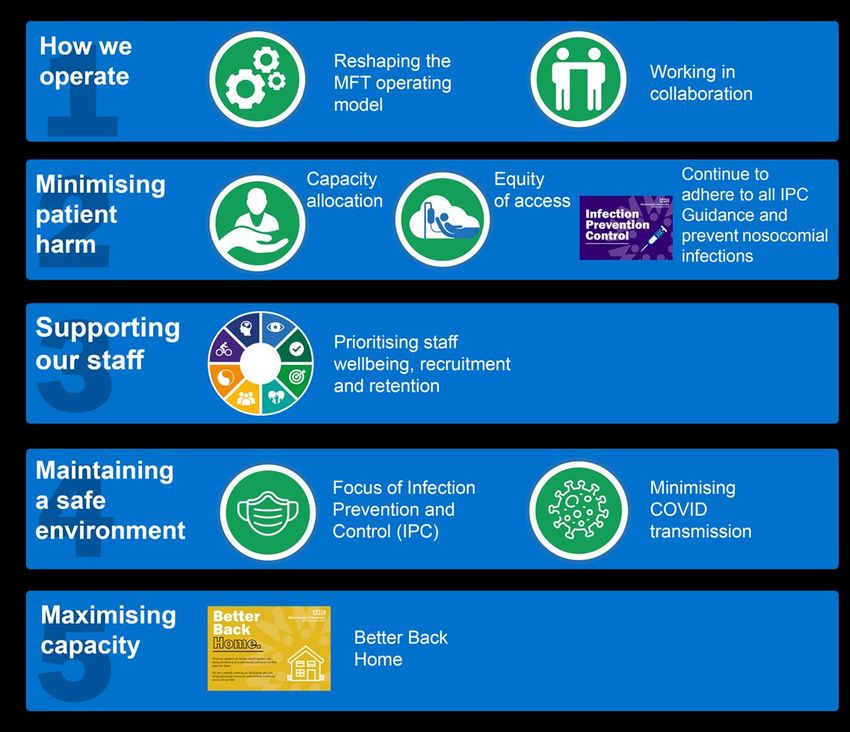
10 | P a g eOur Recovery Principles Recovery from COVID-19 will mean significant changes to the way in which we work and we should not underestimate the demand this will place on our workforce. The graphic below shows the principles that have been developed that will underpin the COVID-19 recovery programme. Recovery will also be aligned with the implementation of our Electronic Patient Record (EPR), which is a key programme of work for 2021/22. We are currently using more than 750 electronic and paper-based patient record systems. The EPR system will bring all of these together into a fully integrated Trust-wide solution so that we can provide better quality care to patients, wherever they are treated. The EPR solution is important, but the implementation programme (known as HIVE) means much more than the introduction of a new digital system. It means wide- spread change in every part and process in the organisation, transforming how we work for the benefit of our patients. The EPR itself and the process to implement the EPR will be important enablers of our recovery. 11 | P a g e
NHS England & NHS Improvement - Priorities for 2021/22

The national planning guidance issued by NHS England & NHS Improvement sets
out six high level priorities for 2001/22 as shown in the table below.

A   Supporting the health and    1   Looking after our people and helping them to recover
    wellbeing of staff and
                                 2   Belonging in the NHS and addressing inequalities
    taking action on
    recruitment and retention    3   Embed new ways of working and delivering care

                                 4   Grow for the future

B   Delivering the NHS               Possible COVID-19 re-vaccination programme, seasonal flu
    COVID-19 vaccination             vaccination and possibility of COVID-19 vaccination of children.
    programme and                    Continue use of home oximetry, ‘virtual wards’, proactive care
    continuing to meet the           pathways in people’s homes
    needs of patients with
                                     Maintain the dedicated Post COVID-19 Assessment clinics and Long
    COVID-19
                                     COVID-19 assessment services.
                                     NHS E will conduct a stocktake of physical critical care capacity and
                                     workforce
                                     All NHS organisations to ensure application of the UK IPC guidance

C   Building on what we have     1   Maximise elective activity and transforming the delivery of services
    learned during the
                                 2   Restore full operation of all cancer services
    pandemic to transform the
    delivery of services,        3   Expand and improve mental health services and services for people
    accelerate the restoration       with a learning disability and/or autism
    of elective and cancer
    care and manage the          4   Deliver improvements in maternity care, including responding to the
    increasing demand on             Ockenden review
    mental health services

D   Expanding primary care       1   Restoring and increasing access to primary care services
    capacity to improve
                                 2   Implementing population health management and personalised care
    access, local health
                                     approaches to improve health outcomes and address health
    outcomes and address
                                     inequalities
    health inequalities

E   Transforming community       1   Transforming community services and improve discharge
    and urgent and
    emergency care to
    prevent inappropriate        2   Ensuring the use of NHS111 as the primary route to access urgent
    attendance at ED, improve        care and the timely admission of patients to hospital who require it
    timely admission to              from emergency departments
    hospital for ED patients
    and reduce length of stay

F   Working collaboratively      1   Effective collaboration and partnership working across systems
    across systems to deliver
                                 2   Develop local priorities that reflect local circumstances and health
    on these priorities
                                     inequalities

                                 3   Develop the underpinning digital and data capability to support
                                     population-based approaches

                                 4   Develop ICSs as organisations to meet the expectations set out in
                                     Integrating Care

                                 5   Implement ICS-level financial arrangements

12 | P a g e
Greater Manchester Health and Social Care System Priorities
Six major programmes of activity and focus have been identified at the Greater
Manchester level:
Maintaining physical, social and mental well being
▪ Delivering the fundamental basics of health and well-being - a home, a job and a
family/social support system building on existing partnerships and agreements
▪ Strengthening the role of health and care organisations as anchor institutions
▪ Building and delivering a plan for local community engagement and development
▪ Allocating resources to neighbourhoods and designing services to reduce inequality
Creating more consistent evidence based preventive and proactive
primary care
▪ Improving healthy life expectancy through primary and proactive care
▪ Capitalising on the development of the neighbourhood model and working at
neighbourhood level
▪ Using and investing in joined up data systems to identify and stratify risk on a real time
basis to prevent deterioration of patients
Greater integration of the community based reablement, residential, rehabilitative,
palliative and social care services
▪ Establishing integrated community teams that can manage physical, mental and social
health problems by offering holistic services
▪ Using new methods of providing services to deliver longer periods of independent living
and speedier return to employment for GM citizens
▪ Building on the Adult Social Care transformation progressed in recent years through
models such as Living Well at Home
Coordinating and improving the urgent and emergency care service response
▪ Developing pathways between local urgent care services and specialist emergency care
▪ Empowering the Provider Collaboratives to work with local organisations, VCSE and
NWAS to organise and deliver a consistent approach to urgent care
▪ Using local groups to train more of the population in first aid
▪ Enabling the use of NWAS insights and data to predict and prevent acute episodes of
care and targeting resources to known areas of need
Delivering more consistent planned care and delivering the planned care recovery
programme
▪ Providers across GM collaborating to lead the planned care recovery programme,
addressing health inequalities, offering virtual services and undertaking clinical validation
▪ System-wide collaboration to better manage the flow of new patients needing diagnosis
and treatment
▪ Reducing unwarranted clinical variation, maximising bed and workforce capacity
▪ Working across the system to facilitate discharge from hospital and using virtual wards
and remote monitoring to accelerate acute care management and rehabilitation at home
Further developing access to and delivery of world class specialised care and
building a hugely capable innovation capability in Health Innovation Manchester
(HInM)
▪ Developing GM’s range and depth of specialised services to attract new investment and
staff, in particular in light of the importance of the life sciences sector to a post Brexit UK
▪ Utilising HIM to encourage inward investments and partnerships and enable the health
and care system to adopt leading edge technologies that will improve outcomes for GM
▪ Work to create the first prototype virtual health and care system
13 | P a g e4. Priorities and Plans for 2021/22 Taking into account all of the internal and external context and drivers, each Hospital / Managed Clinical Service (MCS) and corporate team has developed their own priorities and plans that will enable them to deliver on those priorities for the coming year. The following tables set out, for each of our strategic aims, what we are aiming to achieve and what specifically will be achieved in 2021/22 and by which quarter, and which department or Hospital /MCS is responsible. These are in no way exhaustive but give a flavour of our priority plans for 2021/22. 14 | P a g e
To improve patient safety, clinical quality and
outcomes
MFT wide plans

 What we are going to       Who is going        What will be achieved in 2021/22                   By
 do                         to do it                                                              when
 Implementation of          Hospitals/MCS/      Site and Trust wide Safety Strategy                Q4
 National Patient Safety    MTLCO with          developed
 Strategy                   Corporate           Site and Trust wide Patient Safety Incident       Q4
                            Clinical            Response Plan (PSIRP) developed
                            Governance          Patient safety specialist network developed       Q4
                            Team support        Human Factors Academy created to deliver          Q4
                                                − Integration of safety I and safety II
                                                     concepts in patient safety response
                                                − Training and education opportunities for
                                                     all staff
                                                − Enhanced simulation and a future proof
                                                     simulation strategy
                                                − Patient safety culture assessment tool
                                                − Alignment of Human Factors principles to
                                                     transformation work
                                                Existing approach to safety oversight             Q4
                                                enhanced through site level development
                                                A ‘patient safety partnership forum’              Q4
                                                developed and implemented as an enabler
                                                for meaningful patient and public involvement
                                                in patient safety
                                                A new framework which captures outcomes,          Q4
                                                best practice, national audit programmes
                                                devised with Medical Directors of
                                                Hospitals/MCSs as a base to push
                                                performance
 Infection Prevention &     Clinical services   IPC Board Assurance Framework actions             Q4
 Control (IPC)              with IPC team       intended to protect patients, staff and public
                            and Corporate       during the COVID-19 Pandemic delivered.
                            Nursing             Reduction in Healthcare Acquired Infections       Q4
                                                on 2020/21 levels.
                                                New Antimicrobial Reduction Strategy              Q1
                                                launched.
                                                Staff flu and COVID-19 vaccination                Q4
                                                programme achieved.
                                                Effective collection and utilisation of data to   Q2
                                                monitor and drive improvements
 Re-establish an annual     Corporate           Safer Nursing Care Tool (SNCT) re-                Q1
 nursing and midwifery      Nursing             introduced for all appropriate inpatient areas
 staffing establishment     Hospitals/MCS       and Emergency Departments
 review programme to        Directors of        SNCT census collections completed (X3)            Q3
 provide assurance that     Nursing             Baseline establishment review undertaken          Q1
 staffing levels are safe                       following 1st census.
                                                Establishments re-set following 3rd census.       Q4
                                                Assessment of midwifery staffing levels           Q3
                                                (using Birthrate plus) undertaken across
                                                maternity sites and community.

15 | P a g e
Increase nursing and Corporate Programme of virtual attraction events to Q4
midwifery workforce Nursing with all increase domestic nursing and midwifery
pipeline and reduce hospital / MCS / starters continued
nursing and midwifery LCO DoNs All 3rd year students undertaking placement Q1
turnover – improve on at the Trust (due to graduate in September
2020/21 position 21) issued with a guaranteed job offer
Guaranteed job offer for home grown Q3
students entering 2nd year of training
introduced to increase future pipeline
Minimum 450 International Recruitment Q4
nurses recruited to support service
transformation programmes attracting staff
with specialist skills.
Recruitment pipeline improved and vacancies Q3
reduced in hard to fill areas e.g. theatres,
dialysis, elderly medicine on 2020/21 levels
Maintain compliance Corporate Preparation for CQC inspection of MRI Q3
with CQC standards Nursing, completed
and deliver Medical Following improvements made from last CQC Q4
improvements in Directors' inspection, all services continue to improve
readiness to achieve office, on quality measures (Quality Care Round,
Good and Outstanding All What Matters To Me survey and Friends &
ratings across all hospitals/MCS/ Family Test)
areas. LCOs CEOs Improved quality of evidence of compliance Q3
and senior with regulatory standards
teams Significant assurance found in audits relating Q4
to regulatory standards
Results Group Medical Full launch and switch off of paper reports - Q1
Acknowledgment – Directors paper test reports will no longer be required
implementing an as they will be available electronically.
electronic system to Regular performance reporting established Q2
monitor Learning from this change used to inform Q1
acknowledgment of Electronic Patient Record (EPR) Results
pathology & radiology Acknowledgment design – this will be an
test results by the early example of the cultural change that will
clinicians that ordered be required on a larger scale as we move to
them an EPR.
Ensure that staff are Corporate Electronic Fit & Proper Person (F&PP) Q3
suitable and fit to Governance register established and F&PP checks
undertake their role embedded into appraisal discussions.
and comply with
professional standards
so that CQC Code of conduct declarations established as Q3
requirements are fully an MFT Mandatory programme and E
met. learning and reporting instituted.
Implement the Epic HIVE Team Core Epic system build complete. Testing Q3
Electronic Patient the MFT Epic system started
Record (EPR), Transformation design completed Q4
transforming services All specialty clinical content build completed Q4
to provide better quality
care to patients
Development of Corporate MFT Dementia Strategy reviewed and Q3
dementia care strategy Nursing refreshed in readiness to launch a new
Hospitals/MCS strategy in 2022.
Directors of
Nursing
16 | P a g eHospital / MCS / LCO plans
What we are going to Who is going What will be achieved in 2021/22 By
do to do it when
Prepare for CQC WTWA Internal Key Lines of Enquiry inspection – Q4
assessment self assessment process for CQC
inspection readiness developed
Learning from incidents NMGH Systems developed in line with MFT Q4
approach to share learning from serious
incidents across NMGH
Focusing on delivering MRI Focus maintained across MRI on Q4
fundamentals of care nutrition/hydration, documentation,
medicine management, management of
harm and infection control
Ockenden review into SMH Recommendations of the Ockenden Q4
maternity services review into maternity services delivered.
Reducing delays in MREH Greater Manchester pilot to enable ‘low Q4
monitoring patients risk’ glaucoma patients to be monitored in
the community led by MREH
Management of UDH Clinical validation and risk stratification of Q4
COVID-19 related patients whose care had been delayed
delays in care completed
Improving safety culture CSS Moved to Safety II Culture Q4
Focus on infection RMCH Infection control and policies aligned Q4
control across the whole of the RMCH Managed
Clinical Service (NMGH, WTWA, RMCH)
Development of urgent LCO Community urgent care provision Q4
care provision reviewed and developed to support flow,
timely discharge and reduced length of
stay
17 | P a g eTo improve the experience of patients, carers and their
families
MFT wide plans
What we are going to Who is going to What will be achieved in 2021/22 By
do do it when
Re-establish the MFT Corporate Accreditation programme recommenced. Q1
quality and patient Nursing/DoNs Senior Leadership Walkrounds Q1
experience recommenced.
programme What Matters to Me programme and Q1
surveys consistently undertaken with
patient overall satisfaction with quality of
service over 85%.
Quality of Care Round/What Matters To Q3
Me patient survey platform re-tendered
and implemented.
Integration of quality and safety Q2
governance and data, underpinned by
digital transformation, with evidence of
learning leading to continuous
improvement
Full Improving Quality Programme rolled Q2
out at NMGH.
Corporate Improvements in food provision and Q4
Nursing/DoNs nutritional care on 2020/21 levels.
with Estates &
Facilities
Develop and Corporate LD/autism strategy for MFT will be
implement a Nursing/Hospitals/ developed and implemented through Q2
programme of MCS/LCO DoNs engagement with patients, staff and
excellence in Learning service user groups.
Difficulties (LD) / LD/autism continuous improvement Q2
autism care programme established across all
hospitals/MCS/LCO
LD/autism training integrated into Q3
management development programmes
Training programme for clinical staff Q2
developed and rolled out to support the
LD strategy - improving skills and
awareness of caring for patients with LD
and autism
Hospital / MCS plans
What we are going to Who is going to What will be achieved in 2021/22 By
do do it when
Learning from WTWA Thematic review of complaints Q4
complaints undertaken
Embedding MRI Fundamentals of care embedded and Q4
fundamentals of care promoted through MRI Always Events
Engaging patients SMH SMH patient engagement approach rolled Q4
out to services at North Manchester
NMGH What Matters to Me implemented Q4
18 | P a g eIncreasing access MREH Diagnostic clinics at evening and Q4
weekends increased to maximise
opportunities for virtual review
UDH New ways of working (Attend Anywhere, Q4
Advice & Guidance, Telephone Review
Clinics) further developed and rolled out
Listening to patients / CSS Patient experience feedback and metrics Q4
parents and carers captured in service developments and
delivery
RMCH Voice of Children & Young People (CYP) Q4
and parents / carers embedded in
hospital committees and service change
including the development of NMGH CYP
advocacy and hospital services
Supporting Improved pathways and patient support Q4
independence delivered through the Better Outcomes
Better Lives programme
19 | P a g eTo develop our workforce enabling each member of
staff to reach their full potential
MFT wide plans
What we are going to Who is going to do What will be achieved in 2021/22 By
do it when
Launch MFT People Group Workforce MFT People Plan launched and Q1
Plan Team communicated
Delivery Plan agreed Q1
Develop Workforce Group Workforce Workforce Digital Strategy and delivery Q2
Digital Strategy Team plans developed
Workforce systems eg: job plan, Q4
rostering implemented in line with
delivery plan
Develop MFT Putting Workforce, Disciplinary and Maintaining High Q1
People First Corporate Nursing Professional Standards policies
Framework and Medical reviewed and revised to reflect putting
Directors people first
Training schedule developed Q1
Campaign on Bullying and Harassment Q2
delivered
Ofsted inspections Group Workforce Regulatory rating achieved for: Q1
Team • Apprenticeships service
• First Steps Nursery Oxford Road
site
Review of Nursing Workforce – Review of skill mix required in clinical Q3
Assistant roles in Corporate Nursing settings completed
clinical settings
Revise Policy Group Workforce Policy review schedule agreed Q1
Development Team Revised policies delivered in line with Q1 –
programme schedule Q4
Refresh MFT Group Workforce MFT Organisational Development Plan Q1
Leadership and Team developed
Culture Plan Staff engagement and recognition Q1
deliverables as part of platform launched
the MFT People Plan Talent and Development centres Q3
delivered
Learning & Education Strategy Q2
launched
Develop Reward Group Workforce Scoping for potential reward initiatives Q2
Strategy Team completed
Stakeholders engaged on proposed Q4
strategy and delivery plan
Delivery of workforce Group Workforce Employee Health & Wellbeing Service Q2
COVID-19 recovery Team model including psychological support
programme and enhanced fitness for work services
further developed
Anti-stigma Mental Health Campaign Q2
delivered
Targeted recruitment campaigns held to Q2
increase workforce availability
Key learning programmes made Q3
available on-line
20 | P a g eCompassionate leadership training Q2
series held for line managers
Staff networks, societies and forums Q3
build and expanded to encourage
employee voice
Delivery of ED&I Group Workforce Number of staff belonging to ethnic Q4
Strategy Team minority groups in senior positions (8a
and above) increased
Disability confident leader status Q4
achieved
Alignment of Workforce/Corporate Implementation of Integration plans Q4
workforce services Nursing/ Medical achieved
post integration of Director Temporary staffing arrangements Q3
North Manchester implemented for all staff groups
Improve Training Group Medical Manchester Surgical Skills & Simulation Q1
Opportunities for Directors Centre pilot launched
Medical and other
staff Pilot reviewed and future model agreed Q4
Hospital / MCS plans
What we are going to Who is going to do What will be achieved in 2021/22 By
do it when
Enhancing staff WTWA WTWA communications & engagement Q4
support offer plan developed and implemented
NMGH Vibrant & inclusive support & Q4
development offer built
MRI Staff and teams skilled up and Q4
empowered to improve patient care and
staff experience
SMH MFT initiatives to help staff recover from Q4
pandemic response implemented
MREH Staff well being plan/events calendar for Q4
2021/22 developed
UDH Focussed support provided for staff who Q4
were redeployed
RMCH Our people plan - ‘ All here for you’ Q4
delivered and health and wellbeing
initiatives expanded
Addressing staff CSS Targeted recruitment undertaken for key Q4
shortages CSS staff shortages
LCO Community workforce plans developed Q4
to address capacity, skill-mix and meet
changing demands
21 | P a g eTo develop single services that build on the best from
across all our hospitals
What we are going to Who is going What will be achieved in 2021/22 By
do to do it when
Develop MFT Clinical Group Clinical Service Strategies reviewed and Q4
Service Strategies Strategy Team refreshed following COVID-19 pandemic
Commissioner approval achieved for Q4
positive service changes implemented in
response to COVID-19
Commissioner approval achieved for Q4
significant service changes within the
Clinical Service Strategies
Cancer Strategy for MFT developed Q3
Site strategy for NMGH developed Q4
Identify and progress Group Long term plan for Advanced Therapies Q4
longer term Strategy Team developed
developments Long term plan for Genomics developed Q4
Business case for Community Diagnostic Q4
Hub at Withington Community Hospital
completed
Development of Group MFT represented on regional and national Q4
partnerships and joint Strategy Team Networks
working MREH New ways of working with primary eyecare Q4
services developed to reduce the burden
on hospital services
Clinical Service Strategy WTWA Service strategies for cardiac, respiratory, Q4
implementation Trauma & Orthopaedics, care of the elderly,
stroke, urology implemented
MRI Centres of excellence in individual services Q4
created
CSS Implementation of Advanced Therapy Q4
Medicinal Products (ATMPs) commenced
RMCH Development of Advanced Therapies for Q4
children to be the Northern Hub for
research and specialist commissioned
treatments
CSS Community Diagnostic Hubs implemented Q4
SMH Rare Conditions Centre launched Q4
Development of NMGH NMGH NMGH site redevelopment Full Business Q4
Case progressed
LCO Community service leadership provided to Q4
development of North Manchester and the
well-being hub
22 | P a g eTo develop our research portfolio and deliver cutting
edge care to patients
What we are going to Who is going What will be achieved in 2021/22 By
do to do it when
Get back to business as Research and Non-COVID-19 research income achieved Q4
usual and resume non- Innovation of at least 80% that achieved in 2019/20
COVID-19 research Number of open non-COVID-19 studies to Q3
be greater than 80% of the number open in
2019/20
Develop research Research and Individual R&I projects developed with Q4
partnerships with Innovation QIAGEN (MFT biotech partner)
commercial A further partnership developed with Q4
organisations from the healthcare / biotech company
healthcare and biotech MFT campus developed through working Q4
industry with Bruntwood, Manchester Science Parks
and Alderley Park, and further commercial
partners attracted
Develop our capacity Research and Appointments made to key positions in the Q1
and capability to Innovation and team
undertake analyses on IM&T Terms of reference drafted and approved to Q2
large scale patient data clarify remit and governance arrangements
for research through our for the CDSU
Clinical Data Science Exemplar projects identified Q3
Unit (CDSU)
Develop the Electronic Research and R&I input to design of EPR Q2
Patient Record to Innovation Research module of EPR built Q4
support research
Prepare a bid to NIHR* Research and MFT Diagnostics and Technology Q1
for a Medtech and In Innovation Accelerator (DiTA) Director and Manager
vitro diagnostics Co- appointed
operative (MIC) in Steering Group re-established Q1
Manchester - MICs are MFT strengths / themes for MIC bid Q3
centres of expertise and identified
bring together patients, Online presence increased through, for Q4
clinicians, researchers, example website, webinars, and social
commissioners and media.
industry based in
leading NHS
organisations
Support our NIHR Research and Support 2022 bid to NIHR to renew our Q4
infrastructure Innovation Biomedical Research Centre *
Support 2022 bid to NIHR Clinical Q4
Research Facility*
Lead 2022 bid to NIHR* for a Manchester Q4
MIC (see above)
Encourage involvement Research and Named clinical links between R&I and the Q4
in research through Innovation Hospitals / MCSs staff identified
“research is everyone’s Resources produced for MFT staff to Q3
business” campaign highlight importance/ value of invention
capture & commercialisation;
Provide guidance on research related Q3
objectives in appraisals for non-R&I staff to
raise awareness of how their work related
23 | P a g eto the research agenda
Improve the efficiency Research and Working group convened to explore taking Q1
and scope of clinical Innovation on sponsorship of “first-in-human” trials
trials Metrics achieved for NIHR* Performance in Q4
Initiation and Delivery:
o League 1 for number of trials
o Top 5 for first patient recruitment
speed (initiation) and recruitment to
time and target (delivery)
Metrics achieved for NIHR Clinical Q4
Research Network for Greater Manchester
(GM) performance
o MFT in top 2 Trust recruiting patients
to all trials in GM
o MFT top Trust recruiting to
commercial trials in GM
o MFT top Trust recruiting to CUE-TIP
(COVID-19) trials in GM
o MFT top 10 Trust recruiting patients to
all trials in England
Continue to build on Corporate Delivery of NMAHP research strategy Q4
Nursing, Midwifery and Nursing with continued and 2022 -2025
Allied Health hospitals/ strategy developed.
Professionals (NMAHP) MCS/LCO ’Paper to Practice’ programme (An Q4
research activity DoNs introduction to implementing research-
informed change in health care settings in
collaboration with the Applied Research
Collaboration Greater Manchester (ARC-
GM)) will have been reviewed and
extended to support research
implementation with a focus on oral care,
falls, nutrition and wound care.
4th round of NMAHP fellowships appointed Q2
and commenced.
NMAHP grant income increased on Q4
2020/21 levels
*National Institute for Health Research (part of the Department of Health and Social Care,
https://www.nihr.ac.uk). NIHR is the largest funder of health and care research in the UK
and provides the people, facilities and technology that enables research to thrive, funded
primarily by the Department of Health and Social Care.
24 | P a g eTo complete the creation of a Single Hospital
Service for Manchester with minimal disruption whilst
ensuring that the planned benefits are realised in a
timely manner
What we are going to do Who is going What will be achieved in 2021/22 By when
to do it
Coordinate and manage Collaborative Specified Service Level Agreements Q4
ongoing disaggregation of effort between (SLAs) terminated, services
NMGH services from PAHT SHS Team and disaggregated, and staff/etc
service models (including NMGH transferred.
withdrawal from Service Redevelopment
Level Agreements), and Team, through Well established plans in place for Q4
support progressive new matrix all other SLAs, for termination/
integration into MFT, working disaggregation on an agreed
ensuring consistency with arrangements timescale.
NMGH capital scheme and
single service development
plans.
Complete the integration SHS Team Day 100 integration objectives Q2
management and post achieved
transaction planning PTIP v3 approved Q2
processes, including PTIP On-going issues transitioned to Q2
v3, suitable legacy/archiving business as usual processes
arrangements and transition
to business as usual (BAU)
Deliver the statutory SHS Team Suitable legal arrangements (inc Q2
transaction to complete the Transfer and Dissolution Orders)
transfer of residual NMGH negotiated and executed
assets and liabilities to MFT,
alongside the acquisition of Statutory transaction completed and Q2
Bury/Oldham/Rochdale by PAHT dissolved
SRFT, and the dissolution of
PAHT.
Continued development of North Refreshed North Manchester Q2
the North Manchester Manchester Strategy developed and approved.
Strategy (previously the "NM Strategy PMO,
Proposition"), including work with NMGH Plans for Placemaking Partnership Q4
on service transformation, Redevelopment developed.
the Wellbeing Hub and the Team and SHS NM Service Transformation exercise Q4
Healthy Team completed and outputs contributing
Neighbourhood/Placemaking. to FBC
Wellbeing Hub plans developed and Q4
contributing to FBC.
25 | P a g eTo achieve financial sustainability
Financial Planning
Planning for 2021-22 has been extremely complicated and unusual in comparison to other
years. The financial regime put in place in response to the pandemic in 20/21 has been
rolled forward for the first half (H1) of 21/22 and funding levels agreed for the first half of the
year only.
We have developed a financial plan for the full year 21/22, making significant assumptions in
relation to funding levels for H2, which represent a potential risk to the Trust. As in previous
financial years, the Trust is required to deliver a surplus of £23m, which in turn provides
funding for capital investments identified in the business case for the merger, which created
MFT.
The Payment by Results financial regime is no longer in place and it will not be brought back
in future years, as Aligned Payment Incentives and blended payments contracts will be
introduced. For H1 there is a requirement to manage funding across the whole GM system
within a specified revenue funding envelope, and therefore there have been negotiations
with the other Providers and Commissioners in the system as to the level of funding each
Trust and CCG receives.
Similarly, there is now a GM capital system envelope, which has been negotiated between
Providers to arrive at a plan.
This overall move to system-working is in line with the move to working as an Integrated
Care System, which will be established formally from 1st April 2022. Thus, it is expected
that similar negotiations will be required on an annual basis in future.
Income and Expenditure Plan
The table below shows the Income & Expenditure financial plan for 2021/22.
Enlarged MFT 2021/22 £m Enlarged
Trust
position
Income
Patient Activity 2,000
Non-patient Activity 237
Total Income 2237
Expenditure
Pay -1,321
Non-pay -1,006
Total Expenditure -2,327
Total Net Operating Position -90
Non-operating Income / Expenditure -41
Net position -131
Control Total Adjustments 134
Technical Adjustments 20
Net Position on Control Total Basis 23
Waste Reduction Requirement (WRPs) 50
% 2.6%
26 | P a g eEach Hospital / MCS / LCO and Corporate Department has been set an indicative Control Total and a Waste Reduction Programme target. Year-end and month by month forecasts will be monitored on a monthly basis as part of the Trust’s overall Accountability Oversight Framework. Each area will be held to account based on their forecast variance from their Control Total. Capital Planning 2021/22 The total capital programme for MFT for 2021/22 is £198.3m. The capital plan has been the subject of extensive discussions internally and across GM to agree the share of the envelope to deliver the necessary capital plan for MFT. The table below shows the main categories of spend and how the programme is being funded. MFT 2021/22 Capital programme - £m MFT 2021/22 EPR 18 IM&T 10 Equipment - Project RED 12 Backlog maintenance 10 Wythenshawe theatres 8 Trafford theatres 6 Project PED 0 Estates 25 PFI 11 MFT 100 NMGH IM&T disaggregation 12 IM&T 2 EPR 7 Equipment - clinical due diligence requirements 8 Backlog maintenance 11 Estates – redevelopment 59 NMGH 99 Total - Enlarged MFT 199 MFT 2021/22 Funding for capital programme - £m MFT PDC 12 Loans - to be approved 25 Internally Funded 47 PFI 11 Loans other (e.g. Salix) 3 Charity 2 27 | P a g e
MFT                                                             100
 NMGH
 PDC                                                                60
 Emergency PDC                                                      31
 Loans - to be approved                                              8
 NMGH                                                              99
 Total - Enlarged MFT                                            199

 NB - Internally and loan funded capital spend is subject to final agreement of
 capital envelope at GM level.

It should be noted that although within the plan there is no funding for equipment, this is
because a significant amount was spent on equipment at the end of 2020/21 which has
reduced the risk of equipment failure. Should an urgent need for capital spend arise which is
not in the plan, a re-prioritisation would be undertaken within the financial year to ensure the
spend remains risk-based.

Cash and Balance Sheet

The Trust’s planned cash flow for 2021/22 and 2022/23 recognises repayment commitments
against existing DH loans and PFI liabilities, and investment in the capital programme. Whilst
the cash flow plan shows a relatively strong level of cash is maintained through the year,
there is an overall cash deterioration of £32m to a closing cash position as at the 31st March
2022 of £239m. The cash flow continues to deteriorate in 2022/23 reducing to a closing cash
position of £216m as at the 31st March 2023. This is due to the significant investment in
capital expenditure in each of these financial years. In arriving at this position, we have
assumed a £23m surplus in both years and that WRP will be achieved.

The Trust closed the 20/21 financial year with a higher than forecast cash balance, in part
due to the financial regime during the pandemic, but also due to the level of accruals and
creditors at the year end. The chart below shows the cash profile of the Trust over the
coming two years, which reduces due to the significant capital programme planned over
those two years. The £23m surplus contributes to this chart by offsetting some of the capital
spend. Also supporting the cash balance is the continued intention to access loan funding
from DHSC to deliver some of the capital programme.

28 | P a g e
Cash position April 2021 to March 2023
 £m
300

250

200

150

100

 50

  0
               Apr-21

                                                                               Nov-21

                                                                                                                                                                                           Nov-22
                                           Jul-21

                                                                                                                            Apr-22

                                                                                                                                                       Jul-22
                                 Jun-21

                                                             Sep-21
                                                                      Oct-21

                                                                                                          Feb-22

                                                                                                                                              Jun-22

                                                                                                                                                                         Sep-22
                                                                                                                                                                                  Oct-22

                                                                                                                                                                                                                      Feb-23
                        May-21

                                                                                        Dec-21

                                                                                                                                     May-22
                                                                                                 Jan-22

                                                                                                                                                                                                    Dec-22
                                                                                                                                                                                                             Jan-23
      Mar-21

                                                                                                                   Mar-22

                                                                                                                                                                                                                               Mar-23
                                                    Aug-21

                                                                                                                                                                Aug-22
                                          Cash Position With Loan                                         10 days operating expenditure

Key Risks associated with the 2021/22 financial plan

The delivery of the financial plan for 2021/22 carries a significant level of risk, one of the
most material risks being the achievement of the Waste Reduction Programme target of
£50m which in itself is driven by the assumed amount of system funding to be received for
H2. A full register of risks has been developed and will be managed in line with the Trust risk
management processes.

29 | P a g e
5. Risk and Monitoring Arrangements
Risks to Delivery
Risks to delivering the plan are monitored and managed through the established
Trust risk management processes. All risks across the organisation are identified
and assessed using a common framework. The management of high-level risks is
escalated to the Group Risk Management Committee.
High-level risks are those that present a significant threat to the Trust objectives or
that score 15+. Detailed plans are developed to mitigate these risks and they are
reported bi-monthly to the Group Risk Management Committee.
Risks to the delivery of the organisational strategic aims are mapped on the Board
Assurance Framework. This is reviewed by the Board on a regular basis.
Monitoring Delivery
Delivery of the plans will be monitored throughout the year through the following
mechanisms.
Accountability Oversight Framework (AOF)
The Accountability Oversight Framework is the way in which MFT ensures
that each of the constituent Hospitals, MCS and LCOs are delivering on their
plans so that MFT at the Group level is achieving its targets. Key metrics are
distilled from the Hospital/MCS/LCO Business Plans and form the basis of the
AOF. Progress against each of the indicators is monitored each month and
reviewed by executive directors. Where targets are not being met, a support
package is developed to improve performance.
Board Assurance Report
The Board Assurance Report monitors MFT delivery of targets and key
performance indictors at the Group level. It is presented at each formal
meeting of the Board of Directors.
Hospital / MCS / LCO Review
A more in-depth review of delivery of the Hospitals / MCS / LCO plans takes
place twice a year between the Executive Director Team and the senior
leadership team from each Hospital / Managed Clinical Service / LCO.
Annual Review
A year-end review of the Annual Plan will be undertaken in December.
Through this process, progress to date is used to project year end
performance and RAG rate achievement. This is presented to the Council of
Governors at the Annual Planning development session.
30 | P a g eYou can also read


