Gender equality and Nordic welfare societies - Inkeri Tanhua - STM
←
→
Page content transcription
If your browser does not render page correctly, please read the page content below
Gender equality
and Nordic welfare societies
           Inkeri Tanhua

                 1
Contents
Gender equality and Nordic welfare societies
Introduction................................................................................................................................................................................3
Key themes..................................................................................................................................................................................5
Dual earner / dual carer model and women’s socioeconomic position...............................................6
Dual earners................................................................................................................................................................................6
Dual carers?.................................................................................................................................................................................8
Employed care workers’ position in Nordic welfare societies...................................................................10
Gender equality in public and publicly subsidized services.....................................................................11
Diversity and Nordic welfare societies....................................................................................................................13
Strengths and weaknesses of the Nordic welfare model
in realizing gender equality...........................................................................................................................................15
Recommendations for future policy development and research.........................................................17
References.................................................................................................................................................................................18
Appendix 1...............................................................................................................................................................................19
Appendix 2...............................................................................................................................................................................19
2Introduction
Is the Nordic welfare model gender equal or not? What kind of new challenges do the
changes in the Nordic welfare policies and operating environment cause from the
gender equality perspective? This essay aims to answer those questions, and provides an
analysis of the current strengths, weaknesses and challenges that Nordic societies face in
realizing gender equality. The essay is based on recent Nordic literature on
gender equality and welfare society (see Appendix 1) and the analysis draws also on
interviews with a few researchers and other experts (see Appendix 2).
The essay is produced within the framework of the Nordic priority
project “Norden 2020” - An Open and Innovative Nordic Region with Healthy People in
2020 - Equal Opportunities for Welfare, Culture, Education and Work.
Gender equality of the Nordic welfare model has been Nordic discussions are the focus on care responsibilities,
a widely debated issue, although the mainstream litera- gendered power, structures of the welfare society, and
ture on comparative analysis of welfare models does not women’s position both at home, in the labour market,
adequately cover gendered aspects (Orloff, 2009). Some and as a political and public actor.
feminist authors have claimed that the Nordic welfare
society is a woman’s best friend, while others have been After three decades since Hernes’ and Hirdman’s powerful
critical of this view. One of the best-known authors sup- argumentations, gender equality of Nordic welfare soci-
porting the claim of woman-friendliness is Helga Hernes, eties is still a hot topic. One of the main gender equali-
a Norwegian researcher and politician. In 1987, she wrote ty weaknesses of the Nordic welfare societies is the high
a book called Welfare State and Woman Power: Essays level of gender segregation in labour markets. The public
in State Feminism (Hernes, 1987) in which she argued sector employs women to work in kindergartens, schools,
that welfare states bring women’s social status closer to school kitchens and nursing homes. Consequently, wom-
that of men. However, this claim was soon heavily criti- en earn less than if they worked for instance in the pri-
cized. One of the early critics was a Swedish researcher, vate industries. The high gender pay gap is considered
Yvonne Hirdman. In 1988, Hirdman argued that even in as one of the problems of the Nordic welfare states. This
the welfare state, there is a gender system which oper- phenomenon of high labour market segregation in wel-
ates through gender segregation and hierarchy, leaving fare societies is sometimes called a “welfare state paradox”
women’s position always lower than that of men (Hird- (Ellingsæter, 2013). In order to overcome this inequality,
man, 1988). Both authors have had a significant influence the Nordic welfare states should either succeed in mitigat-
on scholarly and political debates, particularly in Norway ing gender segregation or value care workers’ professions
and Sweden (Borchorst, 2012). The debate on these two more. Ideally, the Nordic countries should aim to accom-
theories is meaningful even today. plish both goals.
Hernes’ and Hirdman’s legacy has been passed on and The ideal of the Nordic welfare model has been to en-
continued by Finnish researchers in books such as Hyvin- courage a dual-earner / dual-carer model. The Nordic
vointivaltio käännekohdassa (Welfare state at a turning countries have been successful particularly in increasing
point) (Julkunen, 1992) and Women and the welfare state women’s employment rates in all socioeconomic classes.
(Anttonen et al., 1994). However, the discussion has not However, the rate of women’s employment is still lower
included a similar strong debate on opposing theories than that of men’s and women’s terms of employment
as the discussions in Sweden and Norway. For instance, are, on average, not as good as men’s. In addition, wom-
Anttonen stresses that Hernes’ woman-friendly welfare en still shoulder more unpaid or modestly paid care re-
society is an ideal, and then continues by analyzing both sponsibilities in the Nordic countries. Because socioec-
the positive and negative aspects of welfare societies on onomic position depends heavily on individual income
gender equality (Anttonen, 1994). Similarities of these and income related benefits, women’s socioeconomic
3position is, on average, lower than men’s in the Nordic the possibilities of reconciling work and care responsibil-
countries. ities.
Recent changes in political ideologies and in the nature One of the critical areas for realizing gender equality is
of work pose also new challenges for achieving gender in providing welfare services. One of the challenges in
equality. For instance, since the 1990s employment has organizing services is to address the needs of different
not been as secure as it used to be. Particularly women groups and particularly the needs of vulnerable groups.
work on fixed-term contracts. New technologies have also For instance, single parents are in a vulnerable position
changed the working environment allowing work from and aged widowed women face higher risks of poverty.
home with different devices and work can thus spill over Some groups of men are also in a vulnerable position.
into family life. Society has also shifted towards the 24/7 For instance, the decline of universal health care services
model, meaning that many businesses face the pressure particularly affects men in lower socioeconomic posi-
of being available all the time. Correspondingly, employ- tions. Also, Nordic welfare states face a new challenge in
ees with children would need flexible childcare services. meeting their residents’ needs, which are broadened by
In addition, while legislation aims to secure women’s and diversity. For these reasons, it is crucial to discuss both
parents’ position in the labour market, entrepreneurs do diversity and the gendered impacts of welfare policies.
not usually enjoy the same benefits as employed parents,
and the emphasis on entrepreneurship in the Nordic wel- Next, I will introduce the key themes discussed in litera-
fare states has been criticized for this reason. ture on gender equality in Nordic welfare societies. Then,
I will continue discussing these themes and provide rec-
To summarize, the changing nature of work has gendered ommendations for future research and policy develop-
consequences because the changes have an impact on ment.
4Key themes
In comparison to classical writings on gender equality in Nordic welfare societies, the current
key themes focus mainly on the same topics as the classical writings. For example, care re-
sponsibilities and gendered power are still at the core of research and researchers continue
to debate over the achievement of gender equality in Nordic welfare societies. In addition to
the old topics, current literature on gender and welfare societies discusses the new chang-
es in the political environment and operating environment. Also, the focus on diversity is
a stronger theme than before. In conclusion, current literature continues the discussion on
gender equality in Nordic welfare societies and considers new changes in society.
The third key theme is inequalities in Nordic welfare
Recent literature on gender equality societies. Research challenges the abilities of achiev-
in Nordic welfare societies focuses on ing gender equality in the Nordic countries (Borchorst,
the following themes: 2012; Ellingsæter, 2013; Midtbøen and Teigen, 2014). For
instance, high segregation of welfare states is discussed
1. The gendered share of care (Ellingsæter, 2013). In addition, researchers discuss the
responsibilities at home difficulties that Nordic welfare societies have with meet-
2. The position of employed care workers ing the needs broadened by diversity (Anttonen et al.,
3. Inequalities in Nordic welfare societies 2012; Ebot, 2014; Siim, 2013).
4. New threats to gender equality
Fourth, current research discusses the changes that
threaten the existence of the universal Nordic welfare
society model and its ideals on gender equality (Ahl et
Researchers contributing to the first key theme, the al., 2016; Dahl, 2012; Eräranta and Kantola, 2016; Hirsto
gendered share of care responsibilities at home, dis- et al., 2014; Piovani and Aydiner-Avsar, 2015). There is, for
cuss particularly parenting, difficulties in reconciling instance, research on the neo-liberalism and technocrat-
work and family, women’s position at home and in the icism of public services. Neoliberal political ideologies
labour markets, and changing fatherhood (Backhans et and ways of working in the care sector can be seen as
al., 2011; Browne, 2013; Duvander and Ellingsæter, 2016; a threat to the appreciation of feminine values such as
Ellingsæter, 2014; Eydal and Rostgaard, 2014; Neilson caring (Dahl, 2012). There is also research on the chang-
and Stanfors, 2014; Öun, 2012). It becomes evident that ing nature of work, and its effects on the possibilities of
women still shoulder more care responsibilities than reconciling work and care responsibilities.
men in the Nordic countries. For this reason, universal
care services, or lack of them, particularly affect women’s Next, I continue discussing the key themes in current lit-
position in society. The familiarization of care increases erature in more detail. The first topic is the dual earner /
the amount of non-paid care work women do. dual carer model and its impacts on women’s socioeco-
nomic position in society. Second, I focus on the position
The second key theme, the position of employed care of employed care workers. Third, I discuss gender equal-
workers, includes research that focuses on the changes in ity in public and publicly subsidized welfare services.
care work and care workers’ positions and terms of em- Fourth, diversity is discussed as a separate topic. At the
ployment (Hirvonen, 2014). In Nordic welfare societies, end of the essay, I provide recommendations for future
labour markets are highly gender segregated because research and policy development.
women are employed in different care work professions,
such as practical nurses and kindergarten teachers. Thus,
care workers’ position and terms of employment is also a
gender equality issue.
5Dual earner / dual carer model and women’s socioeconomic position
The Nordic welfare model emphasizes the ideal of the providing inexpensive publicly subsidised childcare for
dual earner / dual carer model, which means that both young children and free education for older children,
women and men work outside the home and take care including also meals. Policy changes in these areas af-
of the children at home. In the Nordic context, the dual fect realization of the dual earner / dual carer model in
earner model is encouraged through individual and families. Next, I examine how the dual earner / dual carer
strongly progressive income taxation, and legislation model is achieved in the Nordic countries. I then analyse
aiming to secure and ease the employment of parents. the differences in family policies between the Nordic
At the same time, families’ care work is supported by countries.
Dual earners
It can be argued that the dual earner side of the model is achieved rather well in the Nor-
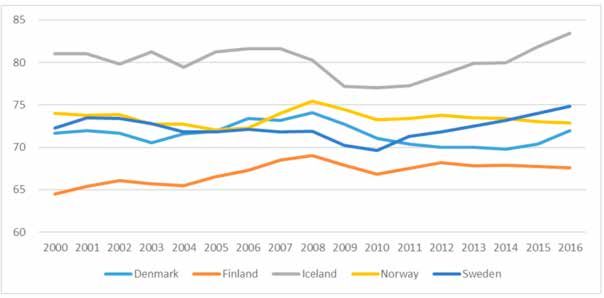
dic countries. Graph 1 shows women’s employment rates in the Nordic countries. While
women’s employment rates are higher in all Nordic countries than in the OECD countries
on average, which is below 58%, there are differences between the Nordic countries. For
instance, Finnish women’s employment rate is lower than the women’s employment rate
in the other Nordic countries, whereas Icelandic women’s employment rate is higher than
in the other Nordic countries. Although women’s employment rates partly mirror the
average employment rates in each country, this does not fully explain the differences. Why
are Finnish women working less than women in the other Nordic countries? How are the
Nordic countries supporting the dual earner / dual carer model?
Graph 1. Women’s employment rates in the Nordic countries 2000–2016 (OECD, 2016a)
Regarding Finland, one explanation might be that wom- er Nordic countries. The Nordic states support part-time
en do not work part-time as often as in the other Nor- working to different extents. Increasing part-time work
dic countries. In 2012, part-time employment as a per- could have a positive effect on women’s socioeconomic
centage of women’s total employment was only 19% position: the possibility to work part-time can ease wom-
in Finland compared to 46% in Iceland, 42% in Norway, en’s possibilities to both work and take care of their care
39% in Sweden and 36% in Denmark (Drange and Ege- responsibilities at the same time. Particularly well-paid
land, 2014). These differences might explain why Finnish part-time employment has a positive effect on women’s
women’s employment rate is lower than that in the oth- position in the society. However, sometimes part-time
6work is not well-paid and does not include the same ca- discrimination. In their study of the Swedish labour mar-
reer possibilities as full-time work. In that case, part-time ket, they found that this is particularly true in the public
work can have also a negative effect on women’s socio- sector and in certain professions, such as medicine (Berg-
economic position. gren and Lauster, 2014). There are also practices that can
decrease recruitment discrimination. For instance, the
That Iceland has the highest employment rate for wom- use of blind CVs, where names and gender are not dis-
en is partly explained by the fact that Iceland has the closed in CVs.
highest employment rate not only among the Nordic
countries but in the whole of Europe, with a relatively While legislation aims to secure women’s and parents’
small difference between men and women. An addi- position in the labour market, entrepreneurs do not
tional explanation might be the parental benefit system usually enjoy the same benefits as employed parents.
with the shortest parental leave when compared with For this reason, the emphasis on entrepreneurialism of
the other Nordic countries. Further, Icelandic men are the Nordic welfare states has also been criticized (Ahl et
increasingly benefiting from parental leaves, leading in al., 2016). It is important to understand that many of the
numbers of taking out days with daily cash benefits at welfare benefits have been tight on employment. How-
childbirth and adoption. ever, it is also possible to change the policies in order to
better incorporate different situations.
Women’s employment and particularly women’s terms
of employment are linked to discrimination of women The changing nature of work brings also new challenges
in the labour markets. The Nordic model aims to secure for reconciling work and family. For instance, since the
the possibilities for women to both work and take care of 1990s employment has not been as secure as it used to
their care responsibilities at home. While this has positive be. Particularly women work on fixed-term contracts.
effects on women’s employment rates, it can have both New technologies have also changed the working envi-
positive and negative effects on women’s terms of em- ronment allowing work from home with different devic-
ployment. When employers expect women to shoulder es. Work can thus spill over into family life. On the other
more care responsibilities at home, women’s negotiation hand, possibilities for remote work can sometimes help
power at work is lower than that of men’s. These beliefs in reconciling work and family. Society has also shifted
coupled with other gender beliefs disadvantage moth- towards the 24/7 model, meaning that many businesses
ers in the labour market (Berggren and Lauster, 2014). face the pressure of being available all the time. Corre-
Even childless women experience discrimination in re- spondingly, employees with children would need flex-
cruitment because family matters are not discussed in ible childcare services. Thus, the changing operating
job interviews. However, Berggren and Lauster (2014) ar- environment creates challenges for policies and in rec-
gue that professional experience and credentials reduce onciling work and family.
7Dual carers?
While the dual earner side of the dual earner / dual carer model is achieved rather well in
the Nordic countries, the achievements in the dual carer side vary. For instance, there are
major differences between the Nordic countries in the usage of parental leaves by moth-
ers and fathers. In Iceland, Sweden and Norway fathers took over 40% of parental leaves
in 2013. During the same year, fathers took under 30% of parental leaves in Denmark and
under 20% of parental leaves in Finland. (OECD, 2016b) While parental leaves are an inter-
esting case because of the differences between the Nordic countries, there are also many
other care responsibilities, which are unevenly divided between men and women. For
instance, women shoulder more responsibilities in taking care of the elderly, such as their
ageing parents. In this essay, I focus on parenting because the literature review includes
more studies on parenting.
The usage of parental leaves by fathers is strongly related Denmark, 74% in Iceland, 69% in Norway and 51% in Swe-
to family policies. For example, before Iceland introduced den (Duvander and Ellingsæter, 2016). These differences
the 3+3+3 parental leave model (3 months for mothers, 3 can be caused by differences in the possibilities to work
months for fathers, and 3 months can be shared) in 2000, part-time. Also, the quality of childcare and parents’ con-
only 3% of Icelandic fathers took parental leaves (Eydal fidence in it can make a difference. On the other hand,
and Gislason, 2014). Father’s quotas are seen as a very in Sweden income-based parental leaves are more exten-
positive policy in the Nordic countries because they have sive and flexible than in the other Nordic countries, and
made it possible for fathers to stay at home with the chil- can be used also when the child is more than 1-year old. In
dren. Currently, when fathers shoulder their care respon- Finland, the parents of over 1-year old children cannot get
sibilities, they face different problems as parents than income-based higher compensation but take care of chil-
mothers do. For instance, in Denmark, fathers need to dren at home for a very low child home care allowance,
negotiate their parental leaves individually, while women which also does not contribute to their pensions. This is
can only announce when they take parental leaves. This highly problematic because it lowers particularly Finnish
means that fathers’ entitlement to take parental leaves mothers’ socioeconomic position in society. However, the
varies a lot between industries and workplaces. (Bloks- solution might not be that simple, because some women
gaard, 2014). Father’s quotas have made fathers’ paren- also take care of children at home because they do not
tal leaves more accepted and reduced discrimination have a workplace to which they could return.
in Iceland, Sweden and Norway. However, men still face
different kinds of expectations at work in comparison to In international literature, the situation in which both state
women in the Nordic countries. For instance, it might be and family are responsible for care is called defamiliariza-
easier for a mother to take a day off in order to care for a tion of care responsibilities. In Nordic literature, the lost
sick child at home. In order to realize dual caring, men’s capacity to defamiliarize care responsibilities is seen as a
possibilities in shouldering care responsibilities would threat to a universal Nordic welfare model (Eydal and Ros-
need to be addressed. tgaard, 2011; Lister, 2009; Rauch, 2007). For example, Eydal
and Rostgaard (2011) argue that the recent introduction
Although caring can make life meaningful in many ways, of cash-for-care schemes in the Nordic countries seems to
the uneven share of care responsibilities has a negative go against the Nordic dual earner / dual carer model and
effect on women’s socioeconomic position. In addition ideals of gender equality, because these schemes support
to making dual caring possible, the Nordic countries pro- maternal care of children at home. Although Finland has
vide childcare services for families. There are, however, a longer history of child home care allowances, also the
also differences in the usage of childcare services in the other Nordic countries have taken steps towards the di-
Nordic countries. For instance, in Finland only 29% of rection of familiarization. Why is familiarisation women’s
1-year old children were in publicly subsidized childcare problem then? And why is it a problem anyway?
in 2013, whereas the corresponding figures were 89% in
8Many care responsibilities are not paid, even in the Nor- level entails lower levels of work-family conflict. (Öun,
dic countries. And when care responsibilities are paid, 2012). While Finnish women suffer financially when they
payment is usually modest in comparison to wages. The use child home care allowances, they also experience
Nordic welfare system provides the most generous bene- less conflicts in reconciling work and family life.
fits, for instance pensions, for those individuals who have
paid high amounts of income tax. Care responsibilities To summarize, the ideal of the Nordic welfare model has
have no or modest effect on increasing the income tax been to encourage the dual earner / dual carer model.
related benefits. It can be argued that even the Nordic The Nordic countries have been successful particularly
welfare society ideal is thus founded on valuing the norm in increasing women’s employment rates. However, the
of a (male) wage earner. Full-time work is valued because rate of women’s employment is still lower than that of
it is seen as guaranteeing economic independence and men’s. In addition, women still shoulder more unpaid
as being one of the most important ways of social inclu- or modestly paid care responsibilities. Because socioec-
sion (Julkunen, 2013). The aim of the dual earner / dual onomic position depends heavily on individual income
carer model is to include women in the wage-earning and income-related benefits, women’s socioeconomic
society. Parental leave benefits are also income-based, position is, on average, lower than men’s in the Nordic
meaning that those parents who have been working be- countries. There are also big differences in family and
fore having children receive higher benefits. In this kind employment policies and their outcomes in the Nordic
of welfare system, the uneven share of care responsibili- countries. Policy changes in these areas affect families’
ties is a gender equality problem. well-being and their possibilities to realize the dual earn-
er / dual carer model.
Families’ well-being is also important in assessing the
success of family policies. Öun (2012) studied the differ- In addition to lowering mothers’ socioeconomic position,
ences in experiences of conflicting demands between changes in childcare, parenting and employment securi-
work and family of parents in the Nordic countries. Ac- ty policies can also contribute to the decline in fertility
cording to her study, a majority of the respondents re- rates in countries providing affordable methods of birth
ported that they experience a balance between their control. Fertility rates per woman are still higher in the
work and family life. In addition to parents, also child- Nordic countries than in OECD countries (OECD, 2015).
less participants reported only somewhat lower levels This supports the view that, despite its problems, the
of work and family life conflicts. One of the interesting Nordic welfare model has been successful in encourag-
findings of the study is that in Finland the reported lev- ing parenting through childcare services, parental leaves
el of work-family conflict was significantly lower than in and child benefits. However, recent changes show that
the other Nordic countries. Öun concludes that the poli- this success might not continue. Fertility rates have been
cies aiming to facilitate reconciliation between work and declining recently particularly in Finland and Norway.
family bring more mothers into the labour market and Declining fertility rates are a concern for the sustainabili-
thus increase the overall level of work-family conflict. She ty of the tax-funded welfare state.
also concludes that gender equality at the household
9Employed care workers’ position in Nordic welfare societies
One of the main gender equality weaknesses of the Nordic welfare society is the high level
of gender segregation in the Nordic countries. The welfare state employs women to work
in kindergartens, schools, school kitchens and nursing homes. In these jobs women do not
earn as much as they would if they worked in private industry and the high gender pay
gap is seen as one of the problems of Nordic welfare states. This phenomenon of the high
segregation of welfare states is sometimes called a “welfare state paradox” (Ellingsæter,
2013). In order to overcome this inequality, Nordic welfare states should either succeed in
mitigating gender segregation or value care workers’ professions more. Ideally, the Nordic
countries should aim to accomplish both goals. Next, I focus on employed care workers.
Changes in the terms of employment of care workers is For instance, in Sweden the professional requirements in
also a gender equality issue because the majority of care home care services for the elderly have been lowered. It
workers are women. For instance, in Finland, parliament is would be crucial to consider the risk of a change in the
working on a major health and social services (SOTE) re- position of these care workers as a result of the reform.
form. This reform includes healthcare and social services
personnel, a total of 220,000 employees, currently em- Research on current values of managing care work and
ployed by the municipalities, who will be transferred to care workers is also troubling. Hirvonen (2013) inter-
the employment of the newly formed counties (“Health, viewed front-line care workers, such as nurses, in Finland.
social services and regional government reform - Person- Her study showed that care workers argue that medi-
nel”). In addition to working for counties, the goal of the co-managerial management ideology views care work
reform is for a large proportion of care workers to work for as disembodied and technical work. She concludes that
private companies, from which counties can buy services. the reconstruction of the welfare state since the 1990s
This reform includes a high future risk of care workers be- has emphasized care workers’ technical and medical
ing valued less and that they will have worse terms of em- competence, while elements of social care have become
ployment. Initially, these private companies might provide regarded as a non-professional activity. (Hirvonen, 2014).
good terms of employment. However, if only a few com- The appreciation of only medical and technical aspects of
panies are left to provide services, they would probably care work means that traditionally female values of care
begin to compete by lowering wages. Also, professional are not respected. This could be addressed by changing
requirements may be lowered in order to save money. managerial practices and ideologies.
10Gender equality in public and publicly subsidized services
In all the Nordic countries, legislation requires public authorities to promote gender equal-
ity. The strategies for promoting gender equality and diversity are specified in legislations
to different extents but, in practice, the strategies for promoting gender equality consist of
a dual strategy. This dual strategy includes a gender mainstreaming strategy and a strategy
of special projects and services. Gender mainstreaming means that the gender perspec-
tive is mainstreamed both in public services and in public decision-making. For instance,
the gender perspective should be mainstreamed in the policies discussed above, including
social, health, education and employment policies. By special projects and services, I mean
services designed for certain groups of women or men or gender minorities.
One of the challenges in organizing public and publicly addition, one of the Swedish state agencies, the Swed-
subsidized services is to address the needs of vulnerable ish Public Employment Service PES, recommends further
groups. For instance, single parents are in a vulnerable developing gender mainstreaming in the process of pro-
position and most single parents are women. Improving curement and in the evaluation of procured services and
their position would also help their children. Aged wid- service providers, in order to secure women’s and men’s
owed women face higher risks of poverty. Some groups equal access to services.
of men are also in a vulnerable position. For instance, old-
er working-class men use health services less often than A second example of gender mainstreaming also comes
other groups. Some groups of boys are at high risk of not from Sweden. The Swedish government and parliament
completing their education. Addressing gender equality organized a fixed-term gender mainstreaming pro-
in public and publicly subsidized services would require gramme called JÄMI. The programme focused on cre-
these vulnerable groups to be taken into account and ating sustainable support structures, which would last
perhaps designing special services for them. In addition even after the programme (Callerstig, 2014: 42-47). In
to vulnerable groups, gender equality is important for all order to be sustainable, gender mainstreaming requires
citizens. For instance, in schools, gender equality ideals, also support structures. These structures can require and
or a lack of them, affect children’s views of their future encourage gender mainstreaming, and provide informa-
possibilities. tion and possibilities for benchmarking.
I will present a few examples of gender mainstreaming. In In Finland, the ministry of Social Affairs and Health has
Sweden, public health policy goals and gender equality developed a guide for gender mainstreaming in law
policy goals are intertwined and addressing domestic vio- making and has provided several training courses on
lence is included in the health policy. Many state agencies gender mainstreaming for law makers. In Norway, stu-
practice gender mainstreaming and analyze gender ine- dents of medicine are offered courses on gender per-
quality within their specific policy areas. The general find- spectives. These courses help them in realizing gender
ing of the analysis is that women are more ill and that they equality in their profession.
do not get the same amount of treatment as men. The
Public Health Agency of Sweden (Folkhälsomyndighet- In Denmark, the Ministry for Children, Education and
en) includes a gender aspect in their yearly reports about Gender Equality publishes an equality report every other
public health. The National Board of Health and Welfare year. This equality report focuses on women’s and men’s
(Socialstyrelsen) has also written reports about gender level of education, wage differences, labour-market par-
equal health and healthcare. In 2007, the Swedish Asso- ticipation, unemployment, retirement and other statis-
ciation of Local Authorities and Regions, SALAR, (Sveriges tics. The other Nordic countries publish similar statistics,
Kommuner och Landsting) released a report about equal- too. This information helps in improving public and pub-
ity in health and healthcare. Gender equal health and its licly subsidized services from the gender perspective.
development over time are also discussed in a report by However, the statistics are not useful without analysis
the Swedish Gender Equality Investigation from 2015. In and theories. For this reason, also analysis and recom-
11mendations based on both data and theories are nec- I will present also a few examples of special projects and
essary in order to make the reports helpful. In addition, services. In Denmark, a special campaign encourages
qualitative studies are also useful in gender mainstream- men to react to symptoms and seek health advice. In the
ing. In Sweden, the government appointed a Delegation campaign picture, there are two older men and a text
for Gender Equality in Working Life in 2011 to collect and “Real men go to the doctor”. The aim of the campaign
disseminate knowledge about the different conditions was to get particularly men above the age of 55 years
and opportunities for women and men in working life. with a low education background to react to cancer-re-
In their report, the delegation stated that the Swedish lated symptoms. In Finland, a network of diversified fam-
labour market is still unequal: women and men still tend ilies brings together 10 family organizations, including
to choose gender stereotypical jobs and typically male an organization for families with a single parent and an
jobs still pay more. organization for families with LGBT parents. The aim of
the network is to influence family policies.
12Diversity and Nordic welfare societies
Diversity and gender equality are intertwined. For instance, without the recognition of
diversity, some groups of women are excluded from the definition of equality. Feminist
identity politics have called for recognition of all women. Sometimes diversity has been
defined through the “big eight” socio-cultural categorizations, which include gender, age,
race, ethnicity, religion, class, sexual orientation and (dis)ability. In addition to women, also
groups of men can be in a vulnerable position. Considering two or more socio-cultural
categorizations and their combined effects is called intersectionality. In this essay, I focus
mainly on ethnic minorities, considering also intersection of gender and ethnicity.
There is a growing number of studies which discuss the forms of inequalities among women are an obstacle for
difficulties that Nordic welfare societies have in meeting achieving gender equality from the perspective of some
their residents’ needs, which are broadened by diversity ethnic and religious minorities. Nordic countries face
(Borchorst, 2012; Ebot, 2014; Häikiö and Hvinden, 2012; common challenges in overcoming the present margin-
Siim, 2013). Some argue that Nordic universalism is in alization of diverse migrant groups and diverse ethnic
fact false universalism because in reality, not all people fit and religious minorities. (Siim, 2013) The recognition of
into the earner role, which is required to receive the best ethnic and religious minorities means recognizing their
benefits (Häikiö and Hvinden, 2012). This earner norm values and cultural practices. Ebot (2014) explains that
can also be described as white, male, middle-class and because family policies in the Nordic countries focus on
non-disabled. When services and benefits in the welfare realizing the dual earner / dual carer model, policy makers
society are designed with only this group and their fam- and researchers do not pay attention to the large-scale
ilies in mind, other people and their families are not rec- social dynamics and realities of ethnic minority groups.
ognized by the system. For instance, the aim of gender Shared parenting has become a prevalent social norm
and diversity mainstreaming of public and publicly sub- and service providers judge other ways of parenting as
sidized services is to design services that are good for all patriarchal and peculiar. The rhetoric of gender equality
genders and diversified groups of people. is detached from religion, leaving different religious val-
ues unrecognized. (Ebot, 2014) In his paper, Ebot draws
From the point of view of designing public services and on interviews with Black African parents in Finland. He
welfare benefits, equality is not achieved by treating all concludes that for those parents, the gendered patterns
people strictly in the same way. Instead, equality of out- of caring include also ethics of mutual support, solidar-
comes can be achieved by treating persons in different ity and obligation. He argues that Black African parents
circumstances in dissimilar ways. This has not been typi- do not link gendered patterns of caring into devaluing
cal in the Nordic countries. While the universality of wel- women’s work. (Ebot, 2014) In order to include ethnic
fare services and benefits is differentiated in various ways minorities in Nordic gender equality politics, their views
in the Nordic countries this differentiation is rarely done need to be recognized and listened to.
to accommodate diversity. Instead, differentiation has in-
volved exclusion, marginalization and reduced access to The recognition of ethnic and religious minorities might
welfare. (Häikiö and Hvinden, 2012) For example, while mean that public service providers train their person-
newly-arrived migrants are entitled to means-tested fi- nel and employ more personnel with diversified back-
nancial benefits, the payments are lower than regular so- grounds and/or professional skills for diversity. However,
cial assistance benefits. In addition, the level of benefits is service providers are only at the surface of the entire sys-
related to the amount of earlier earnings in the country. tem. In order to accommodate ethnic and religious di-
(Häikiö and Hvinden, 2012) This kind of direct and indi- versity, the dual earner norm should be challenged also
rect limitation cannot be defined as universal welfare. in the design of social assistance for families with chil-
dren. In the redistribution of benefits, there is less scope
Sometimes the Nordic ideals on gender equality seem to for accommodating diversity: benefit arrangements
conflict with recognizing ethnic diversity. Currently, new tend to be tightly controlled, discretionary, means-tested
13and meagre, particularly for persons with ethnic minori- dren living in poor families has grown. Social assistance
ty backgrounds and short residence in a Nordic country for families with children has deteriorated and this par-
(Häikiö and Hvinden, 2012). Although there is less room ticularly hits those families in a vulnerable position, such
for diversity mainstreaming of these service practices, it as single parent families. This observation illustrates how
would be possible to take into account diversity in de- equality requires both recognition and redistribution of
veloping the benefit systems. For instance, the systems tax-financed resources, as stated by Häikiö and Hvinden
could be gradually made more flexible. (2012). While the recognition of diversified groups is a
crucial step towards equality, without redistribution it
Nordic countries have also taken many steps towards mainly helps the wealthy. On the other hand, redistribu-
recognizing diversity. For instance, in Finland lesbian and tion without the recognition of diversified groups only
gay parents are currently recognized better than in the helps those who fit into certain strict norms.
1990s. However, at the same time the number of chil-
14Strengths and weaknesses of the Nordic welfare model
in realizing gender equality
The level of gender equality has both increased and decreased due to Nordic welfare
policies since the 1990s. Some of the policies made in the Nordic countries have had a
positive effect on gender equality. These include father’s quotas, policies supporting part-
time work, parental support in maternity health care, better recognition of certain minor-
ities and the development of gender equality politics and policies. On the other hand,
some of the policy changes in the Nordic countries have had a negative effect on gender
equality. These include the reduced capacity of defamiliarizating care responsibilities, and
social and health sector reforms building on technocratic and neoliberal ideologies.
These ideologies cause feminine values of care to not be appreciated in the reforms.
From the perspective of gender equality, the strengths of equality in Nordic societies. For example, the changing
Nordic welfare societies are that there are good universal nature of work can increase the difficulties of reconciling
services such as health care and education, there are ben- work and care responsibilities. Public and publicly subsi-
efits for parents and possibilities to reconcile work and dized services would need to be flexible in order to meet
family, there are many women as political actors, gender the new requirements. Changes in the trade unions can
equality is mainstreamed into politics, and people trust mean that the terms of employment need to be negoti-
the public sector. In Sweden, Norway and Iceland father’s ated in new forums, which causes a challenge for gender
quotas have enabled fathers to have more time with chil- equality. Increased diversity and polarization of different
dren. In addition, some groups, which used to be mar- groups can cause problems if the situation is not ad-
ginalized, such as families with lesbian and gay parents, dressed in time. In addition, the dependency ratio will
are now better recognized in public services. The Nordic cause problems in funding the welfare state in the fu-
welfare model has also been successful in encouraging ture. The dependency ratio is linked to fertility rates, too.
parenting because fertility rates per woman are higher in If Nordic societies are unable to encourage women and
the Nordic countries than in OECD countries. men to have children anymore, fertility rates will decline
and this will create concern for the sustainability of the
Currently, the weaknesses of Nordic welfare societies are tax-funded welfare state. General threats to the Nordic
that the level of gender segregation is high, employed welfare model have gendered effects, too. For instance,
care workers are not valued as much as people employed a possible change in how citizens trust the public sector
by the private sector, vulnerable groups have suffered and difficulties in funding its services would be a risk for
due to budget cuts since the 1990s, and gender equality the quality of services in the future.
policies and gender mainstreaming are not as efficient
as fine speeches claim them to be. It is also a weakness In addition to the operating environment, also politics
that gender equality is often seen only as single cases can cause challenges for achieving gender equality in
and that gendered structures are ignored. At the same the future. For instance, while earlier reforms in the social
time, the theories on which these views are based are and health sector have been criticized as being techno-
not openly discussed. In addition, diversity of residents cratic and neoliberal, this risk continues in the current
is not adequately recognized in public and publicly sub- and future reforms. This is a risk regarding women’s terms
sidized services. Current weaknesses also include the of employment. One of the future challenges of gender
ideologies and attitudes which have already altered the equality politics is that gender equality and diversity
Nordic welfare model. need to be considered together in a meaningful way.
Particularly in Finland and Denmark, there is a risk that
In addition to the current weaknesses, Nordic societies gender equality is seen as already having been achieved
will face more challenges in the future. The operating en- and that gender equality politics are thus forgotten or
vironment causes some challenges for achieving gender changed into gender blind diversity politics.
15Despite the challenges, Nordic societies also have many cies. In addition, the Nordic countries have a possibility to
opportunities to further develop gender equality. The reconsider some of their new political ideologies, which
Nordic countries have made many positive policy chang- aim at abandoning the universal welfare model and will
es and because there are differences between the Nordic cause polarization. However, at the same time, it has to
countries, they have a possibility to learn from each other. be acknowledged that even earlier welfare models have
For instance, there are many good examples of policies sometimes been accused of false universalism and new
on father’s quotas, part-time work, better recognition of challenges require new solutions, too.
minorities, and good gender equality politics and poli-
16Recommendations for future policy development and research
Based on the literature review and interviews, I provide some policy recommendations.
First, the existence of universal care services is cru- employment, education and youth policies. Such state-
cial for maintaining gender equality. Women in particu- ments would increase the transparency of political de-
lar benefit from the existence of these services because cisions. In addition, government statements could help
otherwise they tend to shoulder the care responsibilities public servants in gender mainstreaming. Currently,
at home. In addition, the existence of universal services public servants are required to do gender mainstream-
might encourage parenting and prevent a decline in the ing in all the Nordic countries, but their possibilities and
fertility rate. For these two reasons, gender equality and capacities for gender mainstreaming vary. For instance,
the gendered share of care responsibilities should be tak- gender mainstreaming cannot be based solely on gen-
en into account in the process of designing reforms and der-segregated statistics. Even though statistics are im-
developing public and publicly subsidized services. portant, gender mainstreaming would benefit from the-
ories. Nordic governments could support the usage of
Secondly, health and social services reforms should theories on gender equality and draw on the knowledge
aim at increasing the value of care and secure the acquired in their politics. In addition, qualitative research
terms of employment for employed care workers. could be used more in gender mainstreaming.
Thirdly, it would be important to develop policies which The sixth recommendation is that Nordic benchmarking
address the problems faced by vulnerable groups in of best practices in addressing gender equality in differ-
society. This would include addressing poor families, sin- ent policy areas would be very beneficial. For instance,
gle parents, migrants, old women in poverty and young there are many good examples of policies on father’s quo-
men at risk of dropping out of school. In addition, social tas, part-time work, better recognition of minorities, and
assistance and benefits should be designed to meet also good gender equality politics and policies.
new gendered and diversified needs of residents in the
Nordic countries. I provide also some specific recommendations for future
research. First, health and social services reforms must
Fourthly, gender mainstreaming should be supported be studied carefully. Particularly, the changes in care
at all levels of public administration and required also workers’ terms of employment need to be studied. Equali-
from private organizations providing publicly subsi- ty in needs assessment has to be studied, too. There is also
dized services. This would require support structures for a possibility to compare Nordic research. For instance, in
gender mainstreaming. There are some problems relat- Sweden there is a growing number of studies on health
ed to project funding of gender mainstreaming but also and social services and their reforms. Secondly, the
project funding could be more successful if there were changes in possibilities on reconciling work and family
permanent support structures in place. need to be studied. The reasons affecting fertility rates
should be studied, too. Gender mainstreaming should
The fifth recommendation is that governments could also be studied in order to support gender equality
develop their gender equality politics openly and work. The research on gender and welfare policies could
state the theories that their policies are based on. This support gender mainstreaming by analyzing and compar-
would mean developing government statements on ing current Nordic policies, developing theories and pro-
the desired gender equality outcomes of family, social, viding visions for better policies.
17References
Ahl, H., Berglund, K., Pettersson, K. and Tillmar, M. (2016), “From feminism to FemInc.ism: On the uneasy relationship between feminism,
entrepreneurship and the Nordic welfare state”, International Entrepreneurship and Management Journal, Vol. 12 No. 2, pp. 369–392.
Anttonen, A. (1994), “Welfare pluralism or woman friendly welfare politics?”, Women and the Welfare State, University of Jyväskylä, Jyväskylä, pp. 9–34.
Anttonen, A., Häikiö, L. and Stefansson, K. (Eds.). (2012), Welfare State, Universalism and Diversity, Edward Elgar Publishing Ltd., Cheltenham and
Northampton.
Anttonen, A., Henriksson, L. and Nätkin, R. (1994), Naisten Hyvinvointivaltio [Women and the Welfare State], Vastapaino, Tampere.
Backhans, M.C., Burström, B. and Marklund, S. (2011), “Gender Policy Developments and Policy Regimes in 22 OECD Countries, 1979-2008”,
International Journal of Health Services, Vol. 41 No. 4, pp. 595–623.
Berggren, C. and Lauster, N. (2014), “The motherhood penalty and the professional credential: inequality in career development for those with
professional degrees”, International Studies in Sociology of Education, Vol. 24 No. 1, pp. 44–64.
Bloksgaard, L. (2014), “Negotiating leave in the workplace: leave practices and masculinity constructions among Danish fathers”, in Eydal, G.B. and
Rostgaard, T. (Eds.), Fatherhood in the Nordic Welfare States : Comparing Care Policies and Practice, Policy Press, Bristol and Chicago, pp. 141–162.
Borchorst, A. (2012), “Reasessing woman-friendliness and the gender system”, in Anttonen, A., Häikiö, L. and Stefansson, K. (Eds.), Welfare State,
Universalism and Diversity, Edward Elgar Publishing, Cheltenham and Northampton, pp. 106–120.
Browne, J. (2013), “The Default Model: Gender Equality, Fatherhood, and Structural Constraint”, Politics & Gender, Vol. 9 No. 2013, pp. 152–173.
Callerstig, A. (2014), Making Equality Work: Ambiguiteis, Conflicts and Change Agents in the Implementation of Equality Policies in Public Sector
Organisations, Linköping University, Linköping.
Dahl, H.M. (2012), “Neo-liberalism Meets the Nordic Welfare State—Gaps and Silences”, NORA - Nordic Journal of Feminist and Gender Research,
Vol. 20 No. 4, pp. 283–288.
Drange, I. and Egeland, C. (2014), Part-Time Work in the Nordic Region II. A Research Review on Important Reasons, available at:
http://doi.org/10.6027/TN2014-560.
Duvander, A.-Z. and Ellingsæter, A.L. (2016), “Cash for childcare schemes in the Nordic welfare states - how durable?”, European Societies,
Vol. 18 No. 1, pp. 70–90.
Ebot, M.E. (2014), “Gender Caring: The Everyday Construction of Black African Parents in Finland”, Finnish Yearbook of Population Research,
Vol. 49, pp. 143–167.
Ellingsaeter, A.L. (2013), “Scandinavian welfare states and gender (de)segregation: Recent trends and processes”, Economic and Industrial
Democracy, Vol. 34, pp. 501–518.
Ellingsæter, A.L. (2014), “Nordic Earner–Carer Models – Why Stability and Instability?”, Journal of Social Policy, Vol. 43 No. 03, pp. 555–574.
Eräranta, K. and Kantola, J. (2016), “The Europeanization of Nordic Gender Equality: A Foucauldian Analysis of Reconciling Work and Family
in Finland”, Gender, Work and Organization, Vol. 23 No. 4, pp. 414–430.
Eydal, G.B. and Gislason, I. V. (2014), “Caring fathers and parental leave in prosperous times and times of crisis: the case of Iceland”, in Eydal, G.B.
and Rostgaard, T. (Eds.), Fatherhood in the Nordic Welfare States: Comparing Care Policies and Practice, Policy Press, Bristol and Chicago, p. 325-.
Eydal, G.B. and Rostgaard, T. (2011), “Gender Equality Revisited - Changes in Nordic Childcare Policies in the 2000s”, Social Policy and Administration,
Vol. 45 No. 2, pp. 161–179.
Eydal, G.B. and Rostgaard, T. (2014), Fatherhood in the Nordic Welfare States: Comparing Care Policies and Practice, Policy Press, Bristol and Chicago.
Häikiö, L. and Hvinden, B. (2012), “Finding the way between universalism and diversity: a challenge to the Nordic model”, Welfare State, Universalism
and Diversity, Edward Elgar Publishing Ltd., Cheltenham and Northampton, pp. 69–89.
Hernes, H. (1987), Welfare State and Woman Power, Essays in State Feminism, Norwegian University Press., Oslo.
Hirdman, Y. (1988), Genussystemet: Teoretiska Funderingar Kring Kvinnors Sociala Underordning [The Gender System: Theoretical Reflections on the
Social Subordination of Women], Maktutredningen, Uppsala.
Hirsto, H., Katila, S. and Moisander, J. (2014), “(Re)constructing economic citizenship in a welfare state – intersections of gender and class”,
Equality , Diversity and Inclusion: An International Journal, Vol. 33 No. 2, pp. 122–139.
Hirvonen, H. (2014), “Doing gendered and (dis)embodied work. Care work in the context of medico-managerial welfare state”, Nordic Social Work
Research, Routledge, Vol. 4 No. 2, pp. 113–128.
Julkunen, R. (1992), Hyvinvointivaltio Käännekohdassa [Welfare Sate at a Turning Point], Vastapaino, Tampere.
Julkunen, R. (2013), “Aktivointipolitiikka hyvinvointivaltion paradigman muutoksena” [Activation policies as a paradigm change in welfare states],
in Karjalainen, V. and Keskitalo, E. (Eds.), Kaikki Työuralle! Työttömien Aktiivipolitiikka Suomessa [Everybody needs to work! Activating policies
for unemployed people in Finland], THL the National Institute of Health and Welfare, Helsinki, pp. 21–42.
Lister, R. (2009), “A Nordic Nirvana? Gender, Citizenship, and Social Justice in the Nordic Welfare States”, International Studies, Vol. 16 No. 2, pp. 242–278.
Midtbøen, A.H. and Teigen, M. (2014), “Social Investment in Gender Equality? Changing Perspectives on Work and Welfare in Norway”,
NORA - Nordic Journal of Feminist and Gender Research, Vol. 22 No. 4, pp. 267–282.
Neilson, J. and Stanfors, M. (2014), “It’s About Time! Gender, Parenthood, and Household Divisions of Labor Under Different Welfare Regimes”,
Journal of Family Issues, Vol. 35 No. 8, pp. 1066–1088.
OECD. (2015), “Fertility rates”, available at: https://data.oecd.org/pop/fertility-rates.htm.
OECD. (2016a), “OECD Stat”, available at: https://stats.oecd.org/Index.aspx?DataSetCode=LFS_SEXAGE_I_R#.
OECD. (2016b), Backgrounder on Fathers’ Leave and Its Use, available at: https://www.oecd.org/els/.../Backgrounder-fathers-use-of-leave.pdf.
18You can also read


