2021 Budget Outlook Council Presentation July 8, 2020 - 2021-2025 Budget Outlook: 2020 Jul 08
←
→
Page content transcription
If your browser does not render page correctly, please read the page content below
2021 Budget Outlook
Council Presentation
July 8, 2020

                       1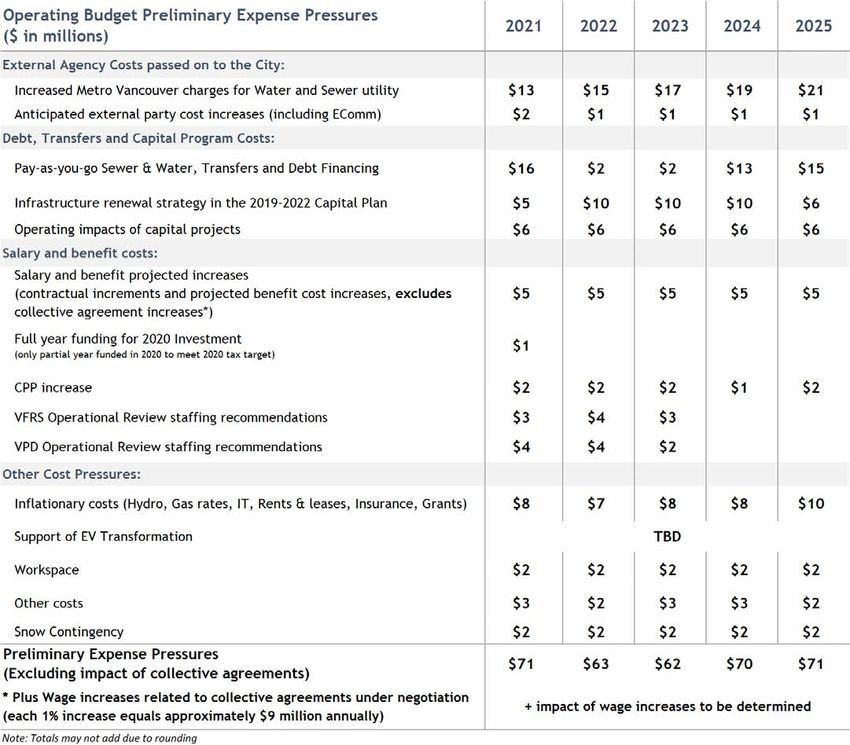
Agenda

• Context and Approach
• 2021 Council Priorities
• 2020 Budget Forecast Update
• 2021 – 2025 Operating Budget Outlook
• Tax Scenarios and Service Impacts
• Public Engagement Update
• Budget Timeline

                                         2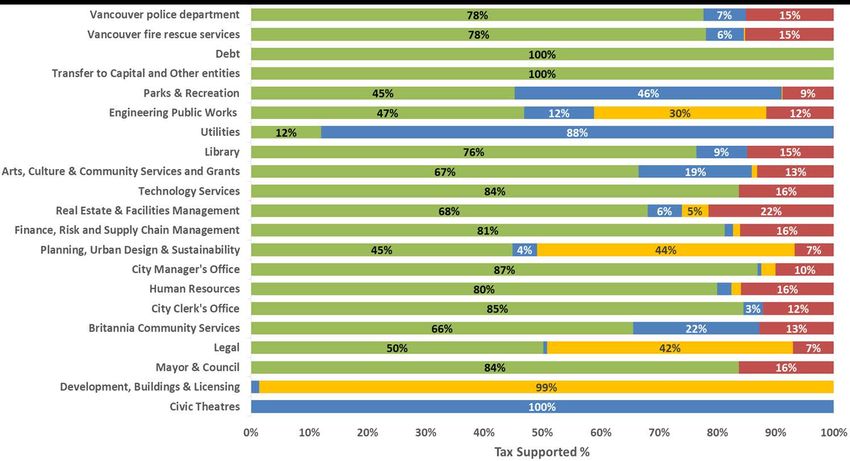
Context: Planning continuum

                             Council
       Council                                           Staff
                             & Staff

                                                             Financial
Vancouver
                                               Service       Strategies
   Plan     Priorities   Goals    Strategies
                                                Plans         Plans &
  Vision
                                                              Budgets

                                                                   3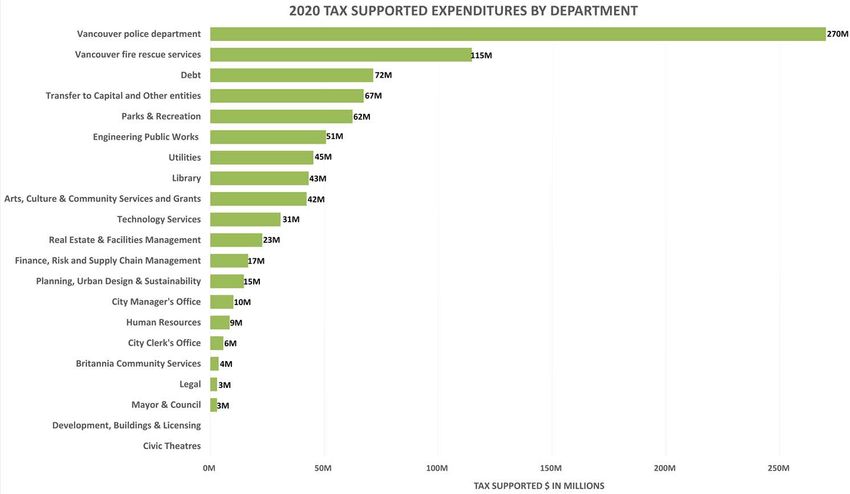
Confirming 2021 Council Priorities

                                     4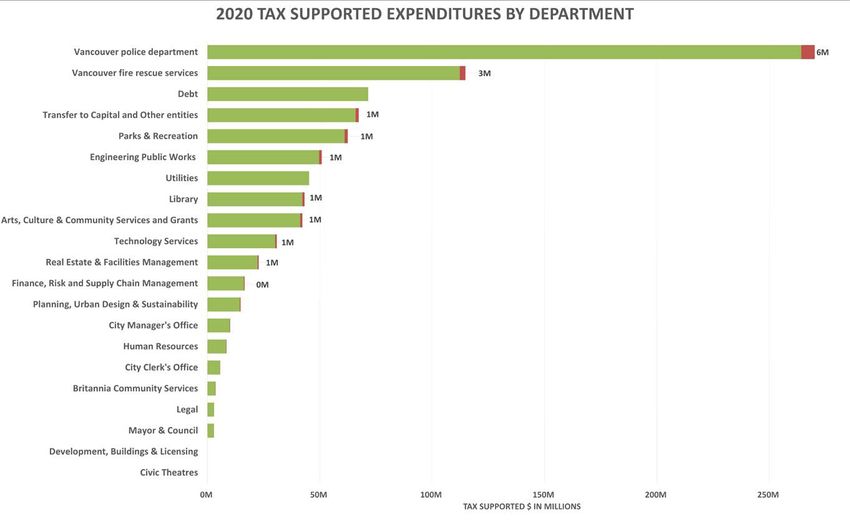
2021 Council priorities - detailed

                                                                             Values
           Environmental Sustainability - Resilience – Inclusion – Reconciliation - Innovation - Efficiency – Accountability - Financial Sustainability
                                                          Outcome – What kind of city we want to be
                 An affordable, livable city      A thriving and vibrant city        A diverse, welcoming city        A sustainable, green city
                                                                           Priorities

                                                     Deliver Quality Core Services that Meet Residents’ Needs

    Address Affordability and             Protect and Build                  Increase Focus on Equity and             Accelerate Action on          (Core Services)
       the Housing Crisis             a Resilient Local Economy                   Critical Social Issues                Climate Change

              Alignment of priority initiatives/issues raised by Council to the Overall Priorities – Examples – not meant to be an exhaustive list

-       Improve social housing    -      Support local business          -       Further actions to address the   -        Meet IPCC / GHG     -   Enhance street cleaning
        options                   -      Grow existing and explore               opioid crisis                             reduction targets       and litter pick up
-       Strengthen renter                more partnerships               -       Improve childcare options        -        Public building     -   Maintain and renew public
        protection                -      Explore more revenue            -       Improve food security                     retrofits               amenities through capital
-       Non-market rental                sources                         -       Ensure services and amenities    -        Sea Level Rise          projects
        housing                   -      Workforce housing including             are widely accessible to, and             mitigation          -   Improve VFRS response
-       Work to end                      affordable rentals                      adequate for, the needs of       -        Zero Waste              times
        homelessness              -      Green economy                           our diverse population                    initiatives         -   Improve cleanliness and
-       Diverse housing options   -      Support local artists / grow    -       Reduce barriers to               -        Urban tree canopy       maintenance in parks and
-       Ensure affordability as          arts and culture job sector             participation                    -        Increase active         other recreation venues
        we grow and develop our   -      Industrial land strategy        -       Continue with Reconciliation              transportation      -   Access to public spaces
        city                      -      Support improved transit                and cultural redress efforts     -        Climate             -   Municipal government
-       Reduce regulatory red            options                                 with all communities                      emergency               role and response (CCRC)
        tape / reduce permit      -      Economic recovery (CCRC)        -       Social well-being, physical               (CCRC)              -   Complete communities
        wait times                                                               and mental health                                                 (CCRC)
-       Housing and                                                                                                                            -   New fiscal tools (CCRC)
        homelessness (CCRC)
                                                                        Vancouver Plan as an enabler

                    We will be flexible and quickly adjust within each priority to best support recovery from the COVID-19 pandemic

                                                                                                                                                                          5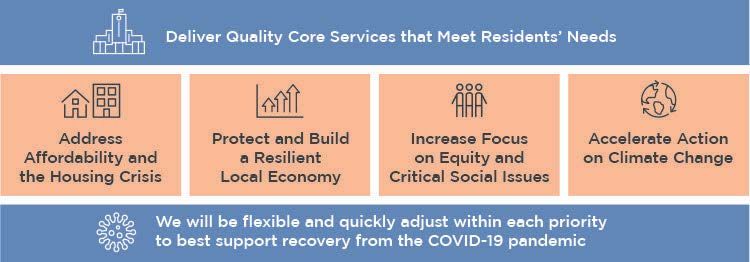
2021-2025 Budget Outlook
Context and Approach

                           6
Purpose of the Budget Outlook
Overview of financial landscape going into next budget cycle
Council direction for 2021 budget development
– Confirm 2021 Council Priorities
– Provide early guidance regarding revenue driven by property tax increase
Staff will develop service plans, revenues and costing
based on this direction for the Draft 2021 Budget in the fall
The outlook initiates the budget process - specific budget
decisions are not made at this time
7External environment
• Continued uncertainty regarding future COVID-19 Impacts
expected into 2021, potentially including :
– Reduced revenues due to provincial health orders and related closures of
facilities and revenue-generating services
– Increased costs due to the City’s response efforts, particularly for the most
vulnerable citizens
– Economic and social impacts on citizens and businesses
• Focus on critical social issues including increased global
focus on racism, ongoing local focus on opioid crisis,
homelessness, etc.
• Continued focus on climate change challenges
8Impacts on City finances
• Working at reduced capacity in 2020 due to COVID
– Several planned 2020 initiatives with approved budget on hold or delayed
– Service offerings reduced and service levels impacted
– Staff layoffs due to facilities closures
– Vacancies not filled due to financial constraints
• Multi year pressures beyond 2021 expected to impact
five-year financial plan
– Fixed cost increases
– Multi-year staffing increases for VPD and VFRS
– Funding for infrastructural renewal
– Full year funding for delayed 2020 initiatives
9Further work
What will we be doing between now and the draft budget?
• Aligning current service plans and budgets to support Council priorities adjusted
for COVID recovery:
– Ongoing social issues – (addressing equity and racism, support for vulnerable populations,
reopening libraries and other facilities)
– Supporting economic recovery (BIA support, patio permits)
– Accelerated action on climate change (Fleet replacement and electrical vehicle resource
allocation
– Continued focus on Housing
• Addressing cost pressures and refining budget estimates:
– Workspace needs – based on success of remote work during pandemic
– Continuous process improvement (CPI) initiatives for ongoing future year savings
– Rebuild program – use this as an opportunity to change how we work and build capacity for the
future
10Senior Government Financial Support and Fiscal stimulus • The Federal government is negotiating safe restart agreements with provincial and territorial counterparts to determine how $14 billion in federal funding will be allocated amongst provincial agencies, territories and their municipalities and other organizations • Funding will be critical for Vancouver to enable the full reopening of all city facilities and services such as Community Centers and Libraries, however the program is not sufficient. • Staff continue to work with FCM to advocate for additional, direct funding to municipalities who are facing estimated non-recoverable losses of $10 - 15 billion nationwide (as reported in April 2020 by FCM). • The City is monitoring potential federal stimulus funding, and is partnering with other municipalities and FCM to ensure that municipal needs are represented as the government considers future stimulus packages • The 2021 Operating and Capital budgets will consider these potential funding programs to ensure the City maximizes opportunities to access funding to support key Council priority areas. 11
2020 Budget Forecast Update

                              12
2020 forecast update
• Overall, still forecasting to achieve balanced 2020 Budget
• Revenues forecast to improve by $12 million compared to May 26 update
Key changes include:
– Parking revenue and bylaw fines due to increased parking activity
– Higher traffic fine sharing revenue received
– Partially offset by lower licence and development revenues from a declining
development activity trend
• Improvement in revenues and continued cost savings have enabled funding
for phased/limited restarts of services including libraries services being
offered online and curbside, DTES community centres, playgrounds, various
sports and rec activities such as outdoor pools, lifeguards etc.
• Due to the continued 2020 revenue impacts of COVID, senior government
funding will be needed to fully enable restart of community centres, all
library services, and other services to pre-COVID levels
13Updated 2020 forecast
2020 Forecast May 26 Forecast June forecast update
Revenues (136) (124)
Salary-related expense mitigation 64 64
Non-salary expense mitigation 20 20
Restart costs (12)
(libraries, parks, and community services)
Reserves 52 52
Balanced 2020 Budget - -
142021 – 2025 Operating Budget
Outlook
15Principles for 2021 Budget
Focus on alignment to Council Priorities
Stay flexible to adjust to expected ongoing uncertainty
Continue to look for opportunities to do things differently in 2021
and future years
Develop options to respond to lower 2021 revenue scenarios
(Approved 2020 budget is baseline for 2021)
Opportunity to prioritize resources designated for 2020 initiatives
that were deferred (limited capacity for new investments)
16Initial 2021 Outlook
Known costs Uncertain costs Uncertain revenues
• Fixed cost increases • Wages i.e. all • Will revenues return
above inflation i.e.
collective bargaining to 2020 levels, and
Metro utility charges,
insurance agreements have when?
expired in 2019 • Ability to offer
• Planned multi-year
staffing increases for • Cost to operate services at previous
VPD and VFRS services at previous levels while
• Infrastructural levels (due to public addressing physical
renewal as per 2019- health constraints) distancing, additional
2022 capital plan cleaning and PPE
• Reinstated staffing requirements may
levels required to limit revenue
meet 2020 Budget
commitments
17Initial 2021 Outlook
Understanding the projected tax increase in the Outlook:
• In a “back to normal” scenario, assuming…
– Revenues reach “normal” levels in 2021 or before
– Services and facilities are operational; while meeting necessary restrictions
– Continued implementation of VPD and VFRS staffing additions identified in
operational reviews
– 2021 capital plan work proceeds as per multi-year plan
– Staffing in support of Council motions and priorities returns to planned 2020
levels
– All cost pressures are realized and funded
• The 2021 tax increase would be 7% (blended tax and utilities of
6.4%)
• Staff will review options to find savings and/or adjust service levels to
achieve a 5% tax increase (or to prepare if revenues do not return to
normal 2020 levels)
182021 impacts of 2020 budget investments
2020
2021 Budget
Draft
Outlook Property
Budget
tax increase of 7%
includes deferral of
2 months of 2020
investments and
new cost pressures
(insurance,
10.0% eComm)
5 Year Plan Property Tax Increase
2021 8.0%
7.0% 7.0%
Budget 6.0% 5.7% 5.6%
5.1%
Outlook 4.6%
4.0%
2.0%
0.0%
2020 Approved 2021 2022 2023 2024 2025
192021-2025 Operating Budget Revenues
202021-2025 Revenue Changes
Operating Revenues are projected to increase primarily due to:
• Property tax increases estimated at approximately 7% in 2021 and
5.4-5.9% in future years, as required to cover fixed cost base,
operational review funding and asset renewal in the capital plan
• Revenue from new development estimated to increase by $5
million
• Program fee and development fee revenues estimated to increase
2% each year assuming volumes to return 2020 levels
• Utility fees estimated to increase by 5.7% annually on average for
the next five years, based on Metro Vancouver regional utility charge
forecasts (estimated at 7.7% shown in the 2020-2024 financial plan)
212021-2025 Operating Budget Expenditure
Pressures
222021-2025 Expense Pressures
Preliminary work shows expense pressures to increase in following area:
• External agencies cost increases (e.g. Ecomm) and senior levels of
government estimated at $1 to $2 million over the next five years
• Regional utility charges passed on to the City by Metro Vancouver
– Forecast to increase 6% -10% for water and 7%-8% for sewer over next 5 years,
driven by major infrastructure investments)
• Fixed Costs increase estimated at $6 to $7 million
– Includes energy, equipment services, rent and Insurance
• Cost to support infrastructure renewal estimated at $5 to $10 million
• Current outlook shows a risk of potential increases in wage expenses,
dependent on the terms of future collective agreement settlements
23Funding priorities for 2021
Subject to sufficient revenue in 2021:
• Restarting of core services (e.g. library, community facilities) primarily bringing staff
back from lay-off
– Restart also considers better ways of providing the services, while meeting
provincial health requirements
• Releasing vacancies
– to focus on core services (examples: fire vacancies, street cleaning)
– to address 2020 council priorities that were delayed to balance the 2020 budget
or reprioritize to areas of higher priority for 2021
• Once these are addressed, if additional revenues are found or cost savings identified,
consideration could be given for new staffing to address:
– new risk areas
– addition to core services (example: fire and police ops reviews)
– additional staff resources needed to address Council priorities
24Tax Scenarios and Service Impacts
25Context
Council direction: THAT Council ask staff to report on the motion
entitled, “Limiting 2021 Property Tax Rate Increase to No More Than
5%”, to a Budget workshop before the July Budget Outlook report as
part of the City’s 2021 budget development process with consideration
for first finding efficiencies and cost savings across the organization
that will inform multiple scenarios of property tax increases”.
Question from the June 15 Council briefing:
• Provide examples of service impacts resulting from the scenarios
presented
26Tax-funded budget focus
• To impact the tax increase, budget adjustments must be from service
areas that are tax-funded
• For that reason, the service impacts examples in this section are
focused on the tax-funded service areas in proportion to the size of
their respective budgets
• While not a focus of this presentation, savings will continue to be
identified in other areas of the budget funded by user fees and other
areas
• Decisions on specific service levels and budgets do not need to be
made at the Budget Outlook - the examples provided will be further
developed as options for Council consideration through the
budget process
27Revenue considerations
• Property tax rate set by Council
– Tax revenue is main source to fund programs and
services that are important to the public
– Public tolerance for tax increase, likely affected by
financial pressures on individuals, households and
businesses due to the pandemic
• Utility fees are based on
– Full cost recovery of utility expenditures
– Primarily driven by Metro Vancouver charges
• Fee-based revenue such as program
fees and other revenues are more
variable
– Economic cycles can impact development-driven
revenue streams (such as building permits)
– Use of services (such as civic theatres); weather can
impact revenue from outdoor activities at City-owned
facilities
282% tax reduction scenario
In order to achieve a 2% tax reduction, $17m in tax-based adjustments
would be needed
The subsequent slides identify City services funded by
multiple sources
the areas that are:
– funded by taxes Recoveries/ City-wide
Departmental revenues with
Revenues direct costs
– require service
adjustments to reduce
Other City-
Taxation
the tax increase wide revenue
City
Services
292020 tax funded expenditures
30
Note: Savings targets have been calculated for all the departments based on their proportionate share in the tax supported budgetTax supported expenditures by department
Public Safety makes up 50%
of the tax-supported based
31Tax based adjustments to 2021 budget estimates
325% tax increase scenario
7% Tax Increase
Funding for staffing
levels at 2020 Council Additional funding for Planned service levels Fixed cost increases
Approved levels Police and Fire per expected to return to and infrastructural
(wage increase estimate operational reviews normal renewal funding
based on historical rates)
5% Tax Increase
Reduced staffing levels Fixed cost increases
& limits ability to No additional funding Service levels impacted
complete planned 2020 Infrastructure renewal
for Police and Fire per for tax-supported funding to be reviewed
initiatives
the operational reviews departments as part of capital plan
(wage increase estimate
based on historical rates) recalibration
335% tax rate scenario (blended rate 5.2%)
2% reduction would equate to a budget gap of $17M
• Any new Council-approved projects or programs with associated costs would
need to be offset by cancelling or scaling back other initiatives
• Over the next months, staff will identify options for reducing the tax increase to
5% while maintaining service levels where possible, including:
– Cost efficiencies and service improvements through
• process improvement initiatives
• transformation opportunities as part of the "Rebuild"
• advocate for senior government funding
• changes to the municipal funding model
• look for new revenue opportunities
– Continue to look for opportunities to reduce the base budget with:
• Energy savings
• Decreased travel and other discretionary spending savings
• Capital plan recalibration
34Service impacts - Public Safety $9M
•Delay hiring of 20 police officers and 10 professional staff as per the 4th year of the Operational Review
•Further savings by holding ~55 sworn vacancies impacting replacement of attrition
•Reductions would lead to slower response times to emergency calls, reduced service levels to citizens
$6M Police and businesses, limited ability to respond to non-emergency calls, greater risk of unsolved crimes and
Services cases being lost in court, and increased rate of officer burnout
• No new hiring – to meet the savings target defer 2021 Operational Review funding
•Delay in hiring of 2 Prevention staff would slow down efforts to reduce the volume and severity of fire calls
through targeted community risk reduction activities, especially in more marginalized communities in the DTES and
SROs.
$3M Fire and •Delay in hiring of 25 new fire suppression staff would reduce the ability to effectively respond to all incident types
and lead to potential increased risk of delayed fire response
Rescue
•Delay in hiring of the Assistant Chief and Lieutenant of Diversity and Outreach positions would slow down efforts to
Services build on culture and diversity, increase focus on critical social issues, and expand efforts to attract and maintain a
workforce that represents Vancouver
35Service impacts 2% reduction cont’d
• Holding vacant ~18 front line RFT staffing positions will negatively impact service levels
• Specific areas of reduction require further investigation to ensure the lowest service impact would
$1.5M
be experienced by parks and recreation users.
Parks and
Recreation
• Additional pressure on the Street cleaning, maintenance, and lighting budgets, which could result in
safety concerns and further deterioration of asset conditions.
• In addition, there is a risk of not receiving $5M TransLink funds for street maintenance; street
$1.4M
cleaning, snow clearing, street lighting maintenance, pavement, traffic signals maintenance on
Engineering
Public Works major roads such as Broadway, Marine Drive, etc.
36Service Impacts 2% reduction cont’d
• Delayed Capital infrastructure funding for renewal of city assets (part of Capital Plan
recalibration work)
• Potential negative impacts to citizens using public facilities due to slower maintenance
response times
$3M Other • Reducing corporate support staff, limiting support for initiatives
• Defer 2021 snow reserve transfer
• Closure of two small library branches
$1M Libraries
37Efficiencies and transformational initiatives
• City departments continue reprioritizing resources and transforming operations to
deliver on key priorities and service requirements
In 2020, a number of CPI and technology initiatives were started (not all impact taxes):
Risk registry Optimizing our risk registry (risk mitigation) and simplify the new driver orientation
process (staff & client time savings)
Facilities maintenance Supporting the facilities maintenance planning process (staff time and risk mitigation)
planning process within REFM
Business commitment Ensuring the City is initiating, managing, and closing commitments effectively
project
Digital Evidence Ensuring effective and efficient processes to manage the significant volume of digital
Management project evidence being collected by VPD
Grants Management project Implementing a grants mgmt. solution to streamline how the City manages its extensive
grants programs
City’s Emergency Operation Providing process support towards the virtualization of the EOC
Center (EOC)
Other Technology E-plan, VPD paperless duty sheets, Treasury Management System, Parking meters
Projects
38Cost for a median household and business
Increase in annual
5% tax increase 7% tax increase
Property Tax ($)
Median strata $64 $86
(assessed value of $688,000)
Median residential overall $104 $139
(assessed value of $1.1 million)
Median single-family $146 $195
(assessed value of $1.6 million)
Median commercial $166 $253
(assessed value of $1.0 million)
The above assumes a tax shift of 0.5% which was previously approved by
Council as part of a multi-year shift. Amounts will change as the 2021
assessment roll is finalized.
39Public Engagement
402021 Budget public engagement
Modified approach due to COVID restrictions
• Civic Service Satisfaction Survey cancelled
• Exploring alternatives to face2face engagement
• Engagement program will test for shifts in the public’s
alignment to Council’s Priorities
• Continued improvements based on feedback including
– Seeking input from traditionally under-represented or
systemically excluded groups
– Further means to reduce barriers to participation
41Questions
42You can also read


