2021 MID-YEAR REPORT - TakeShape
←
→
Page content transcription
If your browser does not render page correctly, please read the page content below
2021 MID-YEAR REPORT

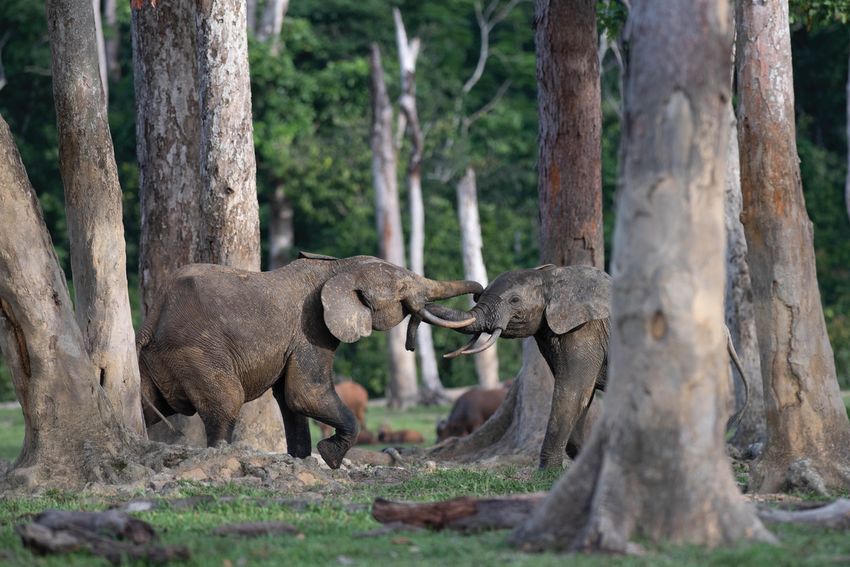
Front cover and this page: Forest elephants gather in
Dzanga Bai, Dzanga Sangha Protected Area, Central
African Republic, to socialize and dig for minerals.
© Miguel Bellosta/WWF
Overview
As the COVID-19 crisis continues, much of Africa remains in some level of lock-down
and under travel restrictions, despite the relatively low level of infection in most
countries. However, ECF partners are continuing their work, and there is no sign of
COVID-19 leading to an increase in elephant poaching and ivory trafficking—although a
five ton ivory seizure in Nigeria in January 2021 was cause for concern.

Some loosening of travel restrictions has allowed stalled activities to resume. Technicians
have finally gained access to Nouabalé Ndoki in northern Congo to set up a new radio system,
for example, and an ultralight aircraft was flown into Zakouma in Chad.

As elephant poaching declines, a new crisis of human-elephant conflict is developing. In
many places this presents a grave threat to the survival of elephants. For example, in Samburu
in northern Kenya, the home of Save the Elephants, nearly half as many elephants were
shot by herders (without the ivory being taken), as were killed at the height of the poaching
outbreak. To address this growing threat, the ECF continues to expand its grantmaking to
include human-elephant coexistence projects across the continent.

Forest elephants
Forest elephants are often overlooked and need more attention. Shy and elusive
creatures, you’re more likely to hear or smell them than to see them—even if they’re only
a few yards away—and they live in remote and difficult parts of Africa seldom visited by
tourists.

          SHY AND ELUSIVE CREATURES, YOU’RE MORE LIKELY
            TO HEAR OR SMELL THEM THAN TO SEE THEM
A change in their status now helps them stand out: forest elephants are now officially
recognized as a separate species from savanna elephants, and are now categorized as
‘critically endangered’ in the International Union for Conservation of Nature (IUCN) Red List.
The spotlight is now on the fact that they have been more impacted by the recent ivory crisis
than savanna elephants. Many of the countries in which they live suffer from weak government
and civil disorder, lack of conservation capacity, and uncontrolled development.

The Elephant Crisis Fund (ECF) has supported forest elephants from its inception, and in
recent years, as poaching has been brought more under control in eastern and southern Africa,
we have allocated more funding to protect them. This report particularly focuses on the
help that ECF partners are giving to forest elephants.

People who safeguard forest elephants work in some of the most dangerous parts of Africa.
After the murder of two rangers in Okapi Game Reserve last year, we were appalled to hear of
the killing of long-term ECF partner Rory Young, the founder of Chengeta Wildlife in Burkina
Faso. We previously supported his work in Mali and recently gave a new grant for Chengeta’s
ranger mentoring work in the Central African Republic. You can read about Rory’s impressive
conservation work on page 11 of this report.
Opposite page: © Miguel Bellosta/WWF.
About forest elephants
Although forest and savanna elephants are now treated as separate
species, don’t be confused by the names! While forest elephants
(Loxodonta cyclotis) favor dense forest, there are forest elephants
living in savanna, and savanna elephants (Loxodonta africana) living
in forests.
Forest elephants differ from savanna elephants in a number of ways,
including:
• Smaller body size.
• Smaller and more rounded ears.
• Straighter and thinner tusks that usually point downwards.
• Found in Central and West Africa, whereas savanna elephants
  are found in East and southern Africa (although there is some
  range overlap).
• Generally smaller group sizes.
• Different diet—forest elephants eat more fruit.
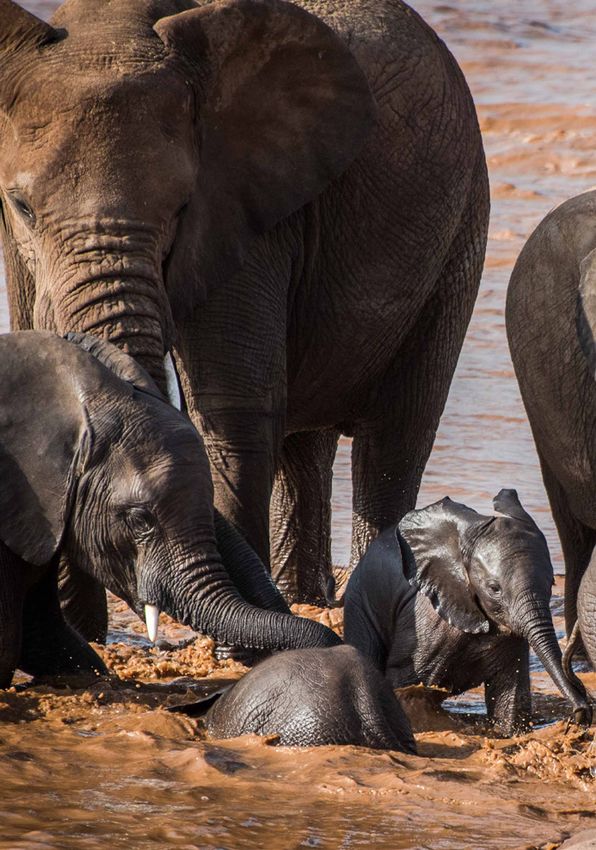
                                                                        Forest elephant above (© Lee White/Agence Nationale des Parcs Nationaux, Gabon) and savanna elephant below (© Jane
     AS WITH SAVANNA ELEPHANTS, FOREST ELEPHANTS                        Wynyard). Forest elephants are generally smaller, with smaller, more rounded ears, and their tusks tend to be straighter
                                                                        and point downwards.
      PLAY INTEGRAL ROLES WITHIN THEIR ECOSYSTEM

As with savanna elephants, forest elephants play integral roles
within their ecosystem. As bulk processors of plant material, they
break down large amounts of vegetation and release the nutrients.
They are responsible for the seed dispersal of many tree species.
They create and maintain forest clearings (‘bais’), with mineral-
rich soil and water on which many other species depend. Some
research has suggested that forest elephants may help with carbon
sequestration.
Of the remaining African elephants left on the planet, only around
20% are forest elephants. They are in deep trouble: threatened by
habitat loss and degradation, human-elephant conflict, and poaching
for ivory. Even when successfully protected, forest elephants have a
slow reproductive rate and need sustained protection over time
to allow population recovery. Climate change is also likely to become
an increasing issue over coming years and decades.
THE                                                                                                                  Total funding to-date

ELEPHANT                                                                                            345 94                                            42
CRISIS FUND
                                                                                                      Grants                Partners                 Countries
                                                                                                       issued by         have received grants      with ECF investments
                                                                                                        the ECF             from the ECF

Save the Elephants and the Wildlife Conservation Network created
the Elephant Crisis Fund (ECF) to tackle the killing of elephants,                                                 % of funding allocated to
the trafficking and the demand for ivory. The crisis is driven by the
international ivory trade, which thrives on insecurity, organized crime,

                                                                                                      90%                      2%                       8%
corruption, greed, and poverty. While there are signs of hope, with
poaching seemingly in decline, the ivory trade continues and the ECF
remains committed to ending it. As other threats to elephants’ survival
are coming to the fore, the ECF is expanding its scope to address them.

   AS OTHER THREATS TO ELEPHANTS’ SURVIVAL ARE COMING TO
   THE FORE, THE ECF IS EXPANDING ITS SCOPE TO ADDRESS THEM
The ECF works with a coalition of individuals, scientists, conservation organizations, and
governments to:                                                                                     ivory crisis      human-elephant                 elephant
• End the ivory crisis - supporting anti-poaching, anti-trafficking, and demand reduction.
• Promote human-elephant coexistence - dealing with the threats to elephants in close
                                                                                                                        coexistence                landscapes
  proximity to people.
• Protect elephant landscapes - protecting elephant habitat to give them space to survive and
  recover.

The ECF uniquely supports the best initiatives in need of funds. Selected organizations able
to make the most impact—whether they are tiny local organizations or large multinational           $27.4 million $1.4 million
NGOs —get our support. A team of experts ensures strategic and cost-effective allocation of
the funds generously provided by donors.                                                             granted to ECF partners               granted Jan to July 2021
                                                                                                           since 2013
The ECF is able to respond quickly and with minimal bureaucracy, deploying funds in as
little as 24 hours when necessary. Uniquely, 100% of funds are used to support on-the-ground
programs that save elephants. Not a single cent goes to administrative fees or overhead.

In eight years, the ECF has deployed $27.4 million to some of the best efforts to safeguard           From January to July 2021, the ECF
the future for elephants, and is aiming to disburse a total of $50 million by 2023. The ECF is
working to ensure that elephant populations across Africa are no longer under threat.            issued 25 grants to 18 partners in 16 countries
© Chris Thouless.

                                                                                                                                  The last substantial refuges for forest elephants national parks such as Nouabalé Ndoki
                                                                                                                                  and Odzala-Kokoua in the Republic of Congo. In other key areas, such as Chinko Conservation
                                                                                                                                  Area in the Central African Republic and Okapi Wildlife Reserve in the Democratic Republic
                                                                                                                                  of Congo, elephant numbers have been greatly reduced from poaching and the habitat is still
                                                                                                                                  intact, giving a chance for recovery so long as the areas are secured for conservation.

Saving Forest Elephants
Multi-faceted and innovative approaches to protection
Protecting forest elephants is much more difficult than looking after their savanna cousins.
Physical conditions in rainforests are tough for the rangers. There are few roads,
so foot patrols last a week or more, often in waist-deep water, with biting insects, poor
communications, limited supplies, the risk of encountering armed poachers, and little chance
of a swift evacuation for an injured or sick ranger. Aerial support is harder, as airstrips are
difficult to make and air crews struggle to see through the canopy. Since protected areas are
often surrounded by timber concessions, there are seldom clear boundaries, and poachers can
slip into protected areas without being detected.

     PROTECTING FOREST ELEPHANTS IS MUCH MORE DIFFICULT
         THAN LOOKING AFTER THEIR SAVANNA COUSINS

                                                                                                                                  Boats purchased with ECF funding allow African Parks rangers in Chinko Reserve, Central African Republic, to access
                                                                                                                                  previously unreachable areas of this vast wildlife area. © Ed Ghaui.

                                                                                                                                  In the past, elephant protection efforts involved sending groups of rangers into the forests on
                                                                                                                                  extended patrols, in the hope that this would deter poachers. Generally, this had little effect,
                                                                                                                                  since the chance of encountering poachers in the dense forest was slim. Park managers
                                                                                                                                  realized that a new approach was needed. This involves understanding the elephants’
                                                                                                                                  distribution and movements from radio-collaring and surveys, using intelligence to direct
                                                                                                                                  patrols, training rangers, setting up rapid reaction units, improving communications and
                                                                                                                                  transport, and establishing strategically located outposts close to poaching hot-spots. The ECF
                                                                                                                                  has supported the implementation of different combinations of these activities according to
                                                                                                                                  need in each site.

                                                                                                                                      THE ECF HAS SUPPORTED THE IMPLEMENTATION OF DIFFERENT
African Parks rangers in Odzala-Kokoua National Park in the Republic of Congo can spend weeks on patrol in challenging
conditions. © Frank af Petersens.
                                                                                                                                     COMBINATIONS OF ACTIVITIES ACCORDING TO NEED IN EACH SITE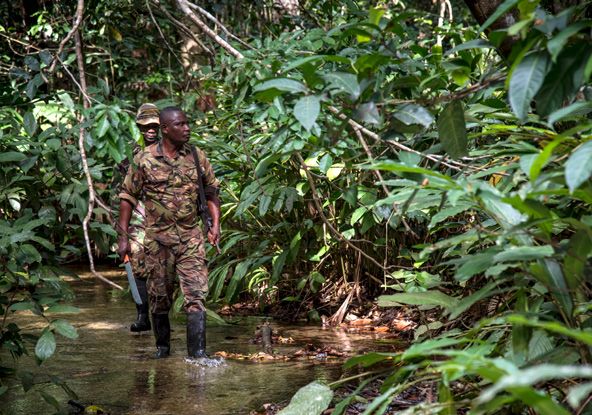
After last year’s conviction of notorious elephant poacher ‘Guyvano’—who had killed an
                                                                                                                              estimated 500 elephants in his career—the Wildlife Conservation Society had another
                                                                                                                              success in the criminal courts of the Republic of Congo. Thanks to coordinated efforts of
                                                                                                                              Congolese law enforcement authorities, Guyvano’s notorious mentor ‘Mondjole’ was arrested,
                                                                                                                              tried and convicted for elephant poaching, along with two other members of his criminal
                                                                                                                              network. He is expected to serve his full sentence, a true indicator of the judicial system’s
                                                                                                                              resolve to treat this crime seriously amidst COVID-19 related constraints.

                                                                                                                              With hardened professional elephant poachers, imprisonment may be the only answer, but
                                                                                                                              many people are driven to poaching out of desperation. Offering them an escape from this way
                                                                                                                              of life is a much better approach when possible. Over the last two years, with ECF support, the
                                                                                                                              Frankfurt Zoological Society in Lomami National Park in the Democratic Republic of Congo
                                                                                                                              has encouraged elephant poachers to surrender to the authorities without fear of retribution,
One of the many rivers intersecting Odzala-Kokoua National Park in the Republic of Congo, which allow access to both
poachers and anti-poaching patrols. © Frank af Petersens.                                                                     and given them the opportunity to start a new life.

Odzala-Kokoua National Park, managed by African Parks, is one of the largest protected                                        During 2019 and 2020, four separate groups of elephant poachers surrendered. They turned in
areas in the Congo Basin rainforest. We have supported the development of new outposts,                                       their weapons and renounced their illegal activities at a special ceremony; some returned to
and access to the key rivers that allow rangers to get deep inside the forest. In partnership                                 local villages while others were retrained as rangers. In February 2021, with news circulating
with Vulcan Inc., we funded the deployment of satellite collars on elephants to track their                                   in the forest about the success of the rehabilitation program, Asani Kongolo and two others
movements. It had been thought that forest elephants move much less than their savanna                                        from his band turned in their weapons at a patrol post. To show the seriousness of their
cousins, but the Odzala-Kokoua elephants undertook some quite surprising treks.                                               intentions, the three ex-poachers joined surveillance teams on a dugout patrol. The remaining
                                                                                                                              four other poachers from the gang also want to re-enter society.
Several of the collared elephants left the park, crossed a new tarmac road, and settled in the
forestry concessions far to the east. Logged forests are quite attractive to elephants (and gorillas)
because of the regrowth of secondary vegetation which provides food close to the ground rather
than out of reach in the canopy. These elephants still return on an annual basis to the ‘bais’ in
the middle of the park. Another elephant headed off to the west and visited the neighboring
country of Gabon. The information from these collared elephants has allowed African Parks to
deploy its rangers in a more efficient way to protect the elephant population.

                                                                                                                              Ex-poachers in Lomami National Park in the Democratic Republic of Congo celebrate the start of their new lives. After
                                                                                                                              turning in their weapons and renouncing poaching, they are being helped to reintegrate into society.
                                                                                                                              © Robert Abani/Frankfurt Zoological Society.

                                                                                                                              Forest elephants in West Africa are in an even more precarious state than in Central
                                                                                                                              Africa. There are no large blocks of forest remaining, and what is left is being rapidly
                                                                                                                              converted to cocoa and oil palm plantations. The main strongholds are a few protected
                                                                                                                              areas, two relatively large forest blocks in Liberia, and the cross-border W-Arly-Pendjari
                                                                                                                              (WAP) complex, where forest elephants are living in open woodland. Other than these areas,
                                                                                                                              there are scattered handfuls of elephants spread across twelve countries, mostly hiding in
                                                                                                                              small patches of forest surrounded by farmland. Inevitably they come into conflict with
                                                                                                                              people. With every elephant killed by a hunter called in to protect the crops, these outlying
A vet fits a collar during a collaring operation in Odzala-Kokoua National Park in the Republic of Congo. © Chris Thouless.   populations inch towards extinction.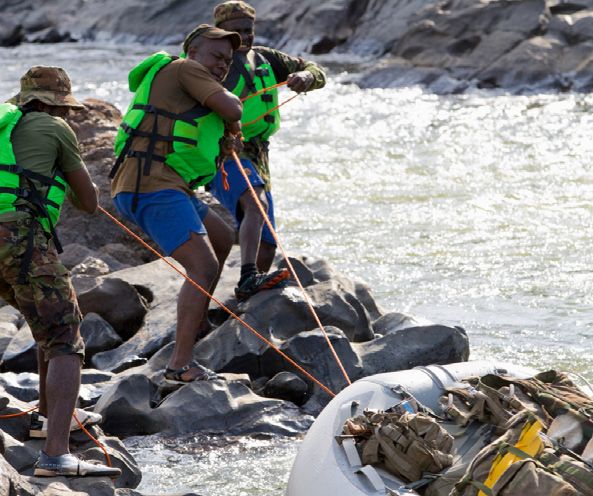
The ECF and its partners are determined to give these elephants the best chance of                 Chengeta then started providing support to the Dzanga Sangha Protected Areas (APDS)
survival. Once forest elephants become extinct in these countries, it is very unlikely that they   Complex in southwestern Central African Republic, again partly funded by the ECF. Rory
could ever return. Without elephants the remaining habitat would probably be lost, as they         and his team helped to professionalize the rangers, including training them to the highest
are a flagship for conservation. We have supported partners in ten West African countries,         standards of human rights adherence. This is particularly important because of the
finding where the last elephants are hiding out, protecting their habitat, and reducing human-     presence of members of the Baka hunter gatherers and other indigenous communities
elephant conflict.                                                                                 in the area. As a result, when an independent review of human rights in World Wildlife
                                                                                                   Fund supported projects was carried out, Dzanga Sangha was commended. Following this
                                                                                                   successful engagement, the park management asked Chengeta to provide wider support to its
Remembering Rory Young                                                                             law enforcement effort and regional programming.

                                                                                                   Chengeta Wildlife training session with rangers in Dzanga Sangha Protected Area, Central African Republic. © Aaron Porter.

                                                                                                   More recently Chengeta became involved in the WAP complex, which extends across Benin,
                                                                                                   Niger, and Burkina Faso, and holds the largest elephant population in West Africa. Thanks
                                                                                                   to the involvement of African Parks, the southern portion in Benin is well protected, but
Rory Young. © Siân Lewis/Chengeta Wildlife.                                                        Arly National Park and the surrounding hunting concessions in Burkina Faso came under
                                                                                                   increasing pressure from the Islamist insurgency. The ECF provided some support in 2019,
Rory Young, the founder of Chengeta Wildlife, was a good friend and partner of the                 but our grantee decided that it was too dangerous, and pulled out.
ECF. He was tragically killed while working in Burkina Faso in April 2021.
                                                                                                   The EU commissioned Chengeta to become involved in Arly and replicate its Malian model
We first got to know Rory when he was training rangers in Malawi and Guinea. He became             of anti-poaching units designed to operate in a high-risk environment. Much effort was
pivotal in the struggle to save the last desert elephants of Mali, following the jihadist          put into understanding the environment and reducing the risks. Unfortunately, on the team’s
uprising. This made the Gourma elephant range one of the most dangerous places in Africa.          first deployment, they were attacked, and Rory and two Spanish journalists, David Beriáin and
With ECF funding, and support from the Mali Elephant Project, he and his team were able            Roberto Fraile, were killed.
to train a mixed unit of soldiers and rangers, the only law enforcement team able to patrol
the area. They faced great danger, and lost several members of the team, but persevered.           Rory was driven to by passion to save wildlife and to help the communities and rangers
Without their efforts, it is likely that few, if any, of this iconic elephant population would     living in some of the most challenging parts of Africa. The impact he has made will not be
have survived.                                                                                     forgotten. His death is a huge loss for the conservation world, but even more so for his family.
© Alex Hofford.

Ivory Crisis
Guarding against a post-COVID rebound
Over the past year, there have been some positive developments in ivory consumption;
following a year of COVID-19 restrictions, demand for ivory in China and South Asia has been
significantly suppressed. The COVID-19 pandemic resulted in a law enforcement crackdown
on the consumptive wildlife trade in China, which in turn triggered a decline in demand.
Additionally, restrictions on travel have limited the ability of Chinese consumers to access
ivory outside their own country.

      OVER THE PAST YEAR, THERE HAVE BEEN SOME POSITIVE
      DEVELOPMENTS IN IVORY CONSUMPTION; FOLLOWING A
       YEAR OF COVID-19 RESTRICTIONS, DEMAND FOR IVORY
             HAS BEEN SIGNIFICANTLY SUPPRESSED

Despite this, demand for ivory may rebound once borders reopen and Chinese tourism
resumes. Traffickers are planning for a mini-boom in demand, holding onto stocks and
hoping to sell when markets reopen. For now, several countries, such as Laos and Cambodia,
are going into a series of new lockdowns and the borders of Vietnam remain firmly closed.
Movement between China and the rest of the world is not closed but is limited and tourism is
likely to remain suppressed for much of 2021.

           THERE IS A REDUCED BUT SIGNIFICANT GROUP OF
           COMMITTED “DIE HARD” IVORY BUYERS IN CHINA
A recent Globescan report commissioned by the World Wildlife Fund (WWF) indicates that
there is a reduced but significant group of committed “die hard” ivory buyers in China, who
are not deterred by the illegality of ivory or the danger of being arrested. ECF partners have
also observed clusters of activity from buyers and sellers who operate through secretive
networks.

In Vietnam, ivory markets have continued to thrive, with online advertising remaining
active and a new market developing in Dak Lak province, where ivory is openly sold over the
counter, mostly to Vietnamese buyers. A retail market feeding Vietnamese demand may be
growing and this needs to be watched closely.

                                               Opposite page: Ivory items on sale in Myanmar. © Lucy Vigne.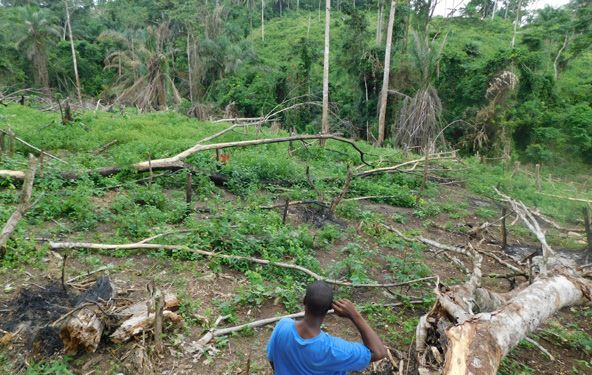
© Southern Tanzania Elephant Project.

                                                                                                                                      WE HAVE BEEN ABLE TO ENGAGE IN DEPTH AND AT PACE WITH

Human-Elephant                                                                                                                           OUR PARTNER NETWORK TO IMPLEMENT URGENT AND
                                                                                                                                                     LONG- TERM SOLUTIONS

Coexistence                                                                                                                        In Tanzania, the ECF is supporting the protection of the stunning Upper Kitete Wildlife
                                                                                                                                   Corridor on the edge of the Ngorongoro Crater, while creating biogas cooking systems for
Increased investment to meet a growing need                                                                                        communities to provide alternatives to wood.

We are witnessing a worrying escalation of human-elephant conflict across the African
continent. The tourism income that sustains so many national parks and communities
disappeared with COVID-19, but the rise in conflict may also be a result of elephants losing
their fear of people as poaching has subsided in many places. While we anticipated the
latter shift as our anti-poaching support matured, the near-collapse of tourism in some
parks has been a major new challenge. Thanks to generous donor support, we have been
able to engage in depth and at pace with our partner network to implement urgent and long-
term solutions to this developing elephant crisis.

While long term strategies for true coexistence take time, consistent funding, and
dedicated community buy-in, we are also providing immediate technical assistance to our
field partners. In Botswana’s Okavango Delta and Makgadikgadi Pans National Park the ECF
has funded new solar fences to protect vulnerable rural farms from crop-raiding elephants,
providing food security for communities reeling from tourism job losses.

                                                                                                                                   Wild Survivors is working with farmers in human-elephant conflict hotspots in the Upper Kitete corridor in Tanzania on
                                                                                                                                   effective mitigation measures, including beehive fences (above and below). Elephants are naturally fearful of bees and
                                                                                                                                   stringing beehives along fences helps keep them away from crops. © Wild Survivors.

A ‘slash-and-burn’ farm in Liberia, established close to an elephant migration route and highly vulnerable to human-
elephant conflict. ECF partner Elephant Research and Conservation is working with communities in Liberia to encourage
human-elephant coexistence in conflict hotspots, helping to ensure a future for a highly significant, remnant population
of West Africa’s forest elephants. © Elephant Research and Conservation.
Next to Nyerere National Park, we’ve been able to fund protective beehive fences and Conflict with forest elephants is particularly hard to resolve and it often comes coupled
supported the implementation of a trial of a new elephant repellent that uses a strong, foul with political instability or habitat loss, generated by destructive activities such as logging,
smell to keep elephants at bay. We’ve also funded the roll out of a large-scale chili deterrent plantations, bushmeat hunting, and mining. Methods that might be effective deterrents for
project across 12 communities. These farmer-managed conflict mitigation strategies are being savanna elephants may not work in densely forested, high rainfall areas where many forest
adopted in Tanzania as the most sustainable way for communities to reduce elephant elephant populations are located.
crop-raid damage without reliance on state support.
Donor support is helping us initiate new ways to protect forest elephants from clashes with
farmers. A new vehicle-equipped rapid response unit is now supporting communities and
protecting the few remaining elephants living deep in the northern forests of Liberia. In
the Republic of Congo, bees, chilis, lights, and non-palatable crops are being trialed as new
mitigation methods on the boundary of Odzala-Kokoua National Park. We’re thrilled to be
entering into new partnership within our 42nd country for the ECF, Equatorial Guinea,
where our partners will soon be testing low-cost alarms, lights, and organic repellent to reduce
conflict between farmers and the elephants roaming outside of Monte Alén National Park.
These interventions show us that with the right investment, we can find tangible solutions
that allow elephants and people to coexist. But in addition to promoting coexistence, we
must also secure suitable elephant habitat both in protected areas and in the vital movement
routes between them if wild elephants are to survive in modern Africa. If ever there was a
time to keep investing into the conservation of the natural world, this is the time.
ECF partner Southern Tanzania Elephant Program is supporting communities to produce ‘smelly elephant repellent’.
This is a fermented and pungent liquid mixture made using natural ingredients such as chilli, ginger, garlic, neem leaves,
eggs and cow/elephant dung (above). Hung in bottles along farmland, it is proving to be a strong deterrent to elephants
(below). © Southern Tanzania Elephant Program.
African Parks is trying out a range of innovative human-elephant conflict interventions near Odzala-Kokoua National Park
in the Republic of Congo, including this strobe barrier. © African Parks.GLOBAL INVESTMENTS
TO END THE IVORY CRISIS CHINA
$1,073,049 18
ECF grants by Country and US$ Investment
BURKINA FASO $116,088 2
NIGERIA $727,503 11
MALI $818,717 6 CHAD $253,468 6
GUINEA $88,050 2 CENTRAL AFRICAN REPUBLIC
$1,453,903 11
SIERRA LEONE $4,412 1
JAPAN
$24,690 1
SUDAN
$3,088 1 HONG KONG $398,168 8
SENEGAL $34,893 2 LAOS $308,710 9
ETHIOPIA
GUINEA-BISSAU $9,880 1 $305,364 6 VIETNAM $375,311 7
CÔTE D'IVOIRE $43,397 3 MYANMAR
SOUTH SUDAN
LIBERIA $126,790 3 $183,347 5
$309,365 5
BENIN $273,217 4 UGANDA $1,036,107 12
CAMEROON $738,828 9 KENYA $2,773,295 44 THAILAND
EQUATORIAL GUINEA $25,000 1 BURUNDI $5,770 1 $160,323 5
GABON $836,561 7 PHILIPPINES
CONGO $3,061,383 25 CAMBODIA $4,180 1
TANZANIA $1,510,826 24 $104,000 3
DEMOCRATIC REP. OF THE CONGO $2,392,001 20
ZAMBIA $2,055,315 36
ANGOLA $120,110 4 MALAWI $872,488 16
ZIMBABWE $727,574 13
NAMIBIA $40,800 2
SOUTH AFRICA $10,500 1
MOZAMBIQUE
$1,322,116 17
BOTSWANA
$131,821 4 KEY
The ECF has also funded 21 anti-trafficking grants that span regional or multi-regional areas,
$ Amount granted (US$) This map includes all grants
with support totaling $2,485,937. In addition, the ECF has funded three demand reduction Number of grants issued since the launch of
grants and one anti-trafficking grant in the USA totaling $91,649. the ECF in 2013.Our Partners
From dense forests to open savanna, from tourist destinations to conflict zones, whether
Thank you
As we look back on the achievements of the ECF since its inception in 2013,
tackling the ivory trade or supporting communities to live in harmony with elephants, our
and ahead as the future for elephants unfolds, we cannot overstate the
partners are diverse yet cohesive. All ECF partners share common traits: they are the most
effective organizations in their fields, share an absolute commitment to ensuring a future for importance of our donors.
elephants and other wildlife, and persevere despite near-overwhelming challenges. We thank You are an integral part of the ECF team and we take strength from your commitment and
them for this unswerving commitment and applaud the achievements that have been made in support on this incredible journey. Thank you for all that you do and for walking this road
this period of uncertainty and change, as the COVID-19 pandemic continues to rage. with Africa’s elephants.
ADM Capital Foundation Legal Assistance Centre, Namibia Thank you to our dedicated major supporters, #knotonmyplanet and Tiffany & Co, and to our
African Conservation Trust Liberty Shared many loyal and valued private contributors.
African Parks Lilongwe Wildlife Trust
African Wildlife Foundation Lukuru Wildlife Research Foundation
Agence Nationale des Parcs Nationaux, Gabon Maisha Consulting
Agency for Peace and Development Mara Elephant Project
Associaçao Moçambicana de Conservaçao de Maravi Risk Management
Fauna Bravia Mareja Community Conservation Project
Basel Institute on Governance Natural Resource Conservation Network
Big Life Foundation Natural Resources Defense Council
Biocarbon Partners Northern Rangelands Trust
Born Free Foundation Oxford Brookes University
Bristol Zoological Society PAMS Foundation
Centre on Illicit Networks & Transnational Panthera France
Organised Crime Research Centre in Biodiversity and Genetic
Chengeta Wildlife Resources
Connected Conservation Save the Elephants
Conservation Justice Saving the Survivors
Conservation Lake Tanganyika Southern Tanzania Elephant Project
Conservation Lower Zambezi Space for Giants
Conservation South Luangwa Stichting Wings for Conservation
EAGLE Network Stop Ivory
East African Wildlife Society Tashinga Initiative Trust
Ecoexist Trust The WILD Foundation
Elephants for Africa The Zambezi Society
Elephant Protection Initiative Tikki Hywood Foundation
Elephant Research and Conservation TRAFFIC
Elephant Voices Tsavo Trust
Elephants Alive Uganda Conservation Foundation
Environmental Investigation Agency University of Utah IsoForensics
Fauna & Flora International University of Washington
Focus Africa Wild Planet Trust
Focused Conservation Wild Survivors
Forgotten Parks Foundation WildAid
Frankfurt Zoological Society Wildlife Action Group Malawi
Freeland Wildlife Conservation Global
Game Rangers International Wildlife Conservation Society
Global Wildlife Conservation Wildlife Crime Prevention
Gorongosa Restoration Project Wildlife Justice Commission
Instituto de Ciências, Tecnologias e Wildlife Traxx Consultancy
Agroambiente da Universidade do Porto Wildlife Works
Integrated Rural Development and Nature WildlifeDirect
Conservation Working Dogs for Conservation
International Fund for Animal Welfare World Wildlife Fund
Kenya Wildlife Service Zoological Society of London
Kissama Foundation © Jane Wynyard.elephantcrisisfund.org © Jane Wynyard.
You can also read


