3 STEPS TO UPSKILL AND RESKILL EMPLOYEES FOR 2021
←
→
Page content transcription
If your browser does not render page correctly, please read the page content below

3 STEPS
TO UPSKILL AND
RESKILL EMPLOYEES
FOR 2021

              WHITE PAPER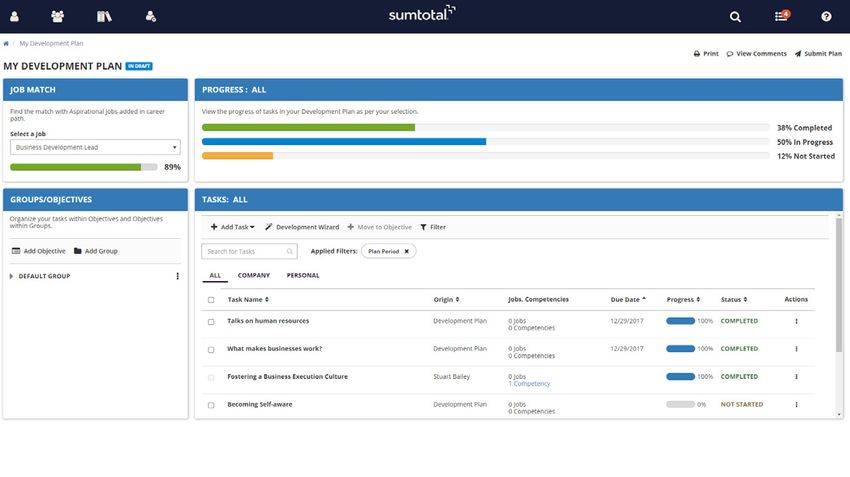
EXECUTIVE SUMMARY
Upskilling and reskilling are top of mind with HR and learning and development (L&D)
leaders for a good reason. While the worlds of HR and L&D are continually evolving, few
leaders have faced the type of seismic changes confronting them now. A confluence of
forces has created a perfect storm forcing HR and L&D to completely reimagine their
                                                                                                              74%          of hiring
                                                                                                              managers agree that
approaches to ensuring their workforce is prepared for anything.                                              there is a skills gap
                                                                                                              in the current labor
    ●	More core processes are going digital. COVID-19 means a large part of the                              market.
       population is working remotely, making it urgent to rethink everyday processes that
       are being digitized. More companies are bringing on people who have never met
       another employee or their manager in person, or set foot in an office. Instead, they
                                                                                                              48%          say that
                                                                                                              candidates lack the
       are recruiting, hiring, and onboarding new employees virtually. Hand in hand with                      skills needed to fill
       this, employees in existing roles need skills in line with the changing environment                    open jobs.1
       to deal with processes that are becoming more virtual and digital-centric.

    ●	Existing talent pipelines have been failing for some time. Even pre-pandemic,
       organizations were experiencing the pains of the skills gap, finding it challenging to
       fill open positions with qualified people. Businesses have been struggling because
       college graduates aren’t demonstrating the fundamental skill sets that organizations
       need. Specifically, many graduates lack core skills such as meeting facilitation,
       conflict resolution, and time management, to name a few. As a result, the HR
       programs that used to focus on developing employees for leadership roles must now
       focus on developing fundamental skills.

    ●	The rise of the new-collar worker. Coined by IBM’s CEO Ginni Rometty, this
       term describes “individuals who develop technical and soft skills needed to work in
       the contemporary tech industry through non-traditional education paths.” It came
       about because IBM — like so many other companies — is looking for new pathways
       to put people in the thousands of jobs going unfilled. The new-collar worker reflects
       the need to emphasize skills and ability versus someone’s academic pedigree. In line
       with this, research by The Chamber Foundation finds that “competencies — defined
       as knowledge and skills that can be observed, measured, or otherwise assessed —
       take precedence over academic credentials in the modern economy.”2

1 U.S. Chamber of Commerce, Closing the Skills Gap, March 14, 2020
2
  U.S. Chamber of Commerce, Closing the Skills Gap, March 14, 2020

                                                          3 STEPS TO UPSKILL AND RESKILL EMPLOYEES FOR 2021                     1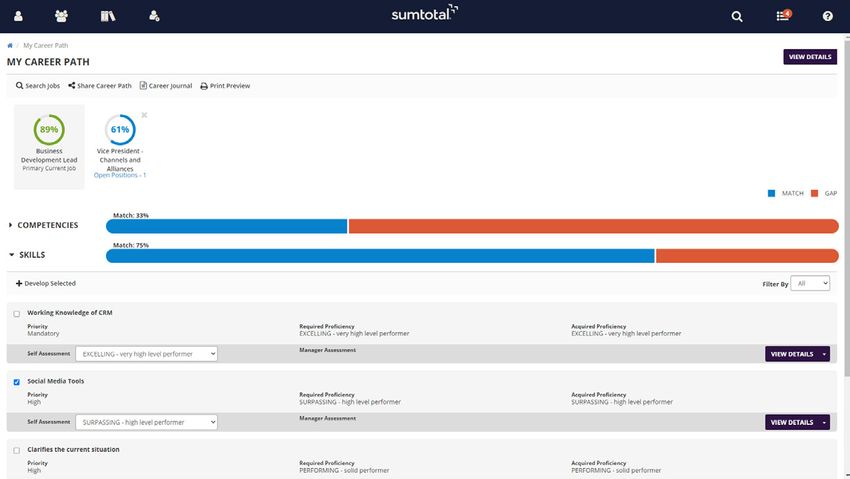
Most organizations are not prepared to address these critical issues. According to a
McKinsey global survey, 87% of executives experience a skills gap in the workforce or                                                      The window of
expect them soon. But less than half have a clear sense of how to address the problem.3                                                    opportunity to reskill
Echoing this, the Deloitte 2020 Global Human Capital Trends Survey found 74% of                                                            and upskill workers has
organizations know that reskilling their workforce is important in the next 12 to 18                                                       become shorter in the
months, but only 10% feel they have the necessary resources to reskill their people.4                                                      newly constrained labor
                                                                                                                                           market.
It isn’t just a matter of changing processes so HR and L&D can keep up; it’s a matter of                                                   For those workers set to
equipping employees to ensure their companies’ futures. As McKinsey says, “Workers                                                         remain in their roles, the
across industries must figure out how they can adapt to rapidly changing conditions,                                                       share of core skills that
and companies have to learn how to match those workers to new roles and activities.                                                        will change in the next
This dynamic is about more than remote working...It’s about how leaders can reskill and                                                    five years is
upskill the workforce to deliver new business models in the post-pandemic era.”
                                                                                                                                           40%
                                                                                                                                           and 50% of all
Organizations look to their HR and L&D leaders to shine a light on the path forward.
Consider that Microsoft launched a global skills initiative in June 2020 to bring more                                                     employees will need
digital skills to 25 million people worldwide by the end of the year.5                                                                     reskilling.6

The question is: How are you going to help your organization prepare for the future that’s
already here? The answer is to take a methodical approach to upskilling and reskilling your
employee base. In this guide, we walk you through the steps you can take to do just that.

3 McKinsey & Company, To emerge stronger from the COVID-19 crisis, companies should start reskilling their workforces now, May 7, 2020
4
  Deloitte 2020 Global Human Capital Trends Survey, May 2020
5
  Microsoft, Microsoft launches initiative to help 25 million people worldwide acquire the digital skills needed in a COVID-19 economy,
   June 30, 2020
6 World Economic Forum, The Future of Jobs Report 2020

                                                          3 STEPS TO UPSKILL AND RESKILL EMPLOYEES FOR 2021                                                  2
UNDERSTAND THE
DIFFERENCE BETWEEN
SKILLS AND
COMPETENCIES
To start, let’s level set. While some use the terms “skills” and “competencies”
interchangeably, they are not the same. Skills and competencies work in concert to enable The value proposition
employees to succeed. But skills are specific to doing a job and competencies capture how of humans in the
someone performs the job. In other words, competencies put skills (along with knowledge workforce is shifting
and behaviors) into context. to essentially ‘human
capabilities,’ such
Let’s unpack this further. A skill is a specific learned ability, while a competency as curiosity and
is usually an umbrella or wrapper for a set of skills that also includes knowledge and empathy. In this
scenario, employers
behavior. For example, writing and speaking are skills, while communication is a
would also need to
competency that measures how articulately, clearly, and persuasively someone speaks,
consider not only how
writes, reads, and presents. to attract top talent,
but also potentially
When it comes to skills, there are both hard and soft ones. Hard skills are those rethink learning and
that people learn, such as coding, data entry, or operating a computer or machine in development and
the factory. Examples of soft skills are the ability to collaborate and adapt, or a person’s better cultivate the
resilience or openness to change. In this way, soft skills are closer to competencies social and emotional
because they account for knowledge and behavior. skills that their
workforce needs to
Competencies are often used to measure employee performance as a way to add value in the future.7
determine whether employees have the necessary skills to perform their job. However,
employees might have certain competencies but need to upskill to handle what was
once a manual process.
For instance, say the competency is selling. Sales reps accustomed to meeting prospects
and closing business in person must now develop the soft skills to engage, present
solutions, and close business virtually. In this scenario, how does a soft skill like
persuasion change?
7 Deloitte, Closing the employability skills gap, January 28, 2020
3 STEPS TO UPSKILL AND RESKILL EMPLOYEES FOR 2021 3STEP 1
MAP SKILLS AND COMPETENCY GAPS TO YOUR
BUSINESS STRATEGY
With that understanding of skills and competencies, how do you determine the gaps in
your employee base? It starts by being firmly grounded in the impact of the three driving MAPPING THE SKILLS
forces we outlined in the introduction. OF THE FUTURE
According to The
One challenge many employees faced early in the pandemic was adapting to a different Future of Jobs Report
working environment. Overnight, employees were working from home, precluding the 2020 published by
the World Economic
ability to walk down the hall to talk to colleagues or for managers to check in on their
Forum, the top skills
teams. This shift alone demanded that employees figure out how to set up a workable
and skill groups that
office, adopt a new time management discipline, and learn to motivate themselves. employers see rising
These skills were the minimum to adapt and continue working and producing as before. in prominence leading
Employees who were adaptable and resilient kept producing while others took longer to up to 2025 include
get up to speed to the same level. groups such as critical
thinking, analysis, and
This example surfaces just a few of the broad skills that all employees need to survive problem-solving, and
and thrive. Then there are the skills specific to each role and how it is evolving. So, where skills such as active
should your organization focus its efforts? learning, resilience,
stress tolerance, and
flexibility.8
A simple framework is to zero in on skills developed toward your organization’s strategic
priorities since those can impact the core business. For example:
● If your organization wants to generate revenue by building a product for a new
market, it needs to skill its employees to understand that market.
● If the goal is to save money by reducing safety incidents, your organization needs
to train employees to avoid risky behaviors and incidents.
The takeaway? HR and learning departments need to ensure they are aligned with business
objectives and measure the impact of their efforts using business-aligned metrics.
8 The Future of Jobs Report 2020 published by the World Economic Forum, October 2020
3 STEPS TO UPSKILL AND RESKILL EMPLOYEES FOR 2021 4As your organization deals with today’s challenges and prepares for unforeseen changes,
it must be able to quickly identify the skills that align with your new needs. The first A study by MIT
step is gathering and capturing an inventory of skills across the organization that the HR Sloan School of
department and other leaders can easily call upon. Management found
that a 12-month
Most organizations lack a central database of skills. At best, they calibrate one once a workforce training
year. Considering the number of positions and people in an organization, it’s easy to see program focused
on improving
why businesses feel overwhelmed about conducting a skills inventory.
communication,
problem-solving
That said, when looking at skills and competencies, it’s easier to inventory skills because and decision-
skills are easier to define. Moreover, it’s easier to identify who has the skills (especially making, time and
hard skills). It’s far more difficult for people to zero in on their own — and even other stress management,
people’s — competencies. financial literacy,
legal literacy and social
The fastest, easiest way to develop a skills inventory is by requiring employees to report entitlements, and
their own. By capturing these in a tool like the SumTotal platform, HR and learning execution excellence
leaders can see the skills of an individual and team. They can match people with the significantly impacted
company’s needs and help people understand their skills gaps. To complement this, productivity. The
program delivered
companies can call upon and customize models or libraries of predefined competencies
a 250% return on
developed by organizations like DDI, Lominger (now Korn Ferry Leadership Architect
investment (ROI)
Legacy Competency Mapping), and Skillsoft. within eight months
of completion, with
Once they take these steps, organizations can upskill their employees with knowledge much of the gain
relevant to today’s issues and ensure skills are continually enhanced or replaced by new attributed to a jump
skills to move the business forward. in productivity.9
Specifically, the Career Plan within the SumTotal Core Platform lets authorized users
view an employee’s readiness to move into another position in the organization. This is
determined based on a configurable set of criteria, including how others have assessed
the employee against the competency model for that job.
9 MIT Sloan School of Management, Soft skills training brings substantial returns on investment, December 11, 2017
3 STEPS TO UPSKILL AND RESKILL EMPLOYEES FOR 2021 5Authorized users can access the Development Wizard directly from the Career Plan.
From the Job Details, they can easily see Competency, Skills, and other gaps. After
providing a gap analysis on job competencies and skills, the Development Wizard
suggests learning activities, books, goals, and other tools to help employees improve in
those areas. Administrators can select learning activities to associate with behaviors, and
the SumTotal platform will suggest those learning activities to users when they use the
Development Wizard to create a development plan for those behaviors.
3 STEPS TO UPSKILL AND RESKILL EMPLOYEES FOR 2021 6STEP 2
BUILD LEARNING PLANS THAT CLOSE THE GAPS
When it comes to delivering the learning programs that will upskill and reskill your
employee base, your organization needs to think beyond the standard curriculum
ORGANIZATIONS
approach. It’s not that curriculums are bad per se, but they have become overwhelming. NEED TO:
Just as people prefer shorter, bite-sized content in other areas of their lives, they show
a growing preference for bite-sized curriculums. Rather than requiring employees to • long-term
invest in effective
remote-
complete a comprehensive curriculum covering multiple programs and courses, enable working foundations
• upskilling
your people to skill up instantly.
revamp their
and
This aligns with how development has evolved in the past year. Where development was
retraining
previously seen as a nice to have, and employees developed skills when time allowed, now approaches
• approach
skills development is essential to an organization’s survival. Simply put, your company
needs to upskill and reskill its employees faster than the competition. adopt an agile
to
strategic workforce
To that end, more organizations enable employees to self-direct their learning. This is planning.10
partly out of necessity (since employees are working remotely) and partly due to employee
engagement initiatives, where it’s important to give employees autonomy so they feel
their organization supports and trusts them.
Fortunately, this syncs perfectly with the need to ensure people gain knowledge to apply PER MCKINSEY:
in the moment. It’s the only way to adapt to an ever-changing business environment The first step is to build
a no-regrets skill set —
effectively. This is similar to the just-in-time learning concept, but in that scenario, an
a tool kit that will be
event happens and the employee learns after the fact. Today, employees need to have
useful no matter how
skills before an event occurs, which means your organization must empower them to gain an employee’s specific
knowledge based on trends and anticipated needs. role may evolve. Focus
your investments on
With that in mind, it’s smart to focus on essential soft skills. Today’s employees need to four kinds of skills:
gain knowledge, adapt quickly, and be resilient. In fact, adaptation and resilience might 1. Digital
be the two skills that get people through these trying times — developing the skills to
support and enable these are key, since no one can predict what’s coming. On top of that, 2. Higher cognitive
critical thinking, communication, and collaboration are some of the top soft skills sought 3. Social and emotional
these days. The ability to draw conclusions from various data points while collaborating 4. Adaptability and
and communicating to move the business forward is invaluable in the current climate. resilience.11
10 McKinsey & Company, The future of work: Reskilling and remote working to recover in the ‘next normal,’ July 2020
11 McKinsey & Company, To emerge stronger from the COVID-19 crisis, companies should start reskilling their workforces now, May 7, 2020
3 STEPS TO UPSKILL AND RESKILL EMPLOYEES FOR 2021 7STEP 3
MEASURE SUCCESS OVER TIME AND ITERATE
Considering the shift in the top skills and competencies employees need today, it should
come as no surprise that the measurement of success needs to evolve also. It’s no longer
relevant to measure course completions or the impact of a skill on an employee. Your
organization doesn’t care how much learning content an employee consumes — it cares
about how L&D enables business success.
Simply put, a highly accurate, relevant measure aligns with business priorities. Did you
keep the doors open, retain employees, advance your business, or solve problems before
they happened because of new skills or competencies?
To align with the business in this way, HR and L&D need to assess the skills associated
with each competency and define relevant metrics that matter to the business and
that can be measured against an employee’s performance. So, instead of measuring for
learning’s sake, measure for metrics that support the business.
From a business perspective, having people ready to adapt is essential, given the current
climate. Relevant metrics include an employee’s ability to learn, unlearn, and learn again.
At the same time, as organizations shift from manual to digital processes, employees
might oversee automated processes. The metric might be ensuring the process outputs
are as expected.
Consider the new position of Director of Remote Work. This position is becoming
increasingly important and requires new skills. Examples of what a director might be
measured on include:
● Are we hiring for the right skills?
● How well is our distributed business running?
● Are we keeping remote employees engaged?
● Are we still innovating rapidly?
3 STEPS TO UPSKILL AND RESKILL EMPLOYEES FOR 2021 8CONCLUSION
TIME IS OF THE ESSENCE
The concepts of upskilling and reskilling are not new. What has changed is the urgency
of enabling this type of learning and development. To date, organizations have been able
to get by with their tried-and-true L&D approaches. But now that we’ve seen wholesale
changes in how work gets done and what it takes to succeed in existing and upcoming
roles, HR and L&D leaders need to shift gears overnight.
Amid so much workplace disruption — with more on the horizon — organizations are
wisely taking steps to future proof their employee base. It starts by reimagining the
workplace and how to enable employees to adapt and learn for the future. By closing the
skills gap with a strategic approach, your organization can position its employees and
business to succeed.
After all, McKinsey found that organizations that already launched successful reskilling
programs were better able to address skill gaps caused by technological disruptions or
implement new business models or strategies.12 In other words, getting started now is the
first step to being prepared for potential future disruption.
To learn more about how SumTotal can help your organization quickly close the skills
gap, visit sumtotalsystems.com.
12 McKinsey & Company, To emerge stronger from the COVID-19 crisis, companies should start reskilling their workforces now, May 7, 2020
3 STEPS TO UPSKILL AND RESKILL EMPLOYEES FOR 2021 9ABOUT
SUMTOTAL
SumTotal provides a unified, comprehensive Learning and Talent
Development suite that delivers measurable impact across the entire
employee lifecycle. With SumTotal, organizations can build a culture
of learning that is critical to growth, success, and business sustainability.
SumTotal’s award-winning technology provides talent acquisition,
onboarding, learning management, and talent management solutions
across some of the most innovative, complex and highly regulated
industries, including technology, airlines, financial services, healthcare,
manufacturing, and pharmaceuticals.
Skillsoft and SumTotal are partners to thousands of leading global
organizations, including many Fortune 500 companies. The company
features three award-winning systems that support learning, performance,
and success: Skillsoft learning content, the Percipio intelligent learning
experience platform, and the SumTotal suite for Talent Development, which
offers measurable impact across the entire employee lifecycle.
Learn more at sumtotalsystems.com.
SUMTOTALSYSTEMS.COMYou can also read


