A BUYER'S GUIDE TO DMARC - MEET THE CYBERSECURITY PROTOCOL THAT REDUCES PHISHING ATTACKS AND IMPROVES EMAIL DELIVERABILITY - ONDMARC
←
→
Page content transcription
If your browser does not render page correctly, please read the page content below
by

A Buyer’s Guide to
DMARC
Meet the cybersecurity protocol that reduces phishing
attacks and improves email deliverability
A brief history of email

                                1971
                           First email sent

                                1981
                      ASCII encoding launched

                                1982
                          SMTP established
                                1988
           Microsoft and Compuserve offer email via dial-up
                                1991
                     First email sent from space
                                1992
                    Email attachments introduced
                                1998
                       The term “spam” coined
                                2003
           Mobile email boom started with Blackberry Quark
                                2004
                          DKIM introduced
                                2005
                           SPF introduced
                                2008
             “SMTP mail is inherently insecure” - RFC5321
                                2012
                            DMARC born
                                201 7
                   269 billion1 emails sent everyday

                                2018
                    DMARC adoption rises by 51%2

               A BUYERS GUIDE TO DMARC - ONDMARC.COM
Email: The easy way in?
According to Verizon’s 2018 Data Breach Investigations3 email continues
to be the most common vector of phishing attacks, making it a a top
cybersecurity concern for organizations.
Spam
More than 50% of emails are spam and criminals regularly use spam
emails as a vehicle for malware.
Advance-fee scams
These are targeted at vulnerable individuals, with scammers
attempting to elicit money or bank details in exchange for the promise
of rewards or for charity (for example, the Nigerian 419 scams4).
Spear phishing
This is an evolution of the traditional phishing email, where scammers
directly target individuals or organizations with content that is relevant
to them. These scammers research the individual or organization in
question - a task made simple by professional networking sites such
as LinkedIn - to make the email appear legitimate.
Whale phishing is a version of spear phishing whereby a scammer
sends a phishing email to a senior executive (the ‘big fish’). Social
engineering is key to successful phishing scams with 93% of data
breaches linked to social engineering incidents5.
A BUYERS GUIDE TO DMARC - ONDMARC.COM 2Is your email security defending one threat and
wide open to another?
Email security technologies come in many forms but ultimately all forms are intended
to keep the volume of spam emails to a minimum and to detect unwanted content
(from malware to suspicious links) to prevent them from reaching the user’s mailbox.
More often than not these technologies look for the most common traits of a malicious
email such as a blacklisted IP address, or a dodgy domain and block it to protect the
recipient.
This is due to an unanticipated flaw in the global email
infrastructure which exposes every organization
But what if the email comes from a legitimate domain?
All email security measures, other than DMARC, are likely to be virtually ineffective
when an email comes from a legitimate domain.
This is a result of the Simple Mail Transfer Protocol (SMTP), originally being designed
without considering security. This has left standards for sending email today still open
to data and financial theft because an email can easily be sent under someone else’s
domain name.
Email impersonation: Your evil twin
Anyone with even the most limited knowledge of coding can learn the basic steps
required to impersonate someone’s email identity. All it takes is a quick Google search.
The result is an email that looks legitimate and does not have the typical indicators of a
phishing attack, such as a suspicious email address. An email server will allow such an
email into a user’s inbox if the appropriate security measures are not in place, where it
will be difficult for the user to identify that the email is a phishing attack.
3 A BUYERS GUIDE TO DMARC - ONDMARC.COMSophistication levels of phishing attacks
1 Obviously suspicious
hsbc@yourbank.com
2 Looks genuine
customercare@hsbo.com
3 Spoofing
info@hsbc.com
It is not surprising that many users are deceived by phishing emails. Although there
will not have been any wrongdoing by the organizations, and a spammer does not
need to access their systems to carry out an attack. Many governments and regulators
consider organizations to have a responsibility to safeguard their customers against
phishing attacks. As such, organizations which have not taken appropriate measures to
safeguard their customers may be liable for a data breach.
Email impersonation bypasses the following security measures:
Strong passwords Biometrics Two-factor authentication Dongle
In the last decade, a series of email protocols have been introduced by industry leaders
to provide email authenticity and to block phishing emails, as well as to increase the
deliverability of genuine emails.
Potential spoofing scenarios
A phishing email usually contains instructions of the following nature
Internal External Outcome
Please pay this invoice Your debit details have
Financial loss
expired...
Can you send over that I need to confirm your
Data loss
contract? personal details
See the attached HR Follow this link to reset Cyber attack
presentation your password...
A BUYERS GUIDE TO DMARC - ONDMARC.COM 4Time to meet DMARC
DMARC

In 2012, several of the major global email providers came together in an attempt to put
an end to phishing.

Although there were already two email security protocols in place at that time Sender
Policy Framework (SPF) and DomainKeys Identified Mail (DKIM), neither protocol
effectively prevented phishing.

        SPF
       This protocol verifies emails which are sent from a valid IP address.

        DKIM
       This protocol verifies that the received emails have been digitally
       signed by the domain they were sent from or on behalf of.

While these protocols had been accepted by the major global email providers, a
secondary layer was required to actually block the emails being identified by the
protocols as fraudulent or spoof.

      DMARC
      In 2012, the Domain-based Messaging, Authentication
      and Reporting Conformance (DMARC) was ratified so
      that domain owners could take back control of their
      email identity by telling receiving inboxes to reject
      spoof emails. This authentication of an email’s origin
      with DMARC also greatly improves deliverability.

                       A BUYERS GUIDE TO DMARC - ONDMARC.COM                              6
How DMARC works
Email is sent
Verifies if the email is Verifies if the email
sent from an
authorized sender
SPF DKIM has been signed by
the same domain it
was sent from
Authentication Authentication
identifiers identifiers
DMARC
Aligns authentication
identifiers
Email passes
or fails
authentication
Fail Pass
The email is blocked The recipient receives
your email
7 A BUYERS GUIDE TO DMARC - ONDMARC.COMActions speak louder than words: Turning security policies into
live defenses
The delivery of emails is handled by DMARC through one of the following three
policies, which can be set by the domain owner:
p=none - this policy allows all emails to reach the receiver,
regardless of whether they have been authorized.
p=quarantine - this policy determines that emails which fail
DMARC validation will be sent to the receiver’s junk/spam folder.
p=quarantine - this policy determines that all unauthorized
emails are completely blocked.
Regardless of which policy the domain is set to, reports will be sent to the domain
owner to help identify the email sources with appropriate authentication, and those
without (these are unauthorized).
Which organizations are already using DMARC?
Senders
DMARC has already been implemented by a number of large brands and organizations,
most of which are already in protection mode, including:
Adobe Google Telefonica
Amazon Instagram Transferwise
AOL Microsoft Twitter
CNN PayPal Verizon
Dropbox Pinterest Yahoo
Facebook Pret-a-Manger YouTube
A BUYERS GUIDE TO DMARC - ONDMARC.COM 8Recipients
DMARC has been widely adopted by most email receivers (including Google, Yahoo
and Microsoft), which means that most consumer inboxes are already protected.
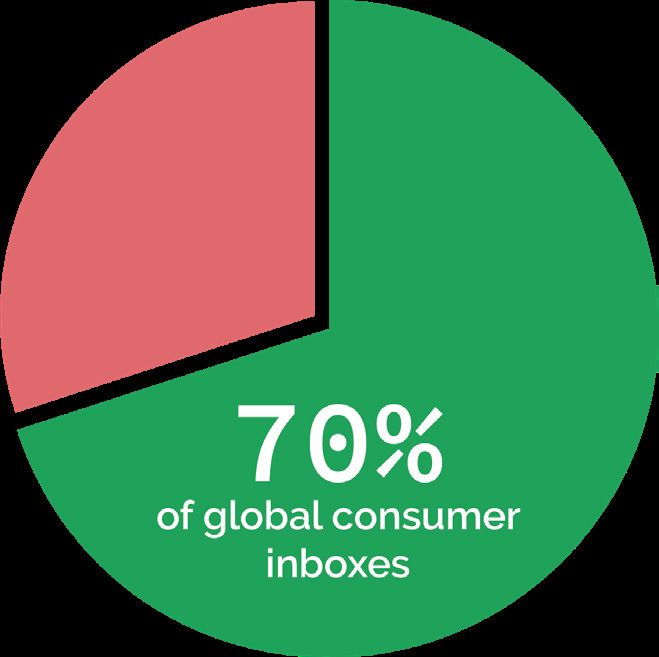
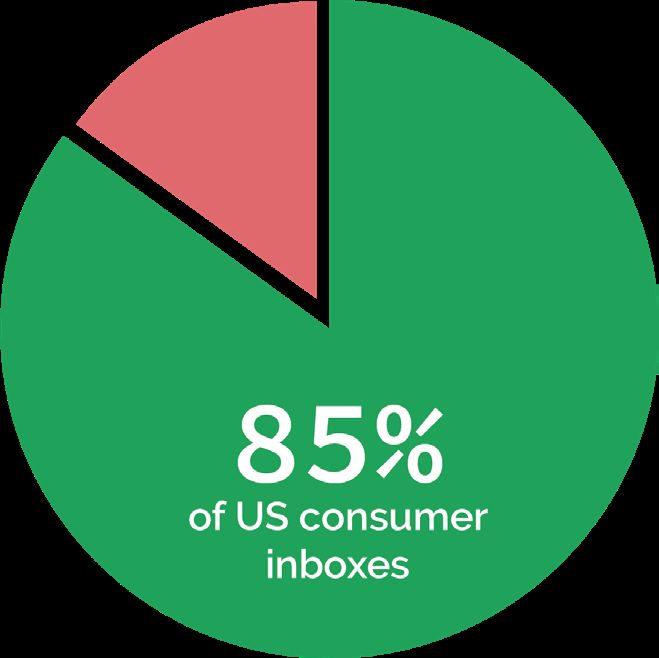
DMARC already protects 85% of consumer US inboxes and approximately 70% of
consumer inboxes worldwide from phishing emails, provided that the organization that
is being impersonated in a phishing email has a published DMARC record.
It is important to note that an organization which has implemented DMARC will not be
notified of phishing emails which impersonate that organization if the inbox of the recipient
of the relevant email has not enabled DMARC.
Supported by
• Since 2015, Gartner has included the provision of DMARC as a
qualifying feature for its Magic Quadrant for Secure Email Gateways
‘leader’ position.
• In 2016, the UK Government mandated DMARC as a must-have
minimum for a new standards framework for all “.gov.uk” domains by
March 2019. This ensured that emails in transit are authenticated.
• In 2017, the U.S. Government mandated DMARC for its Department of
Homeland Security domains.
• 2018, The NCSC (Part of GCHQ) issue guidance to make it a top 5
priority for the board - “Organisations that deploy these measures
properly can ensure that their email addresses are not used by
criminals“.6 They also publish the Minimum Cyber Standard Framework,
defining the minimum security measures that Departments shall
implement with regards to protecting their information, technology and
digital services.
9 A BUYERS GUIDE TO DMARC - ONDMARC.COMMaking the case for DMARC
You can check your organization’s current DMARC set-up at www.ondmarc.com
using the free domain checker tool, where you’ll get clear information on the status of
your DMARC, SPF and DKIM. It’ll also let you know whether your inbox and DNS are
compatible with DMARC.
Complete visibility
DMARC provides reports to users showing most, if not all, emails that come from a
user’s domain, not just those that cross the organization’s network boundary. This
contrasts with traditional cybersecurity solutions, such as MessageLabs and Mimecast,
which only pick up phishing emails that cross the network boundary. Without DMARC,
organizations are therefore not getting a complete picture of the number and scale of
attacks against them.
Hackers send email phishing attacks Hackers can impersonate your email address and
to your firm send phishing attacks inside and outside your firm
send-money@example.com yourname@yourfirm.com
your firm
your firm
Clients Suppliers
Various cyber security solutions OnDMARC stops impersonation of your
filter inbound email email address gobally.
Protect your reputation
Organization’s domains subject to email spoofing may suffer considerable reputational
damage. Phishing scams may well attract negative press, with liability often attributed
to the organization which has been impersonated.
A BUYERS GUIDE TO DMARC - ONDMARC.COM 10Ensure financial security
Paying fake invoices or completing wire transfers impersonating the CEO are
common mistakes incurred as a result of email spoofing. In fact, the financial cost
has consistently increased according to The UK Government’s 2018 Cybersecurity
Breaches Survey7.
Comply with GDPR
General Data Protection Regulation (GDPR) came into force May 2018, requiring you
to have Data Processing Agreements (DPAs) with every cloud service provider that
handles EU consumer data on your behalf. With DMARC, if a cloud service provider
does send email using your company’s domain name in the ‘From’ field then DMARC
will reveal them to you.
Improve email deliverability
Email providers, such as Gmail, Yahoo and Hotmail, are becoming more protective of
their users’ inboxes. An email provider may well refuse to deliver an email to a user’s
inbox if it does not have a SPF and/or DKIM signature.
With DMARC, emails are reliably authenticated, thereby improving deliverability of
legitimate emails to a user’s inbox.
Nurture trust
Organizations that fail to take the necessary precautions to prevent email spoofing
are likely to be considered less trustworthy. Customers may not trust emails which
purport to come from such organizations and may be deterred from using email
to communicate with them, which can impact on those organizations’ ability to
communicate effectively with their customers.
Identify and remove shadow IT
It’s not easy to find all “shadow IT” cloud services. For example, If someone in
Marketing set up an account with a Salesforce add-on years ago that no one in IT
knows about and it sends emails to customers, then you would need to check DPA’s
(Data Processing Agreements) are in place. Implementing the email protocol DMARC
uncovers all the email services sending email from your domain, whether you officially
know about them, or not.
The costs of data theft as a result of spam emails continue to escalate, but adopting
DMARC could save an organization thousands, if not millions, of dollars.
11 A BUYERS GUIDE TO DMARC - ONDMARC.COMAnswering common objections
• Why should we prioritize adopting DMARC?
DMARC is fundamental to cybersecurity. The UK’s National Cyber Security
Centre declared that, “Widespread adoption of the DMARC protocol is
essential to defend against targeted cyber threats.” An organization
which spends money on sophisticated and expensive security measures but
fails to deploy DMARC is analogous to a homeowner installing a high-tech
burglar alarm but leaving the front door unlocked.
• Why should we pay for something that is an open standard?
You can deploy DMARC at no cost by configuring your own reports,
interpreting the results and then adjusting your SPF and DKIM configurations
accordingly. However, DMARC XML reports are very lengthy and require staff
resourcing to interpret the data and make adjustments accordingly. DMARC
providers, such as OnDMARC, provide support in interpreting these reports
and guidance on the appropriate DMARC configuration to get to the stage of
being able to implement p=quarantine or p=reject policies more quickly.
• We haven’t deployed SPF and/or DKIM yet - don’t we have to do that first?
You don’t need to have deployed SPF and/or DKIM to get up and running with
DMARC. In fact, the insight from your DMARC reports will help you to correctly
deploy and configure SPF and DKIM.
• DMARC seems to be really complex to deploy based on our experience with
other cybersecurity providers.
Deploying DMARC should be a logical and iterative process, however it does
rely on a certain level of expertise about email security. A good DMARC
provider, such as OnDMARC, will massively simplify this process and help
you to reach full protection mode.
A BUYERS GUIDE TO DMARC - ONDMARC.COM 12• I’m concerned that implementing DMARC is going to affect our current
email deliverability.
DMARC will improve your email deliverability significantly, providing that it is
correctly configured. An easy-to-use DMARC provider, such as OnDMARC,
will help you reach full protection mode far more quickly, minimizing day-to-
day email operational issues and helping your organization achieve a far higher
level of email deliverability.
• We already have Mimecast/Messagelabs - doesn’t that do this job?
Most of the email security solutions currently available do not give
organizations total protection against email impersonation. This is because
they focus on preventing security breaches which result in spam emails being
sent from within an organization’s network boundary. They do not prevent
attacks which originate outside the organization’s network and which will not
cross the network boundary. The DMARC protocol is the only way to close this
loophole by ring fencing an organization’s domain and preventing spammers
from impersonating it.
The potential costs of data theft and loss of services continue
to escalate, but simple measures, such as DMARC, could
save single organizations, thousands, if not millions of dollars.
13 A BUYERS GUIDE TO DMARC - ONDMARC.COMWhat you should look for in your DMARC provider?
Supplier checklist
What are their security accreditations? It is important to check if the
DMARC provider has the appropriate security accreditations. Check if they are
ISO27001 certified or have Cyber Essentials.
Are they using the p=reject policy themselves? In order to trust that a provider
can implement DMARC effectively within your organization, you should check
if they have been able to properly implement DMARC themselves. You can
easily check using free online tools.
What do existing customers think? If possible, try to speak to one of their
current customers to get an insight on the provider’s product and services.
What does their roadmap look like? You might be buying the product for what
it currently offers today, but also consider what other innovations are being
developed that may be of interest in the future.
How are their support services? Without in-house IT systems expertise,
DMARC may appear to be complex to implement in smaller organizations or to
deploy across larger organizations. A provider’s’ support services may therefore
be integral to fast and effective implementation of DMARC. Support teams will
also be invaluable to ongoing implementation and refinement of DMARC over
time.
A BUYERS GUIDE TO DMARC - ONDMARC.COM 14Product Checklist
What you should look for in your DMARC solution
The basics
Reporting and dashboards: You need to be able to see
all the email validations taking place within your domain.
The best tools will simplify the complex DMARC XML
reports so that you can quickly get an overview of the
DMARC compliance of your emails. Simple dashboards
will enable you to easily identify any misconfigurations, as
well as to see the scale and frequency of spoofing attacks.
For those looking for an in-depth understanding of their
phishing attacks, forensic reports provide greater insight
into how an organization’s domain is being exploited.
Configuration: Once you have used DMARC to understand the security
of your domain, you can put in place a solution which will enable you to
configure your SPF and DKIM policies to ensure that your organization’s
identity can only be used by legitimate users. A clearly structured solution
is important for organizations which do not have specialist in-house DMARC
expertise and/or limited resources. The solution should help you to
confidently move you through the various stages of DMARC implementation
until the organization reaches the p=reject policy.
Ongoing protection: As your organization grows and changes you will
undoubtedly have to update your DMARC configuration to ensure that your
domain continues to be protected and that deliverability is unaffected. A good
DMARC solution will allow you to easily update and maintain your SPF and
DKIM configurations, as well as provide clear alerts when one of these ‘breaks’.
A solution like OnDMARC will highlight any changes that need your attention
and provide clear instructions on how to resolve it quickly.
15 A BUYERS GUIDE TO DMARC - ONDMARC.COMHelpful extras available from some providers
Dynamic SPF: The SPF protocol is limited to 10 DNS lookups. This is
often an issue for organizations with a complex email infrastructure
or those that use a number of cloud services, since they will quickly
reach this limit. Once this limit has been reached, legitimate emails
may fail SPF authentication. The Dynamic SPF feature, which is
available from OnDMARC, overcomes this problem by allowing
an organization to use only 1 SPF lookup to connect to OnDMARC’s
system, from where it will have unlimited lookups.
API Access: The ability to seamlessly integrate the data from your
DMARC solution into your existing security dashboards is a useful
way to create a one-stop-shop for all email security analysis.
Single-Sign-On (SSO): Some providers, including OnDMARC, enable an
organization to integrate DMARC with other key IT systems, such as Okta, so that
it can be accessed with a single sign-on to an organization’s security setup.
ChatBot: A chatbot can deliver real value by allowing an organization
to receive and action DMARC alerts directly in Slack. This means you
do not need to check your DMARC application regularly.
DMARC Checkup: Typically when you make a DNS change, you have
to wait for the first aggregate reports to arrive in order to see the
impact of the change, this can take up to 24 hours. With OnDMARC
the inspection tool ‘Investigate’ enables you to immediately check the
results of changes to the configuration of 5 essential signals: DMARC,
SPF, DKIM, FCrDNS and TLS in human readable dashboards.
Forensics: Forensic reports for emails that have failed DMARC
validation give you comprehensive and useful insight into the
individual emails themselves. Be sure to double check that a provider
does this after they’ve redacted the body of the email.
Email security profiles: Being able to quickly compare your email
configuration with an industry standard is a great way to guarantee
you can meet the needs of any regulation in place. Providers like
OnDMARC enable you to compare your compliance against the
requirements of different security profiles such as the UK Minimum
Security Standards or US Binding Operational Directive 18:01.
A BUYERS GUIDE TO DMARC - ONDMARC.COM 16Implementation services
Implementation: An implementation package can help an organization to
put DMARC protection in place more quickly, minimizing its exposure to email
impersonation. The services included should enable you to identify valid
sources of email within your organization, configure them correctly and then
put DMARC into quarantine or reject.
Managed Services: The benefit of having a managed service is that you
secure access to a team of experts who are available at all times. These
experts can notify you of incident alerts and suggest resolutions, freeing your
team up to focus on other tasks.
Support: Customer support is a great way to
tackle any ad hoc troubleshooting or get help
using the DMARC tool. Some solutions, such
as OnDMARC incorporate chat functions into
their DMARC portal, so with a single click of a
button you can be connected to an engineer
ready to help solve your query.
Also check to see if your provider’s services include a knowledge base,
including answers to frequently asked questions and handy hints and
tips to enable you to optimize your implementation of DMARC and in-life
management.
17 A BUYERS GUIDE TO DMARC - ONDMARC.COMTime to make DMARC work for your organization
Setting up the basics of DMARC
DMARC does not require installation of any software or special devices -
it relies simply on the configuration of three types of DNS records:
SPF Record
This provides a list of IP addresses for the users that are authorized to
send emails on behalf of your domain.
DKIM Records
Services sending emails on your behalf should sign every message using
DKIM. The public key for these signatures are hosted as DNS records,
against which receiving servers validate emails.
DMARC Record
This declares the policy to be applied when validating emails sent from
your domain.
While SPF and DKIM are used by DMARC to enforce a policy the first phase of DMARC
implementation is simply reporting. This means you don’t need to have SPF and DKIM
configured before you set up DMARC, it’s afterwards, once you have insight into your
domain traffic, that your provider can help set up these protocols.
No failing traffic
for 7 days*
Receive Set
Update
reports DMARC
DKIM &
& actions to Reject
SPF
Daily > 7 days
Create your account Add a DMARC
< 1 minute record to your DNS
~ 5 minutes
*Based on a typical business cycle of 1 week
A BUYERS GUIDE TO DMARC - ONDMARC.COM
18Who should manage DMARC?
The individual responsible for an organization’s email system will be best placed
to implement DMARC, as they are likely to have the necessary access to edit the
organization’s DNS settings.
They will have 3 key tasks:
Gather insight
To avoid any impact on their email traffic, set up DMARC in their
DNS in reporting-only mode. Once this DNS record is set up,
your DMARC provider will receive reports indicating whether the
organization’s emails would pass or fail DMARC validation. The
provider should analyze these reports for seven days before
suggesting next steps.
Determine action
Your provider will offer recommendations on how to set up their
SPF and DKIM records to ensure the organization’s email traffic is
DMARC compliant. They will not be able to implement the highest
policy of protection until all of their legitimate email traffic is
confirmed as DMARC compliant.
Maintain protection
Once they have received confirmation that all of their legitimate
email traffic is DMARC compliant, they can then modify the policy
on their DMARC DNS record to instruct receivers of emails from
your domain to reject emails that fail DMARC validation. At this
point, their domain will be effectively protected from phishing
attacks using email impersonation. By implementing DMARC,
the organization is confirming to receivers that their emails are
authorized and should be directed to the inbox rather than junk or
spam folders. Your provider should continue to monitor their email
traffic.
19 A BUYERS GUIDE TO DMARC - ONDMARC.COMWhat’s next?
As with any software or hardware, DMARC requires regular maintenance. Once you
have received a series of DMARC reports, you may wish to refine the features of the
product. Your provider should have support engineers who can work with you to
undertake the necessary improvements.
Your provider can also advise on
the steps to take if your organization
reaches the maximum number of
SPF
DNS lookups provided for by the SPF
protocol, for example implementing
Dynamic SPF.
Remember, DMARC is only designed to protect against phishing attacks that use
your domain to send emails that impersonate someone in your organization. It does
not protect against phishing attacks from lookalike domains. For example, if you
own “example.com” and implement DMARC on that domain, scammers can still use
“examples.com” or “examplesbilling.com” if those domains are not DMARC protected.
It is generally considered a best practice to purchase lookalike domains and park them.
Parking a domain involves using DMARC to protect domains that are not used to send
emails so that they cannot be used by spammers.
Good luck on your DMARC journey!
We hope that you found this guide a useful way to start building your understanding of
DMARC and all its security benefits. We appreciate it’s a lot to take in but remember, if
you can find yourself a trusted and proven provider you’ll have an expert by your side for
your whole DMARC journey.
If you have any further questions about how DMARC works or how you can make it work
for your organization then get in touch with one of the team at team@ondmarc.com
- we’ll be happy to help.
Stay secure,
Team OnDMARC
References
1. http://www.radicati.com/wp/wp-content/uploads/2017/01/Email-Statistics-Report-2017-2021-Executive-Summary.pdf
2.https://techcrunch.com/2018/11/01/half-fortune-500-dmarc-email-security/
3. http://www.documentwereld.nl/files/2018/Verizon-DBIR_2018-Main_report.pdf
4. http://www.newsweek.com/origins-nigerias-notorious-419-scams-456701
5. https://enterprise.verizon.com/resources/reports/dbir/
6. https://www.ncsc.gov.uk/guidance/board-toolkit-five-questions-your-boards-agenda
7. https://assets.publishing.service.gov.uk/government/uploads/system/uploads/attachment_data/file/702074/Cyber_Security_Breaches_
Survey_2018_-_Main_Report.pdf
A BUYERS GUIDE TO DMARC - ONDMARC.COM 20Start your DMARC conversation today!
www.ondmarc.com
The Red Sift Open Cloud is a data analysis platform that is purpose-built for the challenges
of cybersecurity. By harnessing the power of AI we can securely collate, compute & visualize
data from thousands of individual signals to help organizations to optimize their cybersecurity.
www.ondmarc.com
Our first product on the Red Sift platform is OnDMARC, a SaaS product that helps to
contact@redsift.com
implement and maintain DMARC. This email authentication protocol effectively blocks
A BUYERS GUIDE TO DMARC - ONDMARC.COM
phishing attacks and increases the deliverability of genuine emails. @redsift 22You can also read


