A new door to a different world: opportunities from the metaverse and the raise of meta-medical laboratories
←
→
Page content transcription
If your browser does not render page correctly, please read the page content below

Clin Chem Lab Med 2023; 61(9): 1567–1571

Opinion Paper

Damien Gruson*, Ronda Greaves, Pradeep Dabla, Sergio Bernardini, Bernard Gouget
and Tuğba Kemaloğlu Öz

A new door to a different world: opportunities
from the metaverse and the raise of meta-medical
laboratories
https://doi.org/10.1515/cclm-2023-0108                                        Methods: Based on the available evidence, literature and
Received January 30, 2023; accepted February 20, 2023;                        reports, we analyzed the different perspectives of the met-
published online March 2, 2023                                                averse on laboratory medicine and the needs for an efficient
                                                                              transition.
Abstract
                                                                              Results: The convergence and integration of technologies in
                                                                              the metaverse will participate to the reimagination of labo-
Objectives: In the digital age, the metaverse has emerged
                                                                              ratory medicine services with augmented services, users’
with impressive potential for many segments of society. The
                                                                              experiences, efficiency, and personalized care. The revolu-
metaverse could be presented as a parallel dimension able to
                                                                              tion around the metaverse offers different opportunities for
enhance the physical world as well as our actions and
                                                                              laboratory medicine but also open multiple related chal-
decisions in it with the objective to use a coalition between
                                                                              lenges that are presented in this article.
the natural and virtual worlds for value creation. Our aim
                                                                              Conclusions: Scientific societies, multidisciplinary teams
was to elaborate on the impact of the metaverse on labora-
                                                                              and specialists in laboratory medicine must prepare the
tory medicine.
                                                                              integration metaverse and meta-medical laboratories, raise
                                                                              the awareness, educate, set guidance to obtain a maximum
                                                                              of value and mitigate potential adverse consequences.
*Corresponding author: Pr. Damien Gruson, Department of Laboratory            Keywords: artificial intelligence; augmented reality; avatar;
Medicine, Cliniques Universitaires St-Luc and Université Catholique de        digital health; digital twins; metaverse; virtual reality
Louvain, 10 Avenue Hippocrate, B-1200 Brussels, Belgium; Pôle de
recherche en Endocrinologie, Diabète et Nutrition, Institut de Recherche
Expérimentale et Clinique, Cliniques Universitaires St-Luc and Université
Catholique de Louvain, Brussels, Belgium; and Emerging Technologies
Division and MHBLM Committee, International Federation Clinical               Introduction
Chemistry and Laboratory Medicine (IFCC), Milan, Italy, Phone: +32-(0)2-
7646747, Fax: +32-(0)2-7646930, E-mail: damien.gruson@uclouvain.be            ‘The future cannot be predicted, but futures can be invented’
Ronda Greaves, Murdoch Children’s Research Institute, Parkville, VIC,         Dennis Gabor (The Nobel prize winner in Physics1971 In-
Australia; and Emerging Technologies Division and MHBLM Committee,
                                                                              ventor of Holography). Emerging technologies and Artificial
International Federation Clinical Chemistry and Laboratory Medicine (IFCC),
Milan, Italy. https://orcid.org/0000-0001-7823-8797                           Intelligence (AI) are accelerating the transformation of
Pradeep Dabla, Department of Biochemistry, G.B. Pant Institute of             healthcare and laboratory medicine with potential positive
Postgraduate Medical Education & Research, Associated Maulana Azad            impact on patient care, efficiency of healthcare systems and
Medical College, New Delhi, India; and MHBLM Committee, International         “augmented” practices of healthcare professionals [1, 2]. The
Federation Clinical Chemistry and Laboratory Medicine (IFCC), Milan, Italy
                                                                              benefits of emerging technologies is translating at different
Sergio Bernardini, Department of Experimental Medicine, University of
Tor Vergata, Rome, Italy; and Emerging Technologies Division and MHBLM        levels such as the improvement of efficiency and produc-
Committee, International Federation Clinical Chemistry and Laboratory         tivity (automation of tasks, streamlining of processes…),
Medicine (IFCC), Milan, Italy                                                 enhancement of communication and collaboration (real-
Bernard Gouget, National Committee for the Selection of Reference             time connectivity, increased knowledge sharing, collabora-
Laboratories, Ministry of Health, Paris, France; and MHBLM Committee,
                                                                              tive decision making…), better clinical outcomes (increased
International Federation Clinical Chemistry and Laboratory Medicine (IFCC),
Milan, Italy. https://orcid.org/0000-0002-8010-1404
                                                                              accuracy of diagnosis, early prevention, remote moni-
Tuğba Kemaloğlu Öz, Liv Hospital Ulus, Beşiktaş/Istanbul, Türkiye; and        toring…) or increased sustainability (reduction of envi-
Istinye University, Faculty of Medicine, Istanbul, Türkiye                    ronmental impact, promotion of sustainable practices…)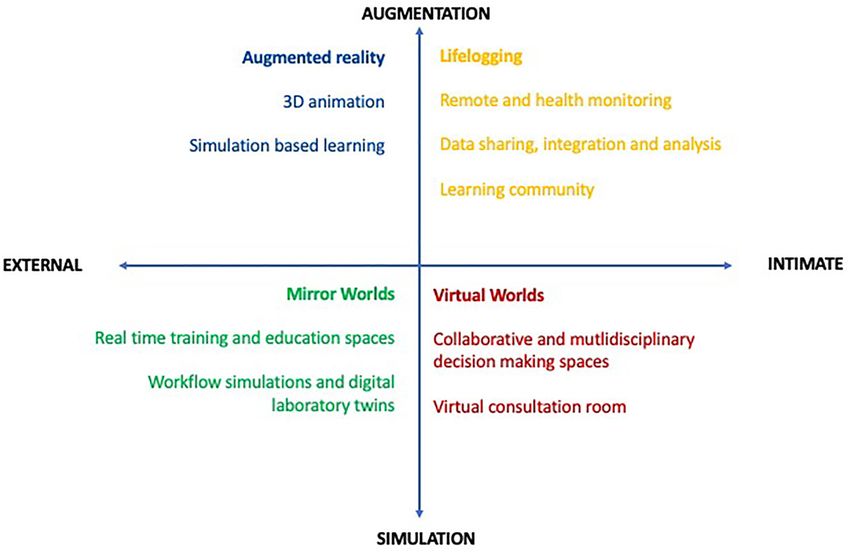
1568         Gruson et al.: Metaverse and laboratory medicine

[3–5]. Mobile health and digital health devices can also play        creation [6, 8]. Metaverse is therefore a virtual space inte-
an important role in monitoring of health conditions at              grating physical and virtual realities and enabling users and
home under doctor supervision connected through auto-                avatars to interact in an environment supported by
mated electrocardiograms devices for the monitoring of               emerging technologies [6]. The metaverse promises to
heart and blood pressure to evaluate the cardiovascular              become a world of its own, an existence somewhere between
systems, oxygen saturation, and even blood glucose calcu-            purely physically and solely digital, it will incorporate
lators for diabetic patients, connecting real life with the          several technological elements. Starting from a variety of
virtual world [3–5].                                                 hardware that includes but is not limited to flat screens,
     Everyday functions like education, logistics,                   Augmented, Virtual and Mixed Reality devices (AR, VR &
manufacturing or healthcare could potentially be repli-              MR), smart glasses and mobile devices. The next significant
cated in the metaverse, connecting physical and digital              fraction is the vast scope of software that will be essential to
presence. In the digital age, the metaverse has emerged              the creation of the metaverse and that covers subjects of
with impressive potential for many segments of society               digital twins, hyper-realistic avatars, data, NFTs, cyber se-
(entertainment, work, commerce, and the social world)                curity, 3D modeling, design and many more [10].
and healthcare [6–8]. The revolution around the meta-                     We have also to underline that metaverse has different
verse offers different opportunities for laboratory                    service types: augmented reality (AR), life-logging, mirror
medicine, with the raise of meta-clinical laboratories               worlds and virtual worlds (Figure 1) [8, 11]. AR can be
(MetaLab) but also open multiple related challenges and              considered as an advanced and versatile version of the
questions that we would like to emphasize in this short              external world able to provide value through immersive
article.                                                             content combining real world, fantasy, and convenience [11].
                                                                     Life-logging is more likely a record-keeping tool in which
                                                                     medical professionals can record their work, such as case
Diving into the metaverse                                            scenarios, surgeries, treatment regimen, and research pro-
                                                                     jects, in a virtual format and share it with others [11]. Life-
The term ‘metaverse’ was invented in the 1992 science fiction         logging leverage value through extensive real-world expe-
novel Snow Crash and results from the combination of the             rience and information can be checked at any time and
words “meta” and “universe” [6]. According to the Oxford             checked by others [11]. The mirror world is a type of
English Dictionary, a metaverse is “a virtual reality space in       augmented reality where real-life situations are simulated in
which users can interact with an environment generated by            the virtual world to create an experience-based learning
computer and with other users” [9]. The metaverse could be           environment. Mirror worlds add value through maximized
described as a parallel experiential dimension able to               usability by integrating and expanding external information
enhance the physical world as well as our actions and de-            into the virtual space [11]. Lastly, virtual reality (VR) is
cisions in it, rather than replacing it, with the objective to use   another type of reality where the environment is built
a coalition between the natural and virtual worlds for value         entirely from the real world, and thus the limitation of

                                                                                           Figure 1: The different service types of the
                                                                                           metaverse.
Gruson et al.: Metaverse and laboratory medicine 1569
Figure 2: The driving factors and challenges
around the metaverse (background image
from https://www.istockphoto.com/fr/photo/
personnage-avec-lunettes-vr-immerg%C3%
A9es-dans-un-liquide-diffus-r%C3%A9tro%
C3%A9clair%C3%
A9-gm1388545145446153881?irgwc=1&
cid=IS&utm_medium=affiliate&utm_
source=Eezy%2C+LLC&click-
id=04uW6oRm7xyNTgqSFxTpAx-
aAUkAwqDWG23r9100&utm_term=www.vec-
teezy.com&utm_campaign=SRP&utm_con-
tent=1141987&irpid=38919).
virtual reality is that person’s imagination. VR value is to – Economical: The metaverse is expected to disrupt
provide a new virtual space that does not exist and where healthcare and open new channels of treatment while
various individuals can perform activities [11]. lowering costs. New business opportunities are
emerging in the metaverse with new faces for interac-
tive e-commerce, visits, demonstrations, and experi-
The driving forces ences. The metaverse also provide the ability to travel
and trade freely between new goods, products, and
Different factors are pillars of the metaverse and stimulate services [13]. Blockchain offers the ability to secure
its development (Figure 2) [12]: payments and exchanges.
– Technological: Progresses and development of the 5G
and 6G communication network and infrastructures,
the Web 3.0 and the high-speed transfer of high volumes
of data. Blockchain technology and artificial intelligence
The opportunities of the metaverse
are also at the heart of the metaverse and its ecosystem in laboratory medicine
as well as wearables and sensors. The metaverse
appearing as a new convergence of these emerging The metaverse is largely discuss in different fields of
technologies. One thing is for sure, that we cannot healthcare such as oncology, cardiology, mental health, or
expect a sudden switch from flat screen devices to imaging [8, 14–19]. Several applications of the metaverse
purely immersive technology. such as educational and teaching, surgical simulations,
– Cultural: The spread of the digital culture and digital conferences and meetings, awareness programs, research
services is one of a key element. The rise of cybernetics, programs, visualization of complex anatomy have been
which has led to the miniaturization of high-speed developed or are under research. Though not limited but
networking devices and the widespread of both mobile bibliometric analysis of virtual reality and augmented re-
device and wearable technology, allowed technology to ality emphasize that the metaverse applications can be
move closer to one’s body, making users more prepared suitable for various diagnostic and surgical procedures. The
for the coming of headword immersive devices. The latest applications has shown satisfying results in rehabili-
evolution of social relationships across digital media has tation on pain, stroke, anxiety, depression, fear, cancer, and
also to be pointed out. The desire of alternatives to broke neurodegenerative disorders. Further, researchers can use
reality and face-to-face contact are becoming the new this metaverse tool to make the research studies faster and
normal and the metaverse appears as a way for imag- with larger sample size and even extending to global levels.
ining and creating a better or different world. Several perspectives and scenarios could be associated
– Demographic pressure: Patients’ rising expectations for to development of Meta-Medical laboratories such as:
customization delivery are also reshaping the Health- – Smart manufacturing, in-silico modeling, pre-evaluation
care market. and simulation of assays and devices performances.1570 Gruson et al.: Metaverse and laboratory medicine
– Dynamic 3D visits of virtual clinical laboratories and Open challenges in the metaverse
digital modeling of laboratory spaces, environments and
workflows. The metaverse is a revolution for healthcare and for labo-
– Use of augmented and virtual reality to assist with lab- ratory medicine. However, several challenges need to be
oratory testing and analysis. addressed before a broader use of the metaverse and regu-
– Virtual comparative of laboratory services to analyze lation and legal frameworks will have to be adjusted [10, 20,
and improve users’ experience. 21]. Technical aspects remain of course to overcome, and the
– Remote services with the integration of point of care growing lack of essential components needs to be consid-
testing, mobile health technologies and sensors for early ered. Health equity and fairness will be other important
detection of diseases and real time monitoring of aspects to allow access to technology and avoid digital divide.
patients. A careful attention will have to be paid to users/human’s
– Virtual services and care pathways to support preven- emotions, cognition, and behavior within virtual environ-
tion and diagnostic with the inclusion of telemedicine ments to avoid dehumanization and breakdown of social
and teleservices. relations the protection and recognition of human charac-
– Tailoring clinical laboratory services to patients and teristics, rights and moral values in such disruptive ecosys-
creation of real virtual care pathways reinvented in the tems will be of major importance with the definition of
metaverse. ethical guidance. Another very important aspect for the
– Reduction of physical and paper-based patients’ records progression of the metaverse is the interoperability of the
and personalized health data monitoring by raw data electronic medical records (EMR) and laboratory informatic
sharing and integrating clinical, imaging and laboratory systems as well as the exchange of structured data is still
data. needed the use of standards such FHIR, which is a widely
– Designing and simulating sustainable facilities and adopted standard for exchanging healthcare information,
processes to reduce the environmental footprint of can help ensure that different systems can communicate.
laboratory services and for a better compliance to legal Application Programming Interfaces (APIs) allow also soft-
requirements. ware systems to communicate with each other in a stan-
– Recruitment and training (including training on blood dardized way. Centralized database and health data space.
collection or pre-analytical steps). Improving the interoperability between healthcare software
– Remote work and collaboration. still requires a collaborative effort between different stake-
– Use of VR and AR to face the shortage of healthcare re- holders in the healthcare industry and clinical laboratories
sources and facilitate collaborative multidisciplinary care. including EMR and software vendors, healthcare providers,
– Consultation, education and information to patients and and government agencies. The security and privacy of data
caregivers in virtual facilities within the metaverse, and model are critical features as well as the liability to cover
from anywhere in the world and with great potential for adverse effects resulting from the metaverse. Education and
rare diseases. training of users, policymakers to the benefits and risks will
– Phantoms, digital laboratory twins and patients’ avatars be another issue where scientific societies and the clinical
to integrate multiple date from omics technologies and laboratory community will play a fundamental role.
develop augmented predictive model and personalized Overall, the metaverse has the potential to change the
care services. way laboratorians work and interact with colleagues and
– Assist with data analysis, improving the speed and ac- patients, offering more opportunities for remote work and
curacy of laboratory tests. collaboration, virtual training and education, and the use of
– Integration and manipulation of different medical data augmented and virtual reality. However, the full extent of
for improvement of diagnosis and treatment options. these changes and their implications on the laboratorians’
– Discussion of complex cases through AR and benefits role is yet to be seen, as the metaverse is still in its infancy.
from peer support. Specialists in laboratory need to embrace this revolution
– Use of VR and lecturing in 3D at congresses and educa- and be actively engaged for this transition and for
tional sessions. providing the validation and warrantee of this novel
– Virtual training and education to offer a more immer- ecosystem but also for the continuous monitoring of the
sive and interactive way for laboratorians to train and quality and safety. The clinical laboratory community
educate themselves. should also carefully define the new digital and data com-
– Enhance the development of sustainable practices. petences for the best use of the metaverse, meaning that itGruson et al.: Metaverse and laboratory medicine 1571
will not imply the death of laboratory medicine but its 4. Liu Z, Ren L, Xiao C, Zhang K, Demian P. Virtual reality aided therapy
augmentation. towards health 4.0: a two-decade bibliometric analysis. Int J Environ
Res Publ Health 2022;19:1525.
5. Kan Yeung AW, Tosevska A, Klager E, Eibensteiner F, Laxar D,
Stoyanov J, et al. Virtual and augmented reality applications in
Conclusions medicine: analysis of the scientific literature. J Med Internet Res 2021;
23:e25499.
6. Wang G, Badal A, Jia X, Maltz JS, Mueller K, Myers KJ, et al. Nature
The metaverse will be an exciting new chapter in not just the machine intelligence development of metaverse for intelligent
history of the internet, but in the development of medical healthcare. Nat Mach Intell 2022;4:922–9.
care globally, providing countless new opportunities. This is 7. Curtis C, Brolan CE. Health care in the metaverse. Med J Aust 2022.
a new world that is advancing daily, and our knowledge https://doi.org/10.5694/mja2.51793.
8. Mrudul A, Kawarase I, Anjankar A. Dynamics of metaverse and
grows with the innovations who are building the new met-
medicine: a review article. Cureus 2022;14:e31232.
averses. Laboratory medicine and in vitro diagnostics will 9. Metaverse noun – definition, pictures, pronunciation and usage notes|
benefit a lot from the metaverse creating a sustainable and Oxford Advanced Learner’s Dictionary at
affordable paradigm. The convergence and integration of OxfordLearnersDictionaries.com. https://www.
technologies in the metaverse will participate to the reima- oxfordlearnersdictionaries.com/definition/english/metaverse?
q=metaverse [Accessed 17 Feb 2023].
gination of laboratory medicine services with augmented
10. Iqbal JD, Krauthammer M, Biller-Andorno N. The use and ethics of
services, users’ experiences, efficiency, and personalized
digital twins in medicine. J Law Med Ethics 2022;50:583–96.
care. Scientific societies, multidisciplinary teams and spe- 11. Lee CW. Application of metaverse service to healthcare industry: a
cialists in laboratory medicine must prepare the transition, strategic perspective. Int J Environ Res Publ Health 2022;19:13038.
raise the awareness, educate, set guidance to obtain a 12. Bhugaonkar K, Bhugaonkar R, Masne N. The trend of metaverse and
maximum of value and mitigate potential adverse conse- augmented & virtual reality extending to the healthcare system. Cureus
2022;14. https://doi.org/10.7759/cureus.29071.
quences. Thus, the metaverse can be considered a tool to
13. NFTs: the metaverse economy – financial times – partner content by
improve the quality of the health care system in terms of CRYPTO.COM. https://www.ft.com/partnercontent/crypto-com/nfts-
improving diagnostics interventions and patient treatment. the-metaverse-economy.html [Accessed 15 Jan 2023].
14. McWilliam A, Scarfe P. The metaverse and oncology. Clin Oncol 2022.
Research funding: None declared. https://doi.org/10.1016/j.clon.2022.06.011.
15. Mesko B. The promise of the metaverse in cardiovascular health. Eur
Author contributions: All authors have accepted responsibility
Heart J 2022;43:2647–9.
for the entire content of this manuscript and approved its
16. Mahtab EAF, Egorova AD. Current and future applications of virtual
submission. reality technology for cardiac interventions. Nat Rev Cardiol 2022;19:
Competing interests: Authors state no conflict of interest. 779–80.
Informed consent: Not applicable. 17. Skalidis I, Muller O, Fournier S. CardioVerse: the cardiovascular
Ethical approval: Not applicable. medicine in the era of metaverse. Trends Cardiovasc Med 2022. https://
doi.org/10.1016/j.tcm.2022.05.004.
18. Plechatá A, Makransky G, Böhm R. Can extended reality in the
metaverse revolutionise health communication? npj Digit Med 2022;5:
References 1–4.
19. Usmani SS, Sharath M, Mehendale M. Future of mental health in the
1. Greaves RF, Kricka L, Gruson D, Martin H, Ferrari M, Bernardini S. metaverse. Gen Psychiatr 2022;35:e100825.
Emerging technology: a definition for laboratory medicine. Clin Chem 20. Marzaleh MA, Peyravi M, Shaygani F. A revolution in health:
Lab Med 2022;61:33–6. opportunities and challenges of the metaverse. EXCLI J 2022;21:791.
2. Padoan A, Plebani M. Artificial intelligence: is it the right time for clinical 21. Bibri SE, Allam Z. The metaverse as a virtual form of data-driven smart
laboratories? Clin Chem Lab Med 2022;60:1859–61. cities: the ethics of the hyper-connectivity, datafication,
3. Al-Jaroodi J, Mohamed N, Abukhousa E. Health 4.0: on the way to algorithmization, and platformization of urban society. Comput Urban
realizing the healthcare of the future. IEEE Access 2020;8:211189–210. Sci 2022;2:22.You can also read


