ACTIVITY BOOKLET 2019 - WITH TOM SKILLING - MLB.com
←
→
Page content transcription
If your browser does not render page correctly, please read the page content below
WITH TOM SKILLING

ACTIVITY BOOKLET 2019

WGN-TV CHIEF METEOROLOGIST
Tom Skilling, WGN-TV chief meteorologist,              the Weather Center started providing weather
appears weekdays on WGN Evening News from              reports to WGN Radio. He has also received an
5-7pm, WGN News at Nine and WGN News at Ten.           immense response for WGNtv.com weather blog.
He celebrates his 41st anniversary with WGN-TV         For 38 years, Tom Skilling hosted a Tornado and
in August 2019.                                        Severe Storms Seminar at Fermilab. As host of the
                                                       event, Skilling welcomed the ‘who’s who’ in the
Starting his successful career at the unheard of       severe weather research and forecast community,
age of 14, Tom was hired by WKKD in Aurora,            including famed University of Chicago tornado
IL, while attending West Aurora High School. He        researcher Dr. Ted Fujita. The Fermilab programs
joined WLXT-TV three years later, while going to       have been attended by thousands over the
school during the day.                                 years and have been streamed to even larger
                                                       audiences online.
In 1970, Tom moved to Madison, WI to study
meteorology and journalism at the University of        Over the past several years, Tom has spoken at
Madison-Wisconsin, while continuing to work in         numerous events throughout the Chicagoland
radio and television. Tom’s first television job was   area discussing climate change. In June 2018,
at age 18 in Aurora, IL, at WLXT Channel 60. Then      Tom was awarded by the Illinois Broadcasters
on to WKOW-TV (ABC affiliate) and WTSO radio           Association (IBA) as their “2018 Broadcast
in Madison, WI before going to work for WITI-TV,       Pioneer” honoree. From recording a podcast
Milwaukee from 1975-1978, where he was rated           with Mayor Emmanuel about climate change to
the city’s #1 meteorologist.                           emceeing several events, Tom has maintained a
                                                       very busy schedule.
Tom joined WGN-TV on August 13, 1978. Since
then, he has established himself as a respected
meteorologist both locally and nationally, known
for his in-depth reports, enthusiasm, and use of
state-of-the-art technology. For over 30 years,
Skilling was chief meteorologist on WGN Midday
News as well as later newscasts. Tom Skilling
has been awarded with three honorary doctorates
from Lewis University, St. Mary’s of Minnesota
and Aurora University.

In early 2004, Tom helped coordinate the Tribune
Weather Center, which combines the meteorology
resources and expertise of WGN-TV, CLTV and
the Chicago Tribune in one location. Since 1997,
Skilling has been a driving force behind the                       friend tom on facebook at
Chicago Tribune’s weather page. Another element
in the column is “Ask Tom Why,” in which Tom                       Facebook.com/tomskilling
takes viewers’ questions and answers the “why”
behind the weather. In October 2008, Tom and

                                   White Sox Weather Day Booklet 2019
HOW TO MAKE A CLOUD IN
        A JAR USING HAIRSPRAY
Materials and Equipment
• A jar with lid

• About 1/3 cup hot water

• Ice

• Hairspray

Experimental Procedure
1. Start by pouring the hot water into the jar. Swirl it around a bit to warm up the sides
   of the jar.

2. Turn the lid upside down and place it on the top of the jar. Place several ice cubes onto
   the lid, and allow it to rest on the top of the jar for about 20 seconds.

3. Remove the lid, quickly spray a bit of hairspray into the jar, and then replace the lid with
   the ice still on top. Watch the cloud form.

4. When you see a good amount of condensation form, remove the lid and watch the “cloud”
   escape into the air.

How Does it Work?
When you add the warm water to the jar, some of it turns to water vapor. The water vapor
rises to the top of the jar where it comes into contact with cold air, thanks to the ice cubes
on top. Water vapor condenses when it cools down. However, a cloud can only form if the
water vapor has something to condense onto. In nature, water vapor may condense onto
dust particles, air pollution, pollen, volcanic ash, etc. In the case of this activity, the water
vapor condensed onto the hairspray.

                           White Sox Weather Day Booklet 2019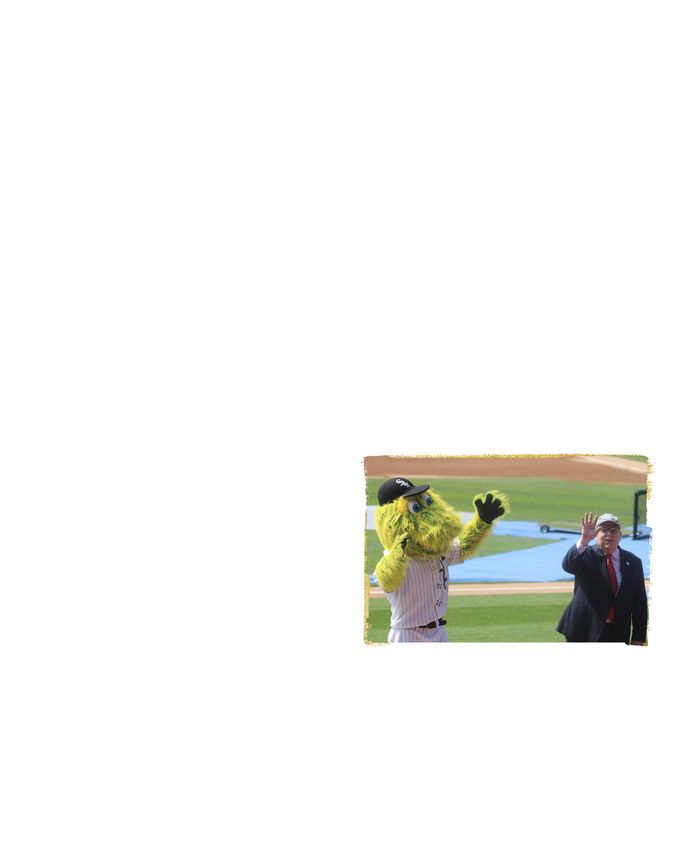
WEATHER DAY QUIZ
QUIZ:
1. _______ is the change in state of water from a liquid to a gas.

   A. Evaporation
   B. Inversion
   C. Condensation

2. Which is NOT a type of cloud?

   A. Stratus
   B. Cirrus
   C. Typhoon

3. The _______ is an index that combines air temperature and relative humidity to determine
   an apparent temperature.

   A. Dew Point
   B. Wind Chill Index
   C. Heat Index

4. Which country experiences the most tornados?

   A. Canada
   B. USA
   C. South America

5. On a single rainbow, red is always located where in the rainbow?

   A. On top
   B. In the center
   C. On the underside

6. Which is a slow, light rain that can go on for hours?

   A. A shower
   B. A drizzle
   C. A cold front

7. A funnel cloud that touches the ground is called a _______.
   A. Tornado
   B. Fog
   C. Dew
                                                            Answers: 1-A, 2-C, 3-C, 4-B, 5-A, 6-B, 7-A

                          White Sox Weather Day Booklet 2019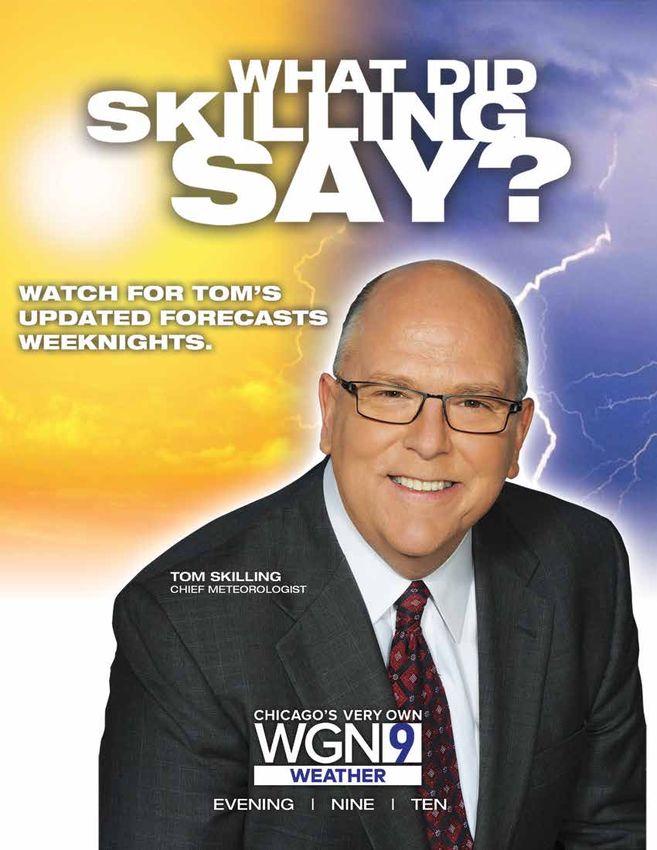
CONNECT THE DOTS

  White Sox Weather Day Booklet 2019

HOW WINDY IS THE WINDY CITY?
• The phrase “the Windy City” actually originates from a political reference and not a weather reference.

• With an average yearly wind speed of about 10 miles per hour, Chicago fails to rank in the top ten
  windiest cities even in the United States.

• The average wind speed in Mt. Washington, New Hampshire is 35 miles per hour.

• With many of the tallest buildings in the world crowded into the downtown “loop” area just off the
  lake, a gusty funneling effect can create winds that will nearly knock the average pedestrian over.

        SUNSHINE
          10

 Hours

           0

        TEMPERATURE
        90º                                                                                    30º

          70º                                                                                  20º

   ºF                                                                                                 ºC
        60º                                                                                    10º

          32º                                                                                  0º

        -15º                                                                                   -10º

        RAINFALL
          4”                                                                                   100

 Inches                                                                                               mm

                Jan   Feb   Mar     Apr   May    Jun    Jul   Aug    Sep    Oct   Nov    Dec
           0                                                                                   0

                                  White Sox Weather Day Booklet 2019
WEATHER DAY WORD SEARCH
Directions
Find and circle all of the direction words that are hidden in the grid. The words may be
hidden in any direction.

                   F   N   T   I     I   Q   B   B   O   I   C   F   A   I   P   L   K
                   L   P   P   R    E    S   S   U   R   E   T   H   G   U   O   R   D
                   U   V W H        V    Y   T   F   V   E   N   O   O   H   P   Y   T
                   R   H   Q   U    D    H   N   E   T   G   E   S   U   N   N   Y   Y
                   R   O   H   S    R    A   V   G   L   J   T   Z   L   M W S       S
                   I   S   M W      J    K   K   N   G   A   N   Z   E   E   T   K   N
                   E   P   E   D    E    G   R   E   E   S   G   X   X   T   S   W O
                   S   J   Y   L    C    A   V   A   L   A   N   C   H   E   A   X   W
                   I   E   Z   A    Z    M   N   T   Z   D   L   Z   R   O   C   O   Y
                   H   N   C   D    Q    Z   Y   F   R   T   S   A   C   R   E   V   O
                   F   A   L   O    M    G   I   A   R   E   T   E   M   O   R   A   B
                   R   C   O   O    L    C   Z   R   B   Q   R   C   F   L   O   U   N
                   O   I   U   L    Y    Z   T   L   D   E   O   F   I   O   F   G   I
                   N   R   D   F     I   S   I   N W O       I   P   Q   G   G   V   A
                   T   R   Y   L    O    A W O       L   O   C   Q   Y   Y   G W R
                   R   U   B   R    H    Q   H   I   F   R   E   E   Z   I   N   G   A
                   A   H   F   C    G    S   K   D   G   Y   T   I   D   I   M   U   H

               Avalanche                 Flood                       Hurricane
               Barometer                 Flurries                    Meteorology
               Blizzard                  Forecast                    Overcast
               Breeze                    Freezing                    Pressure
               Cloudy                    Front                       Rain
               Cool                      Frost                       Shower
               Degrees                   Gale                        Snow
               Drizzle                   Hail                        Sunny
               Drought                   Humidity                    Typhoon

                                   White Sox Weather Day Booklet 2019
QUESTIONS AND ANSWERS
Q: What percentage of days in Chicago from April 1st to October 1st do not have any measurable
precipitation between 6pm and 11pm?
      -Kevin, Chicago

A: Dear Kevin,
The chance of no precipitation on any day in Chicago, averaged over the year, is about two in
three (67 percent), but there are variations around that number through the year. During the
April-September baseball season, the odds of a dry day range from a maximum of about 77
percent in early April and late September to a minimum of 63 percent in late May and again in
late July and early August. The odds of precipitation during the evening are highest in the warm
season when thunderstorms are most prevalent, with activity peaking during between 5-9pm.

Q: Does an identically struck ball that travels 300 ft with a barometer reading of 30 inches travel
less or more distance than one struck with a reading of 29 inches? How much difference in travel
should we expect?
       -Ken, Chicago

A: Dear Ken,
Under identical circumstances, a baseball will travel farther with lower air pressure, a direct result
of less air resistance. It is significant at ball parks with higher elevation like Coors Field in Denver
where the air pressure is equivalent to a 25-inch barometer reading, allowing similarly hit balls
to travel an extra 20-30 feet. A small drop in air pressure from 30 to 29 inches would be minor,
translating to a distance increase of just a few feet.

Q: How do frigid temperatures affect the coefficient of restitution between a MLB baseball and bat?
      -Dustin, Chicago

A: Dear Dustin,
The coefficient of restitution is a ratio of the measure of velocity of the ball and the bat before and
after their impact. Many factors come into play, including the composition and weight of the ball
and bat and their speeds at impact, just to name a few. At lower temperatures, the bats become
less flexible and the ball’s surface becomes stiffer. This increases the force of impact at collision
with the bat, often causing the bat to break. Given the same collision conditions, the ball will not
travel as far at lower temperatures.

Q: Does water effect how the ball comes off of the bat?
      -Cole, Chicago

A: Dear Cole,
Baseball was not meant to be played in the rain. A water-soaked ball is heavy and will not travel as
far as an equally stroked dry one. In addition, a wet bat is harder for the batter to control. He may
have difficulty hitting the ball where he wants to and the bat could slip out of his hands, putting
other players and spectators at risk.

                                White Sox Weather Day Booklet 2019
BECOME A WHITE SOX
KIDS CLUB MEMBER TODAY
COMPLETELY FREE!
ALL MEMBERS RECEIVE
A PERSONALIZED
KIDS CLUB BADGE
AND ACCESS TO
MONTHLY GIVEAWAYS!
VISIT THE 3RD FLOOR OF
THE XFINITY KIDS ZONE TO REGISTER
White Sox Weather Day Booklet 2019You can also read


