Adrienne Doig: It's All About Me! - Bathurst Regional Art Gallery
←
→
Page content transcription
If your browser does not render page correctly, please read the page content below
Adrienne Doig: It’s All About Me!
Adrienne Doig: It’s All About Me!
         Bathurst Regional Art Gallery
             12 December 2020 – 7 February 2021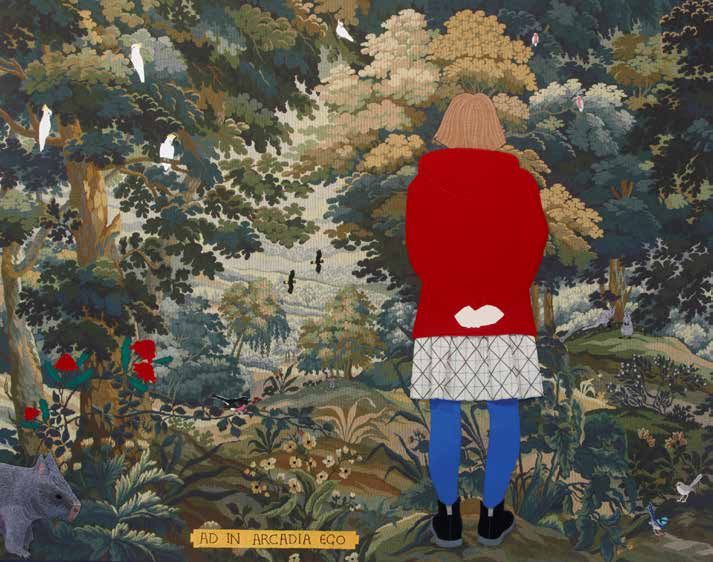
Contents

                                                                                                                                                  Foreword                                    2
                                                                                                                                                  Sarah Gurich
                                                                                                                                                  Director, Bathurst Regional Art Gallery

                                                                                                                                                  Introduction                               5
                                                                                                                                                  Martin Browne
                                                                                                                                                  Director, Martin Browne Contemporary

                                                                                                                                                  Step Into My Shoes                         6
                                                                                                                                                  (Fausto Santini Please)
                                                                                                                                                  Steven Miller
                                                                                                                                                  Head of the Edmund and Joanna Capon
                                                                                                                                                  Research Library and Archive, Art Gallery
                                                                                                                                                  of New South Wales

                                                                                                                                                  Interview with Adrienne Doig              13
                                                                                                                                                  Emma Collerton
                                                                                                                                                  Curator, Bathurst Regional Art Gallery

                                                                                                                                                  Artwork Highlights                        23

                                                                                                                                                  Adrienne Doig: Curriculum Vitae           54

                                                                                                                                                  List of Works                             56

                                                                                                                                                  Acknowledgements                          60

6.36pm Black Dress 2017, acrylic, fabric, appliqué and embroidery on canvas, 34 x 87 cm. Courtesy of the artist and Martin Browne Contemporary.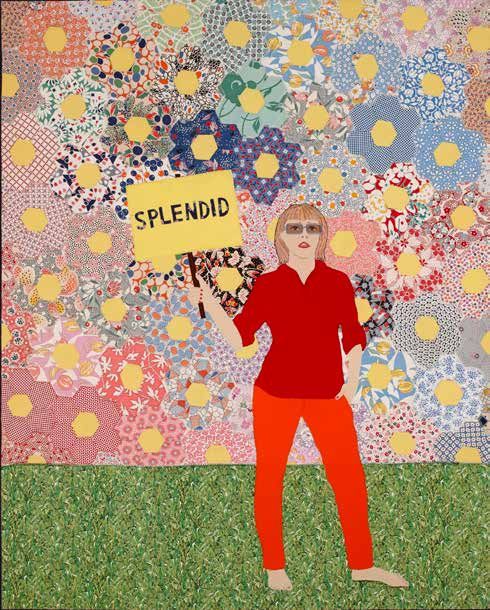
Foreword

It is a great pleasure to present       This exhibition has been some          This catalogue is a rich archive      curator; Vicky Roach, freelance       BRAG acknowledges the funding
Adrienne Doig: It’s All About Me!       time in the making, gestating since    of personal and professional          writer and critic; Alex J. Taylor,    support of the Gordon Darling
as a highlight of Bathurst Regional     I first met the artist in 2013 while   perspectives on Adrienne Doig’s       Assistant Professor in the            Foundation for the It’s All About
Art Gallery’s 2020 exhibition           working at the Blue Mountains          work, and I thank each of the         Department of History of Art and      Me! catalogue, and the ongoing
program. In a year of great             Cultural Centre. As with all good      contributors: Joanna Braithwaite,     Architecture at the University of     financial support provided by
disruption, this exhibition brings      things, sometimes it is wise to        artist; Martin Browne, Director,      Pittsburgh; Joel Tonks, Curatorial    Bathurst Regional Council, Create
joy, humour, and colour to our          wait, and I thank Adrienne for her     Martin Browne Contemporary;           Assistant, BRAG; and Julian           NSW, and the Bathurst Regional
gallery walls.                          patience, professionalism, and         Lisa Catt, Assistant Curator,         Woods; Audience Engagement            Art Gallery Society Inc. (BRAGS).
                                        generosity. I especially thank Emma    International Art, AGNSW; Tracey      Officer, BRAG.
It’s All About Me! spans three                                                                                                                             It’s All About Me! will tour to
                                        Collerton for so enthusiastically      Clement, artist and arts writer;      This exhibition would not             venues in Wangaratta, Tamworth,
decades of Adrienne Doig’s work;                                               Emma Collerton, Curator, BRAG;
                                        embracing this project when she                                              have been possible without            Blue Mountains, and Cowra over
from her first embroidery created                                              Peter Cooley, artist; Jane Gleeson-
                                        joined the BRAG team in 2018,                                                the generous loans from the           the next few years, connecting a
in 1989, to her performance                                                    White, writer; Samantha Littley,
                                        and for working with the artist                                              following individuals and             range of audiences with Adrienne
video artwork produced in the                                                  Curator Australian Art, QAGOMA;
                                        to curate such a thorough and                                                organisations: Fiona Beith, David     Doig’s bold, whimsical, and
mid 1990s, and recent work                                                     James Lynch, Curator, Art
                                        comprehensive survey.                                                        Collins, Adrienne Doig, Deakin        singularly unique vision.
chronicling life in isolation. Doig’s                                          Collection and Galleries, Deakin      University Art Collection, Bruce
singular focus on self-portraiture      I thank Martin Browne, Director        University Art Gallery; Steven        and Jo Hambrett, Lloyd Harris,        Sarah Gurich
forms a consistent thread through       of Martin Browne Contemporary,         Miller, Head of the Edmund and        Martin Browne Contemporary,           Director, BRAG
her practice, utilising different       for his support of the Adrienne        Joanna Capon Research Library         Ross McLean, Louise Mitchell,         November 2020
mediums – video, embroidery,            Doig: It’s All About Me! exhibition    and Archive, AGNSW; Julianne          Queensland Art Gallery | Gallery of
and sculpture – as stages for the       and catalogue, and for the deep        Pierce, independent writer, artist    Modern Art; and private collectors
exploration of complex social and       and abiding respect he has for the     and producer; Melinda Rackham,        who wish to be anonymous.
political issues.                       artists he represents.                 artist, author and independent

                                                                                                                                                                                                                          Dolled Up 2020 (detail).
                                                                                                                                                                                         Courtesy of the artist and Martin Browne Contemporary.

                                                                                                                                                                                                                                                3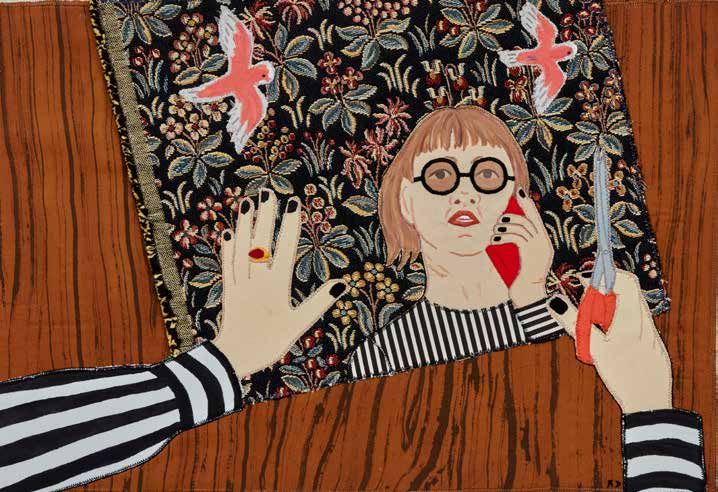
Introduction

                                                                                                       A friend of 20 plus years, I’d followed   had bought in a market while on         devastating bushfires of the Summer
                                                                                                       Adrienne Doig’s work keenly before        a residency in Paris. In so doing,      of 2019/2020, proved prophetic.
                                                                                                       offering her a solo exhibition in my      she recalled the European vision of     Later, in 2018’s Extra, she interposes
                                                                                                       galley in 2012. I’d always been taken     Australia so popularised in the early   her daily life chores and pleasures
                                                                                                       with the sly and self-deprecating         landscapes of Eugene von Guerard,       into the maelstrom of war that is
                                                                                                       humour in her works and admired           John Glover, and W.C. Piguenit while    the Bayeux Tapestry, while most
                                                                                                       that she understood that to be most       at the same time including scenes of    recently, in the domestic interiors of
                                                                                                       effective, irony is best applied with a   her own daily life channelled through   2020’s Picture Me, she has created
                                                                                                       light touch. Yet beneath the humour       iconic images by and of everyone        paeans to the pleasures of home
                                                                                                       and sideways grins, Adrienne has          from Fragonard to Marilyn Monroe.       in these ‘iso times’. In all of these
                                                                                                       always had a very distinctive vision                                              Adrienne has remained true to the
                                                                                                                                                 Adrienne’s portrayal of self has
                                                                                                       in which her figure is central to her                                             central cause that has guided her
                                                                                                                                                 since shifted ground, evolving
                                                                                                       work, but in such a way as she is                                                 work since she started: renewing,
                                                                                                                                                 with her ideas and vision. She
                                                                                                       standing in for us all.                                                           refreshing and reinvigorating the
                                                                                                                                                 has embraced landscapes, both
                                                                                                                                                                                         classic genre of self-portraiture for
                                                                                                       In that 2012 show, AD in Arcadia          her local environment and art
                                                                                                                                                                                         the 21st century.
                                                                                                       Ego, several examples of which are        historical antecedents. The works
                                                                                                       exhibited here, Adrienne playfully        from 2015’s Look Out! Series
                                                                                                                                                                                         Martin Browne
                                                                                                       engaged with Australian art history,      confronted the ‘here and now’ of
                                                                                                                                                                                         Director
                                                                                                       embroidering images of local Blue         environmental devastation around
                                                                                                                                                                                         Martin Browne Contemporary
                                                                                                       Mountains flora and fauna onto            her Blue Mountains home and             November 2020
                                                                                                       commercially-made tapestries of           the possibility of an apocalyptic
                                                                                                       European forest scenes that she           future that, with hindsight of the

AD Gloriam 2011, embroidery on tapestry, 45 x 46.5 cm. Collection of Lloyd Harris and David Collins.

                                                                                                                                                                                                                             5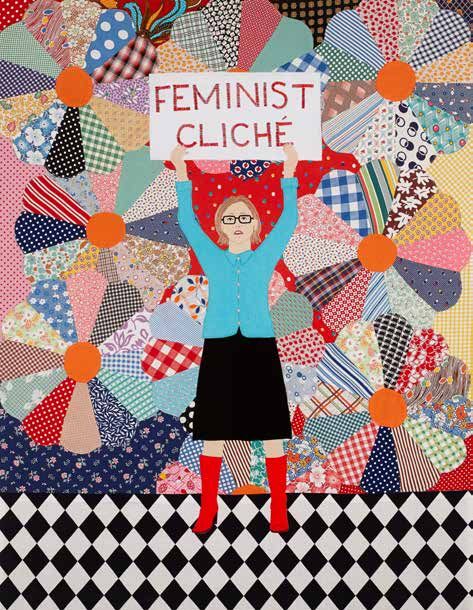
Step Into My Shoes (Fausto Santini Please)

Louise Bourgeois famously                                        the 1960s and 1970s, a period of                              an enormous range of craft and
summed up her artistic practice                                  social change for Australians and                             ‘domestic work’. A formative
in an interview: ‘All my work in the                             of increasing opportunities for                               influence was Mrs McCabe, the art
past fifty years, all my subjects,                               women. Her family was loving and                              teacher at Wangaratta West. Her art
have found their inspiration in                                  home life stable with none of the                             room ‘was an exciting space with the
my childhood. My childhood has                                   trauma experienced by Bourgeois.                              work all around the room and loads
never lost its magic, it has never                               But for those who have followed                               of materials, match boxes, aluminium
lost its mystery, and it has never                               Doig’s artmaking over the last                                bottle tops, egg cartons, tin cans.
lost its drama.’1 The details of that                            30 years, from the performative                               The thing I remember especially
childhood are well known: the family                             works of the 1990s through to the                             about Mrs McCabe’s art room was
tapestry workshop where Bourgeois                                three-dimensional and then two-                               the sense of possibility.’3
first found pleasure in making things,                           dimensional self-portraits, often
                                                                                                                               Possibility is particularly important
the strained relationship between                                using marginalised craft practices
                                                                                                                               for artists who grow up away from
her parents, and her mother’s early                              normally associated with women,
                                                                                                                               the big urban centres, with their
death. Hers was an almost textbook                               the influence of her childhood and
                                                                                                                               galleries and art events and range
example of the Freudian traumatised                              her pleasure in making things are
                                                                                                                               of creative horizons. It allowed Doig
childhood that became a catalyst                                 just as important as they were for
                                                                                                                               to imagine a world beyond her
for artistic creation. ‘I need to make                           Bourgeois.
                                                                                                                               own and after her last year of high
things,’ she explained, ‘the physical
                                                                 From the start, Doig was surrounded                           school she transferred to the Ryflkle
interaction with the medium has a
                                                                 by people who ‘made stuff’,                                   Folkehøgskule in Norway, where she
curative effect. I need the physical
                                                                 including her grandmother, a                                  completed a certificate in art and
acting out.’2
                                                                 knitter and dressmaker, and her                               drama. But before this, the world of
Adrienne Doig’s formative years,                                 father, who turned the garage into                            ‘high art’ briefly invaded the family
thousands of miles away in rural                                 a woodworking studio. Agricultural                            home in Wangaratta when, in 1973,
Wangaratta, a town in the northeast                              shows and church fetes were                                   the fledgling Australian National
of Victoria, could not have been                                 an important part of life in rural                            Gallery purchased Blue Poles by
more different. She grew up in                                   Australia and these showcased                                 Jackson Pollock for the vast amount

‘Louise Bourgeois: Destruction of the Father Reconstruction of the Father’, Writings and Interviews 1923–1997, edited and with texts by Marie Laure-Bernadac and Hans-Ulrich
1

Obrist, MIT Press, 1998, p 277
2
    Louise Bourgeois 2003, unpublished manuscript, quoted in Thomas Kellein, Louise Bourgeois: La Famille, Kunsthalle Bielefield, Bielefield, 2006, p 16
3
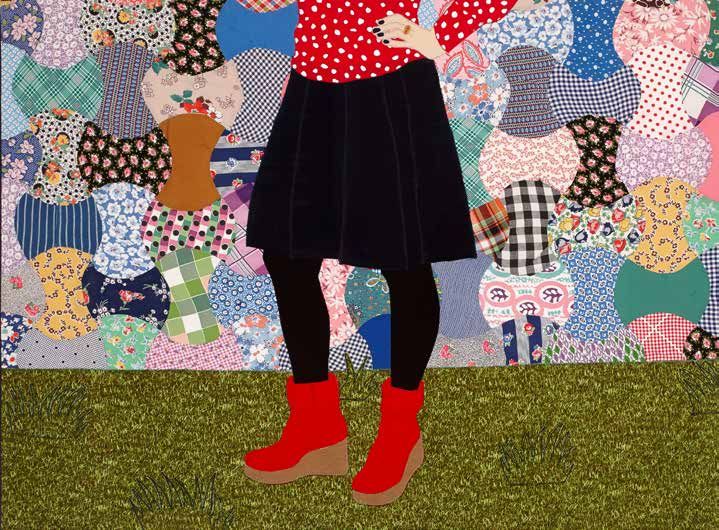
    All quotes from the artist are taken from an interview with Steven Miller, 2020. MS2019.15/ARC449 Adrienne Doig Archive, National Art Archive| Art Gallery of New South Wales   The Red Boots (Apple Core) 2013 patchwork, appliqué and embroidery on canvas, 78 x 105 cm. Courtesy of the artist and Martin Browne Contemporary.

                                                                                                                                                                                                                                                                                                                                   7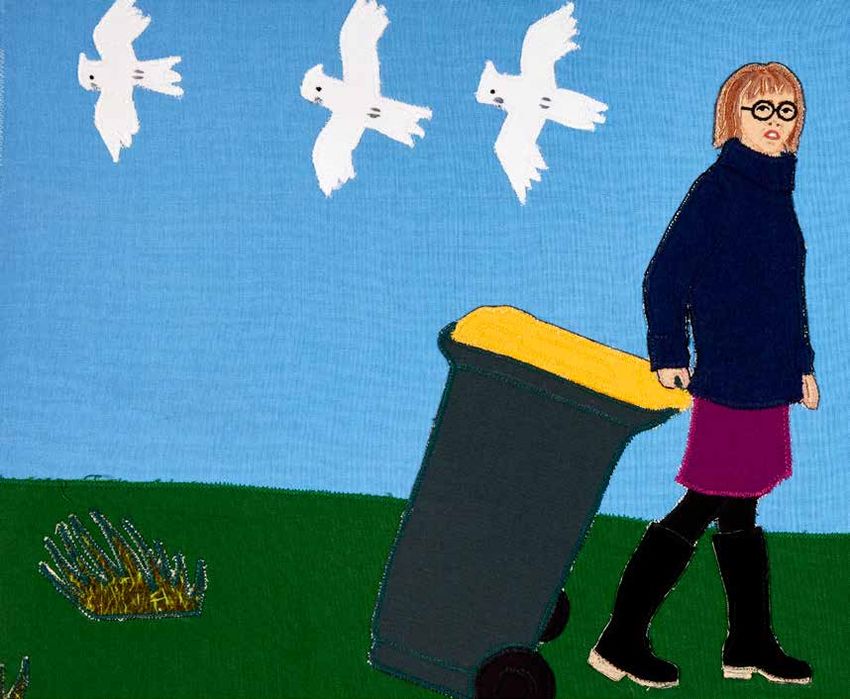
of $1.3 million. All Australians, even                        began her art studies in Sydney,             Street, the Sculpture Centre and
                                                                               those with little previous interest                           many of its assumed values and               Watters Gallery playing host to
                                                                               in art, took note. If she had not                             hierarchies, with painterly painting         many events. The 1990s saw another
                                                                               encountered much ‘actual art’ before                          still at the top, remained firmly in         wave of artists working beyond easel
                                                                               this, Doig remembers when Blue                                place. ‘Too Political’, ‘Feminist Cliché’,   painting, with Performance Space
                                                                               Poles was purchased: ‘I was in grade                          ‘Not Worth It’ and ‘Try Harder’ are          and Pendulum Gallery, where many
                                                                               4 and there was a double page lift-                           some of the placards that Doig holds         of Doig’s works were premiered,
                                                                               out in the Women’s Weekly. I don’t                            in her appliqué and embroidered              at the centre of this renaissance.
                                                                               suppose this was an immediate                                 works. These humorously challenge            Whereas performance art in the
                                                                               influence, but it was about what art                          these hierarchies a generation on            1960s was programmatically avant-
                                                                               could be.’ Art could be big, gestural,                        from Spero, making explicit what             garde, by the 1990s this was less
                                                                               costly and mainly done by men.                                Spero could only code in her early           a preoccupation. Doig’s works,
                                                                                                                                             seminal work Homage to New York              with titles like ‘Wildcat or Bunny’,
                                                                               Nancy Spero, with whom Doig
                                                                                                                                             (I do not challenge) (1953).                 ‘Monster’, ‘Cheap’ and ‘The Other
                                                                               later worked as a studio assistant in
                                                                                                                                                                                          Woman’, playfully continued a
                                                                               New York, struggled with Pollock’s                            When she was working for Spero in
                                                                                                                                                                                          feminist critique of the social
                                                                               influence when she was starting out                           New York, printing and making cut-
                                                                                                                                                                                          construction of the body and
                                                                               as an artist. Spero believed that the                         outs, Doig was also experimenting
                                                                                                                                                                                          sexuality.
                                                                               then dominant school of Abstract                              as an artist with new materials like
                                                                               Expressionism devalued the type of                            fake fur, stitching them into strange        Doig has always enjoyed encoding
                                                                               work that she, a woman engaged                                costumes. These were transformed             art historical references into her
                                                                               with contemporary political, social                           and animated when she began                  work. Whether she was obsessively
                                                                               and cultural concerns, wanted to                              wearing them, leading to a series            cleaning a kitchen in Domestic
                                                                               make. Gestural picture-making, art                            of video performance works in the            Drama (2001) or recounting a
                                                                               for art’s sake could be beautiful, but                        1990s. Performative art, expressed           dream to Dr Freud in Der Erste
                                                                               it could also be an art ‘scrubbed                             in one-off happenings or time-based          Traum (2002), what I particularly
                                                                               clean of social awareness’.4                                  media like film and video, had been          remember about these video
                                                                               Although Abstract Expressionism                               particularly vibrant in Sydney in the        works were the painted backdrops,
                                                                               was art history by the time Doig                              1960s and early 1970s, with Central          the Josef Hoffmann architectural

Die Erste Traum 2002, photograph, video performance. Courtesy of the artist.   4
                                                                                   Anya Ulinich, ‘The uncompromising art of Nancy Spero’, Forward, 3 May 2019

                                                                                                                                                                                                                               9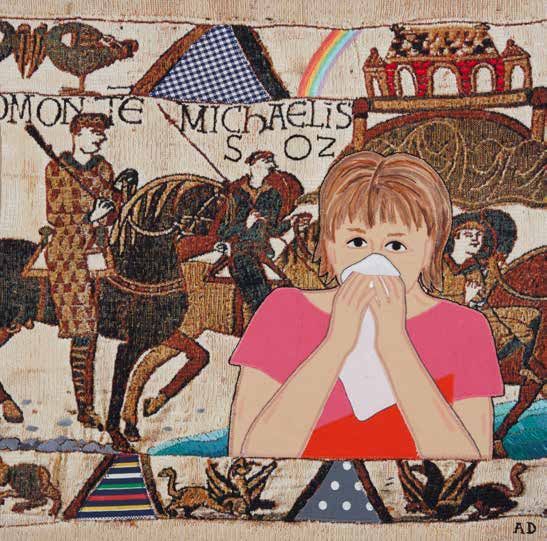
drawing of a kitchen, the witty For Look Out, she painted Carriageworks Curator Daniel
allusions to Wiener Werkstätte. I passages suggestive of the bush Mudie Cunningham is attracted
was reminded of these backdrops that surrounds her home in the to Doig’s self-portraiture ‘because
when the artist was recently Blue Mountains on to scraps of the serial depiction of self is
commissioned by the Art Gallery fabric. Fire is an increasing threat playfully narcissistic, but without
of New South Wales to create an there, and in her daily bushwalks sucking up all the oxygen in the
enormous 29 x 3.4 metre ‘mural’ as Doig has been observing subtle room with a pathological mantra
part of its Archie Plus program. She changes to the environment. In of “me-me-me”’.5
was initially nervous, as this involved most of these works she is turned
Whimsical, self-deprecating and
new ways of working, digitally away from the viewer, with their
multi-layered are how Doig’s self-
constructing a narrative work on patchwork grounds a ‘way of
portraits are usually described. Her
a vast scale using photographs of fragmenting and then piecing
art is hopeful and generous, even at
her hand-painted cut-out figures back together, to give that all-
its most critical. Her shoes – such a
and patchwork pieces. But the encompassing feeling of being
distinctive feature in her works – are
performance works, as well as her surrounded by the bush’.
always big enough for us to step
training in Spero’s studio, uniquely
But Doig was still in the frame into. Indeed, this is what her art
equipped her for this challenge.
and is only too conscious of the asks of us. Once there, we look out
The Art Gallery mural is entitled ‘narcissism’ implied in seeing at the world through those equally
What Do We Want? It is a question ‘nature as a backdrop for our distinctive glasses. The power of
that has had an added urgency explorations rather than a living, possibility in art, which Doig first
during this past year of drought, creative being’. Narcissism is the sensed in Mrs McCabe’s art room, is
fires, floods and pandemic. Just to obvious charge that can be made sometimes the very modest one of
have our lives back as they were, against an artist who has worked being invited to see what is around
with the freedom to travel and unwaveringly in self-portraiture. us through another’s eyes. And it
socialise, seems like a dream. But This exhibition is, after all, entitled really is ‘splendid’.6
is this all we want? Should we not It’s All About Me! When I was told
work for change? Reviewers noted this, I joked with the artist that Steven Miller
a subtle shift of emphasis from self- the catalogue should carry an Head of the Edmund and Joanna
portraiture to the environment in epigraph from her mother, Fran Capon Research Library and Archive,
Doig’s recent exhibitions Look Out Doig: ‘Adrienne, it’s not all about Art Gallery of New South Wales
(2015) and Help Me (2019). you.’ And it never has been. November 2020
5
‘Someone like me’, Art Collector, no 72, April-June 2015, p 160
Splendid (Grandmother’s Flower Garden) 2013, patchwork, appliqué and embroidery on canvas, 98.5 x 78.5 cm. Private collection. 6
One of Adrienne Doig’s favourite words and the title of an exhibition she held in 2013
11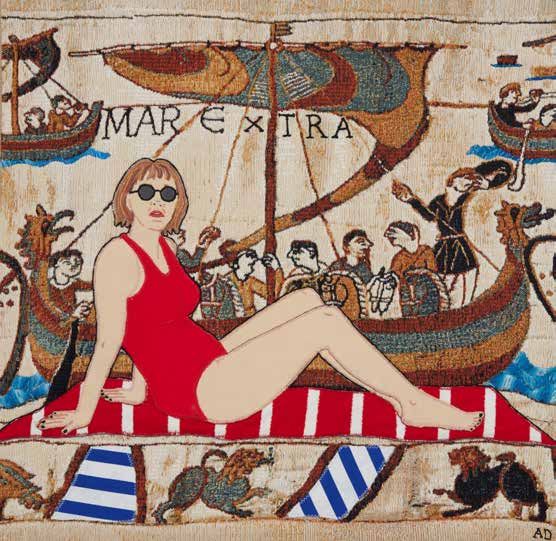
Interview with Adrienne Doig
Using a variety of media, including EC: You have travelled a lot to time and made great friends. I also
embroidery, appliqué, sculpture and further your art career, including went to New York and worked
video, Blue Mountains-based artist undertaking several studio for [the artists] Nancy Spero and
Adrienne Doig playfully explores residencies. How have these Leon Golub.
intimate aspects of her life, from experiences shaped your practice?
I have had residencies in Vienna,
having a cup of tea to performing
AD: After I finished high school, I Milan, Paris and Rome. Each of
mundane housework. Embedded
spent a year at school in Norway. these experiences has led to a new
within her practice are layered
This experience was life-changing. direction or new influences in my
responses to universal themes that
Having spent my life growing up work. During the time in Paris, I
have social, environmental and
in Wangaratta, I realised I wanted discovered reproduction verdure
political narratives. By manipulating,
more adventure. The school was tapestries, which evolved into the
reworking and combining imagery
small and isolated, but I had series AD in Arcadia; in Vienna, I
from multiple sources, Doig records many new experiences and I had became interested in the Weiener
her own experiences within a larger wonderful teachers, in particular, Werkstätte [Vienna Workshop] and
context. Hence, It’s All About Me! Robert and Helga Lid Ball, who created Domestic Drama (2001).
Here, she discusses with BRAG were very inspiring and whom I My travels have been the subject
curator Emma Collerton the themes am still in contact. Bob was an of my work – for example, in the
underpinning Adrienne Doig: It’s All artist and Helga was into theatre sketches AD Grande Tour (2007), I
About Me!, an exhibition spanning and drama. I learned a lot from recorded my travels across Europe
three decades. them, not just about art and in a series of drawings that mirror
performance but about politics the Bayeux Tapestry.
EC: Why self-portraits? and kindness, about the humility
One of the best things about
of making a little into a lot.
AD: Self-portraits provide the working the way I do, in which
perfect forum for me to have a From there I moved to London the subject (myself) remains the
conversation with the viewer, but, to work and explore the galleries. same but the medium changes, is
they also, allow me to work across Throughout my life as an artist I that all these experiences can be
a range of mediums. The theme have sought new experiences to funnelled into new work via the
stays the same, but the materials learn and shape my art-making. I most relevant method. My way of
change. There’s a lot of scope and have lived in Italy, where I shared working can be best adapted to
joy in that. a studio with other artists for a give voice to my concerns.
On The Edge 2015, acrylic, fabric, patchwork, appliqué and embroidery on canvas, 110 x 84 cm. Courtesy of the artist and Martin Browne Contemporary.
13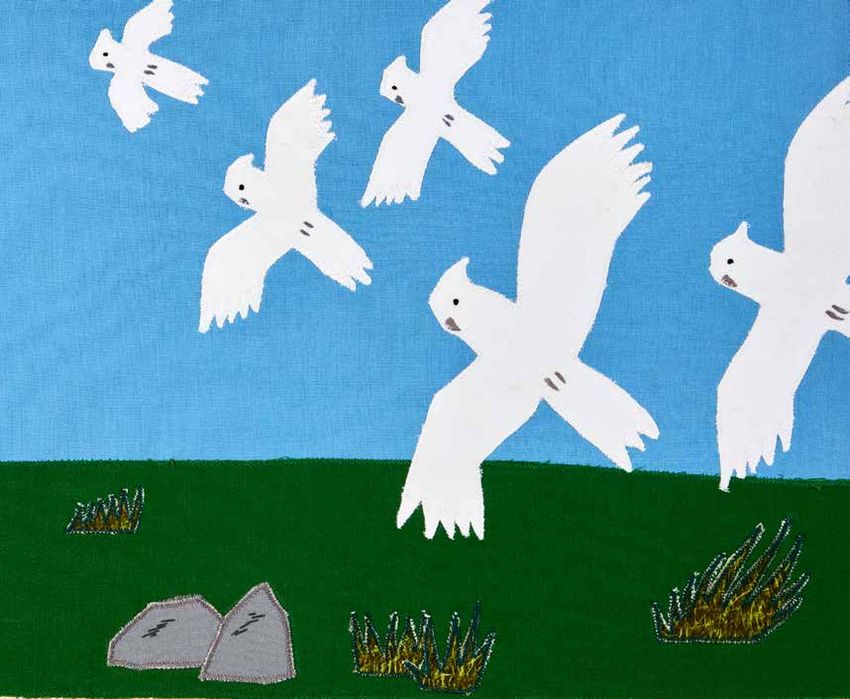
This exhibition shows many of           this for centuries. These activities   highly revered. So, I am trying to
the works created in response to        allow women’s creativity to            playfully question all of this as
these experiences. Monster (1996)       flourish while also having a           well. A doll can be meaningful.
from New York, Domestic Drama           practical aspect. Their revival        These works aren’t angsty or
from Vienna and, AD in Arcadia          during the current pandemic show       heroic, but that doesn’t mean they
Ego (2012) from Paris allowed me        the qualities of these media.          cannot also be insightful. Dolls
to play with ideas and mix it up.                                              can be profound. I know some
Then again, the day-to-day is also      EC: Over the years, you have           people view the repetition of
a feature in my work … It’s all grist   explored self-portraiture through      myself as the subject of the work
for the mill.                           dolls, using different materials       as ego-driven, whereas I think my
                                        and approaches. Some of these,         self-depictions present myself as
EC: Embroidery and patchwork            including commissioned dolls           a kind of antihero in the mundane
is a very technical and time-           and Russian-doll sets, feature in      ordinariness of it all.
consuming form of sewing. What          the exhibition. What inspired this
inspires you to work with textiles?                                            Even in my very early embroideries,
                                        aspect of your work?
                                                                               which were the first works I made
AD: It’s a pleasurable, peaceful        AD: Dolls possess characteristics      after leaving art school, there is a
way of working. The materials are       of the real in a make-believe way.     doll-like quality. These works were
very sympathetic. Unlike painting,      I see them as a stand-in or proxy      based on nursery rhymes – I liked
for example, there are no toxic         for ourselves – more than just a       the way the rhymes often have a
materials or clean-up issues. I also
                                        mini me, they can reveal truths.       double meaning.
enjoy using recycled materials.
Taking discarded pieces, adding         My work with dolls is not viewed in    I clearly remember at the time a
to them and creating something          the same way as a painting would       friend laughing that the character
new, bringing together past and         be. I get the feeling it is seen as    in all of them was me! I hadn’t
present, is a rewarding process.        too crafty, too girly, not serious     realised but yes, it is fairly obvious!
The ‘gentle arts’ – needlework,         enough, but I want to use this         I embroidered images and text
sewing, embroidery, knitting and        as a strategy to question those        from nursery rhymes onto gloves
the like – provide a meditative,        hierarchies of art-making. I look      and a shawl to emphasise the
comforting or calming way of            around and see artists making          performance aspect of the work,
working. Women have known               really macho paintings that are        and foreground things to come.

                                                                                                                         SOZ 2018 embroidery and appliqué on tapestry, 42 x 45 cm. Courtesy of the artist and Martin Browne Contemporary.

                                                                                                                                                                                                                                      15
EC: What led to your work My my pose and all the particulars of The following year, I produced
Life As A Doll (2002) in the the photograph. another portrait project with six of
Queensland Art Gallery and the doll makers that showed Peter
The results show varying levels of
Gallery of Modern Art (QAGOMA) [my partner] and me together.
success and competence. None of
collection? the dolls look particularly like me, These combined portraits show us
but what this project showed me going about our daily routine and
AD: In 2001 on a trip to the UK,
was a good likeness is only a part extended the idea of the earlier
we came across Miniatura, a huge
of creating a good portrait. The portraits, in that they show the
miniature-doll and doll’s-house
success of this project lies, I think, things we like to do and perhaps
fair. I was frankly astounded to
in the overall picture of me that even the kind of people we are.
discover the extent of the doll world.
the group of dolls creates. It is a Again, it was the set of six dolls
Everything that could be found in
composite portrait. The differences that created the overall picture
the real world had, it seemed, a tiny
and similarities between the dolls, and the portrait.
miniature version.
plus the overall look of the work, EC: Another example where you
On my return to Australia, I decided is what creates the portrait. It is have extended upon the concept of
to work in the miniature scale on a the combination of elements and self-portraiture is in your Russian-
self-portrait project where, instead the reading of these that give the doll self-portrait, such as In the
of making the portraits myself, I viewer an idea of Adrienne Doig. Kitchen (2013) and 0-50 (2013).
commissioned miniature-doll artists Interestingly, when viewers were
from across the world –people asked to select the doll that they AD: My Russian-doll portraits are
who were strangers to me – to thought most like me, their choices multiple versions of myself, but,
create my portrait in doll-house varied widely, which showed that in this instance, they are painted
scale. The project was conducted how one appears depends on by me and show different aspects
via email, with me sending posed who is doing the looking. This of my everyday life. I like the
photographic images of myself to work also showed me that there idea that you can separate them
the doll-makers. Each doll-maker is more to a portrait than a good out into individual portraits, but,
was asked to create a portrait of representational portrayal. In fact, as a group they create a bigger
me dressed in a different outfit. I other things can signify a great deal picture, a better idea of what I’m
got them to copy as accurately as and reveal more about a person than like. That was something that
possible all the details of my clothes, a perfect likeness. happened with My Life As a Doll,
The Two of Us ‘At Home’ 2004, unique porcelain miniature dolls by Bev Henderson in 1:12 scale, porcelain, fabric, wood, wire, paint and paper. Private collection.
17too. Individually, the dolls might cardboard cut-out series also Later, when I moved into video In EXTRA (2018), which uses the are pictures of me making pictures example, tea towels, furnishings,
not have looked like me, but all pushes the everyday aspect. This works, there was always a sense of Bayeux Tapestry as a background, of me! They are obviously make- decorative pieces such as cushion
together they create a strong work is a visual diary recording role play and theatre. The earliest I throw myself into the action and believe, but there are many elements covers, other people’s craft projects.
sense of what I am like as a daily activities in quick and of these works was Monster, position myself in history. It’s like of the real in all of them.
Using found items or work by
person. The dolls are caricatures, easy materials. I was looking where I put on the costume I had an adventure! I reinterpret the
In Everyday Me, the ongoing diary another artist as a starting point
but when you have a set of 10, at representing myself and been making and ‘modelled’ the scenes to fit my own experiences
project, there is a lot of action even allows me to play around with
they create a good impression of my everyday experiences, and outfit. The work has both the and concerns. My self-depictions
in the quietness of everyday activity. art history. My pieces in the
me as a person. the banal and mundane things feel of a fashion shoot posing – taking out the recycling bin in
These figures create a fiction in EXTRA series use souvenir wall
that we go through every day. for the camera and a sort of the battle scene or hanging out which there is a lot of drama. Some
EC: You have recently created hangings and cushion covers.
Sometimes that led to me, for weird hidden-camera quality, like the washing while William the of these figures were used in my
Dolled Up (2020) using rag dolls... featuring reproductions of the
example, showing myself with Conqueror plots with his advisors work What Do We Want? (2020)
footage captured in the wild. Bayeux Tapestry. I added myself
AD: Once again, there are multiple coffee spilled on the front of my – add feminist perspective. Even for the Art Gallery of New South into the scene using appliqué
versions of myself that make up the shirt, or eating a bag of crisps, or In other videos like Domestic though this work was most likely Wales Archie Plus series, utilising and embroidery. Similarly, the
portrait. In this work I have included picking out what socks to wear - Drama and I SPY (1998), the sense stitched by women, they have the cut-out cardboard figure to AD in Arcadia Ego series also
dolls that show me making work as all those sort of routine activities of playfulness or ‘pretend’ is also a been left out of the picture. As create a narrative about life during used reproduction verdure soft
that is a significant part of what I that aren’t often celebrated in art. feature. The theatrical has continued a touch of humour and to add a the pandemic. In all these works I furnishings to set the scene.
do! I am adding a lot of detail, some Individually, the paper dolls are in my work – the doll works all contemporary voice, I have also am performing, in the way I present
of which can’t actually be seen again cartoon-like, but en masse I have an aspect of performance, as embroidered some SMS text slang myself to the viewer. Australiana tea towels have also
by the viewer, like the stuff in my think they create a bigger picture. I present myself in a role. My more like ‘LOL’, ‘FOMO’, ‘YOLO’ and provided a stage for my self-
handbag. There has been a lot of recent textile works also contain ‘EXTRA’ in the same manner as EC: Recycling is another reoccurring explorations. Often these souvenirs
pleasure in creating these details. EC: There is a performance the same theatre despite being the original Latin. theme in your practice. Why it is provide a great backdrop. Their
It’s a bit obsessive, but for me it element that underpins your still images. Using an Australiana important to you to incorporate colourful imagery and quirky
The theatrical is also extended in
has been an important aspect of practice. Can you elaborate? tea towel as a backdrop or stage readymade items in your artwork? depictions of Australia they make a
my most recent exhibition, Picture
the work. It’s very much like play. It for my self-depictions heightens great space for me to explore our
AD: Since art school I have Me (2020), where the domestic AD: Yes, I like to recycle! I pick things
feels familiar to me, reminding me the drama. Similarly, in the series relationship with nature.
been making works based on needlework interiors work as a stage up in op-shops and online - eBay
of playing with toys in childhood, Splendid (2013) the repurposed
performing or posing for the set or a cosy scene. These works are has a lot of treasures. I use found In Picture Me, I have utilised the
doing the same thing over and over.
viewer, often making direct eye patchwork pieces are used to create titled ‘Scene’ or ‘Close Up’ to draw materials that have a domestic discarded or abandoned projects
The Everyday Me (2017-2020) contact to speak directly to them. a landscape on which I perform. attention to the fiction. The works function as a starting point, for of other women as the basis for
19my work. In this way I can honour them in this way could turn a harsh my work to be. I don’t want to
the craft, and the frequently comment or a compliment into sound snobbish, but in the past
hidden creative work of women something funny or joyful. ‘Feminist the Archibald Prize subjects had to
– I change the scene, or adapt Cliché’, ‘Try Harder’, ‘Not Worth be ‘worthy’. I want to make work
patterns, and seek to bring new It’ and Very Interesting’ can have that challenges this idea, that uses
interpretations to it. These works different meanings for the viewer other materials [the Archibald is for
are not simply adding to the pre- as well. Also, I am trying to be a bit painting only] and offers a broader
designed imagery; for me, it’s like playful and not too preachy. concept of portraiture.
reinterpretation of these activities, a The series Help Me! seeks to
conversation with the past. EC: The exhibition title It’s All
draw attention to environmental
About Me! is playful reference to
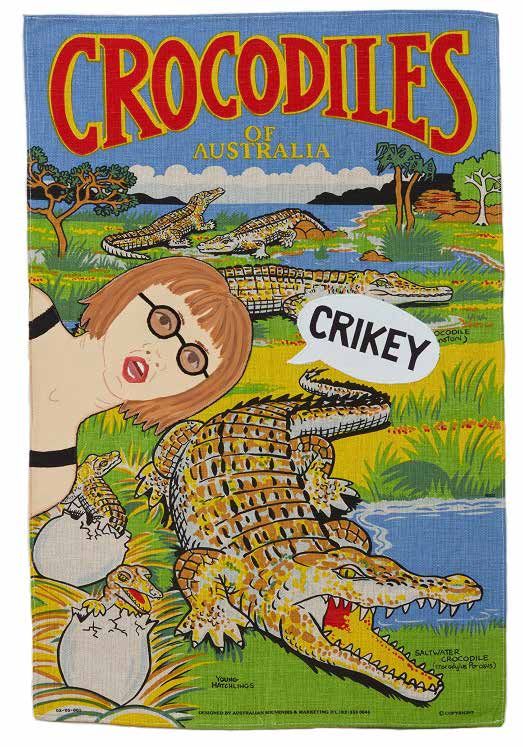
issues. Using Aussie slang phrases
EC: There is a lot of wit and your self-obsession.
– ‘strewth’, ‘crikey’, ‘bludgers’ –
humour in your work. What Do
adds an element of humour, but AD: Yes, I wanted to make it clear
We Want?, a mural created for
hopefully also gets the viewer to the viewer that I am fully aware
Archie Plus features imagery with
thinking about our relationship that these ongoing explorations
placards, slogans and speech
with nature and the issue of climate can all be a bit much. It seems
bubbles. These elements also change. For me, these pieces are a to be a particularly ego-driven
appear in earlier work such as Flora form of protest, but also humorous enterprise to endlessly make art
and Fauna (2010), Splendid (2013) depictions of our Australian identity. about myself. In the social-media
and Help Me! (2019). Tell us about There is pleasure in having people age of self-promotion, I want to
this aspect of your practice. get the humour and enjoy the work. show that this can be more than
AD: I use the placards to speak self-aggrandisement. I hope using
directly to the viewer. I can voice EC: You co-wrote ‘Let’s Face It: The humour and appealing to the
my concerns directly, but also History of the Archibald Prize’, first viewer in a familiar way will allow
published in 1999. Did it influence them to see themselves as well.
possibly allow for multiple readings.
the self-portraiture theme that
Many of the slogans were things “It’s all about me” is also simply a
underpins your practice?
people said to me, sometimes description of the exhibition, the
about my work- some were good, AD: I would say only in the sense work is self-obsessed, I want to
some were not so good! But using that it showed what I didn’t want own that!
Crikey 2018, appliqué, embroidery and paint on linen, 72.5 x 48 cm. Courtesy of the artist and Martin Browne Contemporary.
21Artwork Highlights
Throughout Adrienne Doig’s creative journey, she has
formed friendships and professional connections with
fellow artists, writers and curators, who have supported
and challenged her.
The exhibition title ‘Its All About Me!’ is a humorous and
light-hearted response to the artist’s serious focus on
self-portraiture, her investigation of the world and her
place in it. To contextualise Doig’s practice and counter
It’s All About Me, several of the artist’s friends and
colleagues were invited to respond to key artwork in
the exhibition.
The resulting fifteen artwork highlights - which chart
her development - were written by different authors,
and from a different perspective, to provide a diverse,
insightful and encompassing overview of both the
artist and her practice over the decades.
Writers include Jo Braithwaite, Lisa Catt,
Tracey Clement, Peter Cooley, Jane Gleeson-White,
Samantha Littley, James Lynch, Julianne Pierce,
Vicky Roach, Melinda Rackham, Alex J. Taylor,
Joel Tonks and Julian Woods.
Emma Collerton
Curator, BRAG
Close Up 2 2020, embroidery, appliqué and paint on needlepoint, 34.5 x 51 cm. Courtesy of the artist and Martin Browne Contemporary.
23Lizzie Borden 1989
Lizzie Borden took an axe Lizzie Borden was also the subject of Adrienne Doig’s
And gave her mother forty whacks. first embroidery. After graduating from the College of
When she saw what she had done, Fine Arts in Sydney (now UNSW Art & Design) in 1991,
She gave her father forty-one. Doig travelled to Italy for a year and carried with her a
slim a book of stitches. She recalled, “Embroidery is an
This infamous skipping-rope rhyme dates from
ideal medium for travelling and working. These works
around the time that American heiress Lizzie Borden were based on nursery rhymes I liked the way the
(1860-1927) was tried and acquitted of the 4 August, rhymes often have a double meaning.”
1892, axe murders of her father, property developer
When creating Lizzie Borden, the artist experimented
Andrew Borden, and stepmother, Abby, in Fall River,
with stitching techniques to present a comical, naïve
at Massachusetts, USA.
and eerie representation of the subject. She also
Over the decades, the unsolved murders have inspired embroidered nursery rhymes on a shawl and a pair
speculation in popular culture, from Agnes de Mille’s of evening gloves. These garments are a nod to the
ballet Fall River Legend (1948), to Alfred Hitchcock performance element that has become an important
Presents TV episode ‘The Older Sister’ (1956), Jack aspect of Doig’s practice. So, too, has ambiguity; viewers
Beeson’s opera Lizzie Borden (1965) and The Simpsons’ are encouraged to look, think and draw their own
episode ‘The Treehouse of Horror IV’ (1993). More conclusions on the subjects that the artist is exploring.
recently, there is the telemovie Lizzie Borden Took An
Emma Collerton
Ax (2014), starring Christina Ricci and the feature film
Curator, BRAG
Lizzie (2018), starring Elizabeth Olsen, which explored a
feminist angle of Borden being in a relationship with the
family maid Bridget Sullivan.
Lizzie Borden 1989, embroidery on linen, 40 x 21.5 cm. Courtesy of the artist.
25Monster 1995
In the early 1990s, I moved from Adelaide to Sydney to For Adrienne, the personal is political and she creates
take up the position of Administrator of Artspace. This work that is both playful and critical. She invites the
was an entree for me to a vibrant art scene and Adrienne viewer to explore Australian identity, the place of women
Doig welcomed me to this new city with open arms. in contemporary society and the masks and artifice of
everyday life.
To know Adrienne as a friend is to know Adrienne as
an artist. She embodies charming wit and humour Adrienne Doig is an artist who has dug deep into her
combined with an uncanny ability to investigate who she own life experience to forge a self-reflective world to
is and how she sees the world. mirror the complexities, nuances and layers of the world
around us.
Her 1995 video work Monster was made while living in
New York. The starting point was crafting a pink furry Julianne Pierce
Independent Writer, Artist and Producer
costume and headdress to talk about a feminist idea of
self, identity and beauty. The genius was to put herself
into the costume and create a performance for camera.
In Monster Adrienne positions herself as the feminist
protagonist and agent provocateur, exploring the mask
and performance of femininity. This is one of her earliest
acts of self-portraiture, a form and style which has come
to define her ongoing practice across embroidery, video,
painting and sculpture.
Monster 1995, video stills. Courtesy of the artist.
27Cheap 1997
This series of artworks exist as artefacts of Adrienne Doig’s recall of the character Camille adds another
Doig’s 1997 exhibition Cheap, where video stills meta-layer to a film about film-making, and its artificial
were projected onto a corrugated wall of the former nature. The stills capture the mood of the film, as well as
Pendulum Gallery in Sydney. In the original videos, the characterisation of Bardot herself; a talented actress
Doig roleplays as iconic French model and actress in her own right, but also a 1960s sex-symbol whose
Brigitte Bardot in the 1963 film Le Mépris (Contempt), beauty and frequent nude scenes were often used for
attempting to capture the tension and mood of the film
cheap commercial success. Le Mépris is both complicit in
communicated through Bardot’s body language and
and critical of this, playfully mocking in the film’s taglines
emotive glances.
“Bardot is the body beautiful... she knows it... and she
Le Mépris tells the story of Paul Javal, a struggling shows it!” and “More Bold! More Brazen! And Much,
screenwriter who is hired to rewrite Homer’s ‘Odyssey’ Much More Bardot!”.
for a commercial audience. A communication rift that
Joel Tonks
opens up between him and his wife Camille, played by
Bardot, when he priorities the pursuit of money over Curatorial Assistant, BRAG
their relationship, and uses her looks to his advantage,
ultimately leading to betrayal and marital breakdown.
Cheap (I Spoke Those Words On Purpose) 1997, video still on corrugated zincalume, 69 x 89 cm. Courtesy of the artist and Martin Browne Contemporary.
29My Life As A Doll 2002
My life as a doll 2002 draws us into a world of make She commissioned the work in 2001 after seeing an
believe where identity is malleable. Presented with ten exhibition of miniatures in Birmingham, subsequently
similar yet contradictory likenesses of the artist, we sending photographs of herself in various curated outfits
may be forgiven for asking whether ‘the real Adrienne to artisans around the world. Each maker added their
Doig will please step forward?’ In this sense, the own twist – Belgian Deidre Wilgenburg played up Doig’s
artwork nods to the elusive images of American glamour, giving her doll a flipped bob in complement to
photographer Cindy Sherman who, through her her fur coat, while Dana Sippel from the United States
scrutiny of stereotypes and the self-image, queries the augmented her figure’s bust, perhaps in homage to that
ways in which persona is constructed and received. all-American doll, Barbie.1 This last reference seems apt
and somewhat autobiographical given that Ruth
As a self-portrait, Doig’s artwork prompts numerous
Handler launched her perennially popular toy in 1969,
other questions, including issues of authorship. One of
just four years before Doig was born. The allusion
her earliest forays into the medium that has become
certainly connects with the artist’s interest in the roles
her raison d’être, the sculpture was, in fact, made by
that are chosen for women, and the ones that they
ten dollmakers, rather than the artist herself.
choose for themselves.
Samantha Littley
Curator Australian Art, QAGOMA
My Life As A Doll 2002 (detail), miniature porcelain portrait dolls, 10 dolls ranging in size from 14.3 x 6 to 16.2 x 7.5 x 6 cm. Gift of an anonymous donor
1
The Sydney Morning Herald, ‘Adrienne Doig; Joe Furlonger’, Culture, Art & Design, 20 November 2002.
through the Queensland Art Gallery Foundation 2012. Donated through the Australian Government’s Cultural Gifts Program. https://www.smh.com.au/entertainment/art-and-design/adrienne-doig-joe-furlonger-20021120-gdfu5v.html.
31AD Grande Tour 2007
This collection of pencil sketches, titled AD Grande The narrative of the sketches also has parallels to the
Tour, form one part of a year-long sketchbook project tapestry. It begins in France, traces her journey to
undertaken by Doig in 2007. Beginning at the conclusion conquer the cultural landmarks of Europe, comes to
of an art residency at the Cité Internationale des Arts an end in England (just as the Normans did), before
in Paris, the sketches trace her journey across Europe, returning to her homeland of the Blue Mountains,
visiting famous sites and museums, and meeting with Australia. The influence of the Bayeux Tapestry and
friends. The visual style of the sketches was influenced its blank-background embroidery style can be seen
by an interaction with the Bayeux Tapestry – a 70-metre- throughout Doig’s recent artworks.
long embroidery depicting the epic narrative of the
French-Norman Conquest of England in 1066 AD – Joel Tonks
which the artist visited in Bayeux during her residency. Curatorial Assistant, BRAG
AD Grande Tour 2007 (detail), pencil on paper, 29.7 x 21 cm, sketchbook page. Courtesy of artist.
33AD in Arcadia Ego 2012
Even in Australia, There I Am
It is natural to see 16th and 17th century ‘verdure’ The unique properties of the Australian landscape have
tapestries as unequivocally European images, redolent long preoccupied scholars of Australian art, as though
as they are of royal patrons and palaces. But like so the extent to which this or that artist captured the
many forms of luxury artistic production in the age essence of a gum tree was a matter of profound cultural
of empire, they were also often imperial fantasies, significance. But such debates can also disguise the
images that allowed their owners to imagine visiting the fundamentally shared forms of possession woven into
landscapes of faraway conquest and ‘discovery’. In this the entire landscape tradition. In her inimitably droll way,
sense, Adrienne Doig’s repopulation of mass-produced Doig plays with such contested histories, and asks us
Flemish-style tapestries with embroidered Australian to consider how we still imagine the riches of a national
animals, and indeed with her own crafty self-portraits, landscape to be arranged for our own viewing pleasure.
gives these images precisely what they want. Her
comical recolonisation reveals, I think, something of the Alex J. Taylor
politics of the found imagery into which she intervenes. Assistant Professor in the Department of History of Art
and Architecture at the University of Pittsburgh
To my eye, Doig’s altered tapestries draw an Australian
landscape out of a European one; not just in the brilliant
cockatoos and red waratah that she adds, but also in
the sage greens and greys that their readymade scenery
already uses to suggest distance, a bleached palette that
does somehow evoke the dry haze of pastoral Australia.
AD in Arcadia Ego 2012, embroidery and appliqué on tapestry, 151 x 181 cm. Courtesy of the artist and Martin Browne Contemporary.
35Feminist Cliché (Dresden Plate) 2012
Adrienne Doig’s iconic and unselfconscious multilayered These themes thread through decades of Adrienne’s
critique of portraiture in the age of self-aggrandisement artworks: making and revealing layers of female
was a perfect choice for my #remakemistresses series. identity in nesting Russian dolls; exploring allusions and
Started in response to the global call for art audiences expectations of the feminine through video; dissecting
to recreate museums’ famous paintings (old masters) the double edged sword of beauty and vanity in hand-
on Instagram during the COVID-19 pandemic shutdown,
sewn self-portraiture; darning women into nature
#remakemistresses playfully uses parody to remake
and eco-activism with kitsch tourist tea towels; and
vibrant contemporary Australian mistresses.
embroidering other artists’ works into domestic portraits
Masquerading as simply decorative, women’s crafting to acknowledge no artist works alone.
traditions have always had a powerful political
dimension. Feminist Cliché (Dresden Plate) plays with If clichés are powered by repetition, then, stitch after
this underlying tension as the clichés of quilting culture stitch, elaborately patterned sunburst after romantically
(female, white, older, richer, more conservative) literally ornate sunburst, Feminist Cliché theoretically and
come face-to-face with the stereotypes of second-wave passionately challenges conventions of the under-
feminism (white, middle class, self-interested, aggressive representation of women artists and outmoded
and out of touch with intersectionality). hierarchies of materials, while celebrating the
Doig’s complex handwork is seductive in its luscious significance and value of women’s craft as important art.
intimacy of appliqué, embroidery and patchwork. Her Melinda Rackham
work carefully crafts identity, honours community, Artist, Author and Independent Curator
connects material cultures, creates inter-generational
#remakemistresses
dialogues, relays hidden messages, asserts family values,
memorialises loved ones and commemorates significant
life events. A social history cross-stitched in DNA,
quilting is a tactile language, a text to respect.
Feminist Cliché (Dresden Plate) 2012, patchwork, applique and embroidery on linen, 99 x 77 cm. Private collection, courtesy of Martin Browne Contemporary.
370-50 2013
Faced with one of Adrienne’s Russian/Doig dolls, it is 10 and a very blonde toddler with her toy. Then you
hard to resist the impulse to take it apart – to be actively are compelled to put her back together again and you
involved in a big reveal. realise how a life is about chapters; when you get to
the largest doll, you are left wondering about the future
In 0 to 50, Adrienne’s painted self-portraits show her
Adrienne and the passing of time.
journey from adult to child, checking in about every
five years. You will be intrigued – and you will definitely The dolls offer us yet another approach to portraiture
smile – as each layer uncovers a different wooden doll, characteristic of her varied practice and Adrienne’s
revealing smaller and smaller versions of the artist. exploration of this fascinating genre. She supplies us
with food for thought and we understand that, yes, it is
If you know Adrienne, you will recognise the outfits.
all about her. But it is all about us too.
Her clothing and the objects she carries are accurate
down to the last detail. There’s the sassy dresser we Joanna Braithwaite
know today, the optimistic art student, a netballer aged Artist
0-50 2013, patchwork, acrylic paint on wood, set of 10, dimensions variable. Courtesy of the artist and Martin Browne Contemporary.
39Look Out 2015
Adrienne’s works are extremely competent in combining
sewing and painting. This direct approach with
sewing and constructing the image with a deft hand
and painting within the applied image adds an extra
dimension of true grit. The works are technically and
emotionally terrific and have a high degree of tension,
which ultimately has a lasting significance.
Peter Cooley
Artist
Look Out 2015, acrylic, fabric, patchwork, appliqué and embroidery on canvas, 110 x 85 cm. Courtesy of the artist and Martin Browne Contemporary.
41ORLY 2018
ORLY was first exhibited as part of Doig’s exhibition Doig looks out at the viewer in exasperation and
Extra at Martin Browne Contemporary, Sydney in 2018. dismay - no doubt, at the lack of women represented
In the thirteen works from the series Doig collaged and in this major example of human artistic achievement
embroidered images of herself onto a number of tourist that was likely created by the painstaking labour of
souvenir reproductions of the famous 70-metre long women embroiders.
Bayeux Tapestry, believed to be dated from the 11th
Artists often insert themselves into narratives about the
century. Doig or a version of her, appears like an actor’s
past and ORLY is a fun and funky revision. Doig weaves a
extra into the storyline of this epic artwork.
number of tangential stories together, reminding us that
Doig’s character is replete with a trademark bob the roles of women are still largely excluded from history.
hairstyle, black skivvy, spotted apron and reading While the men return from war as heroes or losers, the
glasses, and sets herself against a background image undervalued and unacknowledged work of women
of cooking and feasting (by men). Doig poses in a continues on regardless.
kind of a heraldic fashion, her arms outstretched James Lynch
holding a wooden spoon and egg flip in each hand, Curator, Art Collection and Galleries,
ready for action. Here, the artist plays homage Deakin University Art Gallery
to Martha Rosler’s iconic feminist performance
Semiotics of the Kitchen (1975), itself a parody of a
television cooking show.1
1
The artist in email conversation with the author January 2019; further reference https://www.moma.org/collection/works/88937 [Accessed 9 November 2020].
ORLY 2018, embroidery and appliqué on tapestry, 59.3 x 119 cm framed. Deakin University Art Collection, purchased 2018.
43Help Me! 2019
Adrienne Doig’s self-portraits always makes me smile souvenirs and suggests that we’ve forgotten them. Do
and exclaim: “That’s so clever!” Here, she presents the we connect their images with our own wantonness, the
artist as environmental activist, framed with iconic way we trash their lands, waterways, seas?
Australian animals, many threatened by the way we
Doig’s aesthetic is also ecological: found objects and
impose ourselves on their homes. But Doig imposes
words recycled, repurposed, recomposed into art. She
herself – in protest! – and demands our attention.
superimposes herself on fragments of capitalist kitsch
She asks something of our gaze: why is a pair of to make a statement – with words, by juxtaposition,
kangaroos ‘TOO POLITICAL?’ What does it mean to her own presence always unsettling the scene. This is
ask ‘WHAT DO WE WANT?’ before a tree of koalas?
women’s work, its materials, tools and repetitions. I see
‘C’MON’ she urges, by a waterhole with five charismatic
ecofeminism writ small in stitches, fabric and the waste
animals. I will finish her sentence… What are we bloody
of others: a genuine ecological economics.
doing? Why aren’t we caring for them and their places?
Her intrusion demands we look more closely at these Jane Gleeson-White
creatures who flag our continent to the world as Writer
Too Political 2018 (from Help Me! series), embroidery and appliqué on linen, 72.5 x 45 cm. Private collection.
45Everyday Me 2017-2020
Everyday Me! by Adrienne Doig is a series of sculptural another of herself making her cardboard portrait for that
self-portrait representations of mundane, everyday day (a tongue-in-cheek meta reference).
activities created with mundane, everyday materials
The sculptures consist of a cardboard cut-out painted
– cardboard, fabric, pencils, & paint. Initially, Doig front and back to give the sense of a more complete
ambitiously set a goal to create one sculpture per day image and then slotted into a shallow cardboard plinth.
for one year, but she found it was too time consuming. Their look is comical and whimsical bringing delight
The project is now ongoing, with Doig creating self- and humour to the mundane. From an historical
portrait sculptures whenever a memorable moment is perspective, Everyday Me! harks back to painters such
worth recording. as Vincent van Gogh and Gustave Courbet painting
Presented as a kind of pictorial diary, Everyday Me! offers everyday scenes of the working class, and the principals
an intimate insight into the life of the artist. We see Doig of the Arte Povera movement using everyday materials.
clad in a towel standing on square tiles as if she has Essentially, Everyday Me! makes art feel relevant to and
representative of the everyday.
just finished a bath or shower; in a moment of distress
with hands ruffling her hair and mouth slightly frazzled; Julian Woods
holding two lit candles while wearing pyjamas; and Audience Engagement Officer, BRAG
Everyday Me 2017-2020 (detail), mixed media, dimensions variable. Courtesy of the artist and Martin Browne Contemporary.
47Picture Me 2020
By rescuing half-finished patchwork quilts from pattern and a tumbling block motif, a cross stitch
family attics and forgotten tapestries from dusty op and a herringbone, Doig’s appliquéd self-portraits
shop shelves, Adrienne Doig grapples actively with tend to be more spontaneous and relaxed. And she is
the art/craft debate. Her repurposed self-portraits certainly not averse to breaking a few rules. There’s
make a playful yet pointed statement about the an unsettling, fairy tale-like quality to Scene 6, for
unpaid and under-appreciated nature of women’s example, which featured in her latest exhibition,
work (aka the domestic arts). Picture Me.
This theme is expanded upon in Doig’s trademark Like Goldilocks, Doig has made herself right at home
tea towels, which successfully liberate an ordinary, in this found log cabin, painstakingly created by an
everyday household object from its customary anonymous needlepoint worker. Having claimed the
place at the kitchen sink. The rich interior world most comfortable chair, the artist sits in slippers beside
suggested by these works, which variously depict a blazing fire, her even gaze challenging any suggestion
Doig snorkelling with starfish and squawking along
that it is she who might be the interloper here.
with sulphur-crested cockatoos, subverts the original,
utilitarian intention of the kitsch canvas. Surrounding herself with previous self-portraits, such
as The Red Boots and a cloth doll, Doig amplifies
One of things I love about Doig’s work is her
the effect of the Lil’ Adrienne nesting dolls on the
ability to celebrate the skills of a homemaker while
mantelpiece.
simultaneously drawing attention to the political
implications inherent in such a job description. While Vicky Roach
she appreciates the difference between an apple core Freelance Writer and Critic
Scene 6 2020, embroidery, applique and paint on needlepoint, 46 x 56 cm. Courtesy of the artist and Martin Browne Contemporary.
49What Do We Want? 2020
‘Make do’. ‘Use your imagination’. These two phrases The mural grew from an online artmaking activity that
can be spotted amongst the jostle of placards, thought Adrienne created for the Art Gallery of New South
bubbles, dogs, bees, friends, family members and (of Wales earlier in the year. At the time, the Gallery had
course) self-portraits that make up Adrienne Doig’s mural just closed its doors due to the pandemic and most of
What Do We Want?. They offer sound advice for the year us were confined to our homes with the introduction
that was 2020. They also tell us much about Adrienne. A of lockdown restrictions; a sense of togetherness was
lover of the found, the domestic, the overlooked, Adrienne hard to come by. But Adrienne found a way to keep us
makes art that is full of hoarded treasures and handmade connected with those we missed – all you needed was
magic. She revels in looking closely, taking things slowly a toilet paper roll. Shared across social media, her toilet
and appreciating what is at hand. paper roll doll activity was a hit. It was doable, playful
and meaningful. And it saw Adrienne interact with
Commissioned by the Art Gallery of New South Wales,
new audiences of fellow makers, young and old, who
What Do We Want? takes on a bigness that is new to
enthusiastically shared their creations with her online.
the artist’s practice. Yet the work teems with the small,
everyday moments – from the witty and awkward to And that’s the thing about Adrienne – she is incredibly
the insightful and serious – of which she is a master. attuned and open to the connections and possibilities
Painted cardboard figures and second-hand patchwork around her. Her work may appear to be all about her,
quilts, stitched together digitally, tell us her story of but really, it is about social fabrics, of which we can all
life during the COVID-19 pandemic. We see Adrienne be makers.
panic buying toilet paper, taking selfies in her mask,
and dreaming of nights out with her partner. A crowded Lisa Catt
scene of her friends and family remind us, alongside Assistant Curator, International Art, AGNSW
individual experiences of isolation and uncertainty, that
2020 was also a time of collective action and reflection.
What Do We Want? 2020, two details from mural commissioned by the Art Gallery of New South Wales for Archie Plus, 3480 x 28915 cm.
Courtesy of the artist and the Art Gallery of New South Wales.
51You can also read


