Aligning Mathematics Pathways with Student Career Goals - OSPI
←
→
Page content transcription
If your browser does not render page correctly, please read the page content below
Aligning Mathematics Pathways with Student Career Goals
             2021–23 Biennial Operating Budget Decision Package (DP)

Agency/Program Recommendation Summary
Washington state’s graduation requirements are designed to signify that a student is prepared
for a meaningful next step in life. Requirements that prioritize algebra have little to no relation
to students’ readiness to succeed in courses such as statistics or quantitative reasoning—which
are more relevant to a wide range of careers. As both college degree based and technical skill
focused careers change, the traditional content of the course no longer suits the graduation
pathway of all students.

The Office of Superintendent of Public Instruction requests funding to strengthen mathematics
pathways by modernizing Algebra II, developing associated professional learning for educators,
and implementing a pilot project in order to provide increased opportunities for all students to
develop diverse foundational skills crucial for developing careers.

Package Description
What is the problem, opportunity, or priority you are addressing with the request?
Completion of Washington state’s minimum graduation requirements signifies that a student is
prepared for a meaningful next step in life.

Washington state graduation requirements include:
   •   Completing a High School and Beyond Plan (HSBP)
   •   Earning high school credits
   •   Completing a graduation pathway

In combination with a robust career and college exploration and planning process (the HSBP)
and quality instruction, completing a graduation pathway helps prepare students for what
comes after high school. In 2019, House Bill 1599 discontinued the direct link between
assessments and graduation requirements and established multiple pathways to graduation. The
purpose of this policy was to expand the ways our students show readiness for their next step
after high school.

Regardless of their identified goals, Algebra II continues to be the most frequently used course
for a student’s third credit of math (63% in the 2018 graduation cohort). Many school districts,
particularly smaller ones, are unable to provide multiple third credit options and must default to
Algebra II to assure college options for their graduates.

Postsecondary institutions around the country have engaged in serious efforts to reform their
math requirements and are offering new pathways in areas like statistics and quantitative
reasoning for students with interests outside of the science, technology, engineering, and
mathematics (STEM) disciplines served by traditional math pathways. These postsecondary

Page | 1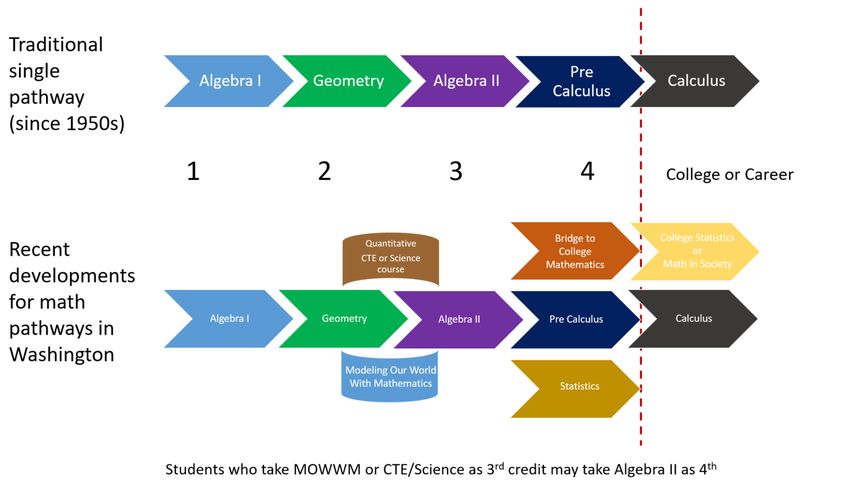
reforms have paved the way for reconsidering the math required for college admission, as well
as the math preparation high schools provide.

The Office of Superintendent of Public Instruction (OSPI) has partnered with teachers across the
state to examine course-taking data and assess current Algebra II courses for their content. This
process identified inequities in quality of and access to mathematics options to support
students’ goals for postsecondary success. The quality of local curriculum and instruction varies,
with students coming from higher-income backgrounds tending to have access to higher-
quality programs. Access to advanced courses is too often influenced by race or family income.
And inequitable access to courses and effective instruction may reflect, or be exacerbated by,
educators’ biases and racial stereotypes about mathematics ability – all of which interfere with
student learning.

Mathematics course requirements in high school and college are a barrier to opportunity for
large numbers of students. Each year, for example, requirements for algebra remediation deny
hundreds of thousands of students the chance to progress in college, regardless of whether
algebra is used in their intended fields of study. Since the burden falls heaviest on historically
disadvantaged students, efforts to improve equity in mathematics outcomes are not likely to
succeed without focusing on this disparity.

Figure 1 shows recent developments for math pathways in Washington, compared to the
traditional single pathways that have existed since the 1950s.

Figure 1: Traditional Single Math Pathway Compared to Recent Developments for
Math Pathways in Washington

Page | 2
In order to prepare students for postsecondary success, we must diversify the traditional
algebra-for-all math content into different math course options that focus on core math
subjects such as statistics, quantitative reasoning, and mathematical modeling while continuing
to build the foundation for advanced algebra or pre-calculus coursework.

"While we have made progress in reducing barriers to flexible math pathways, the next giant step
must include a coordinated and unflinching commitment to eliminating the narrow and
inequitable vision of math pathways."
– Chris Reykdal, Superintendent of Public Instruction

What is your proposed solution?
Modernizing Algebra II would allow for more students to have access to meaningful math skills,
while still providing the foundational concepts essential for university admissions.

Through partnerships with K–12, higher education, business, and industry, OSPI is requesting
funding to convene stakeholders to:
   1) Identify the foundational components of Algebra II essential for preparing students for
      career or college admissions;
   2) Develop expectations for revised/expanded course(s); and
   3) Research and evaluate available instructional materials.

Using stakeholder recommendations, OSPI will then contract with subject matter experts to
adapt or develop a Modern Algebra II course and instructional materials for Washington high
schools.

Once the course and associated instructional materials are available, OSPI will invite school
districts to engage in a grant-based pilot to train teachers and implement the course using the
professional learning model established during the development and implementation of Bridge
to College Math.

OSPI will collect course success data during the pilot for possible course improvement leading
to upscaling Modern Algebra II as an option for all districts across the state.

The implementation of Modern Algebra II will have the potential to positively impact the
mathematics education of all high school students in Washington. Students enrolled in the
course will grow in mathematical skill and reasoning utilizing a wide variety of relevant math
topics. Teachers of the course will improve their instructional practices through professional
learning applicable to all courses they teach.

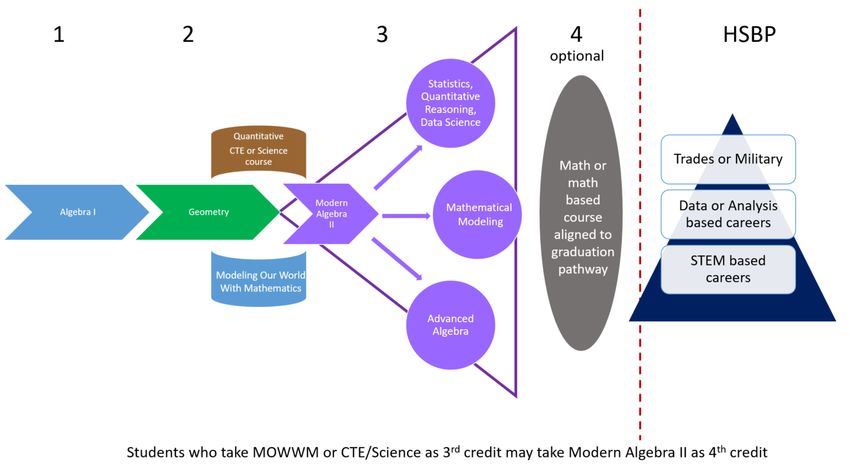
Figure 2 shows an example of how the modernization of Algebra II could increase access to
foundational math skills, strengthening math pathways for all students.

Page | 3
Figure 2: Proposed Math Pathways
What are you purchasing and how does it solve the problem?
• Support for work group made up of higher education and K–12 to determine learning
standards for the course aligned to college expectations.
• Support for work group to research available curricula and to adapt it for Washington
State learning standards in mathematics.
• Development of additional instructional materials as needed for course goals.
• Support for a workgroup to develop and deliver professional learning for high school
teachers to implement the course using best teaching practices.
• Content and pedagogical training for teachers using the course.
• Course evaluation for decision-making around course improvements and statewide scale
up.
• 1.0 full-time equivalent (FTE) high school math specialist for project coordination.
• Curriculum developer to format instructional materials.
What alternatives did you explore and why was this option chosen?
OSPI has partnered with the Dana Center (University of Texas, Austin) and Educational Strategies
Group on the Launch Years Project to explore third and fourth mathematics credit options for
high school students. One of the two phases of Launch Years is focused on Algebra II
equivalency possibilities. The work has been informative and valuable but focused on college
readiness as the ultimate goal. Some schools do not have the resources to offer multiple math
options for their students; consequently, Algebra II becomes the default because it keeps all
post high school doors open (including four-year public college admission).
Page | 4Washington state graduation pathways are designed to support all students’ aspirational goals,
both college and career. By developing course options that still align with student goals to
attend college but also to aim to provide students with foundational skills for the trades, the
military or other career choices, this option will be able to benefit more students, more quickly.
The other alternative is to change public baccalaureate minimum admission requirements to
accept math courses other than Algebra II; however, this does not solve the problem of schools
with limited resources to offer multiple courses.
Performance Measures
Performance outcomes:
• Increased number of students enrolled in fourth credit of math.
• Higher mathematics proficiency for Running Start students, and improved Smarter
Balanced, SAT, and ACT scores of college bound students demonstrating readiness for
college level work following enrollment in Modern Algebra II.
• Fewer students identified for remediation in mathematics in higher education.
• Demonstrated competency and skill readiness with higher proficiency in mathematical
reasoning and problem solving for real world applications exhibited by students
following a career and technical education or ASVAB pathway.
Page | 5Fiscal Details (Funding, FTEs, Revenue, Objects)
Operating Expenditures FY 2022 FY 2023 FY 2024 FY 2025
Fund 001-1 $553,000 $575,000 $484,000 $484,000
Total Expenditures $553,000 $575,000 $484,000 $484,000
Biennial Totals $1,128,000 $968,000
Staffing FY 2022 FY 2023 FY 2024 FY 2025
FTEs 1.0 1.0 1.0 1.0
Average Annual 1.0 1.0
Revenue FY 2022 FY 2023 FY 2024 FY 2025
Fund 001-1 $0 $0 $0 $0
Total Revenue $0 $0 $0 $0
Biennial Totals $0 $0
Object of Expenditure FY 2022 FY 2023 FY 2024 FY 2025
Obj. A $86,000 $86,000 $86,000 $86,000
Obj. B $45,000 $45,000 $45,000 $45,000
Obj. C $80,000 $38,000 $0 $0
Obj. E $205,000 $300,000 $280,000 $280,000
Obj. G $132,000 $106,000 $73,000 $73,000
Obj. J $5,000 $0 $0 $0
Assumptions and Calculations
Expansion or alteration of a current program or service:
This proposal seeks to improve high school mathematics coursework, in particular Algebra II, the
most widely enrolled third credit of math.
Detailed assumptions and calculations:
Professional learning pertinent to the course and relevant to all mathematics teaching would
occur each year.
• In the pilot year, 100 teachers would engage in professional learning pertinent to the
course and relevant to all mathematics teaching. The estimated cost to support this
training is $171,000 in fiscal year (FY) 2022.
Page | 6• In each of the remaining three years, 200 additional teachers would receive the
professional learning. The estimated cost to support this training is $339,000 beginning
in FY23.
Three workgroups made up of 25, 30, and 10, respectively would design, develop, and
implement the course and related professional learning.
• The advisory workgroup to gather 25 higher education and K–12 leaders would meet
four times in FY22 and is estimated to cost $45,000, and three times in FY23 with an
estimated cost of $35,000.
• The workgroup for curriculum development would consist of 30 members, who
would meet five times over the course of FY22, is estimated to cost $77,000.
• The professional development work group would gather a group of 10 people five
times in FY22, estimated to cost $30,000, and meet three times in FY23, estimated
cost $18,000.
Three contracts would also be needed to support workgroup training and development
activities.
• OSPI would need to contract with a curriculum development consultant in FY22 for
approximately $25,000.
• An evaluation contract would also be needed in FY22 and FY23 with an estimated cost of
$38,000 each year.
• The final contract would be with curriculum development leads in FY22 with an
estimated cost of $17,000.
The course would be evaluated annually for effectiveness and potential improvement.
Workforce assumptions:
A 1.0 FTE high school math specialist is estimated to cost $150,000 in FY22 and $145,000 per
year annually thereafter. This position would facilitate and provide oversight for the workgroups,
direct the pilot and professional learning for teachers, communicate with districts and higher
education, and coordinate revisions and upscaling as indicated by the evaluation data.
How is your proposal impacting equity in the state?
The proposed work would increase student access to quality mathematics instruction by
providing engaging, relevant math for students’ third credit coursework, and improving teaching
practices in this course and others through embedded teacher professional learning.
Strategic and Performance Outcomes
Strategic framework:
Modernizing Algebra II supports both the Governor’s and the Superintendent’s priorities for
education by providing school districts with resources to improve academic achievement and
close opportunity gaps for all students. Improving the content and increasing the relevancy of
the course will encourage more students to stay engaged, offer additional opportunities for
graduation pathways, and improve college readiness for students continuing to two- or four-
year colleges and universities.
Page | 7Other Collateral Connections
Intergovernmental:
Not applicable.
Stakeholder response:
By including higher education partners in the development of a modernized Algebra II course,
communication and realization of expectations for college readiness will improve, and additional
pathways to college and careers will develop. Higher education will likely fully support this work
and the course developed therein as meeting admission expectations.
Business and industry partners will be invited to advise in the development of the course. They
are expected to support this request, as it will offer students increased problem-solving skills
and application of mathematics to a wide variety of contexts useful in continuing education or
immediate employment.
It is expected that Modernizing Algebra II will be fully supported by school districts, particularly
those who seek additional options for their students not currently well served by their available
course offerings.
Legal or administrative mandates:
Not applicable.
Changes from current law:
Not applicable.
State workforce impacts:
Not applicable.
State facilities impacts:
Not applicable.
Puget Sound recovery:
Not applicable.
Other Documents
Reference documents:
• The Launch Years Initiative, The Charles A. Dana Center at The University of Texas at
Austin, 2020
• Branching Out: Designing High School Math Pathways for Equity, Just Equations, by Phil
Daro and Harold Asturias, 2020
• A Common Vision for Undergraduate Mathematical Sciences Programs in 2025,
Mathematical Association of America, by Karen Saxe and Linda Braddy, 2015
Page | 8• Data Science for Undergraduates: Opportunities and Options, National Academies of
Sciences, Engineering, and Medicine, 2018
• Higher Math in High School Means Higher Earnings Later, Public Policy Institute of
California, 2001
Information technology (IT) addendum:
Does this decision package include funding for any IT-related costs, including
hardware, software (including cloud-based services), contracts, or IT staff?
☒ No
☐ Yes
Page | 9You can also read


