Atomic & Nuclear Physics - AP Physics B
←
→
Page content transcription
If your browser does not render page correctly, please read the page content below
Atomic & Nuclear Physics

   AP Physics B

Life and Atoms
Every time you breathe you are taking
  in atoms. Oxygen atoms to be
  exact. These atoms react with the
  blood and are carried to every cell
  in your body for various reactions
  you need to survive. Likewise,
  every time you breathe out carbon
  dioxide atoms are released.

The cycle here is interesting.

TAKING SOMETHING IN.
  ALLOWING SOMETHING OUT!
The Atom

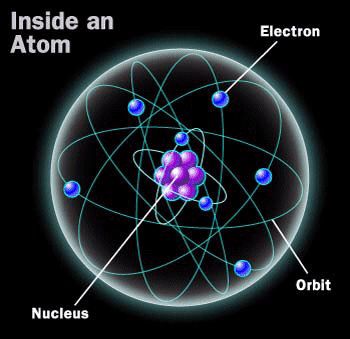
As you probably already know an
  atom is the building block of all
  matter. It has a nucleus with
  protons and neutrons and an
  electron cloud outside of the
  nucleus where electrons are
  orbiting and MOVING.

Depending on the ELEMENT, the
  amount of electrons differs as
  well as the amounts of orbits
  surrounding the atom.
When the atom gets excited or NOT

To help visualize the atom think of it like a ladder. The bottom of
  the ladder is called GROUND STATE where all electrons would
  like to exist. If energy is ABSORBED it moves to a new rung on
  the ladder or ENERGY LEVEL called an EXCITED STATE.
  This state is AWAY from the nucleus.

As energy is RELEASED the electron can relax by moving to a
  new energy level or rung down the ladder.
Energy Levels
Yet something interesting happens as
   the electron travels from energy
   level to energy level.

If an electron is EXCITED, that means
    energy is ABSORBED and
    therefore a PHOTON is absorbed.

If an electron is DE-EXCITED, that
    means energy is RELEASED and
    therefore a photon is released.

We call these leaps from energy level
  to energy level QUANTUM LEAPS.

Since a PHOTON is emitted that
   means that it MUST have a certain
   wavelength.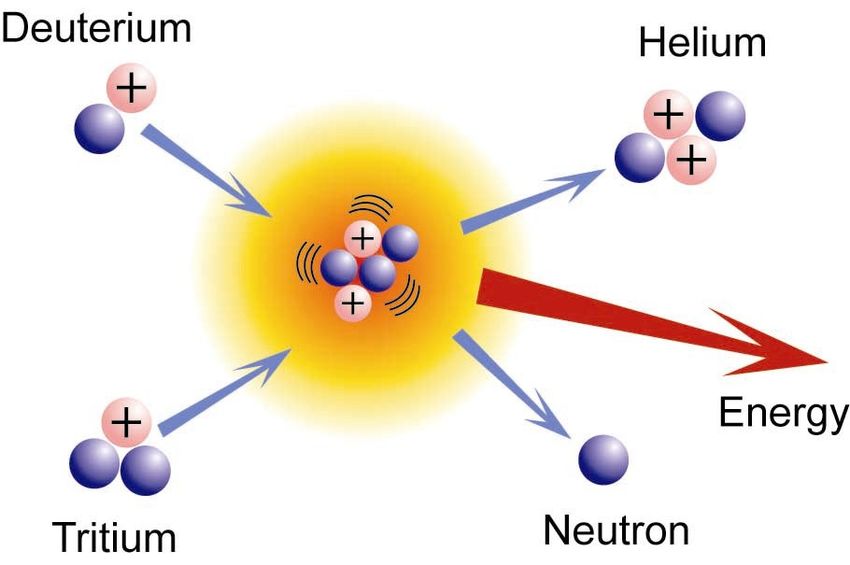
Energy of the Photon
We can calculate the ENERGY
 of the released or absorbed
 photon provided we know the
 initial and final state of the
 electron that jumps energy
 levels.
Energy Level Diagrams                               To represent these
                                                    transitions we can
                                                    construct an ENERGY
                                                    LEVEL DIAGRAM

Note: It is very important to understanding that these transitions DO NOT
have to occur as a single jump! It might make TWO JUMPS to get back to
ground state. If that is the case, TWO photons will be emitted, each with a
different wavelength and energy.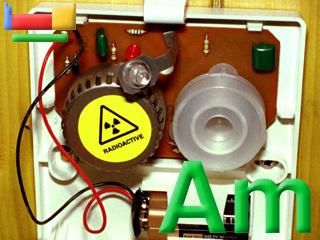
Example
An electron releases energy
   as it moves back to its
   ground state position. As a
   result, photons are
   emitted. Calculate the
   POSSIBLE wavelengths of
   the emitted photons.

Notice that they give us the
   energy of each energy
   level. This will allow us to   This particular sample will release three
   calculate the CHANGE in        different wavelengths, with TWO being
   ENERGY that goes to the        the visible range ( RED, VIOLET) and
   emitted photon.                ONE being OUTSIDE the visible range
                                  (INFRARED)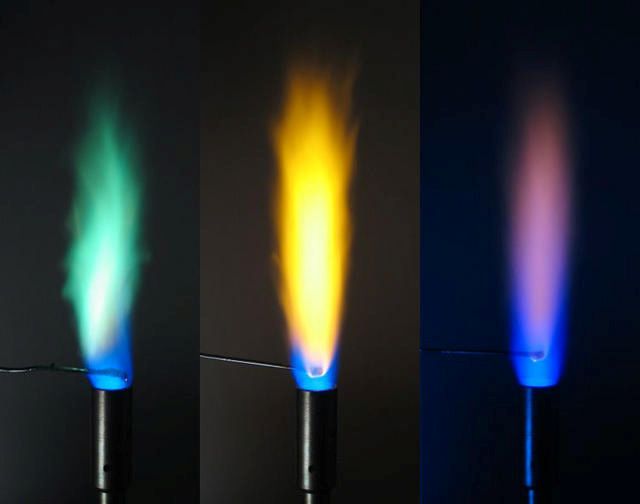
Energy levels Application: Spectroscopy
Spectroscopy is an optical technique by which we can
  IDENTIFY a material based on its emission
  spectrum. It is heavily used in Astronomy and
  Remote Sensing. There are too many subcategories
  to mention here but the one you are probably the
  most familiar with are flame tests.

                        When an electron gets excited inside
                        a SPECIFIC ELEMENT, the electron
                        releases a photon. This photon’s
                        wavelength corresponds to the
                        energy level jump and can be used
                        to indentify the element.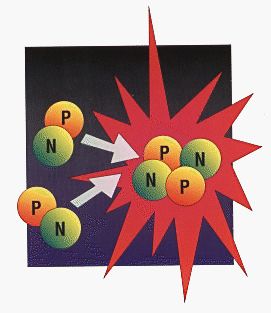
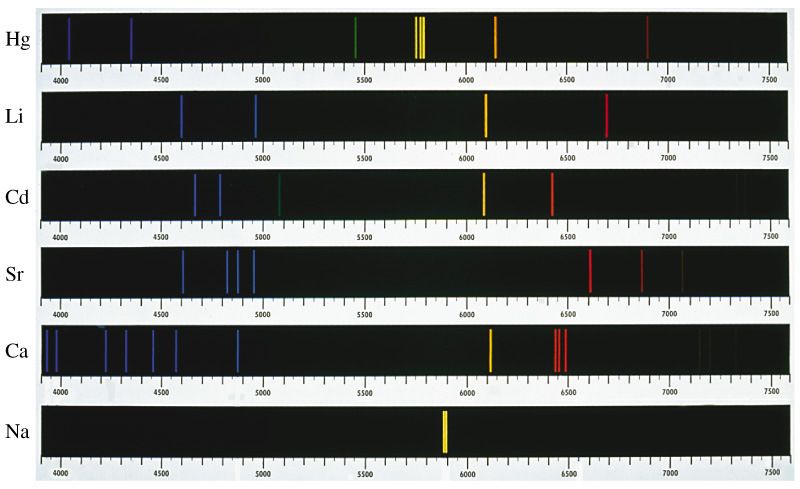
Different Elements = Different Emission
Lines
Emission Line Spectra
So basically you could look at light
  from any element of which the
  electrons emit photons. If you
  look at the light with a diffraction
  grating the lines will appear as
  sharp spectral lines occurring at
  specific energies and specific
  wavelengths. This phenomenon
  allows us to analyze the
  atmosphere of planets or
  galaxies simply by looking at the
  light being emitted from them.
Nuclear Physics - Radioactivity
Before we begin to discuss the specifics of radioactive
  decay we need to be certain you understand the
  proper NOTATION that is used.
                         To the left is your typical radioactive
                         isotope.
                         Top number = mass number = #protons
                         + neutrons. It is represented by the
                         letter "A“

                         Bottom number = atomic number = # of
                         protons in the nucleus. It is represented
                         by the letter "Z"
Nuclear Physics – Notation & Isotopes An isotope is when you have the SAME ELEMENT, yet it has a different MASS. This is a result of have extra neutrons. Since Carbon is always going to be element #6, we can write Carbon in terms of its mass instead. Carbon - 12 Carbon - 14
Einstein – Energy/Mass Equivalence
            In 1905, Albert Einstein publishes a 2nd major
               theory called the Energy-Mass
               Equivalence in a paper called, “Does the
               inertia of a body depend on its energy
               content?”
Einstein – Energy/Mass Equivalence Looking closely at Einstein’s equation we see that he postulated that mass held an enormous amount of energy within itself. We call this energy BINDING ENERGY or Rest mass energy as it is the energy that holds the atom together when it is at rest. The large amount of energy comes from the fact that the speed of light is squared.
Energy Unit Check
                             2
           2            m
 EB = ∆mc → Joule = kg × 2
                        s
 W = Fx → Joule = Nm
                       m
  Fnet = ma → N = kg × 2
                      s
                             2
               m           m
  E = W = kg × 2 × m = kg × 2
               s           s
Mass Defect The nucleus of the atom is held together by a STRONG NUCLEAR FORCE. The more stable the nucleus, the more energy needed to break it apart. Energy need to break to break the nucleus into protons and neutrons is called the Binding Energy Einstein discovered that the mass of the separated particles is greater than the mass of the intact stable nucleus to begin with. This difference in mass (∆m) is called the mass defect.
Mass Defect - Explained

                    The extra mass turns into energy
                    holding the atom together.
Mass Defect – Example
Radioactivity
When an unstable nucleus releases energy and/or
 particles.
Radioactive Decay
There are 4 basic types of     4
                               2   He
  radioactive decay
                                0
 Alpha – Ejected Helium
                               −1   e
 Beta – Ejected Electron
                               0
 Positron – Ejected Anti-     1   e
  Beta particle                0
 Gamma – Ejected Energy       0   γ
                               1
                               1   p
You may encounter protons
                               1
  and neutrons being emitted   0   n
  as well
Alpha Decay
240 236 4
94 Pu → U + He
92 2Alpha Decay Applications
241 4 A
95 Am→ He+ ? 2 Z
Americium-241, an alpha-emitter, is used in smoke detectors. The alpha
particles ionize air between a small gap. A small current is passed through that
ionized air. Smoke particles from fire that enter the air gap reduce the current
flow, sounding the alarm.Beta Decay
There aren’t really any
applications of beta decay
other than Betavoltaics which
makes batteries from beta
emitters. Beta decay, did
however, lead us to discover
the neutrino.
228 0 228
88 Ra→ e+ Ac
−1 89Beta Plus Decay - Positron
Isotopes which undergo this decay
and thereby emit positrons include
carbon-11, potassium-40,
nitrogen-13, oxygen-15, fluorine-
18, and iodine-121.
230 0 230
91 Pa→ e+ Th
1 90Beta Plus Decay Application - Positron
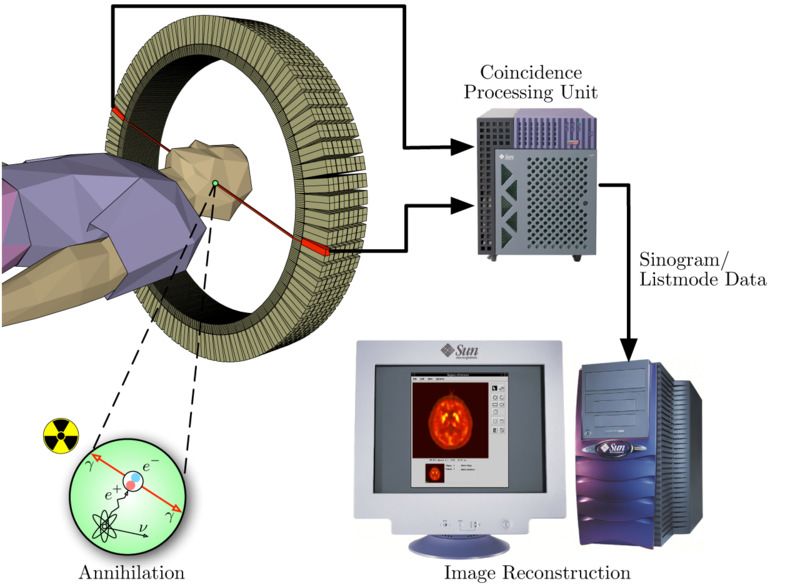
emission tomography (PET)
Positron emission tomography
(PET) is a nuclear medicine
imaging technique which
produces a three-dimensional
image or picture of functional
processes in the body. The
system detects pairs of gamma
rays emitted indirectly by a
positron-emitting radionuclide
(tracer), which is introduced
into the body on a biologically
active molecule. Images of
tracer concentration in 3-
dimensional space within the
body are then reconstructed by
computer analysis.Gamma Decay
240 240 0
94 Pu → Pu + γ
94 0Gamma Decay Applications Gamma rays are the most dangerous type of radiation as they are very penetrating. They can be used to kill living organisms and sterilize medical equipment before use. They can be used in CT Scans and radiation therapy. Gamma Rays are used to view stowaways inside of a truck. This technology is used by the Department of Homeland Security at many ports of entry to the US.
Significant Nuclear Reactions - Fusion

 2            3                 4                  1
 1   H + H → He+ n
              1                 2                  0
 nuclear fusion is the process by which multiple like-charged atomic nuclei
 join together to form a heavier nucleus. It is accompanied by the release or
 absorption of energy.
Fusion Applications - IFE In an IFE (Inertial Fusion Energy) power plant, many (typically 5-10) pulses of fusion energy per second would heat a low- activation coolant, such as lithium-bearing liquid metals or molten salts, surrounding the fusion targets. The coolant in turn would transfer the fusion heat to a power conversion system to produce electricity.
Significant Nuclear Reactions - Fission

       1
       0   n + 235
                92 U →141
                       56 Ba + 92
                               36 Kr + 3 1
                                        0 n + energy
 Nuclear fission differs from other forms of radioactive decay in that it can be
 harnessed and controlled via a chain reaction: free neutrons released by
 each fission event can trigger yet more events, which in turn release more
 neutrons and cause more fissions. The most common nuclear fuels are 235U
 (the isotope of uranium with an atomic mass of 235 and of use in nuclear
 reactors) and 239Pu (the isotope of plutonium with an atomic mass of 239).
 These fuels break apart into a bimodal range of chemical elements with
 atomic masses centering near 95 and 135 u (fission products).
Fission Bomb One class of nuclear weapon, a fission bomb (not to be confused with the fusion bomb), otherwise known as an atomic bomb or atom bomb, is a fission reactor designed to liberate as much energy as possible as rapidly as possible, before the released energy causes the reactor to explode (and the chain reaction to stop).
ERROR: stackunderflow
OFFENDING COMMAND: ~
STACK:
You can also read


