Augmented Reality Interactive Learning Model, using the Imagineering Process for the SMART Classroom
←
→
Page content transcription
If your browser does not render page correctly, please read the page content below
TEM Journal. Volume 10, Issue 3, Pages 1404‐1417, ISSN 2217‐8309, DOI: 10.18421/TEM103-51, August 2021.

        Augmented Reality Interactive Learning
         Model, using the Imagineering Process
             for the SMART Classroom
        Panita Wannapiroon 1, Prachyanun Nilsook 1, Nutthapat Kaewrattanapat 2,
                        Naphong Wannapiroon 3, Wera Supa 4
                   1
                 King Mongkut's University of Technology North Bangkok,Bangkok, Thailand
                           2
                             Suan Sunandha Rajabhat University,Bangkok, Thailand
         3
           Rajamangala University of Technology Suvarnabhumi, Phranakhon Si Ayutthaya, Thailand
                    4
                      Rajamangala University of Technology Tawan-ok,Bangkok, Thailand

   Abstract – The objective of this research is to create   1. Introduction
an augmented reality interactive learning model, using
the Imagineering process for the SMART classroom.              In Thailand, education is emphasized as the key
The overall method is divided into 4 stages: (1)            strategy for national development. The Office of the
development of the augmented reality interactive            Education Council, Ministry of Education,
learning model; (2) development of using augmented          established the national education plan 2017 – 2036
reality learning materials; (3) development of best         [1] to determine the goals and directions of education
practices teachers of ICT; and (4) expanding these          management within the country. The aims of the plan
results with the augmented reality interactive learning     are to: 1) provide education for all Thai people so
model. The target group for the research is 30 excellent
                                                            that all have equal opportunities to access quality
tertiary teachers, 20 vocational instructors, 600
                                                            education; 2) develop an effective educational
vocational students and 900 tertiary students. Qualified
experts certified that the interactive learning model
                                                            management system; 3) develop manpower to work
developed is at the most appropriate level. The             in accordance with the needs of the job market and
interactive learning material activities consist of four    national development; 4) establish the vision that
main processes: preparation, prototype teacher              enables Thai people to learn throughout their life to a
development, outreach, and evaluation. The results of       high standard; 5) determine a strategy to enable all
evaluation indicate that the quality of creative            new teachers to develop information technology
innovation is at the highest level.                         skills so that learners can access information; and 6)
                                                            develop a high-speed fibre-optic network system and
  Keywords – Augmented Reality, Interactive Learning,       wireless access for all schools and communities. The
Interactive Media, Imagineering, SMART Classroom            teachers with best practices are important in ensuring
                                                            that learning is of high quality [2]. In the era of
                                                            digital citizens, the most distinctive component is
                                                            ICT management as a key factor in developing an
DOI: 10.18421/TEM103-51                                     innovative education [3]; the instructor must become
https://doi.org/10.18421/TEM103-51                          a learning designer and facilitate learning, allowing
Corresponding author: Naphong Wannapiroon,                  learners to learn by doing so that it comes from
Rajamangala University of Technology Suvarnabhumi.          within their own mind and brain.
Email: naphong.w@rmutsb.ac.th                                  Teachers and learners in all sectors of education
                                                            continue to have access to a growing number of
Received:    20 January 2021.                               mobile Augmented Reality (AR) applications. AR
Revised:     04 August 2021.                                has seen a significant increase in applications in a
Accepted:    10 August 2021.                                number of fields in recent years. One of the areas – in
Published:   27 August 2021.                                which the AR has been applied to – is education [4].
          © 2021 Panita Wannapiroon et al; published        AR technology is a digital media form of Virtual
by UIKTEN. This work is licensed under the Creative         Reality (VR) technology that utilizes virtual systems
Commons Attribution‐NonCommercial‐NoDerivs 4.0              combined with visual technology to create virtual
License.                                                    worlds for users. AR technology is applied in many
                                                            different fields, especially education technology. AR
The article is published        with   Open   Access   at   has been used to develop teaching materials from
www.temjournal.com                                          kindergarten to university levels [5].

 1404                                                                 TEM Journal – Volume 10 / Number 3 / 2021.
TEM Journal. Volume 10, Issue 3, Pages 1404‐1417, ISSN 2217‐8309, DOI: 10.18421/TEM103‐51, August 2021.

  The SMART Classroom is an appropriate learning          creating images in the mind. It is a tangible form of
environment [6] that includes the following               invention and innovation. The Imagineering process
dimensions: 1) S: Showing is the ability to present       has 6 aspects and 17 steps consisting of: [9]
information in teaching and learning through
                                                          1) Imagine: the process of determining the
technological     media,     which     is    cognitive
                                                             imagination of the work (problem), the
characteristic; lectures given through smart
                                                             brainstorming process regarding how the
classroom significantly increase the academic
                                                             imagination works (brainstorm), the process of
achievements of the students. 2) M: Manageable
                                                             expressing opinions (discussion), and the process
refers to the competent management of media,
                                                             of analysing the feasibility of the imagination
equipment, teaching system, resources, and the
                                                             (feasibility).
environment of the SMART classroom; 3) A:
                                                          2) Design: the process of drafting (draft), the
Accessible denotes the ability to access learning
                                                             process of writing a story board, the process of
resources using SMART classrooms through a
                                                             writing the script, and the process of creating a
variety of media; 4) R: Real-time Interactive refers to
                                                             model prototype.
learning experiences created and taught by teachers
                                                          3) Development: the process of creating (create)
through interactive computer technology media in
                                                             and the process of testing (test).
SMART classrooms. It is clear that basic aspects of a
                                                          4) Presentation: the process of showing the work
classroom are of importance in helping lecturers to
                                                             (show), the process of the contest (contest), and
make classes more flexible or adaptable [7]. 5) T:
                                                             the process of listening to opinions (suggestion).
Testing is concerned with the qualitative examination
                                                          5) Improvement: the process of revising the work
of learning activities or checking learning behaviour
                                                             (revised) and the process of concluding the work
using the SMART classroom.
                                                             (conclusion).
  The arrangement of learning activities, according
                                                          6) Evaluation: the process of evaluating the
to the Augmented Reality, Interactive Learning,
                                                             imagination (process evaluation) and the process
Interactive Media, Imagineering, SMART Classroom
                                                             of evaluating the quality of work (product
model, consists of the following steps: 1)
                                                             evaluation).
imagination, 2) designing, 3) development, 4)
improvement, 5) presentation, and 6) evaluation,            The learning process of Imagineering, therefore
concepts adapted from Walt Disney's Imagineering          constitutes a way to develop learners in the 21st
model [8]. Therefore, the researcher investigates and     century that focus on self-learning, creativity, and
generates an interactive learning media development       innovation. [10]
model with augmented reality, using the
Imagineering process for a SMART classroom that           3.2. SMART Classroom
has revolutionized Thai education in the digital age.
                                                             The SMART classroom as a new frontier for the
2. Research Objectives                                    university, provides a suitable learning environment
                                                          that includes locations, tables, chairs, electrical
1. To develop the augmented reality interactive           systems, audio, and air conditioning systems, mobile
   learning model, using the Imagineering process         and wearable devices, tracking technologies, data
   for the SMART classroom.                               collection systems, big data processing capabilities,
2. To develop learning materials, using the               etc. [11]. It facilitates various learning activities in
   augmented reality interactive learning model.          the classroom, whether this is a small group activity,
3. To develop the Ministry of Education's best            a lecture, project work, or a presentation in front of
   practice    teachers     of    information    and      the class. These enable learners to develop the skills
   communication technology in the production of          to use technology for learning (learning skill) and the
   such learning materials.                               skills of searching by themselves (research skill).
4. To expand the production of learning materials,        This enables them to meet their individual learning
   using the augmented reality interactive learning       needs and participate in the collaborative learning of
   model.                                                 learners and teachers to their full potential.
                                                          Moreover, the use of smart classroom also helps in
3. Theoretical Foundation                                 the process of teaching and learning in the classroom
                                                          where learning becomes more effective and flexible
3.1. Imagineering                                         [12].
                                                             A SMART classroom for the education can be
  “Imagineering” is a portmanteau of the words            defined as the exploitation of a smart environment in
“Imagine and Engineer”. Imagineering means adding         a learning process [13]. SMART classroom is a
imaginative elements into something that is practical;    unique learning resource, different from a

  TEM Journal – Volume 10 / Number 3 / 2021.                                                              1405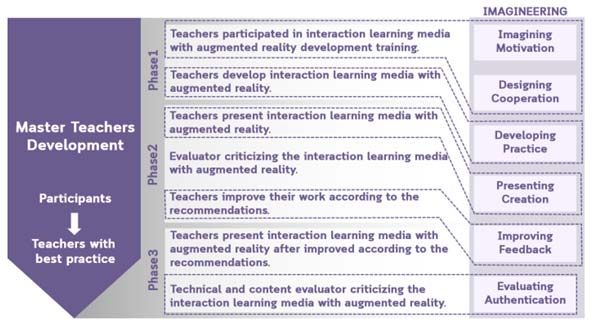
TEM Journal. Volume 10, Issue 3, Pages 1404‐1417, ISSN 2217‐8309, DOI: 10.18421/TEM103‐51, August 2021.

conventional classroom, that enhances teaching and         more engagement in class [19]. Through interactive
learning experiences, training, and skills training in     learning, learners engage with various media such as
various fields. It focuses on facilitating collaborative   computers, smartphones, tablets, and social
learning across multiple technologies and audio-           networks. Such engagement helps create a
visual media, creating both regular and out-of-class       comfortable level of interaction between learners and
learning systems to support effective distance             teachers. Nowadays, this form of learning thrives on
learning [14].                                             digital technology that has evolved enormously. One
                                                           of the approaches widely employed to study
3.3. Augmented Reality                                     interactive learning is “mobile learning” [20],
                                                           smartphone use boosted learners’ critical thinking,
  Virtual and augmented reality technology is              creative thinking, communication and collaboration
becoming more commonly available within                    skills. In addition, those students who performed
educational environments [15]. Augmented Reality           interactive learning are more likely to pass the course
(AR) is a type of digital media that combines the use      with distinction than those who did not show this
of Virtual Reality (VR) with visual technology for         attribute [21]. Because social and interactive
the user. AR is used in many fields, especially in         engagement is integral to cognitive development, the
education. It is a notable technology for pedagogical      learning spaces that are most conducive to interactive
use. AR differs from VR. It has been developed into        learning should be investigated. This is an area that
teaching and learning materials from kindergarten to       motivates learners, especially children and young
university levels; specific insight for exploring          people, who are close to the new generation of
immersive learning approaches utilizing virtual and        electronic devices.
augmented reality tools and applications in a variety
of disciplines is needed and also concerns regarding       4. Research Methodology
accountability for ethical design and the use of
VR/AR products in virtual learning environments              To meet the research objectives, the research was
[16].                                                      conducted in 4 phases as follows:
   AR is a new technology that combines the real             Phase 1: Development of the augmented reality
world with the virtual world through a hardware            interactive learning model, using the Imagineering
device combined with the use of different software.        process for the SMART classroom.
This makes it possible to see images that look like
                                                           1.1. Research on the status of teaching and learning
objects and that are displayed on the screen, where
                                                                management, problems, and needs in the use of
they are transformed into a 3D object floating above
                                                                information and communication technology for
the real surface. This creates a visual effect that
                                                                education among teachers, students, and school
shows the object moving and creates a sense of
                                                                administrators.
excitement. Both AR and VR as elements of the
                                                           1.2. A synthesis of literature related to the augmented
mixed reality continuum rely on the human–
                                                                reality interactive learning model.
computer interaction [17].
                                                           1.3. Development of the augmented reality interactive
   AR has a working principle that can be
                                                                learning model, using the Imagineering process
categorized into 2 types of image analysis: using
                                                                for the SMART classroom, presented on an
marker as the main work (marker-based AR), and
                                                                illustrated essay sheet.
using different characteristics in the image for
analysis (marker-less based AR) [18]. The elements            To certify the suitability of the interactive learning
of virtual reality technology include a Marker (also       model, it was criticized and assessed by 15 experts.
known as a markup), video camera, webcam, cell             The tool used to collect the data was an evaluation
phone camera, or other sensors. Display components         form to certify the suitability of the learning style,
include a display device and processor software for a      which was assessed at five levels: most appropriate,
3D object.                                                 most, moderate, least, and least appropriate. The data
                                                           was analysed, using arithmetic means and standard
3.4. Interactive Learning                                  deviations.
                                                             Phase 2: Development of the Ministry of
   Interactive learning is an approach to teaching and     Education's best practice teachers of information and
learning that focuses on various ways in which             communication technology in the production of
learning activities can "interact" with learners. One      learning materials.
of the key components of interactive learning is
"information" and the design of teaching materials to      2.1. Development of teachers with excellent practice:
attract learners, creating a greater desire to learn.           A group of teachers with excellent practice at the
Students can prepare for class by interacting with              tertiary level, 30 people and 20 vocational
provided resources to reduce lecture time and allow             educations, a total of 50 people, implementing

 1406                                                                TEM Journal – Volume 10 / Number 3 / 2021.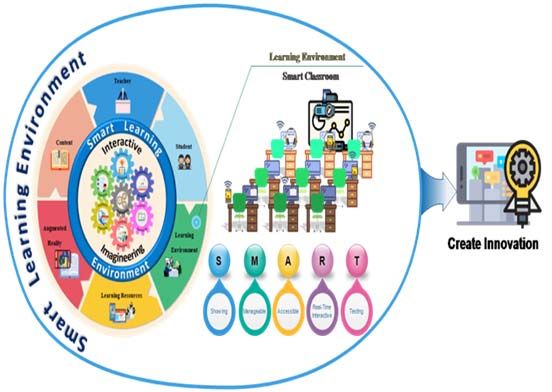
TEM Journal. Volume 10, Issue 3, Pages 1404‐1417, ISSN 2217‐8309, DOI: 10.18421/TEM103‐51, August 2021.
the technology model for human performance 1) Imagination phase: The instructor asks the
technology, organized a 5-day workshop for student what they want to create from their
prototype teachers with excellent practice in own imagination and to determine the topic
producing the augmented reality interactive they want to make work in reality.
learning materials using the Imagineering 2) Design: The instructor allows students to
process. draft whatever they want to create in the
2.2. Development of the augmented reality interactive form of scripts and storyboards, stimulating
learning materials, using the Imagineering their imaginations with a focus on creativity.
process. 3) Development: Learners use draft drawings,
scripted stories, and storyboards to create the
50 teachers with excellent practice created 50
interactive learning materials based on their
augmented reality interactive learning
imagination.
materials. The creation of learning materials
4) Presentation: Learners present the interactive
followed the 6-step process of Imagineering:
learning materials they have created in front
Imagination, Design, Development,
of the class.
Presentation, Improvement, and Evaluation.
5) Improvement: The instructor organizes the
These were integrated with the 5 steps of
production of critical comments on the
Instructional Design, Analysis, Design,
development of learning materials to reflect
Development, Implementation, and
people’s ideas and to allow them to
Evaluation.
participate in exchanging learning,
Teachers created a learning management
suggestions, and improvements.
plan using the augmented reality interactive
6) Evaluation: Teachers and learners jointly
learning materials they had developed.
evaluate the results of the media created
Presentation and review of the augmented
through the process of imagination and
reality interactive learning materials by 3
assess the quality of the interactive learning
experts on the content and technical aspects
materials learners created.
of augmented reality.
Assessment of the quality of the augmented 3.3. Higher education and vocational students create
reality interactive learning materials by the interactive learning materials based on the
same 3 experts. The tool employed in the Imagineering process.
evaluation was: The media quality 3.4. Teachers assess the quality of students' creativity
assessment form for content and technical and innovation using Imagineering learning. The
Augmented Reality. The quality of the tools used in the assessment were the creativity
assessment was rated on a five -level scale: assessment and creative innovation quality
Excellent, Good, Fair, Poor, and Bad. The assessment using rubric assessment criteria. The
data were analysed using arithmetic means criteria for assessment were at 5 levels:
and standard deviations. Excellent, Good, Fair, Poor, and Bad. The data
were analysed using arithmetic means and
Phase 3: Expanding the results of the production
standard deviations.
of learning materials using the augmented reality
interactive learning model. Phase 4: Development of the augmented reality
50 teachers with excellent practice expanded the interactive learning materials using the Imagineering
results by implementing the Imagineering Process to process for the SMART classroom.
900 tertiary students and 600 vocational students
4.1. Research on the teaching and learning
from 5 regions in Thailand, including North, Central,
conditions, problems, and needs regarding the
South, East, and Northeast of Thailand, an overall
use of interactive learning materials with
total of 1,500 people. The process was as follows:
augmented reality by teachers, students, and
3.1. Teachers with excellent practices set content education providers.
boundaries and design activities to enable 4.2. A synthesis of literature related to the
students to create interactive learning materials development of interactive learning materials
by independently creating their own materials, based on augmented reality using the
based on their imagination and creativity. Imagineering process for the SMART
3.2. Teachers with excellent practices performed a 6- Classroom.
step learning activity based on the Imagineering 4.3. The development of a model for these interactive
Process as follows: learning materials.
4.4. Criticism of the model by 10 experts.
4.5. Evaluation by 15 experts to certify the
development of the interactive learning
TEM Journal – Volume 10 / Number 3 / 2021. 1407
TEM Journal. Volume 10, Issue 3, Pages 1404‐1417, ISSN 2217‐8309, DOI: 10.18421/TEM103‐51, August 2021.
materials. The tool used to collect the data was Creates a flexible learning environment, in which
an assessment form that certified the suitability students learn and work independently. Students
of the learning model. There were five levels of have time to learn and work both in the
assessment: Excellent, Good, Fair, Poor, and classroom and outside the classroom, possibly
Bad. The data were analysed using arithmetic using social media.
means and standard deviations. Creates opportunities to communicate, present,
and share new ideas in their own words. The
5. Research Findings knowledge students discover is provided to other
group members and disseminated to other groups
Part 1: The Augmented Reality interactive learning of students or interested parties with expert
model using the Imagineering Process for the advice to ensure the fulfilment of student
SMART classroom. learning.
1.1. There are 6 main components of the augmented Encourages students to reflect on what they have
reality interactive learning model: teacher, learned and express their opinions rationally
student, SMART classroom environment, without using emotions or personal feelings.
augmented reality learning resources, and Allows students to take action in the form of
content. project work, product creation, or innovation.
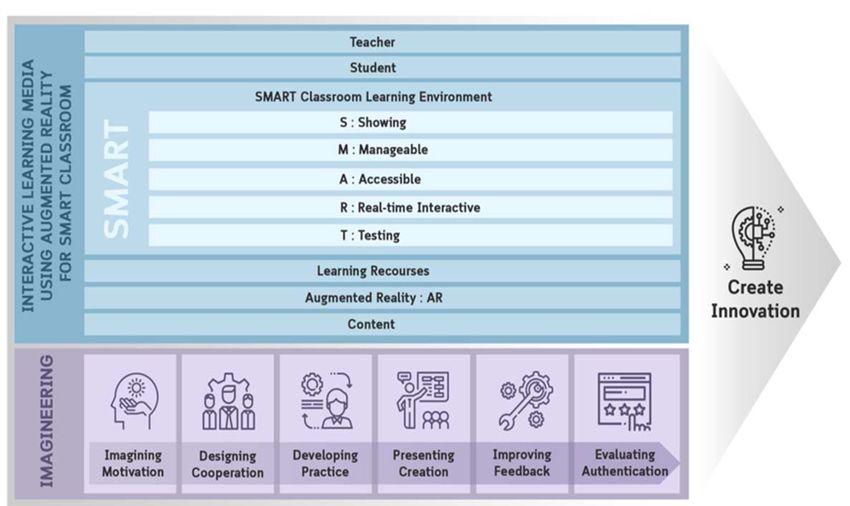
1) Teacher The SMART classroom learning environment
The teacher motivates and inspires students to has 5 dimensions, each of which is detailed as
learn, poses challenging questions, and organizes follows.
a variety of teaching activities to enable students
to find answers on their own. Teachers are S: Showing: The ability to present information
knowledgeable people who will guide students to in teaching and learning through teaching
think, challenge them through project-based technology materials, a feature known as
problem-solving processes, and monitor their Cognitive Characteristic.
progress in creating a product, workpiece, or M: Manageable: A managerial capacity that
portfolio, The teacher encourages students to includes media management, management of
discuss, appreciate, and summarize the correct materials, and organization of the teaching
directions to take after the activity. system, as well as resources and the SMART
2) Students classroom environment.
Students competently participate in a systematic A: Accessible: Accessibility to learning
learning process by conducting research or resources within the SMART classroom through
creating workpieces, expressing opinions, and various media.
presenting and sharing what they have learned, R: Real-time Interactive: The interactive
their knowledge, and their expertise. They have creation of teaching experiences by teachers,
the ability to work in groups, engage in including media-based interactive computer
collaborative learning, allocate functions and technology learning in a SMART classroom.
roles to various group members, and can search T: Testing: This comprises a qualitative
for resources to solve real-world problems examination of learning activities, or the
relating to everyday contexts, questions, issues, examination of learning behaviour within
and challenges. They possess self-learning skills, SMART classrooms, as shown in Figure 1.
can search for knowledge from various learning
sources, are able to create workpieces to enhance
their learning of the subject matter, can be self-
sufficient in assessing their learning, exhibit
open-mindedness, listen to the reasons given by
the group, and are outside educators.
3) SMART classroom learning environment:
The characteristic features of the SMART classroom
learning environment are as follows.
Encourages students to work together as a group;
such grouping must be organized carefully so
that students can learn together happily and with
success. Figure 1. SMART classroom learning environment for the
augmented reality interactive learning model by using the
Imagineering process
1408 TEM Journal – Volume 10 / Number 3 / 2021.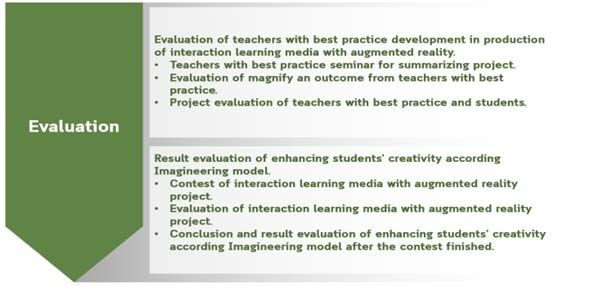
TEM Journal. Volume 10, Issue 3, Pages 1404‐1417, ISSN 2217‐8309, DOI: 10.18421/TEM103‐51, August 2021.
4) Learning resources: The characteristic features 6) Content: The characteristic features of the
of the learning resources employed in the content in the composition of the augmented reality
composition of the augmented reality interactive interactive learning model are as follows.
learning model are as follows:
Encourages students to engage in creative
A versatile learning resource to suit the thinking processes to develop projects, invent, or
individual needs of each student, both as a create an innovation that leads to its practical use
documented source of knowledge, Internet, and in their daily lives.
professionals in the fields of interest to students. Challenges students to acquire additional
Learning resources that students can easily knowledge that forms the basis of invention,
access. innovation, or work that can be used in real life.
Sufficient numbers and types of basic materials Develops an ability to integrate the content or the
necessary for learning to support students and the skills of various subjects in an interdisciplinary
testing of work pieces. way to achieve complete learning.
A system to promote the use of augmented Subjects that lead to experiences that can be
reality such as available internet networks, and applied in the real lives of the students.
sufficient equipment to access this. Consistent with the core curriculum structure of
A learning resource that students can apply in the basic education to provide students with
creation of augmented reality work. knowledge and an understanding of the subject
Easily accessible content. matter according to the standards of the basic
education core curriculum.
5) Augmented Reality: The characteristic features
Suitable for students' abilities, interests, and age,
of augmented reality in the composition of the
but challenges them to seek new knowledge.
augmented reality interactive learning model are as
follows: The Augmented Reality Interactive learning
activity using the Imagineering Process for the
Flexible, can be used with a wide range of tools,
SMART classroom consists of 2 steps:
and teachers can apply and adapt teaching and
learning in a variety of methods and contexts. 1) Pre-teaching preparation process:
Students can use them for learning anywhere and
Orientation clarifies learning objectives and
at any time.
methods of teaching and learning.
Interacting, and an ability to interact with users,
Practice using tools for interactive learning.
denotes the relationship between the real
Assessment of creativity before studying.
environment and the virtual environment.
Improving learning efficiency, helping students 2) The Interactive Imagineering process comprises
to understand contents so that they spend less the following 6 steps:
time learning, reducing the cognitive burden Imagining motivation: This is the process of
resulting in effective learning, helping to make defining the imagination of the works (problem),
abstract content appear more tangible. the process of brainstorming to imagine the work
Convenient for learning without the need for (brainstorm), discussion, and the process of
large experimental tools or multiple materials, analying the possibility of imagination
thus reducing equipment purchase costs. (feasibility) to help motivate students, generate
Students can use it for self-learning with a curiosity, and give rise to inspiration.
variety of devices. Designing cooperation: This is the process of
Motivating learning, promoting independent drawing (draft), writing storyboards (storyboard),
learning in a multimedia format. This gives scripting (script), and modelling (prototype)
students the opportunity to learn at their own which contributes to learning, resulting in
pace according to their needs; it allows students collaboration between student groups and
to experience abstraction and become concrete. It between students and teachers.
stimulates their interest and they develop a Developing practice: This is the creating
positive attitude to study. process (create) and functional testing process
Promotes collaborative learning, facilitates (test). It is a practice that involves creating
collaboration among student groups, and among innovation using learning materials from
students and teachers, enables students to interact technology. It is a form of learning management
well between groups, promotes the creation of that allows students to take action in the form of
augmented reality work in a variety of contexts. project work, creation workpieces, or innovation.
TEM Journal – Volume 10 / Number 3 / 2021. 1409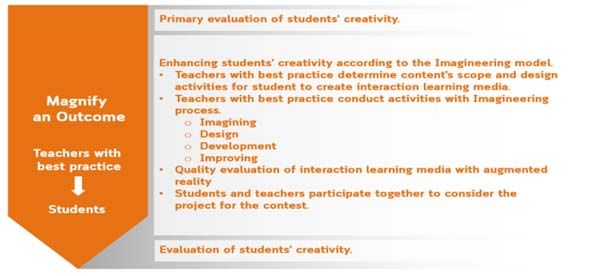
TEM Journal. Volume 10, Issue 3, Pages 1404‐1417, ISSN 2217‐8309, DOI: 10.18421/TEM103‐51, August 2021.
Presenting creation: This is the process of The Interactive Imagineering Process, as shown in
displaying works (show), competing (contest), Figure 2.
and receiving opinions (suggestion). It
encourages creativity and participation.
Improving feedback: This is the process of
editing the results (revised) and summarizing the
work (conclusion). It involves primary
improvement of the output of the presentation,
encouraging students to reflect on what they have
learned and to express their opinions logically.
Evaluating authentication: This is the process
of evaluating the imagination (process
evaluation) and of assessing the quality of work
(product evaluation) according to the reality of
the workpiece. It enables learners to assess their Figure 2. The Interactive Imagineering Process
understanding of the learning process.
Assessment is undertaken by both peers and
participatory teachers.
1.2) The augmented reality Interactive learning model using the Imagineering process for the SMART
classroom is depicted in Figure 3.
Figure 3. The augmented reality interactive learning model using the Imagineering process for the SMART classroom
1.3) Evaluation results for the development of Part 2: interactive learning media development
the augmented reality interactive learning model. model with augmented reality using the
The 15 experts found the development of learning Imagineering process for the SMART classroom
materials to be at the highest level.
2.1) Elements of the interactive learning media
development model
The results show that the model comprising 5
factors: peopleware, software, hardware, procedure,
and data and information, as presented in Figure 4.
1410 TEM Journal – Volume 10 / Number 3 / 2021.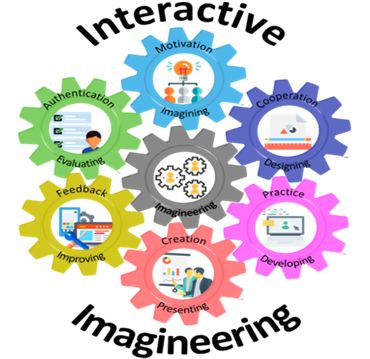
TEM Journal. Volume 10, Issue 3, Pages 1404‐1417, ISSN 2217‐8309, DOI: 10.18421/TEM103‐51, August 2021.
Search for resources to solve real world problems
in the context of everyday life.
Possess self-learning skills and can search for
knowledge from various learning resources.
Can create work pieces through self-learning of
the content.
Can evaluate their learning.
Lecturer and experts should be knowledgeable
and have expertise in various fields that teachers
and students need to rely on, such as virtual
technology, contents and interactive media,
contents for teaching and learning, and so on.
Evaluators should be knowledgeable and expert
Figure 4. The interactive learning media development in technical aspects of virtual technology and
model with augmented reality using the Imagineering content used as teaching materials.
process for the SMART classroom
The system administrators are responsible for
As presented in Figure 4., the model can be overseeing various systems that will support the
explained as follows. development of interactive learning media with
augmented reality using the Imagineering
2.1.1) Peopleware Process for the SMART Classroom and enable
the teaching and learning process to proceed
2.1.1.1) The characteristics of the instructor or smoothly and efficiently.
teacher.
2.1.2) Software
Motivates and inspires students to learn, poses
challenging questions, and sets a variety of 2.1.2.1) The characteristics of the software of the
teaching and learning activities so that students augmented reality development tool are as follows.
can learn to find answers on their own.
Is a facilitator and counsellor who stimulates and Must be flexible and interact with users, which
encourages students to learn fully to fulfil their denotes the relationship between the real
own potential. environment and the virtual environment.
Provides counselling to students and encourages Must be able to increase learning efficiency, help
them to progress in learning. students understand using less time to learn, and
Is knowledgeable and guides students’ thinking. reduce the intellectual burden, resulting in
Presents challenges through the problem of effective learning.
project solving and monitors progress in product Must help to transform abstract content into
creation. concrete.
Provides a variety of learning resources for Must be convenient to use and facilitate learning
student learning. without the need for large-scale experimental
Employs assessment methods that cover the equipment or a large amount of materials, thus
evaluation of work pieces, work processes, and reducing the cost of purchasing equipment. This
student competencies in addition to students’ allows students to learn by themselves with a
learning achievement. variety of devices.
Summarizes and encourages students to discuss Must motivate students to learn and promote
and realize the value and the correct approach to independent learning.
take after the activity. Is a multimedia medium that allows students to
learn by themselves according to their potential
2.1.1.2) The characteristics of the students are as and needs.
follows. Helps students to transform abstract experiences
Responsible for learning and a desire to learn by into concrete ones, stimulating their interest and
themselves rather than people waiting to learn enhancing a positive attitude towards learning.
according to the teacher's instruction. Must enhance cooperative learning, resulting in
Dare to express opinions and present and share collaboration between students and teachers in
knowledge and expertise with others. which students interact well between groups.
Work as a group to learn together and know how This enhances the creation of realistic pieces in
to determine their duties, including roles of different contexts.
group members.
TEM Journal – Volume 10 / Number 3 / 2021. 1411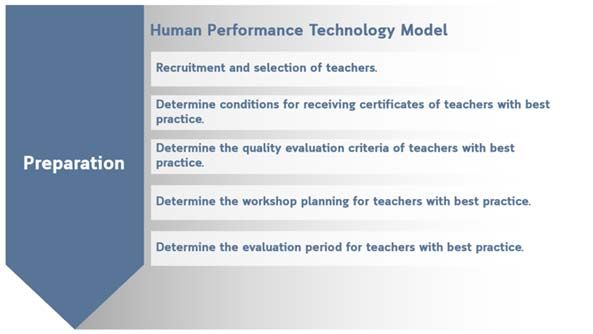
TEM Journal. Volume 10, Issue 3, Pages 1404‐1417, ISSN 2217‐8309, DOI: 10.18421/TEM103‐51, August 2021.

   2.1.2.2) Learning Management System (LMS)                 2.1.4.3) Developing practice is the process of
provides features to support the teaching and learning     creating and testing work. This step is one of practice
process via the Internet, such as access to courses,       and innovation as it involves using learning materials
lessons, and exercises.                                    from technology that students have practiced in the
   2.1.2.3) Database Management System (DBMS)              form of projects, work pieces, or innovations.
provides features for storing the information of             2.1.4.4) Presenting creation is the process of
teachers, learners, and course results.                    showing work, engaging in contests, and eliciting
                                                           comments and suggestions. This step helps promote
2.1.3) Hardware                                            creativity and participation.
                                                             2.1.4.5) Improving feedback is the process of
   The hardware consists of a 3D projector or 3D
                                                           revising and concluding the work. This step improves
visualizer, smart board, automatic detection as
                                                           the work from the presentation, which encourages
camera auto tracking, distribution system as a
                                                           students to reflect on the ideas that they have learned
streaming system, and an internet access point.
                                                           and express their opinions reasonably.
2.1.4) Procedure                                             2.1.4.6) Evaluating authentication is an evaluation
                                                           process based on imagination and product evaluation
  The procedure used to develop interactive learning       according to the actual situation regarding the
materials with augmented reality is based on the           workpiece and the learner. This step involves
Imagineering process model which consists of the           assessing learners’ understanding of the learning
following 6 steps:                                         process by evaluating both friends and teachers.
  2.1.4.1) Imagination motivation consists of the
                                                           2.1.5) Data and information
determination of the problem and brainstorming,
expressing ideas or discussion, analysing the                Data and information is part of the development of
possibilities of imagination or feasibility. This step     interactive learning materials with augmented reality
helps motivate students, making them interested in         and consists of learning resources, a knowledge and
learning and creating inspiration.                         learning media repository, and important contents.
  2.1.4.2) Designing cooperation is a draft process
that consists of storyboard writing, scripting, and          2.2)   The   interactive  learning    media
prototype     designing.    This    step     facilitates   development model with augmented reality using
participation in learning and creates interaction          the Imagineering process for the SMART
between students and teachers.                             classroom.

                                                             The results indicate the model includes 4
                                                           processes: preparation, master teacher development,
                                                           magnify an outcome, and evaluation, as indicated in
                                                           Figure 5.

 Figure 5. The Interactive Learning Media Development Model with Augmented Reality using the Imagineering Process
                                             for the SMART Classroom

 1412                                                                TEM Journal – Volume 10 / Number 3 / 2021.
TEM Journal. Volume 10, Issue 3, Pages 1404‐1417, ISSN 2217‐8309, DOI: 10.18421/TEM103‐51, August 2021.
The sub-processes of the interactive learning media As indicated in Figure 7., master teacher
development model are as follows. development consists of the following activities:
Teachers participate in interaction learning media
1. Preparation with augmented reality development training.
This involves preparing for the interactive learning 50 teachers develop interaction learning media
media development model, based on the human with augmented reality to produce 50 projects.
performance technology (HPT Model) model Teachers present their interaction learning media
presented in Figure 6. with augmented reality project.
Evaluators critique the interaction learning media
with augmented reality projects.
Teachers improve their work according to the
recommendations.
Teachers present interaction learning media with
augmented reality after making their
improvements.
Technical and content evaluator assess the
interaction learning media with augmented
reality.
Report on the evaluation of master teacher
development for the interactive learning media
Figure 6. Preparation stage development model with augmented reality using
the Imagineering process for the SMART
As indicated, preparation consists of the following
classroom.
activities:
3. Magnify an outcome
Recruitment and selection of 50 teachers under
the Ministry of Education. Magnify an outcome is the stage after master
Determine the conditions for receiving teacher development for the interactive learning
certificates of teachers with best practice. media development model with augmented reality, as
Determine the quality evaluation criteria for depicted in Figure 8.
teachers with best practice that indicates such
teachers must be able to develop augmented
reality for the SMART classroom.
Determine workshop planning for teachers with
best practice for 5 days.
Determine the evaluation period for teachers
with best practice after the workshop has
finished.
2. Master teacher development
Figure 8. Magnify an outcome stage
Master teacher development for the interactive As indicated, magnify an outcome consists of the
learning media development model occurs as shown following activities:
in Figure 7.
Primary evaluation of students' creativity before
participating in the workshop.
Enhancing students' creativity according to the
Imagineering model. Teachers with best
practices determine the scope of contents and
design activities for students to create interactive
learning media. Teachers with best practice
conduct activities using the Imagineering
process, which consists of imagining, design,
development, and improving.
Quality evaluation of interaction learning media
Figure 7. Master teacher development stage with augmented reality.
Students and teachers work together to consider
the project for the contest.
Evaluation of students' creativity.
TEM Journal – Volume 10 / Number 3 / 2021. 1413TEM Journal. Volume 10, Issue 3, Pages 1404‐1417, ISSN 2217‐8309, DOI: 10.18421/TEM103‐51, August 2021.
4. Evaluation 2.4) The results of magnify an outcome for
students.
Evaluation of the interactive learning media
development model with augmented reality using the 1,500 students in higher education and vocational
Imagineering process for SMART classroom is education trained, using the Imagineering process
presented in Figure 9. exhibited creativity at a high level and the quality
evaluation results for creativity innovation were at
the highest level.
Part 3: Results for the Ministry of Education's best
practice teachers of information and
communication technology regarding the
production of learning materials with the
augmented reality interactive learning model using
the Imagineering process for the SMART
classroom.
Figure 9. Evaluation stage 3.1) The results for those teachers who participated
in the workshop are presented in Table 1-2.
As indicated, the evaluation process consists of the
Table 1. Results for the Ministry of Education's best
following activities: practice teachers in information and communication
Evaluation of the development of teachers with technology regarding the production of learning materials
best practices in the production of interaction with the augmented reality interactive learning model
using the Imagineering process for the SMART classroom
learning media with augmented reality.
(n = 50).
Teachers with best practice conduct a seminar to
summarize the project. Assessment list X S.D. Opinions
Evaluation of magnifying an outcome from 1. The Knowledge and
teachers with best practices. Understanding gained on
4.74 0.49 Excellent
Project evaluation of teachers with best practices Imagineering Learning
and students. Management.
Result of enhancing students’ creativity 2. The Knowledge and
according to the Imagineering model. Understanding gained in
Contest involving the interaction learning media Imagineering Learning for
4.61 0.71 Excellent
Augmented Reality
with augmented reality project.
interactive learning
Evaluation of interaction learning media with management.
augmented reality project. 3.The Knowledge and
Conclusion and evaluation of the enhancement of Understanding gained in the
students’ creativity according to the development of Learning
Imagineering model after the contest has 4.67 0.63 Excellent
materials with the
finished. Augmented Reality
interactive model.
2.3) The results of developing teachers with best Total 4.67 0.62 Excellent
practice in the production of interactive learning
media with augmented reality using the As indicated in Table 1., the best practice teachers
Imagineering process for the SMART classroom. exhibited an excellent level of knowledge and
understanding as a result of participating in the
50 teachers with best practices trained, using the overall program ( X = 4.67, S.D. = 0.62). When
interactive learning media development model were considered individually, the knowledge and
able to develop interactive learning media of understanding gained in relation to Imagineering
extremely good quality. learning management was at the Excellent level
knowledge and understanding gained on the
development of learning materials with the
Augmented Reality interactive model ( X = 4.67, SD
= 0.63) and the knowledge and understanding gained
on Imagineering Learning Management ( X =4.61,
SD = 0.71), respectively.
1414 TEM Journal – Volume 10 / Number 3 / 2021.TEM Journal. Volume 10, Issue 3, Pages 1404‐1417, ISSN 2217‐8309, DOI: 10.18421/TEM103‐51, August 2021.
Table 2. The ability of the Ministry of Education's best vocational prototype teachers received 200 works of
practice teachers of information and communication interactive learning materials, a total of 511 works.
technology regarding the production of learning materials 4.2) Teachers were able to organize learning
with the Augmented Reality interactive learning model activities for learners based on the Imagineering
using the Imagineering Process for the SMART classroom
process at a ratio of 1:50 people. According to the
(n = 50)
project objectives and the interactive learning
Assessment list X S.D. Opinions materials developed by the learners, both the overall
1. Able to organize learning technical quality and the overall content were good.
activities with Imagineering 4.3) The 1,5000 tertiary and vocational students
4.76 0.43 Excellent
to develop innovation for who used the Imagineering process exhibited a high
learners. level of creativity and the quality of creative
2. Able to produce interactive
innovation was at the highest level.
learning materials with
4.76 0.48 Excellent
Augmented Reality using the
6. Discussion
Imagineering Process.
3. Able to apply the 4.67 0.52 Excellent The objective of this research is to create an
knowledge gained to augmented reality interactive learning model using
introduce others to the
the Imagineering process for the SMART classroom.
material.
The results indicate that:
4. Able to apply the acquired 4.76 0.48 Excellent
knowledge to further extend The Augmented reality interactive learning model
the results with students using the Imagineering process for the SMART
5. Exhibit the ability to 4.91 0.35 Excellent classroom consists of (1) teachers, students, the
become an Imagineering SMART classroom environment, learning resources,
Instructional Designer. Augmented Reality, and contents. (2) Interactive
Total 4.77 0.46 Excellent learning activities consist of the motivating
imagination stage, the participatory design stage, the
As indicated in Table 2., the ability of teachers practical development stage, the creative presentation
with overall excellent practice to apply knowledge stage, the thoughtful improvement stage, and the real
was at the Excellent level ( X = 4.77, SD = 0.46). evaluation stage. (3) The Augmented reality
When considered individually, the ability to become interactive learning environment consists of five
an Imagineering Instructional Designer was at the dimensions: S: Showing, M: Manageable, A:
Excellent level ( X = 4.91, SD = 0.35), followed by Accessible, R: Real-time Interactive, and T: Testing.
the ability to organize learning activities in Qualified experts certified that the interactive
Imagineering for the innovative development of learning model developed is at the most appropriate
learners ( X = 4.76, S.D. = 0.43), and the ability to level. Such technology focused on interactive
produce interactive learning materials with learning environment ignites excitement among the
Augmented Reality using the Imagineering Process students towards the concept of innovation [22]. One
and further extend the knowledge obtained to the important outcome of this work is a set of design
students ( X = 4.76, S.D. = 0.48), respectively. principles for supporting smart classroom [23].
3.2) Excellent practice teachers were found to The development of augmented reality interactive
obtain interactive learning materials with Augmented learning materials using the Imagineering process for
Reality using the Imagineering Process for the the SMART classroom consists of (1) learning
SMART classroom. There were 36 works for the materials, namely related personnel, software,
tertiary level and 37 works for vocational education. hardware, processes, data, and information. (2) The
The interactive learning materials developed by interactive learning material activities consist of four
teachers demonstrated good overall technical quality main processes: preparation, prototype teacher
and excellent content. development, outreach, and evaluation. 50 prototype
teachers with excellent practice in information and
Part 4: Expansion of the augmented reality communication technology were able to apply the
interactive learning material using the acquired knowledge to further study, practice, and
Imagineering process for the SMART classroom. learners at the highest level. The teacher’s position
The results for the expansion of the augmented increases the learner’s motivation, engagement and
reality interactive learning material using the effective learning [24]. AR technology may have the
Imagineering process for the SMART classroom potential to enhance students’ learning outcomes at
were as follows. the analysing level and their learning attitudes.
4.1) 30 tertiary prototype teachers received 311 The augmented reality interactive learning for
works of interactive learning materials while 20 prototype teachers had good technical quality overall,
and the content was extremely good. AR as a tool for
TEM Journal – Volume 10 / Number 3 / 2021. 1415TEM Journal. Volume 10, Issue 3, Pages 1404‐1417, ISSN 2217‐8309, DOI: 10.18421/TEM103‐51, August 2021.
interactive learning in various fields of education, Acknowledgements
and its contribution towards student motivation in
classroom scenarios [25]. It was found that the The interactive learning media development model with
designed AR learning activities encouraged the augmented reality using Imagineering process for SMART
classroom was achieved by supporting the budget from
participants to discuss the concepts with peers,
Office of the Secretary for Educational Technology
enhanced their immersive experience [26]. Development Fund, Ministry of Education, Thailand. The
Integrating interactive learning systems with title of the project is “Development of interactive learning
traditional ones and harmoniously combining them media using augmented reality for smart classroom based
may help improve the overall structure of the on Imagineering model”, the project code is 35/2560, the
learning process and boost student progress [27]. time period of the project from July 2017 to July 2018.
The expansion of the augmented reality interactive The researcher would like to deeply grateful. Thank you
learning material using the Imagineering process for Assoc.Prof.Dr.Pallop Piriyasurawong and Dr.Phibul
the SMART classroom enabled prototype teachers to Choompolpaisal for supplying support and suggestions
organize learning activities according to objectives that are extremely helpful in this research.
and tertiary students. The vocational education of
1,5000 people students using Imagineering learning References
exhibited a high level of creativity. The results of the [1]. Abykanova, B., Nugumanova, S., Yelezhanova, S.,
evaluation indicate that the quality of creative Kabylkhamit, Z., & Sabirova, Z. (2016). The Use of
innovation was at the highest level, the study also Interactive Learning Technology in Institutions of
found that augmented reality technology did not Higher Learning. International Journal of
affect the course engagement of students [28]. In Environmental and Science Education, 11(18),
addition, there are statistically significant differences 12528-12539.
in terms of professional experience, so that younger [2]. Aguilar, J., Cordero, J., & Buendía, O. (2018).
teachers tend to implement methodologies based on Specification of the autonomic cycles of learning
analytic tasks for a smart classroom. Journal of
the use of emerging mobile technologies, such as
Educational Computing Research, 56(6), 866-891.
augmented reality [29]. [3]. Alkhatib, O. J. (2018). An interactive and blended
learning model for engineering education. Journal of
7. Conclusion Computers in Education, 5(1), 19-48.
[4]. Revathi, R., Suganya, M., & NR, G. M. (2020). IoT
The interactive learning media development model based Cloud Integrated Smart Classroom for smart
with augmented reality, using Imagineering process and a sustainable Campus. Procedia Computer
for SMART classroom, consisting of the elements of Science, 172, 77-81.
interactive learning media development model with [5]. Bdiwi, R., de Runz, C., Faiz, S., & Cherif, A. A.
augmented reality using Imagineering process for (2019). Smart Learning Environment: Teacher's Role
SMART classroom include 5 factors: peopleware, in Assessing Classroom Attention. Research in
software, hardware, procedure, and data and Learning Technology, 27.
[6]. Boonkua, A., Tuntinakorngul, A., & Tungkunanan, P.
information. The activities of interactive learning
(2020). Innovative Organization's Components in
media development model with augmented reality Basic Education Institutions in
use Imagineering process for SMART classroom. Thailand. International Journal of Instruction, 13(3),
The results of this research correspond with virtual 31-42.
technology likely to become a standard component of [7]. Choolarb, T., Premsmith, J., & Wannapiroon, P.
education. In addition, this work discusses the (2019, October). Imagineering Gamification using
features of augmented reality technology as a Interactive Augmented Reality to develop Digital
technology that helps teachers to explain abstract Literacy Skills. In Proceedings of the 2019 The 3rd
topics more effectively, which is consistent with the International Conference on Digital Technology in
results of this research, that augmented reality Education (pp. 39-43).
[8]. Dole, S. F., Bloom, L. A., & Doss, K. K. (2016).
technology enhances learning efficiency and
Rocket to Creativity: A Field Experience in Problem-
allowing students to understand abstract content by Based and Project-Based Learning. Global Education
using less learning time. From the research results, it Review, 3(4), 19-32.
was found that augmented reality technology and [9]. Guntha, R., Hariharan, B., & Rangan, P. V. (2020).
Imagineering process are flexible in teaching and Analysis of Multimedia Communication Issues in the
learning. They can be adapted to various teaching Immersive Smart Classroom System–A Control
methods and contexts that use augmented reality Center Approach. Procedia Computer Science, 171,
technology for learning in the SMART classroom as 2600-2609.
a learning source database and used to review [10]. Ke, S., Xiang, F., Zhang, Z., & Zuo, Y. (2019). A
knowledge as a teaching media for students to create enhanced interaction framework based on VR, AR
and MR in digital twin. Procedia Cirp, 83, 753-758.
work pieces.
1416 TEM Journal – Volume 10 / Number 3 / 2021.TEM Journal. Volume 10, Issue 3, Pages 1404‐1417, ISSN 2217‐8309, DOI: 10.18421/TEM103‐51, August 2021.
[11]. Kwet, M., & Prinsloo, P. (2020). The [20]. Recalde, J. M., Palau, R., Galés, N. L., & Gallon, R.
‘smart’classroom: a new frontier in the age of the (2020). Developments for Smart Classrooms: School
smart university. Teaching in Higher Perspectives and Needs. International Journal of
Education, 25(4), 510-526. Mobile and Blended Learning (IJMBL), 12(4), 34-
[12]. Li, H., Kim, M. K., & Xiong, Y. (2020). Individual 50.
learning vs. interactive learning: A cognitive [21]. Rogers, S. L. (2020). Cheap, accessible, and virtual
diagnostic analysis of MOOC students’ learning experiences as tools for immersive study: a proof of
behaviors. American Journal of Distance concept study. Research in Learning Technology, 28.
Education, 34(2), 121-136. [22]. Steele, P., Burleigh, C., Bailey, L., & Kroposki, M.
[13]. López Belmonte, J., Pozo Sánchez, S., Fuentes (2020). Studio Thinking Framework in Higher
Cabrera, A., & Romero Rodríguez, J. M. (2020). Education: Exploring Options for Shaping
Uses and integration of augmented reality in the Immersive Experiences Across Virtual
educational cooperatives of Andalusia Reality/Augmented Reality Curricula. Journal of
(Spain). JOTSE: Journal of Technology and Science Educational Technology Systems, 48(3), 416-439.
Education, 10(1), 4-16. [23]. Steele, P., Burleigh, C., Kroposki, M., Magabo, M.,
[14]. Marcel, F. (2019). Mobile augmented reality & Bailey, L. (2020). Ethical Considerations in
learning objects in higher education. Research in Designing Virtual and Augmented Reality
Learning Technology, 27. Products—Virtual and Augmented Reality Design
[15]. Nilsook, P., Utakrit, N., & Clayden, J. (2014). With Students in Mind: Designers’
Imagineering in Education: A framework to enhance Perceptions. Journal of Educational Technology
students' learning perfomance and creativity in Systems, 49(2), 219-238.
thinking. Educational technology: The magazine for [24]. Sanglub, A., Nilsook, P., & Wannapiroon, P. (2019).
managers of change in education, 54(1), 14-20. Imagineering on Augmented Reality and Digital
[16]. Office of the National Education Commission. Twin for Digital Competence. International Journal
(2014). National Education Act. Bangkok: Office of of Information and Education Technology, 9(3), 213-
the Prime Minister, Thailand. Retrieved from: 217.
http://planipolis.iiep.unesco.org/upload/Thailand/Tha [25]. The office of the education council. (2016). National
iland_Education_Act_1999.pdf Education Plan 2017 –2036. Bangkok: Ministry of
[accessed: 10 January 2021]. Education, Thailand.
[17]. Phoong, S. Y., Phoong, S. W., Moghavvemi, S., & [26]. Tissenbaum, M., & Slotta, J. D. (2019). Developing
Sulaiman, A. (2019). Effect of smart classroom on a smart classroom infrastructure to support real-time
student achievement at higher education. Journal of student collaboration and inquiry: a 4-year design
Educational Technology Systems, 48(2), 291-304. study. Instructional Science, 47(4), 423-462.
[18]. Kaur, D. P., Mantri, A., & Horan, B. (2020). [27]. Vasilevski, N., & Birt, J. R. (2020). Analysing
Enhancing Student Motivation with use of construction student experiences of mobile mixed
Augmented Reality for Interactive Learning in reality enhanced learning in virtual and augmented
Engineering Education. Procedia Computer reality environments. Research in Learning
Science, 172, 881-885. Technology, 28, 1-23.
[19]. Prosperi, L. J. (2016). The Imagineering pyramid: [28]. Weng, C., Otanga, S., Christianto, S. M., & Chu, R.
Using Disney theme park design principles to J. C. (2020). Enhancing students’ biology learning
develop and promote your creative ideas. Theme by using augmented reality as a learning
Park Press. supplement. Journal of Educational Computing
Research, 58(4), 747-770.
[29]. Yeh, H. C., & Tseng, S. S. (2019). Using the ADDIE
model to nurture the development of teachers’ CALL
professional knowledge. Journal of Educational
Technology & Society, 22(3), 88-100.
TEM Journal – Volume 10 / Number 3 / 2021. 1417You can also read


