Avoiding Contrast Nephropathy Clinical Guideline - V3.1 May 2020 - Royal Cornwall Hospitals Trust
←
→
Page content transcription
If your browser does not render page correctly, please read the page content below
Avoiding Contrast Nephropathy
      Clinical Guideline

            V3.1

         May 2020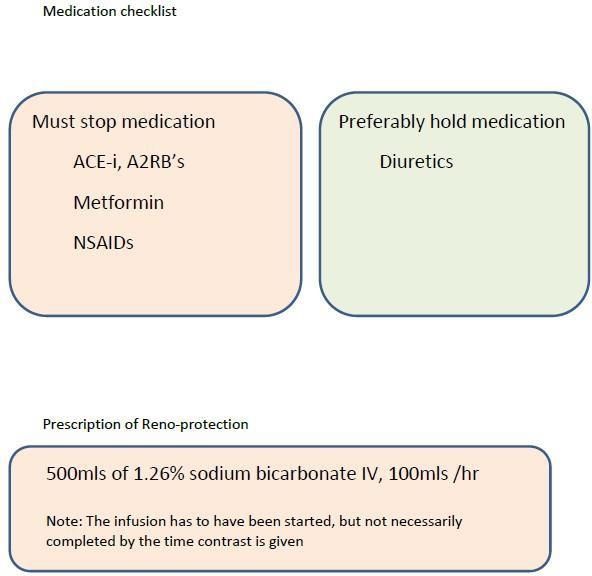
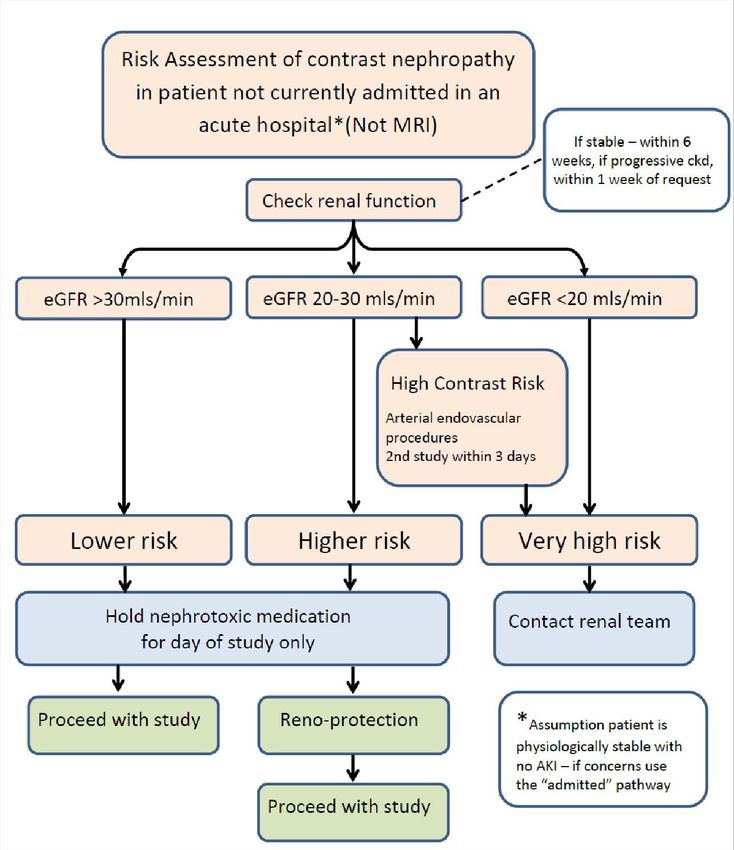
Summary

          Avoiding Contrast Nephropathy Clinical Guideline V3.1
                                 Page 2 of 11
Avoiding Contrast Nephropathy Clinical Guideline V3.1
Page 3 of 11Avoiding Contrast Nephropathy Clinical Guideline V3.1
Page 4 of 111. Aim/Purpose of this Guideline
1.1. This assessment guideline is applicable to any clinician who requests or
performs contrast associated clinical imaging. This includes nurses and doctors at
RCHT and primary care teams who request imaging studies at RCHT.
1.2. This version supersedes any previous versions of this document.
1.3. Data Protection Act 2018 (General Data Protection Regulation – GDPR)
Legislation
The Trust has a duty under the DPA18 to ensure that there is a valid legal basis
to process personal and sensitive data. The legal basis for processing must be
identified and documented before the processing begins. In many cases we may
need consent; this must be explicit, informed and documented. We can’t rely on
Opt out, it must be Opt in.
DPA18 is applicable to all staff; this includes those working as contractors and
providers of services.
For more information about your obligations under the DPA18 please see the
‘information use framework policy’, or contact the Information Governance Team
rch-tr.infogov@nhs.net
2. The Guidance
2.1. Assessing risk factors in adults having iodinated contrast agents
NICE Guidance CG169- Aug 2013
2.1.1. Before offering iodine-based contrast agents to adults for
non-emergency imaging, investigate for chronic kidney disease by measuring
eGFR or by checking an eGFR result obtained within the past 3 months. [2013]
2.1.2. Before offering iodine-based contrast agents to adults for emergency or
non-emergency imaging, assess their risk of acute kidney injury. Be aware that
increased risk is associated with:
chronic kidney disease
diabetes but only with chronic kidney disease
heart failure
renal transplant
age 75 years or over
hypovolaemia
increasing volume of contrast agent
intra-arterial administration of contrast agent.
2.1.3. Ensure that risk assessment does not delay emergency imaging.
2.1.4. Include the risks of developing acute kidney injury in the routine
discussion of risks and benefits of the imaging procedure. Follow the
Avoiding Contrast Nephropathy Clinical Guideline V3.1
Page 5 of 11recommendations on shared decision-making in Patient experience in adult
NHS services (NICE clinical guidance 138).
2.2. Preventing acute kidney injury in adults having iodinated contrast agents
2.2.1. Offer intravenous volume expansion to adults having iodinated contrast
agents if: they are at increased risk of contrast-induced acute kidney injury
because of risk factors in recommendation 1.1.6, or they have an acute illness.
2.2.2. Offer either isotonic sodium bicarbonate or 0.9% sodium chloride.
2.2.3. Consider temporarily stopping ACE inhibitors and ARBs in adults
having iodinated contrast agents if they have chronic kidney disease with an
eGFR < 40 ml/min/1.73 m2.
2.2.4. Discuss care with a nephrology team before offering iodinated contrast
agent to adults with contraindications to intravenous fluids if:
they are at increased risk of contrast-induced acute kidney injury, or
they have an acute illness, or
they are on renal replacement therapy.
3. Monitoring compliance and effectiveness
Element to be Assessment of the risk of contrast nephropathy in patients
monitored having radiological studies. This does not apply to emergency
cases.
The assessment is reviewed by radiology at every request to perform a
contrast study. The only exception is emergency procedures. Failure to
complete the assessment will result in the request being returned to the
requester.
Lead Dr Jon Stratton – for clinical support
Tool The effectiveness of this tool will be demonstrable to the renal team
who will be aware if contrast nephropathy occurs.
An audit of in-patient compliance looking at the adherence to the policy
of repeat blood testing, and the prescription changes should happen
after 6 weeks and, if satisfactory, 1 year.
Frequency Yearly, after its initiation.
If compliance falls, yearly, if compliance holds, it is not necessary to
review the procedure and performance.
Reporting Audit.
arrangements
The primary question will be: Are requesters assessing patients
referred for contrast radiology studies?
This will make up part of the renal audit programme.
Acting on Renal department
recommendations
Avoiding Contrast Nephropathy Clinical Guideline V3.1
Page 6 of 11and Lead(s) Actions will follow as required
Change in This guidance is not changing practice for in patient work. The
practice and guidance however formalises what should be done at present.
lessons to be
shared For out-patient work, this guidance will ensure adequate
assessment. That assessment needs to be completed in real time.
Failure to do so will result in immediate feedback, otherwise the test
will not be performed.
4. Equality and Diversity
4.1. This document complies with the Royal Cornwall Hospitals NHS Trust
service Equality and Diversity statement which can be found in the 'Equality,
Inclusion & Human Rights Policy' or the Equality and Diversity website.
4.2. Equality Impact Assessment
The Initial Equality Impact Assessment Screening Form is at Appendix 2.
Avoiding Contrast Nephropathy Clinical Guideline V3.1
Page 7 of 11Appendix 1. Governance Information
Avoiding Contrast Nephropathy Clinical
Document Title
Guideline V3.1
Date Issued/Approved: 15 May 2020
Date Valid From: May 2020
Date Valid To: 20 March 2023
Directorate / Department responsible
Dr Jon Stratton, Renal Medicine
(author/owner):
Contact details: 01872 252734
This assessment guideline is applicable
to any clinician who requests or performs
contrast associated clinical imaging. This
Brief summary of contents
includes nurses and doctors at RCHT
and primary care teams who request
imaging studies at RCHT.
Suggested Keywords: Contrast, AKI, Prevention, Nephropathy
RCHT CFT KCCG
Target Audience
Executive Director responsible for
Medical Director
Policy:
Date revised: 9 March 2020
This document replaces (exact title of
Avoiding of Contrast Nephropathy
previous version):
Approval route (names of
Renal Governance Meeting
committees)/consultation:
Care Group General Manager
Sharon Matson
confirming approval processes
Name and Post Title of additional
Not Required
signatories
Name and Signature of Care {Original Copy Signed}
Group/Directorate Governance Lead
confirming approval by specialty and
care group management meetings Becky Osborne
Signature of Executive Director giving
{Original Copy Signed}
approval
Publication Location (refer to Policy
on Policies – Approvals and Internet & Intranet Intranet Only
Ratification):
Avoiding Contrast Nephropathy Clinical Guideline V3.1
Page 8 of 11Document Library Folder/Sub Folder Clinical / Renal
Links to key external standards None
Related Documents: NICE CG169
Training Need Identified? No
Version Control Table
Version Changes Made by
Date Summary of Changes
No (Name and Job Title)
14 July
V1.0 Initial version Dr Jon Stratton
2014
14 July
V2.0 Dr Jon Stratton
2017 Re-issue
9 March Full Update. No changes. Transferred onto Dr Jon Stratton,
V3.0
2020 new Trust template. Consultant Nephrologist
15 May Dr Jon Stratton,
V3.1 Route of approval updated.
2020 Consultant Nephrologist
All or part of this document can be released under the Freedom of Information
Act 2000
This document is to be retained for 10 years from the date of expiry.
This document is only valid on the day of printing
Controlled Document
This document has been created following the Royal Cornwall Hospitals NHS Trust
Policy for the Development and Management of Knowledge, Procedural and Web
Documents (The Policy on Policies). It should not be altered in any way without the
express permission of the author or their Line Manager.
Avoiding Contrast Nephropathy Clinical Guideline V3.1
Page 9 of 11Appendix 2. Initial Equality Impact Assessment Form
Name of the strategy / policy /proposal / service function to be assessed
Avoiding Contrast Nephropathy Clinical Guideline V3.1
Directorate and Service area: New or existing document:
Nephrology, Specialty Medicine Existing
Name of individual completing assessment: Telephone:
Dr Jon Stratton, Consultant Nephrologist 01872 252734
1. Policy Aim*
Who is the strategy / To reduce the risk of contrast induces nephropathy to all users of the
policy / proposal / radiology services at RCHT.
service function aimed
at?
2. Policy Objectives*
To reduce the risk of contrast induced nephropathy.
3. Policy – intended
Outcomes* To reduce the risk of contrast induced nephropathy
4. *How will you
Audit
measure the outcome?
5. Who is intended to
Improve safety for the patient
benefit from the policy?
Local External
6a Who did you consult Workforce Patients Other
groups organisations
with
b). Please identify the
groups who have been Nephrology team
consulted about this Renal Governance Meeting
procedure.
What was the outcome This policy is an adaptation of a NICE Guideline
of the consultation? Clear and explicit details will need to be adequately communicated
7. The Impact
Please complete the following table. If you are unsure/don’t know if there is a negative impact you
need to repeat the consultation step.
Are there concerns that the policy could have differential impact on:
Equality Strands: Yes No Unsure Rationale for Assessment / Existing Evidence
Age
Avoiding Contrast Nephropathy Clinical Guideline V3.1
Page 10 of 11Sex (male,
female, trans-gender
/ gender
reassignment)
Race / Ethnic
communities
/groups
Disability -
Learning disability,
physical
impairment, sensory
impairment, mental
health conditions and
some long term
health conditions.
Religion /
other beliefs
Marriage and
Civil partnership
Pregnancy and
maternity
Sexual
Orientation,
Bisexual, Gay,
heterosexual,
Lesbian
You will need to continue to a full Equality Impact Assessment if the following have been
highlighted:
You have ticked “Yes” in any column above and
No consultation or evidence of there being consultation- this excludes any policies which have
been identified as not requiring consultation. or
Major this relates to service redesign or development
8. Please indicate if a full equality analysis is recommended. Yes No
9. If you are not recommending a Full Impact assessment please explain why.
Not indicated
Policy Review Group
Members approving
Date of completion and (PRG)
15 May 2020 screening assessment
submission
APPROVED
This EIA will not be uploaded to the Trust website without the approval of the Policy
Review Group.
A summary of the results will be published on the Trust’s web site.
Avoiding Contrast Nephropathy Clinical Guideline V3.1
Page 11 of 11You can also read


