BCCIS PARENT HANDBOOK OF
EDUCATIONAL POLICIES, PROCESSES AND
           EXPECTATIONS

              2020/21
←
→
Page content transcription
If your browser does not render page correctly, please read the page content below
BCCIS PARENT HANDBOOK OF
EDUCATIONAL POLICIES, PROCESSES AND
EXPECTATIONS
2020/21
Table of Contents
Welcome to the British Columbia Canadian International School-School Philosophy             2
Hours of Operation                                                                          3
Admissions Policy                                                                           4
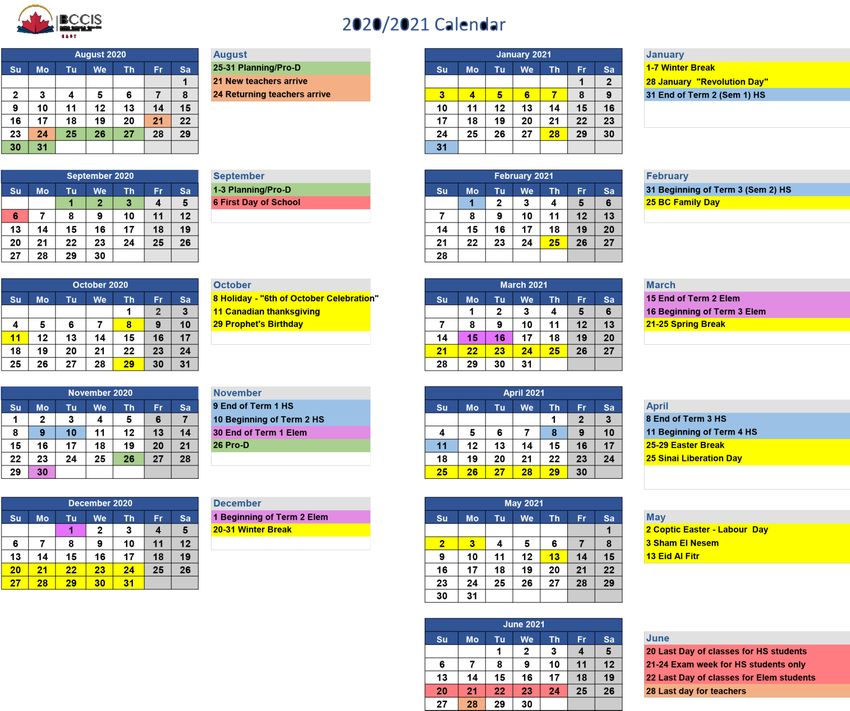
BCCIS Calendar 2020-21                                                                      8
BCCIS Bell Schedule 2020-21                                                                 9
Secondary School Thursday Rotation Schedule                                                10
Assessment                                                                                 11
Honour Roll                                                                                12
B.C. Ministry of Education Course Requirements for Graduation                              13
Behaviour Policy                                                                           14
Attendance and Lates                                                                       15
Appeal Process                                                                             17
School Uniform Policy                                                                      19
Communication                                                                              20
Field Trips, Mosque, Textbook Policy, Extra-Curricular Participation, After School
Activities                                                                                 21
Academic and Personal Honesty                                                              21
Health and Hygiene                                                                         22

                                                    BCCIS Parent Handbook 2020-21 Page 1 of 26
Welcome to the British Columbia Canadian International School
This handbook provides parents a comprehensive description of the educational policies,
procedures and expectations for British Columbia Canadian International School (BCCIS). Please
go through this handbook with your children so everyone becomes familiar with the information.
This is not a complete document as content may be revised and updated as the school year
progresses. Any revisions will be communicated to students and parents at the appropriate time.
School Philosophy
At BCCIS we have three broad goals that guide us as we make decisions with respect to our
school. These goals are:
1. To encourage the pursuit of excellence in all endeavours and the acceptance of
responsibility for the enrichment of oneself and society.
2. To provide students with an exceptional and comprehensive environment in which to
achieve their aspirations and make a positive contribution to the global community.
3. To foster the holistic development of students and to develop a harmonious, updated,
globally connected learning environment that inspires students to envision new possibilities
and empowers them to achieve their aspirations through a partnership of motivated
students, caring staff, and involved parents within a dynamic British Columbia, Canada
educational system.
WE believe that all students can learn to:
▪ be independent
▪ confront and overcome problems
▪ be decision makers
▪ access, analyze, and apply information
▪ use technology to facilitate learning
▪ be active and responsible participants in learning
▪ use every day experiences to achieve their full potential
▪ be dynamic contributors to society
WE believe that all students are entitled to:
1. The highest educational standards that foster intellectual and individual growth.
2. A stimulating, joyful education that embodies internationally respected values qualities.
Our Mission Statement:
Striving for excellence today; preparing students to succeed in a
challenging world tomorrow.
BCCIS Parent Handbook 2020-21 Page 2 of 26HOURS OF OPERATION
Reception desk - Sunday through Thursday from 7:45 a.m. to 2:30 p.m.
Days of Instruction - Sunday through Thursday. The number of days of instruction range between
176-182 days per year depending upon the holidays of the particular year.
Hours of Instruction - 8:00 a.m. to 2:30 p.m. Students are encouraged to be on site 10 minutes
before school begins and need to be seated in their first period class by 8:00.
After school activities will begin at approximately 2:40 and will end no later than 3:40.
School Year - the elementary school year runs on a linear basis and is divided into three terms:
September to mid-November, November to mid-March, and mid-March to the end of June. The
high school runs a combined linear and semester system with first semester running from
September to early February and second semester running from February to June. Four formal
reports are issued throughout the year.
BCCIS Parent Handbook 2020-21 Page 3 of 26BCCIS Student Admissions Policy
The B.C. Ministry of Education School regulates the delivery of the B,C. curriculum to students
who are studying at BCCIS with the purpose of graduating with a B.C. Dogwood Diploma. As a
result, the BCCIS Admissions Policy must reflect the requirements as outlined in the ‘British
Columbia Global Education Operating Manual for Offshore Schools’.
Specifically, with respect to ‘Student Admissions’ the Manual states that:
If the laws of the jurisdiction in which the school operates prohibit students from enrolling
before grade 8, an owner/operator must request approval from the Ministry to allow
students to enter after grade 8. In this case, student may not begin the program after grade
10. They must also be provided English language learner supports to enable success in the
program.
Students who have previously been instruction in English on a full-time basis may be
admitted after grade 8, provided that they have met all English language requirements as
identified under English Language Skills …
With respect to ‘English Language Skills’ the Manual states that:
Students in B.C.- certified offshore schools are required to have a minimum level of English
language skills to meet B.C. curriculum standards.
Students starting after Grade 7 must have an English language assessment before they
can be admitted to the B.C. education program. The assessment must be administered by
the principal or the principal must directly supervise a B.C.- certified teacher in
administering the assessment. If a student does not meet the English language
requirements for entry into the B.C. program (after Grade 7), the owner/operator must
ensure that the student receives the necessary English language learning support.
Language assessment results and language learning supports must be included in the
permanent student record. The assessment results and admission decision must be signed
off by the principal. This information will be reviewed as part of the ministry’s inspection
process.
BCCIS Admissions is open to applicants at grade levels beginning at early childhood to Grade 12
depending a number of factors including:
student assessment and social, emotional, developmental and academic readiness for the
desired grade level;
the availability of space at a specific grade level and the consideration of class size and
composition
the ability of the school to meet special learning needs
the ability of the parent/guardian to pay student fees
the enrollment of siblings at BCCIS
previous English education
previous BC or Canadian education
probability of attaining required course credits to meet the BC graduation requirements.
BCCIS Parent Handbook 2020-21 Page 4 of 26Admissions Process
Action When Who
Parent(s) complete the application form December until Parent
on the BCCIS website Admissions cut-off
date
Parents(s) schedule an orientation Immediately Parent
session, tour, interview, and assessment following
on line through the school website submission of
application
Parent(s) emails the completed January until Admissions
application form to admissions@bccis.ca Admissions cut-off Reception
for processing date
Parent(s) receive a scheduled orientation As soon as Admissions
and tour of the facilities possible following
the reception of
the application
Parent interview appointment scheduled Following Admissions
orientation
Parent (s) pay assessment fees On the scheduled Admissions
appointment date Finance
Pre/KG1 assessments are administered Ongoing as Admissions
required ECE Director
KG2 to Grade 10 Math, reading Ongoing as Admissions
comprehension and composition, writing required Education Admin
assessments are administered
Individual student interview/academic
assessment files are reviewed and Ongoing as Education Admin
approved/not approved by the Principal required
or Vice Principals
Graduation Program course equivalency
determined by Principal or Secondary Ongoing as Education Admin
required
BCCIS Parent Handbook 2020-21 Page 5 of 26Vice Principal as per the ' Course
Equivalency Policy'
Parents are notified of the assessment
results through a direct phone call and/or Upon review and Admissions
email. acceptance by
Principal or VP
An ‘Acceptance Letter’ is issued to the
parents of successful applicants.
Parent(s) sign the ‘Student Behaviour – After acceptance Admissions
Code of Conduct’ policy form decision has been
made
Parent(s) complete the Transportation After acceptance Transportation
Inquiry document the transportation decision has been Department
dept. made
Parent(s) sign Tuition Fees After acceptance Admissions
acknowledgement to Finance decision has been
Department made
Parents meet with Finance Department to After acceptance Finance Dept.
receive the bill and installments decision has been
made
Registration and bus seat reservation After acceptance Finance Dept.
fees to be paid within 3-5 working days decision has been
after acceptance. made
Parent meets with Student Affairs Office After acceptance
to submit and complete the required decision has been Student Affairs
documents: made
- completed application form
- pictures
- e-birth certificate
- report cards from previous 2 years
- coloured copy of passport
- behaviour certificate
- transfer forms
- parent(s) ID
BCCIS Parent Handbook 2020-21 Page 6 of 26The Admissions process is completed
upon fulfillment of all of the above steps Prior to the end of
and the student is timetabled into the the school year Education Admin
appropriate grade/courses/support.
Screening, Assessment and Acceptance of New Students
As stated above, the B.C. Ministry of Education Global Education – Offshore Schools Operating
Manual requires that assessment and/or review of new students at all grade levels take place to
ensure appropriate program and grade placement and the identification of student support at all
grade levels.
In addition to a file review of previous school history, the BCCIS Admission Process involves
assessment in:
English language proficiency
numeracy
functional behavior
Specific tests in these areas will be identified and reviewed as needed by BCCIS education staff.
Implementation will be in collaboration with the Head of Admissions.
Guidelines for Admitting Students:
1. Assessment is not required for new students arriving from:
a. Schools in Canada
b. Canadian schools in Egypt
c. Canadian schools in any other country
2. Returning students who have left BCCIS for one academic year or less will not be
required to do an assessment.
3. Students who are enrolling in Pre-K, KG1 and KG2 will have an initial assessment and
then go through a planned classroom observation with the Director of Early Childhood
Education prior to admission.
Note :The above is based upon the verification and review of report cards and other
documentation for the previous 2 years by the Principal or Vice Principal. If learning
or behavioral questions occur as a result of the review, assessment may be
required.
4. Applications of students to the Graduation Program (Grades 10 – 12) will considered as
follows:
a. Students who apply for Grade 10 prior to the beginning of the school year may be
accepted but not during the school year;
BCCIS Parent Handbook 2020-21 Page 7 of 26b. Students who apply for Grade 11 or Grade 12 will not be accepted unless they come
from a Canadian school. Acceptance is based upon the verification and review of
report cards and other documentation for the previous 2 years by the Principal or
Vice Principal;
c. Student course credits will be examined in view of the ‘BCCIS Course Equivalency
Policy’ to ascertain grade placement with respect to graduation on the Dogwood
program.
Note: Assessments may take place during the summer months but acceptance will
not take place until the Principal or Vice Principal is available.
5. Acceptance of new student is dependent on available space. The class size guidelines are
as follows:
Pre-K 12 students per class
KG1 16 students per class
KG2 18 students per class
Grades 1 - 3 22 students per class
Grades 4 - 12 25 students per class
6. Students who are dismissed from BCCIS due to lack of effort or poor behaviour will be
considered for re-enrolment only if reviewed by the Principal
BCCIS Parent Handbook 2020-21 Page 8 of 26BCCIS Calendar 2020-2021
BCCIS Parent Handbook 2020-21 Page 9 of 26BCCIS Bell Schedule 2020-21
ECE Schedule (Prek-KG1)
Elementary Schedule (KG2-Gr.7)
Secondary Schedule (Gr.8-Gr.12)
Period Time
1st Period 8:00 – 9:23
Recess 9:23 – 9:43
2nd Period 9:43 – 11:08
3rd Period 11:13 – 12:35
Lunch 12:35 – 1:05
4th Period 1:05 – 2:30
BCCIS Parent Handbook 2020-21 Page 10 of 26Thursday Rotation (HS only)
(Sunday - Day 1, Monday - Day 2, Tuesday – Day 1, Wednesday – Day 2)
HS THURSDAY SCHEDULE HS THURSDAY SCHEDULE
DAY 1 DAY 2
September 3 September 10
September 17 October 1
October 15 October 22
November 5 November 12
November 19 December 3
December 10 December 17
January 14 January 21
January 28 February 4
February 11 February 18
March 4 March 11
March 18 April 1
April 8 April 15
April 22 May 6
May 20 May 27
June 3 June 10
June 17
BCCIS Parent Handbook 2020-21 Page 11 of 26ASSESSMENT
At the primary level, updates will be sent home at the end of each month. These updates will give
you information about how your child is doing as well as information regarding what the students
will be learning for the next month. In addition, teachers will keep you up to date with what is
happening in the class on a weekly basis.
Report Cards
Primary – KG2 to Grade 7
Parents of students in KG2 will receive two formal report cards each year. Parents of students in
grades 1 through grade 3 will receive three formal report cards each year (the middle of
November, in February, April and at the end of the year). Parent/Teacher and
Parent/Student/Teacher conferences will be held prior to the report card in both October and in
March. Report cards will include comments in relation to:
▪ What the student is able to do.
▪ Areas in which the student requires further attention or development.
▪ Ways of supporting the student in his or her learning.
▪ Information about student behaviour, attitude, work habits, effort and social responsibility
The primary report card indicates the student’s level of performance in relation to the
Competencies set out in the B.C. curriculum for each subject and grade. For Kindergarten,
performance is described in terms of Approaching expectations, Meeting Expectations or
Exceeding Expectations and for Grades 1, 2, and 3 performance is described in terms of Not Yet
Meeting Expectations, Approaching expectations, Meeting Expectations or Exceeding
Expectations.
Intermediate and Secondary Report Cards Grades 4 to 12
Intermediate students (grades 4-7) will receive 3 report cards throughout the year and secondary
students (grades 8-12) will receive 4 report cards throughout the year (November, February, April
and June) with parent conferences prior to the November and April reporting periods. Grades in
Grades 4 – 12 indicate the student’s level of performance in relation to the Competencies set out
in the B.C. curriculum. Both letter grades and percentages appear on Secondary report cards.
Letter Percentage Range % Notes
Grade
The student demonstrates excellent or
outstanding performance in relation to
A 86 – 100
expected learning outcomes for the course
or subject and grade.
B 73 – 85 very good performance
C+ 67 – 72 good performance
C 60 – 66 satisfactory performance
C- 50 – 59 minimally acceptable performance
(In Progress or Incomplete)
I not demonstrating minimally acceptable
performance
has not demonstrated, or is not
F 0 -49 demonstrating
minimally acceptable performance
BCCIS Parent Handbook 2020-21 Page 12 of 26Honour Roll and B.C Principal’s Honour Roll
Grade Point Averages (GPA) are calculated as follows:
▪ A = 4 points
▪ B = 3 points
▪ C+= 2.5 points
▪ C = 2 points
▪ C- = 1.5 points
▪ F = 0 points
Honour Roll/Academic Excellence
Middle/Secondary Grades
Students in Grades 6 & 7 will receive a certificate for Excellent Academic Achievement based on
the 4 core academic subjects of ELA. Math, Science, and Socials, with a 3.0 GPA in all assessed
curricular competencies.
Students in grades 8 - 12 having a 3.0 GPA or better in all BC subjects will be awarded an Honour
Roll certificate. Certificates will be awarded each term and for the final mark of the year. An
incomplete mark in any subject prevents the awarding of an honour roll certificate.
B.C Principal’s Honour Roll
Middle/Secondary Grades
Grade 8 - 12 students who maintain a 4.0 GPA in all BC subjects will be awarded the Principal’s
Honour Roll. These certificates will be awarded each term and for the final mark of the year. An
incomplete mark in any subject prevents the awarding of a Principal’s Honour Roll Certificate.
Student Support Services
Connections
As an inclusive school, BCCIS serves the academic and socio-emotional needs of all learners. To
ensure every student is able to reach their full potential, we have developed a Connections
department that offers academic and behavioural supports in and out of the classroom. Our
model of intervention provides clear guidelines to teachers when they are experiencing challenges
with students in the classroom setting.
School Based Team
The SBT is made up of both Connections Department teachers, HS and ELE Academic
Counsellors, and all three Educational Administrators. Teachers are encouraged to bring forward
the names of students that are struggling in their classes for a variety of reasons through this
forum. Weekly meetings are held to discuss strategies and solutions in order to best serve the
needs of the student and the teacher.
Shadow Teachers
In the rare event that a student still cannot be successful after SBT intervention and Connections
supports, parents may be required to hire a Shadow Teacher in order to allow their child to
experience success in the classroom.
BCCIS Parent Handbook 2020-21 Page 13 of 26B.C. Ministry of Education Course Requirements for Graduation
The Graduation Program at BCCIS is administered through the British Columbia Ministry of
Education. In order for students to graduate with a Dogwood Diploma, each student must pass
compulsory core subjects as well as complete a minimum number of optional elective subjects as
outlined here.
Students require a minimum of 80 credits to graduate.
Of these 80 credits:
● At least 16 credits must be at the Grade 12 level, including a required Language Arts 12
● At least 28 credits must be elective course credits
● 52 credits are required from the following:
● Career-Life Education (4 credits), and Career-Life Connections (4 credits)
● Physical and Health Education 10 (4 credits)
● Science 10 (4 credits), and a Science 11 or 12 (4 credits)
● Social Studies 10 (4 credits), and a Social Studies 11 or 12 (4 credits)
● A Math 10 (4 credits), and a Math 11 or 12 (4 credits)
● A Language Arts 10, 11 and a required 12 (12 credits total)
● An Arts Education 10, 11, or 12 and/or an Applied Design, Skills, and Technologies
10, 11, or 12 (4 credits total)
In addition, students must also complete three new graduation assessments:
● The new Grade 10 Graduation Numeracy Assessment was introduced in 2018
● The new Grade 10 Graduation Literacy Assessment will be introduced in 2019/20
● The New Grade 12 Graduation Literacy Assessment will be introduced in 2020/21
Electives
Students must complete a minimum of 28 elective credits. These 28 credits may be from Ministry-
authorized or Board/Authority Authorized (BAA) courses, post-secondary courses or external
credentials, but not Locally Developed courses. Once the credits for required courses have been
met, additional courses in that subject area count as elective credits.
Egyptian National Students must successfully complete Arabic through grade 12 along with five
grade 12 courses (Capstone not included) in order to be eligible for entrance to University in
Egypt.
BCCIS Parent Handbook 2020-21 Page 14 of 26Behaviour Policy
The BCCIS Board believes that the school must provide students with a safe environment for
purposeful learning. The Board recognizes that appropriate student behaviour, which is based on
respect for oneself, for others and for private and public property is essential to the development of
responsible global citizens. Appropriate behaviour is a shared responsibility among students, their
parents and the school staff. This policy and regulation emphasizes a positive approach to student
behaviour and a progressive, developmental, preventative and restorative approach to student
discipline.
The Board believes that, pursuant to the BC School Act, the BC Human Rights Act, the Canadian
Charter of Rights and Freedoms and Egyptian law, students have certain rights and
responsibilities.
BCCIS CODE OF CONDUCT
Fighting of any kind including play fighting is not allowed at BCCIS or any school
sponsored events. Infractions will result in suspension.
STUDENTS HAVE THE RESPONSIBILITY
STUDENTS HAVE THE RIGHT TO
TO
Learn in an orderly environment free from Arrive on time and attend all classes, be
unnecessary interruptions or delays prepared with appropriate learning tools,
work to the best of ability and exhibit a
positive attitude towards learning.
Live and work in an atmosphere of mutual Be truthful and honest, take responsibility for
respect and courtesy own actions, show respect to students,
parents, teachers and to our school.
Be safe and secure from threatening and Be involved in positive conflict resolution,
abusive behavior respect and support, the health and safety of
others
Live and learn in an atmosphere free of Conduct themselves in a manner worthy of
foul language, harassment and respect of others
discrimination
Live and learn in a school environment Recognize that vandalism of school facilities
that is free from vandalism and litter is a crime against our school community and
it will be treated as such.
Privacy and security of personal space Respect and support the rights of others and
their property
Be informed of the standard of behavior Learn about the standard of behavior and
expected of them and the consequences accept fair and logical consequences for
of misbehavior misbehavior.
The BCCIS Board expects that students will comply with rules, policies and regulations
established by the Board and the school. The Board also expects that students and their parents
will act respectfully and with due regard to the authority and responsibility vested in school
employees
BCCIS Parent Handbook 2020-21 Page 15 of 26The BCCIS Code of Conduct
The BCCIS Code of School Conduct will be clearly communicated annually to students and
parents/guardians and taught and reinforced at appropriate times throughout the school year.
This Code of Conduct will apply to students while:
▪ attending school
▪ travelling to and from school
▪ attending a function and/or program organized or sponsored by a school
▪ on BCCIS property
The standard of discipline applied to students shall be kind, firm and judicious but shall not include
corporal punishment. Consequences will be logical, fair, consistent, and, when possible, carried
out immediately. This student disciplinary action shall consider the developmental and unique
needs of students and will not discriminate on the basis of gender, race, colour, ethnic or national
origin, language, or religion, except as required to take into appropriate consideration all of the
relevant circumstances.
The BCCIS Board supports a continuum of discipline that may, in some cases, includes in-school
and out-of-school suspensions and loss of the privilege to attend BCCIS when a student has
refused to comply with:
▪ the school rules authorized by the principal
▪ the Code of School Conduct
▪ the requirement to apply oneself to a satisfactory level of work and achievement
Implementation of the BCCIS Code of Conduct
We believe that most students demonstrate appropriate behaviour most of the time. When,
however, a student displays unacceptable conduct, consequences will be implemented based
upon the severity and frequency of the behavior.
Prior to the beginning of the 2020 – 2021 school year individual classroom teachers will
develop a classroom management plan that will be based on the concepts of the Code of
Conduct. These plans will be taught to students and communicated to parents.
ATTENDANCE AND LATES
The policy at BCCIS is to assist students in maintaining regular attendance in order to provide the
maximum opportunity for learning. Regular and punctual attendance in all classes is therefore
required of BCCIS students as a condition of enrollment at our school. Research shows a strong
correlation between poor attendance and lower academic achievement and we find it difficult to
assist a student who does not attend regularly. Attendance and punctuality policy implementation
are the shared responsibility of the student, the parent, the staff and the administration.
Attendance Procedures
▪ It is expected that students will attend every class of every school day and that teachers will
keep a record of absences and tardiness.
▪ It is the responsibility of the parents to inform the school in advance if the student will be
away.
▪ Make-up work will be required for absences and it is the student's responsibility to check
with the teacher to acquire and complete the required make-up work.
▪ It is the responsibility of the student to provide to the school parental/guardian verification of
absence within a day of the absence.
BCCIS Parent Handbook 2020-21 Page 16 of 26▪ If a student has to leave school prior to the end of the day, he/she is to check out at the
front desk after checking with his/her teacher for homework.
▪ Students who are absent from their scheduled classes on the day of a co-curricular activity
(i.e. athletics, etc.) shall not be allowed to participate in that activity. Exceptions will be
made for verified doctor or dental appointments or where prior approval is obtained through
the administration.
▪ Absences will be classified as Excused or Unexcused
An Excused Absence
An excused absence is an absence that involves parent or school consent.
An Unexcused Absence
An unexcused absence is an absence that occurs without valid parental or school consent and
normally to be treated as a truancy.
Absence – Prior Arrangement
BCCIS strongly discourages students from taking vacations during the school year, especially
during exam periods. Students who miss classes lose essential instruction and place increased
demands on their teachers and classmates. When planning for an absence, parents and students
must understand that teachers cannot possibly, in all cases, pre-teach the lessons, nor provide
make-up assignments to cover all the material that will be missed.
Chronic Absences
Chronic absences will be referred to the Vice Principal and will result in a student/Parent/ Vice
Principal Conference. Absences, whether daily or by class, of 10 or more, shall place a student ‘at
risk’ and may result in one or more of the following:
▪ required to attend an after school or make-up session
▪ placed on an attendance contract
▪ forfeit his/her right to sit the final examination in the course concerned; or
▪ lose credit for a course that does not have a final examination; or
▪ be asked to withdraw from the school
Late Procedures
It is expected that all students will be at school and in class on time. Students who are late disrupt
teacher lessons and negatively impact student learning. Please carefully read the following
policy/process regarding lates.
Late to School in the Morning
This is a significant change and it is important that you discuss this at home. In an attempt to
greatly reduce the number of students arriving late for school the following policy has been
created:
▪ All students arriving after 8 am will have to enter through the main gate and sign in.
▪ A student is allowed 4 unexcused lates. On the 5 th late the student will not be admitted
and will have to return home. The student needs to return the next day WITH a parent to
discuss a plan to get to school on time. The student is responsible for any missed work.
▪ If these 4 days are exceeded a second time then and same process happens AND the
student is asked to attend 5 after school sessions (2:30-3:30).
▪ An excused absence includes a medical appointment (note required), illness, family
emergency or pre-arranged event (picking someone up at the airport). Sleeping in, slow
annoying little brothers and sisters, bad traffic, etc. are NOT excused absences.
BCCIS Parent Handbook 2020-21 Page 17 of 26▪ Parents must call the school reception if their child will leave the school early for
whatever reason. Only calls from a recognized number will be accepted. All numbers
must be on file with BCCIS for verification. An email will no longer be accepted.
▪ Students are responsible for meeting with teachers during the break times before
leaving to find out any work they will be missing.
Late to Class
Arriving late to a class means missing out on valuable instructional time. It creates a disturbance
to the classroom and quite often the school in general. In order to encourage students to arrive on
time a policy has been developed.
Teachers will deal with students who are late for class. Consequences might include the following:
student conference, lunch detention, parent phone call, counsellor referral, VP referral, parent
meeting with administration or behaviour contract if the problem is chronic.
Leaving School during the day
▪ If a student has to leave school during the school day, parents must phone the school and
make a request expressing the time of the departure
▪ The student should speak to all their teachers prior to leaving.
▪ If a student needs to leave the school due to illness, she/he should visit the school doctor
who will diagnose the student and contact the parent and the principal or head of
Administration if the student needs to go home.
Appeal Process
Preamble
BCCIS seeks to resolve complaints and disputes as close as possible to their point of origin, with
minimum of formality and in a way that a neutral and reasonable observer would find reasonable
in all circumstances. Escalation to a formal appeal should not occur until all other avenues have
been thoroughly explored.
Where a parent/guardian and/or student disagrees with a major academic, safety or discipline
decision and wishes to appeal this decision, the parent/guardian and/or student must have access
to an unbiased review of the decision.
A parent/guardian and/or student in the School may appeal a decision of an employee or
employees if that decision significantly affects the education, health or safety of the student.
The Process prior to a formal appeal
Before an appeal is brought to the owner/operator, the parent/guardian and/or student shall
discuss the decision under appeal with the teachers involved. These discussions should be
focused on ways to resolve the conflict, or to allow both parties to reach an agreement.
Where practicable, there shall be an expectation that each step in the sequence of discussions will
take no more than three working days, but this may be waived by formal agreement of both
parties. The discussions would normally occur in the following sequence:
▪ Step 1: The parent/guardian and/or student will meet with the teacher(s) involved with the
decision. If there is no resolution;
▪ Step 2: The parent/guardian and/or student will meet with the Vice-Principal. If there is not
resolution;
▪ Step 3: The parent/guardian and/or student will meet with the Principal and appropriate
staff member(s). If there is no resolution;
BCCIS Parent Handbook 2020-21 Page 18 of 26▪ Step 4: The parent/guardian and/or student will meet with the Superintendent and
appropriate staff member(s). If there is not resolution;
▪ Step 5: The parent/guardian and/or student may give written notice of appeal to the
owner/operator.
The process of the formal appeal
The appeal shall state:
▪ The name and address of the student and/or parent/guardian bringing the appeal;
▪ The decision which is being appealed and the date the student and/or parent/guardian was
informed of the decision;
▪ The name of the employee(s) who made the decision being appealed;
▪ The grounds for the appeal or the area of difference and the solution or relief sought;
▪ The steps that the student and/or parent/guardian have taken to attempt to resolve the
matter directly with the employee(s) involved.
The owner/operator reviews all cases where the parent/guardian and/or student disagree with a
decision that affects their standing in the school. The owner/operator provides a non-biased
second look at the decision and will review the evidence considered and procedures used to make
the decision. Among the things to be considered are the following:
▪ Was the decision biased in any way?
▪ Were the policies and procedures of BCCIS Canada followed correctly?
▪ Was all available evidence considered?
▪ Are the consequences to the student reasonable and consistent with other similar
situations?
▪ Are there any mitigating circumstances to consider?
If the decision of the Owner/operator varies from the original decision, the reasons for the variance
must be clearly outlined in the written decision and any recommendations for procedural changes
should be directed to the Principal. The report should provide the parent/guardian and/or student
with a concise but complete statement of reasons for the decision at the time the decision is
handed down.
Hearings
Hearings are to be conducted in a professional manner while according courtesy, respect and
consideration to all participants. Hearings are to be conducted in camera with no electronic
recording devices permitted. The owner/operator shall remind the hearing that the academic,
safety or discipline issue at hand concerns a decision made by the School, not by an employee.
Accordingly, there is no place in the hearing for personalizing the matter to any individual.
At the hearing, the owner/operator will consider written and oral submissions from the parties
involved in the dispute. The parent/guardian and/or student is expected to be his or her own
spokesperson. In case where may be extenuating circumstances that compromise the
parent/guardian and/or student ability as spokesperson, a written request for an alternative
spokesperson may be made.
The employee will be afforded the opportunity to provide the employee with a written response to
the appeal.
BCCIS Parent Handbook 2020-21 Page 19 of 26Appeal Timeline
The decision of the owner/operator shall be final and shall be promptly conveyed, in writing, to the
student and/or parent/guardian bringing the appeal as well as to the employee whose decision
was appealed. In the have a right to have their concerns dealt with quickly and without undue
delay. The timeline provided here outlines the maximum length of time it should take for the
appellant to receive a decision.
Within ten business days of receiving the request for appeal, it shall be considered.
The decision of the owner/operator
Shall be final and shall be promptly conveyed, (within 7 days of the Hearing) in writing, to the
student and/or parent/guardian bringing the appeal as well as to the employee whose decision
was appealed.
The owner/operator may refuse to hear an appeal where the appeal has not been commenced
within one week from the date on which the student/parent/guardian became aware of the
decision; or the student and/or parent/guardian has refused or neglected to discuss the decision
under appeal with person(s) directed by the owner/operator or his/her designate; or the decision
does not significantly affect the education, health or safety of the student.
School Uniform Policy
BCCIS requires all students to wear the approved school uniform. It is the parent’s responsibility
to ensure that student complies with the following:
▪ pants, shirts, shorts, skirts, and jumpers will be red white, beige or black and must be the
official uniform as described and shown in the BCCIS Uniform Flyer. No substitutes are
permitted.
▪ uniforms must be clean and worn neatly.
▪ undershirts must be plain white with no print and must cover the stomach.
▪ sneakers are the preferred footwear and flip-flops, high heels or “roller” shoes with wheels
are NOT acceptable. Socks must be worn.
▪ the uniform is to be worn as it is designed with pants and shorts at the waist level.
▪ hair is to be kept neat and tidy.
▪ with the exception of ‘theme’ days as determined by the administration, the school uniform
must be worn at school and all school related functions, including field trips.
If a student does not meet the uniform requirements when he/she arrives at school, he/she will not
be allowed to attend classes. Parents will be required to supply a uniform and, if the parents are
unable to do so, the student will wait in the Consequence Room to be picked up and taken home.
If this becomes a pattern of behaviour a parent meeting will be arranged to discuss the issue.
BCCIS Parent Handbook 2020-21 Page 20 of 26Communication
Parents, students, teachers and administration need to work together as partners to ensure
ongoing and positive communication. At BCCIS we have a number of ways to ensure that this
occurs.
Visiting the School
If you wish to visit someone at the school the best way to ensure that the person is available at a
specific date and time is to book an appointment under the ‘Parent’ tab on our website.
Please note that when you do come to BCCIS for your appointment you will need to sign in and
receive a visitor’s pass from the security office at the front entrance of the school. From there you
will report to the front desk so that they can assist you in connecting with the person you wish to
see.
PowerSchool
Parents with students in Grades KG2 through 12 will be able to access information about their
child’s performance, attendance and behaviour through the PowerSchool access on our website
which is www.bccis.ca
Email
All staff members have a school email address that may be found at www.bccis.ca. This is
probably the best means of ongoing, regular contact with your child’s teacher and/or other school
personnel.
Parent Teacher Conferences
Parent-Teacher conferences will occur before the end of the first and second term for primary and
intermediate students, and first and third term for secondary students. These conferences are
important in that they supply an opportunity to meet your child’s teacher in a face-to-face situation.
Additional conferences can be scheduled as needed throughout the year when necessary.
Parent Advisory Committee
The purpose of the Parent Advisory Committee shall be to support education and to contribute to a
sense of school community at the British Columbia Canadian International School in Cairo.
Objectives
To advise the School Principal and staff on parental views with regard to school programs,
policies and activities.
To communicate with parents, and to promote and enhance cooperation between the home
and school in providing for the education of students attending BCCIS.
To assist parents with accessing the system, and to advocate on behalf of students and
parents.
To create equal opportunity for all students attending BCCIS.
To contribute to the effectiveness of the school by promoting the involvement of parents
and other community members.
For more information please contact Ms Dina Mourad
BCCIS Parent Handbook 2020-21 Page 21 of 26Homework
Regular homework at the middle and secondary levels helps to develop self-discipline, study
habits, reading skills and the ability to complete assignments independently. It is a good
opportunity for students to review what they learned at school and practice skills. It is also an
excellent opportunity for parents to inquire as to what their child is doing in school. Homework for
primary students should be limited to daily reading for pleasure at home with parents.
Field Trips
Field trips are designed to enrich classroom learning as teacher-organized field trips are
curriculum related. All of our BCCIS field trips go through an application process and are fully
supervised to ensure the safety of our students. Written parent/guardian consent is required via
the ‘Parent Consent Form’.
Please note that some students may be refused the opportunity to participate in a field trip if there
is a behavioral or an academic issue. Students who are denied participation may expect a refund
equal to the amount of money the school is able to have returned on their behalf.
Mosque
Students have the opportunity to visit the Mosque for prayer during free time but not during
instructional time. It is important to note that shoes must be removed before entering and that the
Mosque should be left clean after use.
Textbook Policy
BCCIS will furnish each student with British Columbia authorized textbooks at no extra cost. It is
the responsibility of each student to ensure that the textbooks issued to them are not lost or
damaged. Students will be charged the cost of replacement for lost or books that are damaged
beyond repair. Please note that student report cards will be held by the school until the costs have
been paid.
Extra-Curricular Participation
BCCIS understands the importance of extracurricular activities and participation by all students is
encouraged. Criteria for participation in extracurricular activities include:
▪ demonstrating consistent effort in all classes; completing and turning in assignments
▪ demonstrating respect and responsibility in class, in the school and in the community;
▪ demonstrating good sportsmanship at all times.
Subject and classroom teachers will be consulted with regards to a student’s performance with
respect to the above criteria. If the criteria are not met but a student demonstrates significant
improvement, the student may be allowed to participate on a probationary or week-to-week status.
After School Activities
Each year we plan after school activities two days a week that are based on the interests of our
students and the skill sets of our staff. Information regarding the activities and sign up forms will be
sent home for students and parents to peruse and make decisions as to which to be involved.
BCCIS Parent Handbook 2020-21 Page 22 of 26Academic and Personal Honesty
Academic honesty is expected of all students at BCCIS. Each student is responsible to practice
high standards of academic honesty, personal honesty, and moral character. Dishonest academic
behaviour will be dealt with fairly and firmly. Academic dishonesty is defined to include, but is not
limited to, cheating, representing others’ work as one's own work (plagiarism), lying, inappropriate
collaboration, dishonesty in examinations or the writing of papers, interfering with other students'
work, dishonesty in producing homework, deliberately falsifying data and copyright violations.
BCCIS Parent Handbook 2020-21 Page 23 of 26Health and Hygiene
PERSONAL MEASURES
1. Stay Home When Sick
All students and staff who have symptoms of COVID-19, OR travelled outside Egypt in
the last 14 days, OR were identified as a close contact of a confirmed case or outbreak
must stay home and self-isolate, including children of essential service workers who are
ill.
Parents and caregivers must assess their child daily for symptoms of common cold,
influenza, COVID-19, or other infectious respiratory disease before sending them to
school.
Staff must assess themselves daily for symptoms of common cold, influenza, or COVID-
19 prior to entering the school. School Administrators must ensure school staff are aware
of their responsibility to assess themselves daily for symptoms of common cold,
influenza, COVID-19 or other infectious respiratory disease prior to entering the school.
School Administrators must develop a local protocol that: - Clearly communicates with
parents and caregivers their responsibility to assess their children daily before sending
them to school. - Establishes appropriate conduct and process for school drop-off and
pick-up. - Establish procedures for students and staff who become sick while at school to
be sent home as soon as possible.
Staff and students who are ill, including children of essential service workers, should not
be permitted to attend school (Note: Students and employees should stay home until
deemed healthy to return).
2. Hand Hygiene
Rigorous hand washing with plain soap and water is the most effective way to reduce the spread
of illness. Both students and staff can pick up and spread germs easily, from objects, surfaces,
food and people. Everyone should practice diligent hand hygiene. Parents, caregivers and staff
can teach and reinforce these practices amongst students. How to practice diligent hand hygiene:
Wash hands with plain soap and water for at least 20 seconds. Antibacterial soap is not
needed for COVID-19.
If sinks are not available (e.g., students and staff are outdoors), use alcohol-based hand
rub containing at least 60% alcohol.
If hands are visibly soiled, alcohol-based hand rub may not be effective at eliminating
respiratory viruses. Soap and water are preferred when hands are visibly dirty.
To learn about how to perform hand hygiene, please refer to the BCCDC’s hand washing
poster. Strategies to ensure diligent hand hygiene:
Hand hygiene stations should be set up at the school entrance, so everyone can perform
hand hygiene when they enter and throughout the day (e.g. placing alcohol-based hand
rub dispensers at the front entrance; put up posters to promote the importance of regular
hand washing).
Regularly remind staff and students about the importance of diligent hand hygiene.
Incorporate additional hand hygiene opportunities into the daily schedule.
BCCIS Parent Handbook 2020-21 Page 24 of 263. Respiratory Etiquette
Students and staff should:
Cough and sneeze into their elbow, sleeve, or a tissue. Throw away used tissues and
immediately perform hand hygiene.
Refrain from touching their eyes, nose or mouth with unwashed hands.
Refrain from sharing any food, drinks, unwashed utensils.
Cloth or homemade masks are not recommended, particularly for children. There is limited
evidence outside of health care settings and only in uncontrolled situations where physical
distancing between adults cannot be maintained for extended periods of time (greater than 15
minutes with a person who has probable or lab confirmed COVID-19). Wearing a mask will be
required as deemed necessary by health authorities. It is important to treat people wearing masks
with respect. Parents, caregivers and staff can teach and reinforce these practices amongst
students.
BCCIS Parent Handbook 2020-21 Page 25 of 26You can also read


