Best Practices 2018 - Valia College
←
→
Page content transcription
If your browser does not render page correctly, please read the page content below
Best Practices
         2018 - 19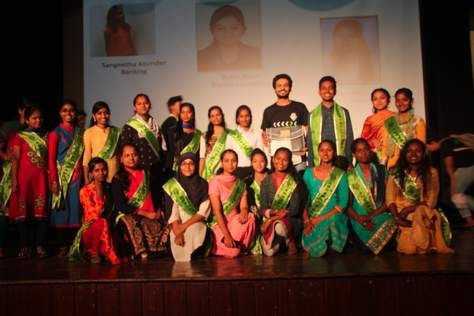
Best Practices 2018-19

                                 Name of the Practice:
        Life Skills Training Programme in Association with external agencies

                                                                                     Goal:
                  The goal was to empower students with employment specific skills

                             Collaboration with Antarang

Context:
  Youth in India are struggling to find a job even after completing education and getting
  a degree. This is especially difficult for disadvantaged youth who end up taking up
  low paying jobs so that they can support their basic needs. Also, the youth have
  limited knowledge of the career options that they have and also about the skill set
  that they require for better employment. The Department of Commerce collaborated
  with Antarang Foundation to address this issue of students being under-skilled for
  employability even after acquiring their graduation degree

                                                                                             1
Best Practices 2018-19

About Antarang:
  Antarang Foundation is a Mumbai based NGO with a primary goal of bridging the gap
  between Education and Employability for youth. Through their structured program–
  CareerReady Employability Skills Program. Antarang guides youth on career choice,
  trains them in core employability skills, connects them to employment opportunities
  of their choice and continues to mentor them through a network of mentors until they
  integrate well into careers of their choice.

Primary Objective of the CareerReady Employability Skills Program
   The primary objectives of the Program are:
   - To help youth identify their strengths and link it up to a suitable career choice
   - Helping student get ready for job interviews
   - Exposure to various forms of employment opportunities
   - Connecting them with potential employers

Collaborating with Antarang at Valia
  In Valia College, the program started with Antarang conducting program orientation
  sessions for Third Year B.Com students with regards to the benefits, the need, the
  commitment expected from students etc. After which interested students enrolled for
  the programme. For the first batch that started in the month of July and went on till
  September, 30 students were shortlisted of which 24 students successfully completed
  the program.
  Due to the positive feedback from the first batch and considering the demand for the
  program, a second batch was started in the second term. It commenced from
  December 2018 and was over in the month March 2019. Of the 30 students enrolled
  for the second batch, 24 students completed the programme.

CareerReady Employability Skills Program
  Over the 40 sessions as a part of the program, the following concepts were covered:
  - Self Awareness activities - these measured the students' Interests, Aptitude,
         Personality, Realities, Aspirations and Support Systems.
  - Career Awareness - detailed information on 8 popular Career choices was given and
         students' Fitment was assessed.
  - Work Skills and Work Ethics - grooming, personal presentation, communication,
         stress & anger management, interview readiness and essential employability
         work ethics.
  - Career Linkages - education (mainstream / vocational) and career linkages (part
         time / full time / internships) are being made.
    The training program consisted of various activities to help the group connect with
    each other and the trainer. Sessions would typically be in teams thus helping the
    students to develop their team work skills. The teams were given many case studies

                                                                                          2
Best Practices 2018-19
and asked to debate over values, judgments and decision-making styles. Besides
team-work, there were individual exercises that involved the participants
developing their individual career plans. At regular intervals, Exposure Visits and
Expert Speakers enabled the students to have first-hand experience in different
sectors and then make suitable career decisions. As a part of the program students
visited variety of places - Eureka Forbes Corporate Office, Jawed Habib Salon,
Domino’s Pizza and Axis Bank and interacted with various professionals. Career
linkages were provided to students based on individual career plans. The most
important aspect of the program was connecting students to their mentors. As a part
of a 12 months intervention, students were assigned a mentor from their respective
field, who guides them during the first steps in the workplace.
Further, Computer and English-speaking courses are also offered as value additions,
to students who graduate from Antarang’s CareerReady Program.
Details of Students completing Antarang in the year 2018-19
Students – Batch 1 Gender Students – Batch 2 Gender
Afreen Padiyar F Amrin Shaikh F
Akshata Zagade F Brijesh Chauhan M
Anjali Gupta F Divya Gogge F
Anju Yadav F Gousiya Khan F
Bhavika Sadavarte F Kumkum Sharma F
Darshan Jain M Lakshmi Dhangar F
Deepti Tupe F Madhu Natekar F
Farhin Sayyad F Maheshwari Gundale F
Gulafsha Shaikh F Mohini Abgul F
Halima Khan F Pinki Sharma F
Jyotsna Kumhar F Pooja Saroj F
Kaneez Shaikh F Poonam Paani F
Khushbu Mahto F Priti Shinde F
Kismatun Shaikh F Renuka Babu F
Mamata Bhavkar F Sahiba Khan F
Masira Memon F Sangeeta Kounder F
Nazmeen Shaikh F Seema Yadav F
Parita Malvia F Shweta Koteshwar F
Pranay Mohite M Sufya Khan F
Rubina Banikar F Supriya Salaskar F
Rupali Johare F Tanvir Shaikh M
Samruddhi Gawade F Vandana Maurya F
Shama Shaikh F Venkatesh Gumma M
Tejal Shelke F Zeenat Faiyaz F
3Best Practices 2018-19
Antarang : At a Glance
Nikhil Paul from Antarang conducting orientation session for TYBCom students
Visit to Eureka Forbes for and interaction with Exposure visit to Axis Bank
Mr. R.S. Moorthy, CFO Eureka Forbes
Visit to Antarang’s office at LalBaug Interaction with Officers from RBI
Valia College being felicitated as Antarang's 'Champion Partner' at Antarang's Graduation
Day Ceremony held in K.C. College on 6th April 2019
4Best Practices 2018-19
Antarang Trainers engaging with parents of students enrolled for the program for
career discussion and guidance and feedback from the parents about the program
Foreign Students from Turkey Afghanistan and Africa studying and working in India
sharing their global experiences with our students
5Best Practices 2018-19
Collaboration with Teach India
About Teach India:
Teach India is a Corporate Social Responsibility initiative of The Times of India.
With the British Council as its knowledge partner. Currently operational in Delhi
and Mumbai, the initiative focuses on promoting volunteerism and imparting
spoken English skills to underprivileged youth to enhance their employability
Teach India Programme –
The ability to converse in English opens the doors to employment in various
sectors. The Times Group launched Teach India as an initiative to teach spoken
English to the youth belonging to the underprivileged sections of the urban
society in order to make them employment ready. The British council has
designed the curriculum and is involved in for training the volunteers who will be
imparting the curriculum to the learners. The target of the training is to make
students job ready in terms of spoken English requirements. The program
proactively attempts to build a bridge between the learners and the potential
employers and connect the two.
The programme aims to give learners the confidence to use English in contexts
such as retail, customer service, travel and hospitality, financial services and job
interviews. They then train classes of learners for three months, using the English
for Employability course. On completion of the course, the learners get a
certificate which is jointly certified by both The Times Group and British Council
6Best Practices 2018-19
Collaborating with Teach India at Valia
In the year 2018-19, the Department of Commerce collaborated with Teach India
for imparting training to Valia College students. It started with Ms. Mary
Mukherjee conducting an orientation session for all the S.Y.B.Com students about
the course and its benefits. On the basis of the number of students interested in
the course, a screening session by way of written exam was conducted on 12th July
2018. Students were identified for the course on the basis of their performance
at the screening test. These students were allotted two Teach India Volunteers –
Ms. Kritika and Mr. Deepit.
The batch that underwent the Spoken English Training Program consisted of 31
students with relatively poor proficiency in English. The curriculum for the
Spoken English Programme has been designed by British Council focusing on
functional spoken English requirement for entry-level jobs. The sessions have
been designed into 2-hour daily capsules, 6 days a week. The curriculum has a
learner-focused approach, with the teacher acting as a facilitator rather than a
dispenser of knowledge. Collaborative learning methodologies have been
extensively used. After a set of modules on strengthening core spoken English, the
learners were trained on the use of language in occupational scenarios, to make
them job-ready. Even the assignments in the curriculum were based on examples
from relevant industries like retail, financial services and hospitality, thus
ensuring the industry relevance. The program also includes a module focused on
soft skills and interview skills which equip the students in facing professional
environments.
Sr.no. Name Gender Sr.no. Name Gender
1 Aaquib Shaikh M 17 Priti Jangid F
2 Aarti Gupta F 18 Priya Bovane F
3 Ain Shaikh F 19 Ragini Das F
4 Akash Gaud M 20 Riya Soni F
5 Ashwini Sonawane F 21 Roshni Karkare F
6 Atul Gudodhe M 22 Rukhsar Lala F
7 Avneesh Pandey M 23 Sadhana Bacche F
8 Firdous Patel F 24 Sameer Shaikh M
9 Komal Sadvilkar F 25 Shabnam Lakhani F
10 Mansi Jadav F 26 Sumaiya Shaikh F
11 Mayuri Gaikwad F 27 Tejal Walunj F
12 Meena Raju F 28 Ujwala Karande F
13 Namrata Mishra F 29 Utkarsha Vane F
14 Nasir Shaikh M 30 Vaibhavi Pednekar F
15 Nazmin Charaniya F 31 Vinamrata Karekar F
16 Nilisha Lad F
7Best Practices 2018-19
TEACH INDIA AT A GLANCE
Ms. Mary Mukherji conducting orientation Students appearing for screening of Spoken
about Spoken English Program English Program
First Batch of Teach India Spoken English Students displaying their Spoken English skills
Program on successful completion of the course through a Skit performed in English
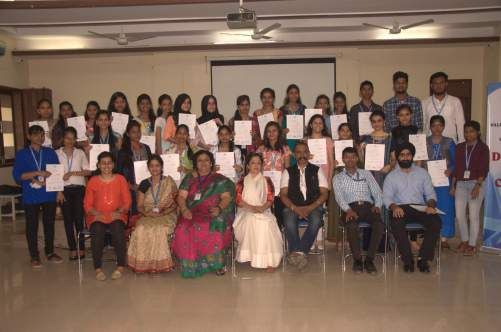
Ms. Mary Mukherji from Teach India, Shri Ajit Balan and Principal Shobha Menon distributing
certificates and congratulating students on completion of the course
8Best Practices 2018-19
Problems encountered and Resources required:
Both the programs, Antarang and Spoken English shared almost similar problems.
One of the problems was that of infrastructure. At times due to extra-curricular
activities, exams etc., classrooms were not available. Also, both the programs saw a
substantial rate of students drop out. When discussed with the students dropping
out of the courses, one of the common issues that was identified, was that of difficulty
in juggling between college, employment and Teach India or Antarang course. Many
students have to work after college hours either to financially support their family
or to manage their expenses. As a result, they decided to give up these courses. Also,
some of the students especially the ones in the T.Y.B.Com quoted the issue of their
coaching classes.
Evidence of Success
With the Teach India Programme, 31 students have gained confidence about their
spoken English skills. With Antarang, 48 students have gained greater clarity about
their career choices and have got a mentor to guide them through for making
informed career choices. Most of the students who completed the CareerReady
Program are placed. The rest are in the process and are being groomed through
English speaking Courses and Computer Skills development courses for better
employment prospects.
For its two batches completing the CareerReady Employability Skills Program
successfully in the first year itself, Valia College was felicitated as Antarang's
'Champion Partner' at Antarang's Graduation Day Ceremony held in K.C. College
on 6th April 2019.
9Best Practices 2018-19
Name of the Practice:
Continuous Evaluation Program
Goal:
Assessing and evaluating students throughout the academic year
Context
Continuous Internal Evaluation was included in the assessment model to evaluate
skills and abilities which are essential for the courses being taught but are difficult
to assess using conventional semester end examinations.
Practice
Continuous evaluation is conducted through various activities throughout the
academic year for B.Com, BMS, BAF, BSc. IT, and BMM, for all courses FY, SY, and
TY. Taking cue from syllabus interpretation and the learning outcomes for every
course, faculty members were directed to select from different methods of internal
evaluation like periodic class tests, quizzes, presentations, assignments, tutorials,
objective questions, debugging errors in programs, etc.
The most frequently adopted methods included class tests, presentations and
assignments on extended topics with reference to what was being taught in the
classroom.
Class tests –The test results help learners to identify the areas that need
improvement and acts as an effective feedback mechanism in classroom teaching.
Assignments and Presentations –Assignments help learners to imbibe the concepts
discussed in class and present them in writing which allows the teachers to analyse
the conceptual clarity as well as writing skills of the learners and make appropriate
suggestions to them. Presentations allow for development of other skills like
communicating ideas along with use of technology to achieve more effective
exchange of thoughts.
Evidence of success:
CIE has aided in ensuring assimilation of concepts that are at the core of various
courses. This method of evaluation has been found effective in gauging the clarity
of concepts and has also helped students by maintaining focus and learning
discipline throughout the semester. It is highly effective as it is a constant probing
that allows learners to adopt the best way to move forward.
10Best Practices 2018-19
CIE model has aided to improve the comprehension and application of learnt
concepts, communication and social skills, personal interest in learning and bring
about a positive attitude amongst learners. In addition, it has also helped learners
to keep track of their studies and aided them in the process of preparation for the
final term end examinations.
Problems encountered and Resources required:
In the beginning, it was difficult to convince the students of the benefits and
importance of this kind of evaluation as it does not involve marks.
Various methods of Continuous Internal Evaluation used in the year 2018-19
Students presenting their ware in an exhibition stall – put up as a part of Export
Marketing activity to evaluate students’ knowledge with regards to promotion
Students appearing for Written Tests
11Best Practices 2018-19
Students presenting the given topics as a part of Continuous Evaluation
12You can also read


