1st Grade Math Overview 2020 2021 - Fort Bend ISD
←
→
Page content transcription
If your browser does not render page correctly, please read the page content below
Department of Teaching & Learning
_____________________________________________________________________________________________
1st Grade Math
Overview
2020 - 2021
This document is designed to provide parents/guardians/community an overview of the curriculum taught in the
FBISD classroom. This document supports families in understanding the learning goals for the course, and how
students will demonstrate what they know and are able to do. The overview offers suggestions or possibilities to
reinforce learning at home.
Included at the end of this document, you will find:
A glossary of curriculum components
The content area instructional model
Parent resources for this content area
To advance to a particular grading period, click on a link below.
Grading Period 1
Grading Period 2
Grading Period 3
Grading Period 4
At Home Connections
The following are suggestions for reinforcing literacy/numeracy development at home. These ideas can be used
throughout the school year. You will find additional ideas to reinforce learning at home within each unit below.
Engage students in problem solving during day-to-day decisions and reasoning through outcomes of decisions
Explain the order or process used to complete day-to-day tasks
Encourage students to justify choices made in day-to-day activities
Discuss scenarios involving math in everyday life and determine the operations needed to solve the problem
Play games that require logic and reasoning skills or counting forward and backward
Process Standards
The process standards describe ways in which students are expected to engage in the content. The process standards
weave the other knowledge and skills together so that students may be successful problem solvers and use
knowledge learned efficiently and effectively in daily life.
1.1A apply mathematics to problems arising in everyday life, society, and the workplace
1.1B use a problem-solving model that incorporates analyzing given information, formulating a plan or strategy,
determining a solution, justifying the solution, and evaluating the problem-solving process and the
reasonableness of the solution
1.1C select tools, including real objects, manipulatives, paper and pencil, and technology as appropriate, and
techniques, including mental math, estimation, and number sense as appropriate, to solve problems
1.1D communicate mathematical ideas, reasoning, and their implications using multiple representations,
including symbols, diagrams, graphs, and language as appropriate
1.1E create and use representations to organize, record, and communicate mathematical ideas
1.1F analyze mathematical relationships to connect and communicate mathematical ideas
1.1G display, explain, and justify mathematical ideas and arguments using precise mathematical language in written
or oral communicationDepartment of Teaching & Learning
_____________________________________________________________________________________________
Grading Period 1
Unit 1: Launching Mathematical Mindsets
Estimated Date Range: 8/17/20 – 9/03/20
Estimated Time Frame: 13 Days
Unit Overview: This unit begins with 8 days of Launching Mathematical Mindsets. Students will engage in activities
that support setting up the systems and structures needed to promote mathematical communication and
collaboration in a face-to-face or virtual environment. Students will then learn about telling time to the hour on a
digital or analog clock. Students will also demonstrate understanding of numbers 16-20 that were learned in
kindergarten during online learning in spring 2020.
At home connections:
Use positive affirmations to build students self-confidence
Talk about their favorite parts of the day and whether they occur during the morning, afternoon, or night
Have students match times on an analog and digital clock
Read, write, and represent numbers 16-20.
Concepts within Unit #1 Competencies that will be Success Criteria for this Concept
Link to TEKS graded in this Concept
Concept #1: Launching N/A The focus for this concept is on students getting used
Mathematical Mindsets to classroom routines while engaging in math related
1.7E, K.2B activities that promote sense making, perseverance,
and teamwork.
Describe events that could occur during morning,
afternoon, or night.
Tell time to the hour using an analog and digital
clock
Unit 2: Skip Counting and Patterns
Estimated Date Range: 9/3/20 – 9/23/20
Estimated Time Frame: 14 days
Unit Overview: In this unit students will expand on their knowledge of reciting numbers from 0-100 by ones and tens
from kindergarten. Students will interact with hundreds charts using counters or small manipulatives to identify
patterns and skip count by 2s, 5s, and 10s. Students will practice skip counting sets of objects by bundling popsicle
sticks/joining cubes in sets of 2, 5, and 10 to determine the total number of objects in a set. Students will then identify
the value of a penny, nickel, dime, and quarter while understanding the relationship between them, and representing
their values using the cent symbol (e.g. 10₵). Then they will apply their knowledge of skip counting t a hundreds chart
and to determining the total value in a set of coins up to one dollar.
At home connections:
Count a collection of pennies, dimes, and nickels up to one dollar starting with different coins each time.
Gather craft sticks or straws and group them by 2s, 5s, or 10s to practice skip counting.
Use real world scenarios to practice skip counting (e.g. number of fingers in your family, number of eyes in the
room, etc.)
Count forward and backward up to 99 starting at any given number.Department of Teaching & Learning
_____________________________________________________________________________________________
Concepts within Unit #2 Competencies that will be Success Criteria for this Concept
Link to TEKS graded in this Concept
Concept #1: Skip Counting Recite numbers between 1 and 99 forward and
1.2A, backward from any given number
1.5A,1.5B,1.5C Skip count to determine the total number of
objects up to 120 in a set
o Twos
o Fives
o Tens
Determine the number that is 10 more and 10 less
than a given number up to 99.
Concept #2: Patterns in Competency 1 Identify U.S. coins, including pennies, nickels,
Money dimes, and quarters.
1.4C, 1.4A, 1.4B Competency 2 Skip count to determine the set value of coins
o pennies by twos
o nickels by fives
o dimes by tens
Count a collection of coins using skip counting (not
quarters)
o same coins
o different coins
Write the number with the cent symbol to
describe the value of a coin (e.g. 25₵).
Unit 3: Numeration (0 – 99)
Estimated Date Range: 9/24/20 – 10/29/20
Estimated Time Frame: 26 days (GP1 12 days and GP2 14 days)
Unit Overview (Concept 1): In this unit, students will develop an understanding of how to represent, compose, and
decompose numbers in multiple ways up to 99. The focus is on understanding tens and ones and the relationship
between the digit’s location and its value within a 2-digit number. Students will then apply their understanding of tens
and ones and patterns from Unit 2 to compare numbers and generate numbers that are more than or less than a
given number.
At home connections:
Use real world situations with numbers up to 99 and compare numbers (e.g. determine whether one color of
blocks has more or less than another color of blocks. Count the blocks to justify the answer.)
Use craft sticks or straws to bundle groups of ones to make ten, then skip count by 10.
Concepts within Unit # 3 Competencies that will be Success Criteria for this Concept
Link to TEKS graded in this Concept
Concept #1: Numeration Competency 1 Use various forms to represent numbers up to
1.2B, 1.2A, 99
1.2C,1.5A, 1.5B Competency 2 o objects
o pictures
o standard
Recite numbers between 1 and 99 forward
and backward from any given number.Department of Teaching & Learning
_____________________________________________________________________________________________
Skip count by fives and tens to determine the
total number of objects up to 99 in a set
Compose and decompose numbers up to 99 in
more than one way
o Objects
o pictures
Grading Period 2
Unit 3: Numeration (0 – 99) Continued
Estimated Date Range: 9/24/20 – 10/29/20
Estimated Time Frame: 26 days (GP1 12 days and GP2 14 days)
Unit Overview (Concept 2): Students will then apply their understanding of tens and ones and patterns from Unit 2 to
compare numbers and generate numbers that are more than or less than a given number.
At home connections:
Look at groups of objects or pictures and determine which one has more or less of something without
counting
Concepts within Unit #3 Competencies that will be Success Criteria for this Concept
cont. graded in this Concept
Link to TEKS
Concept #2: Comparing Competency 1 Generate a number that is greater than or less
Numbers than a given whole number
1.2G, 1.2B, 1.2C, Competency 2 Use symbols to represent the comparison of two
1.2D, 1.2E, 1.5C numbers in a real-world context
Unit 4: Addition & Subtraction
Estimated Date Range: 11/02/20 – 12/18/20
Estimated Time Frame: 30 days
Unit Overview: In this unit students will build an understanding of different structures of word problems involving
joining, separating, and comparing. Students will use objects and pictorial models to represent the actions of a
problem, generate solutions, explain their strategies, and develop basic fact strategies for future grade levels. They
will explore the different types of problems starting with results unknown, moving to start unknown, then change
unknown, and at the end of the unit be able to use objects and pictorial models to solve a variety of addition and
subtraction word problems.
At home connections:
Identify places where you see different number combinations or addition/subtraction situations around you.
(e.g. We started the week with 15 granola bars, how many do we have now? How many have we eaten?)
Use toys and other small objects to model addition and subtraction problems and explain their story as they
model.
Concepts within Unit #4 Competencies that will be Success Criteria for this Concept
Link to TEKS graded in this ConceptDepartment of Teaching & Learning
_____________________________________________________________________________________________
Concept #1: Results Competency 1 Represent and solve word problems involving
Unknown and Comparing addition with results unknown using
Sets Word Problems Competency 3 o objects
1.3B, 1.5D, 1.3D, o pictures
1.3E, 1.5E, 1.5G o number sentence
Represent and solve word problems involving
subtraction with results unknown using
o objects
o pictures
o number sentence
Represent and solve word problems involving
comparing sets using
o objects
o pictures
o number sentence
Concept #2: Start Unknown Competency 1 Represent and solve word problems involving
Word Problems addition with start unknown using
1.3B, 1.5D, 1.3D, 1.3E, Competency 3 o objects
1.5E,1.5G o pictures
o number sentence
Represent and solve word problems involving
subtraction with start unknown using
o objects
o pictures
o number sentence
Concept #3: Change Competency 1 Represent and solve word problems involving
Unknown Word Problems addition with change unknown using
1.3B, 1.5D, 1.3D, Competency 3 o objects
1.3E, 1.5E, 1.5G o pictures
o number sentence
Represent and solve word problems involving
subtraction with change unknown using
o objects
o pictures
o number sentence
Concept #4: Mixed Competency 1 Mixed Problems from Concept 1 – Concept 3
Problem Solving Represent and solve word problems involving
1.3B, 1.5D, 1.3D, Competency 3 addition and subtraction using objects, pictures,
1.3E, 1.5E, 1.3F, and number sentences
1.5G o Results unknown
o Comparing sets
o Start Unknown
o Change Unknown
Grading Period 3
Unit 5: 2-D and 3-D Shapes
Estimated Date Range: 1/06/21 – 1/27/21Department of Teaching & Learning
_____________________________________________________________________________________________
Estimated Time Frame: 15 days
Unit Overview: In this unit students will identify, create, classify and sort 2-D shapes. They will determine attributes
that define 2-D shapes and compose 2-D shapes by joining more than one shape to produce a target shape. They will
then be introduced to the idea of a fraction by partitioning 2-D shapes into fourths and halves and understanding fair
shares. The end of the unit includes identifying and naming 3-D figures and distinguishing between attributes that
define a 3-D figure and attributes that define a 2-D shape.
At home connections:
Go on a scavenger hunt around the house to identify 2-D and 3-D figures, name them, and describe their
attributes.
Use cakes, pizzas, and other rectangular or circular items to help students identify fair shares or equal parts
with halves and fourths.
Concepts within Unit #4 Competencies that will be Success Criteria for this Concept
Link to TEKS graded in this Concept
Concept #1: 2-D Shapes Competency 1 Distinguish between attributes that define and do
1.6B, 1.6A, 1.6C, not define a two-dimensional shapes
1.6D, 1.6F Competency 4 Identify two-dimensional shapes
o circles
o triangles
o rectangles
o squares as special rectangles
o rhombuses
o hexagons
Classify and sort regular and irregular two-
dimensional shapes based on attributes
Compose two-dimensional shapes by joining two,
three, or four shapes to produce a target shape
Create two-dimensional shapes based on
attributes
Concept #2: Partitioning 2- Competency 1 o Identify examples and non-examples of halves and
D Shapes fourths
1.6G, 1.6H Competency 4 Partition two-dimensional shapes (e.g. of shapes to
partition: circle or rectangle)into two fair shares or
equal parts and describe the parts using words such as
o halves
o fourths
o half of
o quarters
Concept #3: 3-D Figures Competency 1 Identify three-dimensional figures and describe
1.6B, 1.6E o spheres
Competency 4 o cones
o cylinders
o rectangular prisms (including cubes)Department of Teaching & Learning
_____________________________________________________________________________________________
o triangular prisms
Describe the attributes of three-dimensional figures
o vertex
o edge
o number of faces
o types of faces (rectangular, circular, etc.)
o Distinguish between attributes that define and do
not define a three-dimensional figure
Unit 6: Numeration (0 – 120)
Estimated Date Range: 1/28/21 – 2/26/21
Estimated Time Frame: 20 days
Unit Overview: In this unit students will continue to develop place value understanding by bundling objects into
groups of ten and use those to make a bundle of one hundred. Students will continue to compose and decompose
number using objects and pictures to deepen their understanding of the relationships within place value as well as
support a foundation for flexibility in operations for future grades. Students will compare numbers, represent
numbers on a number line, and order numbers all up to 120. They will generate a number more than or less than
another number and solve problems involving 10 more, 10 less than a number.
At home connections:
Use real world situations with numbers up to 99 and compare and order the numbers (e.g. determine
whether one color of blocks is more or less than another color of blocks. Count the blocks to justify the
answer.)
Use craft sticks or straws to bundle groups of ten ones to make ten, and ten tens to make one hundred.
Find numbers around the house use objects to build the number in hundreds, tens, and ones.
Look at groups of objects or pictures and determine which one has more or less of something without
counting.
Concepts within Unit #5 Competencies that will be Success Criteria for this Concept
Link to TEKS graded in this Concept
Concept #1: Numeration Competency 1 Use various forms to represent numbers up to 120
1.2B, 1.2C o objects
Competency 2 o pictures
o expanded form
o standard form
Compose and decompose numbers up to 120 in
more than one way
o objects
o pictures
Concept #2: Compare and Competency 1 Use symbols to represent the comparison of two
Order Numbers numbers in a real-world context
1.2G, 1.2F, 1.2C, Competency 2 Order whole numbers using place value and open
1.2A, 1.2D, 1.2E, number lines in a real-world context
1.5A, 1.5B, 1.5C,
1.3ADepartment of Teaching & Learning
_____________________________________________________________________________________________
Unit 7: Addition and Subtraction Including Multiple Terms
Estimated Date Range: 3/01/21 – 4/07/21
Estimated Time Frame: 22 days (GP 2 10 Days and GP3 12 Days)
Unit Overview: Students will reinforce skills learned for adding and subtracting in grading period 2. They will also
begin to generate problems for a corresponding number sentence as well as solve problems for addition and
subtraction where there are multiple terms (e.g. 2+5+10=? or 2+5+?=17). The goal in this unit is to ensure a solid
foundation for basic number operations and develop fluency with a variety of strategies to support fluency for all
operations in future grade levels.
At home connections:
Identify places where you see different number combinations or addition/subtraction situations around you. E.g.
we started the week with 15 granola bars, how many do we have now? How many have we eaten?
Use toys and other small objects to model addition and subtraction problems and explain their story as they
model.
Have students generate as many addition statements as they can that equal a certain number.
Concepts within Unit #6 Competencies that will be Success Criteria for this concept
Link to TEKS graded in this unit
Concept #1: Addition and Competency 1 Represent and solve word problems involving
Subtraction Mixed Problem addition and subtraction using objects, pictures,
Solving Competency 3 and number sentences.
1.3B, 1.5D, 1.3D, o results unknown
1.3E, 1.3F o comparing sets
o start Unknown
o change Unknown
Apply basic facts strategies to add and subtract
within 20.
Explain strategies used to solve addition and
subtraction problems using
o spoken words
o objects
o pictures
o number sentences
Generate and solve word problems when given a
number sentence (numbers should not go
beyond the number 20).
Apply properties of operations to add and
subtract two or three numbers.
Grading Period 4
Unit 7: Addition and Subtraction Including Multiple Terms Continued
Estimated Date Range: 3/01/21 – 4/07/21
Estimated Time Frame: 22 days (GP 2 10 Days and GP3 12 Days)
Unit Overview: Students will reinforce skills for adding and subtracting that they learned in grading period 2. They
will also begin to generate problems for a corresponding number sentence as well as solve problems for addition and
subtraction where there are multiple terms (e.g. 2+5+10=? or 2+5+? =17). The goal in this unit is to ensure a solidDepartment of Teaching & Learning
_____________________________________________________________________________________________
foundation for basic number operations and develop fluency with a variety of strategies to support fluency for all
operations in future grade levels.
At home connections:
Identify places where you see different number combinations or addition/subtraction situations around you
(e.g. We started the week with 15 granola bars, how many do we have now? How many have we eaten?).
Use toys and other small objects to model addition and subtraction problems and explain the story
as they model.
Have students generate as many addition statements as they can that equal a certain number.
Concepts within Unit #7 Competencies that will be Success Criteria for this concept
Link to TEKS graded in this unit
Concept #2: Addition and Competency 1 Represent and solve word problems involving
Subtraction with Multiple addition and subtraction using objects, pictures,
Terms Competency 3 and number sentences.
1.5D, 1.5F, 1.3D, o results unknown
1.3E, 1.3F, 1.5G o comparing sets
o start Unknown
o change Unknown
Apply basic facts strategies to add and subtract
within 20.
Explain strategies used to solve addition and
subtraction problems using
o spoken words
o objects
o pictures
o number sentences
Generate and sole word problems when given a
number sentence within 20.
Apply properties of operations to add and
subtract two or three numbers.
Unit 8: Personal Financial Literacy and Data Analysis
Estimated Date Range: 4/07/21 – 4/30/21
Estimated Time Frame: 16 days
Unit Overview: In this unit students will define money as earned income and a way to obtain goods and services.
Students will also be introduced to the ideas of spending vs. saving and charitable giving. Students use situations
about money, spending, and saving, as well as other real-world situations to collect, sort, and analyze data in up to
three categories. They will use data to create picture and bar-type graphs as well as draw conclusions from graphs.
Students will also be able to generate and answer questions using information in the created graphs or graphs that
are given to them.
At home connections:
Identify times when you are spending money on needs versus wants
Discuss opportunities to earn income, have a lemonade stand, or garage sale
Find data based on a topic of interest sort and organize the data into categories
Create bar-type graphs to represent friends’ or family's favorite colors, favorite foods, shoe size etc.Department of Teaching & Learning
_____________________________________________________________________________________________
Concepts within Unit #8 Competencies that will be Success Criteria for this concept
Link to TEKS graded in this unit
Concept #1: Personal Competency 1 Define money earned as income.
Financial Literacy Identify income as a way to obtain goods and
1.9A, 1.9B, 1.9C, services (also having to make choices between
1.9D wants and needs).
Distinguish between spending and saving
Explain and consider charitable giving
Concept #2: Drawing Competency 1 Collect, sort, and organize data with three
Conclusions from Graphs categories using tally marks and charts
1.8B, 1.8A, 1.8C Competency 5 o determine a label for each category
o describe similarities and differences to justify
groupings
Use data to create
o picture graphs
o bar graphs
Generate and answer questions from picture
graphs and bar graphs
Draw conclusions from picture graphs and bar
graphs
o use comparative language to describe
different sets of data within the same graph
o summarize the data to draw a conclusion
from the data within the graph
Unit 9: Measurement
Estimated Date Range: 5/03/21– 5/26/21
Estimated Time Frame: 18 days
Unit Overview: In this unit students will start by solidifying their understanding of telling time to the nearest hour and
half hour. Then students will use measuring tools to measure objects and describe the length of an object to the
nearest whole unit when laid end to end with no gaps or overlaps. Students will also be able to measure the same
object with two different size measuring tools and describe why the measurements differ.
At home connections:
Use a variety of household objects to measure the length of items. Discuss why it takes fewer of one object
than another to measure the same length.
Have students match times on an analog and digital clock
When getting in the car, about to eat dinner, going to bed etc. Ask what time it is to the nearest hour or half
hour and explain how they know.
Concepts within Unit # 9 Competencies that will be Success Criteria for this concept
Link to TEKS graded in this unit
Concept #1: Length Competency 1 Tell time to the hour and half hour on an analog.
and Time Tell time to the hour and half hour on a digital
1.7C, 1.7A, 1.7B, Competency 5 clock.
1.7D, 1.7E Estimate whether time is closer to the hour or the
half-hour using analog clock.Department of Teaching & Learning
_____________________________________________________________________________________________
Use measuring tools to measure the length to
reinforce the continuous nature of linear
measurement.
Measure the same object or distance with units of
two different lengths and describes how and why
the measurements differ.Department of Teaching & Learning
_____________________________________________________________________________________________
Glossary of Curriculum Components
Overview– The content in this document provides an overview of the pacing and concepts covered in a subject for the
year.
TEKS – Texas Essential Knowledge and Skills (TEKS) are the state standards for what students should know and be able
to do.
Unit Overview – The unit overview provides a brief description of the concepts covered in each unit.
Concept – A subtopic of the main topic of the unit.
Success Criteria—a description of what it looks like to be successful in this concept.
Competency—Standards-Based Grading communicates students’ understanding of the Texas Essentials Knowledge
and Skills (TEKS). Using the TEKS, teachers developed grade-level competencies to communicate student progress in
the Standards-Based gradebook. The competencies are the same for each grade-level content area (i.e. 1st grade
math) across the district. Teachers report students’ progress on the competencies using learning progressions.
Parent Resources
The following resources provide parents with ideas to support students’ understanding. For sites that are password
protected, your child will receive log-in information through their campus.
Resource How it supports parent and students
This is the state adopted textbook for elementary school
Envision Math math. Click on the link for directions on accessing the
textbook through clever.
These online resources provide access to virtual
Didax Virtual Manipulatives
manipulatives.
Math Learning Center Math Apps
This resource from youcubed.org includes articles for
parents on ways to support their students in learning and
Parent Resources from youcubed.org
understanding mathematics.
This resource from youcubed.org includes videos concerning growth
Student Resources from youcubed.org
mindset in mathematics
This resource provides an explanation of why math looks
different now as opposed to how parents learned
Math: Why Doesn’t Yours Look Like
mathematics and how to support students in learning
Mine?
mathematics.
This resources breaks down grade level standards, provides example
Math4Texas questions, vocabulary, and links to online resources for students aligned
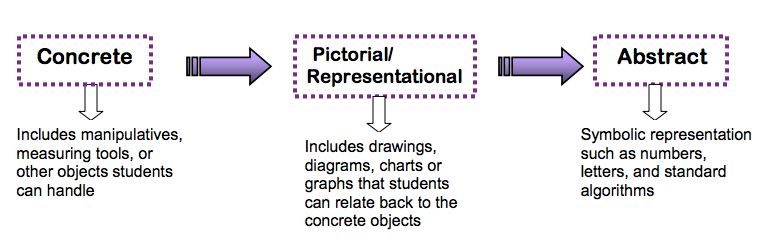
to the standards.Department of Teaching & Learning _____________________________________________________________________________________________ Instructional Model The structures, guidelines or model in which students engage in a particular content that ensures understanding of that content. The instructional model for mathematics is the Concrete-Representational-Abstract Model (CRA). The CRA model allows students to access mathematics content first through a concrete approach (“doing” stage) then representational (“seeing” stage) and then finally abstract (“symbolic” stage). The CRA model allows students to conceptually develop concepts so they have a deeper understanding of the mathematics and are able to apply and transfer their understanding across concepts and contents. The CRA model is implemented in grades K-12 in FBISD.
You can also read


