Beyond participation? - Leadership ideals of future managers from Central and East European Countries
←
→
Page content transcription
If your browser does not render page correctly, please read the page content below
Beyond Participation?

Beyond participation? – Leadership ideals of future managers
from Central and East European Countries

Rainhart Lang, Erna Szabo, Gheorghe Alexandru Catana, Zdeňka Konečná,
Petra Skálová *

This article analyses the leadership expectations of students in their role of
potential future managers, comparing leadership prototypes across countries
from Central and Eastern Europe with a focus on participative leadership. The
findings suggest a complex web of influences, with individual value preferences
being a particular strong predictor of students’ participative leadership
expectations. Compared with middle managers from GLOBE samples, the
students’ profiles match the participatory expectations of middle managers in
their respective countries, but with a common tendency for managers to rank
participative leadership more highly than students of the very country do.
Der Artikel analysiert Führungserwartungen von Studierenden in ihrer Rolle als
künftige Manager, indem er Führungsprototypen mit einem Fokus auf
partizipative Führung für verschiedene Länder Mittel- und Osteuropas
vergleicht. Die Ergebnisse verweisen auf ein Netz von Einflüssen, in dem vor
allem die individuellen Werte der Studierenden besonders bedeutsam sind. Im
Vergleich mit mittleren Managern aus GLOBE-Studien zeigen sich
Ähnlichkeiten, aber mit einer gemeinsamen Tendenz zu höherer Wertschätzung
partizipativer Führung durch die mittleren Manager.
Key words: GLOBE, CEE countries, students, intercultural differences,
leadership expectations, participative leadership, role models (JEL: J24, M14)

*
    Rainhart Lang, Full Professor, Department of Economics & Business Administration, Chemnitz University of
    Technology, Germany. Main research interests: Leadership theories and cross cultural aspects of management
    and leadership, organisational change and transformation, managerial professions. Corresponding Address:
    r.lang@wirtschaft.tu-chemnitz.de
    Erna Szabo, Associate Professor, Department of International Management, Johannes Kepler University Linz,
    Austria. Main research interests: Participative and ethical leadership, cultural intelligence, crossvergence,
    erosion of trust. Corresponding Address: erna.szabo@jku.at
    Gheorghe Alexandru Catana, Full Professor, Technical University of Cluj-Napoca, Romania.Main research
    interests: Organisational behaviour, leadership, marketing. Corresponding Address: Alexandru.Catana
    @mae.utcluj.ro
    Zdeňka Konečná, Ph.D., Senior Lecturer, Brno University of Technology, Faculty of Business and
    Management, Czech Republic. Main research interests: International human resource management, leadership
    across cultures, content and language integrated learning. Correspo nding Adress: konecna@fbm.vutbr.cz
    Petra Skálová, Assistant Professor, Department of Business Administration and Management, Faculty of
    Economics, University of West Bohemia, Pilsen, Czech Republic. Main research interests: Human resource
    management, cross cultural aspects of management, ethical leadership, learning organisations, business
    economics. Corresponding Address: skalovap@kpm.zcu.cz

482                                                                                                       JEEMS 04/2013
                                  https://doi.org/10.5771/0949-6181-2013-4-482, am 13.05.2021, 18:08:37
                                       Open Access –              - http://www.nomos-elibrary.de/agb
Rainhart Lang, Erna Szabo, Gheorghe Alexandru Catana, Zdeňka Konečná, Petra Skálová
1 Introduction11
Leadership styles do not change quickly. As for the Central and Eastern
European (CEE) countries, researchers (e.g. Lindert 1996, Edwards/Lawrence
2000; Reber et al. 2000; Steger/Winkler 2003; Steyrer et al. 2006; Lang et al.
2008) have repeatedly referred to the so-called “stickiness” of traditional or
conservative leadership styles of the managers currently in charge in business
organisations. The question is whether this pattern will change in the future with
a new generation of young managers and leaders. On the one hand, and given
the increasing influences of globalisation spread via mass and social media, one
can expect a certain amount of convergence of values and leadership ideals
across cultures and countries. On the other hand, today’s young people are likely
to hold a more critical stance than their parent generation toward the leadership
practices currently in place in their cultures. This may be especially true for the
high levels of power distance and low levels of participative leadership
behaviour presently observable within the CEE region. Today’s students are
tomorrow’s managers, most likely the ones currently enrolled in business
economics and engineering studies. Consequently, it is of interest to find out
more about the factors that have shaped their leadership expectations,
specifically the drivers toward participative and other types of leadership
expectations universally attributed as positive.
To our knowledge, no large-scale comparative studies have been conducted so
far with respect to the leadership expectations of students – the potential future
managers. Initial evidence stems from earlier phases of the GLOBE Student
project (see Čater/Lang 2011). The current article expands the initial dataset by
including a second Germanic country (Austria), as well as an additional Eastern
European country (Poland). Both countries had also participated in the initial
GLOBE project sampling data from middle managers in 61 societies (House et
al. 2004; Chhokar et al. 2007). This overlap in datasets allows us to not only
take a broader look at leadership ideals of Central and East European students,
but also adds relevance to a manager vs. student comparison across cultures.
In more detail, we analyse the participative leadership prototypes of students in
their role of potential future managers. From a country perspective, we compare
leadership expectations by presenting country and country cluster profiles of
participative leadership. From a hypothesis-testing perspective, we look at
influence factors (in addition to national culture) on participative leadership,
11
The article is based on the data set of the GLOBE Student project. The project is co-ordinated by R. Lang
(Chemnitz University of Technology, Germany). The research team also includes E. Szabo (Johannes Kepler
University Linz, Austria), Z. Konečná (Brno University of Technology, Czech Republic), P. Skálová
(University of West Bohemia, Pilsen, Czech Republic), R. Krzykała-Schaefer (Poznań School of Banking,
Poland), D. Catana and G.A. Catana (Technical University of Cluj-Napoca, Romania), A. Lašáková and A.
Remišová (Comenius University Bratislava, Slovakia), and T. Čater and D. Pučko (University of Ljubljana,
Slovenia).
JEEMS 04/2013 483
https://doi.org/10.5771/0949-6181-2013-4-482, am 13.05.2021, 18:08:37
Open Access – - http://www.nomos-elibrary.de/agbBeyond Participation?
specifically individual value preferences, age, gender, and field of study. We
also test the influence of the institutional context as well as the role of social
agencies and their respective role models, e.g. family/parents, school/teachers,
peer group/friends. Finally, we discuss our data in comparison with the
leadership prototypes of middle managers originating from the GLOBE project,
and develop future research directions.
2 Theoretical background and hypotheses
As the GLOBE Student project builds on the initial GLOBE study, we share a
common theoretical and methodological background, specifically with regard to
implicit leadership theory (ILT) and its extension - culturally endorsed implicit
leadership theory (CLT) (see for example Dorfman/House 2004; Dickson et al.
2012; Dorfman et al. 2012). In other words, we agree on the influence of
societal culture on implicit leadership theories, i.e. leadership ideals.
Additionally, we assume that socialising agents like parents, teachers, friends as
well as leadership examples known from personal experience (e.g. superiors
during internships) or from the media (e.g. politicians, successful business
leaders, sports idols, scientists) play a role in shaping leadership expectations.
Consequently, the GLOBE Student project builds on theories and models of
socialisation to widen its theoretical basis (see Čater/Lang 2011, and the
introduction article by Čater, Lang and Szabo in this special issue).
In more detail, current cross-cultural leadership research has focused on the
influence of leadership prototypes and so-called implicit leadership theories
(ILTs) on the perception and acceptance of managers in intercultural co-
operation (e.g. House et al. 1999; House et al. 2004; Javidan et al. 2006;
Chhokar et al. 2007; Dorfman et al. 2012). Particularly the GLOBE project
strengthened the assumed link between national cultures and these leadership
prototypes (House et al. 2004: 669-719; for an overview Dickson et al. 2012) by
introducing culturally endorsed implicit leadership theories (CLTs). Leadership
expectations are partly universal and partly depend on the cultural context:
Participative leadership, for example, belongs to the culturally contingent
attributes of leadership, while transformational or team oriented behaviours
represent examples of universal leadership attributes (Brodbeck et al. 2000).
The GLOBE results have revealed similarities in leadership prototypes among
cultures, for example among North European cultures and Germanic cultures in
general (House et al. 2004: 669-719), and among Germanic (Central European)
and East European cultures with regard to the expectation of autonomous
leadership behaviour (see Szabo et al. 2001, 2002 for Germanic cultures;
Bakacsi et al. 2002 for East European cultures). At the same time, significant
differences have also been reported regarding culture and CLTs within Europe,
with the Eastern and Southern parts of Europe on the one hand, and the
Northern, Central and Western parts on the other hand (e.g. Brodbeck et al.
484 JEEMS 04/2013
https://doi.org/10.5771/0949-6181-2013-4-482, am 13.05.2021, 18:08:37
Open Access – - http://www.nomos-elibrary.de/agbRainhart Lang, Erna Szabo, Gheorghe Alexandru Catana, Zdeňka Konečná, Petra Skálová
2000; House 2002). The largest differences between Germanic (Central
European) countries and East European countries concern a higher level of
power distance by East European managers, together with a stronger expectation
of participation by their German-speaking counterparts (see Weibler et al. 2000,
Szabo et al. 2001, 2002 for Germanic cultures; Bakacsi et al. 2002 for CEE
cultures). In this article we build on these findings and explore students’ (future
managers’) similarities and differences in leadership prototypes in Germanic and
East European countries. For this purpose, the following review of relevant
studies provides the basis for developing meaningful hypotheses.
To our knowledge, only one study dealing with leadership expectations of
students exists. Keating, Martin and Szabo’s (2002) study, comparing perceived
cultural practices of students and managers in Austria and Ireland, reveals a
stronger country than cohort/age effect: Significant differences regarding
perceptions of cultural practices between the two country samples show for
several dimensions, while the data display hardly any significant differences
between managers and students of the same country (Keating et al. 2002: 646-
647). Despite these within-country overlaps among students and managers, the
authors also point out the possibility of perceptions and attitudes of students
changing once they start their organisational careers (p. 648).
Comparative studies do not only exist with regard to leadership prototypes, but
also concerning perceptions of actual leadership behaviour. Here, differences
show between Germany, Austria and CEE countries such as Estonia and
Romania, mainly with respect to a more authoritarian and less participative style
of CEE managers compared to German and Austrian ones (Lang et al. 2005;
Steyrer et al. 2006; Lang et al. 2008). As for participative leadership, Alt and
Lang (2004) also show that in a number of CEE countries local employees’
leadership expectations differ considerably from the leadership realities applied
by their German top managers, which may cause problems in direct interaction.
The leadership styles of managers in selected CEE countries, specifically the
Czech Republic, Hungary and Poland, as experienced by Finnish expatriates, are
described by Suutari and Riusala (2001). According to this comparison, Czech
managers tend to be more active in criticising, role clarification and interaction
facilitation than their Hungarian and Polish counterparts. Additionally, Czech
managers are less active in informing, coordination, goal setting and providing
vision, which may lead to the conclusion that Czech managers have a stronger
preference for autocratic than participative leadership styles. Additionally,
Suutari and Riusala (2001) point out differences between generations. What the
data show for recently privatised companies (usually with younger managers) in
comparison with state-owned organisations (usually with older managers) is
more open communication, a smaller power distance between managers and
subordinates and a stronger emphasis on achieving goals. This finding fits with
JEEMS 04/2013 485
https://doi.org/10.5771/0949-6181-2013-4-482, am 13.05.2021, 18:08:37
Open Access – - http://www.nomos-elibrary.de/agbBeyond Participation?
our assumption of potentially changing leadership preferences, as described
above.
According to the GLOBE data, power distance is among the cultural dimensions
with fairly high scores for perceived practices, while at the same time the
desired ideal reflects a much more egalitarian interrelation between social
groups. Similar results also show in the first GLOBE Student analysis of five
countries (Čater/Lang 2011: 98-100). As low power distance goes along with a
rejection of autocratic leadership, we expect autocratic leadership styles to
receive negative attributions from the students. At the same time, as GLOBE’s
measure of participative leadership builds on reverse-scored items targeting
autocratic behaviour (compare Appendix A), we assume that students will
evaluate participative styles positively.
In conclusion, the following hypotheses reflect the research reviewed above,
specifically GLOBE’s results on leadership ideals of managers in different
countries, Keating, Martin and Szabo’s (2002) study comparing managers and
students in Austria and Ireland, and our own initial research in the context of the
GLOBE Student project (Čater/Lang 2011).
Hypothesis 1: Students’ leadership expectations will be in favour of
participative leadership. At the same time, students will reject autocratic
styles of leadership.
As pointed out above, the GLOBE study suggested differences between cultures
in middle managers’ appreciation of participative styles (House 2002; House et
al. 2004), i.e. participative leadership is considered to be culturally contingent
(e.g. Brodbeck et al. 2000; House 2002: 54). With regard to the CEE region,
differences between Germanic (Germany and Austria) and East European
countries were found for expected as well as for perceived leadership of middle
managers (e.g. Szabo et al. 2002, Bakacsi et al. 2002 for expected leadership;
Steyrer et al. 2006, Lang et al. 2008 for perceived leadership). In conclusion,
country differences in participative leadership can be expected, especially for
Austria and Germany on the one hand and the other CEE countries in our study
on the other hand.
Hypothesis 2: The degree of participative leadership expectation will differ
between countries. Especially Austrian and German students (Germanic
cluster) will desire participative leadership more strongly than students in
East European countries.
The initial analysis of GLOBE Student data from five countries suggested some
influence of socio-demographic factors on participative leadership expectations
(Čater/Lang 2011: 106-107). Firstly, female students were found to be more
strongly in favour of participation than their male peers. Secondly, the younger
the students were and the fewer study terms they had already spent at the
university, the stronger their expectations of participative leadership. Finally,
486 JEEMS 04/2013
https://doi.org/10.5771/0949-6181-2013-4-482, am 13.05.2021, 18:08:37
Open Access – - http://www.nomos-elibrary.de/agbRainhart Lang, Erna Szabo, Gheorghe Alexandru Catana, Zdeňka Konečná, Petra Skálová
with regard to field of study, students of business economics held particularly
strong expectations regarding the participative leadership ideal. We assume the
same trends to hold true for the current seven-country dataset.
Hypothesis 3: Participative leadership expectations will be differently
shaped according to age, gender, field of study, and number of study terms.
We expect women, younger students and students with fewer study terms as
well as business economics students to display a stronger wish for
participative leadership than their fellow students.
The influence of individually held values (related to societal culture dimensions)
on leadership expectations, i.e. culturally endorsed implicit leadership theories
(CLTs), represents one of the conceptual cornerstones of the GLOBE project.
Empirical results are supportive for different leadership dimensions including
Participative Leadership (e.g. Dorfman et al. 2012: 507). Societal culture values
related to Power Distance, Assertiveness, Institutional and In-group
Collectivism, Humane Orientation and Gender Egalitarianism were also found
influential in the five-country GLOBE Student study (Čater/Lang 2011: 108),
although the initial analysis of student data also suggested that dimensions such
as Value-based or Team-oriented Leadership are more strongly rooted in
cultural values than participative leadership.
Hypothesis 4: Students’ participative leadership ideals will be strongly
related to the individual value preferences they hold. More specifically, low
degrees of Power Distance and Assertiveness, as well as high levels of
Institutional and In-group Collectivism, Humane Orientation and Gender
Egalitarianism will go parallel with high expectations regarding
participative leadership.
Consistent with the literature reviewed above, we assume that societal culture
practices, as perceived by students, will have an additional impact on the
leadership ideals they hold. The GLOBE study (House et al. 2004), as well as
our own research (see e.g. country analysis for Slovakia by Remišová and
Lašáková 2011: 46), lead us to assume the influence of cultural practices in the
way stated in the following Hypothesis 5.
Hypothesis 5: Participative leadership expectations will be related to the
perception of cultural practices in the respective country. In particular,
high degrees of perceived Power Distance and Assertiveness will go
parallel with comparatively low expectations of participative leadership,
while established rules of Collectivism and Gender Egalitarianism will
contribute to a comparatively high appreciation of participative behaviour.
If individual value preferences play an important role in shaping leadership
expectations, early role models may also influence the development of students’
leadership ideals. Among such agents of socialisation are parents, teachers, and
friends during a child’s socialisation in the family, in school and among peers
JEEMS 04/2013 487
https://doi.org/10.5771/0949-6181-2013-4-482, am 13.05.2021, 18:08:37
Open Access – - http://www.nomos-elibrary.de/agbBeyond Participation?
(e.g. Hofstede 1991: 32-35; see also the introductory article by Čater, Lang and
Szabo in this special issue). Depending on the experiences involved, role models
may shape a young person’s emerging ideal of leadership in the participative as
well as non-participative direction. Furthermore, a student’s superior during an
internship, stars known from radio or TV, as well as business leaders,
politicians, sports idols or successful scientists may serve as role models, too. In
our initial analysis of student data, we found support for the influence of the
above-mentioned groups (Čater/Lang 2011: 107-108) and assume similar
tendencies for the current larger sample of students. Specifically, given
potentially negative connotations with politics resulting from recent scandals
and corruption, we expect strong participative leadership expectations to go
along with a weak influence of politicians as role models. In contrast, science
and research are usually highly valued in society. Consequently, scientists as
role models should have a positive impact on participative leadership
expectations.
Hypothesis 6: Students’ attitudes toward participative leadership will be
influenced by role models and experiences from family, school and peer
groups, as well as leadership examples presented by the media. More
specifically, experiences with participative decision processes in family,
school and peer groups will contribute to an appreciation of participative
leadership, and so will scientists as role models. In contrast, examples from
politics will have a negative impact on participative leadership
expectations.
Last but not least we are also interested in how students score in comparison to
middle managers. Consequently, we need to compare our student data with the
managerial results published by the original GLOBE project. In an initial
comparison (Čater/Lang 2011) the clusters did not fully overlap. The current
analysis provides a better basis, with student as well as managerial data
available for Austria and Germany (Germanic cluster), as well as Poland,
Slovenia and Romania (Eastern European cluster). Initial comparisons suggested
that CEE students’ participative leadership expectations are lower than
expectations of middle managers in general, i.e. GLOBE’s worldwide sample,
and of managers in the corresponding Germanic and Eastern European clusters,
specifically. This somewhat puzzling finding may have been related to the
weakly matching datasets. It also contradicts Keating, Martin and Szabo’s
(2002) study, according to which Austrian as well as Irish students displayed
significantly lower levels of Power Distance values than managers, implying
that students should rate participative leadership more highly than managers.
Nonetheless, we assume the initial GLOBE Student study’s trend to hold true
for the seven-country study, acknowledging that further data will be needed to
fully explain the results, no matter what they are.
488 JEEMS 04/2013
https://doi.org/10.5771/0949-6181-2013-4-482, am 13.05.2021, 18:08:37
Open Access – - http://www.nomos-elibrary.de/agbRainhart Lang, Erna Szabo, Gheorghe Alexandru Catana, Zdeňka Konečná, Petra Skálová
Hypothesis 7: Students’ participative leadership expectations will not be as
high as the participation ideals of middle managers’ from the same
country.
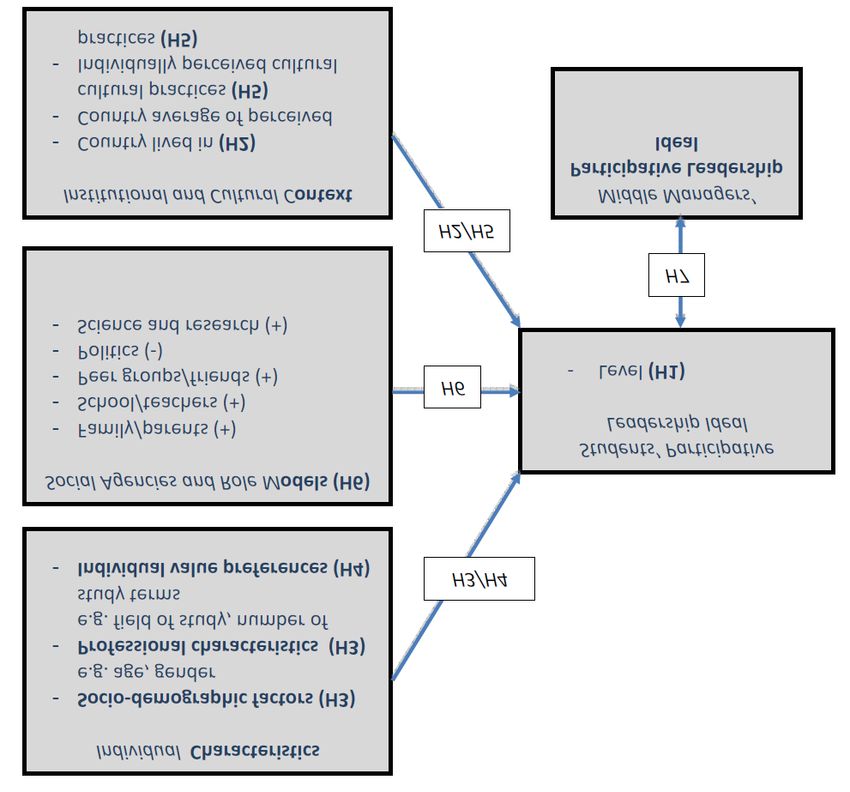
The seven hypotheses are closely related to the conceptual basis of the GLOBE
Student project (see introduction article by Čater, Lang and Szabo in this special
issue) and are summarized in the following research frame (Figure 1).
Figure 1: Research frame
3 Methods and sample
The results presented in this article are generated from a database of 2356
students from Austria, Czech Republic, Germany, Poland, Romania, Slovakia
and Slovenia, with at least 300 students representing each country. A modified
Beta version of the original GLOBE leadership questionnaire was translated into
the relevant languages and used for data collection. The questionnaire included
socio-demographic items, GLOBE’s measures for perceived societal culture
JEEMS 04/2013 489
https://doi.org/10.5771/0949-6181-2013-4-482, am 13.05.2021, 18:08:37
Open Access – - http://www.nomos-elibrary.de/agbBeyond Participation?
practices (“as is”) and values (“should be”), as well as GLOBE’s scales and
items targeting ideal leadership (see Appendices A and B for a list of the
Participative Leadership scale’s items). The leadership items reflected “traits,
skills, abilities, and personality characteristics potentially relevant to leadership
emergence and effectiveness” (Hanges/Dickson 2004: 126). Moreover, we
added items related to the potential influence on one’s values of role models
from family, school, peer groups or job-related contexts (e.g. internships), as
well as stars known from radio or TV, such as business leaders, politicians,
sports idols or successful scientists. Sampling took place between 2008 and
2010. Detailed sample characteristics are presented in the Annex of the special
issue.
For the calculation of the cultural dimensions, we followed the syntax suggested
by the GLOBE Foundation (2006). For the value (“should be”) dimensions we
employed the individual scores of what students described as the desired state in
their country/society. We also used the individual scores to measure their
perceptions of cultural practices (“as is”). However, since earlier analyses
(Čater/Lang 2011) suggest that individual perceptions of students seem to be of
less importance for the development of their participative leadership ideals, and
in order to get a more collectively shared view of a country’s cultural and
institutional context, we additionally used the country-average of students’
perceptions of cultural practices for our analyses of the “as is” cultural
dimensions.
When calculating the leadership dimensions we employed the original GLOBE
syntax, but also a modified version for the Participative Leadership scale. In a
first step we calculated the leadership prototype scales as suggested by the
GLOBE authors (GLOBE Foundation 2006): A total of 112 leadership
attributes, evaluated by the students on a scale from 1 to 7, were grouped into 21
first-order “primary dimensions of leadership”, which were then consolidated
into 6 second-order “global leadership dimensions” (Dorfman et al. 2012: 506).
In a second step we re-configured the original second-order Participative
Leadership dimension (which had a Cronbach Alpha value below 0.6) by adding
and taking out items in order to improve the quality of the scale (see results
section below). A factor analysis revealed three subscales with conceptually
different foci within the participative leadership construct.
To test the seven hypotheses, we ran SPSS procedures including descriptive
statistics, cluster analyses, factor analyses, regression analyses and variance
analyses.
490 JEEMS 04/2013
https://doi.org/10.5771/0949-6181-2013-4-482, am 13.05.2021, 18:08:37
Open Access – - http://www.nomos-elibrary.de/agbRainhart Lang, Erna Szabo, Gheorghe Alexandru Catana, Zdeňka Konečná, Petra Skálová
4 Results
CEE students’ leadership expectations in general and across countries
Figure 2 illustrates the leadership expectations of the students in our seven-
country sample. Average scores above 4.0 indicate students’ positive
evaluations of a particular leadership style, while scores below 4.0 suggest
behaviour inhibiting a person from being an effective leader, in the
understanding of the students.
With an average score of 4.97, students rate Participative Leadership quite
highly and contributing to effective leadership, although their first choice lies in
other styles, namely in Team-oriented and Charismatic/Value-based Leadership
with significantly higher scores of 5.69 and 5.56, respectively. With an average
score of 4.53, Humane Leadership is also among the leadership dimensions
positively evaluated by the students. The case is different for Autonomous
Leadership. A closer look at the data shows that it is accepted by only slightly
more than half of the students, while the others consider Autonomous
Leadership behaviour to inhibit a person from being an effective leader. With an
average score of 3.45, Self-protective Leadership is clearly rejected by the
students.
Figure 2: CEE students’ leadership preferences - to be placed here
As GLOBE’s global Participative Leadership dimension is calculated from
reverse-scored items describing autocratic leadership behaviour (compare
Appendix A), the data logically also reflect a negative attitude of the students
with regard to the autocratic leadership style. More specifically, the individual
item Autocratic as well as the first-order leadership dimension with the same
JEEMS 04/2013 491
https://doi.org/10.5771/0949-6181-2013-4-482, am 13.05.2021, 18:08:37
Open Access – - http://www.nomos-elibrary.de/agbBeyond Participation?
name is rejected in all seven countries, with only slight but significant
differences in the degree of rejection (See Table 2 below for details).
Table 1 shows the different profiles of expected leadership for the seven CEE
student samples. All six global leadership dimensions show significant variation
between countries. Parallel to GLOBE’s managerial findings,
Charismatic/Value-based, Team-oriented and Humane Leadership prototypes
are still more similar (expressed by low F-values), while Autonomous and
particularly Self-protective and Participative Leadership expectations are more
culturally contingent. As for Participative Leadership specifically, Austrian and
German students express the comparatively strongest preference for
participation, followed by the Slovak students, while students from Slovenia and
Romania express a considerably lower level of expected participative behaviour.
Table 1: Leadership preferences of CEE students by country
Charismatic Team- Participa- Humane Autonomous Self-
/Value- oriented tive protective
based
Austria 5.53 5.47 5.30 4.44 4.14 3.09
(AUT)
Germany 5.60 5.62 5.29 4.55 4.50 3.29
(GER)
Czech 5.43 5.56 4.93 4.45 4.36 3.37
Republic
(CZ)
Slovakia 5.45 5.68 5.16 4.32 4.04 3.37
(SLV)
Slovenia 5.46 5.69 4.50 4.52 4.26 3.70
(SLO)
Poland 5.48 5.82 4.86 4.66 4.24 3.58
(POL)
Romania 5.76 5.89 4.77 4.73 3.66 3.72
(ROM)
Max.-Min. 0.33 0.33 0.80 0.41 0.84 0.43
Average 5.56 5.69 4.97 4.53 4.13 3.45
Significance F= 12.156 F= 18.050 F= 36.645 F= 10.425 F= 24.410 F= 59.339
of Country
0.000 0.000 0.000 0.000 0.000 0.000
Differences
Note: Means range from 1 (inhibiting effective leadership) to 7 (supporting effective leadership).
492 JEEMS 04/2013
https://doi.org/10.5771/0949-6181-2013-4-482, am 13.05.2021, 18:08:37
Open Access – - http://www.nomos-elibrary.de/agbRainhart Lang, Erna Szabo, Gheorghe Alexandru Catana, Zdeňka Konečná, Petra Skálová
These results support the hypothesised assumption of the participative
leadership prototype’s cultural contingency. Yet, we explored the data further to
get an even more precise picture. The GLOBE questionnaire contained items
potentially related to participative leadership beyond the ones already
incorporated in the second-order dimension, as well as additional reverse-scored
items reflecting autocratic behaviour. Table 2 shows the results of our
investigation.
Table 2: Selected attributes conceptually related to CEE students’ participative
leadership expectations
Participative 7- F-
Germany
Romania
Republic
Slovakia
Slovenia
Austria
Poland
Leadership country Czech Value
Item Mean Sig.
Autocratic 2.65 2.42 2.47 2.60 3.18 2.36 3.38 2.33 0.000
Micromanager 3.39 2.71 3.76 2.98 3.30 3.10 3.69 4.02 0.000
Non- 2.73 2.24 3.29 2.32 2.43 2.64 3.06 3.05 0.000
delegating
Non- 2.29 2.14 3.04 2.22 2.21 2.42 1.88 2.15 0.000
participative
Non- 2.69 2.57 2.77 2.96 2.75 2.48 2.73 2.58 0.002
egalitarian
Individually 3.51 3.37 3.15 3.37 3.94 3.36 3.30 3.85 0.000
oriented
Non- 1.88 1.75 2.01 1.85 1.92 1.73 2.19 1.77 0.000
cooperative
Consultative 5.32 4.78 5.39 4.99 5.60 5.23 5.51 5.68 0.000
Collaborative 5.78 5.68 5.73 5.75 5.84 5.83 5.68 5.94 0.006
Notes: Scores range from 1 (inhibiting effective leadership) to 7 (supporting effective leadership);
highest country score per item marked bold, lowest country score per item marked bold and italic.
The data show a strong rejection of various types of autocratic-related behaviour
and support the above findings. Students especially rejected the attributes Non-
cooperative and Non-participative, as well as Autocratic and Non-egalitarian.
Individually Oriented behaviour was slightly rejected, while the students gave
preference to Consultative and Collaborative behaviour.
The item-level data presented in Table 2 also support the above findings
concerning divergence between countries. Strongly significant differences
between countries show especially for Micromanager (F=35.846), Non-
JEEMS 04/2013 493
https://doi.org/10.5771/0949-6181-2013-4-482, am 13.05.2021, 18:08:37
Open Access – - http://www.nomos-elibrary.de/agbBeyond Participation?
delegating (F=30.105), Autocratic (F=25.360), Non-participative (F=24.717)
and Consultative (F=23.614). In addition, the data also point to quite different
country profiles: In comparison with the other countries, the Austrian data for
instance show a strong rejection of autocratic and non-delegating behaviour, but
only a limited preference for consultative behaviour, while the Slovenian data
display a particularly strong preference for egalitarian, collaborative and
cooperative behaviour.
Re-configuration of GLOBE’s participative leadership dimension
The statistics for GLOBE’s second-order dimension with a Cronbach Alpha
value below 0.6 and the relevance of additional items for interpreting
participative leadership (compare Table 2) led us to the idea of re-configuring
the factor. In a first step, we added as well as took out items to test whether this
would improve the quality of the scale. We got a refined Participative
Leadership dimension with a Cronbach Alpha of 0.677. The new scale included
the reverse-scored items for Autocratic, Non-egalitarian, Individually Oriented,
Non-delegating, Micro-managerial and Elitist from the original GLOBE
dimension, and added the reverse-scored items Non-participative and Non-
cooperative. The items Bossy, Domineering, Ruling and Dictatorial were
excluded for conceptual as well as empirical reasons, while new items like
Collaborative and Consultative did not improve the scale and were removed
again. This may suggest that students view, for example, consultations as
conceptually different from participation in decision making.
In a next step we explored the sub-structure of the new Participative Leadership
construct. A factor analysis led to a three-factor solution with around 60%
explanation of the overall variance (Kaiser-Meyer-Olkin 0.750; sig. 0.000):
1. Autocratic vs. cooperative-participative decision behaviour (“Participative
Decision Making”),
2. Non-delegating and micro-managing vs. delegating behaviour (“Non-
elitist Delegating Behaviour”),
3. Individually-oriented vs. group-egalitarian orientation and behaviour
(“Egalitarian Group Orientation“).
The three factors describe different facets of participative behaviour, centred on
the aspects decision making, delegation and equality. Table 3 shows the results
for the newly calculated dimension and its three subscales.
494 JEEMS 04/2013
https://doi.org/10.5771/0949-6181-2013-4-482, am 13.05.2021, 18:08:37
Open Access – - http://www.nomos-elibrary.de/agbRainhart Lang, Erna Szabo, Gheorghe Alexandru Catana, Zdeňka Konečná, Petra Skálová
Table 3: New scales related to CEE students’ participative leadership
expectations by country
GLOBE GLOBE Student: Re-configured Scales
Second-order New Second- Subscale 1: Subscale Subscale 3:
Participative order 2:
Participative Egalitarian
Participative
Leadership Decision Non-elitist Group
Leadership
Dimension Making Delegating Orientation
Dimension Behaviour
Austria 5.30 5.33 5.80 5.21 4.81
(AUT)
Germany 5.29 5.35 5.78 5.31 4.77
(GER)
Czech R. 4.93 5.01 5.50 4.50 5.04
(CZ)
Slovakia 5.16 5.36 5.83 5.09 5.08
(SLV)
Slovenia 4.50 5.06 5.52 4.65 4.99
(SLO)
Poland 4.86 5.18 5.57 5.16 4.65
(POL)
Romania 4.77 5.15 5.92 4.63 4.78
(ROM)
Max.-Min. 0.80 0.35 0.42 0.81 0.43
Average 4.97 5.21 5.71 4.93 4.87
Significance F= 36.645 F= 10.181 F= 10.951 F= 29.186 F= 5.928
of Country 0.000 0.000 0.000 0.000 0.000
Differences
Notes: Scores range from 1 (inhibiting effective leadership) to 7 (supporting effective
leadership); highest country mean per scale marked bold; lowest country mean per scale
marked bold and italic.
The higher complexity of the new Participative Leadership dimension leads to
an obviously more differentiated picture. It shows a strong collective (!) wish
and expectation of students for participation in decision making processes, with
a weaker focus on delegating and egalitarian leadership behaviours. Table 3 also
shows that expectations toward participation in decision making are more
universally attributed and less divergent across countries. Delegating behaviour
in turn seems to be more culturally contingent, at least for the groups of
JEEMS 04/2013 495
https://doi.org/10.5771/0949-6181-2013-4-482, am 13.05.2021, 18:08:37
Open Access – - http://www.nomos-elibrary.de/agbBeyond Participation?
students. Additionally, the new second-order dimension seems to equalize the
differences between the subscales, so that at this level differences between the
countries diminish. Nonetheless, the data show that divergence is still present,
especially in the above-mentioned area of delegation. In contrast to the original
Participative Leadership dimension, the difference between the Germanic cluster
and the Eastern European cluster no longer shows as clearly.
Demographic characteristics and individual value preferences
Slight gender differences between countries were found for the participative
leadership measures, the original GLOBE second-order dimension as well as the
newly calculated one (>0.01 ** and >0.05 *, respectively): Female students
displayed a stronger wish for participative leadership styles than their male
counterparts. The data also indicate differences between age groups, specifically
for the new subscale Non-elitist Delegating Behaviour, which seems to be of
less importance to older students compared to younger ones (at a significance
level of >0.01 **). Minor effects regarding number of study terms point into the
same direction and are obviously related to age. To explore the potential impact
of professional socialisation, we tested the student sample for differences based
on field of study. The analysis showed significant differences (with >0.01 ** for
both Participative Leadership dimensions as well as the three subscales) between
business economics students on the one hand and engineering students on the
other hand. Especially the Participative Decision Making ideal (Subscale 1)
seems to be of higher importance to the students enrolled in business and
economics studies.
As for individual value preferences students hold with regard to societal culture
dimensions, Table 4 exhibits the correlations between student values and their
participatory leadership expectations. All nine cultural “should be” dimensions
show highly significant relationships with the newly calculated Participative
Leadership dimension, and only Future Orientation was not found significantly
correlated with GLOBE’s original second-order participative measure.
Table 4: Impact of individual value preferences on CEE students’ participative
leadership expectations
Individual Value Participative Leadership Participative Leadership
Preferences Regarding (GLOBE’s Second-order (New Second-order
Societal Culture Dimension) Dimension)
Dimensions
Uncertainty Avoidance - 0.120** -0.092**
Future Orientation n.s. 0.046*
Power Distance -0.406** -0.346**
496 JEEMS 04/2013
https://doi.org/10.5771/0949-6181-2013-4-482, am 13.05.2021, 18:08:37
Open Access – - http://www.nomos-elibrary.de/agbRainhart Lang, Erna Szabo, Gheorghe Alexandru Catana, Zdeňka Konečná, Petra Skálová Institutional Collectivism 0.182** 0.193** Humane Orientation 0.259** 0.225** Performance Orientation 0.183** 0.218** In-group Collectivism 0.229** 0.252** Gender Egalitarianism 0.223** 0.229** Assertiveness -0.341** -0.209** Note: **p
Beyond Participation?

practices) in combination with high Performance Orientation practices and
distinctive Assertiveness practices seem to have an impact on GLOBE’s second-
order Participative Leadership dimension. The correlations between country-
average cultural practices and the new, re-configured Participative Leadership
dimension point into the same direction, yet suggest a slightly weaker impact.
In contrast, when students’ individual perceptions of cultural practices enter the
analysis, significant correlations with the Participative Leadership dimensions
show for only five of the nine cultural dimensions. Parallel to the country-level
analysis, weak In-group Collectivism practices and high Future Orientation and
Uncertainty Avoidance practices seem to support the participative leadership
ideal (for both dimensions of Participative Leadership).

Table 5: Impact of the perceived institutional and cultural practices on CEE
         students’ participative leadership expectations
 Perceived                 Participative Leadership                                      Participative Leadership
 Institutional and         (GLOBE’s Second-order                                              (New Second-order
 Cultural                      Dimension)                                                        Dimension)
 Practices
                          Individual                      Country                    Individual          Country
                          Perceptions                     Average                    Perceptions         Average
 Uncertainty               0.116**                          0.197**                     0.069**           0.085**
 Avoidance
 Future Orientation        0.119**                          0.226**                     0.063**           0.094**
 Power Distance                n.s.                      - 0.117**                        0.046*         - 0.050*
 Institutional                 n.s.                         0.178**                         n.s.          0.063**
 Collectivism
 Humane                    - 0,051*                      - 0.160**                          n.s.         - 0.044*
 Orientation
 Performance                   n.s.                         0.194**                         n.s.          0.059**
 Orientation
 In-group                  - 0.136**                     - 0.247**                      - 0.048*         - 0.118**
 Collectivism
 Gender                        n.s.                      - 0.164**                        0.052*         - 0.070**
 Egalitarianism
 Assertiveness              0.068**                         0.179**                         n.s.          0.094**
Note: **p
Rainhart Lang, Erna Szabo, Gheorghe Alexandru Catana, Zdeňka Konečná, Petra Skálová
expectations seems to be of high relevance especially for the subscale Non-
elitist Delegating Behaviour. Here, especially perceived cultural practices of
pronounced Uncertainty Avoidance and Future Orientation, weak In-group
Collectivism combined with a positive view toward Institutional Collectivism
and a negative one toward Performance Orientation seem to support high
expectations of Non-elitist Delegating Behaviour on behalf of leaders and
managers. Interestingly, a slightly positive correlation was in turn found for
Performance Orientation practices and the subscale Participative Decision
Making (in contrast to a non-significant relation for the overall scale).
All in all, compared with the strong impact of individual value preferences
described above, perceptions of institutional and cultural practices in place seem
to be of less importance for the shaping of students’ participatory expectations.
Our analyses also indicate that perceptions of cultural practices may differ
considerably between individual students and countries.
Socialising agents as role models
Next, we looked at the influence of social agencies and respective role models.
The results show positive correlations between both participative leadership
factors (GLOBE and newly calculated dimensions including subscales) on the
one hand and the perceived influence of family (e.g. parents), school (e.g.
teachers) and peer group (e.g. friends) on the other hand (all with >0.01 **). In
other words, the stronger the influence of these factors, the more highly students
value participative leadership. As for the original GLOBE second-order
dimension, experiences with superiors during internships also contribute to
participative leadership expectations. It is worth mentioning that opposed
experiences during socialisation may have led to a positive assessment of
participative leadership: Negative experiences with autocratic decision making
in contexts such as family or school as well as positive role model experiences
may eventually have contributed to the described effect.
In addition, experiences with some other role models seem to have a negative
impact on students’ leadership prototypes. The more frequently students refer to
leadership examples from science and research, the less important participation
seems to be as an aspect of their leadership ideals (> 0.01 **). This may indicate
that students perceive these role models to be individualistic rather than group-
oriented, cooperative and participative. The results for stars in politics and other
public role models spread through the media are pointing in the same direction,
but with a weaker correlation (>0.05 *).
As for the subscales of the new Participative Leadership dimension, the above-
mentioned role models from family, school and peer groups can be expected to
enhance participative expectations with respect to Egalitarian Group Orientation
and Participative Decision Making. In contrast, Non-elitist Delegating
JEEMS 04/2013 499
https://doi.org/10.5771/0949-6181-2013-4-482, am 13.05.2021, 18:08:37
Open Access – - http://www.nomos-elibrary.de/agbBeyond Participation?
Behaviour seems to be especially inspired by negative leadership examples
among radio and TV stars, politicians, business leaders, scientists and superiors.
We may conclude that while it is far from clear how role models related to
characteristics of good vs. bad leadership are formed during the various stages
and settings of socialisation, their differentiating influence should not be
neglected and needs further consideration and in-depth analysis.
Impact analysis for participative leadership expectations of CEE students
To further explore the multifaceted influence of the above-mentioned single
factors shaping the patterns of students’ positive participative leadership
expectations, we ran two linear regression models. Tables 6 and 7 show the
models for participative leadership expectations of students based on the original
GLOBE Participative Leadership dimension (Table 6) and the new, re-
configured dimension of Participative Leadership (Table 7).
Table 6: Regression model for CEE students’ participative leadership
expectations (based on GLOBE’s original second-order dimension)
Model Non-standardized Standardized T Sig.
Coefficient Coefficient
Regression Standard Beta
Coefficient Error
B
1 (constant) - 1.880 1.063 - 1.768 0.077
Field of Study - 0.035 0.016 - 0.041 - 2.212 0.027
Gender - 0.067 0.034 - 0.036 - 1.979 0.048
Power Distance - 0.252 0.021 - 0.243 - 11.916 0.000
Values
Assertiveness - 0.169 0.020 - 0.173 - 8.457 0.000
Values
500 JEEMS 04/2013
https://doi.org/10.5771/0949-6181-2013-4-482, am 13.05.2021, 18:08:37
Open Access – - http://www.nomos-elibrary.de/agbRainhart Lang, Erna Szabo, Gheorghe Alexandru Catana, Zdeňka Konečná, Petra Skálová
Gender Egalitarian 0.159 0.026 0.109 6.008 0.000
Values
In-group 0.078 0.020 0.077 3.967 0.000
Collectivism Values
Institutional 0.083 0.021 0.075 3.934 0.000
Collectivism Values
Uncertainty - 0.068 0.020 - 0.064 - 3.374 0.001
Avoidance Values
Humane Orientation 0.072 0.024 0.061 3.013 0.003
Values
Uncertainty 0.405 0.066 0.243 6.128 0.000
Avoidance Country
Practices
Power Distance 0.644 0.124 0.210 5.191 0.000
Country Practices
Institutional 0.366 0.087 0.105 4.229 0.000
Collectivism
Country Practices
Role Model: 0.037 0.010 0.089 3.719 0.000
Teachers
Role Model: - 0.030 0.010 - 0.074 - 3.177 0.002
Examples from
Science
JEEMS 04/2013 501
https://doi.org/10.5771/0949-6181-2013-4-482, am 13.05.2021, 18:08:37
Open Access – - http://www.nomos-elibrary.de/agbBeyond Participation?
Table 7: Regression model for CEE students’ participative leadership
expectations (based on re-configured second-order dimension) – to be
placed here
Model Non-standardized Standardized T Sig.
Coefficient Coefficient
Regression Standard Beta
Coefficient Error
B
1 (constant) 14.657 3.552 4.127 0.000
Field of Study - 0.540 0.005 - 0.071 - 3.750 0.000
Age 0.100 0.005 0.040 2.121 0.034
Power Distance - 0.189 0.020 - 0.206 - 9.361 0.000
Values
Gender Egalitarian 0.157 0.025 0.122 6.325 0.000
Values
Institutional 0.093 0.020 0.095 4.703 0.000
Collectivism Values
Assertiveness - 0.080 0.019 - 0.092 - 4.234 0.000
Values
In-group 0.072 0.019 0.081 3.749 0.000
Collectivism
Values
Uncertainty - 0.070 0.019 - 0.075 - 3.720 0.000
Avoidance Values
Performance 0.060 0.022 0.059 2.753 0.006
orientation Values
Humane Orientation 0.048 0.022 0.046 2.158 0.031
Values
502 JEEMS 04/2013
https://doi.org/10.5771/0949-6181-2013-4-482, am 13.05.2021, 18:08:37
Open Access – - http://www.nomos-elibrary.de/agbRainhart Lang, Erna Szabo, Gheorghe Alexandru Catana, Zdeňka Konečná, Petra Skálová
In-group - 0.509 0.147 - 0.319 - 3.474 0.001
Collectivism
Country Practices
Uncertainty - 0.640 0.218 - 0.435 - 2.931 0.003
Avoidance Country
Practices
Power Distance - 0.766 0.280 - 0.283 - 2.731 0.006
Country Practices
Institutional - 0.360 0.139 - 0.118 - 2.590 0.010
Collectivism
Country Practices
Role Model: Parents 0.032 0.008 0.104 3.942 0.000
Role Model: -0.036 0.009 -0.098 - 4.015 0.000
Examples from
Science
The models explain between 20 and 30% of the variance (RQ with 0.220 for the
newly calculated Participative Leadership dimension, 0.300 for GLOBE’s
original one). The main factors in both models are:
- the rejection of Power Distance values, Assertiveness values and
Uncertainty Avoidance values,
- a positive evaluation of In-group and Institutional Collectivism values,
Gender Egalitarianism values and Humane Orientation values,
- an influence of the field of study, with participative ideals being more
influential for the group of business economics students,
- a negative impact of role models from science and research, and
- a divergent but relevant influence of Uncertainty Avoidance country
practices, Power Distance country practices and Institutional Collectivism
country practices.
Moreover, some factor influences were only included in one of the two models,
such as the positive impact of the role models teachers (original GLOBE
dimension) or parents (re-configured dimension), a stronger preference for
participative leadership by females (GLOBE) or older students (re-configured
dimension), and the positive impact of students’ individual values with respect
to Performance Orientation (re-configured dimension). Additionally, In-group
Collectivism country practices seem to negatively influence a positive valuation
of participative leadership (reconfigured dimension).
JEEMS 04/2013 503
https://doi.org/10.5771/0949-6181-2013-4-482, am 13.05.2021, 18:08:37
Open Access – - http://www.nomos-elibrary.de/agbBeyond Participation?
The most striking and somewhat puzzling difference between the two regression
models is the completely different direction of influence of the perceived
cultural practices. In the case of GLOBE’s original Participative Leadership
dimension, the three cultural factors included in the regression model are all
positively associated, i.e. country-level perceptions of high Uncertainty
Avoidance, Power Distance and Institutional Collectivism practices go hand in
hand with students’ high appreciation of participative leadership. In contrast, the
regression model for the re-configured Participative Leadership dimension
shows just negative correlations for the included cultural practices dimensions.
Comparison between students and managers
Last but not least, we compared the GLOBE Student data with the results of the
original GLOBE study regarding leadership ideals of middle managers. We used
the GLOBE results for an overall assessment and for selected countries.
The data show that participative leadership expectations of the 7-country CEE
student sample on average bear more resemblance to the CEE managers’ as well
as to the GLOBE world-wide sample’s ideal of participative leadership than do
other leadership prototypes. More in detail, the data allow a direct comparison of
the countries for which data of managers as well as of students are available.
Within the GLOBE project, data were sampled from Austrian, German, Polish
and Slovenian managers (House 2002; House et al. 2004). Moreover, data for
Romanian middle managers became available via the GLOBE Student project
(Bakacsi et al. 2006). Table 8 shows the results of the student-manager
comparison for these five countries.
Table 8: Participative leadership expectations of students and middle managers
by country
Country Students 1) Middle Managers Gap 4)
Austria 5.30 6,00 2) - 0,70
Germany 5.29 5,87 2) - 0.58
Poland 4.86 5,05 2) - 0.19
Romania 4.77 4,89 3) - 0.12
Slovenia 4.50 5,42 2) - 0.92
Notes: 1)source: GLOBE Student database (original second-order dimension); 2)source: House
et al. (2004); 3)source: Bakacsi et al. (2006); 4)gap calculated as students minus managers
score.
The data show a common tendency across countries that managers rank
participative leadership more highly than the students in the same countries do,
although both managers’ and students’ evaluations of participative leadership
are clearly positive (mean scores above 4.0). Yet, there are also striking
504 JEEMS 04/2013
https://doi.org/10.5771/0949-6181-2013-4-482, am 13.05.2021, 18:08:37
Open Access – - http://www.nomos-elibrary.de/agbRainhart Lang, Erna Szabo, Gheorghe Alexandru Catana, Zdeňka Konečná, Petra Skálová
differences between the countries. In Germany, Austria and Slovenia students
display drastically lower participative leadership expectations than managers,
while the differences are less pronounced for Poland and Romania.
5 Summary results and conclusions
With respect to our seven hypotheses the results allow the following
conclusions:
(1) There is full support for Hypothesis 1, with regard to CEE students’ desire
for participative leadership as well as their clear rejection of autocratic
leadership behaviour. With a seven-country mean of 4.97 the degree of
expected Participative Leadership significantly exceeds the medium of
4.0. Nevertheless, Participative Leadership is not as strongly desired by
CEE students as are other styles, such as Charismatic/Value-based or
Team-oriented behaviours. Analyses based on the new re-configured
participation dimension also support Hypothesis 1 and so do the three new
subscales.
(2) As hypothesised, Austrian and German students display significantly
higher expectations in favour of participative leadership than their
counterparts from the other CEE countries. Restrictions in support of
Hypothesis 2 have to be made for Slovakia, especially with respect to the
newly calculated dimension. Furthermore, the re-configured factor set
does not confirm the difference between the Germanic and East European
countries as clearly as GLOBE’s original scale.
(3) As for Hypothesis 3, participative leadership expectations were found to
differ according to gender and field of study in the expected way: Females
as well as students of business economics displayed a comparatively
stronger desire for participative leadership styles than other students. The
influence of age as well as number of study terms in the direction of
younger students showing a stronger wish for participative leadership has
to be rejected for the following reasons: (1) Significant differences
between age groups did not show in the overall measures, only in one of
the subscales, (2) Age as a factor showed in only one of the regression
models, suggesting a positive correlation with participative leadership
expectations.
(4) Hypothesis 4 found full support by the data. In other words individual
value preferences seem to be a strong predictor of students’ participative
leadership expectations. More precisely, low scores on power
stratification and assertiveness values, as well as high scores on values
related to gender equality, humanity and collectivism go hand in hand
with students’ strong preferences for participative leadership. Thus,
Hypothesis 4 is supported for all specified societal culture dimensions in
JEEMS 04/2013 505
https://doi.org/10.5771/0949-6181-2013-4-482, am 13.05.2021, 18:08:37
Open Access – - http://www.nomos-elibrary.de/agbYou can also read


