Beyond the Red Line - recherches & documents - Fondation pour la recherche stratégique
←
→
Page content transcription
If your browser does not render page correctly, please read the page content below
N° 06/2018                                                  recherches &
                                                              documents
                                                                          April 2018

                    Beyond the Red Line
                                   The United States, France, and Chemical Weapons
                                                        in the Syrian War, 2013-2018

Jeffrey Lewis, Scholar at the Middlebury Institute for International Studies (MIIS)
Bruno Tertrais, Deputy Director, Fondation pour la recherche stratégique

w w w   .   f r s t r at e g i e   .   o r g
Édité et diffusé par la Fondation pour la Recherche Stratégique
4 bis rue des Pâtures – 75016 PARIS
ISSN : 1966-5156
ISBN : 978-2-490100-11-8
EAN : 9782490100118
W W W . F R S T R AT E G I E . O R G 4 B I S R U E D E S P ÂT U R E S 7 5 0 1 6 P AR I S T É L . 0 1 4 3 1 3 7 7 7 7 F AX 0 1 4 3 1 3 7 7 7 8
SIRET 394 095 533 00052 TVA FR74 394 095 533 CODE APE 7220Z FONDATION RECONNUE D'UTILITÉ PUBLIQUE – DÉCRET DU 26 FÉVRIER 1993SOMMAIRE1
INTRODUCTION ................................................................................................................... 5
THE CRISIS .......................................................................................................................... 8
The First Phase: Drawing Red Lines ............................................................................. 8
The Second Phase: Reacting to the Ghouta Attack ....................................................11
The Third Phase: UK and US Backtracking .................................................................16
The Fourth Phase: The Russian Surprise ....................................................................20
IMPACT AND LESSONS .....................................................................................................22
What Impact on Deterrence? ........................................................................................22
The Impact on US-French Relations .............................................................................27
What caused the crisis? ...............................................................................................28
Could it have been avoided? ........................................................................................29
Lessons drawn .............................................................................................................30
Trump and Macron: Repairing the Damage? ...............................................................32
1
Research for this monograph was made possible by a grant of the Richard Lounsbery Foundation. A shorter
version was published as “The Thick Red Line: Implications of the 2013 Chemical-Weapons Crisis for Deterrence
and Transatlantic Relations”, Survival, vol. 59, n° 6 (2017).B EYOND THE R ED L INE – T HE U NITED S TATES , FRANCE ,
AND C HEMICAL W EAPONS IN THE S YRIAN W AR , 2013-2018
R ECHERCHES & D OCUMENTS N ° 06/2018
©
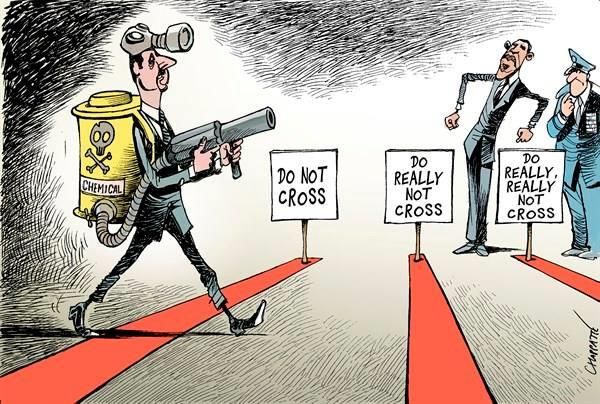
Chappatte, 2013
INTRODUCTION
On 14 April 2018, French, UK and US forces led a large-scale intervention against Syria’s
chemical weapons arsenal and associated targets. This temporarily concluded a sequence
of events that had started in 2013.
In the summer of 2013, the Syrian regime had engaged in a large-scale chemical weapons
attack against its own people in the Damascus suburb of Ghouta, an event that left many
people dead, disturbed France-US relations and reverberated around the world with
potentially profound consequences for deterrence.
In the years leading up to the gassing of Ghouta, the United States, France and the United
Kingdom had attempted to coordinate their policies toward the civil war that was
threatening Syria’s dictator, Bashar Al Assad. This included declaratory statements
intended to deter the use of chemical weapons.
And yet the response to the attack was disorganized, reflecting the very different paths
that led Obama and Hollande to this moment.
The American President Barack Obama had struggled for much of his presidency to
articulate a doctrine on the use of force. Obama was able to defeat Hilary Clinton for the
Democratic nomination, and then defeat Senator John McCain for the Presidency, in no
small part by emphasizing that both candidates had supported the 2003 invasion of Iraq.
F O N D A T I O N pour la R E C H E R C H E S T R A T É G I Q U E 5B EYOND THE R ED L INE – T HE U NITED S TATES , FRANCE ,
AND C HEMICAL W EAPONS IN THE S YRIAN W AR , 2013-2018
R ECHERCHES & D OCUMENTS N ° 06/2018
Yet Obama was not a straightforward anti-war candidate – he had campaigned as
pragmatist who would wind down the unnecessary war in Iraq while seeking victory for
the necessary one in Afghanistan. Obama used his Nobel Prize address to articulate his
doctrine for the use of military force, one that was consistent with his views on just war
theory and the constitution. Moreover, Obama, and his close staff, were largely dismissive
of a conventional wisdom on foreign policy, which they believed had resulted in the
catastrophe of Iraq. Ben Rhodes, the President’s speechwriter and a close confidant, was
famously quoted as calling the community of foreign policy and national security experts
“the blob.”2 The term served to dismiss objections to the President’s foreign policy
choices – including objections by members of the President’s cabinet – as the sour grapes
of a discredited elite.
It was in this context that Obama approached the growing carnage in Syria. He had
opposed the war in Iraq, and felt “boxed in” by his generals in Afghanistan. The
Administration was also disappointed with the failure to create a stable government in
Libya following the 2011 NATO intervention – in public, Obama called Libya a “mess”;
in private, he referred to the situation in the country as a “shit-show.”3 He also blamed the
United States’ European allies, specifically the United Kingdom’s David Cameron and
France’s Nicolas Sarkozy, for not “being invested in the follow-up” necessary to create a
stable Libyan government.4 As a result, Obama and those closest to him were reluctant to
be drawn into the war in Syria, believing that intervention would draw the United States
into yet another intractable conflict.
And yet the President had issued a strong warning that his reluctance might change if
Assad were to unleash his stockpile of chemical weapons against Syria’s civilian
population. Asked about that possibility at press conference, Obama had indicated that
the use of chemical weapons in Syria’s civil war would cross a “red line” and change his
thinking about the conflict. Obama’s remarks were widely reported around the world,
including in Paris, where senior officials, including Hollande, took them seriously.
In August of that year, follow a number of incidents where Syrian forces may have used
small amounts of chemical weapons, the Syrian Arab Army unleashed a large-scale attack
with the nerve agent sarin against the Damascus suburb of Ghouta, which caused the
death of several hundreds.
The French President François Hollande, had been far more willing to consider a military
intevervention in Syria. Hollande, the first Socialist elected President of France in two
decades, was an unlikely hawk. And yet shortly after taking office, he had approved an
intervention to stop Islamist forces from seizing control in Mali. Acting on the assumption
that Obama would enforce his red line, Hollande and the French government began to
prepare for a limited use of force to degrade Syria’s chemical weapons infrastructure,
damage military units responsible for the attack and ultimately punish Assad’s regime.
2
David Samuels, “The Aspirant Novelist Who Became Obama’s Foreign Policy Guru”, The New York Times,
5 August 2016, https://www.nytimes.com/2016/05/08/magazine/the-aspiring-novelist-who-became-obamas-
foreign-policy-guru.html
3
Jeffrey Goldberg, “The Obama Doctrine”, The Atlantic, April 2016,
https://www.theatlantic.com/magazine/archive/2016/04/the-obama-doctrine/471525/
4
Catherine Treyz, “Obama : Europe distraction led to Libya ‘mess’”, CNN.com, 11 March 2016,
http://edition.cnn.com/2016/03/11/europe/obama-cameron-europe-libya/index.html
6 F O N D A T I O N pour la R E C H E R C H E S T R A T É G I Q U EB EYOND THE R ED L INE – T HE U NITED S TATES , FRANCE ,
AND C HEMICAL W EAPONS IN THE S YRIAN W AR , 2013-2018
R ECHERCHES & D OCUMENTS N ° 06/2018
In the United States, too, preparations were underway for what US officials to one
believed would be a strike – until Obama began to waver. After the conservative
government of David Cameron lost a vote in the House of Commons, Obama announced
that he would seek an authorization from Congress to use force, a step that appeared to
many as a transparent effort to avoid a strike while laying the blame upon the President’s
opponents in Congress.
At the last moment, a Russian initiative to persuade Syria to abandon its chemical
weapons and accede to the international treaty prohibiting their possession ended the
crisis.
But the manner in which the crisis played out was deeply unsatisfying. In Paris, Obama’s
decision was seen for a cynical attempt to avoid enforcing his red line, while shifting the
blame to his opponents in Congress. Although comparisons to tensions over Suez in 1956
or even the Iraq War in 2003 may be overblown, the President’s actions alienated an ally
in Paris. President Hollande was described as “stunned” by Obama’s turnabout, while
outgoing Foreign Minister Laurent Fabius would publicly blame Russia’s annexation of
Crimea and intervention in Ukraine on the Obama’s failure to follow through in Syria.5
For his part, President Obama and most of the people working in his administration were
unrepentant about the decision to refrain from using force. Obama told Jeffrey Goldberg,
in a widely publicized interview, that departing from the “Washington playbook” was
among his proudest moments. In other parts of the interview, he referred to US allies,
including Britain and France, as “free-riders,” a depiction that angered many in Paris.6
Five years later, it is now possible to take a dispassionate look at what happened – and
what went wrong – in 2013. Whether one believes the ultimate course of action to be wise
or not, the execution was bungled and resulted in a severe and unnecessary strain to the
US-France relationship. As Trump and Macron attempted to repair the damage and
restore deterrence, it is useful to ask what lessons we might learn from the “red line”
incidents, both for deterring WMD weapons attack but also managing crisis coordination
among allies.
5
Xavier Panon, Dans les coulisses de la diplomatie française, Paris, L’Archipel, 2015, p. 183.
6
Goldberg.
F O N D A T I O N pour la R E C H E R C H E S T R A T É G I Q U E 7B EYOND THE R ED L INE – T HE U NITED S TATES , FRANCE ,
AND C HEMICAL W EAPONS IN THE S YRIAN W AR , 2013-2018
R ECHERCHES & D OCUMENTS N ° 06/2018
THE CRISIS
The First Phase: Drawing Red Lines
In the spring of 2012, intelligence began to suggest that Syria might unleash its chemical
weapons stockpile in an effort to win the civil war that had erupted following the Arab
spring. Over the course of 2012, there were reports of very small-scale uses of chemical
weapons, including Sarin. The US, France and the UK increased mutual consultations
and worked on possible common options. The new French president, François Hollande,
was personally inclined to take a hard line on the Syrian question as soon as he was
elected.7 By the summer, he ordered contingency planning to be moved forward.
In August, the intelligence strengthened, reportedly including signals intelligence
ordering troops to prepare for the use of chemical weapons, and images of technicians
mixing of binary agents in preparation for their use and units the loading of trucks used
to transport the weapons. The possibility that Syria might be preparing for a large-scale
chemical weapons attack was apparently in the back of Obama’s mind when he surprised
his national security team in August with an unscripted remark that appeared to commit
the United States to a Syrian intervention in the event that the Assad government used
chemical weapons – a remark that came to be known as the “red line.”
“I have, at this point, not ordered military engagement in the situation. But the
point that you made about chemical and biological weapons is critical. That’s an
issue that doesn’t just concern Syria; it concerns our close allies in the region,
including Israel. It concerns us. We cannot have a situation where chemical or
biological weapons are falling into the hands of the wrong people. We have been
very clear to the Assad regime, but also to other players on the ground, that a red
line for us is we start seeing a whole bunch of chemical weapons moving around
or being utilized. That would change my calculus. That would change my
equation. (..). We have put together a range of contingency plans. We have
communicated in no uncertain terms with every player in the region that that’s
a red line for us and that there would be enormous consequences if we start
seeing movement on the chemical weapons front or the use of chemical
weapons. That would change my calculations significantly.”8
Later reports would suggest that the indications over the previous forty-eight hours
factored into the President’s surprising statement.9 “The idea was to put a chill into the
Assad regime without actually trapping the president into any predetermined action,” one
senior official told the New York Times. But, another official explained, the remark was
unscripted and the problem, officials said, was there was growing evidence of the small-
scale use of chemical weapons. The red line was intended to deter a mass chemical
7
Thomas Wieder and Nathalie Guibert, “Comment François Hollande a choisi l’option militaire”, Le Monde,
10 September 2013, http://www.lemonde.fr/international/article/2013/09/10/comment-francois-hollande-a-
choisi-l-option-militaire_3473857_3210.html
8
Barack Obama, “Remarks by the President to the White House Press Corps”, 20 August 2012.
https://obamawhitehouse.archives.gov/the-press-office/2012/08/20/remarks-president-white-house-press-corps
9
Peter Baker et al., “Off-the-Cuff Obama Line Put US in Bind on Syria”, The New York Times, 5 May 2013.
http://www.nytimes.com/2013/05/05/world/middleeast/obamas-vow-on-chemical-weapons-puts-him-in-tough-
spot.html?pagewanted=all
8 F O N D A T I O N pour la R E C H E R C H E S T R A T É G I Q U EB EYOND THE R ED L INE – T HE U NITED S TATES , FRANCE ,
AND C HEMICAL W EAPONS IN THE S YRIAN W AR , 2013-2018
R ECHERCHES & D OCUMENTS N ° 06/2018
weapons attack (and as the remarks indicated, perhaps even more importantly at that time,
the transfer of such weapons to terrorists, for instance Hezbollah), but the “nuance got
completely dropped” and the Administration spokespeople struggled to recast the remark
as a reference to the international norm against chemical weapons use.10
Presidential utterances, however, are not such an easy thing to reframe. Over the coming
days, the statement would be repeated to create precisely the trap the President sought to
avoid. On 24 August, President Obama and UK Prime Minister David Cameron made it
clear that they had a common position: they “both agreed that the use – or threat – of
chemical weapons was completely unacceptable and would force them to revisit their
approach so far”.11
In France, a few days later, at the occasion of his annual address to the ambassadors,
Hollande drew his own red line: “I am stating it with the appropriate solemnity: with our
allies, we remain very vigilant to prevent the employment of chemical weapon by the
regime, which would be for the international community a legitimate cause of direct
intervention”.12 At that time, Hollande already saw the possibility of Western reprisals as
a possible way to alter the political situation in Syria. At this point, the question of Syrian
CW use was the topic of a Defense Council meeting every two months. Hollande ordered
“maximum cooperation” with the United States on the topic.13 He later reported that
finding chemical sites was done in liaison with the United States and Israel.14 This even
though some of his closest advisers were reluctant to adopt the very concept of red line.
(“Red lines are for pajamas”, one of them derided.15)
In this period Obama made a second statement, a statement no more nuanced than the
previous: “The use of chemical weapons is, and would be, totally unacceptable and if you
make the tragic mistake of using these weapons, there will be consequences and you will
be held accountable.”16 Then he clarified his warning about chemical weapons being
“moved” as meaning “transferred to terrorist groups” or “being prepared for use.”17
10
Press Gaggle by Principal Deputy Press Secretary Josh Earnest en route Columbus, OH, 21 August 2012.
https://obamawhitehouse.archives.gov/the-press-office/2012/08/21/press-gaggle-principal-deputy-press-
secretary-josh-earnest-en-route-colu
11
David Hughes, “David Cameron and Barack Obama warn Syria over chemical weapons”, The Independent,
23 August 2012. http://www.independent.co.uk/news/world/politics/david-cameron-and-barack-obama-warn-
syria-over-chemical-weapons-8075650.html
12
François Hollande, Address to the French ambassadors, 27 August 2012. http://discours.vie-
publique.fr/notices/127001575.html
13
Wieder & Guibert.
14
Fabrice Lhomme & Gérard Davet, ‘Un Président ne devrait pas dire ça…’, Paris, Fayard, 2016 (electronic
version).
15
Interviews former senior French officials, Paris, January-July 2017.
16
Matt Williams & Martin Chulov, “Barack Obama warns Syria of chemical weapons ‘consequences’”, The
Guardian, 4 December 2012. https://www.theguardian.com/world/2012/dec/04/barack-obama-syria-chemical-
weapons-warning
17
David E. Sanger & Eric Schmitt, “U.S. Shifting Its Warning on Syria’s Chemical Arms,” The New York Times,
December 6, 2012, http://www.nytimes.com/2012/12/07/ world/middleeast/syrias-chemical-weapons-moves-
lead-us-to-be-flexible.html
F O N D A T I O N pour la R E C H E R C H E S T R A T É G I Q U E 9B EYOND THE R ED L INE – T HE U NITED S TATES , FRANCE ,
AND C HEMICAL W EAPONS IN THE S YRIAN W AR , 2013-2018
R ECHERCHES & D OCUMENTS N ° 06/2018
In the spring of 2013, reports of chemical weapons attacks multiplied In April, France
and the United Kingdom sent letters to then-United Nations Secretary-General Ban Ki
Moon stating that soil samples and witness interviews provided credible evidence of CW
use by the regime in multiple locations. The United States intelligence community,
however, seems to have been reluctant to reach a conclusion. Then-Director of National
Intelligence James Clapper was non-committal in Congressional testimony on the
subject18, with an anonymous senior U.S. official explaining to Reuters that “More review
is needed.”19
In this period, the Administration then formalized the red line in a letter to Congress:
“The President has made it clear that the use of chemical weapons – or the
transfer of chemical weapons to terrorist groups – is a red line for the United
States of America. The Obama Administration has communicated that message
publicly and privately to governments around the world, including the Assad
regime. … [T]he Administration is prepared for all contingencies so that we can
respond appropriately to any confirmed use of chemical weapons, consistent
with our national interests. The United States and the international community
have a number of potential responses available, and no option is off the table.”20
Eventually the review would determine that Assad had, in fact, “used chemical weapons,
including the nerve agent sarin, on a small scale against the opposition multiple times in
the last year.”21 The finding was released in June, along with an announcement of
additional assistance to Syrian rebels, including limited amount of arms that would arrive
in September. This had been the preferred option of the Obama Administration all along.
While it represented a modest escalation of commitment, it represented continuity, not
change, in Obama’s calculus. Overall, the emphasis remained on diplomacy backed with
almost no force. Far more emphasis, was placed on demanding that the Syrian
government provide access to the UN fact-finding team investigating the claims. French
Foreign Minister Laurent Fabius made public its conclusions. Hollande then choose to
“give everything to UN experts”.22 The threat of force was to remain a deterrent against a
larger attack.
18
US Senate, Committee on Armed Services, Hearing to receive testimony on the current and future worldwide
threats to the national security of the United States, 18 April 2013, https://www.armed-
services.senate.gov/imo/media/doc/13-24%20-%204-18-13.pdf
19
Phil Stewart, “US looks into possible chemical weapons use in Syria”, Reuters, 19 April 2013,
http://www.reuters.com/article/us-usa-syria-chemical/u-s-looks-into-possible-chemical-weapons-use-in-syria-
idUSBRE93H1D920130418
20
Letter by Miguel E. Rodriguez, Assistant to the President and Director, Office of Legislative Affairs, 25 April
2013.
21
Text of White House Statement on Chemical Weapons in Syria, 13 June 2013,
http://www.nytimes.com/2013/06/14/us/politics/text-of-white-house-statement-on-chemical-weapons-in-
syria.html
22
Wieder & Guibert.
10 F O N D A T I O N pour la R E C H E R C H E S T R A T É G I Q U EB EYOND THE R ED L INE – T HE U NITED S TATES , FRANCE ,
AND C HEMICAL W EAPONS IN THE S YRIAN W AR , 2013-2018
R ECHERCHES & D OCUMENTS N ° 06/2018
The Second Phase: Reacting to the Ghouta Attack
But Bashar al Assad was not deterred. Assad may have calculated that Obama was
unwilling to engage in another Middle East war. Or perhaps he simply concluded that the
advantage of the attack was worth the risk.
On Wednesday, 21 August gruesome videos surfaced of a mass CW attack against
civilians in the Damascus suburb of Ghouta, perpetrated by the Syrian regime. This attack
stood out from previous ones in both its scale and the ease with which it could be verified:
thousands of people were affected, videos of the attack surfaced immediately, and there
was consensus among humanitarian groups on the ground and intelligence entities around
the world that the Assad regime has used sarin against the civilian population as part of a
military offensive in the area.
The attack on Ghouta was the first indisputable case of CW usage by the Assad regime
to occur since the US “red line” had been drawn almost exactly a year earlier.23 French
intelligence assessed total fatalities to be anywhere between 281 (confirmed) and 1,500
(probable), the latter number being close to the US official estimate (1,429).24
Although Obama had not committed himself to a specific course of action should Assad
cross the red line, the power of presidential utterances is such that most observers believe
the red line would be enforced with military action. Indeed, the United States, France,
and the United Kingdom began to prepare for military strikes. London called an
emergency meeting of the UN Security Council (UNSC). The Syrian regime offered to
allow UN inspectors access to the site of the alleged attack in order to investigate, while
Assad vehemently denied that his government was responsible for the attack and blamed
Syrian opposition forces instead.
In Paris, the Ghouta attack was perceived as a “turning point”; the Foreign Ministry set
up a task force; Laurent Fabius consulted with John Kerry.25 On 22 August, Fabius
mentioned the use of force on French radio. Images of Syrian casualties broadcasted on
August 23 bolstered Hollande’s resolve. “We cannot let this happen”, he reportedly said. 26
He pushed the issue personally, overcoming some reservations in the defense and foreign
ministries. At the same time, remembering the controversy about Iraq’s WMD, the French
were keen to have an independent technical evaluation and in addition to analyses of
photographs and films, had Syrian casualties exfiltrated to Amman for analysis. 27 On the
25th, samples from the attack began to be analyzed by the French: they were disconcerting:
the product was a deadly mix, but one that contained only 1 nanogram of sarin by
milliliter. However, the tactics used by the Syrian forces showed clear intention, and the
UK and US samples showed concentrations many times higher. Moreover, French
intelligence had evidence that the order had been given at a “very high level”, and that
23
Given that the regime denied any responsibility, it seems unlikely that the choice of dates was more than a
coincidence.
24
The Syrian Network for Human Rights put the total to 1,127.
25
Benjamin Barthe et al., “Chroniques syriennes (1/3): A l’été 2013, le choc de l’attaque chimique en banlieue de
Damas”, Le Monde, 13 février 2014. http://abonnes.lemonde.fr/international/article/2014/02/13/chroniques-
syriennes-1-3-a-l-ete-2013-le-choc-de-l-attaque-chimique-en-banlieue-de-damas_4365000_3210.html
26
Panon, p. 176.
27
Barthe et al.
F O N D A T I O N pour la R E C H E R C H E S T R A T É G I Q U E 11B EYOND THE R ED L INE – T HE U NITED S TATES , FRANCE ,
AND C HEMICAL W EAPONS IN THE S YRIAN W AR , 2013-2018
R ECHERCHES & D OCUMENTS N ° 06/2018
Assad had at least tacitly approved, even if perhaps in retrospect, the strike.28 Whether or
not the deadly mix had been overdosed by mistake – a hypothesis suggested by German
intelligence, and deemed credible by the French – was thus politically irrelevant.29 French
officials noted that no military official had been fired.30
Over the week-end, there were intense transatlantic consultations, with Washington,
London and Paris discussing “possible responses”.31 French sources claim that a common
response was agreed upon either on the 25th or the 26th.32 They believed that the British
were on board, and that the United States could not let this happen without a reaction.33
On 27 August, in his annual address to the French ambassadors, Hollande publicly raised
the question of CW use and said that Paris was “ready to punish” the Syrian regime. 34 The
next day, on 28 August, a Defence Council formalized the presidential decision. The
minutes of the meeting allegedly referred to “the reality of a chemical attack now
recognized by all parties”, the “responsibility of the regime”; it was decided “to prepare
a punitive strike coordinated with the Americans and the British, that could be launched
on short notice on the basis of an air raid from the national territory, delivering cruise
missiles on Syrian regime’s military targets linked with its chemical capabilities”.35
Hollande reportedly affirmed that “under no circumstance should we appear as auxiliaries
in a possible use of force as a response to this chemical attack. In this regard, any military
action will have to be commonly and simultaneously decided and conducted with our
allies, notably our American allies”.36 This was to be a “firm and proportionate response
against the Damascus regime”.37 The possibility of terror attacks against French territory
or interests (such as the French UN military contingent in South Lebanon) in reprisal was
taken seriously.
Also on August 28, Obama announced that the U.S. had conclusive evidence of the Assad
regime’s guilt. Over the next few days, all three countries would release intelligence
dossiers to demonstrate Assad’s culpability. At this stage, a military strike on Syria
seemed inevitable. The strike was to involve a large number of cruise missiles fired from
28
Laurent Fabius, 37 Quai d’Orsay. Diplomatie française, 2012-2016, Paris, Plon, 2016 (electronic version).
29
Ian Black, “German intelligence: Syria chemical attack may have been an overdose”, The Guardian,
4 September 2013. https://www.theguardian.com/world/on-the-middle-east/2013/sep/04/syria-assad-obama-
germany
30
Interviews with former senior French officials, Paris, January-July 2017.
31
Chris Good, “President Obama’s ‘Red Line’: What He Actually Said About Syria and Chemical Weapons, ABC
News, 26 August 2013. http://abcnews.go.com/blogs/politics/2013/08/president-obamas-red-line-what-he-
actually-said-about-syria-and-chemical-weapons/
32
25 August: Panon, p. 178; 26 August: Fabrice Lhomme and Gérard Davet, “Le jour où… Obama a laissé tomber
Hollande”, Le Monde, 24 August 2016. http://www.lemonde.fr/politique/article/2016/08/24/le-jour-ou-obama-a-
laisse-tomber-hollande_4987167_823448.html
33
Barthe et al.
34
François Hollande, Address to the French ambassadors, 27 August 2013. http://discours.vie-
publique.fr/notices/137001975.html
35
David Revault d’Allonnes, Les Guerres du président, Paris, Seuil, 2015, p. 62.
36
Revault d’Allonnes, p. 63.
37
Interview du Président de la République au quotidien Le Monde, 31 August
2013. http://www.lemonde.fr/international/article/2013/08/30/francois-hollande-au-monde-il-ne-s-agit-pas-de-
renverser-le-dictateur-syrien_3468865_3210.html
12 F O N D A T I O N pour la R E C H E R C H E S T R A T É G I Q U EB EYOND THE R ED L INE – T HE U NITED S TATES , FRANCE ,
AND C HEMICAL W EAPONS IN THE S YRIAN W AR , 2013-2018
R ECHERCHES & D OCUMENTS N ° 06/2018
the Mediterranean.38 The plan was apparently significantly larger than the 2017 strike
would be, involving about 100-150 cruise missiles against several tens of targets, though
not the CW stockpiles themselves for fear of dispersal. “Our finger was on the trigger,”
recalls then-Chairman of the Joint Chiefs of Staff Martin Dempsey, “We had gone
through the targeting plans and the targeting solutions. The crews were alerted. And so
we had everything in place, and we were just waiting for instructions to proceed.”39
According to Philip Gordon, the goal was “to deter [Assad] from ever using chemical
weapons again, to degrade his capacity to do so”. It was “a targeted strike to increase the
cost to having used chemical weapons. It was not a decision to go to war and change the
regime in Damascus”. The model was the US-UK Desert Fox operation against Iraq
(1998).40 Though the plan involved much less than the 600 munitions dropped during
Desert Fox (including 415 cruise missiles), it was clearly not the “unbelievably small,
limited kind of effort” announced by John Kerry.41
It was decided that the strikes would take place between August 30 and September 2.42
The timeframe was dictated by the need to wait until the UN inspectors left Syria and the
planned G20 Summit (September 5). The French insisted that time was of the essence,
arguing that waiting for the UN inquiry would take time and that a UNSC decision was
improbable due to Russian obstruction.43 Also, there was a risk that Syrian targets would
have been relocated if the operation was delayed. “We need to act fast, for operational
and political reasons”, recommended diplomatic adviser Paul Jean-Ortiz.44 Accordingly,
the strikes would begin as soon as the UN inspectors returned from Syria, on August 31.
The strikes were planned for the night of Saturday to Sunday, August 31 – September 1.45
The French target selection received final presidential approval on August 30: it focused
on units and command centers “closely connected” with Syrian CW use.46
Regarding France, according to an official document, the presidential order was to be
given at 2000 CET; aircraft were to take off at 2240 CET (from Abu Dhabi and Djibouti);
and the strike was to take place at 0300 CET the next day – as to minimize possible
civilian casualties.47 The French contribution was modest: while the exact number
38
Dan De Luce, “Hagel: The White House Tried to ‘Destroy’ Me”, Foreign Policy, 18 December 2015,
http://foreignpolicy.com/2015/12/18/hagel-the-white-house-tried-to-destroy-me/. This source mentions 50 targets,
but a French source (Bromberger, infra.) referred to about 20.
39
PBS, Frontline, Obama at War, 25 May 2015. http://www.pbs.org/wgbh/frontline/film/obama-at-war/transcript/
40
Interview of Philip Gordon by Antoine Vitkine for his documentary “Bachar : Moi ou le Chaos” (2016). This
was material unused for the documentary.
41
Jonathan Karl, “John Kerry Promises ‘Unbelievably Small’ US Strike Against Syria”, ABC News, 9 September
2013. http://abcnews.go.com/blogs/politics/2013/09/john-kerry-promises-unbelievably-small-u-s-strike-against-
syria/
42
Revault d’Allonnes, p. 63.
43
Interview du Président de la République au quotidien Le Monde, 31 August 2013.
44
Fabrice Lhomme & Gérard Davet, ‘Un Président ne devrait pas dire ça…’, Paris, Fayard, 2016 (electronic
version).
45
PBS, Frontline.
46
Dominique Bromberger, “Syrie 2013, ces frappes annulées”, L’Express, 11 April 2018,
https://www.lexpress.fr/actualite/monde/proche-moyen-orient/en-syrie-ces-frappes-qui-n-ont-jamais-eu-
lieu_1999618.html
47
Davet & Lhomme.
F O N D A T I O N pour la R E C H E R C H E S T R A T É G I Q U E 13B EYOND THE R ED L INE – T HE U NITED S TATES , FRANCE ,
AND C HEMICAL W EAPONS IN THE S YRIAN W AR , 2013-2018
R ECHERCHES & D OCUMENTS N ° 06/2018
remains classified, most testimonies report a dozen Scalp-EG cruise missiles.48 They were
to be fired on targets in and around Damascus, targeting, inter alia, chemical weapons
brigades and CW-related command centers, as well as Scud missiles sites. French sources
insist that operations were to be strictly limited to sites connected with CW, in order to
avoid escalation and signal that this was not about regime change.49 Hollande would later
describe the goal as “to destroy chemical installations, as well as administrative centers
from which we know that the orders had been given”.50 The CW stocks themselves would
not be targeted as to avoid creating a risk of agent dispersal.51 Aircraft would strike from
the Mediterranean, avoiding overflying Turkish territory (in order to not appear making
Ankara an accomplice). They were limited to Western Syrian targets due to the limited
range (250 km) of the Scalp-EG missiles.52 Hollande ordered to “study the planning of
follow-on strikes to respond, if needed, to response or retaliation by the regime”. 53 Such
a follow-on strike could have taken place 72 hours later.54 Planning was coordinated with
USCENTCOM in Tampa, FL. The Americans and the French shared “everything” with
each other in terms of military planning.55 An adviser to Le Drian would later say: “We
had planned everything together, the Americans had opened all their books to us. For the
first time, it was just the two of us in the bedroom”.56
For the French, three goals appeared:
One was to “punish” the regime. There was unquestionably a moral dimension in the
operation the way the French saw it. Hollande mentioned a “crime against humanity”. 57
“It was about showing that, when one crosses a number of lines, one has to pay a bitter
price”, said an adviser.58 For Hollande, this was an important dimension – including
perhaps because his distant predecessor Mitterrand (the convener of the 1993 meeting)
was always an unspoken reference in his foreign and defense policy. The word “punish”,
48
Interviews with former senior French officials, Paris, January-July 2017. A reliable defense correspondent
detailed the planned French raid as involving a total of 17 aircraft including 8 for strike (thus potentially 16
missiles) and 12 targets (Jean-Dominique Merchet, “Il y a un an, 17 avions français devaient effectuer un raid
contre la Syrie”, Secret Défense, 1er septembre 2014 http://www.lopinion.fr/blog/secret-defense/il-y-a-an-17-
avions-francais-devaient-effectuer-raid-contre-syrie-15832). Another French source mentions about 20 missiles
(Bromberger).
49
Interviews with former senior French officials, Paris, January-July 2017. A key adviser claims that “the Scalp
missiles were also to target sites directly connected to Bashar” (quoted in Panon, p. 184).
50
Nathalie Guibert & Marc Semo, “Le testament syrien de François Hollande”, Le Monde, 12 April 2017.
http://abonnes.lemonde.fr/international/article/2017/04/12/francois-hollande-en-syrie-nous-avons-su-saisir-la-
faute-de-l-adversaire_5109957_3210.html
51
Interviews with former senior French officials, Paris, January-July 2017.
52
Vincent Jauvert, “Objectif Damas”, Le Nouvel Observateur, n° 2551, 26 September 2013.
53
Revault d’Allonnes, p. 63.
54
Lhomme & Davet.
55
Barthe et al.
56
Thomas Hofnung & Lorraine Millot, “Une nouvelle lune de miel militaire”, Libération, 12 February 2014.
http://www.liberation.fr/planete/2014/02/11/une-nouvelle-lune-de-miel-militaire_979528
57
Interview du Président de la République au quotidien Le Monde, 31 August 2013.
58
Revault d’Allonnes, p. 63.
14 F O N D A T I O N pour la R E C H E R C H E S T R A T É G I Q U EB EYOND THE R ED L INE – T HE U NITED S TATES , FRANCE ,
AND C HEMICAL W EAPONS IN THE S YRIAN W AR , 2013-2018
R ECHERCHES & D OCUMENTS N ° 06/2018
however, attracted criticism within the Hollande government itself, since it could not
convince French public opinion of the legitimacy of the reprisals.59
A second goal was to reduce the threat, by neutralization of some capabilities and by
deterrence. “It was [first] about deterrence”, but also about “reducing its ability to inflict
harm”, said a high-level military official.60 At one point, Hollande mentioned “an act of
international self-defense”.61 The French believed one had to see the bigger picture of
WMD proliferation and use – committed as it was to the negotiation of a deal with Iran.
The congratulations telegram sent by Damascus to Kim Jong-Un on September 6, at the
occasion of the 65th anniversary of the Korean Republic, would not go unnoticed in the
Elysée.62
A third one was about changing the politics of the Syrian conflict through symbolic but
determined military action. This was not a clearly articulated goal, but still one the French
reportedly had in mind as early as 2012.63 Considerations reportedly included “to create
a stress effect in Moscow, put them in a situation of uncertainty”, according to a Hollande
adviser64; as well as “to stop the process of jihadi recruitment”, according to the Elysée.65
However, at no time was a Libya scenario of open-ended engagement possibly leading to
regime collapse considered in Paris.66 This was explicitly stated by Hollande on August
31.67 Fabius confirmed in his memoirs that they did not want to trigger the dislocation of
the regime.68
Additionally, France wanted to be “in the game” as early as possible: memories of the
initial shots of Operation Enduring Freedom on October 8, 2001 (of which France was
excluded, partly because it did not have cruise missiles at the time) were still present.
“Never again!” was reportedly a motto at the French ministry of defense.69
Legally, the French were unsure of their position. Hollande reportedly referred to the
“Responsibility to Protect”, but had few realistic options to legitimize the action. Still,
French authorities publicly stated that the absence of a UN resolution should not be
allowed to be an obstacle.70 An attempt to get a majority of the UN Security Council
59
Panon, p. 178.
60
Revault d’Allonnes, pp. 63-64.
61
Lhomme & Davet.
62
Wieder & Guibert.
63
See Panon, Revault d’Allonnes.
64
Panon, p. 179.
65
Wieder & Guibert.
66
Barthe et al.
67
Interview du Président de la République au quotidien Le Monde, 30 August 2013.
68
Fabius.
69
Jean Guisnel, “Syrie : La France ne renonce pas à l’option militaire”, Défense ouverte, 21 September 2013.
http://www.lepoint.fr/editos-du-point/jean-guisnel/syrie-la-france-ne-renonce-pas-a-l-option-militaire-21-09-
2013-1733715_53.php
70
Interview du Président de la République au quotidien Le Monde, 31 August 2013; Déclaration du ministre des
Affaires étrangères Laurent Fabius au Parlement, 4 September 2013. http://discours.vie-
publique.fr/notices/133002017.html
F O N D A T I O N pour la R E C H E R C H E S T R A T É G I Q U E 15B EYOND THE R ED L INE – T HE U NITED S TATES , FRANCE ,
AND C HEMICAL W EAPONS IN THE S YRIAN W AR , 2013-2018
R ECHERCHES & D OCUMENTS N ° 06/2018
members to agree to a resolution (which took place on Thursday 29), forcing Moscow
and Beijing to veto it, failed.71
The Third Phase: UK and US Backtracking
If the previous phase of the crisis was marked by a sense of inevitability, the next ones
were chaotic.
The third phase of the crisis began on the evening of August 29 when David Cameron’s
conservative government unexpectedly lost a vote in the House of Commons, which had
been called to authorize the UK strikes. The memories of the Iraq war were still present
in London, and the Libyan operation of 2011 was considered by many a dubious success
at best. The British vote unnerved Obama. Moreover, on the same day, he received a letter
by 186 US Representatives requesting a vote on any use of force in Syria. “This is the
day that Obama really became plagued by doubts”, says Jeffrey Goldberg.72 The House
of Commons vote (a “cold shower” for the French73) forced a readjustment of targeting,
with Paris and Washington taking over the former UK targets.74 But US State Secretary
John Kerry assured the French that it did change the US position.75 On Friday 30, he
publicly confirmed the US resolve and flattered the French by recalling their status as
“America’s oldest ally”. He reportedly told Fabius that Obama had asked him to “prepare
(US) public opinion for strikes”.76
But the signals from Washington were mixed. During a conversation with French
presidential diplomatic adviser Paul-Jean Ortiz, US National Security Adviser Susan Rice
told his counterpart that Obama was “almost ready to go ahead”; but overall, the
conversation left Ortiz with the impression that the US commitment was no longer fully
assured.77
Late in the morning of August 30 (at 1805 CET), a 45-minute conversation between the
two presidents began. According to Hollande, Obama told him that he was also exploring
several options. “There are two solutions”, he reportedly said, “either we go very fast, or
we wait” after the G20 Saint-Petersburg Summit.78 The French president, for his part,
pressed his US counterpart for acting as early as possibly – to ensure that intelligence
would still be valid – though he acknowledged that without UN support, their political
position was not fully assured. His target was right after the return of UN inspectors
(scheduled for the evening of the next day).79 Obama reportedly concluded by saying “We
71
Jauvert.
72
“Obama’s ‘Red Line’ That Wasn’t”, The Atlantic (video), 16 March 2016.
https://www.theatlantic.com/video/index/473025/syria-red-line-that-wasnt/
73
Barthe et al.
74
Interviews with former senior French officials, Paris, January-July 2017.
75
Barthe et al.
76
Jauvert.
77
See Revault d’Allonnes, p. 65; Panon, p. 182; Jauvert, op. cit.
78
Lhomme & Davet.
79
Davet & Lhomme.
16 F O N D A T I O N pour la R E C H E R C H E S T R A T É G I Q U EB EYOND THE R ED L INE – T HE U NITED S TATES , FRANCE ,
AND C HEMICAL W EAPONS IN THE S YRIAN W AR , 2013-2018
R ECHERCHES & D OCUMENTS N ° 06/2018
have these two options, we have to think about them, I’ll call you back on Sunday”.80 The
conversation confirmed to Paris that the White House was not 100% committed. Still,
Hollande was confident: “Obama is slow to make decisions”, he told journalists that day,
adding he understood that after Iraq, it was not easy for him to launch a WMD-related
operation in the Middle East.81
That day (August 30) was supposed to be dedicated to refining the military plans. But in
the afternoon, following a long National Security Council meeting, Obama took an hour-
long walk with his Chief of Staff, Dennis McDonough – “the Obama aide most averse to
U.S. military intervention”.82 When he returned, he had decided that he would seek
Congressional support for a strike.83Around 1900, he gathered senior White House staff
and told them he had a “big idea” he wanted to run by them.84 This touched off a
“vigorous” debate that lasted two hours, most of his staff having negative reactions, but
Obama had made up his mind.85 The President notified cabinet officials as well as the
Chairman of the Joint Chiefs of Staff, by telephone on Friday evening. After Kerry talked
to the President, he reportedly told a friend “I just got fucked over.”86
On Saturday 31 at 0800 CET, Ortiz learned that the White House had called during the
night (at 0300 CET) to schedule a presidential phone call. It was assumed by the
presidential team that Obama’s call was about the go-ahead for the operation. A call was
scheduled for late afternoon, then its timing moved forward by one hour by the White
House. The French expected Obama to say he wanted to move the timing forward: signals
from the White House on that day were interpreted as positive.87 The Defense Council
was convened in the next room in order for the decision to be immediately formalized
after the call.
At 1600 CET, a few minutes before the scheduled presidential conversation, Rice called
Ortiz, who could feel something was wrong.88 Still, French refueling aircraft took off.
When the call came, Obama began with assuring Hollande of his “determination” and
“solidarity”.89 He had “decided to go ahead”.90 But he then reminded his French
80
Lhomme & Davet. Another version has Obama saying « OK, let’s think about it and talk again on Sunday”
(Panon, p. 181).
81
Davet & Lhomme.
82
Goldberg.
83
Goldberg.
84
Quoted in Adam Entous et al., “Inside White House, a Head-Spinning Reversal on Chemical Weapons”, The
Wall Street Journal, 15 September 2013. https://www.wsj.com/articles/inside-white-house-a-reversal-on-syrian-
arms-1379298924
85
Roberta Hampton & Jeff Mason, “Obama’s Syria decision: a walk, a debate, and e new approach”, Reuters,
1 September 2013. http://www.reuters.com/article/us-syria-crisis-obama-decision-idUSBRE98001520130901
86
Goldberg.
87
Barthe et al.
88
Panon, p. 182.
89
Fabius. The exact time of the presidential conversation is unclear: 1630 (Fabius), 1700 (Panon, p. 182), 1800
(Revault d’Allonnes, p. 66), 1815 (Wieder and Guibert, who claim that the timing of the call had been moved
forward by one hour by the White House). See also Vincent Jauvert, “Objectif Damas”, Le Nouvel Observateur,
n° 2551, 26 September 2013.
90
Jauvert, op. cit.
F O N D A T I O N pour la R E C H E R C H E S T R A T É G I Q U E 17B EYOND THE R ED L INE – T HE U NITED S TATES , FRANCE ,
AND C HEMICAL W EAPONS IN THE S YRIAN W AR , 2013-2018
R ECHERCHES & D OCUMENTS N ° 06/2018
counterpart of the trauma of recent US military involvements and that he had been elected
to stop wars, not to begin them. He also argued that two elements had changed the
perspective: the British vote, and the impossibility to get consensus at the UN Security
Council. In light of all this, he preferred having Congressional support to ensure the
legitimacy of the operation.91 (The need to have such backing was also useful in case the
operation was unsuccessful or backfired.92) The intervention was “neither cancelled nor
stopped”, only “postponed until the vote of the US Congress”.93 Hollande insisted that it
would be difficult to strike later, due to the forthcoming G20 summit (and the perishable
nature of intelligence). However, when asked, Obama mentioned a “fifteen days”
timeframe. This was, for the French president, tantamount to giving up. 94 The call lasted
about half an hour.95
Despite the warning signs before that fateful phone call, most French officials were
aghast. Some Defense Council participants – who were sitting in the next room and were
immediately informed – understood right away that there would be no operation. They
had the impression to be “left alone and naked in the fields”, according to an adviser, or
to be “struck down [as if by lightning]”, according to another.96 Hollande was reportedly
“stunned”.97 However, he did to show his disappointment, and told the Council that he
understood the US position.98 (“I think he was looking for a solution, not a pretext”, he
would later say.99)
Later in the morning (US time), president Obama announced his dual-track decision in
the Rose Garden, with Vice-President Biden on his side. He first explained all the reasons
why it was necessary to act: the importance of maintaining the taboo on CW use; the risk
of terrorist acquisition; the need to avoid broader WMD proliferation, including Iranian
acquisition of a nuclear weapon. But then, he stated:
“After careful deliberation, I have decided that the United States should take
military action against Syrian regime targets. (..) I'm also mindful that I'm the
president of the world's oldest constitutional democracy (..) and that's why I've
91
Lhomme & Davet.
92
Interview of Philip Gordon by Antoine Vitkine.
93
Revault d’Allonnes, p. 67. A Hollande adviser summarized the Obama point of view as “There is no international
coalition (…), no majority at the UN Security Council, no public opinion support, so I need to at least have
Congressional approval, because I’m not George W. Bush” (quoted in Barthe et al.).
94
Lhomme & Davet.
95
40 minutes according to Wieder & Guibert.
96
Revault d’Allonnes, p. 69; Christophe Boltanski & Vincent Jauvert, « Hollande, chef de guerre », L’Obs,
n° 2663, 19 November 2015.
97
Panon, p. 183. In retrospect, speaking to journalists in early October, he said that he had not been surprised that
Obama needed more time, but that he had been « astonished » by his decision to consult Congress, given the UK
vote (Davet & Lhomme).
98
See Nathalie Guibert & Marc Semo, “Le testament syrien de François Hollande”, Le Monde, 12 April 2017.
http://abonnes.lemonde.fr/international/article/2017/04/12/francois-hollande-en-syrie-nous-avons-su-saisir-la-
faute-de-l-adversaire_5109957_3210.html
99
Lhomme & Davet.
18 F O N D A T I O N pour la R E C H E R C H E S T R A T É G I Q U EB EYOND THE R ED L INE – T HE U NITED S TATES , FRANCE ,
AND C HEMICAL W EAPONS IN THE S YRIAN W AR , 2013-2018
R ECHERCHES & D OCUMENTS N ° 06/2018
made a second decision: I will seek authorization for the use of force from the
American people's representatives in Congress.”100
The House and Senate were in recess at the time, meaning that a formal bill to authorize
the use of force would not be submitted until a special session of the Senate could be
convened on September 6. The Administration appeared to make a sincere effort to win
support in the Congress, although the over the next week it became increasingly clear that
the vote in the Senate would be close and the House would be unwilling to support any
measure.
A few French officials thought – or wanted to believe – that since US credibility was on
the line, the White House would mobilize and get Congressional support: had not Barack
Obama stated that he had “decided” to strike? The government decided to put pressure
on both French and international public opinion by publicizing on September 2 a dossier
prepared during the week-end, composed of declassified French intelligence elements on
the responsibility of the Syrian regime for the 21 August strike.101 The publication was
also designed to build the image of France as a leader, not a US follower.
Hollande asked his advisers if he would get a majority if he decided to ask for
parliamentary support: he was told it would be a small one – at least not one that would
show overwhelming support and legitimacy. He thus discarded this scenario and decided
instead to fully take advantage of the power invested in him by French Constitution as
the executive, arguing in particular that speed was of the essence. 102 Nevertheless, at a
time when it was believed the strikes would have taken place, a parliamentary debate had
been set up for September 4. The Hollande administration made its case as if nothing had
changed. Fabius addressed the National Assembly.103 According to him, “refraining from
acting” would mean: (1) “tolerate that massive chemical weapons use would remain
unpunished” (punishment), (2) “send Bashar el-Assad and the Syrian people a terrible
message: chemical weapons can be used tomorrow, against Damascus, against Aleppo,
perhaps in an even more massive way (CW deterrence), (3) “endanger regional peace and
security altogether, but also, beyond that, our own security. Because – we have to ask the
question – what credibility would then have international commitments against the
proliferation of weapons of mass destruction, including nuclear weapons? What message
would we send to other regimes, I’m thinking of Iran and North Korea? This message
would then unfortunately be very clear: feel free to carry on; the possession of these
weapons gives you impunity and the division of the international community protects
you” (dissuasion re: broader WMD concerns), (4) “close the door to a political settlement
of the Syrian conflict. (…) Let us look at reality upfront: if we do not put a stop to such
acts by the regime, there will not be a political solution. For what would be the point for
Mr. Bashar el-Assad to negotiate, if he can (…) ‘liquidate’, his own words, his opposition,
notably by weapons that disseminate terror and death?” (broader political goal). For
100
Roberta Rampton & Jeff Mason, “Obama’s Syria decision: a walk, a debate, and a new approach”, Reuters,
1 September 2013. http://www.reuters.com/article/us-syria-crisis-obama-decision-idUSBRE98001520130901
101
Available at http://www.diplomatie.gouv.fr/fr/IMG/pdf/Syrie_Synthese_nationale_de_renseignement_de
classifie_le_02_09_2013_cle01b7e8.pdf
102
Davet & Lhomme.
103
Déclaration du ministre des Affaires étrangères Laurent Fabius au Parlement, 4 September 2013,
http://discours.vie-publique.fr/notices/133002017.html
F O N D A T I O N pour la R E C H E R C H E S T R A T É G I Q U E 19B EYOND THE R ED L INE – T HE U NITED S TATES , FRANCE ,
AND C HEMICAL W EAPONS IN THE S YRIAN W AR , 2013-2018
R ECHERCHES & D OCUMENTS N ° 06/2018
Paris, there were few domestic political benefits to be gained – the prospect of an
intervention in the Syrian conflict was not relished by public opinion, and Hollande had
already gained his credentials as a war leader due to his widely-applauded intervention in
Mali in January 2013.104
At the Saint-Petersburg G20 meeting of September 6, Obama and Hollande met for 45
minutes. The US president kept its cards close to his chest (“It’s difficult”, he reportedly
said about the prospect for Congressional support105), but Hollande was left with the
impression that action was still possible. When asked about a new date for the strikes,
Obama replied “let our chiefs of staff work together”.106 Hollande was also vindicated by
EU-wide support for a “strong and clear” international reaction at a defense ministers
meeting in Vilnius on September 5, as well as by John Kerry’s strong words – the
inevitable reference to “Munich” – two days later in Paris.107 At this point, he reportedly
still believed that US Congressional support would come, and anticipated support from
the forthcoming UN technical report on the Ghouta event, expected by mid-September.
The Fourth Phase: The Russian Surprise
The crisis entered its fourth and final phase on September 9.
At the time, it appeared that an off-the-cuff remark by Kerry in London prompted the
Russian proposals for a CW disarmament plan. Kerry was asked “Is there anything at this
point that his government could do or offer that would stop an attack?” He responded
rhetorically:
“Sure. He could turn over every single bit of his chemical weapons to the
international community in the next week. Turn it over, all of it, without delay,
and allow a full and total accounting for that. But he isn’t about to do it, and it
can’t be done, obviously.”108
Despite the caustic tone of the remark, some reporters took Kerry’s remarks as a serious
proposal. The State Department sent reporters a statement stating that “Secretary Kerry
was making a rhetorical argument about the impossibility and unlikelihood of Assad
turning over chemical weapons he has denied he used.”109
Yet by the end of the day in Washington, Russia had proposed precisely such a deal and
Administration officials had begun to embrace it. Moscow announced a proposal to avoid
104
In late August, 64% of the French were against French military intervention in Syria. L’Express, 31 August
2013.
105
Barthe et al.
106
Barthe et al.
107
Panon, pp. 188-189; Barthe et al.
108
John Kerry, “Remarks With United Kingdom Foreign Secretary Hague”, 9 September 2013. https://2009-
2017.state.gov/secretary/remarks/2013/09/213956.htm. Kerry claims that Obama and Putin had talked about a
similar proposal in St. Petersburg a few weeks earlier.
109
“Kerry speaking rhetorically over Syria turning in weapons: State Department”, Reuters, 9 September 2013.
https://www.reuters.com/article/us-syria-crisis-weapons/kerry-speaking-rhetorically-over-syria-turning-in-
weapons-state-department-idUSBRE9880GE20130909
20 F O N D A T I O N pour la R E C H E R C H E S T R A T É G I Q U EYou can also read


